INTRODUCTION
Schizophrenia is a severe psychiatric illness that affects social behavior in daily life situations. Commonly affected domains are self-care, work, and social relationships. These domains are usually summarized by the term “community functioning” (Couture et al., Reference Couture, Penn and Roberts2006). Community functioning is among the most meaningful outcome measures of schizophrenia, as it is closely connected to patients’ perception of quality of life (Dickerson et al., Reference Dickerson, Ringel and Parente1998). The association between psychiatric symptoms and community functioning has been studied extensively. Typically, small to moderate negative associations are found between negative symptoms and community functioning (e.g., Milev et al., Reference Milev, Ho, Arndt and Andreassen2005). Another series of studies have demonstrated that cognitive impairments hamper several areas of social functioning, including community functioning (for a review, see Green Reference Couture, Penn and Roberts1996), but the variance accounted for by cognition is usually small (Holthausen, Reference Holthausen2003; van Beilen, Reference van Beilen2004), even in combination with measures of psychiatric symptomatology (Milev et al., Reference Milev, Ho, Arndt and Andreassen2005). Thus, besides general cognition and psychiatric symptoms, other factors must account for the variance in community functioning in schizophrenia.
Factor analytic studies (Nuechterlein et al., Reference Nuechterlein, Robbins and Einat2005) reveal seven cognitive domains that are reliably impaired in schizophrenia (speed of processing, attention/vigilance, working memory, verbal learning, visual learning, reasoning and problem solving, and verbal comprehension). Recently, social cognition has been added to this list. It has been suggested that social cognition is associated with community functioning in schizophrenia (for a review, see Couture et al., Reference Couture, Penn and Roberts2006). Social cognition is defined as “ mental operations underlying social interactions, which include the human ability and capacity to perceive the intentions and dispositions of others” (Brothers, Reference Brothers1990). Two important aspects of social cognition are emotion perception and Theory of Mind (ToM). Emotion perception is the ability to infer emotion from facial expressions, vocal inflections, or a combination of both (Couture et al., Reference Couture, Penn and Roberts2006). ToM is defined as the ability to infer mental states and to understand that they can be used to predict others’ behavior (Premack & Woodruff, Reference Premack and Woodruff1978). Impairments in emotion perception and ToM are found in many schizophrenia patients (for a review, see Brüne, 2005a and Edwards et al., Reference Edwards, Jackson and Pattison2002).
Positive relationships between emotion perception and community functioning (Brekke et al., Reference Brekke, Kay, Kee and Green2005; e.g., Kee et al., Reference Kee, Green, Mintz and Brekke2003), and ToM and community functioning (Pollice, et al., Reference Pollice, Roncone, Falloon, Mazza, de Risio and Necozione2002; Zhu et al., Reference Nuechterlein, Green, Kern, Baade, Barch, Cohen, Essock, Fenton, Frese, Gold, Goldberg, Heaton, Keefe, Kraemer, Mesholam-Gately, Seidman, Stover, Weinberger, Young, Zalcman and Marder2007) have been demonstrated several times. ToM has also been associated with functioning in a treatment milieu (Brüne, 2005b; Brüne et al. Reference Brüne, Abdel-Hamid, Lehmkamper and Sonttag2007) and role-playing (Pinkham & Penn, Reference Pinkham and Penn2006).
Several issues remain unclear from previous studies. First, to the best of our knowledge, no study has included tests of both emotion perception and ToM to predict community functioning. Therefore, the unique contribution of these functions together over and above the effect of general cognition and psychiatric symptoms is unknown. Furthermore, it is not yet clear whether performance in specific domains of community functioning is particularly poor in schizophrenia patients with impaired social cognition. Finally, none of the previous studies examined the relationship between social cognition and community functioning in the control group. Therefore, it is unclear whether the processes that are associated with poor community functioning in schizophrenia are different from those in healthy controls. In clinical practice, these issues are especially relevant since clinicians are faced with the tremendous impact of schizophrenia on community functioning and other aspects of social functioning. To date, insufficient clinical indices are available to predict social outcome.
The main objective of the present study was to examine the predictive validity of measures of social cognition for community functioning. First, we hypothesized that social cognition (emotion perception and ToM) would have a predictive value for community functioning in schizophrenia that goes beyond that of psychiatric symptoms and general cognition. Second, we hypothesized that both emotion perception and ToM each would make a unique and significant contribution to the prediction of community functioning.
Furthermore, we are interested in the value of tests of social cognition for clinical purposes. We examined whether impaired social cognition according to norm scores based on controls’ task performance is associated with poorer performance in specific domains of community functioning. We hypothesized that patients with impaired social cognition would demonstrate significantly poorer performance on each domain of community functioning than those who score within the normal range.
Finally, we are interested in whether cognitive functions that underlie community functioning in schizophrenia are different from cognitive functions associated with community functioning in a control sample. Our third hypothesis is that social cognition would also be related to community functioning in healthy controls.
MATERIALS AND METHODS
Participants
Forty-six people (34 men and 12 women) with a diagnosis of schizophrenia according to Diagnostic and Statistical Manual, 4th Edition (DSM IV) criteria (American Psychiatric Association, 1994) were included. Diagnoses were determined by using chart information to check whether DSM IV criteria for schizophrenia were met and were confirmed by independent on-site psychiatrists. Exclusion criteria were the existence of comorbid neurological pathology and intelligence quotient (IQ) score <70 (which is considered the upper border of mental retardation). Patients’ mean age was 27.4 (SD = 7.7) years. A scale (Verhage, Reference Verhage1983) ranging from 1 = primary school (6 years of formal education) to 7 = university (16 years of formal education) was used to classify the level of education; the mean level of education was 4.8 (SD = 0.9). In this sample, the mean number of psychotic episodes was 2.1 (range 1–10, SD = 2.0), the mean duration of illness was 7 (SD = 8.5) years, and the mean age of onset was 24.2 (SD = 5.1) years. Four patients did not use antipsychotic medication at the time of assessment, being first-episode patients not yet prescribed medication. One patient used classic antipsychotic medication (haloperidol) and 41 patients used atypical antipsychotic medication (aripiprazol, n = 5; clozapine, n = 8; olanzapine, n = 12; quetiapine, n = 1; and risperidone, n = 15). Fifteen patients were living independently, of whom nine received outpatient care and six participated in a rehabilitation program (Withaar & Arends, Reference Withaar, Arends, Brouwer, Van Zomeren, Berg, Bouma and Haan2002). Twenty-seven patients lived temporarily in houses provided by the institution to facilitate participation in a rehabilitation program. One patient lived in a sheltered home. The remaining 3 patients were inpatients.
A group of 53 healthy controls (24 men and 29 women) was also included. Exclusion criteria were a history of psychiatric disorders, comorbid neurological pathology, and IQ <70. Patients’ mean age was 31.1 (range 18–53, SD 10.2) years, and mean education level was 6 (SD = 0.6).
Materials
Community functioning
Community functioning was assessed with the Social Functioning Scale (SFS; Birchwood, Reference Birchwood, Smith, Cochrane, Wetton and Copestake1990). The scale is a measure of community functioning of individuals with schizophrenia and has good psychometric properties; it has proven to be reliable and valid (SFS; Birchwood, Reference Birchwood, Smith, Cochrane, Wetton and Copestake1990). The community functioning scale consists of seven subscales: social engagement/withdrawal (time spent alone, initiation of conversations, and social avoidance), interpersonal behavior (number of friends, whether the patient has a partner, and quality of communication), independence competence (ability to perform skills necessary for independent living), independence performance (performance of skills necessary for independent living), recreation (engagement in a range of common hobbies, interests etc.), prosocial behaviour (engagement in a range of common social activities), and employment (engagement in structured employment or structured program of daily activity). Community functioning was rated by persons who were close to the patients, as the SFS assesses objective and factual information about a person’s daily life (e.g., how often someone washes the dishes). In addition to the standard SFS subscales, a number of other variables were extracted from this measure. We constructed a variable called “work performance,” consisting of a five-point scale ranging from “ having a job consistent with level of education” or “student” to “never had a job”. This was done because the SFS subscale “employment” also includes information on subjective ratings of the subject being capable of working, while we were interested in actual job performance only. Furthermore, we scored the number of friends and whether patients had a partner. Higher scores on the SFS mean better community functioning.
Social cognition
Emotion perception measures. Prosody task. To assess the perception of auditory affect, the prosody task (Pijnenborg et al., Reference Pijnenborg, Withaar, van den Bosch and Brouwer2007) was administered. The prosody task consists of 16 audiotaped sentences with a neutral content (e.g., “The old car drives through the streets of the capital” and “The big plane flies over the trees of the rain forest”) and eight patterned syllable structures (“ba ba ba ba ba ba”). Sentences are pronounced with five different emotions (anger, fear, sadness, happiness, and surprise) and in a neutral way. Participants were asked to identify the emotion; answer categories were presented in a multiple-choice format. A total score was calculated by counting all correct answers.
FEEST. The Facial Expression of Emotions: Stimuli and Test (Young et. al., Reference Young, Perrett, Calder, Sprengelmeyer and Ekman2002) requires participants to identify emotions in pictures of faces. The test includes 60 pictures of six basic emotions (anger, fear, sadness, happiness, disgust, and surprise) from the Ekman and Friesen (Reference Ekman and Friesen1976) series. Participants were asked to identify the emotion: answer categories were presented in a multiple-choice format. A total score was calculated by counting all correct answers.
ToM measure. Faux pas task, short version (Stone et al., Reference Stone, Baron-Cohen, Calder and Keane1998). Participants were presented with 10 short stories, read aloud by the experimenter. Five of these stories contained a faux pas. A faux pas implies an embarrassing or awkward situation that occurs when someone says something he or she should not have said, without realizing that he or she should not say it. After hearing each story, participants were asked whether someone in the story said something he should not have said (detection of a faux pas) and how the other person in the story may feel (empathy). The first question assesses a cognitive process/knowledge of social rules, while the second question concerns empathic abilities. This task requires the representation of two mental states: that of the person who made the faux pas and that of the person who is hurt or embarrassed by it. The recognition of a faux pas requires the ability to detect false beliefs: one needs to realize that the person who makes the faux pas misses information to infer the mental state of the other character in the story. The number of correctly detected faux pas and the number of correctly answered empathy questions (the total score across the five genuine faux pas stories) are counted, and a total score is calculated for each.
General cognition
A battery of neuropsychological tests was used to assess overall intellectual ability, psychomotor speed, and memory. All these areas have shown to be related to community functioning in previous studies. To estimate general intellectual abilities, we used the short version of the “Groninger Intelligentietest” (GIT; Luteijn & Barelds, Reference Luteijn and Barelds2004), an intelligence test that is widely used in the Dutch language area. The GIT has good psychometric properties. The short GIT consists of five subtests: spatial abilities, arithmetic, verbal knowledge, verbal logical reasoning, and word fluency I and II. The total IQ score was used as the independent variable. The 15 Words Test (Saan & Deelman, Reference Saan and Deelman1986), a Dutch modification of the Rey Auditory Verbal Learning Test with good psychometric properties, was used to assess verbal memory. The total number of words reproduced over five trials was used as the independent variable. Perceptual-motor speed and speed of information processing were assessed with the Trail Making A, whereas the Trail Making B was used to assess perceptual-motor speed, speed of information processing, and mental flexibility (Reitan, Reference Reitan1979). The independent variables were the time needed on each tasks.
Psychopathology
The Positive and Negative Symptom Scale (PANSS; Kay et al. Reference Kay, Fishbein and Opler1989) was used to measure psychopathology. Symptom clusters were based upon the model of Lindenmayer et al. (Reference Lindenmayer, Bernstein-Hyman and Grochowski1994), which encompasses five psychiatric symptom subscales: positive symptoms, negative symptoms, disorganization, depression, and excitement.
Procedure
All patients were assessed during their treatment at the Department of Psychotic disorders of GGZ Drenthe in Assen, the Netherlands. All patients in the study gave their written informed consent for the use of their assessment data for research purposes. The conduct of the work reported in the article is in line with the APA Ethical Standards, and the data included in this article were obtained in compliance with regulations of our institution.
Patients’ community functioning was rated by a nurse or in the case of the outpatients, a spouse, close friend, or family member. Controls were recruited by advertising in a local newspaper. Their community functioning was rated by a close friend or family member.
RESULTS
Between-Group Differences
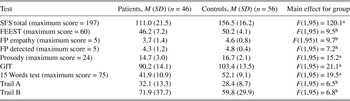
The comparability of the patient and control groups was assessed for each demographic variable. Patients and controls differed on relevant demographic variables (see “Participants”). The mean age in the control sample was slightly higher than that of the patients [t = 2.04, p = .04; 95% confidence interval (CI) [0.1, 7.4]], whereas the patient group contained relatively more males (χ 2 = 8.3, p = .005; 95% CI [0.16, 0.52]). Therefore, age and gender were included as covariates in the between-group analyses for the dependent measures. To this end, univariate analyses of covariance were performed for the measures of cognition and community functioning. After controlling for the effect of group differences in age and gender, statistically significant main effects for group (patients vs. controls) were found on each of the dependent measures (with patients performing worse than controls; see Table 1).
Difference in test performance between patients and controls
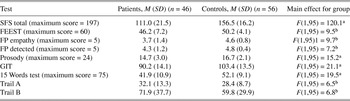
Note.
SFS, total score on the SFS (Birchwood et al., Reference Birchwood, Smith, Cochrane, Wetton and Copestake1990); FP empathy, correct answers on the empathy questionnaire of the faux pas test (Stone et al., Reference Stone, Baron-Cohen, Calder and Keane1998); FP detected, number of correctly detected faux pas on the faux pas test (Stone et al., Reference Stone, Baron-Cohen, Calder and Keane1998); FEEST, correct answers on the FEEST (Young et al., Reference Young, Perrett, Calder, Sprengelmeyer and Ekman2002); GIT, IQ based on the GIT (Luteijn and Barelds, Reference Luteijn and Barelds2004); 15 WT, total number of words encoded on the 15 Words Test (Saan and Deelman, Reference Saan and Deelman1986); trail A, time needed on the Trail Making A (Reitan, Reference Reitan1979); trail B, time needed on the Trail Making B.
a Difference is significant at the .001 (one-tailed).
b Difference is significant at the .05 level (one-tailed).
Within-Group Correlations
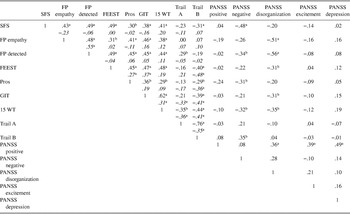
Pearson’s correlation coefficients between community functioning, social cognition, general cognition, and psychiatric symptoms for patients and controls are shown in Table 2. For all patients, all measures of social cognition were significantly associated with community functioning. Moreover, community functioning was also significantly associated with all measures of general cognition, except Trail Making A, and with the PANSS negative symptom score. Significant correlations existed between most of the independent variables. On the contrary, in healthy controls, none of the measures of social cognition or general cognition were associated with community functioning in healthy controls. Intercorrelations between measures of social cognition and general cognition were also lower than in the patient sample.
Pearson’s correlations of community functioning, social cognition, neuropsychological assessment, and psychopathology in the schizophrenia patient sample (correlations in the control sample are in italics)
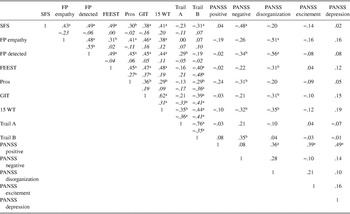
Note.
SFS, total score on the SFS (Birchwood et al., Reference Birchwood, Smith, Cochrane, Wetton and Copestake1990); FP empathy, correct answers on the empathy questionnaire of the faux pas test (Stone et al., Reference Stone, Baron-Cohen, Calder and Keane1998); FP detected, number of correctly detected faux pas on the faux pas test (Stone et al., Reference Stone, Baron-Cohen, Calder and Keane1998); FEEST, correct answers on the FEEST (Young et al., Reference Young, Perrett, Calder, Sprengelmeyer and Ekman2002); Pros, number of correct answers on the prosody task (Pijnenborg et al., Reference Pijnenborg, Withaar, van den Bosch and Brouwer2007) GIT, IQ based on the GIT (Luteijn and Barelds, Reference Luteijn and Barelds2004); 15 WT, total number of words encoded on the 15 Words Test (Saan and Deelman, Reference Saan and Deelman1986); trail A, time needed on the Trail Making A (Reitan, Reference Reitan1979); trail B, time needed on the Trail Making B (Reitan, Reference Reitan1979); PANSS positive, score on the positive subscale of the PANSS; PANSS negative, score on the negative subscale of the PANSS; PANSS disorganization, score on the disorganization subscale of the PANSS; PANSS excitement, score on the excitement subscale of the PANSS; PANSS depression, score on the depression subscale of the PANSS (Lindenmayer et al., Reference Lindenmayer, Bernstein-Hyman and Grochowski1994).
a Correlation is significant at the .001 (one-tailed).
b Correlation is significant at the .05 level (one-tailed).
Given the smaller variance in test performance in healthy controls, the low correlations between cognition and community functioning for controls could be due to a restriction of range effect. To examine the latter, we estimated for the control group correlations with a correction for restriction of range between all measures of social cognition, general cognition, and community functioning. If the difference in correlations between patients and controls could entirely be attributed to a restriction of range effect in the latter, then restriction of range-corrected correlations of the controls are expected to be about equal to the observed correlations of the patients. In our sample, each of the corrected correlations in the control group still appeared to be lower than the observed correlations in the patient group. This difference reached significance for the correlations between detection of a faux pas, FEEST, Trail Making B, and community functioning. Thus, for those measures, observed correlations of the patients were significantly larger than corrected correlations of the controls. This suggests that the absence of significant correlations between community functioning and (social) cognitive measures of controls is not just a reflection of a smaller variance in test performance in controls.
Regression Analyses
Given the absence of significant correlations in controls, we did not perform any further analyses on the predictive value of social cognition and general cognition in this sample. For the patient sample, we calculated Z scores for each of the independent variables and calculated composite Z scores by summing measures of ToM, emotion perception, general cognition, and psychiatric symptoms.
Subsequently, ToM and emotion perception were entered simultaneously into a regression equation, with community functioning as the dependent variable. The overall relationship of the model was significant, F(2,43) = 10.4, p < .01. This model explained 33% of the variance in community functioning. ToM was the strongest and only significant predictor of community functioning (B = 5.0, p < .05, 95% CI [1.2, 8.8]). The regression weight for emotion perception was 3.0 [not significant (ns), 95% CI [−0.8, 6.9]]. When general cognition and psychiatric symptoms were entered into the model, the overall relationship remained significant, F(2,43) = 6.2, p< .01. This model explained 38% of the variance in community functioning; however, the prediction of community functioning was not significantly better than that on the basis of ToM and emotion perception only (F change = 1.7, ns). Furthermore, none of the B value in this model appeared to be significant (ToM: B = 3.7, ns, 95% CI [−0.6, 8.1]; emotion perception: B = 1.6, ns, 95% CI [−2.5, 5.9]; general cognition: B = 2.0, ns, 95% CI [−0.7, 4.7]; psychiatric symptoms: B = −1.4, ns, 95% CI [−4.8, 2.0]). This is due to the relatively high correlations between the independent variables. To assess the strength of the unique relationship of each of the independent variables with community functioning, the semipartial correlations between each of the independent variables and community functioning were inspected. ToM had the highest semipartial correlation with community functioning (r = .21), and semipartial correlations with emotion perception, general cognition, and psychiatric symptoms were lower (rs = .10, .19, and −.10, respectively). Finally, we examined the contribution of faux pas detection and empathy separately. When these variables were entered into a regression equation together with emotion perception, none of them contributed significantly to the prediction of community functioning (faux pas detection: B = 5.9, ns, 95% CI [−1.0, 12.9]; faux pas empathy: B = 4.3, ns, 95% CI [−2.1, 10.7]; emotion perception: B = 2.9, ns, 95% CI [−1.0, 6.9]). This can be explained by the relatively large correlations between the independent variables.
Impaired Versus Unimpaired Patients
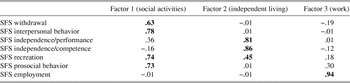
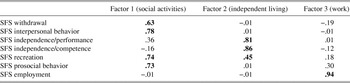
For clinical purpose, we were interested in whether impaired social cognition according to norm scores based on current clinical standards would differentiate between patients on different aspects of community functioning. To identify factors of community functioning, we performed a principal component analysis with varimax rotation on the seven SFS subscales to establish whether separable factors in community functioning could be distinguished. This resulted in three factors with eigenvalues greater than 1. These factors together accounted for 70% of the variance in community functioning (see Table 3 for factor loadings). The strongest loadings on the first factor were withdrawal, interpersonal behaviour, recreation, and prosocial behaviour; on the second factor were independence performance, independence competence, and recreation; and on the third factor was employment. We labeled these three factors “social activities,” “independent living,” and “work performance,” respectively.
Factor loadings for principal components analysis of SFS subscales(loadings >.4 are indicated in boldface)
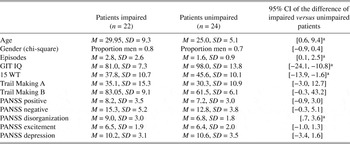
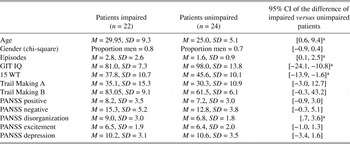
Subsequently, we calculated decile scores from the healthy control sample for each of the measures of social cognition. Patients who scored within the first decile (impaired performance according to clinical standards) on more than one of the four measures of social cognition were considered to have an impairment in social cognition. Based on this rating, the patient sample was divided into two groups: “impaired” (n = 22) and “unimpaired” (n = 24) (see Table 4 for demographic and cognitive variables of both subgroups). Patients in the impaired subgroup were relatively younger and experienced less psychotic episodes. As was to be expected given the significant correlations between general cognition, symptoms, and social cognition in our study, patients with poor social cognition also performed significantly poorer on the GIT and 15 Words Test and scored higher on the disorganization subscale of the PANSS.
Difference between “impaired” and “unimpaired” patients in demographical variables, general cognition, and symptoms
Note.
Data are mean (M), standard deviation (SD), and 95% CI of differences between impaired and unimpaired patients.
a Significant at the .05 level (one-tailed).
b Significant at the .001 level (one-tailed).
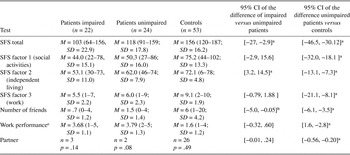
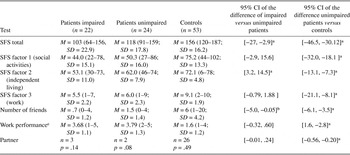
Table 5 provides a summary of group comparisons on relevant outcome measures. Unimpaired patients scored significantly higher than impaired patients on SFS total, SFS factors independent living, and number of friends. Unimpaired patients also scored better on social activities and work/work performance, but this difference did not reach significance. Although unimpaired patients scored better than impaired patients, they still performed significantly worse than healthy controls on all measures.
SFS total and subscales, number of friends, number of people with a partner, and work performance
Note.
mean (M), standard deviation (SD), range (R), and 95% CI of differences between impaired and unimpaired patients, and unimpaired patients and controls
a Significant at the .001 level (one-tailed).
b Significant at the .05 level (one-tailed).
c 1 = job consistent with level of education or student, 2 = job below expectations based on level of education, 3 = had a job consistent with level of education, currently no job, 4 = had a job below expectations based on level of education, currently no job, 5 = never had a job.
DISCUSSION
Social cognition was as a better predictor of community functioning in schizophrenia than either general cognition or negative symptoms together. Furthermore, the variance that was explained by symptoms and general cognition overlapped almost entirely with the variance explained by social cognition. This means that general cognition and psychiatric symptoms made no unique contribution to the prediction of community functioning when social cognition was included as a predictor. By contrast, with regard to our second hypothesis that emotion perception and ToM would both make an independent significant contribution to prediction of community functioning, we found that emotion perception did not make a significant independent contribution to variance in community functioning once ToM has been accounted for. Thus, ToM emerged as the best predictor of community functioning in schizophrenia.
The amount of variance in outcome that is explained by social cognition in our study is somewhat smaller than that in studies where ward functioning (Brüne, 2005b) or role-playing (Pinkham & Penn, Reference Pinkham and Penn2006) was used as an outcome measure. This may be because behavioral demands in complex daily life situations are larger than those in more structured wards or role-play situations. Therefore, specific factors such as personality and motivation may have been more important in our study. Nevertheless, the effect size observed was very large, at least in Cohen’s (Reference Cohen1988) terms, suggesting that a robust relationship exists between performance on measures of social cognition (particularly ToM) and everyday functioning in the community.
For clinical purposes, it is relevant to examine whether patients with impaired social cognition according to norm scores based on controls’ performance indeed show poorer community functioning. Therefore, our third hypothesis was that patients with impaired social cognition would show poorer community functioning than unimpaired patients. Overall, patients with impaired social cognition showed significantly poorer community functioning. Patients with impairments in social cognition were older and had experienced more psychotic episodes. Moreover, they performed more poorly on tests of intelligence and memory and had more symptoms of disorganization. When different components of community functioning were examined separately, the difference between impaired and unimpaired patients was significant for independent living skills. The independent living scale assesses the ability to perform skills necessary for independent living such as washing, grooming, cleaning, cooking, shopping, and budgeting. An association with social cognition and independent living abilities is consistent with earlier studies: emotion perception is related to personal appearance and hygiene (Mueser et al., Reference Mueser, Doonan, Penn, Blanchard, Bellack, Nishith and Deleon1996), neatness on inpatient ward (Penn et al., Reference Penn, Spaulding, Reed and Sullivan1996), appropriate clothing and appearance (Poole et al., Reference Poole, Tobias and Vinogradov2000), and self-care skills (Kee et al., Reference Kee, Green, Mintz and Brekke2003). Kee et al. (Reference Kee, Green, Mintz and Brekke2003) argue that the skills needed for independent living require the same information-processing skills and task-oriented requirements as emotion perception. Alternatively, we propose that impaired patients may not process the social context effectively. Therefore, they will not experience feedback from nonverbal social cues. For example, in the case of ToM impairments, motivation for household tasks may be lacking if someone is not able to infer the mental states of his roommates (e.g., their being annoyed by his dirty room). Contrary to our expectations, the difference between impaired and unimpaired patients did not reach significance with regard to work, number of friends, having a partner, and social activities. The fact that a substantial number of patients were participating in a rehabilitation program may have played a role here. In this regard, Brekke et al. (Reference Brekke, Hoe, Long and Green2007) investigated whether intensity of a rehabilitation program moderates the relationship between social cognition and outcome. The authors found that social cognition was predictive of treatment success and that the influence of social cognition on rehabilitative change increased—at a trend level—as the days of treatment decreased. Results suggest that an intensive treatment compensates for the effects of impaired social cognition on rehabilitative change. Our findings may be interpreted in the same vein: for example, by practicing job skills in sheltered jobs with job coaching, the association between social cognition and work performance may decrease as practice compensates for social cognition impairments. In addition, some patients may not have had a job nor were they looking for one because they were attending daily training sessions and did not have enough time to work. Also, participating in a rehabilitation program may enhance the number of social activities, regardless of a patient’s cognitive capacities. Stronger associations between social cognition and work/social activities are to be expected in samples of patients who receive less intensive treatment. It should be noted that even patients with unimpaired social cognition showed much poorer community functioning than controls. This illustrates clearly that factors other than social cognition also severely hamper community functioning in schizophrenia.
As to our final hypothesis, we did not find the expected association between social and general cognition and outcome in healthy controls. It appeared that this finding is not simply caused by methodological issues, such as a ceiling effect or restriction of range effect. Several possible explanations arise here. It may be that healthy controls will have enough spare cognitive abilities to compensate in case of impaired social cognition. This phenomenon has also been demonstrated in autism (Klin, Reference Klin2000). A second possibility is that social cognition is only associated with community functioning when abilities are below a certain critical limit. If social cognition is above this level, an individual has the necessary cognitive prerequisites for adaptive community functioning and performance will depend upon other factors. Finally, specific perceptual biases in social cognition in schizophrenia, for example, the tendency to perceive more negative affect in neutral faces (Kohler et al., Reference Kohler, Turner, Bilker, Brensinger, Siegel, Kanses, Gur and Gur2003) may account for the association between social cognition and community functioning. These ideas warrant more elaboration in future studies.
The present study has a number of limitations. First, we did not control for the effect of antipsychotic medication. We expect this did not seriously affect our results as Sergi et al. (Reference Sergi, Green, Widmark, Reist, Erhart, Braff, Kee, Marder and Mintz2007) recently showed no effect of antipsychotic medication on social cognition in schizophrenia. Second, there is a gender imbalance between patients and controls, with men being overrepresented in the patient sample. Third, the number of tests of general cognition was limited, which may have biased the results in favor of the predictive validity of ToM. Finally, since our study concerns cross-sectional data, causality is questionable.
Based on our results, we provide a number of recommendations for clinical practice. First, for research purposes, a standard test battery to assess cognition in schizophrenia has recently been proposed (Nuechterlein et al., 2008). This battery covers cognitive domains that are often impaired in schizophrenia (Nuechterlein et al., 2004). With regard to social cognition, the committee has recommend two tests of the MSCEIT battery (Mayer et al., Reference Mayer, Salovey and Caruso2002). These tests assess emotion perception and management. Our findings demonstrate that ToM predicts community functioning even better than emotion perception. Thus, when clinicians aim to predict outcome in daily life in schizophrenia for individual patients, we advise them assess ToM abilities in their test battery. Second, at a group level, social cognition is a better predictor of community functioning than general cognition and psychiatric symptoms combined. One potential implication of this is that tests of social cognition could replace tests of general cognition and psychiatric symptoms for the purpose of individual assessment. However, this would be inappropriate. Neuropsychological assessment involves careful observation and collection of data that is taken into account to make an individualized prediction of outcome, and the relationship between test performance and functioning in daily life is potentially much stronger in individual cases than at a group level. Third, clinicians should bear in mind that an association between social cognition and community functioning was only found in patients and not in controls. Based on this finding, we discussed factors that may mediate the relationship between social cognition and community functioning, such as compensation by general cognition and illness-related perceptual biases in social cognition. To identify these factors in individual patients, the necessity of carefully documented observations of individual test performance is stressed.
ACKNOWLEDGEMENTS
This project received financial support from the Foundation de Open Ankh, Foundation “Dienstbetoon Gezondheidszorg,” PO Box 142, 3769 ZJ, Soesterberg and ZONMW, PO Box 93 245, 2509 AE, Den Haag. The authors gratefully acknowledge Jikkelies Spoelman for her help in collecting the data. The authors have no financial or other relationships that could be interpreted as a conflict of interest affecting this article.