In October 2008, teachers in Pixian County started a wave of strikes that quickly spread into other counties in Sichuan Province, protesting the treatment they received in the wage reform in that year. The teachers canceled classes for one week until the local government gave in to their demands.Footnote 1 In November of the same year, taxi drivers in Chongqing City staged a large-scale strike that quieted down the streets of the city of eight million.Footnote 2 Those are just two examples among many incidents of labor revolt that are becoming more and more common in China's cities. More familiar to the international media regarding Chinese workers’ conditions and behavior are the substandard working and living conditions (Fisher Reference Fisher2012; Su and He Reference Su and He2012), the series of suicides (Baidu Baike Reference Baike2012) and recent worker unrests at Foxconn, one of the world's biggest electronics manufacturers and an important supplier to companies like Apple (Barboza and Bradsher Reference Barboza and Bradsher2012).
As China has rapidly developed in recent decades, social and economic inequalities have increased dramatically (see Wang Reference Wang2008). How do the working classes cope with their lowly status in the ever-changing landscape of social transformation? That is an urgent question both for social scientists and policy makers. Underlying such interest and anxiety is a presumption that the socially disadvantaged represent a potential pool of social insurgency. Hence it is important to know what the available channels for redressing grievances are, and when the workers resort to joining public protest, as opposed to private solutions. The extent to which those socioeconomically disadvantaged individuals may resort to collective action remains a puzzle. As social movement scholars may have it, what is the “mobilization potential” (Klandermans and Oegema Reference Klandermans and Oegema1987, 519) like in China?
Since Marx and Gramsci, serious analysts have put under critical scrutiny the linkage between social deprivation and social protest. In fact, the linkage is often considered to be problematic, as suggested by such celebrated concepts as “false consciousness” (Marx Reference Marx1898) and “hegemony” (Gramsci Reference Gramsci1972). Applying these concepts to the case of contemporary China, Marc Blecher (Reference Blecher2002, 283) lamented that the sporadic, spontaneous, and uncoordinated nature of the protests is attributable to the “workers’ hegemonic acceptance of the core values of the market and the state.” He concluded that “the vast majority of Chinese workers, including the unemployed, remain to be politically passive” (286). Assertions of this sort await systematic investigations.
The readiness to get involved in protest seems to be less problematic, according to other studies (O'Brien Reference O'Brien2008). Recent case studies have addressed spontaneous claim-making by industrial workers (Chen Reference Chen2000, Reference Chen2004, Reference Chen2006, Reference Chen and O'Brien2008; Hurst Reference Hurst2009) and pensioners (Hurst and O'Brien Reference Hurst and O'Brien2002), complaint lodging by peasants (Cai Reference Cai2010; O'Brien and Li Reference O'Brien and Li1995, Reference O'Brien and Li2005, Reference O'Brien and Li2006) and migrant workers (Lee Reference Lee2007; Su and He Reference Su and He2010), protests by laid-off workers (Cai Reference Cai2002, Reference Cai, Perry and Goldman2007; Kernan and Rocca Reference Kernan and Rocca2000), and mobilizations by urban homeowners (Cai Reference Cai, Perry and Goldman2007; Read Reference Read, Zhang and Ong2008; Shi and Cai Reference Shi and Cai2006). Researchers describe contentious issues and detail the perceptions and behavior of the participants. Unmistakable in all these accounts is a linkage between a sense of deprivation and a willingness to act on the part of the participants.
These case studies are invaluable in furnishing us with essential elements to form a portrayal of China's contemporary social protest—contested issues, strategic choices, organizational dynamics, targets, coalition building, and possible political impacts (also see Bernstein and Lü Reference Bernstein and Xiaobo2003; Bianco Reference Bianco2001; Gilley Reference Gilley2001; O'Brien Reference O'Brien2008; Perry Reference Perry2001; Unger Reference Unger2002). Together these studies suggest that protests in contemporary China are mostly “rights” based—on issues of land disputes, family planning, laid-off worker benefits, and pensions. They are desegregated in local settings, yet amount to national coordinated political events. Leading scholars conceptualize them as “rightful resistance” (O'Brien Reference O'Brien1996; O'Brien and Li Reference O'Brien and Li2006).
These case studies examine individuals who are already involved in protest. For this group of individuals, the association between grievances and protest propensity is perfect. But in real life, protest may be only one of many ways of redress, and protesters usually only make up a minority of a community's population. Armed with data from a rural survey conducted in 2002, Michelson (Reference Michelson2007, Reference Michelson2008) asked a very different question. He pushed his inquiry one step backward and included individuals with grievances who chose to mobilize as well as those who chose other means of redress. He was then able to ask, under what conditions will individuals take mobilization as the preferred way of redressing grievances? His findings showed that the majority of rural disputes are resolved through local negotiations; only a small portion of them spill outside the village in the form of litigation or protest (Michelson Reference Michelson2008). He also found that villagers who enjoy outside “political connections” are more likely to resort to litigation or protest (Michelson Reference Michelson2007).
Parallel to Michelson's work on rural settings, we used a 2003 survey to investigate the mobilization potential in urban China. While his studies were about rural residents’ choices of redressing grievances, our study represents a first systematic look at the similar issues among urban residents. While Michelson conducted a multifaceted analysis, we took advantage of the richly available network measures in our survey and focused on the contrast between protest and adaptation—engineering life-changing events through social networks. Informed by the concept of “rightful resistance” (O'Brien Reference O'Brien1996; O'Brien and Li Reference O'Brien and Li2006), we believed that localized resistance was the most plausible form of protest at the time of our survey. We hence designed a question that detects the willingness to join a workplace-based protest. We proposed a hypothetical pay dispute, and asked about respondents’ willingness to collectively challenge their leaders. In our analysis, we investigate how such willingness is shaped by social class position and social network resources.
Below we will first discuss individuals’ level of willingness to engage in protest activities. We then tabulate whether it varies across five social classes. Third, we test two theoretical models. In the first model, we hypothesize that well-connected individuals are less inclined to protest, since they can change their life's circumstances through other means, such as personal favors and back-channel dealings. In the second model, we test the hypothesis that those with extensive and strong social ties may be more inclined to protest, as they may be more informed and more efficacious, a hypothesis that echoes a long tradition of the social movement literature. But first let us consider a few theoretical issues.
Theoretical Considerations
We define protest propensity as an individual's willingness to join a collective action event of protest. Absent information about the individual's behavior, propensity to protest serves as a device to gauge mental readiness to act, so it carries significant implications for protest behavior. In a society that lacks a legal guarantee for free speech, the propensity reflects a level of acceptance, or a willingness to consider social protest as a legitimate form of social activity.Footnote 3
The significance of protest propensity derives from an understanding that positive attitude is the starting point, a necessary condition, for possible action. If mobilization potential refers to “the people in a society who could be mobilized by a social movement” (Klandermans and Oegema Reference Klandermans and Oegema1987), protest propensity is then critical for gauging a society's “mobilization potential.” In Klandermans and Oegema's (Reference Klandermans and Oegema1987) study, their sample starts with those who show sympathy toward the movement, a pool of individuals who identify with the movement's goal. Despite a low percentage of people who eventually turn out to protest, the protest propensity serves as a critical starting point for movement recruitment. Outside such a pool, the turnout rate would be even lower.Footnote 4
Who is more inclined to protest in China? Our analysis will mainly consider two factors: a “push” factor and a “pull” factor. We will investigate whether class disadvantage will increase the level of protest propensity—in other words, whether class disadvantage “pushes” individuals to voice their grievances. We will also investigate whether stronger social connections provide more channels for social advancement—in other words, whether social connections “pull” individuals away from forming intentions of protest.
Deprivation, Propensity, and Protest
A key relationship to be examined in this paper is one between social class and protest propensity. We may recall an old debate as to whether social deprivation is a good predictor of social protest. In the case of contemporary China, the relationship should not be presumed but should be subject to empirical investigation.
The linkage between socioeconomic deprivation and protest was proposed by an early generation of scholars. Well-known models in collective behavior research included theories of deprivation, relative deprivation, and J-curve theory of revolution (e.g., Davies Reference Davies1962, Reference Davies1974; Gurr Reference Gurr1972). But social movement scholars such as Charles Tilly and others (see Crawford and Naditch Reference Crawford and Naditch1970; Muller Reference Muller1972; Tilly Reference Tilly1973, Reference Tilly1978; Tilly, Tilly, and Tilly Reference Tilly, Tilly and Tilly1975) have mounted empirical evidence challenging these traditional theories. The two sides, however, have somehow managed to bypass a key intervening factor—protest propensity. While Gurr (1970) and Davies (Reference Davies1962, Reference Davies1974) used economic indicators (commodity price, GDP, etc.) as proxies for psychological stress, their critics marshaled the evidence that there is no significant association between economic indicators and the occurrence of protest. Missing in the debate is a discussion of the attitudinal aspect of protest, or protest propensity. Once we insert such an intervening variable, we have to consider the linkage between deprivation and protest as consisting of two segments: one between economic hardship and protest propensity, the other between protest propensity and protest activity. This study will focus on the first segment of the relationship to demonstrate the existence or the lack thereof of a positive relationship between economic hardship and protest propensity.
In the context of American society, the findings are mixed on the relationship between class status and attitude toward protest. Earlier authors generally subscribed to various versions of the so-called marginality thesis. They portrayed protest participants as mainly consisting of criminal elements, the chronically unemployed, and other fringe members of the ghetto. Some scholars associated protest with black citizens with less education, lower incomes, and a higher rate of unemployment than the rest of the population (Downes Reference Downes1968, Reference Downes1970). In studies conducted in the 1970s, Spilerman (Reference Spilerman1970, Reference Spilerman1971) showed that a major determinant of the probability of a riot in a given city was the number of aggrieved blacks in that community. In the 1980s, however, Mason and Murtagh (Reference Mason and Murtagh1985, 352) concluded that “willingness to participate in civil violence is fairly evenly distributed across income, educational, and occupational strata, thereby disconfirming the social marginality thesis.” Their study even showed that certain forms of protest are disproportionately supported by people with higher socioeconomic status. The general inconclusiveness of past studies makes our examination in the Chinese case even more meaningful.
Alternatives to Protest Participation
The issue of protest becomes relevant when there is a sense of injustice, or in Tilly's (Reference Tilly1993, 275) phrase, when a segment of the population is being “wronged.” But protest only stands as one of multiple options in response to injustice. Following Olson (Reference Olson1965), we consider protest participation as the result of a cost-benefit consideration. Hence the choice set available to individual actors is important to understand their propensity for action.
In his classic work Exit, Voice, and Loyalty (Reference Hirschman1970), Hirschman specified two general options for individuals faced with the decline of a firm, or “general decay” in other areas of the society (1). One is voice, which he defined as “any attempt at all to change, rather than to escape from, an objectionable state of affairs” using means that could include protests (4). The other is exit, an option similar to a situation in which “some customers stop buying the firm's products or some members leaving the organization” (4).
Hirschman subsequently applied this conceptual scheme to examine the ups and downs of social protest in his other book, Shifting Involvements (Reference Hirschman1982). He distinguished between two separate realms of activities: public and private. The separation of these two realms, he suggested, would lead to cycles of involvement in collective action. On one hand, frustrations and dissatisfactions over issues in the public realm often push individuals into collective action. On the other hand, individuals are unlikely to participate in collective action when they find that engaging in private activities suffices to satisfy their self-interest. Using the terminology of exit and voice, we may restate Hirschman's proposition in this way: one may choose to “voice” by engaging in collective action in the public realm, or to “exit” by retreating to the private realm. Retreating to the private realm can then be regarded as an alternative to protest.
A corollary is that the willingness to engage in collective action is a function of the attractiveness of the place one is exiting to. In a free society, the private realm consists of the marketplace, with competition and rule of law. Only when the market is not working properly would people rush to the political domain. “The role of voice increases as the opportunities for exit decline, up to the point where, with exit wholly unavailable, voice must carry the entire burden of alerting management to its failings” (Hirschman Reference Hirschman1970, 34).
Adaptation through Guanxi Networks in China: Model A
Though suggestive and perhaps useful in other settings, Hirschman's dichotomous scheme of the public and private realms is problematic in describing social activities in contemporary Chinese society (X. Zhou Reference Zhou1993). There are two related reasons why this is the case. The first is that China today lacks a social space that can be truly described as “the private realm.” The second is that guanxi networks play a prominent role in Chinese society.
Since the late 1970s, market reform has transformed China into a society mixing three layers of institutions: the state, the market, and the guanxi networks (see Boisot and Child Reference Boisot and Child1996; Pieke Reference Pieke1995). The three layers defy a public-private dichotomy, but are intertwined with no clear boundaries. If an individual feels frustrated when working in the governmental sector and pursues opportunities in the marketplace, as evidenced in the xiahai phenomenon (resigning from jobs in state sectors and plunging into the “sea” of the market), that individual would quickly discover that connections to the state are essential to his or her competitive advantage. In other words, when one quits the state to go to the market, one finds the state right in the market. The marketplace is then less an arena that rewards honesty and hard work than a realm rampant with nepotism, favoritism, backdoor dealings, and even illegal activities (Yang Reference Yang1989). As a common Chinese saying goes, “Earnest folks eat the bitter fruit” (laoshiren chikui). The market is not a desirable site to fall back on if one does not command social network resources that can connect one back to state power.
In between the proverbial private (market) and public (state) realms is the realm of guanxi networks. For social actors in China, that is a third realm that is neither private nor public. Scholars have made numerous attempts to characterize this in-between social space as interpersonal relations, social ties, or social embeddedness of action. In his classic work on the Chinese industry authority, Walder (Reference Walder1986) referred to the patron-client relations between leaders in authority positions and party activists. Bian (Reference Bian1994, Reference Bian1997) pointed to the role of personal networks in helping individuals achieve various social goals, including finding a job. Some believe that, in China, one's guanxi networks rival the importance of class position, political power, or professional skills, and they are deemed as a form of “social resources” crucial in status attainment (Lin Reference Lin1999; Lin, Ensel, and Vaughn Reference Lin, Ensel and Vaughn1981; Lin, Vaughn, and Ensel Reference Lin, Vaughn and Ensel1981).
Existing research emphasizes both the extensiveness and the strength of guanxi. Inspired by research on the American labor market (Granovetter Reference Granovetter1973, Reference Granovetter1974), China scholars extend the analysis to guanxi networks and make a useful distinction between information and influence (Bian Reference Bian1997). In the American labor market, weak ties can bring long reaches beyond one's close circles, hence producing useful information that strong ties may not be able to generate. This is the so-called strength of weak ties (Granovetter Reference Granovetter1973). In comparison, strong and powerful connections, rather than information availability, are important for one's getting a job in China. In Bian's (Reference Bian1997, 366) phrase, students of Chinese society have to “bring strong ties back in.” In our analysis below, we will measure both the extensiveness and the strength of guanxi.
Given the importance of social networks in Chinese society, individuals in China are likely to fall back on their guanxi networks, rather than private-realm pursuits, as alternatives to protest. To the extent they have extensive and strong guanxi resources, they may pursue life-changing goals through a variety of means, including information assistance, informal favors, backdoor dealings, or even illegal activities. We call this alternative to protest a form of “adaptation.” We expect that adaptation helps diffuse the desire for protest, thus lowering individuals’ “protest propensity.”
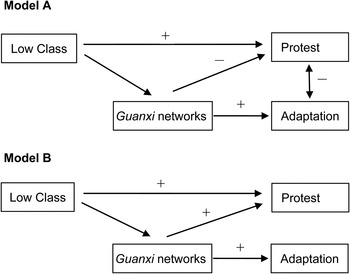
The above theoretical considerations can be presented as Model A in Figure 1, illustrating two possible routes of reaction to class position. One is voice-making through the public realm, or protest; the other is engineering life-changing events (finding a new job, for example) through guanxi networks. To the extent the second route—adaptation—is available, one may be less likely to pursue the first route—protest. Three testable hypotheses can be derived from this model. First, protest propensity is a function of class position: those in lower classes tend to be more inclined to protest participation. Second, those who enjoy more extensive and stronger guanxi networks are more likely to cultivate extra-institutional favors (adaptation) but less inclined to protest participation. Third, those who have cultivated extra-institutional favors are less inclined to protest participation; that is, the association between protest and adaptation is negative.
Two Models Predicting Protest Propensity in China.

Social Ties and Protest: Model B
In the above model we suggest that a socially well-connected person may be less inclined to participate in protest. This is problematic, because social movement scholars have long found the relationship between social ties and protest to be positive, at least since the first refutation of the mass society models (Kornhauser Reference Kornhauser1959; Selznick Reference Selznick1960; for more concise summaries and early critiques, see Gusfield Reference Gusfield1962 and Pinard Reference Pinard1968). Social connections are now commonly believed to be a facilitating factor in protest participation. From this alternative perspective, we may hypothesize that better connected Chinese may be more inclined to protest because social ties empower their sense of efficacy. That is, social ties may enhance both protest and adaptation.
Some early theorists (see, e.g., Pinard Reference Pinard1968) asserted a negative relationship between social ties and protest, reasoning that social ties to organizations and other members of the society exert “restraining effects” on deviant behaviors, including protest. But subsequent scholars contended that social integration has opposite effects: “The intermediate structure may actually . . . exert mobilizing, rather than restraining effects. . . . [C]ertain intermediate groups, because of their positive orientations to the means and goals of a social movement, can be a strong force acting to motivate and legitimate individual as well as group participation in a movement” (Pinard Reference Pinard1968, 687). Moreover, seen from a diffusion perspective, the more integrated individuals are, the more widespread the adoption of the same attitude and behavior regarding protest. Diffusion research by Coleman (Reference Coleman1957) and others (see, e.g., Lionberger Reference Lionberger1961; Rogers Reference Rogers1962) provides evidence for this line of argument. Coleman (Reference Coleman1957) found that the more integrated members of the community would be among the first to join a community conflict, while the relatively isolated were less often and less easily drawn in.
Starting in the late 1970s, scholars have elaborated the positive link between social ties and protest. Useem (Reference Useem1980) proposed a solidarity model based on his analysis of the Boston anti-busing movement. Social solidarity has an impact on mobilization in two ways. First, social solidarity furnishes individuals with a communication network, a set of common values and symbols. Second, it enables “bloc mobilization”—enlisting entire blocs of individuals en masse (Useem Reference Useem1980). Other classic studies (see, e.g., Gould Reference Gould1991; McAdam Reference McAdam1986; McAdam and Paulsen Reference McAdam and Paulsen1993; Snow, Zurcher, and Ekland-Olson Reference Snow, Zurcher and Ekland-Olson1980) also point to the positive impact of social ties on mobilization. The relationship is best articulated in McAdam and Paulsen's (Reference McAdam and Paulsen1993) “Microstructural Model of Recruitment.” Such a formulation speaks to both the attitudinal as well as the behavioral aspects of participant recruitment. According to this model, participants in a social movement are mostly recruited along “established lines of human interaction,” either through individuals’ informal social ties or their membership in formal organizations. Particularly germane to our study on protest propensity is the cognitive component of the model. McAdam and Paulsen (Reference McAdam and Paulsen1993, 647) cite the notion of identity salience to drive home this point:
First, the individual must be the object of a recruitment appeal that succeeds in creating a positive association between the movement and a highly salient identity. The linkage creates a positive initial disposition to participate. Second, the recruit discusses this disposition with those persons who normally sustain the identity in question. In effect, the recruit is seeking to confirm the linkage between movement and identity and hence the ultimate “correctness” of the intention to participate.
The above review provides the rationale for hypothesizing that guanxi networks may in fact be a positive predictor for protest propensity. Those who enjoy more social connections may also be more inclined to protest. This alternative reasoning can be expressed as Model B in Figure 1, whereas other effects are similar to those covered under Model A. The relationship between guanxi and protest propensity is hypothesized as positive rather than negative.
Data and Measurement
We drew on data from the China General Social Survey jointly conducted by Hong Kong University of Science and Technology and Renmin University of China in 2003. Using the four-stage sampling method of probability proportional to size, the survey covered 598 Juweihui (Neighborhood Committees), 299 Jiedao (Street Clusters), and 92 counties (districts) from 30 out of 34 province-level administrative divisions of China (excluding Hong Kong, Macau, Taiwan, and Tibet). The survey collected information from 5,980 adults aged 18–69 sampled from an equal number of urban households, and 5,894 cases remained after data cleaning.Footnote 5
Dependent Variables
Protest Propensity. We coded a dummy variable from an original question that reads: “In an adjustment of wages or position, suppose a large number of workers including yourself are treated badly and unfairly. In such a situation, if someone suggests that workers should band together and go see the leaders for a fair accounting, what would you do?”Footnote 6 Due to the censorship of surveys, we could not explicitly mention words like “protest” and “resistance.” We used tao ge shuo fa (讨个说法, ask for a fair accounting), in the context of “band together and go.” In the Chinese language, tao ge shuo fa is associated with defiance and protest, a term popularized by the 1992 Zhang Yimou movie Litigation by Qiuju.
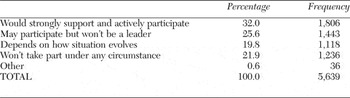
In Table 1, we show the distribution of respondents who chose one of five answers.
Level of Propensity for Joining a Hypothetical Protest among China's Urban Residents.

As the table shows, more than half of respondents indicated a willingness to participate, and more than 30 percent indicated a strong willingness with no reservation. We contrast this strongest group (“would strongly support and actively participate”) with the rest (“may participate but won't be a leader,” “depends on how situation evolves,” etc.). In coding this dummy variable for logistic regression analysis, we err on the conservative side by choosing those who expressed the strongest view.Footnote 7 We expect to find among this group the readiness for protest participation, since sociology literature has famously shown the gap between attitude and behavior. Our bivariate analysis will show a differentiated percentage across class and social networks categories, and multivariate analysis will use the dummy variable for the logistic regression models.Footnote 8
Adaptation. This is a dummy variable created to record whether individuals got help through guanxi networks in getting their last job. The question asked, “Which channels were used when you found your current job or the last job right before retirement, layoff or unemployment?” We coded those who answered “Introduced or recommended by guanxi” as 1, and the rest as 0.
Obviously adaptation is not limited to getting a job, one of myriad ways of using guanxi networks. Social connections are useful in amassing political power, founding a company, getting good education for one's children, and so on. But getting a job as a dependent variable nonetheless measures a critical transition in life. It is also one of the most extensively used measures in the scholarship on social networks (Bian Reference Bian1994, Reference Bian1997; Granovetter Reference Granovetter1973, Reference Granovetter1974).
Independent Variables
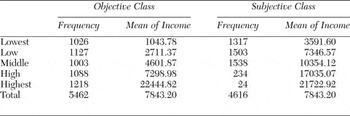
Objective Class. This variable is recoded from household yearly income per capita. We designated four cutoff points and allocated respondents into five classes: “lowest,” “low,” “middle,” “high,” and “highest.” Each of the resulting “classes” consists of an approximately equal number of respondents. The frequency and average income for the five classes are shown in Table 2. Admittedly this is an approach of convenience with no attempt to reveal class boundaries. The word “objective” here simply means that the classification is based on an objective measure (income), rather than the respondent's self-identification (see next measure).
Mean Income Per Capita by Class Status among China's Urban Residents.

Subjective Class. Respondents were asked to self-identify themselves into five classes, “lowest,” “low,” “middle,” “high,” and “highest.” The frequency and average income for each subjective class are also shown in Table 2.
Guanxi Number. Following past research on social networks, we measured the extensiveness of guanxi by counting the numbers of people who maintained regular “discussion networks” (Burt Reference Burt1984; Marsden Reference Marsden1987). The average number of ties is 4.88, with most respondents reporting having fewer than ten ties. For the ease of presentation, we also classify respondents into five groups from lowest to highest number of ties.
Guanxi Strength. To measure the strength of an individual's guanxi connections, we computed how many occupations the individual's connections reach and how prestigious those occupations are. We asked respondents to report who they greeted in the last Chinese New Year holiday, in person, by phone, or by short message on the phone (Bian et al. Reference Bian, Breiger, Davis and Galaskiewicz2005). Then we calculated the sum of the International Socio-Economic Index of Occupational Status (ISEI)Footnote 9 score of occupations that had been reached by the respondent's greetings. The resulting score ranged from 0 to 971. Again we assigned grades (0–4) and classified respondents into five groups.
Control Variables
Sex. This is a dummy variable, coding Male = 1; Female = 0.
Age. This is a continuous variable, ranging from 18 to 69.
Years of Education. We measured educational attainment with a continuous variable coded from the original “Degree of Education.” We assigned each degree a number as follows: Uneducated = 0; Elementary school = 6; Junior high school = 9; Senior high school = 12; Three-year college = 15; Four-year college = 16; Post-graduate and above = 19.
Party Membership. This is a dummy variable, coding CCP member = 1; Others = 0.
Unemployment. This is a dummy variable, coding Unemployed = 1; Others = 0.
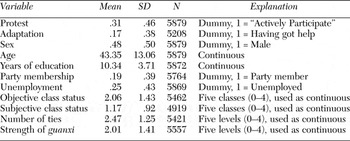
A complete list of variables and their descriptive statistics is presented in Appendix 1.
Findings
The Level of Willingness to Protest
Respondents were asked whether they would join a collective action of protest if they were treated unfairly in their workplace. Although the wording refers to protest only obliquely, the question leaves no doubt about one's willingness and preparedness for taking part in overt protest that may be sanctioned by the government.Footnote 10 Measured by this particular question, the propensity for protest is very high. As shown in Table 1, more than half of the respondents embrace collective action as a way of redressing grievances, and as high as 32 percent reported that they would “strongly support [the action] and actively participate.”
This level of willingness may be surprising to some. As we have already mentioned, some scholars suspect that a lack of political awareness accounts for the sporadic, small, and uncoordinated state of Chinese social protest (Blecher Reference Blecher2002). Our finding (shown in Table 1) indicates otherwise; it points to a high level of mobilization potential. The segmented nature of Chinese protest seems to be more due to external constraints rather than to any passive state of mind.
Class, Guanxi, and Protest Propensity
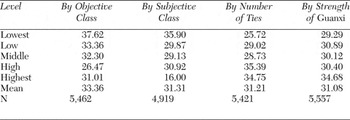
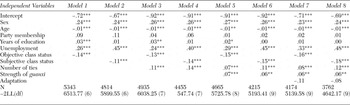
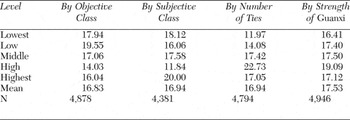
In Table 3 and Table 4, we report how class and guanxi affect protest propensity. Table 3 reports the relationship between protest propensity and class measures, and the relationship between protest propensity and guanxi measures.Footnote 11 Two opposite trends emerge from the table. Either measured objectively or subjectively, improvement of class status is unmistakably associated with lower protest propensity (columns 1 and 2). Those who occupy lower class positions tend to be more inclined to protest. This finding confirms our hypothesis with regard to the effect of class status.
Percent of Individuals Who Would Actively Participate in Protest by Class Status and Guanxi Ties.

Coefficients of Logistic Models Predicting Protest Propensity in Urban China.

*p < .10 **p < .05 ***p < .01
In contrast, both the extensiveness and strength of guanxi networks are positively associated with protest propensity. That is to say, those who enjoy better social connections are more inclined to protest (columns 3 and 4).
The effects of class and guanxi on protest propensity turn out to be very robust when we control for other factors (Table 4). We control for sex, age, education, party membership, and employment. Across the regression models, most of these control measures are significant in the expected directions. For example, the coefficient for sex is a positive and significant .24, indicating that men are more likely than women to participate in a protest by a ratio of 1.27 (exp[.24]), or 27 percent. As for the other control measures, people with younger age, higher education, and unemployment are more likely to show a willingness to participate in a protest. The party membership measure is not significant in the model.Footnote 12
The class effect remains sizable and negative across the models. For example, as specified in Model 1, one level increase in objective class status will lead to a decrease in protest propensity by a ratio of 1.15 (1/exp[−.14]), and the difference between the lowest class and the highest class will be 1.75 times, or a 75 percent increase.
The guanxi effect also remains sizable and positive across models. This is so both for the number measure and the strength measure. When both measures are introduced in the model (Models 5 through 8), they are significant as well.
In the last two models in the table, we introduce adaptation as an independent variable in predicting protest propensity (Models 7 and 8). This is to test whether those who resort to adaptation are less likely to resort to protest participation. The results show that there is no significant relationship between the two. Adaptation is not significant in either of the two models.
Class, Guanxi, and Adaptation
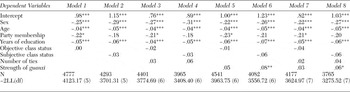
We conceptualize adaptation as an alternative to protest when individuals find themselves in a disadvantaged class position. Now let us see whether those who have better a guanxi network are in fact more likely to adapt. Table 5 and Table 6 report findings using adaptation as the dependent variable.
Percent of Those Who Got Help in Finding Their Last Job by Class Status and Guanxi Ties.

Coefficients of Logistic Models Predicting Getting Help for Jobs in Urban China.

*p < .10 **p < .05 ***p < .01
Table 5 reports the percentage of adaptation by class status and guanxi. Across five class or guanxi categories, the numbers report the percentage of individuals who have obtained help in finding their last job. There does not appear to be any discernible pattern with regard to the relationship between class and adaptation, according to the first two columns. The last two columns show a clear pattern: the percentage increases as the number of ties or the strength of guanxi increases from the “lowest” to the “highest,” although the trend is not very sizable; neither at this point is it clear whether the differences are statistically significant.
The association is put to a test in the multivariate regression models in Table 6. The results are mixed. In Models 6 and 8, the strength variable is significant in predicting adaptation (but not in Models 5 and 7). This provides some support—albeit relatively weak—for our expectation that the better connected are more capable of adapting. The measure of number of ties is not significant in all of the models predicting adaptation. The strength of the guanxi ties seems to matter more than the number of ties, a point that is consistent with past findings about the effect by strong ties (Bian Reference Bian1997).
Adapt or Voice: Summary of Findings
How do our hypotheses fair in light of the data analysis? Are those in the disadvantaged class position more willing to join a protest? Are those who can adapt less inclined to voice? We reach three conclusions from the above analysis. First, class disadvantage is a robust predictor of the willingness to protest. Second, guanxi is a positive predictor both for adaptation and protest propensity. Finally, adaptation has no significant relationship with protest propensity.
Comparing these results with our hypotheses in Model A as presented in Figure 1, the class effect is confirmed, but the unexpected results include the positive effect of guanxi on protest propensity, and the insignificance of the relationship between adaptation and protest propensity. It appears that those who enjoy strong guanxi networks are more likely not only to adapt but also to participate in protest activities. The answer to the question of “adapt or voice” then is this: they both adapt and voice. Hence Model B fits the data better.
Discussion and Conclusion
Mobilization Potential in Urban China
When treated unfairly in the workplace, urban residents in China show a great level of readiness to act collectively and defiantly. As reported above, more than 30 percent indicate that they would strongly support the collective action and actively participate, with another 25 percent who “may participate but won't be a leader.”Footnote 13 This level of willingness may partly explain the high rate of occurrence of collective action. Available data put the numbers of collective action events at 87,000 in 2005 (B. Zhou Reference Zhou2008). China is in an age of resistance, unimaginable in the Cultural Revolution era under Mao when the party-state tightly channeled the masses into state-sponsored campaigns.
Our data also show that the willingness to protest is associated with economic disadvantage; citizens in the lower class categories show higher levels of protest propensity. This finding points to one of the major sources of social unrest, although we need to be careful with the extent to which we can link socioeconomic grievances to mobilization potential. Literature in social movement research has repeatedly demonstrated that the most deprived may not be the most active in collective action. The missing link is their capacity to act. The associational resources—closely knit social ties, for example—are a factor of such capacity that help translate willingness to real action. This leads to another finding of this study: individuals who enjoy better social connections express higher levels of willingness to join collective action. This may reflect a sense of efficacy.
Hirschman, Chinese Society, and Protest
We started the paper by asking the question “adapt or voice,” but we have reached a conclusion that compels us to summarize our findings with a different statement: “adapt and voice.” The change to the conjoining word reflects a new understanding of Chinese protest in particular, and of the Chinese society in general. The arenas for adaptation and for voice are intertwined and overlapping; the two options of coping strategy are not mutually exclusive.
We derive our hypotheses by first citing Hirschman's (Reference Hirschman1970) dichotomous concepts of exit versus voice, and the public realm versus the private realm. We also draw on his insight that those who find one attractive option may do less of the other. Although we depart from Hirschman by pointing out that these concepts and ideas may not fit the Chinese society, we continue to use Weberian ideal types, as Hirschman does, in formulating our working hypothesis that those who resort to adaptation may be less inclined to join a protest.
Our data, however, reject such a hypothesis. As it turns out, those who enjoy stronger guanxi networks not only engage in more economic dealings (getting help in finding a job, for example), but also feel more efficacious toward the prospect of social protest participation. Guanxi ties, whose potent forms are often associated with state power, are useful not only in economic pursuits, but also in the realm of politics. Two considerations must have real consequence when respondents were asked about their propensity for protest. First, everything else equal, protests will have a higher rate of success if they are undertaken by people with insider connections. Second, protesters are also better positioned to escape state persecution if they have ties with the authorities.
In fact, social movement research has long uncovered the positive effects of social ties on recruitment (see, e.g., Ansell Reference Ansell1997; Diani and McAdam Reference Diani and McAdam2003; Fernandez and McAdam Reference Fernandez and McAdam1988; Gould Reference Gould1991, Reference Gould1993; McAdam and Paulsen Reference McAdam and Paulsen1993; Schulz Reference Schulz1998; Snow, Zurcher, and Ekland-Olson Reference Snow, Zurcher and Ekland-Olson1980). Preexisting ties facilitate mobilization and recruitment by relaying information and aligning the identity. Our findings about their effect on protest propensity add some new evidence.
The finding may be the reflection that three layers of Chinese institutions—the state, the market, and guanxi networks—are intertwined with no discernible boundaries. We agree with Nee, Stark, and Selden's assessment when they remark, “The penetration of the state into all realms of life did not extend a public sphere so much as to negate it, for without attachment to the party or one of its subsidiary organizations no particular individual can make claims with any validity” (Reference Nee, Stark and Selden1989, 22).
What do we make of our findings for understanding the current state of social protest in China? Based on our analysis, we conclude that in contemporary China protest propensity is a function of low class status and high social connections. The state control has so far been successful in preventing cross-unit mobilization or alliance building, a strategy that explains the segmented nature of recent protests. By undermining mobilization-related social connections, the state is able to take care of one of the two key factors that affects protest propensity. But the other factor—social inequality—is soaring with no effective checking mechanism in sight. Will that strain the capacity of the state so much that cross-unit mobilization is no longer preventable someday?
Acknowledgments
This research is supported by a grant from the Fundamental Research Funds for the Central Universities, and the Research Funds of Renmin University of China (No. 10XNK036 entitled “Social Ties and the Mobilization of Collective Action in China”).
Explanations and Descriptive Statistics of Variables for Logistic Regression Models Predicting Protest Propensity and Social Adaptation, China