


Background
The study of healthy human development is continuing to emerge after a lengthy history of empirical emphasis on pathology. The importance of resilience in the positive development of children has been well documented (Law, Cuskelly, & Carroll, Reference Law, Cuskelly and Carroll2013; Mutimer, Reece, and Matthews, Reference Mutimer, Reece and Matthews2007). The term resilience is used to describe the process of gaining positive outcomes despite the presence of challenging circumstances (Garmezy & Masten, Reference Garmezy, Masten, Cummings, Greene and Karraker1991; Zimmerman & Arunkumar, Reference Zimmerman and Arunkumar1994). The construct of resilience has received notable criticism from the scientific community, primarily around the lack of an accepted definition. Understanding resilience as a contextual, dynamic, multidimensional process governed by developmental change was determined by the early writings of Garmezy (Reference Garmezy and Stevenson1985) and Rutter (Reference Rutter1987). Focus has shifted from an initial preoccupation with resilience being related solely to the individual, to now acknowledge the influence of multidimensional contexts within the environment (Rutter, Reference Rutter2006). Bronfenbrenner's (Reference Bronfenbrenner1977) ecological model of development described these interactions between the individual and environment. The application of this model to research facilitates the identification of strengths found within multiple life contexts that can be maximised and aligned to promote healthy development (Law et al., Reference Law, Cuskelly and Carroll2013; Oberle, Schonert-Reichl, & Zumbo, Reference Oberle, Schonert-Reichl and Zumbo2011; Theokas & Lerner, Reference Theokas and Lerner2006). An emphasis on wider developmental systems may lead to more efficient and economical interventions (Zimmerman & Arunkumar, Reference Zimmerman and Arunkumar1994).
The transition from childhood into adolescence marks a significant stage in the lives of young people (Ross, Shochet, & Bellair, Reference Ross, Shochet and Bellair2010). It is during this time, known as preadolescence, that most children experience the onset of puberty (Wigfield, Byrnes, & Eccles, Reference Wigfield, Byrnes and Eccles2006). Along with physical transformations, children experience changes in their cognitive ability. The enhancement of executive functioning due to brain maturation has a profound influence on problem solving and self-concept (Wigfield et al., Reference Wigfield, Byrnes and Eccles2006). Subsequently, this is a time when individuals begin to consolidate and modify their beliefs, goals, and overall identity in significant ways (Erikson, Reference Erikson1968). It is also during preadolescence when children encounter the transition from primary school to secondary school. Students having to endure multiple life transitions at the same time are often met with challenges, such as lowered self-esteem and self-efficacy (Ross et al., Reference Ross, Shochet and Bellair2010; White, Shelton, & Elgar, Reference White, Shelton and Elgar2013). Some important processes therefore emerge when considering resilience in preadolescence. First, the two major contexts of family and school arise with the power to either facilitate or impede positive development. Second, the internal beliefs and attitudes relating to competence and self-efficacy are of increasing importance.
A Protective Factor Model of Resilience
Past researchers who have examined protective factors associated with resilience have acknowledged a distinction between factors that are internal and external to the individual (Hobfoll, Reference Hobfoll2002; Zolkoski & Bullock, Reference Zolkoski and Bullock2012). A protective factor model of resilience purports that protective factors alter the response to risk factors so that negative outcomes are avoided (Fergus & Zimmerman, Reference Fergus and Zimmerman2005; Garmezy, Masten, & Tellegen, Reference Garmezy, Masten and Tellegen1984). From an ecological perspective, it is important to acknowledge the role of both internal protective factors, such as personal attributes, and external protective factors, such as family and school, and the relationship between them.
Family functioning
Researchers have consistently found development to be strongly influenced by the home environment (Bronfenbrenner, Reference Bronfenbrenner1977; Renzaho, Mellor, McCabe, & Powell, Reference Renzaho, Mellor, McCabe and Powell2013; Vickers, Reference Vickers1994; Wigfield et al., Reference Wigfield, Byrnes and Eccles2006). The systemic nature of a family indicates that family structure and transactional patterns are influential in determining the behaviour of each member (Epstein, Bishop, & Levin, Reference Epstein, Bishop and Levin1978). A functional family, in which the needs of each member are met, is believed to enhance resilience and therefore foster positive development and academic achievement (Renzaho et al., Reference Renzaho, Mellor, McCabe and Powell2013; Vickers, Reference Vickers1994). A prominent model of family functioning is the McMaster Model of Family Functioning developed by Epstein et al. (Reference Epstein, Bishop and Levin1978). The complex nature of the family unit is acknowledged through the inclusion of the following six dimensions: problem solving, communication, roles, affective responsiveness, affective involvement, and behaviour control.
Children from poorly functioning families have been found to have a higher frequency of behavioural difficulties, emotional symptoms, and peer relationship problems (Renzaho et al., Reference Renzaho, Mellor, McCabe and Powell2013). Effective family functioning is therefore believed to provide a buffer against negative developmental outcomes. Mutimer et al. (Reference Mutimer, Reece and Matthews2007), from the Parenting Research Centre in Victoria, explored the relationship between family functioning and resilience in kindergarten children. Children reported to have positive adaptation scored higher on all dimensions of family functioning. A link was also established between effective family functioning and increased self-worth. White et al. (Reference White, Shelton and Elgar2013) found higher levels of family cohesion, communication, expressiveness, and warmth to be associated with fewer symptoms of depression and disordered eating. It is therefore believed that effectively functioning families are more likely to produce children with higher levels of resilience and fewer developmental problems (Renzaho et al., Reference Renzaho, Mellor, McCabe and Powell2013).
School connectedness
As preadolescent children spend more waking time at school than anywhere else, its potential impact on development is vast (Eccels & Harold, Reference Eccles and Harold1993). Sense of belonging toward school is said to represent the basic psychological need for social acceptance (Roffey, Reference Roffey2013). Researchers have identified this belonging, or connectedness, as a significant protective factor for children facing adversity (Roffey, Reference Roffey2013; Werner & Smith, Reference Werner and Smith2001). Acceptance is particularly important during preadolescence when identity is malleable and vulnerable to influence (Goodenow, Reference Goodenow1993). School connectedness can be defined as the belief held by students that their school, peers, and teachers accept them and support their academic and personal needs (Frydenberg, Care, Freeman, & Chan, Reference Frydenberg, Care, Freeman and Chan2009; Goodenow, Reference Goodenow1993). Adult support, belonging to a positive peer group, commitment to education, and the quality of the school environment are all factors that influence school connectedness (Blum & Libbey, Reference Blum and Libbey2004).
Preadolescence appears to be the time when school connectedness is established as either a critical risk or protective factor for developmental problems (Ross et al., Reference Ross, Shochet and Bellair2010). Students have been found to be more connected to schools classified as ‘high’ health promoting schools, and those with higher levels of school connectedness experience greater resilience (Stewart, Sun, Patterson, Lemerle, & Hardie, Reference Stewart, Sun, Patterson, Lemerle and Hardie2004). Shochet, Dadds, Ham, and Montague (Reference Shochet, Dadds, Ham and Montague2006) found ratings of school connectedness in children aged 12 to 14 years to be strongly and negatively correlated with measures of depression and anxiety. School connectedness has also been found to partially mediate the influence of social skill deficits on depressive symptoms (Ross et al., Reference Ross, Shochet and Bellair2010).
Relationship between family functioning and school connectedness
A link has been identified between family functioning and school connectedness, with studies revealing school connectedness to protect students against the poor outcomes of negative family relations (Law et al.; Loukas, Roalson, & Herrera, Reference Loukas, Roalson and Herrera2010). From the extensive breadth of research on the impact of environmental factors on resilience, Law et al. (Reference Law, Cuskelly and Carroll2013) formulated the Social Connectedness Model. The model proposed relationships between student views of parenting, family functioning, peer connectedness, school connectedness, peer group, family structure, and their combined impact on adjustment. To assess the model, self-report data was collected from 563 students aged between 9 and 16 years in Queensland, Australia. All independent variables, besides peer group, made a unique contribution to adjustment. Family and school connectedness had the largest, and fairly equal, influence. Results further supported the model by establishing peer connectedness, school connectedness, and peer group to partially mediate the impact of family functioning. The unique association between school connectedness and adjustment suggests that non-familial contexts may hold a compensatory role and constitute a protective factor modifying the impact of family disconnect. These findings indicate that school connectedness may facilitate positive development in children who experience poor family functioning.
Sense of mastery: Self-efficacy and optimism
The broad nature of resilience leaves the process of identifying measurable constructs challenging. In addition to the environmental processes outlined above, internal factors involved in resilience are also highly influential (Prince-Embury, Reference Prince-Embury2007). Prince-Embury's work (Reference Prince-Embury2007) identifies three internal factors: mastery, relatedness, and emotional reactivity. The current study focused on mastery, considered a pivotal construct enabling the person to interact with the environment and solve presenting problems. An individual's sense of mastery involves two key factors referred to as self-efficacy and optimism (Prince-Embury, Reference Prince-Embury2007). Self-efficacy can be defined as the self-belief of having the ability to perform tasks successfully and overcome challenges to attain desired outcomes (Rutter, Reference Rutter1985). This construct provides children with the motivation and capacity to succeed, rendering them less likely to experience maladaptive outcomes (Bandura, Reference Bandura1977; Prince-Embury, Reference Prince-Embury2011; White, Reference White1959). Self-efficacy is one of the most widely researched factors of resilience (Hobfoll, Reference Hobfoll2002) and is seen as a core characteristic (Prince-Embury, Reference Prince-Embury2007). Research has demonstrated self-efficacy to be a distinguishing feature between resilience and maladaptive outcomes (Hamill, Reference Hamill2003). An ecological framework illustrating the interactions between self-efficacy, social support, and sense of school community on wellbeing has been examined using self-report data (Vieno, Santinello, Pastore, & Perkins, Reference Vieno, Santinello, Pastore and Perkins2007). External support from family and friends was related to school sense of community and self-efficacy, which in turn was strongly associated with psychosocial wellbeing. Vieno et al. (Reference Vieno, Santinello, Pastore and Perkins2007) made a notable contribution to the literature by determining self-efficacy to mediate the impact of external factors on adjustment, and consequently highlighted the significance of self-efficacy as an internal factor of resilience.
Optimism plays a critical role in success expectations and represents the belief that the future will be positive (Schwarzer & Warner, Reference Schwarzer, Warner, Prince-Embury and Saklofske2013). The significance of optimism as a factor of resilience is reflected in the development of intervention programs targeted at increasing optimistic thinking to enhance coping (Cunningham, Brandon, & Frydenberg, Reference Cunningham, Brandon and Frydenberg2002). The role of optimism in psychological wellbeing has been well demonstrated in adult populations (Karademas, Reference Karademas2006; Vickers & Vogeltanz, Reference Vickers and Vogeltanz2000); however, there is limited research on children and adolescents. Chang and Sanna (Reference Chang and Sanna2003) found greater optimism to be significantly related to fewer depressive symptoms and less hopelessness in adolescents. The link between life challenges and negative psychological adjustment was significantly stronger for participants with higher levels of pessimism. Adolescents who are pessimistic are therefore more likely to experience maladaptive outcomes compared with those who are optimistic under the same conditions. Optimism has also been found to mediate the relationship between parental authoritativeness and positive adjustment in an adolescent population (Jackson, Pratt, Hunsberger, & Pancer, Reference Jackson, Pratt, Hunsberger and Pancer2005).
Summary
The construct of resilience is continuing to feature throughout the literature as a prominent area of research in child development. Difficulties associated with measurement are continuing to challenge researchers in their attempts to determine how resilience can be enhanced. In review of existing research, the influence of external factors such as family and school is evident. The relationship between these factors has been explored, along with their combined impact on resilience, but to a lesser extent. A review of literature has also revealed the importance of internal factors of resilience, such as sense of mastery. Despite research on these specific external and internal factors independently, few studies have explored the relationship between them, and in particular, the impact of external factors on the specific internal factor of mastery. Even fewer researchers have explored these factors in preadolescence. By identifying external and internal factors, the capacity to develop effective resilience interventions is strengthened. Schools and practitioners will be better able to promote adaptive outcomes for children at risk.
Research Aims and Hypotheses
The current study aimed to explore and describe the relationship between family functioning, school connectedness, and sense of mastery (in terms of optimism and self-efficacy) in preadolescent children. The following research questions were addressed:
1. To what degree are perceptions of family functioning associated with sense of mastery, optimism, and self-efficacy in preadolescent children?
2. Is school connectedness significantly associated with levels of sense of mastery, optimism, and self-efficacy in preadolescent children?
3. Does school connectedness mediate the relationship between family functioning and sense of mastery in preadolescent children?
It was firstly hypothesised that students with negative perceptions of their family functioning would report significantly lower levels of sense of mastery, optimism, and self-efficacy. It was secondly hypothesised that students with high levels of school connectedness would report significantly higher sense of mastery, optimism, and self-efficacy. It was lastly hypothesised that school connectedness would mediate the relationship between family functioning and sense of mastery. Exploratory analysis was also conducted to identify which dimensions of family functioning had the greatest impact on sense of mastery.
Method
Participants
Participants were recruited voluntarily from a primary school in the western suburbs of Melbourne, Australia. Seventy-five students (46 female, 29 male) participated, 34 from Grade 5 and 41 from Grade 6, all aged between 10 and 12 years (M = 10.84, SD = .66). The majority (81.3%) of participants reported living in two-parent households.
Measures
Family functioning
Family functioning was measured using the Family Assessment Device (FAD; Epstein, Baldwin, & Bishop, Reference Epstein, Baldwin and Bishop1983). The FAD is a 60-item self-report measure designed to assess specific aspects of family functioning based on the McMaster Model of Family Functioning (Epstein et al., Reference Epstein, Bishop and Levin1978). The six dimensions of the model (i.e., problem solving, communication, roles, affective responsiveness, affective involvement, and behavioural control), along with the addition of a general functioning scale, form the seven subscales of the FAD. Participants rated their level of agreement with how well each item describes their family using a 4-point Likert scale ranging from 1 (strongly agree) to 4 (strongly disagree).
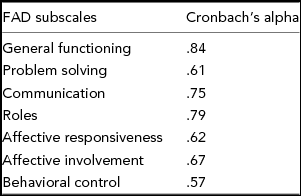
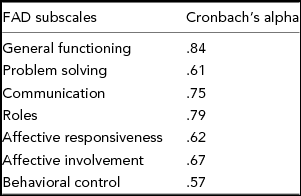
The FAD has demonstrated acceptable reliability and internal consistency, with Cronbach's alphas ranging from .72 to .92 across the seven subscales (Epstein et al., Reference Epstein, Baldwin and Bishop1983). Although designed for use with individuals aged 12 years and over, acceptable use with children aged between 7 and 12 is endorsed with modification (APA, 2014; Bihun, Wamboldt, Gavin, & Wamboldt, Reference Bihun, Wamboldt, Gavin and Wamboldt2002). The FAD has been used successfully with Australian children between the ages of 9 and 16 (Law et al., Reference Law, Cuskelly and Carroll2013). In keeping with Law et al. (Reference Law, Cuskelly and Carroll2013), items 11 and 13 were deleted to improve internal consistency. A number of minor alterations to the language of the items were also made to ensure accessibility to children aged 10 to 12 years. As shown in Table 1, Cronbach's alpha in the current study ranged from .57 to .84. Behavioural control did not demonstrate acceptable reliability and was therefore not included in analysis.
Reliability Analysis of the Family Assessment Device (FAD)
School connectedness
School connectedness was measured using the 18-item Psychological Sense of School Membership (PSSM; Goodenow, Reference Goodenow1993). The PSSM is a self-report measure in which each item is rated on a 5-point Likert scale, ranging from 1 (not true at all) to 5 (completely true), with higher scores indicating higher school connectedness. The items are designed to explore sense of acceptance and inclusion within school; for example, ‘I feel like a real part of this school’ and ‘I am treated with as much respect as other students’. The PSSM has strong internal consistency, with a Cronbach's alpha of .88 (Goodenow, Reference Goodenow1993). Although the PSSM was originally designed and tested for use with individuals aged between 12 and 18 years, strong internal consistency (α = .89) was reported in an Australian study with participants aged between 10 and 13 years (Ross et al., Reference Ross, Shochet and Bellair2010). Strong internal consistency was also demonstrated in the current study (α = .87).
Sense of mastery: Self-efficacy and optimism
Preadolescent sense of mastery was measured using the Sense of Mastery Scale (MAS) from the Resiliency Scales for Children and Adolescents (RSCA; Prince-Embury, Reference Prince-Embury2007). The MAS is a 20-item self-report questionnaire used to measure internal factors associated with resilience. Each item is rated on a 5-point Likert scale ranging from 0 (never) to 4 (almost always). The scale has strong internal consistency for children aged between 9 and 11 years (α = .85) and 12 and 14 years (α = .89). Strong internal consistency was also demonstrated in the current study (α = .91). The MAS comprises of three conceptually related subscales: optimism, self-efficacy, and adaptability. Optimism obtained strong internal consistency in the current study (α = .84), as did self-efficacy (α = .82). The adaptability subscale score was not used in the current study due to poor internal consistency for children aged 9 to 11 years (Prince-Embury, Reference Prince-Embury2007).
Procedure
This study received ethical clearance from the University of Melbourne Human Research Ethics Committee and approval from the Department of Education and Early Childhood Development. Parent consent forms and information regarding the study were sent home to all parents of students attending Grade 5 or 6. Students who returned signed parent consent forms were invited to participate. To facilitate data collection and supervision arrangements of school staff, participants were randomly divided into two equal groups. Each group completed the same three questionnaires in a large double classroom following the same procedure described below. Two sessions were allocated for each group. The first session involved introduction to the study, signing of student consent forms, and administration of the PSSM, the MAS, and a brief demographic questionnaire used to obtain age, gender, grade level, and parent structure. The second session involved the administration of the FAD. The majority of students completed session 1 within 15 to 20 minutes and session 2 within 10 to 15 minutes.
Results
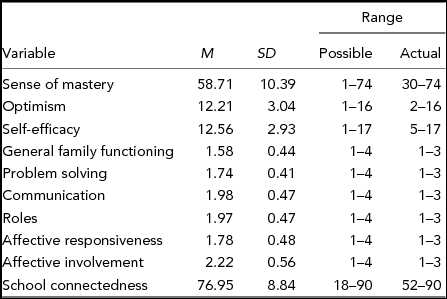
Prior to analysis, the data was examined for accuracy of data entry, missing values, and variable distribution using the Statistical Package for the Social Sciences (SPSS) version 22. A small proportion of missing data (0.51%) was found across all three questionnaires. A process of mean substitution was used to complete missing data (Hair, Black, Babin, & Anderson, Reference Hair, Black, Babin and Anderson2010). An outlier was detected in the distribution of school connectedness (z = -3.83) and was identified as having a considerable impact. The outlying case was assigned a new value that was one unit smaller than the next lowest score in the data set (Field, Reference Field2009; Tabachnick & Fidell, Reference Tabachnick and Fidell2013). Assumptions of normality, linearity, and homoscedasticity were all met. Table 2 presents the descriptive information for the total sample.
Mean, Standard Deviation, and Ranges of the Study Variables
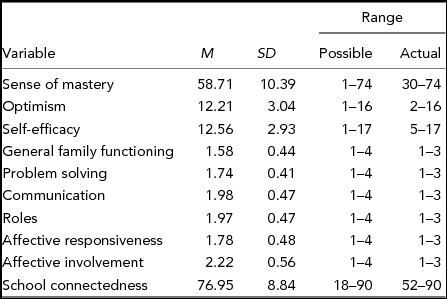
Note: M = Mean, SD = Standard deviation.
Family Functioning and Sense of Mastery
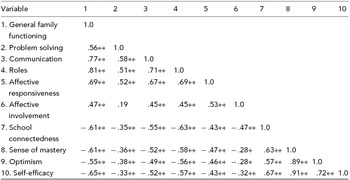
The relationship between family functioning and sense of mastery was investigated using Pearson product-moment correlation coefficient. As shown in Table 3, there was a strong, negative correlation between the two variables. Higher scores on the FAD were significantly associated with lower scores on the MAS. The lower participants perceived their family to function, the lower their sense of mastery. The relationship between family functioning and sense of mastery was explored further by examining the two factors of sense of mastery, optimism and self-efficacy. Strong, negative relationships were identified between family functioning and both optimism and self-efficacy. Poor family functioning was significantly associated with low optimism and low self-efficacy. This association was stronger for self-efficacy.
Correlations Between All Study Variables

Note: **p < .01 (two-tailed), *p < .05 (two-tailed).
School Connectedness and Sense of Mastery
The relationship between school connectedness and sense of mastery was also examined using a Pearson product-moment correlation coefficient. Table 3 shows a strong, positive relationship between the two variables. Increased school connectedness was significantly associated with increased sense of mastery. The more connected participants reported feeling toward their school, the greater their sense of mastery. Strong, positive relationships were also identified between school connectedness and optimism and self-efficacy. Similar to the relationship with family functioning, this association was stronger for self-efficacy.
Mediation Effect of School Connectedness
A mediation analysis was conducted using a bootstrap method to examine the impact of school connectedness on the relationship between family functioning and sense of mastery. This was performed using a macro for SPSS called PROCESS (Hayes, Reference Hayes2013). Table 3 shows significant correlations between the independent variable (family functioning) and the mediator (school connectedness), the mediator (school connectedness) and the dependent variable (sense of mastery), and the independent variable (family functioning) and dependent variable (sense of mastery), satisfying the initial conditions of a mediation analysis.
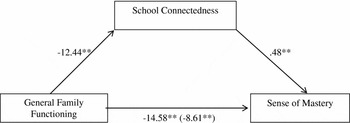
As Figure 1 illustrates, the unstandardised regression coefficient between family functioning and school connectedness was statistically significant (a = -12.44), as was the unstandardised regression coefficient between school connectedness and sense of mastery (b = .48). The indirect (i.e., mediating) effect (ab = -5.97) was significantly different from zero, as indicated by the 95% bias-corrected bootstrap CI [-10.01, -3.26] based on 10,000 bootstrap samples. This suggests that the connection a student feels with their school may reduce the impact of poor family functioning on sense of mastery. The effect size of the indirect effect was calculated in PROCESS using kappa-squared (κ2) index, a ratio of the indirect effect relative to its maximum possible value in the data (Preacher & Kelly, Reference Preacher and Kelly2011). The proportion of the maximum indirect effect observed was κ2 = .25 with a bootstrap 95% CI [.13, .38], suggesting a large effect size. As shown in Figure 1, even after controlling for the impact of school connectedness, family functioning still had a significant effect on sense of mastery (c’ = -8.61, p < .01), indicating school connectedness to be a partial mediator between family functioning and sense of mastery.
Unstandardised regression coefficients for the relationship between family functioning and sense of mastery as partially mediated by school connectedness. The unstandardised regression coefficient between family functioning and sense of mastery, controlling for school connectedness, is in parentheses.

Components of Family Functioning and Sense of Mastery
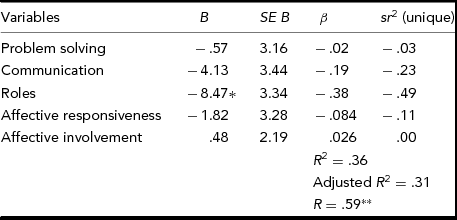
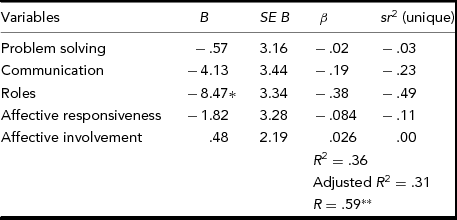
A standard multiple regression was conducted to explore which dimensions of family functioning measured by the FAD had the greatest impact on sense of mastery. No violation of multicollinearity was identified between variables. Problem solving, communication, roles, affective responsiveness, and affective involvement were entered into the regression model as independent variables, with sense of mastery as the dependent variable. As displayed in Table 4, R was significantly different from zero, F(5,69) = 7.70, p < .001, 95% CI [0.12 to 0.52]. An R 2 value of .36 was determined, suggesting that over a third of the variability in preadolescent sense of mastery is predicted by problem solving, communication, roles, affective responsiveness, and affective involvement within the family. As shown in Table 4, roles (B = -8.47, p < .05) made the largest and only significant unique contribution to the regression model, 95% CI [-15.15, -1.81]. The size and direction of the relationship suggests that preadolescent children who experience poor role management within the family have lower sense of mastery.
Standard Multiple Regression of FAD Dimensions on Mastery
Note: **p < .01, *p < .05.
Although bivariate correlations between each of the five variables and sense of mastery were significant (see Table 3), problem solving, communication, affective responsiveness, and affective involvement did not make significant unique contributions to the regression model. This is likely due to the overlap among the variables in the model, meaning that when all variables were forced into the same model, roles was the only significant contributor.
Discussion
Research into the understanding of resilience can assist with interventions to promote positive development. This study explored the impact of family functioning and school connectedness on sense of mastery in preadolescent children. The results supported the hypothesised relationships between family functioning, school connectedness, and sense of mastery. In support of hypothesis 1, negative perceptions of family functioning were significantly associated with decreased sense of mastery. Students who reported poor family functioning were more likely to report lower sense of mastery, optimism, and self-efficacy. Consistent with past findings (Mutimer et al., Reference Mutimer, Reece and Matthews2007; Renzaho et al., Reference Renzaho, Mellor, McCabe and Powell2013), these results indicate that positive sense of mastery is associated with effective family functioning. In support of Mutimer et al., the findings reveal that effective family functioning may act as a protective factor against negative developmental outcomes. A key factor of resilience (i.e., sense of mastery) was therefore identified as having an important role in the relationship between poor family functioning and maladaptive development. By examining two central components in sense of mastery, this study determined that the link with family functioning was stronger for self-efficacy than it was for optimism. Data from within a school setting therefore suggests that individuals high in self-efficacy may possess the self-belief and motivation needed to overcome challenges and effectively problem solve to avoid adverse outcomes
In support of hypothesis 2, higher levels of school connectedness were associated with greater sense of mastery, optimism, and self-efficacy. This link between school connectedness and resilience supports the findings of researchers who have considered similar relationships (Shochet et al., Reference Shochet, Dadds, Ham and Montague2006; Stewart et al., Reference Stewart, Sun, Patterson, Lemerle and Hardie2004; Vieno et al., Reference Vieno, Santinello, Pastore and Perkins2007). Consistent with Stewart et al. (Reference Stewart, Sun, Patterson, Lemerle and Hardie2004), the school environment was determined to influence resilience. Although Stewart et al. focused on different factors of resilience (i.e., self-esteem, empathy, goals and aspirations, and communication and cooperation), the established relationship between school connectedness and sense of mastery is consistent with their findings. The importance of school connectedness in sense of mastery may also provide further insight into past research. Previous studies have demonstrated an association between poor school connectedness and symptoms of depression and anxiety (Ross et al., Reference Ross, Shochet and Bellair2010; Shochet et al., Reference Shochet, Dadds, Ham and Montague2006). The link identified between school connectedness and sense of mastery in the current study may help to explain the impact of school connectedness on mental health as being influenced by an individual's sense of mastery.
The importance of sense of mastery, in particular self-efficacy, during preadolescence has not been established in all past research. Vieno et al. (Reference Vieno, Santinello, Pastore and Perkins2007) did not find self-efficacy to be significantly associated with psychological wellbeing in their 11-year-old age group. This relationship was, however, found to be significant in the 13- and 15-year-old groups. It was therefore suggested that self-perceptions become increasingly important as children move through adolescence. Early intervention to improve self-efficacy during preadolescence is therefore of even greater importance in preparation for adolescence. Despite the lack of relationship identified by Vieno et al. between self-efficacy and wellbeing, their results, together with the current findings, highlight the importance of targeting self-efficacy in preadolescence.
The hypothesised role of school connectedness as a mediator between family functioning and sense of mastery was supported through a partial mediation effect. Family functioning was found to account for some of the individual differences in school connectedness and to deploy a significant influence on sense of mastery through school connectedness. Whether a preadolescent experiences effective family functioning appears to influence their level of school connectedness, with those perceiving higher functioning also reporting greater school connectedness. Further, preadolescent experience of family functioning influences sense of mastery, partly through the influence on school connectedness. This partial mediation highlights the powerful role of family functioning in resilience for preadolescents, both as a direct influence and indirect influence as a potential precursor to school connectedness. Consistent with the findings of Law et al. (Reference Law, Cuskelly and Carroll2013) and Loukas et al. (Reference Loukas, Roalson and Herrera2010), the results underscore the power of school connectedness to hold a compensatory role and provide a degree of buffering against the impact of poor family functioning. School connectedness appears to have the power to compensate for the developmental opportunities lost in a poorly functioning family.
In addition to the main analyses of this study, exploratory analysis was conducted to investigate which dimensions of family functioning had the greatest influence on sense of mastery. Preadolescent perceptions or reported experience of role management in the family had the largest influence on sense of mastery. This suggests that perceptions of role allocation and role accountability within the family may be particularly influential in the development of self-efficacy. It may be that children from families with clearly defined roles and expectations have demonstrated competence and experienced accomplishment by performing their assigned duties, which in turn fosters the development of self-efficacy. Role management appears to be critical in the development and wellbeing of preadolescent children, a finding worthy of further investigation.
Implications for Policy and Practice
This study supports the recognition of school connectedness as a target for intervention, particularly for children from less functional families. As low sense of mastery has been linked with poor school connectedness, findings suggest interventions to increase mastery may benefit from focusing on improving school connectedness. Despite the powerful role of families in development, the significance of non-familial contexts for preadolescent children indicates the possibility of intervening in settings other than the family to improve resilience and mitigate the effects of poor family support. The significance of these findings is to highlight that poor family functioning can have a negative impact on the resilience of a child, and that, in addition to direct teaching programs to develop mastery in the students, schools in their work on building the school connectedness of their students and their families have the power to enhance resilience. It is important to recognise that negative attitudes held by school staff and other students toward individuals from poorly functioning families may be detrimental to their development, as their ability to form a healthy connection to school is impaired, which may consequently exclude them from the compensatory benefits of school connectedness. This study emphasises the importance of making an effort to engage students from poorly functioning families with the school community, but also highlights the need for a multifaceted approach in order to fully compensate for poor family functioning. Interventions implemented by schools to improve the connectedness of their students may take on many different forms and incorporate other factors in addition to self-efficacy and optimism. Whether it is through changes in policy-making or specifically targeted interventions, the potential impact is valuable to the whole school community.
In further consideration of the implications emerging from this study, the finding that self-efficacy appears to be the central factor contributing to sense of mastery needs to be highlighted. This provides schools with a particular area of focus when tailoring interventions to meet the academic, emotional, and social needs of their students. By developing school programs to foster confidence in coping ability across a range of settings, schools may have the power to improve sense of mastery in their students and subsequently enhance resilience. This may be particularly important for students from poorly functioning families or those facing adversity. Interventions should therefore ensure that they are delivered with an active effort to encourage the participation of those students.
In addition to providing schools with the evidence needed to inform interventions, results from the exploratory analysis provides practitioners and families with information on what factors within the family system are likely to have a larger impact on resilience. The finding that perceptions of roles had the largest impact on sense of mastery indicates that if families are able to maintain and manage the flow of tasks, and make it clear which member is responsible for completing each task, children will perceive their family to function more effectively and consequently experience greater resilience. The management of roles within the family has emerged as a specific intervention target for practitioners working with families and has provided schools with the information needed to facilitate awareness of the impact of family functioning.
Limitations and Future Research
One of the main limitations of this study is the cross-sectional nature of the research design. This not only limited our ability to examine potential changes in participant responses over time, but also indicates that the findings are correlational. It would be highly beneficial for future researchers to replicate these findings using a longitudinal design or an experimental approach in which an intervention is employed. The results of this study highlight the importance of school connectedness in the resilience of preadolescent children, particularly those from poorly functioning families; however, more research is needed to discern the complex relationship between family functioning, school connectedness, and sense of mastery. While the reliance on self-reporting was beneficial to place emphasis on the perceptions of children, future research may also consider the perceptions of family members, teachers, and peers.
A further limitation is the nature of the sample, which may not have been an accurate cross-section of the target population. The size of the sample was small and all participants were from the one school. It would be valuable to examine family functioning, school connectedness, and sense of mastery in a larger, more inclusive sample of preadolescents. As one of the key variables was school connectedness, it may be beneficial to include government, Catholic, and independent schools. These variables should also be observed in participants from different socioeconomic areas as this may give further insight into the impact of family functioning. In a further review of the sample, only 85 students returned consent forms out of the 356 who were invited to participate. The low return rate brings into question the characteristics that differed between those who did and did not participate in the study. These unknown factors may limit the generalisability of the results. It is reasonable to speculate that consent forms were more likely returned from families who have established a more trusting and engaged relationship with the school. It may have therefore been the case that families who consented were those with greater school connectedness. Given the importance of school connectedness and the potential measurement difficulties, it may be useful for schools to conduct regular assessment of school connectedness to inform and specifically target their interventions.
Conclusion
This study has provided insight into factors associated with the resilience of preadolescent children. Perceptions of poor family functioning appear to impair the successful development of self-efficacy and optimism, both of which are factors contributing to sense of mastery and overall resilience. The school environment has been identified as a powerful context in the lives of children, with the capacity to somewhat buffer the impact of poor family functioning on the development of sense of mastery. Evidence has subsequently been provided for the development of preventative interventions to enhance school connectedness during preadolescence in order to improve mastery and subsequent resilience. Strong support has been established for the relationships between family functioning, school connectedness, and sense of mastery. Future research should continue to explore these factors and their role in the development of children. Continuing to advance our understanding of this complex ecological process is vital in order to facilitate optimal development.