Introduction
Watermelon [Citrullus lanatus (Thunb.) Matsum & Nakai] is a high-value, fresh-market crop grown on 3.5 million hectares annually across the world (FAO 2017). As with many vegetable and specialty crops, watermelon growers have adopted production practices that optimize yields and fruit quality. Vegetable growers regularly use transplants, polyethylene mulch, and drip irrigation to produce earlier harvests with higher yields (Lament Reference Lament1993; Olson et al. Reference Olson, Hochmuth and Hochmuth1994). Vegetable grafting is another production practice that has become increasingly common throughout the world, particularly with crops of the Cucurbitaceae and Solanaceae (Louws et al. Reference Louws, Rivard and Kubota2010). In modern production, watermelon was first grafted to squash (Cucurbita moschata Duchesne) rootstocks in Japan to provide resistance to Fusarium wilt (Fusarium oxysporum f. sp. niveum) in infested fields (Tateishi Reference Tateishi1927). With the recent phasing out of methyl bromide as a soil fumigant (Zagheni Reference Zagheni2003), an increased interest in vegetable grafting exists, particularly in countries with limited arable land where crop rotation is done infrequently (Kubota et al. Reference Kubota, McClure, Kokalis-Burelle, Bausher and Rosskopf2008; Miguel et al. Reference Miguel, Maroto, Bautista, Baixauli, Cebolla, Pascual, Lopez and Guardiola2004). While grafting was initially adopted for management of diseases caused by soilborne pathogens (Lee and Oda Reference Lee and Oda2003), evidence exists that grafted plants confer additional benefits such as tolerance to drought, salinity, and suboptimal temperatures (Ahn et al. Reference Ahn, Im, Chung, Cho and Suh1999; Colla et al. Reference Colla, Roupahel, Cardarelli and Rea2006; Rouphael et al. Reference Rouphael, Cardarelli, Colla and Rea2008; Zhou et al. Reference Zhou, Huang, Zhang, Shi, Yu and Nogues2007).
Little research is available to compare the weed-competitive ability of grafted plants and nongrafted plants. In response to a natural population of weeds, grafted tomato (Solanum lycopersicum L.) yield and biomass were similar to nongrafted tomato (Ghosheh et al. Reference Ghosheh, Al-Kawamleh and Makhadmeh2010). The critical period for weed control (CPWC) for a mixed population large crabgrass [Digitaria sanguinalis (L.) Scop.], common purslane (Portulaca oleracea L.), and yellow nutsedge (Cyperus esculentus L.) in grafted and nongrafted tomato lasts the same duration (2.3 to 2.5 wk), though the CPWC occurs 1 wk earlier in the season for grafted tomatoes (Chaudhari et al. Reference Chaudhari, Jennings, Monks, Jordan, Gunter, McGowen and Louws2016). In watermelon, the effect of grafting on the CPWC for the same population of weeds is dependent on the rootstock selection, but nongrafted watermelon produces higher yields and has a shorter CPWC than grafted watermelon (Bertucci Reference Bertucci2018).
If left uncontrolled, weeds can cause substantial reductions in watermelon yield and fruit quality. In bareground production, season-long interference from D. sanguinalis reduced yields up to 82% (Monks and Schultheis Reference Monks and Schultheis1998). Polyethylene mulch reduces weed interference in watermelon, but it is possible for weeds to emerge from the planting holes or through tears in the plastic. In plasticulture, weed interference due to American black nightshade (Solanum americanum Mill.) and a mixed population of D. sanguinalis, P. oleracea, and C. esculentus caused yield losses of 60% and 46%, respectively (Adkins et al. Reference Adkins, Stall, Santos, Olson and Ferrell2010; Bertucci Reference Bertucci2018). Cyperus esculentus, a weed that is capable of penetrating polyethylene mulch, caused yield loss of 40% at a density of 12 C. esculentus tubers m−2 (Buker et al. Reference Buker, Stall, Olson and Schilling2003).
Palmer amaranth (Amaranthus palmeri S. Watson) was recently reported as the most common and troublesome weed in North Carolina watermelon fields (Webster Reference Webster2010). Amaranthus palmeri is a dioecious summer annual broadleaf weed native to the southwestern United States and northwestern Mexico (Sauer Reference Sauer1957). It has spread across the southern United States and is among the most troublesome weeds in corn (Zea mays L.), cotton (Gossypium hirsutum L.), and soybean [Glycine max (L.) Merr.] (Webster and Nichols Reference Webster and Nichols2012). Amaranthus palmeri is a C4 plant with high photosynthetic potential (Ehleringer Reference Ehleringer1983), and it germinates earlier, grows taller, and accumulates more biomass than other weed species of the genus Amaranthus (Sellers et al. Reference Sellers, Smeda, Johnson, Kendig and Ellersieck2003). In field settings with no supplemental irrigation, A. palmeri grows at a rate of 1.8 to 2.1 mm per growing degree day (GDD) and can reach a height of 231 cm (Horak and Loughin Reference Horak and Loughin2000). Under drip irrigation, A. palmeri grows more rapidly (up to 4.2 mm GDD−1) and can reach a height of 395 cm (Norsworthy et al. Reference Norsworthy, Oliveira, Jha, Malik, Buckelew, Jennings and Monks2008). Amaranthus palmeri has remarkable fecundity and is capable of producing 200,000 to 600,000 seeds per female plant (Keeley et al. Reference Keeley, Carter and Thullen1987; Sellers et al. Reference Sellers, Smeda, Johnson, Kendig and Ellersieck2003; Sosnoskie et al. Reference Sosnoskie, Webster, Grey and Culpepper2014). High seed production and the prevalence of herbicide-resistant biotypes have led to increased hand weeding and a proposed zero-tolerance threshold for A. palmeri in cotton fields (Heap Reference Heap2014; Norsworthy et al. Reference Norsworthy, Griffith, Griffin, Bagavathiannan and Gbur2014; Sosnoskie and Culpepper Reference Sosnoskie and Culpepper2014).
Several studies have characterized the competitive relationship between A. palmeri and row crops, such as corn, cotton, peanut (Arachis hypogea L.), and soybean (Bensch et al. Reference Bensch, Horak and Peterson2003; Burke et al. Reference Burke, Schroeder, Thomas and Wilcut2007; Massinga et al. Reference Massinga, Currie, Horak and Boyer2001; Morgan et al. Reference Morgan, Baumann and Chandler2001). In sweetpotato [Ipomoea batatas (L.) Lam.], A. palmeri at densities of 0.5 to 6.5 plants m−1 causes marketable yield reductions from 36% to 81% (Meyers et al. Reference Meyers, Jennings, Schultheis and Monks2010). Vegetable production often includes polyethylene mulch and drip irrigation, which favor crop growth, but A. palmeri could grow more competitively than in-field crops as a result. In plasticulture-grown bell pepper (Capsicum annuum L.), interference due to A. palmeri reduced fruit number and crop biomass by 94% and >60%, respectively (Norsworthy et al. Reference Norsworthy, Oliveira, Jha, Malik, Buckelew, Jennings and Monks2008). Tomato marketable yield was reduced by 53% when exposed to season-long interference by A. palmeri (Garvey et al. Reference Garvey, Meyers, Monks and Coble2013). Season-long interference by a mixed population of Amaranthus weeds caused up to 85% yield reduction and reduced sugar content in muskmelon (Cucumis melo L.), a cucurbit crop similar to watermelon (Nerson Reference Nerson1989).
In a high-value crop like watermelon, a zero-threshold model is frequently adopted for weed control. But it is important to characterize the competitive relationship of watermelon and A. palmeri in this production system. Given the reported benefits of watermelon grafting, there is reason to investigate whether grafting could play a role in mitigating yield loss due to weed interference. The objective of this study was to determine the competitive ability of grafted and nongrafted watermelon when exposed to season-long interference by A. palmeri at increasing weed densities. Further, this study was designed to describe the intraspecific competition and seed production potential of A. palmeri at varying population densities in a watermelon field.
Materials and Methods
Field studies were conducted at the Horticultural Crops Research Station (35.028°N, 78.288°W) near Clinton, NC, in 2015 and 2017. Soil was an Orangeburg loamy sand (fine-loamy, kaolinitic, thermic Typic Kandiudults) with pH 6.1 and 6.3 and 0.8 and 0.4% organic matter in 2015 and 2017, respectively.
‘Exclamation’ (Syngenta Seeds, Greensboro, NC) seedless (triploid) watermelon was used as the scion for all grafted plants. Grafting treatments included two interspecific hybrid squash (ISH) rootstocks ‘Carnivor’ and ‘Kazako’ (Syngenta Seeds), and nongrafted Exclamation as the control. Carnivor and Kazako ISH rootstocks are derived from a cross between Cucurbita maxima Duchesne × Cucurbita moschata Duchesne and are resistant to Fusarium wilt of watermelon (Kleinhenz Reference Kleinhenz2015). Carnivor is reported to grow more rapidly and produce higher yields than Kazako (D Liere, personal communication).
Watermelon and ISH seeds were sown in premoistened Tobacco Soil Mix (Carolina Soil Company, Kinston, NC) in 72-cell trays (T.O. Plastics, Clearwater, MN), using a germination protocol similar to Hassell and Schultheis (Reference Hassell and Schultheis2004). Before grafting, rootstock apical meristems were treated with a 6.25% dilution of a sucker control agent (Fair 85 ® fatty alcohol, Fair Products, Cary, NC) to prevent rootstock regrowth in the field (Daley and Hassell Reference Daley and Hassell2014). Grafting was conducted using the one-cotyledon method (Hassell et al. Reference Hassell, Memmott and Liere2008). Because ISH rootstocks emerge more rapidly and seedlings must be of the same size for grafting, Exclamation seeds for scions were sown first, and Carnivor and Kazako were sown 4 d after. Following grafting, plants were kept for 7 d in a healing chamber maintained with a low-light and high-humidity (>95% relative humidity, 23 to 27 C) environment to slow photosynthesis and allow the graft union to heal. Shading was achieved by placing four layers of 50% black knitted shade cloth (DeWitt, Sikeston, MO) over the healing chamber and removing one cloth every 24 h after plants were placed in the chamber. To account for delayed growth while grafted plants were in the healing chamber, Exclamation seeds for the nongrafted plants were sown 6 d after sowing Exclamation scions for grafting. Germination, seedling propagation, and healing were conducted in a greenhouse adjusted to maintain temperatures between 24 and 29 C. Plants were allowed to acclimate in an open-air greenhouse for a minimum of 7 d before transplanting. All seedlings had 3 to 5 true leaves at the time of transplanting.
To prepare fields, beds (15-cm high by 76-cm wide) were formed on 3-m centers, drip tape was laid (8-cm depth), and beds were covered with black polyethylene mulch. As beds were formed, Pic-Clor 60 fumigant (TriEst Ag Group, Greenville, NC) was applied, delivering chloropicrin and 1,3-dichloropropene at 174 kg ai ha−1 and 114 kg ai ha−1, respectively. Watermelon transplanting occurred on May 19, 2015, and May 30, 2017. At 24 h before transplanting, holes were punched in polyethylene mulch using a water wheel. Each experimental unit was a 7.6-m plot with 10 watermelon seedlings transplanted at 0.76-m in-row spacing and 3-m between-row spacing, with a 3-m alley separating plots within a bed. Due to poor graft compatibility between Exclamation and Kazako rootstock, 8 seedlings were transplanted per plot in 2015. SP-6 pollenizer seedlings (Syngenta Seeds) were transplanted within the plots, between every third triploid seedling, to ensure proper fruit set for the triploid watermelons (Dittmar et al. Reference Dittmar, Monks and Schultheis2010). Fertilizer was applied through drip irrigation in accordance with conventional watermelon production in North Carolina (Kemble Reference Kemble2017). Foliar applications of insecticides and fungicides were made as necessary based on disease forecasting and field scouting (Kemble Reference Kemble2017). Row middles were maintained weed free by shallow cultivation between rows, hoeing, and hand weeding throughout the season.
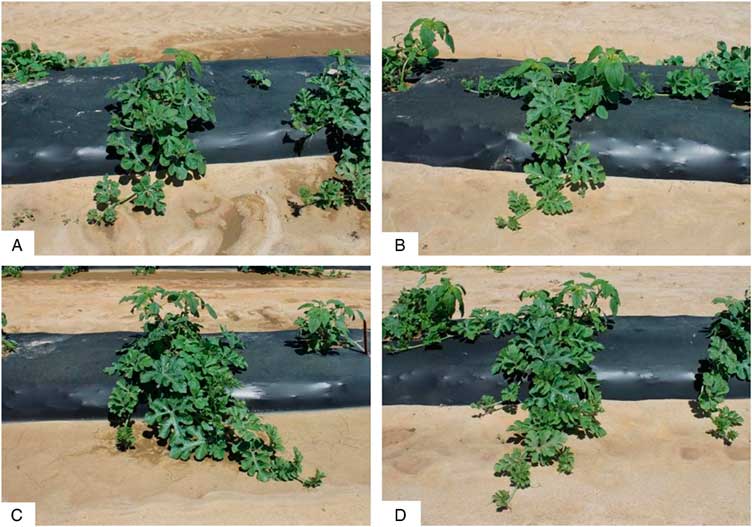
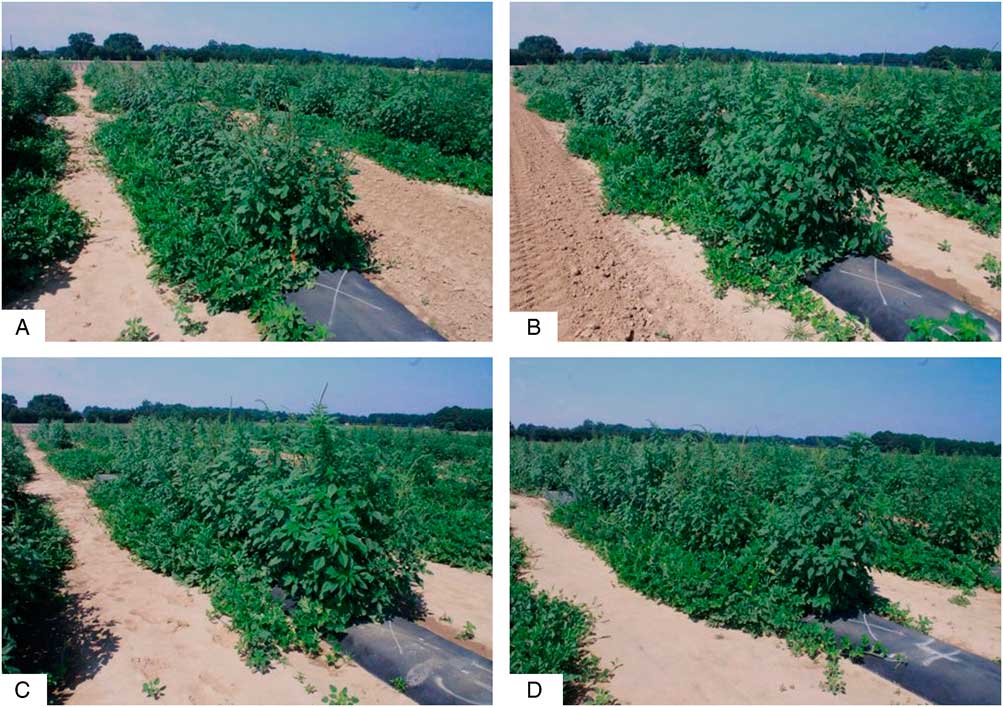
Weed treatments included A. palmeri at densities of 1, 2, 3, and 4 A. palmeri per watermelon planting hole (i.e., 0.76-m row) and a weed-free control (Figures 1 and 2). These densities simulate what growers would encounter in weedy areas of a field with a large A. palmeri seedbank. Immediately following watermelon transplanting, approximately 50 A. palmeri seed were sown into each planting hole where triploid plants were located. Amaranthus palmeri seedlings were thinned to the intended density at 2 wk after transplant (WATr), then scouted weekly, and later-emerging A. palmeri and other weed species were removed to maintain weed density. In commercial watermelon production, planting holes in polyethylene mulch range from 5 by 5 to 10 by 10 cm, depending on equipment (Sanders et al. Reference Sanders, Granberry and Cook2016); however, to ensure A. palmeri seedlings would establish at intended densities alongside watermelon plants, a 15 by 15 cm square was cut from the polyethylene mulch and centered on each triploid watermelon. Amaranthus palmeri seed was not sown alongside SP-6 pollenizers.
Amaranthus palmeri growing alongside watermelon plants at 3 wk after transplant in Clinton, NC. Weed densities were 1, 2, 3, and 4 A. palmeri planting hole−1 for A, B, C, and D, respectively.

Amaranthus palmeri growing alongside watermelon plants at 6 wk after transplant in Clinton, NC. Weed densities were 1, 2, 3, and 4 A. palmeri planting hole−1 for A, B, C, and D, respectively.

Watermelons were harvested two times each season, 1 wk apart. The first harvest occurred on July 28, 2015, and on August 7, 2017. At harvest, each fruit was weighed individually and recorded. Any fruit weighing ≥4 kg was classified as marketable (Schultheis and Thompson Reference Schultheis and Thompson2014). Yield and fruit number for Kazako, which had lower graft success in 2015, were adjusted based on number of triploid watermelon plants per plot. Before analysis, total yield, marketable yield, total fruit number, and marketable fruit number were summed across harvests for each year. At each harvest, 5 ripe fruits plot−1 were cut longitudinally from stem end to blossom end and scored for hollow heart disorder on a 0 to 4 scale: 0 representing no hollow heart and 4 representing severe hollow heart (>3-cm width, >10.2-cm depth) (Dittmar et al. Reference Dittmar, Monks and Schultheis2010). To determine watermelon soluble solids content (SSC), juice from the heart flesh of 3 ripe fruits plot−1 was measured in degrees Brix using a handheld refractometer (Atago 3810 Pal-1 digital refractometer, Atago, Bellevue, WA).
Immediately following the final watermelon harvest (11 WATr), watermelon stem diameter as well as A. palmeri stem diameter, aboveground biomass, and seed production estimates were collected from a single watermelon planting hole (i.e., 0.76-m row) in each plot. Two perpendicular measurements of stem diameter were recorded at the soil line and then averaged for each watermelon plant and A. palmeri sampled. Weed seed was harvested by stripping terminal and axillary pistillate flowers by hand in the field, collecting floral material in bags, and drying it in an oven (70 C for 7 to 9 d). Amaranthus palmeri biomass was collected by cutting weeds at the soil line and drying it in an oven (70 C for 7 to 9 d). Amaranthus palmeri biomass was calculated using the sum of dried floral material and vegetative material harvested from each plot.
Dried floral material was threshed by hand using a grout float and a textured rubber runner mat. Threshed floral material was sieved to remove large particles (twigs and stems) using a series of sieves with 2.8-, 2.36-, and 2.0-mm openings. Material was then fed into a custom seed-cleaning machine (Seed Cleaning Machine Design, Real Seed Collection, Fishguard, Pembrokeshire, UK) that uses vacuum suction to draw away light floral material (bracts and utricle sheaths), and suction was adjusted to ensure no seed was drawn from the sample during seed cleaning. Finally, seed was separated from remaining vegetative material using a vertical air-column seed cleaner. Clean seed was weighed, then a 0.5-g subsample was collected and hand counted. Hand counts were used to extrapolate total seed number using the formula presented by Sosnoskie et al. (Reference Sosnoskie, Webster, Grey and Culpepper2014):
 $${S_{{\rm{Total}}}} = {{({M_{{\rm{Total}}}})({S_{{\rm{Sample}}}})} \over {{M_{{\rm{Sample}}}}}}$$
where S Total and M Total are seed number and mass of clean seed from harvested A. palmeri, respectively, and S Sample and M Sample are seed number and mass of clean seed from 0.5-g subsamples, respectively. Seed production was reported as total seed biomass, average seed size, total seed number, and seed number per female. Seed number per female was calculated by dividing the number of total seed (S Total) by the number of female A. palmeri sampled in each respective planting hole.
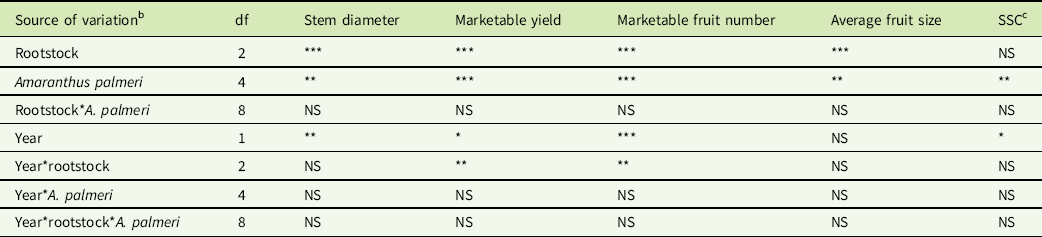
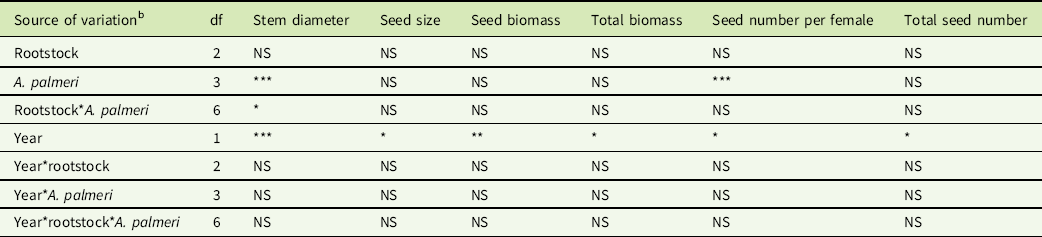
ANOVA was conducted using PROC MIXED in SAS (v. 9.4, SAS Institute, Cary, NC) with year, transplant type, A. palmeri density, and all interactions treated as fixed effects, and replicate nested within year treated as a random effect (Table 1). For weed biomass and seed production estimates, a separate ANOVA was conducted excluding the weed-free treatments, which adjusted the degrees of freedom for A. palmeri density and corresponding interactions (Table 2). All dependent variables were checked for signs of heteroscedasticity by plotting residuals using output from PROC MIXED. Based on residual plots, transformations were required for some dependent variables to meet the assumptions of ANOVA. Thus, watermelon and A. palmeri stem diameter were log transformed, and A. palmeri seed size, seed biomass, seed number, and seed number per female A. palmeri were square-root transformed. Interactions of weed density, year, and transplant type were checked, and least-squares means for transplant types at each weed density were averaged over years when interactions were not significant at the 0.05 significance level. However, with some marketable yield and marketable fruit number, significant interactions (P ≤ 0.05) between year and transplant type were observed (Table 1). In these cases, graphs of interaction means were assessed; if interactions with year were deemed to be biologically unimportant and uninformative relative to the main effects of transplant type and weed treatment, then means for transplant type and weed treatment combinations were obtained by averaging over years. Means separation was reported on a subset of treatments, including the highest weed density (4 A. palmeri planting hole−1) and weed-free treatments, to compare the main effect of transplant types on marketable yield, marketable fruit number, total yield, total fruit number, and average marketable fruit size according to Fisher’s protected LSD at the 0.05 significance level. The linear relationship between least-squares means of several yield components were determined graphically and by calculating the Pearson’s correlation coefficient using PROC CORR in SAS v. 9.4.
PROC MIXED output for P-values of main effects and interactions associated with watermelon stem diameter, yield, fruit number, and fruit quality, Clinton, NC.Footnote a

a Significance of P-values: *, significant at α = 0.05; **, significant at α = 0.01; ***, significant at α = 0.001.
b Rootstock includes nongrafted Exclamation and Exclamation grafted to Carnivor and Kazako rootstocks. A. palmeri includes treatments of 0, 1, 2, 3, or 4 A. palmeri plants per watermelon planting hole.
c SSC, soluble solids content of watermelon, measured in degrees Brix.
PROC MIXED output for P-values of main effects and interactions associated with Amaranthus palmeri stem diameter, biomass, and seed production, Clinton, NC.Footnote a

a Significance of P-values: *, significant at α = 0.05; **, significant at α = 0.01; ***, significant at α = 0.001.
b Rootstock includes nongrafted Exclamation and Exclamation grafted to Carnivor and Kazako rootstocks. A. palmeri includes treatments of 0, 1, 2, 3, or 4 A. palmeri plants per watermelon planting hole.
To determine linearity of dependent variables on A. palmeri density, the density main effect was partitioned into two components, the first measuring variation due to a linear relationship to A. palmeri density and the second measuring the remainder of the density effect, referred to as lack of fit to linear. All interactions between A. palmeri density and the other factors, transplant type and year, were partitioned in a similar way. If the lack-of-fit term and its interactions were not significant (P >0.05) and the linear relationship was significant, then a linear model was appropriate. If no significant interaction was observed between transplant type and the A. palmeri density linear term, then transplant types were fit to one linear regression with a common slope and separate intercepts (Ritz et al. Reference Ritz, Kniss and Streibig2015).
Amaranthus palmeri biomass accumulation, average watermelon fruit size, and watermelon stem diameter were determined to be best described by a linear model:
 $$Y = (a \times D) + b$$
where Y is weed biomass or average watermelon fruit size, D is weed density, and a and b are the slope and intercept, respectively.
Nonlinear regression of least-squares means for transplant type and A. palmeri density combinations was conducted in SAS using PROC NLIN to estimate coefficients for models to describe watermelon marketable yield and marketable fruit number as a function of A. palmeri density. The effects of A. palmeri density on watermelon marketable yield, marketable fruit number, and A. palmeri stem diameter were determined to be best described by the rectangular hyperbola model (Cousens Reference Cousens1985):
 $${Y_{\rm{L}}} = \left( {I \times D} \right){\mkern 1mu} /{\mkern 1mu} [1 + (I \times D{\mkern 1mu} /{\mkern 1mu} A)]$$
where Y L is the predicted watermelon yield loss, fruit number reduction, or stem diameter response to weed interference; I is the response per unit weed density as density approaches zero; D is weed density; and A is the response as A. palmeri density approaches infinity.
To account for the dioecious nature of the weed, A. palmeri seed production was adjusted based on the number of females sampled from each planting hole (0.76-m row). The seed number per female A. palmeri was fit to the following two-parameter exponential equation:
 $$Y = a \times \exp ( - b \times D)$$
where Y is the amaranth seed number adjusted per female, a is the y-intercept, b is the asymptote of the curve, and D is the density of A. palmeri.
Results and Discussion
Watermelon Fruit Size and Fruit Quality
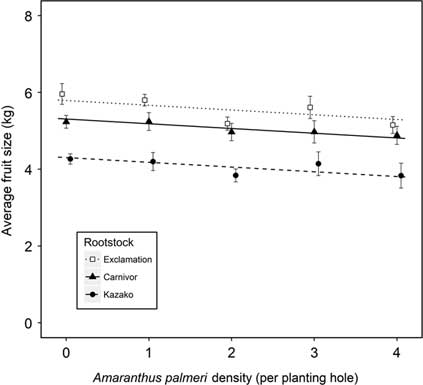
Average watermelon fruit size was reduced in a linear fashion in response to increasing densities of A. palmeri (Figure 3). The interaction of transplant type with A. palmeri density was not significant (P = 0.947), and the average fruit size decreased similarly for all rootstocks, which shared a common slope of −0.12. Thus, for each additional A. palmeri per planting hole, the average watermelon fruit size decreased by 0.12 kg. Transplant type had a significant effect (P <0.001) on average fruit size, and the intercept was 5.8, 5.3, and 4.3 kg for Exclamation, Carnivor, and Kazako, respectively. Nongrafted Exclamation produced larger fruit than either ISH rootstock, which is consistent with previous research using the same rootstocks (Bertucci Reference Bertucci2018). In Florida, watermelon grafted to an ISH rootstock produced smaller fruit than nongrafted watermelon (Kokalis-Burelle et al. Reference Kokalis-Burelle, Butler, Hong, Bausher, McCollum and Rosskopf2016). However, other research reported increased average fruit size as a result of grafting (Colla et al. Reference Colla, Roupahel, Cardarelli and Rea2006; Miguel et al. Reference Miguel, Maroto, Bautista, Baixauli, Cebolla, Pascual, Lopez and Guardiola2004; Turhan et al. Reference Turhan, Ozmen, Kuscu, Serbeci and Seniz2012). Research in Turkey reported no size difference for fruit produced by a nongrafted control compared with plants grafted to ISH rootstocks (Yetisir and Uygur Reference Yetisir and Uygur2010). While fruit size may vary based on rootstock and scion combinations, results from the present study demonstrate a consistent decrease in fruit size as A. palmeri density increases.
Influence of Amaranthus palmeri density on average watermelon fruit size of nongrafted Exclamation and Exclamation grafted on Carnivor and Kazako rootstocks combined over 2015 and 2017, in Clinton, NC. The linear equation, Y = (a × D)+b, described the effect of A. palmeri density (D) on average fruit size (Y) for all rootstocks, which shared a common slope (a) of −0.12 (±0.03) with intercepts (b) of 5.8, 5.3, and 4.3 (±0.1) kg for Exclamation, Carnivor, and Kazako, respectively; R2 = 0.95.

Watermelon fruit quality was determined using the frequency of hollow heart disorder and the average SSC. Hollow heart disorder was observed in 4% and 1% of sampled fruit in 2015 and 2017, respectively. The low frequency of hollow heart made ANOVA inappropriate; however, it can be concluded that neither grafting nor interference by A. palmeri elicited hollow heart disorder when using this combination of ISH rootstocks and watermelon scion. No significant effect (P = 0.840) of grafting on SSC was observed, but the effect of A. palmeri density was significant (P = 0.004) (Table 1). The least-squares mean SSC of the weed-free and highest density of A. palmeri were 12.6°Brix and 12.2°Brix, respectively (unpublished data). According to Fisher’s protected LSD, this represented a significant difference, but the effect was sufficiently small as to be biologically irrelevant, because previous research has demonstrated that consumer panels are incapable of distinguishing a change in SSC below 1°Brix (Harker et al. Reference Harker, Marsh, Young, Murray, Gunson and Walker2002). An experiment using the same rootstocks also reported statistically significant but biologically irrelevant effects of weed interference and transplant type on watermelon SSC (Bertucci Reference Bertucci2018). Depending on rootstock selection, substantial decreases in SSC of fruit have been reported as a result of grafting, which was not observed in this experiment (Turhan et al. Reference Turhan, Ozmen, Kuscu, Serbeci and Seniz2012; Yetisir et al. Reference Yetisir, Sari and Yucel2003).
Watermelon Yield and Fruit Number
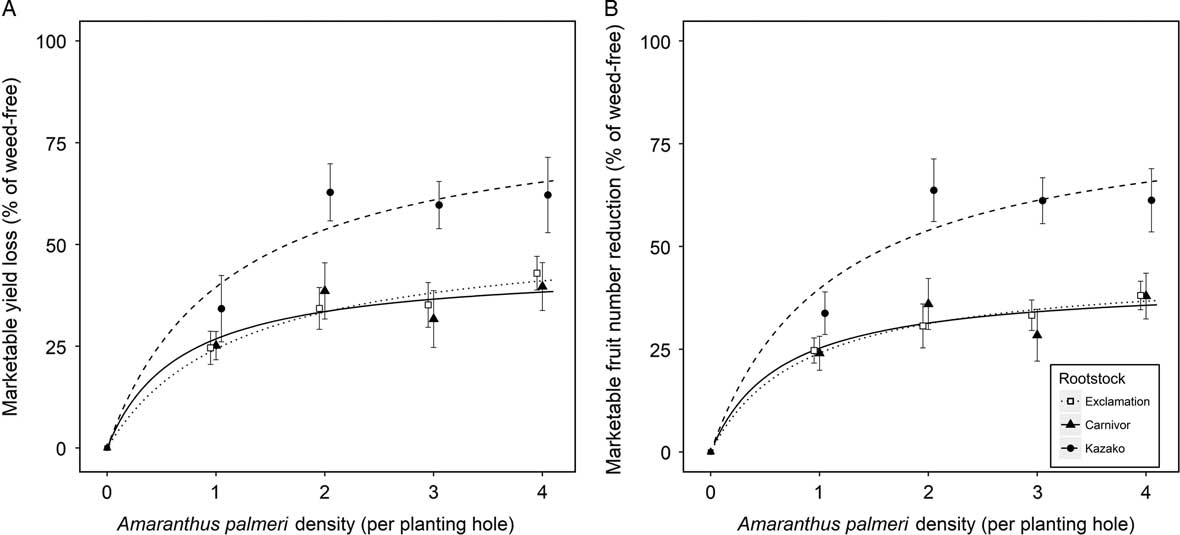
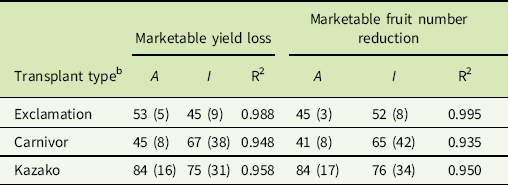
Amaranthus palmeri density and grafting treatments significantly influenced watermelon marketable yield and marketable fruit number (Table 1). Marketable yield loss and fruit number reduction were determined to be best described by the rectangular hyperbola model (Cousens Reference Cousens1985) and expressed as a percent of weed-free treatment of each watermelon transplant type (Figure 4). Curves describing marketable fruit number reduction and marketable yield loss were very similar, and nonlinear regression on A. palmeri density generated similar parameter estimates for each respective rootstock (Table 3). Parameter I represents incremental yield loss and fruit reduction at low A. palmeri densities. For marketable yield, parameter I was calculated as 45%, 67%, and 75% for Exclamation, Carnivor, and Kazako, respectively. Estimates of parameter I were very similar for marketable fruit number reduction: 52%, 65%, and 76% for Exclamation, Carnivor, and Kazako, respectively. Generally, the standard error was below half of the parameter estimate (Table 4), but a high standard error associated with parameter I estimates suggests some uncertainty extrapolating below the observed A. palmeri densities in this experiment. High standard errors with estimates of parameter I have been attributed to inherent variation in field experimentation and to plasticity of crop growth (Cousens Reference Cousens1985; Dieleman et al. Reference Dieleman, Hamill, Weise and Swanton1995). Nongrafted Exclamation responded most consistently to treatment effects in each year, which is reflected in the low standard error associated with its parameter I estimates. High R2 values and the proximity of each predicted curve to observed means provide evidence that the model accurately describes the relationship within the range of A. palmeri densities included in the experiment, despite some error associated with estimates of parameter I (Figure 4). Previous experiments with A. palmeri interference report estimates of parameter I as 39%, 62%, 104%, and 86% for peanut, corn, soybean, and sweetpotato, respectively (Bensch et al. Reference Bensch, Horak and Peterson2003; Burke et al. Reference Burke, Schroeder, Thomas and Wilcut2007; Massinga et al. Reference Massinga, Currie, Horak and Boyer2001; Meyers et al. Reference Meyers, Jennings, Schultheis and Monks2010). Thus, low densities of A. palmeri in watermelon will cause yield reductions similar to those reported in corn and peanut and less yield loss than reported in soybean and sweetpotato.
Influence of Amaranthus palmeri density on (A) marketable yield loss and (B) marketable fruit number reduction of nongrafted Exclamation and Exclamation grafted on Carnivor and Kazako rootstocks combined over 2015 and 2017, in Clinton, NC. The relationship was described by the rectangular hyperbola equation Y = (I × D)/[1+(I × D/A)]. Coefficients of determination (R2) were 0.99, 0.95, and 0.96 for marketable yield loss (A) and 0.99, 0.93, and 0.95 for marketable fruit number reduction (B) for Exclamation, Carnivor, and Kazako, respectively.

Parameter estimates for rectangular hyperbola model for each watermelon transplant type for marketable yield loss and marketable fruit number reduction, Clinton, NC.Footnote a

a Rectangular hyperbola: Y = (I × D)/[1+(I × D/A)], where Y is marketable yield loss of marketable fruit number reduction, I is the percent yield loss or reduction in fruit number per unit weed density as density approaches zero, D is Amaranthus palmeri density, and A is the percent yield loss or reduction in fruit number as density approaches infinity. Parameter estimates are followed by SE in parentheses.
b Exclamation is the nongrafted control. Carnivor and Kazako are interspecific hybrid squash rootstocks with Exclamation used as the scion.
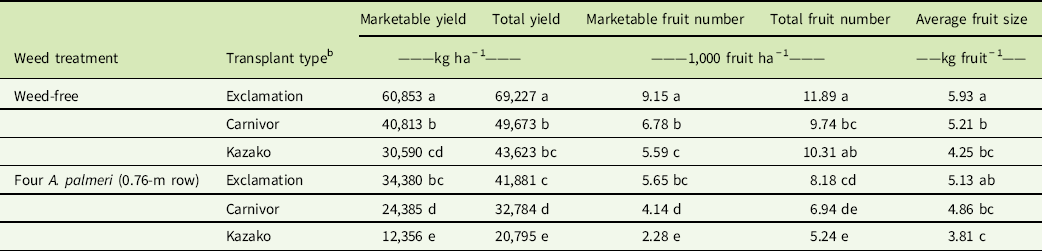
Effect of watermelon transplant type and Amaranthus palmeri density on marketable and total yield, marketable and total fruit number, and average fruit size, Clinton, NC.Footnote a

a Means separation achieved using weed-free and the highest weed density, applying Fisher’s protected LSD at a 0.05 significance level. Means that do not share a common letter are significantly different.
b Transplant type includes nongrafted Exclamation as well as Exclamation grafted onto Carnivor and Kazako interspecific hybrid squash rootstocks.
Parameter A represents the maximum yield loss or fruit number reduction due to weed interference. For marketable yield, parameter A was calculated as 53%, 45%, and 84% for Exclamation, Carnivor, and Kazako, respectively. Similarly, regression on marketable fruit number reduction calculated parameter A to be 45%, 41%, and 84% for Exclamation, Carnivor, and Kazako, respectively. Standard errors associated with estimates of parameter A were relatively small (Table 3) and indicated good coverage of the higher densities of A. palmeri for this cropping system. Previous competition studies with A. palmeri reported estimates of parameter A as 100%, 90%, 87%, and 90% for peanut, corn, soybean, and sweetpotato, respectively (Bensch et al. Reference Bensch, Horak and Peterson2003; Burke et al. Reference Burke, Schroeder, Thomas and Wilcut2007; Massinga et al. Reference Massinga, Currie, Horak and Boyer2001; Meyers et al. Reference Meyers, Jennings, Schultheis and Monks2010). Lower estimates for parameter A suggest that a crop is more competitive and can maintain yields even at high weed densities. However, given the prostrate growth habit of watermelon, yield stability is more likely a result of the plasticulture production system, rather than the competitive nature of the crop. In a plasticulture system with drip fertigation, nutrients and water are not limiting. In addition, watermelon is a trailing vine that can take advantage of bare spaces between planting holes and alongside the beds more readily than an upright weed like A. palmeri, especially in the initial 3 WATr (Figure 1).
Grafting has a rootstock-dependent effect on weed-competitive ability. Compared with respective weed-free treatments, Kazako rootstock had much greater reductions in marketable yield and fruit number than Carnivor or nongrafted Exclamation (Figure 4). Predicted marketable yield loss at 4 A. palmeri planting hole−1 was 41%, 38%, and 65% for Exclamation, Carnivor, and Kazako, respectively. Based on the present study, Kazako is more impacted by weed interference than either Carnivor or nongrafted Exclamation. Pearson’s correlation detected a strong positive linear relationship (r = 0.978, n = 30, P <0.001) between marketable yield and marketable fruit number across all grafting treatments and A. palmeri densities. In comparison, the correlation between marketable yield and average marketable fruit size was much smaller (r = 0.597, n = 30, P = 0.001). These results indicate that increased marketable yield is more closely associated with an increase in fruit number than an increase in fruit size. Considering the small reduction in average fruit size across this experiment (Figure 3), it is likely that marketable yield loss is predominantly explained by fewer marketable fruit produced at increased densities of A. palmeri, rather than by a decrease in average fruit size. Regardless of weed interference, nongrafted Exclamation produced the highest yields and fruit numbers when compared with the grafted Carnivor and Kazako (Table 4).
Watermelon Stem Diameter
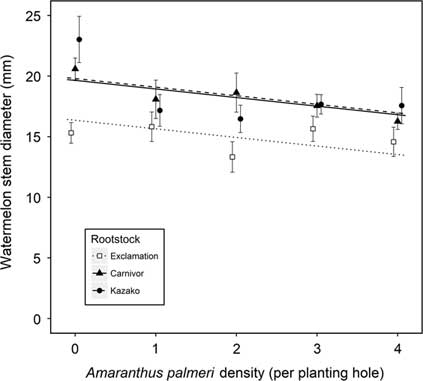
A significant effect of A. palmeri density and rootstock was observed for watermelon stem diameter (Table 1). The relationship between watermelon stem diameter and A. palmeri density was linear (Equation 2; Figure 5), and there was no significant interaction of rootstock with the linear term, so all rootstocks shared a common slope of −0.71, which would be interpreted as a 0.71-mm decrease in watermelon stem diameter for each additional A. palmeri per planting hole. The intercepts represent the predicted stem diameters under weed-free conditions and were 16.4, 19.6, and 19.8 mm for Exclamation, Carnivor, and Kazako, respectively. Despite a general decrease in watermelon stem diameter as weed density increases, the coefficient of determination was small for the linear model describing the relationship (R2 = 0.66). Thus, there is much variation that is not described by the linear model. Carnivor and Kazako rootstocks had wider stems than the nongrafted Exclamation, which is consistent with previous reports of larger root systems of ISH rootstocks (Lee and Oda Reference Lee and Oda2003).
Influence of Amaranthus palmeri density on average watermelon stem diameter of nongrafted Exclamation and Exclamation grafted on Carnivor and Kazako rootstocks combined over 2015 and 2017, in Clinton, NC. The linear equation, Y = (a × D)+b, described the effect of A. palmeri density (D) on watermelon stem diameter (Y) for all rootstocks, which shared a common slope of −0.71 (±0.29) with intercepts of 16.4, 19.6, and 19.8 (±0.9) mm for Exclamation, Carnivor, and Kazako, respectively; R2 = 0.66.

Amaranthus palmeri Biomass, Stem Diameter, and Seed Production
Amaranthus palmeri biomass was not affected by watermelon transplant type (Table 2). Thus, despite reports of increased vigor associated with grafted watermelon plants (Lee and Oda Reference Lee and Oda2003), grafting to Carnivor and Kazako rootstocks did not produce more weed-competitive plants and did not inhibit A. palmeri biomass accumulation. Regarding density, a single A. palmeri per planting hole (0.76-m row) produced biomass similar to biomass produced by 4 A. palmeri in the same area. Thus, a single A. palmeri is capable of maximizing productivity in that area, and any increase in A. palmeri density (beyond 1 A. palmeri planting hole−1) will produce similar weed biomass.
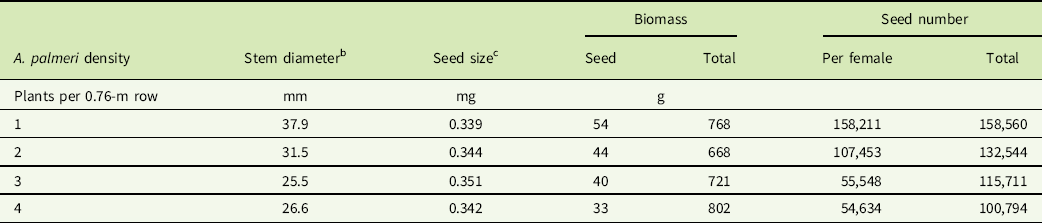
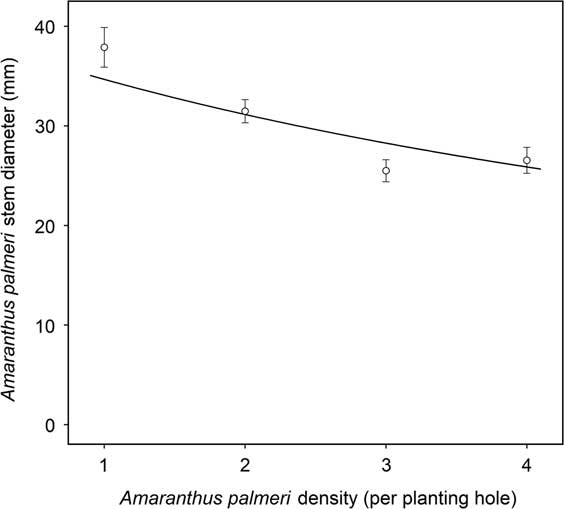
Amaranthus palmeri stem diameter was not affected by transplant type, but there was a significant effect of A. palmeri density (Tables 2 and 5). As A. palmeri density increased, average A. palmeri stem diameter decreased according to a decreasing rectangular hyperbola model (Equation 3; Figure 6). Despite significant evidence of a nonlinear relationship between the A. palmeri stem diameter and A. palmeri density (P = 0.015), the trend of the data points is roughly linear (Figure 6). Mean A. palmeri stem diameter ranged from 37.9 to 26.6 mm for densities of 1 to 4 A. palmeri planting hole−1, which represents a 30% decrease.
Effects of Amaranthus palmeri density on A. palmeri stem diameter, seed size, biomass accumulation, and seed production, combined across all transplant types and years in Clinton, NC.Footnote a

a Least-squares means calculated using output from PROC MIXED in SAS v. 9.4.
b ANOVA of weed stem diameter was conducted on log-transformed data, then back-transformed for this table.
c ANOVAs of seed size, seed biomass, and seed number were conducted on square-root-transformed data, then back-transformed for this table.
Influence of Amaranthus palmeri density on A. palmeri stem diameter in 2015 and 2017 in Clinton, NC, combined across rootstocks. The density lack-of-fit term was significant (P = 0.015), suggesting a nonlinear relationship, and PROC NLIN was used to fit the effect of A. palmeri density on A. palmeri stem diameter to the rectangular hyperbola model, Y = (I × D)/[1+(I × D/A)]. D represents A. palmeri density, and estimates were 45.2 (±3.5) and 9.6 (±3.0) for parameters A and I, respectively; R2 = 0.90.

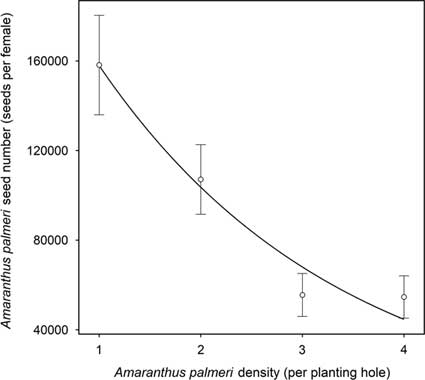
There was no significant effect of transplant type or A. palmeri density on seed biomass, average seed size, or total seed number per planting hole (Tables 2 and 3). The average seed size for the entire study was calculated to be 0.334 mg, which is 23% to 31% smaller than previously reported sizes of 0.437 and 0.485 mg seed−1, respectively (Sellers et al. Reference Sellers, Smeda, Johnson, Kendig and Ellersieck2003; Sosnoskie et al. Reference Sosnoskie, Webster, Grey and Culpepper2014). It is possible that the smaller seeds observed in the present study are due to the elevated drying temperature of 70 C for 7 to 9 d compared with temperatures of 35 C until dry (Sosnoskie et al. Reference Sosnoskie, Webster, Grey and Culpepper2014) and 60 C for 3 d (Sellers et al. Reference Sellers, Smeda, Johnson, Kendig and Ellersieck2003). When seed number was adjusted to the number of female A. palmeri sampled per planting hole, the effect of A. palmeri density was significant (Table 2). As A. palmeri density increased, the number of seeds per female decreased from 158,211 to 54,634 (Table 5). The number of seeds produced per female A. palmeri plant was reduced according to the two-parameter exponential decay equation (Figure 7) and closely fit the observed means (R2 = 0.96). The narrower stems and reduced seed production per female in response to increased A. palmeri density suggest that, while overall weed growth was not inhibited (as measured by biomass or total seed production), each A. palmeri in a planting hole was reduced in size and fecundity. Thus, increases in A. palmeri density beyond 1 planting hole−1 led to increased intraspecific competition.
Influence of Amaranthus palmeri density on seed produced per female A. palmeri in 2015 and 2017 in Clinton, NC, combined across rootstocks. PROC NLIN was used to fit the effect of A. palmeri density on seed number per female to the two-parameter exponential decay equation: Y = a × exp(−b × D). D represents A. palmeri density, and estimates were 240,626 (±28,824) and 0.42 (±0.07) for parameter a and b, respectively; R2 = 0.96.

Results from the present study demonstrate that relatively low populations of A. palmeri can cause substantial yield losses in watermelon production. Parameter estimates from nonlinear regression for yield and fruit number differed depending on rootstock selection. With Kazako rootstock, relative yield losses and fruit number reductions were higher than those of Carnivor rootstock or nongrafted Exclamation. As with previous research using the same rootstock and scion combinations, nongrafted Exclamation produced the highest yield and fruit number, regardless of weed interference (Bertucci Reference Bertucci2018). Thus, there is no apparent benefit in competitive ability associated with grafted watermelon. No hollow heart or biologically meaningful change in SSC was associated with weed interference or grafting treatment, suggesting that yield reduction due to weed interference should be the primary concern for watermelon growers. Grafted seedlings may cost US$0.75 seedling−1 compared with US$0.28 seedling−1 for nongrafted triploid watermelon seedlings (Taylor et al. Reference Taylor, Bruton, Fish and Roberts2008); thus, grafting is not an economically viable option for weed management. While grafting may offer disease resistance and tolerance to abiotic stresses, there is no immediate benefit regarding weed-competitive ability and a consistent yield penalty associated with grafting, even in weed-free treatments. However, if grafting is economically justified based on disease in a field, the present study suggests Carnivor rootstock is a higher-yielding and more weed-competitive alternative to Kazako rootstock.
Acknowledgments
The authors express their gratitude to Cavell Brownie for her consultation in statistical analysis. Further appreciation is extended to following individuals for their assistance with conducting this research: Sushila Chaudhari, David Suchoff, Brad Thompson, Keith Starke, Nicholas Basinger, Stephen Smith, Sam McGowen, Shawn Beam, Matt Waldschmidt, Wesley Hairr, and the station crew at Horticultural Crops Research Station in Clinton, NC. The authors thank Dean Liere and Syngenta for providing seed for the experiment, USDA-NIFA-2011-51181-30963 for providing funding for this research, and the North Carolina State University and North Carolina Department of Agriculture and Consumer Services for supporting this research. No conflicts of interest have been declared.