INTRODUCTION
The reduction in the awareness of deficits in Alzheimer's disease (AD) patients is a complex and non-unitary phenomenon (Starkstein, Sabe, Chemerinski, Jason, & Leigarda, Reference Starkstein, Sabe, Chemerinski, Jason and Leigarda1996; Vasterling, Seltzer, Foss, & Vanderbrook, Reference Vasterling, Seltzer, Foss and Vanderbrook1995).
Different studies have examined the clinical and neurocognitive variables considered important for defining a reduction in awareness. The most studied cognitive disorders relating to this phenomenon are memory (Galeone, Pappalardo, Chieffi, Iavarone, & Carlomagno, Reference Galeone, Pappalardo, Chieffi, Iavarone and Carlomagno2011) and executive dysfunctions. Despite some contrary evidence (Derouesne et al., Reference Derouesne, Poitreneau, Hugonot, Kalafat, Dubois and Laurent1999; Hannesdottir & Morris, Reference Hannesdottir and Morris2007; Migliorelli et al., Reference Migliorelli, Tenson, Sabe, Petracca, Petracchi, Leiguarda and Starkstein1995; Reed, Jagust, & Coulter, Reference Reed, Jagust and Coulter1993; Starkstein et al., Reference Starkstein, Sabe, Chemerinski, Jason and Leigarda1996), several authors have described AD patients with reduced awareness of deficits as significantly more severely impaired on neuropsychological tests that are fairly sensitive to prefrontal lobe damage (Auchus, Goldstein, Green, & Green, Reference Auchus, Goldstein, Green and Green1994; Loebel, Dager, Berg, & Hyde, Reference Loebel, Dager, Berg and Hyde1990; Lopez, Becker, Somsak, Dew, & DeKosky, Reference Lopez, Becker, Somsak, Dew and DeKosky1994; Mangone et al., Reference Mangone, Hier, Gorelick, Ganellen, Langenberg, Boarman and Dollear1991; Michon, Deweer, Pillon, Agid, & Dubois, Reference Michon, Deweer, Pillon, Agid and Dubois1994; Ott et al., Reference Ott, Lafleche, Whelihan, Buongiorno, Albert and Fogel1996), particularly the Trail Making Test (Drewe, Reference Drewe1985; Lopez et al., Reference Lopez, Becker, Somsak, Dew and DeKosky1994), the Continuous Performance Test (Mangone et al., Reference Mangone, Hier, Gorelick, Ganellen, Langenberg, Boarman and Dollear1991), the Wisconsin Card Sorting Test (Michon et al., Reference Michon, Deweer, Pillon, Agid and Dubois1994), and the World Color subtest of the Stroop Test (Kashiwa et al., Reference Kashiwa, Kitabayashi, Narumoto, Nakamura, Ueda and Fukui2005). Consistent with this, patients with impaired awareness showed reduced activation in the medial prefrontal circuit, in particular in the Anterior Cingulate Cortex (ACC), during a response inhibition (go/no-go) task, compared to subjects aware of their deficits (Amanzio et al., Reference Amanzio, Torta, Sacco, Cauda, D'Agata, Duca and Geminiani2011). Moreover, our recent findings and previous results showed that apathy and disinhibition appear as the first significant behavior changes in unaware subjects (Amanzio et al., Reference Amanzio, Torta, Sacco, Cauda, D'Agata, Duca and Geminiani2011); findings which point out the need for a clear characterization of behavioral assessment in these patients.
Since there is no definitive consensus on which sub-component of executive functions might play a role in the neuropsychology of disease awareness in mild AD, three points appear very important and should be included in this type of study. As previously demonstrated, the first point is that reduced awareness of cognitive deficits may be dissociated from reduced awareness of behavioral deficits (Migliorelli et al., Reference Migliorelli, Tenson, Sabe, Petracca, Petracchi, Leiguarda and Starkstein1995; Starkstein et al., Reference Starkstein, Sabe, Chemerinski, Jason and Leigarda1996; Starkstein, Jorge, Mizrahi, & Robinson, Reference Starkstein, Jorge, Mizrahi and Robinson2006), which suggests that it may be domain-specific.
The second point seems particularly relevant for our purposes. Executive functions represent a multifaceted domain including different sub-competences. We decided to dwell mainly on the most widely accepted model of executive functioning, which suggests important executive components, such as attention and inhibition, monitoring, planning, task management and coding (Smith & Jonides, Reference Smith and Jonides1999). A latent variable analysis study by Miyake, Friedman, Emerson, Howerter, and Wager (Reference Miyake, Friedman, Emerson, Howerter and Wager2000) analyzed basic executive functions such as mental set-shifting, information updating, and monitoring and inhibition of prepotent responses, all of which are frequently postulated in the literature as important executive functions (Baddeley, 1986; Logan, Reference Logan1985; Lyon & Krasnegor, Reference Lyon and Krasnegor1996; Rabbit, Reference Rabbit1997; Smith & Jonides, Reference Smith and Jonides1999). Mild AD patients can show impaired executive system functions (Buckner, Reference Buckner2004; Chen et al., Reference Chen, Ratcliff, Belle, Cauley, DeKosky and Ganguli2000; Duke & Kaszniak, Reference Duke and Kaszniak2000; Espinosa et al., Reference Espinosa, Alegret, Boada, Vinyes, Valero, Martinez-Lage and Tirraga2009; Sebastian, Menor, & Elosua, Reference Sebastian, Menor and Elosua2006), that is, control of actions in situations where routine control of behavior will not suffice, such as situations that require the suppression of habitual or dominant responses in terms of inhibition, or novel situations. These deficits are often described as a dysexecutive syndrome (Baddeley, Reference Baddeley1986). In this direction, Lopez et al. (Reference Lopez, Becker, Somsak, Dew and DeKosky1994) suggested that reduced awareness in AD may result from a greater impairment of the Central Executive System (Baddeley, Reference Baddeley1986) which is a metacognitive structure involved in the control of information flow in tasks requiring, for example, mental set-shifting, monitoring, and inhibition (Amanzio et al., Reference Amanzio, Torta, Sacco, Cauda, D'Agata, Duca and Geminiani2011). Although there appears to be a relationship between executive dysfunction and unawareness of deficits, neuropsychological studies involving an overall analysis of executive dysfunction in unaware AD patients are still lacking.
The third point concerns the assessment of executive dysfunction. This type of assessment requires the use of specific subtests to measure the different sub-components of executive functions. Of interest, as Lezak, Howieson, and Loring (Reference Lezak, Howieson and Loring2004) pointed out, there is only one neuropsychological battery that is actually able to provide an extensive overview of executive function analyses, the Behavioral Assessment of the Dysexecutive Syndrome (BADS) (Wilson, Alderman, Burgess, Emslie, & Evans, Reference Wilson, Alderman, Burgess, Emslie and Evans1996). Indeed, the BADS has been reported to be useful in detecting executive dysfunction in various types of diseases as well as in Alzheimer-type dementia (Amanzio, Geminiani, Leotta, & Cappa, Reference Amanzio, Geminiani, Leotta and Cappa2008; Espinosa et al., Reference Espinosa, Alegret, Boada, Vinyes, Valero, Martinez-Lage and Tirraga2009). Importantly, performance on the BADS was previously related to prefrontal activity (Rodrigues Gouveia, Dozzi Brucki, Fleury-Malheiros, & Bueno, Reference Rodrigues Gouveia, Dozzi Brucki, Fleury Malheiros and Bueno2007).
Considering all these important aspects, we carried out a domain-specific assessment of our AD population to assess the unawareness of deficits, as proposed by Barrett, Eslinger, Ballentine, and Heilman (Reference Barrett, Eslinger, Ballentine and Heilman2005), using the Awareness of Deficit Questionnaire - Dementia scale, AQ-D (Migliorelli et al., Reference Migliorelli, Tenson, Sabe, Petracca, Petracchi, Leiguarda and Starkstein1995) to differentiate between aware and unaware patients. The AQ-D was also used to study the different domains of deficit unawareness, not only at a cognitive and behavioral level, but also considering a reduction of awareness in instrumental activities of daily living in our AD population. We were particularly interested in determining whether there was an association between scores on the BADS subscales and a reduction in awareness in our mild AD patients. Moreover, with a view to considering further important aspects previously underlined by other authors (see reviews by Clare, Reference Clare2004a, Reference Clareb and Clare et al., Reference Clare, Nelis, Martyr, Roberts, Whitaker, Markova and Morris2012) and with the aim of studying this phenomenon by adopting an omni-comprehensive approach never previously proposed in the literature, we also considered other important variables—such as cognitive dysfunctions, behavioral changes and perspective-taking tasks—in the explanation of the different domains of impaired awareness. We approached the study by first conducting an explorative factor analysis considering the role of these variables in the awareness of deficits in our mild AD patients and then by using regression analysis models to define which of these should be considered important with regard to reduction of awareness.
We hypothesized that disturbance of awareness may arise as a result of a disruption of the comparator mechanisms responsible for the monitoring of performance on tasks requiring inhibition of responses. In this respect, we recently demonstrated that the ACC dysfunction represents one of the corresponding neurobiological substrates of the executive unawareness (Amanzio et al., Reference Amanzio, Torta, Sacco, Cauda, D'Agata, Duca and Geminiani2011). Interestingly, as two BADS subtests measuring these abilities (the Rule Shift Cards, RSC, and the Modified Six Elements, MSE), we particularly expected these to play an important role in the cognitive domain of unawareness.
Moreover, having recently found apathy and disinhibition to be the first behavioral changes in our unaware AD patients (Amanzio et al., Reference Amanzio, Torta, Sacco, Cauda, D'Agata, Duca and Geminiani2011), we here hypothesize a role of mood orientation changes in the behavioral domain of unawareness.
Materials and Methods
Participants
A group of 117 consecutive out-patients were included in the study. The patients had been referred to the Unit for Alzheimer's disease evaluation at the Martini Hospital in Turin. All patients met the criteria for probable Alzheimer's disease as defined by the NINCDS-ADRDAFootnote 1 (McKhann et al., Reference McKhann, Drachman, Folstein, Katzman, Price and Stadlan1984). They had a Hachinski ischemic score of 4 or less; a Mini-Mental State Examination (MMSE) score (Folstein, Folstein, & McHugh, Reference Folstein, Folstein and McHugh1975) between 19 and 24; no history of stroke or any other neurological or psychiatric illness; normal blood tests; no lesions detectable on MRI (T1-weighted).
Patients were excluded from the study if they: (1) had major depression or dysthymia (APA, 2000); (2) had subclinical depressive symptomatology assessed by means of a psychological evaluation; (3) were on medication that could directly impact cognitive functioning, such as neuroleptics; or (4) had taken antidepressants and/or anxiolytics and/or anti-cholinesterase drugs less than 15 days before the neuropsychological evaluation.
A second group of 117 normal elderly participants (the caregiversFootnote 2) also took part in the study to provide information about the patients’ awareness of their disease using the AQ-D scale (Migliorelli et al., Reference Migliorelli, Tenson, Sabe, Petracca, Petracchi, Leiguarda and Starkstein1995). Since this method is based on a subtractive index of perception by caregivers and patients, excluding any bias in the caregivers’ judgments is crucial. Indeed, the caregivers had normal neurological and psychiatric evaluations and a negative history of neurological disorders and were not on any medication known to affect the CNS. Mental deterioration was excluded by means of a clinical examination and MMSE. Subclinical depressive symptomatology was also excluded by means of a psychological evaluation, as it could not be assessed by using psychiatric scales only. Neuropsychiatric scales (the Hamilton depression scale, HAM-D and the Hamilton anxiety scale, HAM-A) [Hamilton, Reference Hamilton1960; Reference Hamilton1959 respectively] and Theory of Mind (ToM) tasks (Amanzio et al., Reference Amanzio, Geminiani, Leotta and Cappa2008) were administered to exclude any tendency toward anxiety or depressive mood and difficulty in the ability to make inferences about another individual's mental state.
Patients and caregivers participated voluntarily and all gave their informed consent before being recruited into the study. The study was approved by the ethical committee of the Department of Psychology, University of Turin.
Design and Procedures
All behavioral test batteries and psychiatric scales were administered by a neuropsychologist blinded to the aims of the study. The AD participants were assessed in three experimental sessions, each lasting 1 hr, on three different days at a week's distance, in the absence of the caregivers. During the first session, the AD patients were primarily assessed for deficit awareness using the AQ-D scale and consequently for behavioral status with the neuropsychiatric batteries. On the other 2 days, subjects were tested using neuropsychological batteries. The caregivers were assessed during a single experimental session lasting approximately 1 hr in the absence of the patients.
Assessment of Impaired Awareness
Impaired awareness of deficits in the AD population at the time of testing was analyzed by means of a domain-specific assessment as proposed by Barrett et al. (Reference Barrett, Eslinger, Ballentine and Heilman2005), using the AQ-D scaleFootnote 3 which is an instrument of proven reliability and validity for rating the severity of unawareness of deficits in people with Alzheimer's disease (Amanzio et al., Reference Amanzio, Torta, Sacco, Cauda, D'Agata, Duca and Geminiani2011; Starkstein et al., Reference Starkstein, Jorge, Mizrahi and Robinson2006).
Patients with a score of ≥32 were classified as being unaware, whereas patients with a score of ≤14 were classified as being aware of their deficits. Patients who scored between 15 and 31 were classified as borderline (Migliorelli et al., Reference Migliorelli, Tenson, Sabe, Petracca, Petracchi, Leiguarda and Starkstein1995).
In addition to classifying the cognitive and the behavioral parts, we also considered specific items of the AQ-D scale to gather information about reduced awareness within a more specific domain. In particular, we followed the classification of Starkstein et al. (Reference Starkstein, Jorge, Mizrahi and Robinson2006) who used principal component analysis to subdivide the global AQ-D scale into four domains taking into consideration the factors loading on each item. One of these factors, identified in terms of impaired awareness in instrumental activities of daily living (iADL), was designated factor 1Footnote 4 by the authors. Thus it accounted for most of the variance and also rated as the earliest functional deficit in AD, we decided to take this into consideration in our analyses. Our purpose was to verify any differences between these items and the entire cognitive subscale. In particular, we used this domain and the cognitive and behavioral subscales separately in our regression analyses.
Neuropsychological, Neuropsychiatric and Functional Assessment
The AD patients were assessed with a wide battery of neuropsychological and neuropsychiatric tasks. The MMSE enabled the selection of a homogeneous population (see Amanzio et al., Reference Amanzio, Torta, Sacco, Cauda, D'Agata, Duca and Geminiani2011). In particular, only patients with scores between 19 and 24 were selected, as also previously suggested by Clare (Reference Clare2004a). Alzheimer's disease severity was evaluated using the Global Deterioration Scale, GDS (Reisberg, Ferris, de Leon, & Crook, Reference Reisberg, Ferris, de Leon and Crook1982). The Alzheimer's Disease Assessment Scale-cognitive subscale, ADAS-Cog (Rosen, Mohs, & Davis, Reference Rosen, Mohs and Davis1984), the Token Test for auditory comprehension of sentences of increasing complexity, Attentional Matrices and the recall of a Short Story for episodic memory (Spinnler & Tognoni, Reference Spinnler and Tognoni1987) were also administered.
Executive functions were analyzed by means of the BADS and its subscales (Wilson et al., Reference Wilson, Alderman, Burgess, Emslie and Evans1996)Footnote 5.
Perspective-taking abilities were tested using visual ToM stories (Amanzio et al., Reference Amanzio, Geminiani, Leotta and Cappa2008, Reference Amanzio, Torta, Sacco, Cauda, D'Agata, Duca and Geminiani2011) to solve problems involving first-order attributions and second-order attributions of false belief.
The patients were also tested using the HAM-D and the Mania Assessment Scale, MAS (Bech, Rafaelsen, Kramp, & Bolwing, Reference Bech, Rafaelsen, Kramp and Bolwing1978). Basic and instrumental activities of daily living were assessed, respectively, with the Katz, Ford, Moskovitz, Jackson, and Jaffe (Reference Katz, Ford, Moskovitz, Jackson and Jaffe1963) and Lawton and Brody (Reference Lawton and Brody1969) scales (these two variables were labeled in terms of ADL and IADL to differentiate them from the two domains of reduced awareness in instrumental activities of daily living defined as iADL).
Data Analysis
Statistical analyses were performed using SPSS Software for Windows (15.0 program. Inc., Chicago, IL).
To investigate whether the level of awareness could be predicted by a combination of the neuropsychological-behavioral measuresFootnote 6 both factor analysis and regression analyses were conducted for all patients. The factor analysis (principal component method with orthogonal rotation “varimax”) was performed on the variables of interest (see note 5). Eigenvalues (λ) > .8 and the scree plot (visual break at the elbow) were used to inspect for factor solution and to identify the underlying number of factors. Furthermore, associations were tested with regression analyses, conducted with various subdivisions of the AQ-D as dependent variables and the identified factors from the principal component analysis as independent variables.
First, regression analyses were conducted with AQ-D global, AQ-D cognitive and AQ-D behavioral, respectively, as dependent variables and the identified factors as independent variables. Next, regression analysis was performed considering a reduction of awareness in iADL as the dependent variable and the indentified factors as independent variables.
Results
Evaluation of Reduced Awareness of Deficits
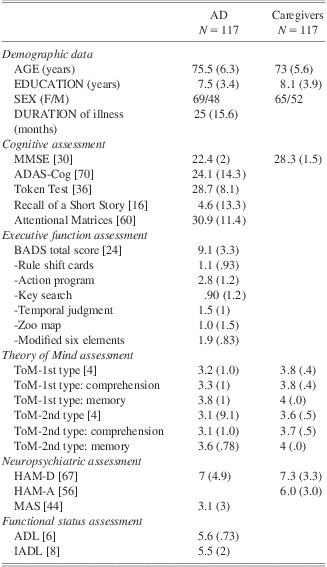
Fifty-six of the patients were classified as aware and 41 were classified as unaware using the AQ-D scale, the remaining patients were borderline. As shown in Table 1, the patients were considered homogeneous given their scores on the MMSE (range, 19–24) and on the GDS scale (all obtained a score of 3).
Data of the overall group of AD patients and caregivers

Note. For MMSE, lower scores indicate more severe cognitive impairment. For ADAS-Cog, higher scores indicate more severe cognitive impairment. For ADL and IADL, Attentional Matrices, Recall of a short story, Token Test, ToM tasks, and BADS tests higher scores indicate better performance. For HAM-D, HAM-A, and MAS, higher scores indicate more severe symptoms. Maximum scores for tests are shown in square parentheses.
ADAS-Cog = Alzheimer's Disease Assessment Scale-Cognitive subscale; ADL and IADL = Basic and Instrumental Activities of Daily Living; BADS = Behavioural Assessment of the Dysexecutive Syndrome; HAM-A = Hamilton anxiety scale; HAM-D = Hamilton depression scale; and MAS = Mania Assessment Scale; MMSE = Mini-Mental State Examination; ToM = Theory of Mind tasks.
Neuropsychological, Neuropsychiatric and Mentalizing Assessment
Table 1 also shows the demographic and cognitive functioning data of the overall sample of AD patients and caregivers. The AD group achieved low scores on the HAM-D, MAS, ADL, and IADL scales, attesting a low level of depression, mania and low functional disabilities. It is also important to underline that depressive and anxiety mood were absent in caregivers on the HAM-D and HAM-A scales.
The caregivers performed the ToM tasks perfectly and demonstrated a good ability to make inferences about another individual's mental state, an important aspect to be considered in this type of study.
Principal Component Analysis (PCA)
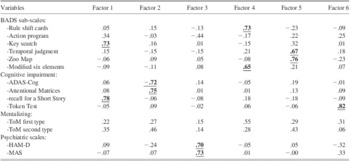
The PCA revealed six underlying factors. The first factor accounted for 17.35% of the variance (λ1 = 2.43), the second factor accounted for 11.25% (λ2 = 1.57), the third factor 10.32% (λ3 = 1.45), the fourth factor 8.22% (λ4 = 1.15), the fifth factor 7.75% (λ5 = 1.08), and the sixth factor 6.62% (λ6 = .93). Altogether the six factors accounted for 61.51% of the variance.
The recall of a Short Story and the Key Search (KS) of the BADS loaded highly on the first factor. The ADAS-Cog and the Attentional Matrices loaded highly on the second factor. The HAM-D and MAS loaded highly on the third factor. The RSC and the MSE BADS subscales loaded highly on the fourth factor. The Temporal Judgment (TJ) and the Zoo Map (ZM) of the BADS loaded highly on the fifth factor and the Token Test loaded highly on the sixth factor (see Table 2).
Rotated pattern matrix for the principal components analysis (N = 117)

Note. Factor loadings > 0.60 are expressed in bold type and underlined. Factor 1 refers to the recall for a Short Story and the Key Search subtest of the BADS. Factor 2 concerns the level of cognitive impairment measured through ADAS-Cog and the Attentional Matrices. Factor 3 is represented by MAS concerning a tendency toward hypomania and by HAM-D concerning a tendency to apathy. The Rule Shift Cards and the Modified Six Elements subtests of the BADS were the most important contributors to Factor 4. Factor 5 is represented by Temporal Judgment and the Zoo Map subtests of the BADS. The Token Test was the most important contributor to Factor 6.
ADAS-Cog = Alzheimer's Disease Assessment Scale-Cognitive subscale; BADS = Behavioral Assessment of the Dysexecutive Syndrome; HAM-D =Hamilton Depression Scale; MAS = Mania Assessment Scale; ToM = Theory of Mind;
As far as the interpretation of the factor extracted by factor analysis was concerned considering the hypothesized role of each variables of interest (see note 6) in the awareness of deficits, we first performed a factor analysis, extracting six factors:
1. Episodic memory tested with the logical memory test (recall of a Short Story) and the KS (exploring planning in the visual spatial domain) were the most important contributors to factor one.
2. The second factor refers to the level of cognitive impairment measured through ADAS-Cog and to the ability to detect visual targets among distractors in terms of visual search through the Attentional Matrices.
3. The third factor is represented by an early mild change in behavior in terms of MAS and HAM-D.
4. The fourth factor concerning abilities to shift and inhibit response and monitoring behavior. In particular, in the second subpart of the RSC the dominant response consists of saying “yes” to red and “no” to black cards (first subpart), instead of saying “yes” if the card is the same color of the previous one and “no” if it is a different color (second subpart). In the MSE the dominant response consists of solving all the problems in the order presented to patients, not considering the rule to resolve each task alternating it with a different type of task (Wilson et al., Reference Wilson, Alderman, Burgess, Emslie and Evans1996).
5. The fifth factor is represented by the TJ subtest that measures cognitive estimation and the ZM analyzing set-shifting and maintaining sets (see Millar, Griffiths, Zermansky, & Burn, Reference Millar, Griffiths, Zermansky and Burn2006).
6. The fifth factor is represented by the Token Test for auditory comprehension of sentences of increasing complexity.
To verify the hypothesis that these constructs may play an important role in the reduction of awareness of deficits in our AD population, we performed regression analyses using the factor scores as independent variables.
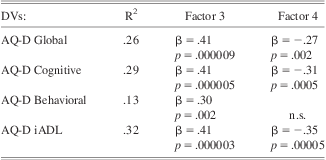
Regression between AQ-D and the PCA factors (significant results)
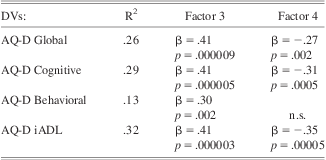
Note. Factor 3 is represented by MAS concerning a tendency toward hypomania and by HAM-D concerning a tendency to apathy. The Rule Shift Cards and the Modified Six Elements subtests of the BADS were the most important contributors to Factor 4.
AQ-D = Awareness of deficit Questionnaire – Dementia scale; AQ-D iADL = Awareness in instrumental activities of daily living; DVs = dependent variables; n.s. = not significant.
Regression Between AQ-D (Global, Cognitive, and Behavioral) and the Five PCA Factors
To ascertain whether measures from each factor may contribute to the prediction of scores on the AQ-D global, cognitive and behavioral subscales in the overall AD population, we conducted three multiple regression analyses using the AQ-D global, cognitive and behavioral parts of the scale as dependent variables.
The regression analysis between AQ-D global and the six factors revealed a highly significant overall model F(6,98) = 5.86, p < .00003.
The regression analysis between AQ-D cognitive and the six factors revealed a highly significant overall model F(6,98) = 6.76, p < .00001. The regression analysis between AQ-D behavioral and the six factors revealed a significant overall model F(6,98) = 2.45, p < .03.
Regression Between Selected Items of the AQ-D (Reduced Awareness in Terms of iADL) and the Six-PCA Factors
To ascertain whether measures from each factor might contribute to predicting scores on the reduction of awareness in iADL we conducted a multiple regression analysis using selected items of the AQ-D scale as dependent variable (see Methods and Table 3).
The regression analysis between a reduction in the awareness of the iADL and the six factors revealed a highly significant overall model F (6,98) = 7.64, p < .000001.
Discussion
This study adds important new elements to the literature on neuropsychological impairments in patients with mild AD in terms of everyday executive dysfunction, suggesting a role for subcomponents of executive functions in impaired awareness of deficits such as inhibition, self-monitoring and set-shifting. Furthermore, in line with previous findings (Amanzio et al., Reference Amanzio, Torta, Sacco, Cauda, D'Agata, Duca and Geminiani2011), we also found apathy and disinhibition, measured through HAM-D and MAS, to be prominent features of the first behavioral changes that are indicators of reduced behavioral awareness of AD patients.
In particular, considering the hypothesized role of each variables of interest (see note 5) in the awareness of deficits, we first performed a factor analysis, extracting six factors.
As a consequence of the first analysis, a series of multiple regression analyses were carried out to determine which of the variables in question better predicted a reduced awareness of deficits in the AD subjects. We found that factors 3 and 4Footnote 7 were the best predictors of a reduction in awareness in global, cognitive, and iADL in our AD patients, thus demonstrating no differences between these three domains. On the other hand, factor 3 was the best predictor of unawareness in the behavioral domain.
In particular, the ability to inhibit a response, self-monitoring, and set-shifting measured through two specific BADS subscales (the RSC and the MSE) all appear to be important skills for awareness of everyday deficits in our AD population. Being a modified version of Shallice and Burgess’ Six Elements Test (Shallice & Burgess, Reference Shallice and Burgess1991), the MSE subtest of the BADS was created to evaluate the Supervisory Attentional System hypothesis (SAS). This task relies on the ability to inhibit a dominant response. In particular, the dominant response consists of solving all the problems in the order presented to the patients, not considering the rule to resolve each task alternating it with a different type of task. The MSE test also measures the ability to self-monitor by performing the necessary strategic planning and switching to end the task. Our results appeared in line with the hypotheses of Eslinger et al. (Reference Eslinger, Moore, Troiani, Antani, Cross, Kwok and Grossman2007), according to whom prefrontal damage has been associated with lack of awareness of deficits and inability to use feedback about behavior, as we observed through the use of the MSE BADS subscale. In this direction some authors hypothesized that impaired awareness of deficits in AD patients was caused by poor “on-line” self-monitoring, related to frontal-lobe dysfunction, and various studies have also shown that the lack of awareness may be marked by specific executive function disabilities related to self-monitoring, flexible thinking, and inhibition of a dominant response (Amanzio et al., Reference Amanzio, Torta, Sacco, Cauda, D'Agata, Duca and Geminiani2011; Kashiwa et al., Reference Kashiwa, Kitabayashi, Narumoto, Nakamura, Ueda and Fukui2005; Kaszniak & Zak, Reference Kaszniak and Zak1996; Lopez et al., Reference Lopez, Becker, Somsak, Dew and DeKosky1994; Michon et al., Reference Michon, Deweer, Pillon, Agid and Dubois1994). Interestingly, the RSC task is not a planning or organization of behavior task for longer periods of time. Rather, it is a measure of cognitive flexibility involving the ability to shift response set (Cools, Brouwer, de Jong, & Slooff, Reference Cools, Brouwer, de Jong and Slooff2000). Poorer cognitive flexibility in terms of the RSC task appears to be associated with poor awareness, as the multiple regression analyses also demonstrated. Although it has not yet been demonstrated, it would not be surprising if patients deficient in the ability to think flexibility (RSC) were also found to have difficulties perceiving and accepting alternate views of themselves, such as the view that they have AD deficits. Accordingly, we postulated that patients with AD who exhibit some degree of rigidity in their thinking processes (as demonstrated by measures of cognitive flexibility) are less likely to have the ability to appreciate and understand that their perceptions, behavior, symptoms, and experiences are due to an illness and that their experiences are unusual and unaccounted for by normal healthy functioning. We recently demonstrated that unaware patients showed more severe cognitive flexibility disabilities (Amanzio et al., Reference Amanzio, Torta, Sacco, Cauda, D'Agata, Duca and Geminiani2011).
From the results of the multiple regression analysis, we also found MAS and HAM-D to be predictors of a reduced awareness of behavioral deficits. Although previous studies (Migliorelli et al., Reference Migliorelli, Tenson, Sabe, Petracca, Petracchi, Leiguarda and Starkstein1995; Starkstein et al., Reference Starkstein, Sabe, Chemerinski, Jason and Leigarda1996) found that unaware AD subjects achieved higher mania scores than aware AD ones, there is one important element to be pointed out. In our study, the clinical psychiatric assessment using the MAS excluded the occurrence of clinical mania in our AD subjects with reduced awareness of deficits (all patients had scores below the cutoff value in MAS). Moreover, our mild AD patients were in an early stage of the disease compared to the above-mentioned studies. The authors further suggested that scores on disinhibition scales increase as the disease progresses (Starkstein, Garau, & Cao, Reference Starkstein, Garau and Cao2004). Starkstein et al. (Reference Starkstein, Sabe, Chemerinski, Jason and Leigarda1996) suggested that a reduced awareness of behavioral problems may be part of the disinhibition syndrome. Our previous results and those here obtained suggest that an early mild change in behavior occurs in the subgroup of reduced awareness and that this is not to be considered relevant from a psychopathological point of view (Amanzio et al., Reference Amanzio, Torta, Sacco, Cauda, D'Agata, Duca and Geminiani2011). It may, instead, constitute an important early marker of changes in behavior to be assessed in such patients. In factor 3, we also observed a role of HAM-D scores. The HAM-D scale actually measures changes, not only in terms of depressive mood but also of apathetic behavior possibly related to prefrontal dysfunctions (Assal & Cummings, Reference Assal and Cummings2002). This result suggests a probable role of apathy in the reduced awareness of cognitive and behavioral domains. Starkstein et al. (Reference Starkstein, Sabe, Chemerinski, Jason and Leigarda1996) found that a reduction in the cognitive awareness was related to apathy.
Considering factor 2, we found no generalized cognitive impairment in terms of ADAS-Cog as a prerequisite of unawareness of deficits in our mild AD patients. Many studies have reported significant relationships between cognitive deterioration and unawareness of deficits in AD patients (Barrett et al., Reference Barrett, Eslinger, Ballentine and Heilman2005; Gil et al., Reference Gil, Arroyo-Anllo, Ingrand, Gil, Neau, Ornon and Bonnaud2001; Harwood, Sultzer, & Wheatley, Reference Harwood, Sultzer and Wheatley2000; Migliorelli et al., Reference Migliorelli, Tenson, Sabe, Petracca, Petracchi, Leiguarda and Starkstein1995; Ott et al., Reference Ott, Lafleche, Whelihan, Buongiorno, Albert and Fogel1996; Sevush & Leve, Reference Sevush and Leve1993; Starkstein et al., Reference Starkstein, Chemerinski, Sabe, Kuzis, Petracca, Tesòn and Leiguarda1997; Vogel, Hasselbalch, Gade, Ziebell, & Waldermar, Reference Vogel, Hasselbalch, Gade, Ziebell and Waldemar2005), while others have found no such association (Reed, Jagust, & Coulter, Reference Reed, Jagust and Coulter1993; Sevush, Reference Sevush1999; Seltzer, Vasterling, Mathias, & Brennan, Reference Seltzer, Vasterling, Mathias and Brennan2001). Based on the above consideration, it is important to emphasize that, although unawareness tends to become more pronounced as the disease progresses (Lopez, et al., Reference Lopez, Becker, Somsak, Dew and DeKosky1994; Migliorelli et al., Reference Migliorelli, Tenson, Sabe, Petracca, Petracchi, Leiguarda and Starkstein1995; Sevush & Leve, Reference Sevush and Leve1993; Verhey, Ponds, Rozendaal, & Jolles, Reference Verhey, Ponds, Rozendaal and Jolles1995), there is no linear relationship between awareness of disease and severity of disease (Sevush, Reference Sevush1999; Zanetti et al., Reference Zanetti, Vallotti, Frisoni, Geroldi, Bianchetti, Pasqualetti and Trabucchi1999).
On the basis of the results obtained, it appears that there are no straightforward relationships between awareness and specific aspects of neuropsychological functioning such as logical memory in terms of recall of a Short Story and language comprehension in terms of Token Test. Despite some contrary evidence (Feher, Larrabee, Sudilovsky, & Crook, Reference Feher, Larrabee, Sudilovsky and Crook1994; Mangone et al., Reference Mangone, Hier, Gorelick, Ganellen, Langenberg, Boarman and Dollear1991; Migliorelli et al., Reference Migliorelli, Tenson, Sabe, Petracca, Petracchi, Leiguarda and Starkstein1995; Reed et al., Reference Reed, Jagust and Coulter1993), other studies found no association between awareness and overall memory performance (Auchus et al., Reference Auchus, Goldstein, Green and Green1994; Kotler-Cope & Camp Reference Kotler-Cope and Camp1995; Michon et al., Reference Michon, Deweer, Pillon, Agid and Dubois1994; Weinstein, Friedland, & Wagner, Reference Weinstein, Friedland and Wagner1994). Indeed, the association mostly applies specifically to the ongoing monitoring of memory performance as measured by Objective Judgment Discrepancy (Hannesdottir & Morris, Reference Hannesdottir and Morris2007). This has led to the suggestion that perhaps the impairment of episodic memory may be considered as a maintenance factor in unawareness rather than a primary cause (Agnew & Morris, Reference Agnew and Morris1998). Associations with language functions have also been found (Sevush & Leve, Reference Sevush and Leve1993), but these reflect poor understanding of questions on unawareness (Morris & Hannesdottir, Reference Morris and Hannesdottir2004).
According to our results, planning abilities as higher-level subcomponent of executive functions did not seem to have any relationship with the unawareness phenomenon. In particular, we found no positive results with two BADS subtests, such as ZM and KS. Indeed, the ZM has been demonstrated to be useful in detecting planning impairment in AD patients. AD patients seem to have more problems developing logical strategies and executing complex predetermined plans (Allain et al., Reference Allain, Chaudet, Nicoleau, Etcharry-Bouyx, Barr, Dubas and Le Gall2007; Piquard, Derouesné, Lacomblez, & Siéroff, Reference Piquard, Derouesné, Lacomblez and Siéroff2004). KS is also another BADS subtest, more abstract than the ZM, examining a person's ability to prepare an efficient plan of action in the context of a routine event. It is important to point out that these two tasks considered to tap similar executive functions tended to show moderate correlations with one another (Wood & Liossi, Reference Wood and Liossi2007). In this respect, we found them in different factors (1 and 5). Moreover, these two tests had been associated with dorsolateral frontal lobe dysfunctions (Millar et al., Reference Millar, Griffiths, Zermansky and Burn2006). The negative association we observed between these two BADS subtests and the unawareness of deficits seems to go in the direction we found in our recent article in which we demonstrated a role of ventromedial areas in this phenomenon (Amanzio et al., Reference Amanzio, Torta, Sacco, Cauda, D'Agata, Duca and Geminiani2011).
For the obtained results, we believe the most fruitful approach for studying AD-reduced awareness is the neurocognitive model defined as the Conscious Awareness Model by Agnew and Morris (Reference Agnew and Morris1998). This model may help us understand how the executive system contributes to awareness-related abilities, such as response inhibition and self-monitoring (Agnew & Morris, Reference Agnew and Morris1998; Litvan et al., Reference Litvan, Agid, Calne, Campbell, Dubois, Duvoisin and Zee1996, Reference Litvan, Agid, Goetz, Jankovic, Wenning, Brandel and Bartko1997; Starkstein et al., Reference Starkstein, Migliorelli, Teson, Petracca, Chemerinsky, Manes and Leiguarda1995). If the executive system does not function correctly, as we recently observed in our mild AD patients with impaired awareness (Amanzio et al., Reference Amanzio, Torta, Sacco, Cauda, D'Agata, Duca and Geminiani2011), the comparator mechanism does not detect mismatches. We also observed this phenomenon in the current study when the patients were asked to report unsuccessful experiences in their everyday living through the AQ-D, and we compared their responses with the caregivers’ judgments about their cognitive performance. Consequently, in these patients, a failure in cognitive performance may not reach metacognitive output or conscious awareness, leading to an “executive unawareness” in the conscious awareness model. Since the comparator mechanisms are responsible for monitoring performance on different cognitive tasks, even if these theorizations about unawareness in AD were more associated with memory-related cognitive tasks, we believe that monitoring the information flow on tasks requiring inhibition of responses and set-shifting provides a fruitful approach for studying reduced awareness of deficits in mild AD patients (see also Kashiwa et al., Reference Kashiwa, Kitabayashi, Narumoto, Nakamura, Ueda and Fukui2005). In particular, if the comparator mechanism for monitoring attentive performance is compromised, patients lose the ability to recognize their disturbances and errors. We reached this conclusion in our recent study (Amanzio et al., Reference Amanzio, Torta, Sacco, Cauda, D'Agata, Duca and Geminiani2011) and it was confirmed in the present study, on the basis of our innovatively neuropsychological approach through two BADS subscales such as the RSC and the MSE.
With regard to assessment of reduced awareness, these findings clearly indicate that it must be investigated quantitatively using a multidimensional approach to elucidate the nature and correlates of this multifaceted phenomenon in relation to the role of everyday executive dysfunction. In particular, given the results obtained, the BADS and its subtests, the RSC and the MSE, seem to be the best tools for assessing activities that are involved in reduced awareness of deficits in mild AD patients and which traditional tests fail to examine, such as inhibition, self-monitoring, and set-shifting. Moreover, our study also points out the importance of assessing mood changes in terms of hypomania and depression through MAS and HAM-D, as both these aspects were found to be involved in the unawareness phenomenon involved in the study of our mild AD patients. Indeed, the study of unawareness and its neuropsychological correlates is clinically important because this phenomenon may have diagnostic, nosological, and prognostic values that affect treatment adherence directly. Unaware patients increase the caregivers’ burden, thus requiring additional assistance (Seltzer, Vasterling, Yoder, & Thompson, Reference Seltzer, Vasterling, Yoder and Thompson1997; Rymer et al., Reference Rymer, Salloway, Norton, Malloy, Correia and Monast2002). We believe that theoretical models of unawareness are of great clinical utility and effectiveness. Thus, the BADS may represent an appropriate measure to assess both the cognitive and behavioral domains of unawareness in mild AD patients.
Acknowledgments
This study is dedicated to the memory of Luca Latini Corazzini (1972–2009). The authors thank all the patients and caregivers who participated in this research. The research received no specific grant from any funding agency, commercial or not-for-profit sectors. The authors declare no conflict of interest. The information in this manuscript and the manuscript itself has never been published either electronically or in print.