INTRODUCTION
Traumatic brain injuries (TBI) account for substantial mortality and morbidity among children and adolescents (Kraus, Reference Kraus, Broman and Michel1995). Moderate and severe injuries are more likely to result in negative outcomes than milder injuries (Yeates, Reference Yeates, Yeates, Ris and Taylor2000). However, the vast majority of TBI among children are mild in severity. Approximately 500,000 children ages 14 and younger sustain TBI resulting in emergency department visits annually in the United States, and 80–90% of them can be classified as mild (Bazarian et al., Reference Bazarian, McClung, Shah, Chen, Flesher and Kraus2005). Even if only a small proportion of children with mild TBI suffer persistent negative outcomes, then mild TBI is a serious public health problem.
Previous studies of the neurobehavioral outcomes of mild TBI have yielded contradictory results. On one hand, the literature provides little evidence of persistent cognitive deficits resulting from mild TBI, especially in studies that are methodologically rigorous (Asarnow et al., Reference Asarnow, Satz, Light, Zaucha, Lewis, McCleary, Michel and Broman1995; Carroll et al., Reference Carroll, Cassidy, Peloso, Borg, von Holst, Holm, Paniak and Pépin2004; Satz, Reference Satz2001; Satz et al., Reference Satz, Zaucha, McCleary, Light and Asarnow1997). On the other hand, children with mild TBI reportedly display a variety of cognitive, somatic, emotional, and behavioral problems. These problems, referred to as postconcussive symptoms (PCS), are more frequent and severe than those reported by children with injuries not involving the head, and the symptoms can persist over time in at least some individual cases (Mittenberg et al., Reference Mittenberg, Wittner and Miller1997; Ponsford et al., Reference Ponsford, Willmott, Rothwell, Cameron, Ayton, Nelms, Curran and Ng1999; Rivara et al., Reference Rivara, Jaffe, Polissar, Fay, Martin, Shurtleff and Liao1994; Yeates et al., Reference Yeates, Luria, Bartkowski, Rusin, Martin and Bigler1999, in press).
Persistent PCS following mild TBI have been proposed to constitute one feature of a coherent syndrome or disorder (Brown et al., Reference Brown, Fann and Grant1994; Mittenberg & Strauman, Reference Mittenberg and Strauman2000). The diagnosis of postconcussion syndrome is included in the International Classification of Diseases (ICD-10; World Health Organization, 1992), and research criteria for postconcussional disorder are included in the fourth edition of the Diagnostic and Statistical Manual of Mental Disorders (DSM-IV; American Psychiatric Association, 1994). However, the DSM-IV and ICD-10 have different diagnostic criteria, which make different assumptions about the etiology of PCS, result in different incidence estimates, yield limited diagnostic agreement, and may not be specific to TBI (Boake et al., Reference Boake, McCauley, Levin, Contant, Song, Brown, Goodman, Brundage, Diaz-Marcham and Merritt2004, Reference Boake, McCauley, Levin, Pedroza, Contant, Song, Brown, Goodman, Brundage and Diaz-Marcham2005; Yeates & Taylor, Reference Yeates and Taylor2005).
One of the first steps in defining a syndrome is to determine whether and how symptoms cluster together. Several studies with adults have been undertaken to determine whether PCS form reliable clusters or dimensions (Axlerod et al., 1996; Bohnen et al., Reference Bohnen, Wijnen, Twijnstra, Zutphen and Jolles1995; Cicerone & Kalmar, Reference Cicerone and Kalmar1995; Piland et al., Reference Piland, Motl, Guskiewicz, McCrea and Ferrara2006). Despite differences in samples, rating scales, and statistical methods, the results of previous studies are generally alike in suggesting that PCS form distinct dimensions of symptoms that co-occur; moreover, the studies identified three common dimensions. The first was a cognitive factor that typically included difficulties with memory, attention and concentration, the performance of daily tasks, and decision making. The second common dimension was a somatic factor, which characteristically included symptoms such as headache, sleep disturbance, dizziness, sensitivity to noise or light, visual problems, and nausea. A third factor that emerged involved affective symptoms, such as depression, irritability, anxiety, poor frustration tolerance, and loss of motivation or apathy.
The existing literature on the structure of PCS is limited to adults. We are not aware of any published study that has focused on children. Therefore, the primary goal of the current study was to examine the dimensions of PCS in children with mild TBI, based on a sample of one hundred eighty-six 8- to 15-year-olds who were participants in a larger prospective, longitudinal study. The primary study hypotheses were that ratings of PCS in children with mild TBI would cluster into four dimensions, representing cognitive, somatic, emotional, and behavioral symptoms, and that those dimensions would remain stable across time. We anticipated the first three dimensions based on existing studies of the factor structure of PCS in adults, which have consistently identified cognitive, somatic, and emotional dimensions (Axlerod et al., 1996; Bohnen et al., Reference Bohnen, Wijnen, Twijnstra, Zutphen and Jolles1995; Cicerone & Kalmar, Reference Cicerone and Kalmar1995; Piland et al., Reference Piland, Motl, Guskiewicz, McCrea and Ferrara2006). We expected a fourth dimension, reflecting behavioral symptoms, based on previous research on neurobehavioral symptoms in moderate to severe traumatic brain injury in children (Barry et al., Reference Barry, Taylor, Klein and Yeates1996; Yeates et al., Reference Yeates, Taylor, Barry, Drotar, Wade and Stancin2001).
The secondary goal of the study was to examine parent-child agreement regarding the dimensions of PCS. Children and parents typically display only modest agreement about the presence, severity, and duration of behavioral and emotional symptoms (Achenbach, Reference Achenbach2006; Edelbrock et al., Reference Edelbrock, Costello, Dulcan, Conover and Kala1986; Hodges et al., Reference Hodges, Gordon and Lennon1990). Thus, parent-child agreement regarding PCS may be relatively limited. However, few studies have examined parent-child agreement with regard to the dimensionality of symptoms, as opposed to symptom occurrence or severity. Parent and child ratings could display more agreement regarding the clustering of symptoms than about symptom presence or severity per se. The current study sought to determine the extent to which parent and child ratings of PCS would cluster into the four a priori dimensions described above, as well as parent-child agreement with respect to these dimensions. To the best of our knowledge, this is the first study to assess both parent and children’s ratings of PCS following mild TBI.
METHOD
Participants
Participants were part of a larger prospective, longitudinal study of the neurobehavioral outcomes of mild TBI in children and adolescents (Yeates & Taylor, Reference Yeates and Taylor2005; Yeates et al., in press). Children were recruited from the Emergency Departments at Nationwide Children’s Hospital in Columbus, Ohio and Rainbow Babies and Children’s Hospital in Cleveland, Ohio. All children from 8 to 15 years of age who presented for evaluation of closed-head trauma were screened to determine whether they met criteria for participation.
Children were included if they had sustained a blunt head trauma resulting in an observed loss of consciousness, or a Glasgow Coma Scale (Teasdale & Jennett, 1974) score of 13 or 14, or at least two acute signs or symptoms of concussion as noted by Emergency Department medical personnel. Acute signs and symptoms of concussion included persistent posttraumatic amnesia, transient neurological deficits, vomiting, nausea, headache, diplopia, or dizziness. Children were excluded if their injury resulted in a loss of consciousness lasting more than 30 min or if they had any Glasgow Coma Scale score less than 13. They were also excluded if they demonstrated any delayed neurological deterioration or had any medical contraindication to magnetic resonance imaging. Children were not excluded if they required hospitalization or demonstrated intracranial lesions or skull fractures on acute computerized tomography.
Children also were excluded if they met any of the following general criteria: neurosurgical or surgical intervention; any associated injury with an Abbreviated Injury Scale (AIS; American Association for Automotive Medicine, 1990) score greater than 3; any associated injury that interfered with neuropsychological testing (e.g., fracture of preferred upper extremity); hypoxia, hypotension, or shock during or following the injury; ethanol or drug ingestion involved with the injury; documented history of previous head injury requiring medical treatment; premorbid neurological disorder or mental retardation; any injury determined to be a result of child abuse or assault; or a history of severe psychiatric disorder requiring hospitalization.
Among children who met all inclusion/exclusion criteria, the participation rate was 48%. Demographic and census tract data were compiled for both participants and nonparticipants (Federal Financial Institutions Examinations Council Geocoding System, 2002). Participants and nonparticipants did not differ significantly in age, gender, or ethnic/racial minority status, or in census tract measures of socioeconomic status (i.e., mean family income, percentage of minority heads of household, and percentage of households below the poverty line).
The final sample included 186 children with a mean age of 11.96 years (SD = 2.22). They were 71% male and 27% ethnic or racial minority. Their socioeconomic status as rated on the Duncan Occupational Status Index (Stevens & Cho, Reference Stevens and Cho1985) was generally middle class (M = 39.04; SD = 18.47). Their overall injury severity as rated on the Modified Injury Severity Score (Mayer et al., Reference Mayer, Matlak, Johnson and Walker1980) was mild (M = 4.62; SD = 4.54). Within the sample, 10% had a GCS score less than 15 and 39% had an observed loss of consciousness, usually very brief in duration (median = 1 min, range = 0–15 min). Recreational and sports-related injuries were the most common cause of injury.
Procedure
Children who met all inclusion/exclusion criteria and whose parents agreed to participate were scheduled for an initial assessment no later than 3 weeks post injury, with 80% completed between 1 and 2 weeks post injury. Institutional review board approval and informed parental consent and child assent were obtained prior to participation. As part of the initial assessment, children and their parents completed measures of PCS. They did so again at 1, 3, and 12 months post injury. At the initial assessment, parents also completed a retrospective rating of preinjury symptoms, prior to rating current symptoms. For the purposes of this study, we focused on parent and child ratings obtained at the initial assessment and 3 months post injury. Of the 186 children who completed the baseline assessment, 178 or 96% also completed the assessment at 3 months post injury. Analyses were based on the total samples available at each assessment.
PCS were assessed using the Health and Behavior Inventory (HBI), which includes a variety of cognitive, somatic, emotional, and behavioral symptoms. This 50-item questionnaire requires parents and children to rate the frequency of occurrence of each symptom over the past week on a 4-point scale, ranging from “never” to “often.” The parent and child forms are worded slightly differently to be age-appropriate and to reflect first- versus third-person perspectives (see Appendix A for parent version & Appendix B for child version). The HBI was developed based on previous research involving children with moderate to severe TBI (Barry et al., Reference Barry, Taylor, Klein and Yeates1996; Yeates et al., Reference Yeates, Taylor, Barry, Drotar, Wade and Stancin2001), as well as on a review of similar checklists used in adult studies of PCS (Axelrod et al., Reference Axelrod, Fox, Less-Haley, Earnest, Dolezal-Wood and Goldman1996; Cicerone & Kalmar, Reference Cicerone and Kalmar1995; Gerber & Schraa, Reference Gerber and Schraa1995; Gouvier et al., Reference Gouvier, Cubic, Jones, Brantley and Cutlip1992). An earlier version of the HBI was used in a previous study of PCS in children with mild TBI (Yeates et al., Reference Yeates, Luria, Bartkowski, Rusin, Martin and Bigler1999). Parents and children completed the HBI independently, out of each others’ presence, by reading the items and rating each in writing; a small number of children and parents were read the HBI by research staff and responded orally because they indicated they were unable to read the questionnaire themselves.
Data Analysis
We initially examined the distribution of ratings on individual items from the HBI to identify those that demonstrated restricted variance (i.e., greater than 90% of all ratings either “never” or “often”). Two items (i.e., “has double vision,” “sleepwalks”) were eliminated based on that criterion. The remaining items from the HBI were subject to exploratory factor analyses as described below (Floyd & Widaman, Reference Floyd and Widaman1995).
Both parent and child ratings were submitted to a common factor analysis using target rotation (Browne, Reference Browne2001). Target rotation is similar to confirmatory factor analysis in that values for some factor loadings are specified to be 0 in advance. Unlike confirmatory factor analysis, however, loadings that are prespecified as 0 are only made to be as close to 0 as possible during the rotation, but are not held to 0. Target rotation permits incorrectly specified elements to be identified and changed; the revised target matrix can then be used in future rotations (Browne, Reference Browne2001). The initial target matrix for this study was constructed by having the two principal investigators for the larger parent study (K.O.Y. and H.G.T.) assign each item to one of four potential dimensions of PCS: cognitive, somatic, emotional, and behavioral.
The agreement between child and parent factor structure was examined next. The target rotation for parent-reported PCS was examined for any incorrectly specified items. Items that did not load on the expected factors as expected (i.e., < .40) were eliminated from the original factors and moved to the factor on which they had the highest loadings. Items that had loadings below 0.40 on all factors were dropped. The refined matrix was then used as a target matrix for child-reported PCS. This entire process was then repeated, but starting instead with child-reported PCS. The child target matrix was refined, and parent-reported symptoms were rotated to that refined matrix. A final target matrix that was identical for parents and children was constructed after the process of refinement was completed separately for both parent- and child-reported symptoms. This final refined target, containing the same items for parent-reported and child-reported symptoms, allowed for an examination of configural invariance between parent-rated and child-rated symptom dimensions. In all cases, the overall adequacy of factor solutions was determined by examining the root mean squared error (RMSEA).
Additional exploratory factor analyses using oblique rotation were conducted, varying the number of factors to be extracted. Because the dimensions of PCS have yet to be examined in children, we wanted to explore whether a different number of factors (i.e., other than the four hypothesized) would better account for the interrelationships among PCS in children. Several methods for assessing the correct number of factors were used, including scree tests and examination of eigenvalues. All factor analyses were conducted using CEFA: Comprehensive Exploratory Factor Analysis (version 2) software (Browne et al., Reference Browne, Cudeck, Tateneni and Mels2004)
The refined target matrix based on baseline ratings was then applied to parent and child ratings obtained 3 months post injury. The resulting factor structures were compared with those derived from baseline ratings to determine whether the pattern of factor loadings remained consistent over time for parents and children. In other words, we examined factorial invariance across time (Millsap & Meredith, Reference Millsap, Meredith, Cudeck and MacCallum2007). Factorial invariance is typically examined using a nested sequence of models, from least restrictive to most restrictive. We focused on configural invariance, which requires the same factor structure (as opposed to specific factor loadings). Configural invariance is obtained when the zero elements of the factor solutions are in the same locations (Millsap & Meredith, Reference Millsap, Meredith, Cudeck and MacCallum2007).
The solutions rotated to the refined target matrix were also used to examine factorial invariance between children and parents at both baseline and 3 months post injury. Again, we focused on configural invariance, which requires the same factor structure for both groups (Millsap & Meredith, Reference Millsap, Meredith, Cudeck and MacCallum2007). Thus, child-reported and parent-reported factors were compared with determine whether the zero elements of the factor solutions were in the same locations for children and parents.
RESULTS
The initial factor analysis for parent-reported symptoms at the baseline assessment suggested a moderate fit (RMSEA = 0.09) for the four factors. After rotation to a partially specified target, examination of the rotated factor matrix suggested that several items were incorrectly specified (i.e., has a low energy level; displays poor judgment; is dependent on others; is unable to accept change; gets tired easily). These items were allowed to load on other factors. Several other items were dropped, as they did not load significantly on any of the four factors (i.e., fidgety or restless; moody; grouchy or irritable; has difficulty falling asleep; has difficulty staying asleep; experiences nightmares; does not care much about things; poor fine motor coordination; poor gross motor coordination).
The initial factor analysis for child-reported symptoms from the baseline assessment also resulted in a moderate fit (RMSEA = 0.07). After target rotation, the cognitive and somatic factor loadings were similar to those for parent-reported symptoms. The emotional factor was less robust, with only five loadings above 0.40, and the behavioral factor was poorly defined, with only two factor loadings above 0.40. The cognitive and somatic factors were refined, moving items that were incorrectly specified onto other factors (i.e., fidgety or restless; moody; difficulty falling asleep) and dropping items that did not load on either factor (i.e., difficulty finding words to express self; difficulty staying asleep; experiences nightmares; poor fine motor coordination; poor gross motor coordination). Incorrectly specified items on the emotional and behavioral factors were moved to other factors, but items with low loadings were not dropped, to preserve these factors so that consistency across raters could be evaluated.
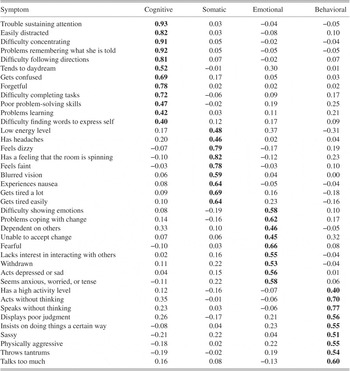
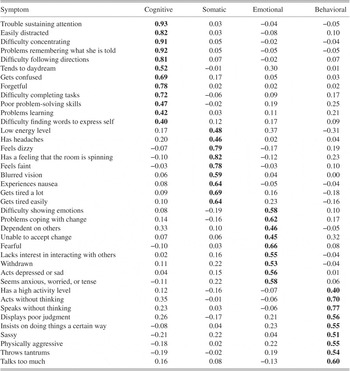
A comparison of the refined child and parent matrices demonstrated similar cognitive and somatic factors. Thus, for the final revision of the target matrix, items that had significant loadings for both parents and children on those factors were retained. Because the factor matrix for child-reported symptoms did not demonstrate clear emotional or behavioral factors, items were retained for those dimensions based on factor loadings for parent-reported symptoms. The final factor analysis suggested moderate fit for parent-reported symptoms (RMSEA = 0.08). Table 1 shows the resulting factor loadings after target rotation for the baseline parent ratings. Correlations between the four factors ranged from r = 0.05 between the somatic and behavioral factors to r = 0.45 between the somatic and emotional factors. Correlations between the other factors were as follows: Cognitive and emotional, r = 0.43; cognitive and somatic, r = 0.35; behavioral and cognitive, r = 0.44; emotional and behavioral, r = 0.28.
Refined factor matrix for parent ratings at the initial assessment

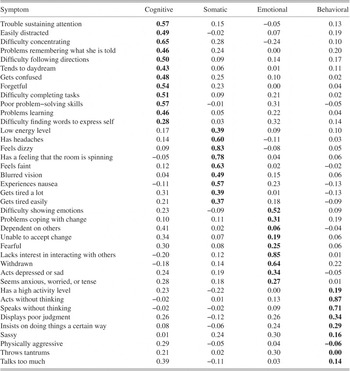
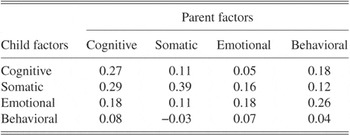
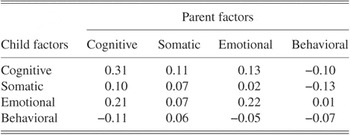
The final factor analysis of child-reported symptoms demonstrated strong cognitive and somatic factor loadings, moderate loadings for the emotional factors, and low loadings for the behavioral factor. The overall fit of the model was moderate (RMSEA = 0.07). Table 2 shows the resulting factor loadings for the baseline child ratings after target rotation. Correlations between the four factors ranged from r = 0.34 for the somatic and behavioral factors to r = 0.53 for the cognitive and somatic factors. Correlations between other factors were as follows: Cognitive and somatic, r = 0.53; cognitive and emotional, r = 0.50; somatic and emotional, r = 0.41; emotional and behavioral, r = 0.35. Correlations between the child and parent factors were modest in magnitude, with only one exceeding .30; the largest correlations were between parent and child somatic factors (see Table 3).
Refined factor matrix for child ratings at the initial assessment

Factor correlations between child and parent factors for refined factor matrix at the initial assessment

Exploratory factor analyses with blind CF-Varimax oblique rotations were conducted for baseline symptom ratings, retaining from two to six factors. For parent ratings, a scree plot suggested retaining three or four factors. Four factors were chosen. Rotation indicated that these consisted of cognitive, somatic, emotional, and behavioral symptoms, respectively. For child ratings, a scree plot suggested retaining two factors. Rotation indicated that these consisted primarily of cognitive and somatic symptoms. Thus, the results of the exploratory analyses were generally consistent with the target rotations described above.
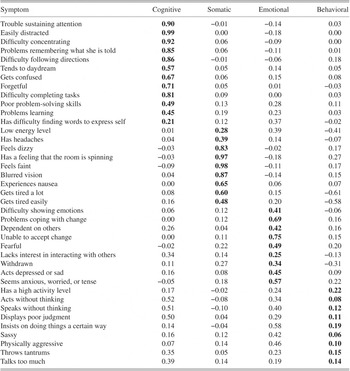
Using the refined target matrix from the baseline analyses, factor analyses were performed using parent and child symptom ratings at 3 months after injury. The analysis of parent-reported symptoms suggested a moderate fit (RMSEA = 0.09). Target rotation showed that cognitive, somatic, and emotional factor loadings were consistent with baseline analyses, but the behavioral factor did not produce any strong loadings (see Table 4). Correlations between the four factors ranged from −0.02 between the emotional and behavioral factors to 0.65 between the cognitive and emotional factors. Correlations between other factors were as follows: Cognitive and somatic, r = 0.39; cognitive and behavioral, r = 0.09; somatic and emotional, r = 0.41; somatic and behavioral, r = 0.05.
Refined factor matrix for parent ratings at the 3 month assessment

The analysis of child-reported symptoms also showed a moderate fit (RMSEA = 0.07), and yielded results consistent with the analyses of baseline ratings. Specifically, the cognitive and somatic factors had strong loadings, the emotional factor had moderate loadings, and the behavioral factor had only low loadings (see Table 5). Correlations between the four factors ranged from r = 0.02 between the behavioral and somatic factors to r = 0.64 between the cognitive and emotional factors. Correlations between other factors were as follows: Cognitive and somatic, r = 0.49; behavioral and emotional, r = 0.10; somatic and emotional, r = 0.39; cognitive and behavioral, r = 0.07. Correlations between the child and parent factors were generally small in magnitude, with only the correlation between cognitive factors exceeding .30 (see Table 6).
Refined factor matrix for child ratings at the 3 month assessment

Factor correlations between child and parent factors for refined factor matrix at the 3 month assessment

Thus, the cognitive and somatic factors identified based on baseline ratings showed substantial configural invariance across time for both parents and children, and the emotional factor showed moderate configural invariance across time. In contrast, the behavioral factor did not demonstrate configural invariance across time for either parents or children.
The secondary goal of the study was to compare parent-child agreement regarding the dimensions of PCS. As can be seen in Tables 1, 2, 4, and 5, parents and children demonstrated substantial configural invariance for cognitive and somatic symptom dimensions. Although absolute factor loadings tended to be lower for children, the symptoms that loaded on these two factors were highly similar for parents and children. In contrast, configural invariance was less robust for emotional and behavioral symptom dimensions. For the emotional factor, parents displayed relatively high and consistent loadings as compared with children. The behavioral factor yielded significant loadings only for parent ratings at baseline; it did not emerge for parent ratings at 3 months or for child ratings at either occasion. Despite substantial configural invariance for cognitive and somatic symptom dimensions, the correlations between child and parent factors were quite modest (see Tables 3 and 6).
DISCUSSION
The primary goal of the current study was to examine the dimensions of PCS in children with mild TBI, based on parent and child ratings. The results of factor analyses with target rotation suggest three replicable dimensions of PCS based on parent ratings, reflecting cognitive, somatic, and emotional symptoms, which emerged both at baseline and 3-months post injury. A fourth dimension representing behavioral symptoms was identified based on baseline ratings, but did not emerge from analyses based on ratings at 3-months post injury. Although we had hypothesized an additional behavioral factor based on previous research on the outcome of moderate to severe TBI in children (Barry et al., Reference Barry, Taylor, Klein and Yeates1996; Yeates et al., Reference Yeates, Taylor, Barry, Drotar, Wade and Stancin2001), the findings suggest that behavioral symptoms are not likely to represent a consistent part of the constellation of PCS in children with mild TBI.
For child-reported symptoms, factor analyses consistently identified two dimensions of PCS, represented by cognitive and somatic symptoms, which emerged at both occasions. A third dimension, represented by emotional symptoms, may have some validity for children, although the factor loadings for that dimension were lower than those for the cognitive and somatic dimensions. A factor based on behavioral symptoms was not evident based on child ratings at either baseline or 3 months post injury, providing further evidence that behavioral symptoms do not represent a coherent grouping commonly seen after mild TBI in children.
The secondary goal of the study was to assess parent-child agreement regarding the dimensions of PCS. The cognitive and somatic dimensions were similar across parents and children, such that items with significant factor loadings for these two factors were highly similar across groups. In contrast, configural invariance across parents and children was only modest for the emotional dimension, and extremely poor for the behavioral dimension, even at baseline. These results suggest that the structure of PCS is similar for parents and children when ratings involve cognitive and somatic symptoms, somewhat less consistent for emotional symptoms, and not at all invariant for behavioral symptoms. In the future, direct tests of measurement invariance comparing children and parents on the cognitive, somatic, and possibly emotional symptom dimensions should be undertaken using confirmatory factor analyses (Millsap & Meredith, Reference Millsap, Meredith, Cudeck and MacCallum2007).
Although the structure of PCS is similar for parents and children following mild TBI, correlations between parent and child factors were modest, with only cognitive and somatic factors demonstrating moderate correlations. Future research will be needed to determine whether parents and children agree on the occurrence or severity of PCS, as opposed to their dimensional structure. Based on the existing literature on cross-informant agreement (Achenbach, Reference Achenbach2006; Edelbrock et al., Reference Edelbrock, Costello, Dulcan, Conover and Kala1986; Hodges et al., Reference Hodges, Gordon and Lennon1990), only moderate concordance is likely between parent and child symptom reports, consistent with the modest correlations between child and parent factors found here.
The symptom dimensions identified in this study are similar in many respects to those found in studies of adults who have sustained mild TBI (Axlerod et al., 1996; Bohnen et al., Reference Bohnen, Wijnen, Twijnstra, Zutphen and Jolles1995; Cicerone & Kalmar, Reference Cicerone and Kalmar1995; Piland et al., Reference Piland, Motl, Guskiewicz, McCrea and Ferrara2006). We believe this is the first published study to examine the structure of PCS in children with mild TBI. Thus, the findings replicate and extend previous research on the dimensions of PCS by suggesting that cognitive, somatic, and emotional symptom dimensions are also characteristic of children with mild TBI, whether rated by parents or by the children themselves.
The cognitive, somatic, and emotional dimensions that emerged in this study, as well as in studies of adults of mild TBI, include many of the symptoms listed in the ICD-10 diagnostic criteria for Post-Concussion Syndrome (World Health Organization, 1992) and the DSM-IV research criteria for Post-Concussive Disorder (American Psychiatric Association, 1994). As noted earlier, however, the DSM-IV and ICD-10 have different diagnostic criteria, including partially overlapping lists of PCS, the validity of which is uncertain (Boake et al., Reference Boake, McCauley, Levin, Contant, Song, Brown, Goodman, Brundage, Diaz-Marcham and Merritt2004, Reference Boake, McCauley, Levin, Pedroza, Contant, Song, Brown, Goodman, Brundage and Diaz-Marcham2005; Yeates & Taylor, Reference Yeates and Taylor2005). The current findings, together with the past literature, set the stage for possible refinements of the ICD-10 and DSM-IV criteria, by identifying replicable and distinct dimensions of symptoms that may arise following mild TBI. The research to date suggests that diagnostic criteria for postconcussive syndrome should refer to specific dimensions of symptoms (i.e., somatic, cognitive, emotional) derived from empirical, factor analytic studies, rather than to a generic list of individual symptoms.
One potential limitation of the current study is the sample size. A participant-to-variable ratio of 5:1 is often considered to be the minimum needed to conduct a valid factor analysis (Gorsuch, Reference Gorsuch1983). The current sample size falls a bit short on that score. However, traditional guidelines regarding participant-to-variables ratio are not statistically defensible (Fabrigar et al., Reference Fabrigar, Wegener, MacCallum and Strahan1999; Floyd & Widaman, 1995). Recent research indicates that an adequate sample size for factor analysis depends on the communalities of measured variables and the number of variables with substantial loadings per factor, rather than on the number of variables per se (Guadagnoli & Velicer, Reference Guadagnoli and Velicer1988; MacCallum et al., Reference MacCallum, Widaman, Zhang and Hong1999; Velicer & Fava, Reference Velicer and Fava1998). When communalties are relatively high and factors are overdetermined (i.e., represented by at least three or four variables), accurate parameter estimates can be obtained with samples as small as 100. Based on the magnitude of communalities for individual items and overdetermination of most factors in the analyses reported in this study, we believe the current sample is sufficiently large to yield valid findings. Nonetheless, the results should be replicated in other samples.
The current findings do not directly address the ongoing controversy regarding the outcomes of mild TBI in children. The inconsistency between studies using standardized cognitive testing as opposed to subjective symptom reports to assess outcomes remains a major source of debate in the scientific literature regarding TBI (Yeates & Taylor, Reference Yeates and Taylor2005). Future research is needed to examine whether children with mild TBI demonstrate more PCS than children with injuries not involving the head or healthy children and whether any differences between groups persist over time. Notably, the current findings suggest the need to examine specific dimensions of PCS, which could be differentially sensitive to the effects of mild TBI and show different time courses post injury.
The identification of specific dimensions of PCS may also help to quell the ongoing controversy regarding the determinants of those symptoms, often framed in terms of “psychogenesis versus physiogenesis” (Alexander, Reference Alexander1997; Lishman, Reference Lishman1988). Research with children and adults indicates that both injury characteristics and noninjury related variables help explain outcomes following mild TBI, with noninjury related variables often accounting for relatively more variance (Luis et al., Reference Luis, Vanderploeg and Curtiss2003; Ponsford et al., Reference Ponsford, Willmott, Rothwell, Cameron, Ayton, Nelms, Curran and Ng1999, Reference Ponsford, Willmott, Rothwell, Cameron, Kelly, Nelms, Curran and Ng2000). However, the contributions of injury characteristics and noninjury related factors may well vary as a function of both symptom type and time post injury. In a previous study of children with moderate to severe TBI, we showed that different symptom types were related in distinct ways to injury and noninjury related risk factors at different intervals following injury (Yeates et al., Reference Yeates, Taylor, Barry, Drotar, Wade and Stancin2001). For instance, post-injury parent and family adjustment predicted emotional and behavioral symptoms but not cognitive and somatic symptoms, and injury severity was a stronger predictor of cognitive and somatic symptoms immediately post injury than later during recovery. The current results suggest that future research should examine specific dimensions of PCS over time when attempting to determine the relative contributions of injury characteristics and noninjury related variables as predictors of PCS following mild TBI in children. In the future, we intend to present analyses along these lines, based on the larger parent study that served as the basis for this study.
ACKNOWLEDGMENTS
The research reported here served as the basis for a dissertation submitted by the first author to The Ohio State University in partial fulfillment of the requirements for a doctoral degree. Portions of the research were presented at the annual meeting of the International Neuropsychological Society, Boston, February 2006. The larger project from which the research was derived was supported by grants R01 HD39834 and K02 HD44099 from the National Institute of Child Health and Human Development to the second author.
APPENDIX A
Parent Version of Health and Behavior Inventory
Directions: Below is a list of problems that your child may or may not have. For each problem, please rate your child based on the last week using the scale below.

APPENDIX B
Child Version of Health and Behavior Inventory
Directions: Below is a list of problems you may or may not have. For each problem, please rate yourself using the scale below based on the last week.