In the Plateau neighborhood of Dakar, Ahmed Kane wrote an article for his school newspaper. He penned his words just blocks from the Place de l'Indépendence where, eight years earlier, Senegalese people gathered to celebrate Senegal's independence from France. The year 1968 was known for protests at university campuses across the world, including at the University of Dakar. Yet at the Catholic high school of Saint-Michel, Kane had a different message. ‘Do not forget that we are the hope of Senegal’, he exhorted his classmates.Footnote 2 As class president, he asserted that they must ‘understand the necessity of discipline, because the school is a nation in miniature: a poorly disciplined student will be a bad citizen’.Footnote 3
Kane's words offer a glimpse into how formative these schools were for a key generation of schoolchildren who came of age as their countries were born. Through teaching a set of moral values explicitly linking school behavior to civic behavior, as well as individual actions to communal goals, Catholic schools provided a blueprint for Catholic-inflected civic engagement. Administrators and teachers did this by inculcating a comprehensive set of habits, most intensified in a boarding school setting. As ‘nation[s] in miniature’, Catholic schools taught a Catholic civism that emphasized public service, self-discipline, moral restraint, honesty, and community. This community was comprised of students from various faiths, regions, ethnicities, and socioeconomic backgrounds. As single-sex environments, they encouraged gender-specific notions of civic duty while providing unprecedented educational opportunities for boys and especially girls. Catholic schools thus both encouraged uniformity and celebrated difference. Catholic civism, as I have termed it, embodies the balance between these two tendencies.
Students were meant to live this Catholic civism both while in school and once they graduated. When interviewed many decades after graduating, alumni attested to school's indelible mark on their lives. They thus demonstrate what values Catholic-educated youth held fast to in a moment of profound political transition. Though French funding, missionaries, and curricula set these schools into motion, they became a training ground for what independent West Africa might be. Catholic schools were sites to instantiate visions of how to live together as responsible members of a community-oriented society. Catholic civism accounts both for the formative role students perceived their Catholic schooling to have in their lives, and for the significance of these schools as institutions that thrived during both colonial and independent rule. Students self-identified as a distinctly important social group that was ‘the hope’, in Kane's words, of their new nations, by embodying the hallmarks of Catholic civism. These values and habits had a life beyond Catholic school, as alumni intentionally applied them to their professional lives. In their own estimation, this influenced their workplaces, communities, and countries.
The relative obscurity of this influential social group is the product of overlapping scholarly blind spots. Emphasis on laïque and nationalist actors in this era has obscured transnational, religiously affiliated actors. The scarce attention paid to Catholic school students is further reinforced by overly narrow paradigms of social change.Footnote 4 As part of the move to include Africa in the ‘global 1960s’, scholars have addressed the African university protests in 1968, looking at students through the prism of rebellion and higher education. Indeed, scholars place 1968 on a continuum of radical student politics with origins in the decades prior.Footnote 5 This article adopts an alternate perspective, shifting the focus to younger students and those who reconfigured systems rather than rebelling against them. In seeking to compensate for earlier histories that shortchanged African actors, Africanists have focused on anti-imperial movements at the expense of the comparatively subtler process of remaking the region in which many Catholic students, alumni, and teachers engaged.Footnote 6 Moreover, historians of education have tended to concentrate on public or Muslim schools rather than Catholic ones, and on the colonial era instead of the aftermath of decolonization.Footnote 7
Students’ experiences serve as a reminder that independence did not necessarily mark a drastic shift in people's daily lives, and Catholic education was no exception. Indeed, as Elizabeth Foster and Giuliana Chamedes observe, scholars who focus on religious communities often find continuity rather than rupture at the moment of decolonization.Footnote 8 Especially in the cases of Benin and Senegal, where independence was relatively smooth, the changes in education were gradual. Largely respectful of hierarchy and of their past, Catholic school students nevertheless pushed the boundaries of achievement. Alumni attribute their civic-mindedness and work ethic to their school years, insisting that it motivated their careers in public service. To demonstrate that students used these Catholic, colonial-era institutions to navigate independent, multireligious West Africa is not to show continuity as stagnancy, but rather to showcase the adaptability of the values of Catholic civism from one political and social reality to another.
CATHOLIC EDUCATION IN INDEPENDENT WEST AFRICA
The main turning point for Catholic education in West Africa came not with independence in 1960, but earlier. In 1946, the French government funded a range of infrastructural projects in West Africa and across the empire through a program known as the Investment Fund for Economic and Social Development, or by its French acronym, FIDES. This funding continued after decolonization, though FIDES changed part of its name to Cooperation one year prior, in 1959. The government invested in infrastructure such as bridges, roads, schools, and hospitals. In keeping with the policy of laïcité, the French state subsidized religious as well as public schools. In this case, the administration allocated the majority of FIDES funds earmarked for education to Catholic schools, dramatically increasing the number of such schools in West Africa. The postwar turning point was due not only to the sharp quantitative increase in French funding, but also to a qualitative shift by which schools were charged with catering to all, not just the elites. The amount and proportion of FIDES or Cooperation funding for Catholic schools varied over time, as did contributions from territorial and local governments. Missionary societies also shouldered as much as half of the costs.Footnote 9 Both in their own estimation and by general opinion, those who attended schools during this period would become the new elite of West Africa. The students came from a range of backgrounds, the sons and daughters of civil servants as well as illiterate farmers, fisherman, and pastoralists.Footnote 10 Ruth Schachter Morgenthau has noted how one generation prior to the students described here – the small minority of those who were educated pre-1945 – took up important government posts.Footnote 11 This trend continued, and indeed accelerated, among Catholic school alumni in the 1960s and 1970s.
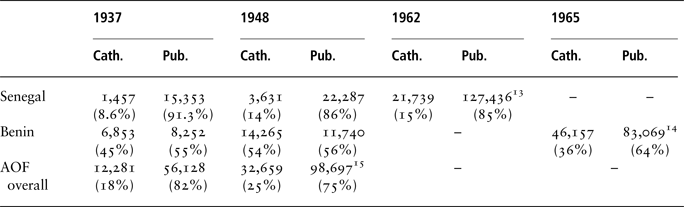
Schooling statistics suggest a consistent increase in schooling over the period when this cohort of students experienced such unprecedented social mobility. The number of Catholic school students increased almost threefold in the 1950s and continued to multiply after 1960 (Table 1).Footnote 12 By the 1948–9 school year, one in three French West African students attended a Catholic school. The number of public school students also grew during this time. Whereas in Senegal the proportion of Catholic school and public school students remained relatively constant from the 1940s to the 1960s, in Benin, Catholic school students went from being a majority to a sizeable minority during the same period. Though the overall rate of school attendance was higher in Senegal and Benin than most other West African territories, schooling was still out of reach for many. Rates of school attendance in Senegal and Benin still hovered between 25 and 30 per cent. Thus, while schooling remained elusive for many, it nevertheless became increasingly common. These Catholic schools are therefore emblematic of the tensions and possibilities of the growing ranks of schooled youth across the region.
Number of students enrolled in Catholic and public schools.

Analyzing Catholic schools’ role in promoting Catholic-inflected habits and values in two countries – Senegal and Benin – offers at once a political and religious contrast and an educational similarity. Senegal is a majority Muslim country, and Dakar was the capital of the French empire in West Africa. The first president of independent Senegal, Léopold Sédar Senghor, was Catholic and part of a well-established Catholic elite. As a legacy of early Portuguese settlement, Benin had a large Catholic population and an educated populace second to Senegal.Footnote 16 Consequently, Senegalese and Beninois were over-represented in French West African-wide schools as well as in civil service positions.Footnote 17
Most alumni quoted in this article graduated from high school between 1966 and 1972. Concentrating on this narrow timespan demonstrates the consistency of experiences of alumni whose school years bridged the colonial and independence eras. Given that alumni insisted on connections between their schooling and their engagement with society as adults, it is worth examining what was so formative about Catholic education. Centering on these students’ experiences is predicated on the conviction that their qualitative significance, as the new elite of their countries, went beyond their numbers. The nature of the interview process, whereby alumni self-selected to speak with me, means that this group may skew towards more positive associations with Catholic schooling than the Catholic school alumni population more broadly.
Nevertheless, these oral histories are suggestive of how a significant portion of the students experienced Catholic schooling, both at the time and retrospectively as adults. Indeed, alumni continue to meet as part of alumni associations, maintaining social and professional ties as well as a group identity. Inclusion of several alumni who graduated earlier and later than the target group demonstrates the consistency of the hallmark aspects of Catholic education beyond the age band under primary consideration. Further, a focus on the commonalities in student experience between Benin and Senegal speaks to a broader story of Catholic schools as sites for instilling values across West Africa, as well as suggests parallels with Catholic schools beyond the region. Since the tenets of Catholic civism were legible within school grounds as well as externally as visible behaviors, it signaled a larger public the convictions of this key cohort of alumni.
Catholic schools coexisted alongside Koranic and public ones, employing teachers from various backgrounds. Since demand for schooling tended to outstrip supply, Catholic and public schools did not often compete for students. Indeed, local governments frequently treated both types of schools as part of the same educational system. Many students, including those quoted here, attended both Catholic and public schools at various points, making the distinction they drew between the two systems all the more striking. The teaching staff was comprised of a combination of missionary and lay people, both West African and European. Over time, West African clergy and laypeople made up a larger proportion of the teaching staff, especially at the primary school level. However, metropolitan French nationals still comprised a significant percentage of the teaching staff, and often the head of school, even after independence, was European, likely clergy.Footnote 18
The ethos of Catholic civism permeated those who were not themselves Catholic. Muslim students attended Catholic schools in significant numbers, the exact proportion varying depending on the region or town. Indeed, as Ahmed Kane's name suggests, he – the class president of Saint-Michel – came from a Muslim family. Catholic schools did not actively seek to convert Muslims. This was in keeping with the missionary strategy from the outset of their presence in the region; missionaries were more concentrated on converting non-Muslims. Muslim students were integrated into the Catholic rhythms that suffused the school day. Catholic education – and, by extension, Catholic civism – were thus capacious enough to encompass non-Catholics.
Catholic civism was not primarily tied to Catholic doctrine, but rather was comprised of values and habits that were a part of students’ lived experience in schools. Indeed, since Catholicism permeated the school environment and many public schools lacked similar environment, which also enjoyed superior facilities, they became an indelible part of the Catholic educational experience for students. Further, these experiences formed the basis for the traits that they believe set them apart from their peers who did not attend Catholic schools. Catholic school officials may have encouraged the idea of Catholic schools as a ‘nation in miniature’, instilling Catholic civism in their students, but it was the students themselves who ensured that these values resonated and had staying power. They took ownership over the key habits that they developed in Catholic school, choosing to apply them beyond their school years.
EDUCATIONAL DUALITIES AND RELIGIOUS PLURALITIES
Undergirding all aspects of Catholic schooling was the idea of engaging the spiritual and intellectual in tandem to develop the ‘whole person’. This concept guided both Catholic school administrators and teachers. It was inculcated at all echelons of the Catholic hierarchy, from regional organizations to individual schools. As a moral and academic duality, it expressly encompassed students of all religious backgrounds. The ‘whole person’ was not based on knowledge of liturgy or on other articles of faith, but instead on deeds and acts. Emphasizing the academic and moral underpinnings of daily habits such as honesty, time management, discipline, and a strong work ethic created a common set of values that Catholic school alumni believe set them apart from others. They further contend that these skills continued to influence them in their adult lives. Rather than attesting to internal divisions between students from different backgrounds, students generally expressed positive identification with those who had attended Catholic school, perceiving themselves as distinct from those who did not have the same educational experience. The main demarcation, then, was not among Catholic school students, but instead between Catholic school alumni and the alumni of non-Catholic institutions. What separated the two, from the Catholic alumni perspective, was whether they were oriented around this holistic idea of education.
Alumni may have exaggerated the perceived difference between Catholic school graduates and others. However, the fact that many insisted on this distinction is revealing of the extent to which they imbibed and sought to embody it. Their belief in the superiority of Catholic schools led many to send their own children to them, when possible.Footnote 19 Those who did not send their children to Catholic school often did not have the possibility. In the case of Benin, the government secularized all schools during the years this generation's children attended school. Further, in both Senegal and Benin, those alumni who went on to teach in public schools could not send their children to Catholic schools without negative professional repercussions. Nevertheless, those who did not send their children to Catholic school still maintained their own, strong identification with fellow Catholic school alumni.
Alumni were not alone in their insistence on the distinctiveness of Catholic schooling. Official terminology reflected a contrast between a more reductive view of education and the Catholic schools’ more expansive one. Educational and school officials often distinguished between instructing and educating (instruire and éduquer), the latter of which included the moral education of students to ‘form souls according to the divine law’.Footnote 20 The verb éduquer means something that is distinct from the English verb ‘to educate’, the former referring more to overall upbringing and comportment rather than strictly academic pursuits. In this regard, Catholic educators believed that it was not the times reserved for prayer and mass that made the school Catholic, but rather that ‘a spirit … should penetrate all of our teaching’, including the textbooks themselves, which must ‘breathe the Christian spirit’.Footnote 21 For Catholic school leaders and teachers, preparing students to be good people was synonymous with a religious upbringing. In the words of the Episcopal Conference of bishops in charge of West African Catholic education, ‘The human formation and the religious formation can be neither parallel nor successive, but one needs to be imbricated in the other.’Footnote 22 A report of the chaplaincy of Collège Aupiais in Cotonou, Benin, used very similar language, stating the importance of ‘the education of the person not only to have a full head, but also to have a balanced heart’.Footnote 23
This conception of éducation was consistent across the Catholic hierarchy as well as according to alumni recollections. At its base, it relied on the integration of religion throughout the school day. Thérèse Faye recalled how each class began with the teacher leading a prayer.Footnote 24 Catholic students were also required to go to mass on Sundays.Footnote 25 Issa Kpara (‘68), who was a boarding student at the Catholic Collège Aupiais in Cotonou, Benin, believed that this ‘puts you in an environment of reflection’, and allowed you to see your teachers as ‘spiritual educators’.Footnote 26 Teachers and administrators were not only concerned with strictly scholastic pursuits, but also ‘tried to form the heart’, said André Kochoni (‘66).Footnote 27
The ‘whole person’ was also supposed to be an ethically grounded citizen, first of France, and later of the newly formed African nations.Footnote 28 Strikingly, the language as well as the logic of citizenship carried over from the colonial era to the independent era. After decolonization, West African Catholic organizations emphasized that national development was not just about economic progress, but also about ‘the good of every man and of the whole man’.Footnote 29 In a 1967 meeting of the Episcopal Conference, the clergy in attendance stated the aim of Catholic education was to educate the ‘human person in his totality, his intellectual faculties no less than his willingness and his instincts, the future hardworking and honest citizen, the Christian son of God participating in the celestial vocation’.Footnote 30 Here, the ‘celestial vocation’ and good citizenship are joined as core values, with individual development paralleling national development. Similarly, students referred to themselves in a school newspaper as ‘young citizens’ and urged their classmates to progressively assume more civic responsibilities as they progressed towards adulthood.Footnote 31 Nevertheless, the transition to adulthood looked different for males and females, and the concept of the ‘whole person’ remained a gendered one.
Students rehearsed the application of school lessons to adult life while in school, often by debating key political and ethical issues in class. In Senegal, a class on moral principles, known as morals class (la morale), was generally reserved for Muslim students, while Catholic students attended a class in which they learned about Catholicism. Morals class at Saint-Michel in Dakar was held for one hour per week. In one such morals class, students (named in parentheses) discussed such topics as racial segregation (Boubacar Diallo), youth (El Hadj Guèye), and African unity (Cheikh Kamara). The class took the format of a student doing an exposé, followed by a class-wide debate. A student reported that ‘in our class, you would think you were at a national assembly meeting due to the importance of the questions that students are discussing’.Footnote 32 In likening the class to a national assembly meeting, the student connected scholastic pursuits to political ones. Saint-Michel students engaged in similar debates in the student newspaper, exploring such questions as ‘Can we be happy when our brothers suffer?’Footnote 33 In facilitating debates about politically pressing issues, Catholic schools imbued a sense of social engagement in all students, regardless of religious background. It is unclear whether equivalent, overtly political conversations occurred at girls’ schools.
That the precepts of Catholic civism resonated with a multireligious student body helped them permeate student and alumni life. Alumni spoke openly of this religious pluralism. Thérèse Faye, herself Catholic, recounted that the Catholic school that she attended in Senegal was very welcoming of the many Muslim students. Yet at the same time, ‘the spirit [of the school] remained Christian’.Footnote 34 Coura Sarr (‘72), a Senegalese Muslim, said her parents sent her and her sister to Catholic school because of the quality of the education and were unconcerned about them being converted. In Senegal, ‘Muslim students make Catholic schools work [marcher]’, she declared, matter of factly.Footnote 35 The demographics in Senegal are such that the Catholic schools would have had significantly fewer students to draw from if they excluded or alienated Muslims.
While many of the values students learned in Catholic school were not exclusively Catholic, students nevertheless associated these values with Catholic school. Since Catholic schools were the sites where they imbibed and practiced these values, alumni perceived these values as something distinctively exhibited by Catholic school alumni. These values are a central component of their self-identification as a distinct social group, which both reinforces and is made possible by the conviction of the staying power of what they learned in school. Thus, Catholic civism's values were purposefully constructed to be broad enough to appeal to Catholics and non-Catholics alike, resonating so profoundly in a society that was not largely Catholic.
STRENGTH IN UNITY, STRENGTH IN DIFFERENCE
An inclusive sense of Catholic-inflected civic duty is just one example of how Catholic schools struck the balance between celebrating and erasing difference. In so doing, schools imbued a sense of community that was to last beyond graduation. The bedrock of this staying power was a responsibility towards fellow classmates and the school. Following the same daily schedule under conditions that minimized socioeconomic differences, students developed a common sense of belonging and purpose that they believe influenced their professional trajectories. Fiercely loyal to their community, these students stood in contrast to the oppositional defiance that characterizes the historiography of youth around 1968.
Exemplifying this commitment to unity is an article in the 1968 edition of the Standard, the school newspaper for Saint-Michel school in Dakar. François Dieng, a contemporary and classmate of Ahmed Kane, wrote to his classmates:
Do not ignore the reputation of your collège, try to conserve it and augment it. You know that there is strength in unity; it is with this union that a climate of discipline and dialogue will reign among the students. Every student must take responsibility for conducting himself as an honest man, generous in his work and conscientious of the growth of our collège.Footnote 36
Dieng's sentiment of strength in unity was widespread in West African Catholic schools, and a key tenet of Catholic civism. It was inculcated through the daily rituals of the school day, further reinforced by the common affinities forged by living together in a single-sex boarding school. This sense of unity continued past graduation, as alumni continued to associate with one another through alumni associations, community involvement, and in the workplace.
Despite these educational similarities between Senegal and Benin, boarding schools operated quite differently in each case. In Benin, government scholarships covered boarding fees. Therefore, boarding schools were more common and the population was more economically heterogeneous than in Senegal, where boarding schools were fewer and largely reserved for those who could afford to pay full fees. The origins of these diverging practices are unclear. Nevertheless, the communal atmosphere of the boarding school undergirded all other aspects of the Catholic school experience, even for those who did not board.
Students formed enduring bonds through living and learning together. The fact that many in Benin received scholarships to board reinforced the impression that, in Marie-Paule Guidibi's (‘71) words, ‘the life of the boarding school is an opportunity’. For it was in the boarding schools that ‘you lived in a community. You d[id] everything together.’Footnote 37 Though they spoke of a rigorous, strict environment, alumni also testified to steadfast camaraderie. Indeed, the former likely reinforced the latter. Claire Ndiaye Mendy, Felicite Diatta Basse, and Marcelle Adams Dieng (‘67) recalled that their time in Catholic school in Senegal taught them not to be too individualist and how ‘to live in community’ (vivre en société), a phrase many Catholic school alumni used.Footnote 38 Issa Kpara stated that ‘[f]raternity of students was the first order’ at the school he attended in Benin.Footnote 39 Living in close quarters with those different from themselves meant that students became well accustomed to moving past differences towards group goals, a skill they later used as adults.
This sense of community extended beyond the classroom, as students learned responsibility through extracurricular activities. For instance, Catholic school teachers saw the communal effort of maintaining the school grounds as part of their education.Footnote 40 Students also undertook service projects in rural areas. For those from urban centers, this was often their first experience in a rural environment. Peveina Marie Madeleine Seck (‘74) said when she and her classmates went to villages in Senegal to do community work it was the first time she realized the difference in standards of living.Footnote 41 Now, with the alumnae association of the Catholic school she attended, she continues to undertake service projects in rural areas.Footnote 42 Those who came from privileged backgrounds were made aware of this fact, and those from more disadvantaged communities were given the tools to improve their socioeconomic standing.
This combination of humility and constructive training leveled the community such that everyone had a strong experience to draw on after graduating. Like Seck, many Catholic school alumni work in non-profit organizations or volunteer in their larger community. Cabral (‘70), who started an AIDS-related non-profit organization in Senegal with his wife, said his Catholic school experience inspired him to teach his own students to ‘do something for free for your own fulfillment … there is more than money in life’.Footnote 43 Catholic schooling not only influenced how alumni comported themselves in the workplace, but also motivated their very choice of profession in the first place. Among those alumni interviewed, many had chosen public service-oriented careers, and their perception was that Catholic school alumni chose these professions more than others, due to the education they had received.
The bylaws of the individual schools also reflected the commitment to communal values and equal treatment of students. The preamble of rules for the Collège Our Lady of Lourdes in Porto-Novo, Benin, stated that the school:
is a place for assiduous development of intellectual faculties, the exercise of judgment, the introduction of cultural patrimony inherited from past generations, promises the sense of values, preparation for professional life, and encourages a spirit of camaraderie between students of different social origins that facilitates mutual understanding.Footnote 44
An almost identical list of goals for schools circulated elsewhere in the diocese, such as in Liaison, a monthly newsletter for Catholic schools in Benin.Footnote 45 Students, regardless of background, ate the same food, wore the same uniform, and had the same books. Catholic schools facilitated camaraderie by de-emphasizing material differences.Footnote 46
Students also followed the same timetable. Unified around a common rhythm, punctuality undergirded all other values, providing structural as well as ideological cohesion. Alumni highlighted the inculcation of a strong work ethic linked to time management skills as a hallmark of their school experience that they applied to their adult lives. The director of Saint-Michel, Mr Etienne, was quoted in 1972 as saying: ‘He who has the habit of being late will be always behind in his work.’Footnote 47 Students’ habits were therefore engrained with a focus on their future achievement. They learned that their daily actions had long-ranging consequences. Even thirty to forty years removed from their boarding school experience, most alumni could still recall the precise time allocated to certain tasks. Many could recite their schedule in its entirety. Different components of the day occurred, said Guidibi, ‘at the exact time, not more, not less’.Footnote 48 Everything was permeated by discipline and rigor; as Ernest Pelebe (’66) remarked, ‘there was no place for indiscipline’.Footnote 49 Guidibi also remembered the exact times they woke up, took showers, did their chores (corveé), and ate. As with other aspects of the boarding schools, students associated these daily behaviors and their schedule with forming good, life-long practices. Guidibi appreciated that the day was ‘well-regulated’, because it meant that ‘you got into the habit of being orderly’.Footnote 50 Alphonse Diatta (‘77), too, credited this rigorous schedule with inculcating ‘good habits’, which he defined as getting up early, looking over lessons before school, and doing homework after school.Footnote 51
Alumni believe the hard work exacted from them as students gave them professional advantages after they graduated. This was both in real terms as it formed a strong work ethic, as well as in symbolic terms as the reputation for hard work gave them a certain prestige. Prestige combined with the perspective of hindsight meant that while alumni acknowledged that disciplinary measures were often quite harsh, they mostly believed this experience served them well. Alumni frequently echoed the sentiment expressed in a 1971 document about Catholic schools: ‘with the priests or nuns, one works seriously’.Footnote 52 Yet some admitted the discipline was excessive at times. Catholic schools often used corporal punishment. Though this was similar to medersas and public schools at the time, alumni nevertheless insisted on the distinctively strict nature of Catholic schools over and above other schools, especially public schools. This was therefore a widespread perception regardless of whether it was the reality. It also serves as a reminder that social cohesion is formed in large part by ostracizing those who failed to comply.
Alumni cited instances of public castigation as proof of the harshness that they experienced. For example, if a student had a disorganized notebook, a teacher clipped the notebook to the back of the student. The student was then forced to walk around that way during recess.Footnote 53 Students who were caught speaking a West African language instead of French faced a range of socially ostracizing punishments, from wearing a heavy object around their neck that visually marked them as having erred, to writing standards on the chalkboard, to policing their fellow classmates for similar infractions. Orou Yérima Korogone (‘68) recounted his first day of school, arriving with his suitcase and sleeping bag. He reassured himself that he would be greeted by fellow Christians, that someone would be waiting to welcome him. Instead the unsympathetic priest in charge asked him why he had a suitcase and sleeping bag. When Korogone explained that he knew there was no option to board at the school but that he needed a place to sleep, the priest put the suitcase and sleeping bag in his office, and without another word on the topic, simply ordered him to ‘Get to class!’ Korogone was responsible for finding a place to live, which fortunately he was able to do quickly.Footnote 54 Korogone's story illustrates how the schools’ strictness strengthened students’ own problem-solving skills. Being on the receiving end of harsh discipline also likely fostered a sense of camaraderie among the students.
Students placed discipline within the larger framework of preparation for adulthood, just as they were building other lifelong skills. Koda Diaw used this logic in an attempt to come to terms with the strict rules at Saint-Michel. In an article in the school's student newspaper, he admitted that he initially felt that the discipline was unnecessarily harsh. He then went on to insist that students were misguided if they thought that school was ‘a type of purgatory that you have to submit to before enjoying the paradise of unlimited liberties’. Instead, Diaw warned that adult life was much harsher than school: ‘life in a community demands a certain order, a certain discipline, often more illogical, even more inhumane than the relationship between teachers and adults in general towards children’.Footnote 55 He urged his fellow students to consider their school environment in comparison with what they would encounter after graduating, contending that school was a training ground for later civic engagement.
Diaw casts the idea of a ‘nation in miniature’ in a more critical light. Here, students must prove themselves and overcome hardships in order to progress from the nation in miniature to the nation at large. It also suggests that many students likely resisted and resented this discipline, and that their feelings about it in interviews may be tempered by time. Indeed, several alumni alluded with acrimony to teachers, both lay and clergy, whom they found to be too harsh. As Korogone's story also attests, camaraderie often stemmed from a common, difficult relationship with authority. Thus, bonds between students may have been a coping mechanism as much as being positively reinforced by administrators and teachers. Despite any misgivings on the part of students, those interviewed tended to credit their Catholic schooling with their solid moral grounding. They believe, at least in retrospect, that this outweighed the harshness that they endured.
While many students emphasized hard work and time management, they also stressed morality and honesty. Adama Sarr (‘74), a former Catholic school student in Senegal, declared that students who went to Catholic school were less likely to cheat, because good moral values were ‘anchored in their heads’. He continued: ‘All day at every instant, you're imbued with these values’.Footnote 56 Indeed, Kpara's memory of school echoed this sentiment, as he described it; ‘Everything was suffused with moral values.’Footnote 57 Bienvenu Antonio (‘66) explained ‘If you asked me to take all of the university's money, I would not take any of it.’Footnote 58 At the time of interviewing, Antonio was a philosophy professor at the University of Abomey-Calavi in Benin. Certainly, Koranic and other religiously affiliated schools also emphasized honesty. Yet it was the unparalleled scale and consistency, as well as the self-identified singularity of this pillar of Catholic civism, which meant it radiated so profoundly within and beyond school walls.
As alumni made the transition from honest students to honest workers, they insisted they could distinguish fellow alumni from those colleagues who had not attended a Catholic school. Three alumnae of Immaculate Conception School in Dakar, Claire Ndiaye Mendy, Felicite Diatta Basse, and Marcelle Adams Dieng, shared the conviction that they could tell who their fellow alumni were, that ‘one sees it automatically’ in the workplace.Footnote 59 They elaborated that Catholic school alumni can keep professional secrets, and that they have a ‘much more solid foundation’ for their work. ‘It was difficult, but at least we have the results today’, Mendy, Basse, and Dieng concluded.Footnote 60 Sarr concurred in his own assessment of coworkers from Catholic versus public schools, contending that ‘you notice a difference [in] how they behave, how they hold themselves, et cetera’.Footnote 61 These alumni felt a strong connection to others in the workplace who had attended Catholic school and who outwardly exhibited a set of moral traits. In insisting on applying values they learned in Catholic school, in this case honesty, to their professional lives, alumni implicitly critique corruption and dishonesty in the region. In this regard, Catholic school alumni disparaged others in their country who did not attend Catholic school and consequently, so they believed, had fewer moral scruples. Catholic civism, then, served the dual purpose of social critique and social marker.
The Catholic school community continued to serve as a touchstone for many alumni, providing a foundation of civic values for their adult lives. In spite or because of this aspect of implicit critique, Catholic civism demonstrates how youth strategically drew on these values in a register of contestation that was less overt than what one associates with youth based on the 1968 paradigm. Many alumni believe boarding school facilitated a personal transformation. Gisèle Acakpo (‘89) credited her Catholic school experience in Benin and her friendships there with the fact that she became more outgoing, assuming leadership roles. She led her diocese's female chapter of the Jeunesse Étudiante Chrétienne (Young Christian Students [JEC]), an international Catholic youth group. Acakpo reflected, ‘It is bizarre that [as an adult] today I talk a lot. I was a very timid girl.’Footnote 62 She originally became a teacher and subsequently became principal of a Catholic school. Acakpo, like many other alumni who pursued teaching, drew on her own educational experience for her students.
GENDERED CIVISM
Acakpo's trajectory also highlights the gender-specific empowerment that a Catholic education afforded many of its female students.Footnote 63 Catholic civism was gendered even as it provided unprecedented opportunities for female students. The single-sex environment of the schools not only lent itself to a particular type of camaraderie, but also meant that Catholic schools shaped gender-specific notions of civic responsibility. In addition to promoting strength in unity, gendered Catholic civism was one of the ways in which Catholic schools promoted strength through difference.
By 1965 in Benin, a girl who attended primary school was just as likely to attend a Catholic school as a public one.Footnote 64 This figure alone demonstrates the prominent role, heretofore understudied, of Catholic education for West African females. It is especially striking given that there were more students attending public school in Benin overall, suggesting that female students made up a greater proportion in Catholic schools than public schools. In Senegal at around this time, there were still more public schools, so the public schools educated more female students in absolute terms. However, the proportion of female students was higher in Catholic schools than public ones. Girls made up approximately 30 per cent of public primary school students versus 40 per cent of Catholic primary school students.Footnote 65 As the cases of Senegal and Benin make clear, girls’ education was a crucial part of Catholic education, even alongside the parallel growth in public schooling.
While boys’ schools generally offered a classical, academic curriculum, in some cases learning Latin, girls’ schools taught vocational and domestic skills that were considered feminine. Thérèse Laure Vinakpon (‘77) recalled that she and her classmates learned sewing, painting, and cooking in Senegal.Footnote 66 Others became skilled at stenography, embroidery, and accounting.Footnote 67 Beyond particular crafts and homemaking skills, female students learned how to comport themselves as respectable, Catholic women. Hougette Degboe (‘67) remembered, ‘The nuns inculcated in us the small good habits that Catholic women should know.’Footnote 68 Coura Sarr (‘72) in Senegal recalled that the nuns walked down the street with them to tell them how to carry themselves.Footnote 69 Many female students who attended all-girls Catholic schools remarked that they lived like sisters. Guidibi recalled how everyone braided one another's hair during their free time.Footnote 70
Catholic school teachers and administrators may have been responding to or anticipating concern from parents about educated women abandoning particular values and domestic responsibilities. The conservative elements of Catholicism made families of varying religious backgrounds feel comfortable sending their children to Catholic schools. One newsletter for the diocese of Abomey, Benin reassured the parents of Catholic school girls, declaring that a Catholic education
Dear parents, you complain sometimes that your children, well-versed in the ways of life coming from abroad, only emulate the aspects … that are questionable or defective, abandoning the values of our ancestral patrimony such as the respect due to elders, politeness, discretion, and modesty which define them as young ladies and women. Here [in Catholic schools] we insist on all of these traditional values because they are key to individual development, which is achieved through self- discipline, self-mastery, a sense for others, and courage in the face of difficulties and harshness in life.Footnote 71
The poignant image of borrowed masks suggests that parents’ fears of upending longstanding cultural practices were inflected along gender lines and more pronounced for daughters than sons.
Catholic schools naturally emphasized religious observance as the bedrock of female domestic responsibilities. Thérèse Faye worked at the Catholic school St Marie de Hann in Dakar at the time of her interview and is a graduate of Catholic school herself. She said that Catholic school taught her how to ‘integrate prayer at home with [her] family’ and she often leads prayers with her extended family.Footnote 72 Catholic schools thus prepared female graduates to take on spiritual leadership in the home. In teaching religious observance, Catholic schools facilitated a direct bridge between school lives and home lives.
While girls’ schools reinforced conventional notions of femininity, they also challenged them. In some cases, if particular upper-division science and mathematics courses were not available at the girls’ school, the students were allowed to take them at the nearest Catholic boys’ school.Footnote 73 Catholic school graduates were among the first female doctors, judges and scientists in Senegal and Benin. Olga Irène Aitchedi (‘74) worked as a judge, and prior to her retirement was one of three women to receive a scholarship to study law and work in the justice system in Benin.Footnote 74 Marie Thérèse Basse (‘56), a niece of former President of Senegal Senghor, was in the first class of female medical students in Dakar after having graduated from Catholic high school. She later worked for a scientific research institute, specializing in nutrition and food products. When Basse was promoted to head of the institute, she was met with resistance from male colleagues who called her Margaret Thatcher and Golda Meir.Footnote 75
Individual success stories notwithstanding, overall, fewer girls attended school than boys. This was especially true in rural areas. Emily Louise Adjobo (‘61), who started school in 1948, said that at her elementary school in Kilibo, Benin, they began with 43 girls, but only three, including herself, graduated.Footnote 76 By contrast, some families in both Benin and Senegal had been sending their daughters to Catholic school for generations prior to FIDES and Cooperation; several alumni interviewed were the third generation of females in their families to attend Catholic school.Footnote 77 Thus class, gender, and geography often intersected, meaning that Catholic schools provided unprecedented opportunities for some girls, while allowing others from more elite and urban milieu to continue a multigenerational tradition of Catholic school attendance. The gender-specific opportunity for female Catholic school graduates illustrates well the combination of conservative and progressive repercussions of Catholic education. On the one hand, female students were taught very conventional notions of what it meant to be a good Catholic woman. Yet perhaps it was this seemingly unthreatening stance that allowed for them to move past gender-specific limits and achieve professional milestones. Female Catholic school alumnae suggest even more strongly than male alumni that social change does not always happen through dramatic confrontation.
Despite the differences in educational content, Catholic girls’ schools taught their students that they were important to the future of the nation, just as the boys’ schools did. The school song for Joan of Arc High School in Abomey, Benin, as sung from memory by several of its alumnae, reflects this notion. One verse states: ‘Here we begin/ to fulfil our mission. Benin awaits us/It counts on its children.’Footnote 78 Female graduates had an important role to play in newly formed nations that both continued and broke with gendered notions of civic duty. They assumed leadership roles in traditionally male-dominated sectors of the workforce. By their very existence as lawyers, judges, doctors, and heads of NGOs, female alumni embodied Catholic civism.
REGIONAL INTEGRATION
While school campuses were homogenous in terms of gender, the students were heterogeneous in terms of regional provenance. Catholic civism encouraged the creation of a cohesive student body, a ‘nation in miniature’ that hewed to a singular – though capacious – sense of civic purpose. Students celebrated their heterogeneity through cultivating regional and ethnic affinities. Issa Kpara recalled that at Collège Aupiais in Cotonou, Benin, students formed clubs in order to study West African languages. There were regional orchestras and choirs that sang in West African languages. Catholic schools were also not as exclusively tied to the French-style curriculum as the French archival record suggests. Kpara was a member of a literary club that read African literature not part of the formal curriculum.Footnote 79 School newspapers showcased students’ views, albeit with some adult oversight.
Students lived alongside others from regions and communities different from their own, forging common experiences as Senegalese or Beninois. Catholic schools thus socialized them into a particular community. This sense of community was not uniquely Catholic. Yet Catholic schools attracted students from throughout the country. By contrast, public schools, especially if they did not have a boarding option, would have attracted mostly local students. This makes Kane's concept of the ‘nation in miniature’ quite literal. Indeed, Catholic schools and similarly elite educational institutions were some of the few sites for the convergence of people from all parts of the country – a rare and crucial commingling for newly formed countries. Significantly, when students identified with one another after graduating, it was due to common loyalty to the school, rather than a common region, ethnicity, or religion.
Nevertheless, acclimatization was often more pronounced for those who came from rural areas. Despite the overall increase in schools, there were much denser networks of schools in coastal, urban areas than in interior regions. This meant that those from less well-serviced areas often went to school far away from where they grew up. Students – especially those from northern Benin or the eastern Senegal – often described their first experience at school as dépaysé or as feeling out of place. Many contrasted this to how they later felt at ease once they adapted. Before these students even arrived at Catholic school, they had already experienced considerable social estrangement. Hamade Faye (‘85) explained that when parents from rural Senegal sent their children to school, everyone in the village talked about it, asking: who would tend the fields? But, in his case, his uncle ‘closed his eyes to all of this’.Footnote 80 Ernest Pelebe came from a rural community in Benin that grew tobacco and hunted. He described himself as ‘very tied to traditional life of the village’. However, the village policeman obliged him to go to school. He remembered that ‘the day that I severed ties with this [village life] to go to school there was a lot of crying. [But] after a few months, I was accustomed to my new life.’Footnote 81 Pelebe's word choice in describing the transition to Catholic school as a ‘severing’ and starting a ‘new life’ highlights how attending Catholic school often entailed a rupture with a community even as it created a new one.
CONCLUSION: RE-EXAMINING SOCIAL CHANGE
While many of the values of Catholic civism were filtered down the administrative and religious hierarchy, it was the initiative of students, teachers, and administrators that perpetuated these values. At the confluence of prestige, financial resources, and a holistic sense of rigor, Catholic schools proved transformative for those who attended them across West Africa. Rather than openly antagonistic dissent, like the movements that crystallized around 1968, Catholic school students and alumni tell a different story of social change. By raising flags instead of burning them, these students definitively shaped their nations. Though they had different agendas, their investment in their school and larger communities often overlapped with the French government's intensified interest in continued influence in the wake of decolonization. Looking beyond the dichotomy of rebellion and obedience, Catholic schools demonstrate how social change is not always radical, but instead is often incremental. While Catholic schools offered gendered versions of civic duty, they nevertheless were sites where students from different socioeconomic, religious, and regional backgrounds formed lasting affinities. These schools were increasingly numerous in the decades before and after independence, yet still the experience of a limited number of youth. Thus, West African Catholic school alumni were widespread enough to be recognizable as a cohesive social group, yet still in a limited enough subset of the population to be of high value, distinguishing those who attended them from the many who did not have such educational opportunities.
Looking beyond the paradigm of 1968, we can see a broader range of scholastic experiences that shaped youth's civic engagement while in school and after they graduated. This is important not only historiographically, but also historically. Though the alumni interviewed were a self-selecting group, they nevertheless demonstrate how crucial the maintenance of ties with their schoolmates was. The bonds forged in boarding school outlasted the formal school years, and have had larger societal reverberations. To cite just one example of many, Thérèse Tohouegnon, Valerie Coffi, and Marie Olga Gbaguidi (‘69) felt that their time at Joan of Arc in Benin was the best moment of their lives, and they have remained friends with many of their classmates up to the present.Footnote 82 The lasting friendships and regular alumni gatherings may seem at first to be purely social, but they create a web of professional support, as well as an opportunity to continue to reinforce the shared moral habits accrued during their school years. Further, these social bonds serve to perpetuate the distinction between those who attended Catholic school and those who did not, pointing to the investment in a sense of elite status. In these respects, the Catholic schools formed an enduring community, which continues to influence the professional lives of their alumni, shaping the region today.
Catholic schooling reveals what values youth held fast to in the transition from colonialism to independence. Indeed, Catholic alumni demonstrate that a degree of consistency can be just as formative as rupture when looking at the early post-independence era. Contrary to republican laïcité, religious ideals motivated much public and professional engagement in late colonial as well as early independence West Africa. That the values undergirding Catholic civism continued to animate multireligious countries speaks to their durability and flexibility. It also demonstrates the weight of the vision carried out by a group of highly educated and socially mobile youth in nations that were still largely undereducated and impoverished. In linking individual student behavior to larger civic goals, schools served as a bridge between scholastic and civic life, as well as between two eras. Student voices urge us to reconsider how the French colonial inheritance was adapted by West Africans for their own purposes. They also serve as a reminder that those who were in the best position to shape the future of West African education were profoundly attached to its past, preventing a radical rupture from colonial foundations. This generation of students, then, highlights the ongoing task of change far beyond these ‘nation[s] in miniature’.