Secondary security markets play an important role in economic development by making bonds and stocks liquid and facilitating price discovery. Historically, two different mechanisms have been used to facilitate trading: the organized exchange and over-the-counter (or unorganized) markets. This article explores the competition between these two trading mechanisms during the telecommunications revolution of the late nineteenth and early twentieth centuries.
Organized exchanges, such as the New York Stock Exchange, increase the efficiency of security trading by mitigating information problems. First, their centralized location reduces search costs. Second, they decrease information asymmetries by imposing listing requirements on traded issues. Third, exchanges reduce counterparty risk by restricting trading to member brokers. Finally, exchanges provide transparency to investors by publicizing transaction prices and quantities.
Over-the-counter markets, such as the modern NASDAQ Stock Market, provide an alternative trading mechanism. In contrast to the stock exchange, buyers and sellers do not communicate their interest to trade at a central location. Rather, transactions are facilitated by a decentralized network of dealers who “make markets” by buying and selling securities for their own account and earn the spread between their bid and ask prices (in contrast to the fixed commission of the exchange broker). For much of their history, over-the-counter markets were unregulated, dealers faced low entry barriers, and transaction prices and quantities were private information.Footnote 1
As Robert Wright has pointed out, over-the-counter markets developed rapidly in the United States during its early history. The first information revolution—the expansion of the postal service and commercial press during the late eighteenth century—played an important role in this growth by increasing information flows and reducing information asymmetries.Footnote 2 In contrast, the telecommunications revolution during the second half of the nineteenth century is widely credited with fostering growth of the organized exchange. Using private wire telegraph, brokers routed buy and sell orders to an organized exchange located in a distant city. Combining the telegraph with the stock ticker, the exchange broadcast information about security trades across the nation. These communication systems made organized exchanges more liquid, increased the pace of price discovery, integrated geographically disperse markets, and caused exchange trading to consolidate in one location.Footnote 3 On this last point, Lance Davis and Robert Gallman have concluded that by World War I the New York Stock Exchange “was no longer the first among equals; it had become the American securities exchange.”Footnote 4
Although the exchange may have dominated secondary markets, there is evidence that over-the-counter markets re-emerged as an important trading venue by the 1930s. For example, in 1935 the Twentieth Century Fund concluded that:
While attention is likely to be somewhat concentrated upon the more spectacular activities of the exchanges, the extent and importance of the unorganized over-the-counter markets must not be overlooked. Over-the-counter markets deal in a far larger number of issues than the organized exchanges. Furthermore, while there is no statistical proof, there is good reason to believe that both the value of the total issues that are dealt in over the counter and the volume of transactions that take place in these issues each year, are but little less than the value of the listed issues and the volume of transactions on the exchanges.Footnote 5
By 1963, stock market historian George Leffler observed that over-the-counter markets were “far more important in dollar volume of business than all of the organized markets together” and “very real competitors of the organized exchanges.” On this last point, he noted that significant migration had taken place between these trading venues because approximately 25 percent of all over-the-counter transactions involved listed securities.Footnote 6
Three explanations for growth of the over-the-counter markets have been offered in the literature. First, it has been argued that structural changes in the American economy created a growing number of small- and medium-size businesses seeking finance at the start of the twentieth century. Given unit banking and other constraints on the American banking system, many of these firms sought financing in security markets. Because these firms were unable or unwilling to meet listing requirements, or their issues were too small to support exchange trading, they traded over-the-counter by default.Footnote 7
Second, the emergence of the institutional investor (banks, insurance companies, and so on) may have caused trading to migrate—par-ticularly for bonds—to over-the-counter markets because institutions preferred the opaqueness and price negotiability in this venue.Footnote 8 Given this preference and the presence of network externalities (investors prefer to trade where others trade because these markets are more liquid) it is possible that security markets were characterized by multiple equilibria, which were locally stable. According to Bruno Biais and Richard Green, this describes security markets in the early twentieth century. Although institutions preferred to trade over-the-counter prior to the 1920s, they continued to utilize the organized exchange because it provided greater liquidity. Once the number of institutional investors grew large enough, however, a tipping point was reached and trading rapidly migrated to over-the-counter markets.
Third, it has been argued that advances in communication technology provided a competitive advantage to the decentralized over-the-counter markets, causing them to grow in both absolute and relative terms.Footnote 9 The telegraph was important for both trading mechanisms because it facilitated rapid transmission of individual buy/sell orders over long distances. While transaction prices and quantities were not broadcast in over-the-counter markets on a stock ticker, trades were (and are) intensive in search and negotiation and likely benefited from diffusion of the telegraph.Footnote 10 Moreover, the telegraph helped dealers manage inventory risks more effectively by locating counterparties to rebalance their portfolios. Because brokers simply match buyers and sellers and do not trade securities for their own account, the exchange mechanism does not benefit from this function.Footnote 11
Although the telegraph likely played an important role in the development of over-the-counter markets, the diffusion of the telephone may have been an even more decisive factor.Footnote 12 On theoretical grounds, the telephone was important for four reasons. First, for many purposes telephone communication is faster and cheaper because it does not require the mediation of a Morse code operator. This makes the telephone a good search technology and reduces the problem of stale quotes. Second, it allows traders to project personality and tone used in negotiation.Footnote 13 Third, the telephone facilitates open-ended communication and allows dealers to become repositories for qualitative information (“market color”) about unexpressed order flow (“hidden liquidity”).Footnote 14 By learning trader preferences the dealer can, for example, offer sellers a higher price than prevails on the exchange if he knows that other customers are interested (but unexpressed) buyers. Finally, the telephone can be used by investors to establish reputations as liquidity-based traders. This reduces the risk to dealers that they will be left holding the bag and allows them to offer lower spreads.Footnote 15
Previous research has shown that advances in communication technology have caused over-the-counter markets to grow at the expense of organized exchanges. For example, Tom Arnold et al. argue that decreased costs of cross-continent telephone service between 1926 and 1940 and the development of the open-end teletype in 1935 enabled over-the-counter markets to compete effectively with regional exchanges as a trading venue for the securities of local companies.Footnote 16 In response, the regional exchanges innovated (employing new technology, reducing transfer taxes, extending trading hours, and merging) and took business away from the NYSE. Others have shown that the NYSE's edge for trading of comparable securities was eliminated after the NASDAQ system was formed in 1971.Footnote 17
This article examines the impact of the telegraph and telephone on over-the-counter markets during the late nineteenth and early twentieth centuries. One difficulty in doing so is that, in stark contrast to the organized exchanges, little historical record exists for over-the-counter markets because trading in this venue was largely private. To circumvent this measurement problem, this article uses two previously underutilized data sources. The first is a directory of financial firms, Security Dealers of North America, which provides information about the telecommunication networks utilized by brokers and dealers. Second, I use membership roles for the National Quotation Bureau (NQB)—an organization created early in the twentieth century, which collected and disseminated price quotations in over-the-counter markets—to track growth in the number of dealers.
The article provides three main findings. First, I show that over-the-counter markets expanded dramatically in the decade prior to World War I. This conclusion is supported by the explosive growth in the number of NQB dealers observed during this period and a great deal of anecdotal evidence. It contrasts with previous research, which has concluded that over-the-counter markets took off in the 1920s.
Second, I argue that trading for some securities migrated to the over-the-counter markets from the organized exchanges prior to World War I. This is evidenced by reduced turnover on the exchanges, falling prices of exchange seats and commentary of contemporary observers. This finding suggests that growth of the over-the-counter markets did not simply result from an increasing number of securities that were unfit for exchange trading. Rather, it appears that technological changes conferred a competitive advantage to dealer-inter-mediated trading during this period.
Third, I link growth of the over-the-counter markets to the diffusion of telegraph and telephone technologies. In the former case, I show that dealers in over-the-counter markets were intensive users of private wire telegraph during the first part of the twentieth century. In some cases dealers created their own private wire networks. For example, National City Bank of New York created a large private wire network, which it used to act as a market maker for government bonds by the turn of the century. In other cases, dealers utilized networks established by large investment banking syndicates to place new issues around the country. Finally, there is evidence that exchange brokers subsidized over-the-counter trading by allowing dealers to communicate on their wire networks at little cost.
The diffusion of the telephone also correlates well with growth of the over-the-counter markets. Although the telephone was invented in 1876, it was not until the Bell patents expired in 1894 that network competition between Bell and independent telephone companies lowered the cost of telephone service, spurred technological progress, and increased the density and reach of telephone networks. This finding suggests that the diffusion of the telephone—in addition to the growth in the institutional investor—pushed American financial markets to a new equilibrium and caused rapid growth of the over-the-counter markets.
Finally, institutional factors influenced the competitive balance between these trading venues. While restriction of NYSE trading to member brokers reduced counterparty risk, it also allowed them to form a cartel and maintain minimum commissions.Footnote 18 This collusive behavior caused other markets to challenge the NYSE, and these threats were strengthened by the telegraph and telephone, which allowed rivals to free-ride on the NYSE's price discovery services. For example, the Consolidated Stock Exchange of New York began trading NYSE-listed stocks in 1885 on the basis of price quotes from the floor of the NYSE transmitted to the Consolidated using the telegraph and stock ticker.Footnote 19 While the NYSE eventually repelled that challenge, over-the-counter markets, armed with the telephone, proved to be a stronger adversary in the long run. The private nature of these markets made them less visible targets for retaliation by the NYSE and dealers were not constrained by membership requirements or floor space.Footnote 20 Thus over-the-counter markets had the potential to grow rapidly in response to technological change.
THE DIFFUSION OF TELEPHONE SERVICE
Whereas the impact of the telegraph on financial markets has been studied extensively by economic historians, much less attention has been paid to the telephone. I begin to explore its role in this section by examining the diffusion of telephone service during the late nineteenth and early twentieth century.
The early history of the telephone can be split into four periods. For most of the 18 years following its invention by Graham Bell in 1876, the American Bell Telephone Company enjoyed a monopoly in the market for telephone equipment and service. A period of intense network competition ensued following the expiration of the Bell patents in 1893 and 1894. Starting in 1907 this competition subsided as the Bell System and independent companies began interconnecting their long distance networks. Finally, Bell became a regulated monopoly in 1913.
According to some economic historians, the monopoly period was characterized by high prices, sluggish growth in service, and slow technological progress.Footnote 21 This situation changed dramatically when Bell's patents began to expire in 1893 and independent companies, attracted by high profits, entered the telephone market. David Gabel and David Weiman describe the impact of this competition:
With the expiration of Bell's patents, independent manufacturers often matched Bell's own standards in station apparatus and deployed new technologies, such as the handset and the automatic switch, which greatly enhanced service quality and reduced operating costs. Independent operating companies developed new markets, even within large urban centers, by tapering service quality and prices to the varied demands of residential and business customers. They would even contest Bell's control over the lucrative business market in many metropolitan centers.Footnote 22
In response, Bell operating companies improved the quality of their service and slashed rates. For instance, the average price of Bell's local service fell by more than 50 percent from $70 dollars in 1894 to $31.3 in 1910.Footnote 23 Technological improvements included the replacement of open wire (which was susceptible to signal disruption caused by inclement weather) with cable, the development of vacuum tubes and circuitry to amplify signals and carrier multiplexing to increase line capacity.Footnote 24
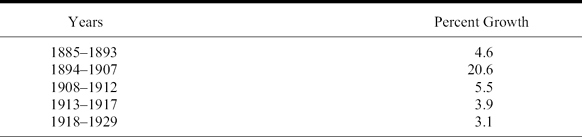
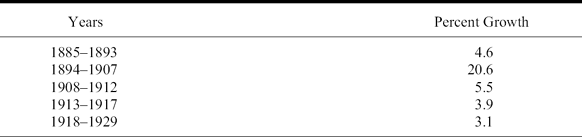
The competition and price declines had a dramatic impact on the diffusion of telephone service. As shown in Table 1, the number of telephones in the United States per 1,000 people grew 4.6 percent annually during the monopoly period (1876–1893) and 20.6 percent per year during the competitive period (1894–1907). In New York City alone, the number of telephones rose from 56,000 in 1900 to 810,000 in 1908. By 1910 there were more telephones in New York City than in France, Belgium, Holland, and Switzerland combined.
TELEPHONES PER 1,000 POPULATION: RATES OF GROWTH, 1885–1929
Sources:
U.S. Department of Commerce, Historical Statistics, vol. 2, p. 783; and Gabel, “Competition,” table 4, p. 567.
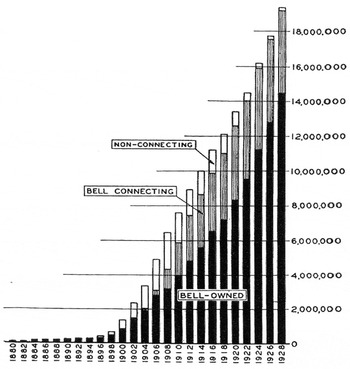
Figure 1 illustrates the relative growth of Bell- and independent-owned telephones. The number of Bell-owned telephones doubled between 1885 and 1895 (from 155,751 to 309,502), and it increased by a factor of seven (from 309,502 to 2,284,587) from 1895 to 1905.Footnote 25 The growth of the independents was even more impressive, and they owned almost as many telephones (3.0 million) as the Bell System (3.1 million) by 1907.
NUMBER OF TELEPHONES IN THE UNITED STATES

The presence of network externalities helps explain the explosive diffusion of the telephone.Footnote 26 Because the value of a telephone network to a subscriber is a function of the number of others connected to it, telephone companies had an incentive to expand their networks. Thus from the beginning, AT&T, a Bell subsidiary, attempted to build a long distance network by linking Bell-controlled local and regional exchanges using toll lines. After the Bell patents expired, AT&T refused to connect with the independents, and they were forced to build their own long distant networks. These rivals were under considerable pressure to build a critical mass of subscribers or risk domination by others. Consequently, they pursued aggressive pricing and investment strategies to increase the value of their networks.Footnote 27
This competition diminished beginning in 1907 when AT&T and the independents began interconnecting their long distance networks (see Figure 1). According to Gabel and Weiman, both sides saw the futility of network competition and sought a more cooperative arrangement. Moreover, their business customers demanded more connections and supported monopolization of the telephone market by the Bell System to achieve this goal.Footnote 28 Interconnection was achieved either through the absorption of independents into the Bell System, or it was mandated by state regulation.Footnote 29 Interconnection reduced the pressure on Bell and the independents to expand their networks and, as seen in Table 1, the growth rate in the number of telephones fell dramatically after 1907. It fell even more when Bell became a regulated monopoly in 1913.
THE ROLE OF PRIVATE WIRE NETWORKS
Prior to the invention of the telephone, the telegraph was the primary medium for long distance communication. Beginning in 1873 exchange brokers began to lease private telegraph wires from the main carriers—primarily Western Union and Postal Telegraph—to provide their customers with faster execution and confirmation of orders. Private wire service was superior to the “telegram” provided on public wire because it was faster, more reliable (for example, priority was given to the restoration of private wire service following outages created by downed lines), and provided confidentiality. By adding “drops” and “legs” to additional parties off of their main circuits, financial firms could increase the size of these communication networks.
The Bell System entered the market for private wire telegraph service in the 1880s, and this led to two important advances. First, the Bell System exploited economies of scope because its subscribers could transmit both telegraph and telephone signals over Bell circuits.Footnote 30 They began promoting dual use of their wire in 1886, and a year later the brokerage firm of L. H. Taylor and Company was the first to utilize it.Footnote 31 Second, in 1909 the Bell System embarked on an ambitious research program to develop the printing-telegraph.Footnote 32 This technology was important for security trading because it eliminated the need for Morse code operators and provided an efficient means for transmitting price quotes.
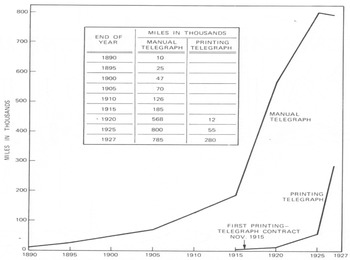
The impact of Bell's entry into the market for private wire service was dramatic. By 1904 it supplied 28 percent of the private wire service in the United States and 68 percent by 1914. Figure 2 shows the growth of the Bell System's private wire mileage. Between 1890 and 1915 it increased by 1,750 percent. It grew even more rapidly between 1915 and 1920, a period marked by the first use of the teletypewriter in November 1915.
BELL SYSTEM PRIVATE LINE TELEGRAPH CONTRACT MILEAGE

If over-the-counter markets grew rapidly during the early part of the twentieth century as a result of advances in communication technology, we should observe the emergence of a large number of dealer firms making extensive use of private wire networks. To examine this issue, I use the Security Dealers of North America (SDNA), a biannual directory of financial firms first published in 1922. The directory provides information about exchange brokers and over-the-counter dealers including the firm's location, the year it was founded, the number and location of its branches, organizations in which it had memberships (e.g., NYSE or Investment Bankers Association), its financial functions (broker, dealer, underwriter or distributor), telephone number, and whether it had its own private wire or was a correspondent on the wire networks of other firms.
I classify firms into three categories. Brokerage firms executed stock or bond orders on organized exchanges for a fixed commission. In all cases, these firms were members of at least one exchange and not described as a “dealer” by the SDNA. Dealer firms, in contrast, bought securities (other than new issues) for their own account offering them to their clients in turn.Footnote 33 These firms dealt in different types of bonds (railroad, municipal, public utility, government, industrial, and foreign bonds), unlisted stocks, commercial paper, or bankers' acceptances. Many of the larger dealers were also underwriters and distributors and, in most cases, members of the Investment Bankers Association of America or the Bond Dealers Association of Canada. Our third category, hybrid firms, includes those described by the SDNA as both exchange brokers and dealers.
To understand the use of private wire networks by security dealers, it is important to consider how their counterpart in the primary market—the investment bank—came to use them toward the end of the nineteenth century. At this time investment banks began forming syndicates with out-of-town houses to speed up the distribution of large issues.Footnote 34 The syndicate was an important innovation because it reduced the investment banks' risk of carrying unsold securities. This made them more willing to take positions in securities and benefited issuing firms by giving them immediate access to capital. The syndicate was instrumental in the turn-of-the-century merger boom, which created companies such as U.S. Steel, and became common practice by 1914.Footnote 35
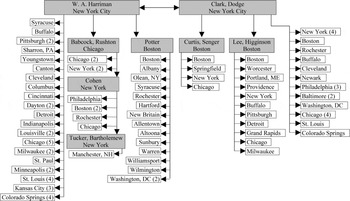
To facilitate communication between syndicate members, investment banks created private wire networks. Figure 3 shows the network created by W. A. Harriman & Co. and Clark, Dodge & Co.—two large investment banks with dealer operations. W. A. Harriman had 36 correspondents and four branches on its wire system, which stretched through Western New York, Pennsylvania, the Midwest, and as far west as Colorado Springs. Using its connection to Clark, Dodge & Co., it could communicate with 61 additional firms.
A PRIVATE WIRE NETWORK IN 1922

Importantly, while this network could be used by W. A. Harriman to distribute new issues rapidly and reduce underwriting risk, it could also be used by Harriman—and others linked to it—to manage inventory risk incurred when serving as a dealer in over-the-counter markets. In essence, financial firms could use the same wire to offer liquidity services in both primary and secondary markets. As the cost of the communication networks fell and they became more expansive, dealers could bear more risk, and this should have increased their willingness to make markets.
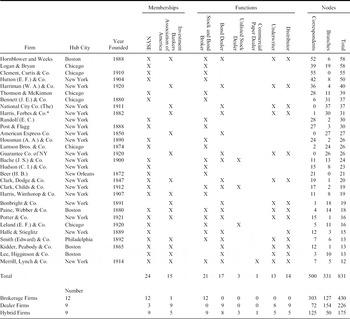
To assess the use of private wire networks by brokerage and dealer firms, Table 2 shows those with the 30 largest private wire networks in 1922 measured by the number of primary nodes (i.e., the number of correspondents and branches directly connected to the firm's wire). The majority (18) of these “wire houses” had their headquarters, or network hub, in New York City. Chicago had the second largest number of hubs (6), followed by Boston (4), Philadelphia (1), and New Orleans (1). The 30 largest firms were directly connected to 831 other firms through their private wires. Approximately 60 percent (500 of 831) of the connections were with correspondents, and 40 percent (331 of 831) with branches. Interestingly, brokerage firms ran their wire to correspondents more frequently than to branches (303 versus 127 nodes), whereas dealer firms linked to branches more frequently than to correspondents (154 versus 72 nodes). One explanation for this difference is that inventory and asymmetric information risk associated with underwriting and dealing necessitated the increased control achieved through branching.
30 LARGEST PRIVATE WIRE TELEGRAPH NETWORKS IN 1922

* Affiliated with Harris, Forbes & Co., Inc., Boston; Harris, Forbes & Co., Ltd., Montreal; and Harris Trust & Savings Bank, Chicago.
Notes:
Brokerage firms execute orders on a commission basis, dealer firms buy securities (other than new issues) for their own account offering them to their clients in turn, and hybrid firms provide both functions.
Sources:
Security Dealers of North America; and author's calculation.
Did dealer firms make extensive use of private wire networks? The two largest networks each had 58 primary nodes. One was assembled by Hornblower & Weeks, a Boston-based underwriter, which operated as both a broker and dealer in secondary markets. The other belonged to Logan & Bryan, a Chicago-based brokerage firm with a network that stretched across the western United States. The next two largest networks were operated by brokerage firms, Clement, Curtis & Co. of Chicago and E. F. Hutton & Co. of New York. The fifth position was held by W. A. Harriman & Company. Table 2 shows that 12 of the largest networks were created by brokerage firms, nine by dealer firms, and nine by hybrid firms. The number of nodes on brokerage networks (430) was almost twice as large as the number on dealer networks (226).
Based on these results, it appears that private wire networks were more important for brokerage firms. However, two observations suggest that this was not the case. First, there is evidence that over-the-counter transactions took place on networks assembled by brokerage firms. Consider the following:
[A] Chicago broker arranged for one drop in the office of a correspondent in Des Moines and another drop in the office of a second correspondent in Milwaukee. These two correspondents had frequent transactions with each other over the private wire. Neither had any direct dealing with the . . . carrier and neither paid for any expense connected with the service except the wages of his operators and incidental expenses. The only consideration moving to the lessee from these correspondents was the possibility that their trades would stimulate others in which the lessee's services as a broker might be required.Footnote 36
This account suggests that the Milwaukee and Des Moines correspondents bypassed the organized exchange and traded over-the-counter with each other. Because they did not have to pay for use of the wire, the Chicago broker was subsidizing their trading. When brokerage firms charged correspondents on a per-trade basis, these tolls were an “agreed share of the commission of the brokers who negotiated the trade over the private wire” and remained “constant regardless of the number of messages necessary to consummate the trade.”Footnote 37 This type of arrangement would have benefited over-the-counter trading where search and negotiation play important roles.
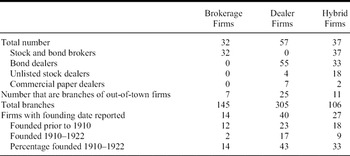
Second, a different picture emerges when we focus on smaller private wire networks. Table 3 provides data for all 128 New York City firms listed in the SDNA with private wires in 1922. Importantly, dealer firms outnumbered brokerage firms almost two to one (57 versus 32). This result suggests that smaller dealer firms made more extensive use of private wires than their brokerage counterparts. Another interesting finding emerges if we focus on the subset of firms that reported the year they were founded. Note that 43 percent of dealer firms with wires began operation between 1910 and 1922 compared to only 14 percent of brokerage firms. Thus, the firms created during the period when the Bell System was expanding its private wire service most rapidly tended to be dealers.
NEW YORK CITY FIRMS WITH PRIVATE WIRES IN 1922

Source:
Security Dealers of North America.
Two examples illustrate how private wire networks facilitated market making by dealers. The first involves the National City Bank of New York. Between 1893 and 1906 the number of correspondent banks with deposits at National City rose from 116 to 606, and it became the largest bank in the country. National City was also a bond underwriter and dealer and built a private wire network to expand and integrate these functions:
It made bonds more liquid, enhancing correspondents' ability to use them as secondary reserves thus supporting [National City's] underwriting efforts. To facilitate its trading, National City set up a private wire network to receive orders from correspondents.Footnote 38
In 1911 National City Bank created National City Company. As a security affiliate, National City Company could open offices around the country using funds borrowed from its parent and expand its activities as an underwriter, distributor, and bond dealer.Footnote 39 By 1922 National City Company had 37 branches located across the country. By 1926 it controlled 11,000 miles of private wire telegraph lines and owned “one of the largest private telephone exchanges in the country.”Footnote 40
A second example was C. F. Childs & Co., a Chicago-based government bond dealer. Founded in 1911, Childs had offices in five cities in 1922 and 28 by 1928. C. F. Childs claimed to have the “first transcontinental wire system used in the securities business” and that by 1919 “the telephone, as compared to correspondence and personal visitation, became the practice for transacting business.”Footnote 41 In 1927 the New York Times reported that one of Childs's traders, Irma Eggleston, had traded more Liberty bonds since 1917 ($30 billion) than had been traded on the NYSE ($14.3 billion) during that same period and that Eggleston, “spent a larger part of her day hanging over the telephone . . . rarely seeing a customer.Footnote 42
THE NATIONAL QUOTATION BUREAU
The organized exchange reduced search costs by providing a physical location for traders to meet. At the end of the nineteenth century, investment houses seeking to trade over-the-counter communicated their interest, much as they had 100 years earlier, through advertisements in financial publications, daily newspapers, and circulars. To stay abreast of the market, investment houses hired statisticians to compile this information. Seeking to eliminate this redundant effort and create a clearinghouse for price quotations, Roger Babson established the Babson Statistical Organization in Wellesley Hills, Massachusetts in 1904.Footnote 43 Babson published two Monthly Composite Circulars, one for railroad, public utility, and industrial bonds and the other for municipal bonds and miscellaneous stocks, which he sold to bond houses for $12.50 per month. They showed “who NOW are interested in the securities; HOW MANY they desire to buy and sell; and AT WHAT PRICE they will trade.”Footnote 44 In 1910 Babson claimed that his service had “the largest number of subscribers of anything of its kind” and was “used by practically all bond dealers and bond brokers in America.”Footnote 45
In 1911 Arthur Elliott, a publisher who had once sold advertising for the yellow pages of Boston telephone directories, sought to take Babson's idea one step further by collecting and disseminated quotations on a daily basis. Footnote 46 Elliott purchased Babson's organization, created the National Quotation Bureau (NQB) in New York City, and was distributing daily security lists to five Eastern cities by 1913.Footnote 47 The lists included the names and addresses of dealers along with their “wants” and “offerings.” The lists for stocks were known as the “pink sheets” for the color of paper they were printed on, while bond quotations appeared in the “yellow sheets.” The NQB later added “green sheets” and “white sheets” printed in Chicago and San Francisco, respectively, which contained quotations of dealers outside the Eastern region. The NQB earned revenue from subscriptions to the sheets and fees dealers paid for placing quotes in them.
Assuming a function like that performed by the organized exchanges, Elliott sought to protect the NQB quotation system from manipulation. One of his concerns was that unscrupulous brokers and dealers could create the illusion of demand for a security by placing fictitious quotations in the sheets. To increase the integrity of the quotation system, the NQB granted listing privileges to dealers based on personal knowledge of their veracity. As the market grew, this became impractical, and the NQB developed a system whereby ten adverse votes by incumbent firms was sufficient to exclude an applicant.Footnote 48 To further “police the sheets,” the NQB relied on its typists to catch dealers who submitted outlier quotes and complaints from subscribers about dealers backing away from quotes.
Without development of the nationwide telecommunications networks, it would have been impossible for the NQB to provide daily price quotes. Early stock market historians recognized this point:
The National Quotation Bureau . . . collects and disseminates quotations daily to its subscribers . . . Quotations are received from out-of-town dealers via telephone, telegraph, teletype, or air mail . . . A single quotation issue averages 120 pages. By 6:00 pm the pages have been printed and . . . shipped to various financial communities for distribution. The next morning thousands of dealers throughout the country will have the quotations ready to serve their customers.Footnote 49
Initially, distribution was restricted to the East Coast and made possible by train service. The U.S. Post Office began experimenting with air mail in 1911 and scheduled service between New York and Washington, D.C. was available in 1918. Service to Chicago was available in 1919 and to San Francisco by 1920.Footnote 50
Historical accounts suggest that the NQB sheets were the security dealer's “daily bible” and the “backbone” of the over-the-counter markets.Footnote 51 Interestingly, the NQB enjoyed a “virtual monopoly” as an inter-dealer quotation service until the 1960s.Footnote 52 One explanation for this was that the value to an individual security dealer of posting quotes in the NQB sheets was an increasing function of the number of others who posted quotes there. Thus, much as in the competition between competing stock exchanges or telephone companies, network externalities led to a natural monopoly.
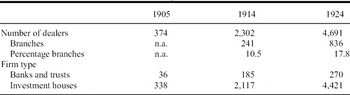
To quantify expansion of the NQB network, Table 4 shows the number of dealers who placed quotes in the sheets in 1905, 1914, and 1924.Footnote 53 The growth is remarkable. Babson started with just eight dealers in 1902 but was publishing the quotes of 374 by the end of 1905. Over the next nine years the NQB network grew by more than sixfold with the number of dealers hitting 2,302 in 1914.Footnote 54 Over the next ten years the number of dealers climbed to 4,691. Differentiating between investment houses and bond departments of banks and trusts, we see that the former group grew faster between 1914 and 1924. Much of the expansion in the number of investment houses occurred because of branching. In 1914, 10.5 percent of dealers were branches of other firms, and 17.8 percent fit this description in 1924.
DEALERS IN THE NATIONAL QUOTATION BUREAU NETWORK

Sources:
Babson, Bond Offerings; and National Quotation Bureau, Yearly Bond Offering Book.
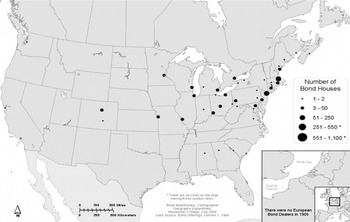
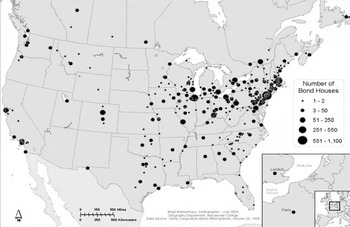
Figures 4 and 5 illustrate the spatial distribution of dealers in the NQB network. In 1905 NQB dealers were located primarily in the Northeast and Midwest. Boston and New York had the largest concentrations of dealers, with 54 and 119 respectively, and all other cities had fewer than 50 each. By 1924, 13 cities had more than 50 NQB dealers, Boston and Chicago had more than 250, and New York City had 1,072. By that same year the density of the NQB network had increased in the Northeast and Midwest and spread westward and to the South. Many larger cities with no NQB dealers in 1905 had them in 1924 (Dallas, Des Moines, Houston, Louisville, Memphis, Nashville, New Orleans, Oklahoma City, Omaha, Portland Oregon, Salt Lake City, and San Diego). Los Angeles had one NQB dealer in 1905 and 120 in 1924. By 1924, many smaller cities were home to NQB dealers and the network extended into Canada (Montreal had zero NQB dealers in 1905 and 102 in 1924) and Europe.
SECURITY DEALERS IN THE NQB NETWORK, 1905

SECURITY DEALERS IN THE NQB NETWORK, 1924

National Quotation Bureau efforts in the interdealer market were followed by similar initiatives in retail markets. In 1926 the Unlisted Securities Dealers Association of New York was formed to assist newspapers in the publication of retail quotations. Prior to its formation, newspapers collected this information themselves, and there were frequent disparities. The association attempted to eliminate redundant effort and bring uniformity to the data collection process. Contemporary observers suggest that the quality of the retail quotes improved and that “business could be done near these prices.”Footnote 55
DID THE OVER-THE-COUNTER MARKETS TAKE BUSINESS FROM THE EXCHANGES?
The reach and density of telecommunication networks expanded rapidly in the first two decades of the twentieth century. In addition, there was dramatic growth in the number of security dealers during this period who were heavy users of the communication technology. Taken together, these findings suggest that growth in the over-the-counter markets was driven by technology. However, an alternative hypothesis is that they grew simply because there was increased issuance of new securities unsuitable for exchange trading. To test between these hypotheses, I examine whether trading migrated from the exchanges to the over-the-counter markets during the early part of the twentieth century. If it did, there is evidence that the new telecommunication networks created a competitive advantage for the over-the-counter trading mechanisms.
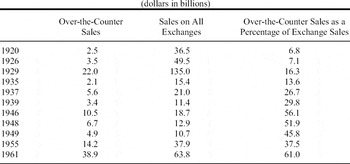
Given the private nature of the over-the-counter markets, there is no historical record of trading volume in this venue. The best historical estimate of over-the-counter trading activity in stocks is provided by Irwin Friend, Wright Hoffman, and Willis Winn who use stock transfer tax receipts to measure exchange and over-the-counter trading volumes.Footnote 56Table 5 provides estimates for select years between 1920 and 1961. The sales of corporate stocks over-the-counter in 1920 were $2.5 billion or 6.8 percent of stock sales on the exchanges. By 1929 over-the-counter sales were $22 billion or 16.3 percent of exchange sales. Friend et al. conclude that there “seems to be little doubt about the existence of a strong upward trend from 1920 to the present in the relative importance of the over-the-counter market . . .”.Footnote 57
OVER-THE-COUNTER AND EXCHANGE SALES OF CORPORATE STOCKS

Sources:
1920–1948 data are from Friend, Hoffman, and Winn, Over-the-Counter Securities Markets, p. 109; and 1949–1961 data are from the Securities and Exchange Commission, Report of Special Study of Securities Markets, p. 547.
Unfortunately, transfer tax data are not available prior to 1920 so I must rely on more indirect and anecdotal evidence of over-the-counter market growth for this earlier period. One indirect measure is annual turnover (transaction volume divided by quantity outstanding) for securities traded on the NYSE. If over-the-counter markets were growing simply because more small companies were issuing unlisted securities, NYSE turnover should not have been affected. If, on the other hand, migration was taking place and securities listed on the NYSE were trading over-the-counter, NYSE turnover should have fallen. By examining turnover of corporate bonds and stocks listed on the NYSE, I can assess whether migration was specific to particular types of securities or a more general phenomenon.Footnote 58
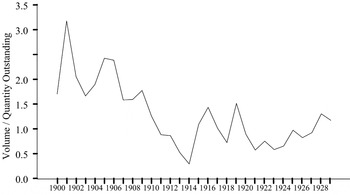
Figure 6 illustrates turnover on the NYSE for listed stocks. It shows a sharp decline in the 15 years leading up to World War I. For example, turnover exceeded 3.0 in 1901 and stood at less than 0.5 by 1913. Although this downward trend was partially reversed during the speculative boom of the 1920s, turnover never returned to the high levels seen at the start of the century. This decline in turnover is consistent with the hypothesis that trading in NYSE-listed stocks migrated to other markets prior to 1914.
STOCK TURNOVER ON THE NYSE

Where did the trading activity go? One possibility is that it moved to other organized exchanges. Technological and organizational changes enhanced the ability of the NYSE to create liquidity during the last three decades of the nineteenth century, and this success, along with its high commissions, attracted competition.Footnote 59 One important rival was the Consolidated Stock Exchange. Formed by the merger of several smaller exchanges, the Consolidated began trading NYSE-listed stocks, especially railroad stocks, in 1885. This threatened the NYSE because the Consolidated could use the telegraph ticker to free-ride off of the NYSE's price discovery mechanism, undercut the commissions charged by NYSE brokers, and attract trading volume. The NYSE responded by demanding that its members end their affiliation with the Consolidated and attempted to remove NYSE stock tickers from the floor of the Consolidated. It also created an unlisted department to compete for Consolidated business.
If the decline in turnover of listed stocks on the NYSE during the first 15 years of the twentieth century was caused by migration to the Consolidated, trading volume on the Consolidated should have risen relative to that on the NYSE. However, the evidence indicates that the trading volume of NYSE-listed stocks on the Consolidated Exchange fell in absolute terms and relative to the trading volume of common stocks on the NYSE during this period.Footnote 60 This suggests that reduced turnover on the NYSE was not caused by migration to the Consolidated Exchange and is consistent with the conclusion that the NYSE was able to blunt the competitive threat posed by the Consolidated.Footnote 61
Another possibility is that trading of NYSE-listed stocks migrated to the New York Curb Exchange. The Curb Exchange grew alongside the NYSE during the nineteenth century and provided a venue for brokers who did not become members of the increasingly organized and regulated NYSE. The Curb Exchange was an open air market located for much of its history on Broad Street near the NYSE. Curb brokers received orders from their offices located in the adjoining buildings and traded with one another in an open outcry market. The Curb Exchange became more organized in 1908, established a listing department and fixed trading hours in 1911, and moved inside to a new building on Trinity Place in 1921.
The historical record does not support the hypothesis that trading of NYSE-listed stocks migrated to the Curb Exchange during the early part of the twentieth century. Rather, the Curb played a complementary role to the NYSE, serving as a trading venue for the more speculative stocks of mining, oil, and industrial companies that could not meet NYSE listing requirements or whose corporate officers were unwilling to open their books to NYSE scrutiny. The number of these issues, as well as the number of Curb brokers, increased greatly during the first decade of the twentieth century due to a merger wave, the development of new industries, and stricter listing requirements at the NYSE. According to Ranald Michie, the Curb Exchange primarily served as a “trial market” for new issues, which Curb brokers stopped trading once they were quoted on the NYSE.Footnote 62 The fact that the NYSE disbanded its unlisted trading department in 1910 when the Curb Exchange was becoming more organized provides evidence of the symbiotic relationship that had developed between the two exchanges.
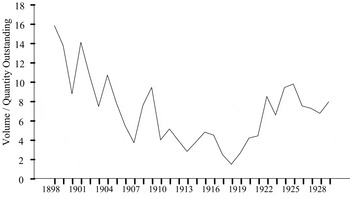
The decline in turnover on the NYSE during the first 15 years of the twentieth century was not limited to stocks. As Figure 7 shows, turnover for corporate bonds also fell during this period. It rose during the wartime boom and the 1920s, but, as we saw for stocks, corporate bond turnover did not return to turn-of-the-century levels. Where did the bond trading go?
CORPORATE BOND TURNOVER ON THE NYSE

Anecdotal evidence suggests that it migrated to over-the-counter markets early in the twentieth century. For example, in 1904 one writer observed that:
. . . the bond market on the New York Stock Exchange does not represent much over one-fifth of the trading that is carried on in bonds in the New York market. Quite certainly, the business that is done “over the counter,” by mail and in person, approximates a greater volume than does the cash business in bonds done through the stock exchanges.Footnote 63
Similar commentary was provided in 1905:
There is one feature very noticeable about the general bond market. That is that the bond houses are getting closer and closer to a monopoly of the bond business . . . The figure of $400,000,000 municipal bonds, against $225,000,000 last year, largely handled through the bond dealers directly, is a legitimate and probably accurate criterion of the “counter” trading during this year.Footnote 64
Importantly, 1905 was also the last year that bonds were traded on the Consolidated Exchange.Footnote 65
In 1909 Bankers' Magazine added a new section on bond markets and began publishing dealer price quotations. In one article that appeared in 1910, it was noted that:
. . . but it is not on the Board that the real market for bonds exists. It is the “outside” trading between the bond houses—the “over-the-counter” business which each day largely exceeds the total volume of dealings on the exchange—that constitutes the real market for bonds.Footnote 66
An article published in July 1911 stated that the NYSE's dominant position was threatened by the “present marked and continuing increase of 'over-the-counter' trading.”Footnote 67 In 1918 the New York Times reported that “the bulk of the business in United States Government bonds is done over the counter, and not on the stock exchange.”Footnote 68 In 1929 it was estimated that trading in New York State and City bonds on the NYSE represented less than 1 percent of the total daily transactions in these issues.Footnote 69 In 1931 one observer noted that “it is a matter of common knowledge that the bulk of high grade rail bonds is traded in 'over the wires,' even though they are listed on the exchange” and that liberty bonds gained “marketability” by moving off of the exchanges.Footnote 70
In one of the first books written on over-the-counter markets, published in 1917, Lawrence Chamberlain concluded that:
The great system of American bond houses, which has no like in any European country, is really an immense exchange in itself, reaching out with its branch offices and traveling representatives over the more settled parts of the United States and Canada. This system, with the aid of the telegraph and telephone, fulfils for most purposes the legitimate functions of an investment exchange.Footnote 71
While Chamberlain noted that a similar network of houses did not exist for unlisted stocks, he estimated that, “So satisfactory is this system of bond-interchange that over 90 [percent] of transactions in listed bonds (it is estimated) take place outside of the exchanges.”Footnote 72
Why would investors trade bonds in the opaque over-the-counter markets and sacrifice the price discovery provided by the NYSE? As Edward Meeker has pointed out, bond dealers often free-rode on the price discovery services of the NYSE:
Thus the bond market on the Stock Exchange regularly serves as a guide to the usually larger “over-the-counter” market, by reason of its highly perfected price-quotation system. Leading outside dealers sometimes make a market on the Exchange with relatively few bond sales, in order to establish prices as a standard for larger dealings outside.Footnote 73
Because the Consolidated Exchange was centralized, brokers who attempted to free-ride on NYSE price discovery were easy targets for retaliation. This was less true for the decentralized dealers who used the telephone to trade over-the-counter from the privacy of their offices.
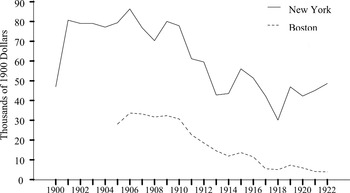
It is possible that trading activity moved to organized exchanges in other cities rather than to over-the-counter markets. To examine this possibility, I compare the real value of membership seats on the NYSE and Boston Stock Exchange.Footnote 74Figure 8 shows that real seat prices fell for both exchanges over the same period that we saw turnover decline on the NYSE. Thus the decline in the return to providing brokerage services was not unique to those who labored on the NYSE.
REAL STOCK EXCHANGE MEMBERSHIP PRICES

CONCLUSION
The rapid expansion of telecommunication networks following expiration of the Bell patents in 1894 created the “nerve center” necessary for dramatic growth in the decentralized over-the-counter markets. The telephone created a competitive advantage for over-the-counter markets by lowering search and negotiation costs, making transactions less anonymous and reducing dealer exposure to asymmetric information, and making it easier for dealers to uncover hidden liquidity. I have provided evidence of this growth and argued that, particularly in the case of bonds, it came at the expense of the organized exchange.
A reoccurring theme in this article is the role of network externalities. These forces help explain, during the first part of the twentieth century, the concentration of exchange trading on the NYSE, the intensity of competition between Bell and the independent telephone companies, and the rapid growth of the over-the-counter markets. By their very nature, networks are self-reinforcing and create switching costs for their members. However, if a new network is able to develop a critical mass through a technological or institutional change, it can expand rapidly. The evidence provided in this article suggests that the rapid diffusion of the telephone at the turn of the twentieth century propelled the decentralized over-the-counter markets to a more prominent position in the American financial system.
One interesting question that this article raises is why technological change did not cause over-the-counter markets to flourish in Canada, the United Kingdom, or other countries. One unique feature of the U.S. financial system was the large size of its security markets as a result of changes in corporate scale and unit banking restrictions.Footnote 75 Because the United States was more reliant on security markets, it makes sense that over-the-counter market development would occur there first. Also, the telephone diffused much more rapidly in the United States during the early part of the twentieth century than in other countries. This could also explain the differential pattern of over-the-counter market development.
Failure to account for growth of the over-the-counter markets has led scholars to miss-measure financial development. For example, Raghuram Rajan and Luigi Zingales use measures of stock exchange turnover to argue that the countries of continental Europe were more financially developed than the United States in 1913.Footnote 76 This conclusion ignores the fact that development of over-the-counter markets early in the twentieth century caused trading of some securities to move off the organized exchanges. My findings suggest that the lower levels of U.S. exchange turnover were a sign of superior financial development rather than backwardness.
Finally, our findings shed light on the link between financial and economic development. The telephone undoubtedly contributed to economic growth by making labor more productive. However, it may have had an indirect effect as well by making secondary markets for a broad class of securities more liquid. As liquidity increased, these securities became more attractive to investors, and smaller and medium-sized companies had greater access to capital. Just as development of the NASDAQ market increased the ability of high-tech firms to obtain financing during the 1990s, growth of over-the-counter markets early in the twentieth century meant that many new firms could influence the American economy with their innovative technologies.