
Introduction
Societies in Scandinavia, c. AD 540–1000, shared many similarities with those of England during the same period. There were also important differences: the Scandinavian kingdoms were smaller, urbanisation was newly emergent, the Church had no institutional presence and literacy was limited. Further, written sources are completely lacking, rendering the period effectively prehistoric. Even in the absence of a ‘Nordic Bede’, however, archaeologists have long recognised petty royal centres, the equivalents of Rendlesham and Yeavering in England (Austin Reference Austin2017; McBride Reference McBride2020; Scull & Thomas Reference Scull and Thomas2020; Thomas & Scull Reference Thomas and Scull2021). Over the past 40 years, metal detecting and machine stripping of the plough soil have turned up a wealth of evidence for these Scandinavian power centres and contributed to an energetic area of research. One key research problem is that the distribution of known centres is uneven, probably reflecting the routes of road-building projects and differing national legislation on metal detecting more than the period's political geography. Until recently, the Swedish province of Östergötland did not feature on the map of Scandinavian early medieval power. The present contribution stems from a fieldwork project begun by the first author in 2003 and a book about the bigger picture of aristocratic settlement (Rundkvist Reference Rundkvist2011). The field methods introduced large-scale metal-detector survey to the province, followed by studies of museum collections and archives, ground-penetrating radar and extended excavations at three sites.
In this article, we present new evidence from Aska in the parish of Hagebyhöga, resulting from work undertaken between 2006 and 2021, which establishes the site as the principal manor of a petty royal lineage (c. AD 650–1000), and a top-level site in a pan-Scandinavian perspective. We focus on the evidence of precious metals and human remains used as offerings and for religious customs: a series of gold-foil miniatures deposited in the royal hall and a ritual involving human skulls to mark out the footprint of the building when it was dismantled after 300 years.
Long houses and halls
Architecture in Scandinavia between 2300 BC and AD 1000 is largely a tale of the long house (Göthberg et al. Reference Göthberg, Kyhlberg and Vinberg1995; Artursson Reference Artursson2009). This was a single-storey wooden structure with roof frames supported by internal posts. In the earliest long houses, the posts formed a central line under the roof ridge; from the 1600s cal BC, the design altered and posts were paired in parallel lines, dividing the internal space into three aisles. The associated postholes for these roof supports were deep and consequently many survive beneath the reach of the plough.
For most of its history, the Scandinavian long house was multifunctional, often with one half used as a barn and the other for housing. From c. AD 150, however, we find long houses where the post pairs are irregularly spaced, creating an extra-large room: the hall. From c. AD 300, at some large farmsteads, the function of this enlarged space expands to fill a dedicated long house. This is the medu-heall, or mead hall, that Grendel haunts in Beowulf and that looms large in the world of Old Norse sagas and poems (Herschend Reference Herschend1993, Reference Herschend1998; Lönnroth Reference Lönnroth, Callmer and Rosengren1997; P.M. Sørensen Reference Sørensen, Munch, Johansen and Roesdahl2003; Carstens Reference Carstens and Eriksen2015; Sundqvist Reference Sundqvist2016). In Old Norse literature, hǫll is the standard word for the main building of a royal manor. These halls formed the main political and religious stage of the mid-first millennium AD, where kings, queens, heroes and poets played their roles.
Several very large halls have been investigated in Denmark, Sweden and Norway: Gudme, Old Lejre, Tissø, Uppåkra, Järrestad, Lunda, Old Uppsala, Borre and Borg in Lofoten (Petersen Reference Petersen, Nielsen, Randsborg and Thrane1994; P.Ø. Sørensen Reference Sørensen, Nielsen, Randsborg and Thrane1994; Jørgensen Reference Jørgensen, Pestell and Ulmschneider2003; Munch et al. Reference Munch, Johansen and Roesdahl2003; Larsson Reference Larsson2004; Söderberg Reference Söderberg2005; Skyllberg Reference Skyllberg, Andersson and Skyllberg2008; Christensen Reference Christensen2015; Ljungkvist & Frölund Reference Ljungkvist and Frölund2015; Tonning et al. Reference Tonning2020). Recently discovered halls yet to be published include Fuglebjerg on Zealand, Rødbyhavn on Lolland and Kongstubbe on Bornholm.
The first hall to be identified in Östergötland was discovered only in 2012 at Ströja in Kvillinge near Norrköping. The building measured approximately 44m in length, with two phases spanning c. AD 450–650, and was succeeded by a 38m-long hall nearby (Hjulström Reference Hjulström2012, Reference Hjulström2018; M. Karlsson Reference Karlsson2020).
The platform hall at Aska
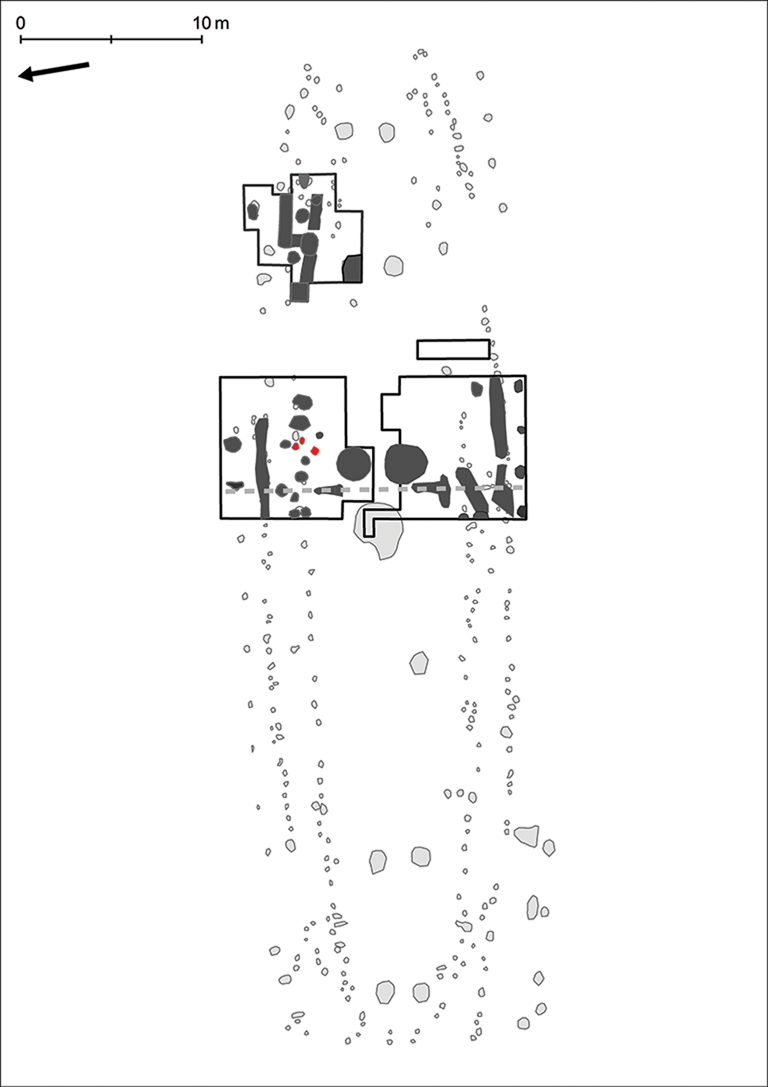
The hamlet of Aska is located in Hagebyhöga parish near Vadstena in Östergötland (Figure 1). The locality is renowned for having the richest Viking Period burials in the province, one of which was unearthed in 1920 and yielded the ‘Aska Lady’ pendant (Arne Reference Arne1932). At the end of the hamlet's main street is an oblong platform mound 65 × 40m at its base and 3–4m in height. Such steep-sided and high platforms are known at sites including Old Uppsala (Ljungkvist & Frölund Reference Ljungkvist and Frölund2015), Fornsigtuna (Allerstav et al. Reference Allerstav1991; Edberg & Heimer Reference Edberg and Heimer2021) and Hovgården on Adelsö (Brunstedt Reference Brunstedt1996), all located around the east end of Lake Mälaren. Ground-penetrating radar survey directed by Andreas Viberg has documented the postholes of a 48 × 14m hall on the Aska platform (Figure 2; Rundkvist & Viberg Reference Rundkvist and Viberg2014). It is so like one of the platform halls at Old Uppsala, the main royal centre of the Swedes, that it is probable the architect travelled there and took measurements. Lines of widely spaced buttress posts outside the long walls at Aska, on the other hand, suggest contact with the Danish kingdom (cf. halls at Old Lejre and Tissø on Zealand, Rundkvist & Viberg Reference Rundkvist and Viberg2014).
Aerial view of Aska hamlet with building platform and ploughed-out cemeteries. The latter's dashed boundary lines are based on Middle Viking Period metalwork scatters in the plough soil (figure by Jon Lundin).

Features of the Aska long house and platform. Ground-penetrating radar anomalies, trenches excavated in 2020–21, first-millennium features. The three red features contained most of the gold-foil figures. The dashed grey line marks a probable interior wall (figure by Andreas Viberg and Jon Lundin).

Excavations on the platform in 2020–21 (Rundkvist Reference Rundkvist2021; Rundkvist & Lindgren Reference Rundkvist and Lindgren2022) revealed that the postholes had been robbed of their large packing stones and almost all cut features were backfilled with cobbles and what seemed to be the former floor layer of the hall. It produced a large assemblage of small bone fragments and artefacts (see online supplementary material (OSM)). The platform hall cannot have been the only building at this manorial settlement: future fieldwork will help to establish the full nature of the site.
Dating the hall
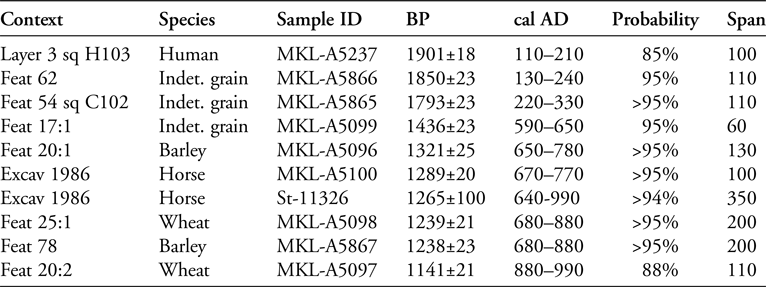
In 1985–86, trial trenching through the platform exposed a large stone cairn on the original ground surface beneath the platform's western end (Claréus & Fernholm Reference Claréus, Fernholm, Andersson, Lagerlöf and Åkerlund1999). Radiocarbon dating confirms that the cairn was not the core of an earlier burial mound that had been incorporated into the platform, as at Huseby in Tjølling (Skre Reference Skre and Skre2007: 227 f). Limited investigation by the excavators recovered well-preserved, articulated bones from the rear right leg of a large mammal, which appears to have been sacrificed and butchered during the building project. Osteologist Per Eriksson identified the bones as horse, a determination confirmed with ZooMS at the University of York in 2020 (Samantha Presslee, pers. comm.). The bones have been radiocarbon dated twice: in 1988 using the scintillation method and again in 2020 by AMS. The results are comparable, placing the death of the horse at cal AD 670–770 (>95% probability; Table 1).
Radiocarbon analyses (calibration: OxCal 4.4, https://c14.arch.ox.ac.uk/oxcal/OxCal.html)

In 2020 and 2021, Jens Heimdahl identified charred grain in soil samples from cut features on top of the platform. Seven charred grains or mixed samples of grain fragments have been radiocarbon dated. Two samples have returned late Roman-period dates older than the horse, suggesting that they were residual material redeposited when the platform was built (Claréus & Fernholm Reference Claréus, Fernholm, Andersson, Lagerlöf and Åkerlund1999: 133). The remaining five samples place the start of activity within the building between cal AD 590–650 (95% probability). If the two dates for the horse and the oldest non-residual grain are modelled in OxCal as a single event—representing the erection of the platform and the start of activity in the hall—this gives a date range of cal AD 650–680 (>95% probability).
As well as the earliest activity, it would also be valuable to establish the date of the final fire lit in the hall. However, we have not yet located any hearth. The large, slightly off-centre feature identified by geophysical survey proved to be a modern refuse pit. The latest date for grain recovered from the hall is cal AD 880–990. This interval includes the likely date c. 975 for the last burials at the hamlet's cemeteries, one of which was the wealthy grave excavated in 1920. In sum, the hall likely stood between 650 and 990.
Gold-foil figures
Context
Scandinavian gold-foil figures (guldgubbar in Swedish, “GG”) are designs embossed on sheets of gold alloy, approximately 10mm in width, dating from the sixth to eighth centuries AD (Lamm Reference Lamm, Clarke and Lamm2004; Pesch & Helmbrecht Reference Pesch and Helmbrecht2019a). Examples have been found across Scandinavia, but most find spots are within the territory of medieval Denmark, with the largest and most varied assemblage being from Sorte Muld on the Baltic island of Bornholm (Adamsen et al. Reference Adamsen, Hansen, Nielsen and Watt2009).
Most foils feature images of single human figures or embracing couples. Many depict richly dressed individuals, making them a useful source for costume history (Mannering Reference Mannering2017). The figures demonstrate no distinct iconographic attributes and do not form narrative scenes that allow any secure connections to myths or other texts. The foil figures, which are strongly associated with elite settlement sites, do not seem to have served any practical function even as personal adornment.
On the Aska platform, within an area of less than 6m in diameter, we recovered 30 gold-foil figures, some of them fragmented, crumpled or folded. At the time of writing, this is the largest assemblage of gold-foil figures found within the borders of the medieval Swedish kingdom. Some 22 of the 30 figures were concentrated within an area of less than 1.5m in diameter, in and between three cut features: two small postholes in the inner northern wall, and a cut feature (one of two) inside the line of the postholes (Figure 2). The fill of the latter feature differed from others at the site in that it contained no flooring cobbles. The pair of postholes may represent a high seat (cf. Herschend Reference Herschend1995; Rasmussen Reference Rasmussen1999; Sundqvist Reference Sundqvist2016: 219–242). A pair of stone-filled gullies by the nearby roof supports suggests the presence of a transverse wall, meaning that the foil figures were deposited in the north-west corner of a large room.
Foil figures at Slöinge, Halland, were also found in the north-west corner of the hall; there, however, most figures were in the posthole for the north-west roof-support (Lundqvist Reference Lundqvist1996; Lundqvist & Arcini Reference Lundqvist and Arcini2000: 44, 51–59). At Helgö, on the other hand, the foil figures were found concentrated in the south-east corner of a hall and along the south wall line (Lamm Reference Lamm, Clarke and Lamm2004: 51 f). Unusually, the long house at Borg in Lofoten was orientated south-west to north-east, and there foil figures were found in the northern corner of the building (Munch et al. Reference Munch, Johansen and Roesdahl2003: 251), differing from Aska, Slöinge and Helgö.
In comparison, the Uppåkra temple in southern Sweden belongs to a category of its own and cannot be equated with a hall. But there, as in Aska and Slöinge, foil figures were found concentrated in the posthole for the north-west roof support and around it (Watt Reference Watt and Larsson2004: 169). Geophysical survey and ongoing excavations at Sorte Muld suggest that the main find spot at that site for thousands of gold-foil figures is a temple rather than a hall (F.O. Nielsen, pers. comm.). For an in-depth discussion of these various structures and their functions, see Sundqvist (Reference Sundqvist2016).
Motifs
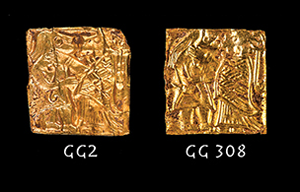
All the Aska foils are embossed rectangular images of an embracing, fully clothed couple (Figures 3–8). Axel Löfving has identified four die families—a group of similar designs from several production dies that were used to emboss the foils. The families are referred to here as Adam, Betty, Carl and Daisy; within each group, some figures are die-identical meaning that they were produced by the same die (Figure 3). Margrethe Watt of the Sorte Muld project has placed Löfving's Aska die families in relation to her forthcoming, informally disseminated, pan-Scandinavian classification scheme.
Aska's gold-foil figures: four die families including some die identities. Orphans are designs that cannot be assigned to families in the currently known material (photographs by Björn Falkevik; editing by Cheyenne Olander).

Foil-figure 306, shown from the reverse side, die-identical to the Husby in Glanshammar figure. Die family Adam (photograph by Björn Falkevik).

Foil figure 308. Die family Betty (photograph by Björn Falkevik).

Foil figure (in two fragments) 5+8, die-identical to Borg in Lofoten figure 8334. Die family Carl (photograph by Björn Falkevik).

Foil figure 303, die-identical to the Svintuna figure. Die family Daisy (photograph by Björn Falkevik).

Foil figure 12. Die family Daisy. Note the vertical crack to the right, from the embossing (photograph by Björn Falkevik).

At Aska, die family Adam has five members, including two that are die-identical to the foil figure from Husby in Glanshammar (Figure 4; Andersson et al. Reference Andersson, Ekman and Persson2000: 286; Ekman Reference Ekman and Olausson2000; Lamm Reference Lamm, Clarke and Lamm2004: 95). The man depicted wears a garment with decorated front-edge trim. This may be the first-discovered kaftan represented on a foil featuring the embracing couple motif. It is hard to be certain, however, because the kaftan is difficult to depict at this scale, and less visible when the man is depicted in profile and in the woman's embrace. Nonetheless, it would be the first indication that men shown on these embracing-couple foils held the same princely rank as the kaftan-wearing men on single-figure foils and Vendel helmets (Wamers Reference Wamers, Pesch and Helmbrecht2019). The kaftan wearers appear to be earthly rulers rather than deities, as suggested by the bird-horned Odinn who guides their spears in battle on helmets from Valsgärde and Sutton Hoo, as well as the Pliezhausen disc (Wamers Reference Wamers, Pesch and Helmbrecht2019). Die family Adam equals Watt's family 68.
Die family Betty has two members (Figure 5) and no known die identities. The woman cups the man's cheek in her hand. On his tunic is a long S or Z symbol that also appears on Helgö 603 (Lamm Reference Lamm, Clarke and Lamm2004: 79). The woman's long hair ends in a spiral echoing the symbol on the man's tunic. The alternating hatched pattern of the woman's cloak finds no parallels with other gold-foil figures, but it is known from Vendel helmet imagery such as the Torslunda dies (Helmbrecht Reference Helmbrecht, Pesch and Helmbrecht2019: 146). Die family Betty has no equivalent in Watt's classification.
Die family Carl has three members, including two die-identical foils and one that is die identical to Borg in Lofoten 8334 (Figure 6; Munch et al. Reference Munch, Johansen and Roesdahl2003: 247, 255). In this die family, the woman wears a cloak reversed with the train forward. This has been interpreted to suggest that the die maker did not fully understand the motif (Munch et al. Reference Munch, Johansen and Roesdahl2003: 247). On the other hand, the die maker has followed an animal art convention and interlaced the woman's lower arm with the front edge of the cloak in a way that would demand a slit in the fabric. This latter feature is also found at Slöinge and Helgö. Die family Carl equals Watt's family 66.
Die family Daisy has eight or nine members, including two that are die-identical to the Svintuna figure (Lamm Reference Lamm, Clarke and Lamm2004: 104; Figure 7). Here, the woman's hair style is reduced to a top knot. The man wears a collar with long triangles descending onto the front of his shoulders. This difference in decoration between the upper and lower parts of the garment is unusual and represents a fashion unattested elsewhere (Mannering Reference Mannering2017: 56). The Svintuna die demonstrates the influence of horror vacui, the figures filling out the entire surface of the foil as also found in contemporaneous animal art. The large identical group found at Aska is new: embracing couples have not previously been recognised in large die-identical assemblages at a single site within medieval Sweden. While die-identical sets are common among single-figure foils, a ratio of die-identical embracing figures comparable to that at Aska is not. Slöinge and the Norwegian sites of Hauge and Mære offer the closest parallels (Lamm Reference Lamm, Clarke and Lamm2004; Tangen Reference Tangen2010; Watt Reference Watt, Pesch and Helmbrecht2019). Die family Daisy equals Watt's family 67.
The 11 figures from Aska that have not yet been assigned to families are largely fragmented or poorly embossed, making classification difficult, though three orphans (guldgubbar GG3, GG4 and GG14) are well preserved and may eventually be allocated to families. Although the figures on the Aska foils embrace, many do not face each other eye to eye. Instead, they stand chin to chin, heads back, facing the sky. This imagery links back to Migration period depictions pre-dating AD 540, as seen, for example, on the Gummersmark relief brooch, the four identical type-B gold bracteates in the Söderby hoard and the Ålleberg gold filigree collar (Lamm et al. Reference Lamm, Hydman and Axboe1999; Lamm Reference Lamm, Clarke and Lamm2004: 48; Kristoffersen Reference Kristoffersen, Pesch and Helmbrecht2019: 96).
Manufacture and deposition
Fragment 305 is a piece of foil-figure manufacturing waste, indicative of on-site production. Such pieces are commonly found in large foil-figure assemblages collected using wet screening. The particularly thick, heavy and well-preserved figure 12 (Figure 8) shows a vertical crack caused by the embossing procedure: as this was not repaired, it suggests that the figure was deposited immediately. We doubt that any foil figures were ever transported any distance because they are so small and fragile. More likely, the die-identities are the result of goldsmiths travelling between sites with their dies (cf. Axboe Reference Axboe, Pesch and Blankenfeldt2012; Pesch & Helmbrecht Reference Pesch and Helmbrecht2019b; Löfving Reference Löfving2020: 55). A small fragment of embossed silver foil found with the gold-foil figures at Aska is possibly from a silver-foil figure similar to those found in small numbers at Sorte Muld (Watt Reference Watt, Pesch and Helmbrecht2019: 36).
Other artefacts and ecofacts
Other artefacts from the hall include pieces of a decorative mount from a Vendel-Valsgärde or Sutton-Hoo-type shield and three domed gaming pieces made from right-whale bone. It is unusual for this type of site that no glass that can be morphologically dated to the first millennium has been found on the platform. Animal bones and charred grain indicate a high-status diet. See OSM for further details.
Demolition and closure
The great hall appears to have been dismantled no later than cal AD 990. This was a systematic event leaving no remains of posts or any large packing stones in the postholes. The planks were pulled out of the slots for the outer walls, leaving the packing stones undisturbed. All the cut features were then carefully filled using material from the hall's floor. Differences in the proportions of animal species among the bones across the excavated surfaces suggest that each cut feature was filled with the material from the floor area closest to it.
With the top surface of the platform carefully levelled, the internal footprint of the building was covered with a dense pavement of cobblestones. This event is undated, but there is no reason to believe that it occurred long after the demolition of the hall. Such sealing and closure of demolished buildings, or the construction of a monument on top, was a common Viking-period custom (Lindeblad & Nielsen Reference Lindeblad and Nielsen1997; Stenholm Reference Stenholm2012; Eriksen Reference Eriksen2016). Within the cobblestone pavement at Aska were human bones. Rudolf Gustavsson has identified 20 human fragments, all from crania, representing at least two adults and one child.
During trial trenching on the platform in 1985–86, fragmented artefacts and bone were collected, suggesting that the structure partly consists of material taken from an early first-millennium cremation cemetery (Claréus & Fernholm Reference Claréus, Fernholm, Andersson, Lagerlöf and Åkerlund1999: 133). As noted, this impression is now strengthened by two late Roman-period radiocarbon dates for charred grain (Table 1).
Whether this construction material was chosen intentionally is unclear. In the subsequent Viking Period we have ample evidence for the targeted re-use of earlier first-millennium monuments across Sweden, as was also the case at Aska (see below). It does not, however, seem likely that the cranial fragments in the platform's closing pavement were included unintentionally. All but one of them are unburnt suggesting they are not residual from the cremation cemetery; moreover, the predominance of crania indicates intentional selection. Radiocarbon dating of one of the cranial fragments from the pavement has returned a date in the first century cal AD (Table 1). This suggests that when the time came to procure human remains for inclusion in a closing pavement on the Aska platform, they were acquired from inhumation graves of the Roman period. When laying to rest the memory of this building, 300 years after it had first been erected, the remains of forebears who had died 800 years previously played an important role.
Discussion
Evidence from the Aska hall's construction, including the large number of gold-foil figures, indicates that Aska may have been the principal seat of a petty royal lineage (Rundkvist Reference Rundkvist2011: 78; Rundkvist & Viberg Reference Rundkvist and Viberg2014). As such, it fits into the pan-Scandinavian category of ‘second generation ruler site’ (Jørgensen Reference Jørgensen, von Freeden, Friesinger and Wamers2009; Skre Reference Skre and Skre2020: 195). These sites, characterised by their establishment on fresh ground and their greater number than the first generation, were founded after AD 540 and include among others Old Uppsala, Borre, Old Lejre and Tissø. Aska's membership of this group integrates Östergötland into the map of early medieval Scandinavian power, with kings behaving here much like their contemporaries in Zealand, Østfold and Uppland.
Like other east Scandinavian examples, however, Östergötland's putative royal lineage and associated territory are not attested in any written source. We cannot know exactly what lands the lineage ruled c. AD 700. But the erection of the platform hall at Aska was its first major claim to rulership, the hall standing for 300 years. In the 800s, the rune-master Varin of nearby Rök is likely to have been a frequent guest at Aska. The platform hall is located in the densest cluster of early and middle Viking-period elite indicators in Östergötland (Rundkvist Reference Rundkvist2011: 60). The Aska lineage probably organised Östergötland's first major public construction projects: a defensive dyke and sea barrages in the Slätbaken inlet (Rundkvist Reference Rundkvist2011: 72), and they did not relinquish power until the establishment of the Kingdom of Sweden, c. AD 995. That kingdom survives to this day.
As far as we know, the Aska hall was the largest building in Östergötland prior to the construction of Linköping Cathedral c. AD 1100. In addition to being an enormous investment of labour, the hall was a bold symbolic statement, visible far and wide across some of the area's best agricultural land. To any visiting aristocrat, the high-status, inter-regional affinities of the hall's architecture would have been obvious. Circa AD 700, the elite lifestyle at Aska was indistinguishable from that at Old Uppsala, Vendel, Valsgärde and Helgö.
Among the visitors was at least one internationally active goldsmith who also went to Lofoten in northern Norway, as noted above with the foil figures’ die identities. This is a distance of 1090 km as the ravens fly. With the 2007 discovery of a production die at Sättuna in Kaga (Rundkvist Reference Rundkvist2007) and the 2020–21 finds at Aska, Östergötland can now be recognised as an important region for the production of gold-foil figures.
Despite evident Christian influence on burial practices before 975 (E. Karlsson Reference Karlsson2022), Aska never became a church site. Instead, three churches were erected at hamlets roughly equidistantly around Aska, and these later became the parish centres. After 1000, though, Aska appears to have become the site of a hundred assembly, and the old mead-hall platform its assembly mound (Rundkvist Reference Rundkvist2022).
Perhaps the most important lesson Aska can teach us as we ponder the geography of power during its centuries of royal glory is this. We will probably find second-generation ruler sites in Södermanland, Västergötland, Halland, Gotland, Öland and Saaremaa too, and more modest ones in Småland. The empty areas on our archaeological maps are not always empty.
Acknowledgements
Our thanks to all the students, metal detectorists, landowners and many other supportive people of the area. The first author thanks colleagues at Östergötland County Museum for many years of fruitful collaboration. Finally, thanks to two anonymous referees for their constructive and supportive comments.
Funding statement
This work was funded by the Johan & Jakob Söderberg Foundation, with additional support from the Lennart J. Hägglund Foundation, the Royal Swedish Academy of Letters, the Åke Wiberg Foundation, the Claes & Greta Lagerfelt Foundation, the Magnus Bergvall Foundation, King Gustav VI Adolf's Foundation for Swedish Culture, and the Swedish Antiquarian Society. All radiocarbon analyses were funded by the University of Łódź.
Supplementary material
To view supplementary material for this article, please visit https://doi.org/10.15184/aqy.2023.157