Introduction
Modern society is undergoing rapid transformation and increasingly demands that individuals acquire competencies in specialised domains. In response, education should be restructured to foster the development of students’ skills and knowledge that they can apply in life and work in modern society. Success in a particular area and engagement in completing educational tasks are considered to be closely linked to student motivation. Along with innate abilities, motivation is one of the causes of individual differences among people and their readiness to meet the demands and challenges posed by school. It is also responsible for academic achievement (Kolić-Vehovec, Reference KOLIĆ-VEHOVEC1999; Asmus, Reference ASMUS2021). The term ‘motivation’ is of Latin origin (Lat. movere), meaning movement, and refers to something that gets us going, spurring activity and enabling task completion (Schunk et al., Reference SCHUNK, MEECE and PINTRICH2014; Asmus, Reference ASMUS2021). In psychological literature, motivation is often viewed as a state in which an individual is internally driven by needs, motives or desires that direct them towards achieving a goal (Petz, Reference PETZ2005; Schunk et al., Reference SCHUNK, MEECE and PINTRICH2014; Woolfolk, Reference WOOLFOLK2016). Moreover, motivation entails physical or mental activities such as effort, persistence, planning, practice, decision-making, etc. To accomplish a task, motivation must be continually encouraged and maintained (Schunk et al., Reference SCHUNK, MEECE and PINTRICH2014; Woolfolk, Reference WOOLFOLK2016). Thus, the contemporary understanding of motivation encompasses cognition (thoughts, beliefs, goals), behaviour and emotions (Schunk et al., Reference SCHUNK, MEECE and PINTRICH2014).
Theoretical framework
With regard to the reason for action, that is, whether the locus (source of motivation) is within or outside the individual, we distinguish two types of motivation (Woolfolk, Reference WOOLFOLK2016). Intrinsic motivation arises as an individual’s response to satisfy an internal need, without external incentives. In contrast, extrinsic motivation originates outside an individual and is influenced by external factors such as school grades or rewards (Ryan & Deci, Reference RYAN and DECI2000; Schunk et al., Reference SCHUNK, MEECE and PINTRICH2014; Woolfolk, Reference WOOLFOLK2016; Asmus, Reference ASMUS2021).
A review of the literature highlights several motivation theories relevant to the field of music:
-
(1) The Attribution Theory of motivation is based on the presumption that human behaviour can be explained by the reasons and causes that influence motivation and actions (Woolfolk, Reference WOOLFOLK2016). The assessment of success or failure is attributed to factors such as ability, effort, task difficulty, personality, mood and assistance of others (Graham, Reference GRAHAM1991).
-
(2) The Expectancy-Value Theory is based on the idea that choice, persistence and performance can be explained by individuals’ beliefs and values about how well they can perform a task and how much they value that task (Wigfield & Eccles, Reference WIGFIELD and ECCLES2000). Expectations and values are shaped by individuals’ beliefs about their abilities, the difficulty of the task, personal goals, self-concept and affective memories (Wigfield & Eccles, Reference WIGFIELD and ECCLES2000; Eccles & Wigfield, Reference ECCLES and WIGFIELD2002).
-
(3) The Self-Efficacy Theory explores how self-efficacy influences an individual’s actions and quality of life (Bandura, Reference BANDURA1982, Reference BANDURA1997; Eccles & Wigfield, Reference ECCLES and WIGFIELD2002). Self-efficacy refers to an individual’s belief in their ability to organise and execute a specific task, with this assessment being influenced by both personal and situational factors. The level at which an individual evaluates their self-efficacy determines the amount of effort they will invest in performing a task. Individuals with a stronger sense of self-efficacy exert greater effort in completing tasks (Bandura, Reference BANDURA1982, Reference BANDURA1997).
-
(4) Goal Orientation Theories focus on the purposes and reasons why students aim to achieve a goal, as well as on the ways they engage and participate (Anderman et al., Reference ANDERMAN, AUSTIN, JOHNSON, Wigfield and Eccles2002; Pintrich, Reference PINTRICH2003; Meece et al., Reference MEECE, ANDREMAN and ANDERMAN2006; Schunk et al., Reference SCHUNK, MEECE and PINTRICH2014). The literature distinguishes between mastery goals, centring on learning, skill development and self-improvement and performance goals, which focus on demonstrating competence and being evaluated in relation to others (Ames, Reference AMES1992; Pintrich, Reference PINTRICH2003; Schunk et al., Reference SCHUNK, MEECE and PINTRICH2014).
-
(5) The Flow Theory focuses on a mental state in which an intrinsically motivated individual, with a high level of concentration and engagement, becomes fully immersed in a task (Csikszentmihalyi et al., Reference CSIKSZENTMIHALYI, ABUHAMDEH, NAKAMURA and Csikszentmihalyi2014). This state is characterised by enjoyment and task performance without external incentives (Woolfolk, Reference WOOLFOLK2016). A sense of deep enjoyment is marked by challenging activity, full involvement in the task, clearly defined goals, high level of concentration, sense of control, loss of self-consciousness and transformation of time perception (Csikszentmihalyi, Reference CSIKSZENTMIHALYI1991; Eccles & Wigfield, Reference ECCLES and WIGFIELD2002; Schunk et al., Reference SCHUNK, MEECE and PINTRICH2014).
-
(6) The Self-Determination Theory emphasises an individual’s competence, sense of control and connection with others within a community (Deci & Ryan, Reference DECI and RYAN2000; Woolfolk, Reference WOOLFOLK2016). Self-determination refers to an individual’s ability to make decisions independently and manage their behaviour to meet their own needs (Schunk et al., Reference SCHUNK, MEECE and PINTRICH2014). Such behaviour is intrinsically motivated and stems from the individual’s interests (Deci & Ryan, Reference DECI and RYAN2000; Ryan & Deci, Reference RYAN and DECI2000).
Self-efficacy helps us understand how confident students feel about their music abilities, while flow enables us to recognise the level of enjoyment experienced during musical activities (O’Neill & McPherson, Reference O’NEILL, MCPHERSON, Parncutt and McPherson2002). Previous studies reported a lack of enjoyment and interest in class music lessons among students in secondary school (Harland et al., Reference HARLAND, KINDER, LORD, STOTT, SCHAGEN, HAYNES, CUSWORTH, WHITE and PAOLA2000; González-Moreno, Reference GONZÁLES-MORENO2010; McQueen & Hallam, Reference MCQUEEN, HALLAM, Hallam and Creech2010). Music classrooms that emphasise practical experiences contribute to an increased student satisfaction and development of musical skills, thereby improving learning outcomes and motivation (Hallam et al., Reference HALLAM, CREECH, SANDFORD, RINTA and SHAVE2008; McQueen & Hallam, Reference MCQUEEN, HALLAM, Hallam and Creech2010). According to Hallam (Reference HALLAM2002), motivation in music is shaped by the complex interactions between an individual and their environment. A crucial factor is the assessment of self-efficacy, which enables students to perform musical tasks effectively (Hallam, Reference HALLAM2002). Successfully completing tasks, accompanied by appropriate feedback, enhances both self-confidence and self-efficacy, which can further motivate students to engage in music learning (Sichivista, Reference SICHIVISTA2007; Ritchie & Williamon, Reference RITCHIE and WILLIAMON2011). These self-beliefs have been identified as the strongest predictors of success in the field of music (McPherson & McCormick, Reference MCPHERSON and MCCORMICK2006). Bandura (Reference BANDURA1997) identifies four sources of self-efficacy: enactive mastery experience, vicarious experience, verbal/social persuasion and physiological and affective states. It is the role of music teachers to encourage students, foster their self-confidence and develop their competencies by utilising these resources (McPherson & McCormick, Reference MCPHERSON and MCCORMICK2006; Hendricks, Reference HENDRICKS2016; Zelenak, Reference ZELENAK2020; Gill et al., Reference GILL, OSBORNE and MCPHERSON2024). McPherson and Hendricks (Reference MCPHERSON and HENDRICKS2010) reported that students in the USA showed the least interest in music learning compared to other subjects. Furthermore, according to McPherson and O’Neill (Reference MCPHERSON and O’NEILL2010), the perceived value of music as a school subject declined as students progress through the school, with students often feeling less capable in music than in other subjects.
Flow or optimal experience is crucial for successful engagement in the field of music. Flow makes activities enjoyable and rewarding, engaging individuals and intrinsically motivating them to act (MacDonald et al., Reference MACDONALD, BYRNE and CARLTON2006). Activities were experienced as pleasant when their difficulty matched the students’ skills, and more competent individuals, along with those with clearly defined goals, reported experiencing higher levels of flow (O’Neill & McPherson, Reference O’NEILL, MCPHERSON, Parncutt and McPherson2002; Fritz & Avsec, Reference FRITZ and AVSEC2007). According to the self-determination theory, a sense of competence contributes to an individual’s satisfaction (Deci & Ryan, Reference DECI and RYAN2000). MacDonald, Byrne and Carlton (Reference MACDONALD, BYRNE and CARLTON2006) investigated the relationship between flow and musical composition. The research showed that a higher level of flow was associated with greater creativity. Additionally, students reported higher optimal experiences in activities that required more musical engagement (O’Neill, Reference O’NEILL1999).
Previous research showed that students were eager to participate and felt comfortable in class music lessons based on collaboration and various forms of musical expression, such as singing, playing instruments or creativity activities (Lamont et al., Reference LAMONT, HARGREAVES, MARSHALL and TARRANT2003; Kokotsaki & Whitford, Reference KOKOTSAKI and WHITFORD2024). This suggests that to enhance student motivation, teachers should consider basing their music lessons on practical experiences and aligning them with students’ interests.
Research aim and research questions
To date, no research in Croatia has examined motivational factors influencing students’ participation in general music classes, and this was the reason why it was considered necessary to conduct this study, in order to obtain a deeper understanding of what motivates students to engage in class music lessons. The aim of the research is to assess students’ motivation to participate in class music lessons in a general upper primary school in Croatia. The research aims to determine how students evaluate their motivation to engage in class music lessons, identify the most noticeable motivational factors and determine if there are differences in the assessment of motivation based on age and gender. Additionally, the research examines the connection between factors related to participation in extracurricular music activities and the frequency of music listening during students’ free time.
The following five research questions were used:
-
(1) How do students assess their motivation to participate in class music lessons?
-
(2) How do students perceive their motivation to participate in class music lessons across different year groups?
-
(3) Is there a difference in the motivation for participating in class music lessons between boys and girls?
-
(4) Is there a difference in the assessment of motivation for participating in class music lessons between students who are involved in extracurricular music activities and those who are not?
-
(5) Is there a correlation between the frequency of music listening during students’ free time and their motivation to participate in class music lessons?
Research participants and context of the research
Primary education in Croatia lasts from Year 1 to Year 8 (ages 7–14), and music is a compulsory subject throughout. In class music lessons in Croatian schools, students participate in music-listening activities, while teachers can choose which musical expression activities to lead in class (singing, playing an instrument or musical creativity activities). In Years 1–4, lessons are taught by the class teacher, while a specialist music teacher takes over in Years 5–8. However, if necessary, the specialist music teacher may also teach Year 4. The upper primary school in Croatia is equivalent to a lower secondary school in England.
A convenience sample (Cohen et al., Reference COHEN, MANION and MORRISON2000) was used in the research, comprising students from Year 4 to Year 8 (aged between 10 and 14 years) at an upper primary school in Croatia. The research was conducted by the music teacher employed at the school where the research was carried out. Of the total number of students from Years 4 to 8 (n = 213), 186 students participated in the study, including 90 (48.4%) boys and 96 (51.6%) girls (Table 1).
Student involvement in the research by gender and class (N = 186)

Table 1 Long description
A table with 2 rows and 8 columns. The columns are labeled Year, Gender, with specific years 4, 5, 6, 7, 8, Male, and Female. The row labels are n and %. Row 1: Year 4, 27; Year 5, 40; Year 6, 40; Year 7, 39; Year 8, 40; Male, 90; Female, 96. Row 2: Year 4, 14.7 percent; Year 5, 21.5 percent; Year 6, 21.5 percent; Year 7, 21.0 percent; Year 8, 21.5 percent; Male, 48.4 percent; Female, 51.6 percent.
In accordance with the Ethical Code for Research with Children (2020), students were informed about the aim and purpose of the research, with particular emphasis on the voluntary and anonymous nature of their participation. Parental/guardian consent was obtained, with signatures indicating agreement for their child’s involvement in the research. Students who did not complete the questionnaire were either absent or did not have parental consent to participate in the study. The Ethical Committee of the Faculty of Education in Osijek provided positive approval for the methodology of this research.
Research method
The study used the Motivation Measure questionnaire, which was developed to investigate student motivation (Year 7 students) in the context of the Cypriot education system (Hadjikou, Reference HADJIKOU2021). The questionnaire was used in its original form, and it consists of 26 items, organised into four motivational subscales: self-efficacy, enjoyment, flow and musical goals. The first part of the questionnaire included questions related to the collection of socio-demographic data (gender, age, participation in extracurricular music activities, music listening during their free time). The second part contained a series of statements related to motivation during class music lessons. Students responded using a 4-point Likert scale (1 – strongly disagree, 2 – disagree, 3 – agree, 4 – strongly agree). Before calculating the flow subscale, the statement ‘Music is a hard subject’ was recoded. According to the author of the questionnaire (Hadjikou, Reference HADJIKOU2021), this statement reflects a negative flow, whereas all other items indicate a positive flow. By recoding this statement, the direction of all items within the flow subscale was aligned. The author of the questionnaire (Hadjikou, Reference HADJIKOU2021) omitted the neutral response option to encourage students to express their opinions on individual items.
The constructs of the questionnaire were deemed to be suitable for research in music education within the context of the Croatian education system, as it covered all activities conducted in class music lessons in Croatia and was suitable for the sample of this study. The students completed the questionnaire using Google Forms during music lessons at the beginning of the academic year (September 2024). The reliability of the questionnaire in the tested sample was high (Cronbach’s α = .923). In data analysis, Pearson’s correlation and the t-test were used.
Research results and discussion
Students’ motivation for participating in class music lessons
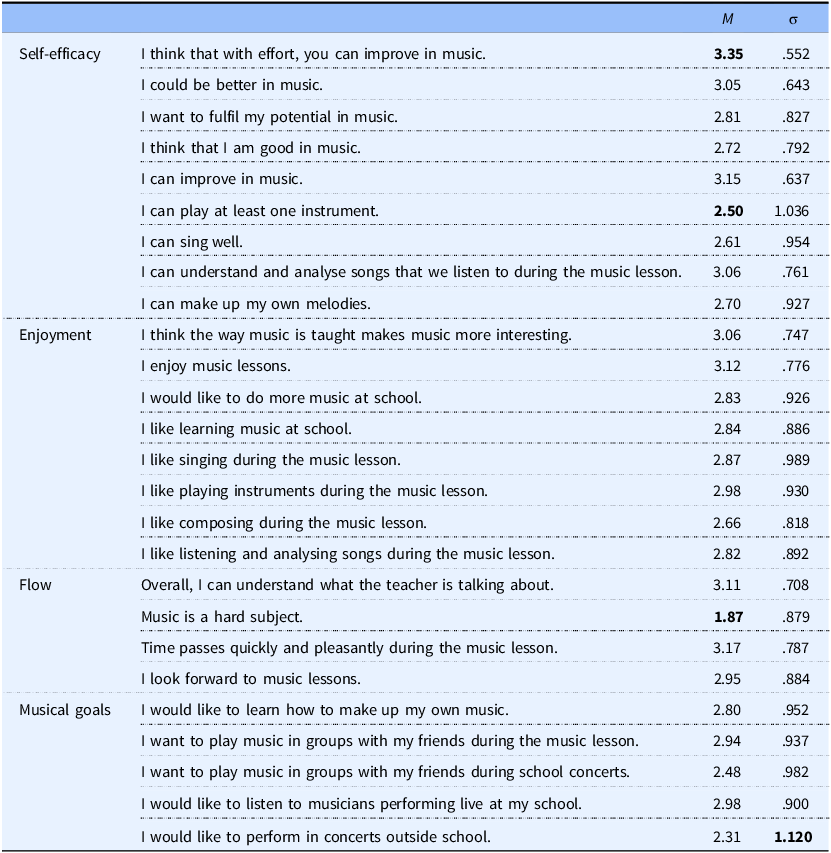
The first research question aimed to examine students’ attitudes towards the four motivational subscales. Self-perception is crucial as it determines the students’ motivation levels and engagement in music, which can influence their further musical development and achievement (O’Neill, Reference O’NEILL, MacDonald, Hargreaves and Miell2002; Hargreaves et al., Reference HARGREAVES, MARSHALL and NORTH2003). The results in Table 2 indicated that students mostly had a positive opinion about music lessons and wanted to participate in various musical activities during the lesson, so it was not surprising that students did not perceive music as a difficult subject (M = 1.87). Although most of the students stated that they did not like performing publicly at school (M = 2.48) or out of the school (M = 2.31), findings also showed that most students who were involved in this study played an instrument (M = 2.50). It is possible that some students considered playing Orff instruments during music lessons while answering this question, while others focused on playing more traditional instruments. Items related to musical creativity activities, however, revealed a lower level of satisfaction with these activities (M = 2.66) (Table 2). Previous studies demonstrate that creativity activities, which encompass composing and improvising, are among the least represented in music classrooms both in Croatia and internationally (Svalina, Reference SVALINA2015; Abril, Reference ABRIL, Abril and Gault2016). One possible reason for this could be that, according to the students’ opinions, these activities require more effort compared to other forms of musical expression (Mucić, Reference MUCIĆ2024). Generally, students enjoy participating in hands-on experiences in class music lessons (Kokotsaki, Reference KOKOTSAKI2016). Although the results from the current study suggest that these students perceived music lessons positively, other studies indicated that they considered music less important compared to core subjects (McPherson & O’Neill, Reference MCPHERSON and O’NEILL2010; Kokotsaki & Whitford, Reference KOKOTSAKI and WHITFORD2024).
Descriptive statistics for items of the Motivation Measure questionnaire (N = 186, TR = 1–4)

Table 2 Long description
A table with descriptive statistics for items of the Motivation Measure questionnaire. The table has 4 columns and 24 rows. The columns are labeled 'Self-efficacy', 'Enjoyment', 'Flow', and 'Musical goals'. Each row contains statements related to these categories, along with corresponding mean (M) and standard deviation (σ) values. The table captures students' attitudes towards music lessons, their self-perception, enjoyment, flow, and musical goals. Notable trends include positive opinions about music lessons and a desire to participate in various musical activities, with lower satisfaction in musical creativity activities.
Students who participated in this research regularly listened to music in class, as well as engaging in singing, playing instruments and participating in creativity activities (composing or improvising). Previous research suggests that in classrooms that placed greater emphasis on musical expression, such as singing, playing instruments or composing, students tended to be more engaged and felt more confident in their abilities. They also perceived music lessons as enjoyable and derived greater pleasure from them (Kokotsaki & Whitford, Reference KOKOTSAKI and WHITFORD2024).
The overall mean for the four constructs was calculated to examine which motivational subscale was the most prominent (Table 3). The difference between the arithmetic means was tested with a paired samples t-test, and it was found that there was no statistically significant difference between self-efficacy and enjoyment, t(185) = −.440, p = .660. Other differences were statistically significant (p < .05). Flow was the most prominent motivational factor for students’ participation in music lessons (M = 3.09), while self-efficacy (M = 2.88) and enjoyment (M = 2.89) were less prominent. The least prominent subscale was musical goals (M = 2.70).
Means and standard deviation for subscales of the motivation measure questionnaire (N = 186, TR = 1–4)

Table 3 Long description
A table with four rows and four columns. The columns are labeled Self-efficacy, Enjoyment, Flow, and Musical goals. The rows are labeled M and σ. The values in the table are as follows: Row 1: Self-efficacy, M 2.88, σ .462; Enjoyment, M 2.89, σ .647; Flow, M 3.09, σ .629; Musical goals, M 2.70, σ .679.
According to Bandura (Reference BANDURA1997), self-efficacy has a dominant influence on an individual’s motivation. The assessment of self-efficacy affects an individual’s effort, persistence and achievement, and students who show a higher level of self-efficacy also demonstrate higher levels of achievement (Zelenak, Reference ZELENAK2020). Although the musical goals subscale was found to be the least prominent in this research (M = 2.70), students appeared to agree on the desire to learn how to create their own melodies and play in groups. Previous research indicated that playing and singing activities were the most popular classroom activities, which also allowed students to create and perform music (Hargreaves & Marshall, Reference HARGREAVES and MARSHALL2003). The results of the research conducted at the beginning of the academic year by Hadjikou (Reference HADJIKOU2021) were similar to this current study, although they showed slightly higher average values. In that study, the flow subscale was the most prominent, followed by enjoyment and self-efficacy, while musical goals was the least prominent.
Difference in students’ motivation based on the school year
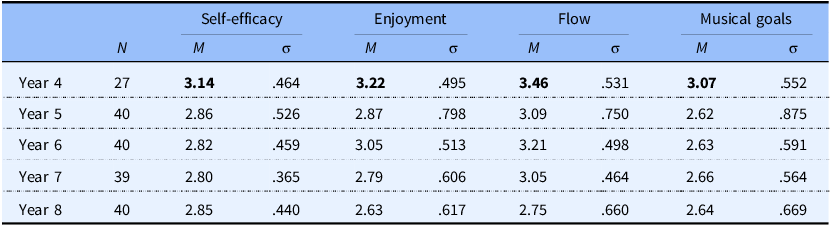
The second research question aimed to investigate whether there was a difference in the assessment of motivation between students from the school years 4 to 8. The results in Table 4 showed that Year 4 students were the most motivated to participate in class music lessons and rated their agreement with all four motivational subscales higher. In contrast, the lowest motivation was observed among Year 8 students (Table 4). The obtained results indicated a nonlinear decline in motivation among students (Figure 1). Although students enjoyed music lessons, the level of enjoyment and motivation decreased with age. However, a slight increase in the musical goals subscale was observed among students in Years 7 and 8. The nonlinear nature of the decline suggests that various factors influenced the students’ motivation.
Average values of motivational subscales by year level

Table 4 Long description
A table comparing motivational subscales across different school years. The table has five rows and five columns. The columns are labeled Self-efficacy, Enjoyment, Flow, and Musical goals, with each column showing the number of students (N), the mean (M), and the standard deviation (σ). The rows are labeled by school year from Year 4 to Year 8. Row 1: Year 4, N 27, Self-efficacy M 3.14, σ 0.464, Enjoyment M 3.22, σ 0.495, Flow M 3.46, σ 0.531, Musical goals M 3.07, σ 0.552. Row 2: Year 5, N 40, Self-efficacy M 2.86, σ 0.526, Enjoyment M 2.87, σ 0.798, Flow M 3.09, σ 0.750, Musical goals M 2.62, σ 0.875. Row 3: Year 6, N 40, Self-efficacy M 2.82, σ 0.459, Enjoyment M 3.05, σ 0.513, Flow M 3.21, σ 0.498, Musical goals M 2.63, σ 0.591. Row 4: Year 7, N 39, Self-efficacy M 2.80, σ 0.365, Enjoyment M 2.79, σ 0.606, Flow M 3.05, σ 0.464, Musical goals M 2.66, σ 0.564. Row 5: Year 8, N 40, Self-efficacy M 2.85, σ 0.440, Enjoyment M 2.63, σ 0.617, Flow M 2.75, σ 0.660, Musical goals M 2.64, σ 0.669.
Trends in the students’ motivation according to grades.

Given that the same music teacher teaches these year groups, it is possible that students’ motivation was influenced by differences in the curriculum and teaching activities. Specifically, in Years 4, 5 and 6, students participate in a variety of music activities (singing, playing instruments, composing or improvising) and are introduced to theoretical musical content. The same activities should also be included in Years 7 and 8. However, practical experience has shown that in these year groups, there is less time for musical activities due to the increased amount of theoretical and musicological content that students are required to learn, which speculatively may impact the results.
Previous research showed that students’ beliefs about their musical abilities decreased as they progressed through the years at school, which affected their motivation (Randles, Reference RANDLES2011). Additionally, as students advanced through the years, their level of enjoyment and interest in music in school tended to decline (Hargreaves & Marshall, Reference HARGREAVES and MARSHALL2003; McPherson & Hendricks, Reference MCPHERSON and HENDRICKS2010). Although students continued to enjoy music classes, the level of enjoyment decreased with age, which could impact motivation.
Differences in motivation based on gender and additional music education
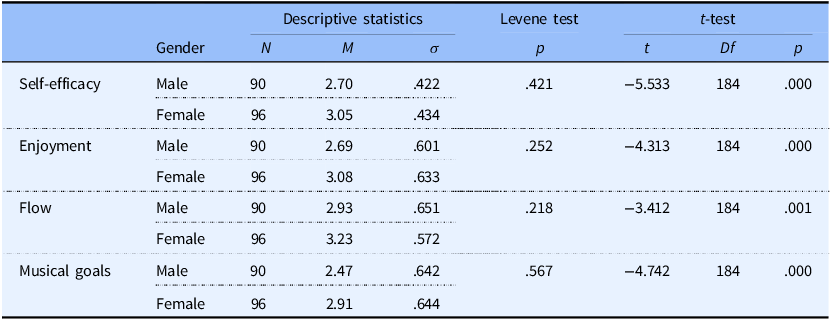
The third research question aimed to determine whether there was a difference in the assessment of motivation between female and male students. As Levene’s test was not significant (p > .05), the assumption of equal variances was satisfied. An independent samples t-test was conducted, revealing statistically significant differences across all motivational subscales, p < .05 (Table 5). Motivational factors such as self-efficacy, enjoyment, flow and musical goals were more prominent with female than male students. This research confirmed the findings of previous research. Girls tend to enjoy music more, exhibit greater motivation and have a more positive attitude towards music (Kokotsaki, Reference KOKOTSAKI2016; Papageorgi & Economidou Stavrou, Reference PAPAGEORGI and ECONOMIDOU STAVROU2023). They also perceive themselves as more competent in music compared to boys (McPherson & O’Neill, Reference MCPHERSON and O’NEILL2010; Juvonen, Reference JUVONEN2011; Randles, Reference RANDLES2011; Ritchie & Williamon, Reference RITCHIE and WILLIAMON2011). Since motivation stems from the perception of one’s abilities, this may be one of the reasons why girls are more motivated to participate in music lessons.
Differences in the students’ motivation based on gender

Table 5 Long description
A table comparing student motivation based on gender. The table has four rows and three columns. The columns are labeled Descriptive statistics, Levene test, and t-test. The rows are labeled Self-efficacy, Enjoyment, Flow, and Musical goals. Each row contains data for Male and Female students, including the number of participants (N), mean (M), standard deviation (σ), p-value for Levene's test (p), t-value for t-test (t), degrees of freedom (Df), and p-value for t-test (p).
The fourth research question aimed to determine whether there was a difference in the assessment of motivation between students who are involved in and those who are not involved in various forms of extracurricular music education. Extracurricular music education refers to formal or informal music learning outside regular music classes in general education schools. Of the total number of participants in the study (N = 186), 66 students participated in additional music activities, of which 55 (83%) were female and 11 (17%) were male. This aligns with Harland et al.’s (Reference HARLAND, KINDER, LORD, STOTT, SCHAGEN, HAYNES, CUSWORTH, WHITE and PAOLA2000) finding from research on extracurricular music activities in the UK.
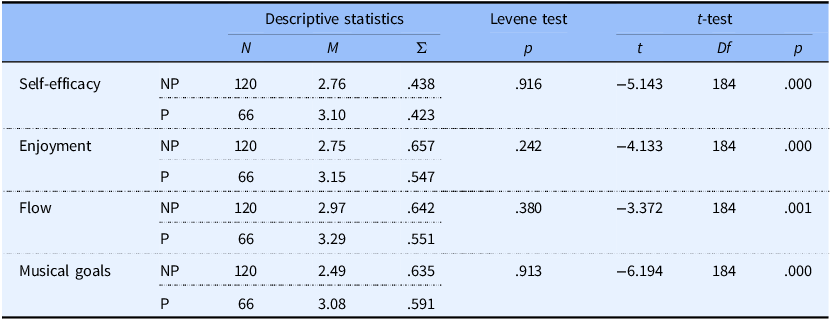
To determine whether there was a difference between students with regard to participation in extracurricular music activities, a paired samples t-test was conducted. The results of Levene’s test indicated that the assumption of homogeneity of variance was satisfied (p > .05). The results of the t-test showed a statistically significant difference for all subscales of the motivation questionnaire, p < .05 (Table 6). The constructs of self-efficacy, enjoyment, flow and musical goals were more pronounced with students who were engaged in additional forms of music learning compared to those students who were not. In contrast, another study did not find a statistically significant difference in student motivation (Arriaga Sanz & Madariaga Orbea, Reference ARRIAGA SANZ and MADARIAGA ORBEA2014). Students engaged in music outside of school had more positive opinions about their musical competencies and enjoyed music lessons more (Juvonen, Reference JUVONEN2011), which increased their intrinsic motivation (Eccles & Wigfield, Reference ECCLES and WIGFIELD2002; Csikszentmihalyi et al., Reference CSIKSZENTMIHALYI, ABUHAMDEH, NAKAMURA and Csikszentmihalyi2014; Schunk et al., Reference SCHUNK, MEECE and PINTRICH2014). It is suggested that by participating in additional activities, students may be more likely to develop their self-confidence, which potentially further enhances their motivation.
Differences in the students’ motivation according to the involvement in additional forms of musical education

Table 6 Long description
A table comparing student motivation based on additional musical education involvement. The table has four rows and three columns. The columns are labeled Descriptive statistics, Levene test, and t-test. The rows are labeled Self-efficacy, Enjoyment, Flow, and Musical goals. Each row is further divided into two groups: NP and P. For Self-efficacy, NP has 120 samples with a mean of 2.76 and a sum of 0.438, while P has 66 samples with a mean of 3.10 and a sum of 0.423. The Levene test p-value is 0.916, and the t-test shows a value of -5.143 with 184 degrees of freedom and a p-value of 0.000. For Enjoyment, NP has 120 samples with a mean of 2.75 and a sum of 0.657, while P has 66 samples with a mean of 3.15 and a sum of 0.547. The Levene test p-value is 0.242, and the t-test shows a value of -4.133 with 184 degrees of freedom and a p-value of 0.000. For Flow, NP has 120 samples with a mean of 2.97 and a sum of 0.642, while P has 66 samples with a mean of 3.29 and a sum of 0.551. The Levene test p-value is 0.380, and the t-test shows a value of -3.372 with 184 degrees of freedom and a p-value of 0.001. For Musical goals, NP has 120 samples with a mean of 2.49 and a sum of 0.635, while P has 66 samples with a mean of 3.08 and a sum of 0.591. The Levene test p-value is 0.913, and the t-test shows a value of -6.194 with 184 degrees of freedom and a p-value of 0.000.
NP – not participate; P – participate
p < .05
Listening habits and motivation
The final research question focused on the relationship between listening to music and the students’ assessment of their motivation. Results suggest that students choose to listen to music during their free time. A smaller number of students listen to music rarely (n = 12; 6.5%), somewhat more listen to music occasionally (n = 39; 21%), while the largest number of students listen to music frequently (n = 57; 30.6%) and always, that is, every day (n = 78; 41.9%). Similarly, other studies have confirmed that students often listen to music, mostly every day (North et al., Reference NORTH, HARGREAVES and O’NEILL2000; Boal-Palheiros & Hargreaves, Reference BOAL-PALHEIROS and HARGREAVES2001; Arriaga Sanz & Madariaga Orbea, Reference ARRIAGA SANZ and MADARIAGA ORBEA2014). Tarrant, North and Hargreaves (Reference TARRANT, NORTH and HARGREAVES2000) highlighted self-actualisation and fulfilling emotional and social needs as the main reasons for listening to music. Given the significant role of music listening in the students’ free time, the research examined whether there was a correlation between music listening and their motivation in class music lessons.
The results of Pearson’s correlation indicated that the motivational factors of self-efficacy and musical goals were more pronounced in students who listened to music more frequently. However, the correlation between music listening and the subscales enjoyment and flow was not found to be statistically significant, p > .05 (Table 7). If an individual highly rates their self-efficacy, suggesting they have greater confidence in their abilities, they are also likely to set higher goals (Woolfolk, Reference WOOLFOLK2016). One study also suggests that students who listen to music during their free time and follow music-related programmes tend to be more motivated to participate in music lessons (Arriaga Sanz & Madariaga Orbea, Reference ARRIAGA SANZ and MADARIAGA ORBEA2014). The relationship between listening to music and students’ intrinsic motivation to engage in music lessons in order to fulfil their own musical interests merits further investigation.
Correlation of music listening and the motivational subscales (N = 186)

Table 7 Long description
A table with four columns and two rows. The columns are labeled Self-efficacy, Enjoyment, Flow, and Musical goals. The row label is Music listening. The values in the table are as follows: Row 1: Self-efficacy, .250**; Enjoyment, .123; Flow, .097; Musical goals, .236**. The table shows correlation values between music listening and different motivational subscales.
**p < .01
Limitations and further research
This research involved students from a single primary school, so the results cannot be generalised to the entire population. Additionally, in this research, the students self-assessed their motivation to participate in class music lessons, which might introduce subjectivity in their responses. The students’ answers might reflect specific teaching methods employed by their music teacher. Nevertheless, although the results cannot be generalised, they can provide insights into ways to increase and prevent the decline of the students’ motivation to participate in music lessons.
There is much scope for deeper investigation into students’ motivation relating to music education. Further research could focus on expanding the sample to include a larger number of schools or regions in Croatia and on interrogating the findings of each of these research questions to understand the students’ perspectives on the reasons for their ratings. The study could also be extended to music schools, which specialise in students’ musical education (in Croatia, students attend music school alongside general primary school). In addition, a longitudinal study may determine whether specific students’ motivation increases or decreases during the school year. It will be interesting to compare students’ motivation to participate in class music lessons across different countries to identify potential cultural differences. There could also be merit in exploring how different teaching and learning approaches influence students’ motivation.
Conclusion
Motivation trends in this small sample of Croatian students largely follow trends observed internationally. Overall, the results indicate that these students were motivated to participate in class music lessons. The most prominent motivational subscale is flow, suggesting that these students enjoyed their music lessons and felt that time passed quickly and in a pleasant atmosphere. It is possible that the teaching strategies employed during class music lessons suited these students, thus intrinsically motivating them to participate and actively engage in the learning process, although this is speculative as the reasons were not investigated within this research. Specifically, the students who took part in the study regularly engaged in musical expression activities such as singing, playing instruments, dancing, composing and improvising.
However, the results also show a nonlinear decline in motivation as students progress through the school years. The most motivated students are those in Year 4, while the lowest levels of motivation are observed in Year 8. Possible reasons for this include different curricula and teaching activities that contribute to achieving learning outcomes. Additionally, it is possible that students in higher years are more focused on academic subjects that are necessary for their further education. To change the trend of declining motivation in this specific school, it is necessary to find ways to maintain the students’ interest in music in the higher years and to investigate the reasons for the decline. However, the findings of this study tentatively suggest that teachers should provide practical experiences that may contribute to increasing the students’ motivation.
The research results also show that female students in this school in Croatia were more motivated to participate in music lessons, which aligns with previous studies. Furthermore, the relationship between listening to music and the students’ participation in additional music activities and motivation is examined. Students who participated in additional music activities were more motivated to engage in music lessons. The results highlight the importance of additional music activities as a source of student motivation. Recommendations for increasing student motivation include organising more extracurricular and out-of-school musical activities that meet students’ interests and motivations. Moreover, students in this school who listen to music more frequently in their free time rated their self-efficacy and musical goals more highly. The findings suggest that listening to music plays a significant role in these students’ lives, as they listen to it daily, and in some way, music listening may shape their attitudes towards music lessons. Students in this school who listen to music more often possibly recognise its benefits, have higher beliefs in their abilities and wish to actively engage in music-making, although this needs further investigation. The teacher cannot influence the amount of time students spend listening to music in their free time. However, they can encourage students to listen to music beyond school by assigning additional tasks that involve music-listening activities and validating their preferences within school. Since the findings suggest a correlation between music listening and students’ motivation for these specific students, such activities could be a useful tool to foster greater engagement and motivation in music lessons.
In summary, to increase engagement in the teaching and learning process, the results from this primary school in Croatia suggest that music teachers should focus on students’ interests and preferences. Speculatively, it seems particularly important to create a comfortable and positive environment and encourage practical music experiences that seek to facilitate active participation in the learning process and contribute to increasing students’ motivation.
Author contribution
Mia Mucić, PhD, is a music teacher at Zrinski Nuštar Primary School in Croatia. She graduated in music pedagogy at the Academy of Arts in Osijek. Her scientific interest focuses on music education in general education schools, extracurricular musical activities and musical creativity.
Competing interests
The author declared no potential conflicts of interest with respect to the research, authorship and/or publication of this article.