Introduction
Prior to World War II, forage species, used for pasture, silage and hay, were routinely included in Iowa crop rotations. By providing feed for livestock and work animals, cash income to farmers from hay sales and crucial ecological benefits to the farming system, these multifunctional crops mitigated risk on the farm. The post-war influx of cheap, abundant chemical fertilizers and synthetic pesticides, along with a shift from animal to machine-based labor, caused a decrease in forage-based cropping sequencesReference Dimitri, Effland and Conklin1, Reference Cardwell2, in part because farmers did not need to rely solely on forage legumes to supply nitrogen nor did they need feed for draft animals.
Since 1950, Iowa agriculture has increasingly focused on intensive corn (Zea mays L.) and soybean [Glycine max (L.) Merr.] production, an effort that produced impressive results—corn and soybean yields nearly quadrupled and more than doubled, respectively, between 1950 and 20043. Ironically, these yield increases did not represent improved welfare for Iowa farms or farmers. During the same period of time, the number of farms in Iowa decreased by more than 50% and crop prices plummeted4. After adjusting for inflation, average net income per Iowa farm in 2001 was 9% lower than it was in 1960, despite a more than twofold increase in the number of acres per farm4.
Meanwhile, the environmental implications of intensive corn and soybean production are cause for concern. Runoff and artificial drainage from corn and soybean fields are well-documented causes of non-point source contamination of surface and groundwater bodies with sediment, nutrients (especially NO3-N and P)Reference Gast, Nelson and MacGregor5–Reference Kladivko, Van Scoyoc, Monke, Oates and Pask8, and pesticidesReference Buhler, Randall, Koskinen and Wyse9–Reference Kanwar, Bjorneberg and Baker13. NO3-N loading to the Mississippi River from agricultural operations in the Mississippi River Basin has been linked to a hypoxic zone in the Gulf of Mexico that is growing in size and severityReference Rabalais, Turner, Justic, Dortch and Wiseman14. Further, pesticide and herbicide use in corn and soybean production may have negative effects on human and wildlife healthReference Relyea15–Reference Rohr and Crumrine17.
We hypothesize that diversifying Iowa corn and soybean rotations by including forage crops would offer farmers a way to mitigate negative environmental impacts caused by corn and soybean production while providing a lucrative source of income not dependent on government subsidization. In this paper, we review the literature on the agronomic and ecological effects of forage incorporation into Iowa and Midwestern cropping systems. We also look at the economic effect of incorporating forages into corn and soybean rotations in Iowa and assess socio-political barriers that discourage farmers from including forage species as part of their agricultural systems. Finally, we make recommendations for policy changes that would encourage the adoption of forages by corn and soybean farmers, a goal that has the potential to greatly improve not only the ecological health of Iowa waterways and soil but also the economic health of the state's farmers. Although this analysis primarily focuses on Iowa, the discussion and conclusions can likely be generalized to other agroecosystems as well.
Forage Production
Forage is defined as the edible part of a plant, other than the separated grain, that is generally above ground and that can provide feed for grazing animals or can be harvested for feeding18. In Iowa, several grass and legume species are cultivated as forages, including smooth bromegrass (Bromus inermis Leyss.), orchardgrass (Dactylis glomerata L.), switchgrass (Panicum virgatum L.), red (Trifolium pratense L.) and white clover (Trifolium repens L.), birdsfoot trefoil (Lotus corniculatus L.), and most commonly, alfalfa (Medicago sativa L.)Reference Barnhart19. Forages can be harvested by animals in pasture-based systems or mechanically harvested throughout the growing season as silage/haylage, hay or pellets for use as year-round livestock feed.
Precise estimates of the amount of perennial forage crops grown in Iowa are not available. Iowa has between 1 and 2 million ha of pastureland, encompassing cropland, permanent and woodland pasturesReference Barnhart19. An additional 650,000 ha of hay were harvested in Iowa in 2004, 525,000 ha (81%) of which was alfalfa20. This represents 7% of Iowa's crop harvest, which also includes corn, soybeans, oats (Avena sativa L.) and wheat (Triticum aestivum L.).
Relative to corn and soybeans, perennial forage crops have high caloric and protein yields, and high output/input energy ratios. Based on energy data from production in Ohio, alfalfa yields nearly twice as many calories and protein per hectare as soybeans and more than 40% more protein than corn per hectare. The energy output/input (energy inputs include labor, machinery, fuel, fertilizers, pesticides, electricity and transportation) ratios for alfalfa, soybeans and corn are 6.17:1, 4.15:1 and 2.5:1, respectivelyReference Pimentel and Pimentel21. The relative energy efficiency of alfalfa over a corn and soybean rotation is mainly the result of the high energy cost of nitrogen fertilizer applied primarily to corn.
Agronomics
Rotational yield benefits
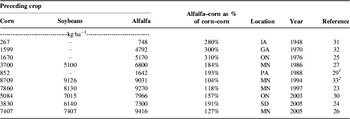
Little debate exists over the yield benefits arising from diversifying crop rotations, particularly those combining legume and grass crops in succession. A rotation of corn and soybeans yielded 10% more than continuous corn and 8% more than continuous soybeans in Minnesota, evidence for a ‘rotation effect’Reference Crookston, Kurle, Copeland, Ford and Lueschen22. Adding perennial forage legumes, particularly alfalfa, to the system creates more substantial benefits to corn yield, a trend that has been observed for over 50 years and in many regions of North AmericaReference Porter, Crookston, Ford, Huggins and Lueschen23–Reference Huggins, Randall and Russelle33 (Table 1). In Minnesota, a single year of alfalfa increased succeeding corn yields by 19%Reference Pikul, Hammack and Riedell24 to 84%Reference Crookston, Kurle, Copeland, Ford and Lueschen22 compared to corn following corn and by 33% compared to corn following soybeansReference Crookston, Kurle, Copeland, Ford and Lueschen22. Even when nitrogen is applied to the corn crop, corn following alfalfa typically yields more than corn following soybeansReference Anderson, Buxton, Karlen and Cambardella34. These studies demonstrate that rotations including at least 1 year of alfalfa would produce higher corn and soybean yields than the typical corn–soybean rotation. Because the preceding alfalfa crop supplies nitrogen to the corn for free, the higher yield is produced at lower input cost as well. Yield benefits conferred by alfalfa occur in sub-humid regions like the Midwest or in areas under irrigation. When water availability is restricted, alfalfa, which uses large quantities of water, can decrease subsequent corn yieldsReference Hesterman, Griffin, Williams, Harris and Christenson35.
Corn yield following corn, soybeans or alfalfa across ten environments.

Weed effects
In recent years, Iowa farmers have sprayed more than 95% of corn and soybean fields annually with herbicides36. Evidence of human and animal toxicity of the most frequently applied herbicides—atrazine for corn and glyphosate for soybeans—has raised concerns about their widespread useReference Relyea15–Reference Rohr and Crumrine17. In particular, the widespread adoption of Roundup Ready® soybeans and corn has resulted in a large increase in the application of Roundup® (glyphosate), which is now present in many water samples in the MidwestReference Battaglin, Kolpin, Scribner, Kuivila and Sandstrom37. Further, herbicide-tolerant crops do not solve the weed control problem; resistance has developed in many weed species to herbicides like Roundup®, diminishing the value of the technologyReference Cerdeira and Duke38. In other words, the technological fix of herbicide-resistant crops is transient, requiring continual reinvigoration by more advanced technology.
In contrast, alfalfa and other forages planted in rotation with corn and soybeans offer non-chemical means of controlling weeds. When grown in monoculture, alfalfa stands decrease or eliminate populations of several weed species, including milkthistle [Silybum marianum (L.) Gaertn.], field bindweed (Convulvulus arvensis L.), white campion [Silene latifolia subsp. alba (Mill.) Greuter & Burdet; syn. Silene alba (Mill.) E.H.L. Krause], and common lambsquarter (Chenopodium album L.)Reference Michael39–Reference Ahmed42. By their second year, alfalfa stands can often be weed-free without any herbicide useReference Brink and Marten43, Reference Sheaffer44. Without decreasing yields of succeeding crops, alfalfa has been shown to reduce weed densities to a comparable degree as herbicidesReference Curran, Kephardt and Twidwell45–Reference Westerman, Liebman, Menalled, Heggenstaller, Hartzler and Dixon47. A recent demonstration of one alternative system has shown that diversifying crop rotations to include triticale and either red clover or alfalfa is nearly as effective as herbicide use in controlling velvetleaf (Abutilon theophrasti Medik.) and foxtail (Setaria faberi Hermm.), two of the most prevalent weed species found in corn and soybean crops in the Midwestern USReference Heggenstaller and Liebman48.
Soil nutrients
All plants require nitrogen for growth. Corn, like most grass species, cannot fix its own nitrogen and must mainly rely either on synthetic fertilizer or animal manure nitrogen inputs or on nitrogen that has been fixed by a legume species planted before it. Soybeans are legumes, and hence fix nitrogen, but in quantities insufficient to fully meet the N demands of themselves or of successive corn crops. In contrast, alfalfa can fix up to nine times more N than soybeans, birdsfoot trefoil up to four times as much, and red clover up to five times moreReference Francis, Flora and King49. Sweetclover (Melilotus spp.), once widely planted throughout the Midwest and Great Plains, can produce even more N than these speciesReference Stickler and Johnson50. The value of alfalfa for increasing soil nutrient levels has been documented since at least the time of the Roman agronomist Columella, who wrote sometime around 100 CE that alfalfa ‘dungs the land’Reference Putnam, Russelle, Orloff, Kuhn, Fitzhugh, Godfrey, Kiess and Long51. The decomposing alfalfa crop results in more mineralizable N than either soybean or corn cropsReference Carpenter-Boggs, Pikul, Vigil and Riedell52, further demonstrating the value of the crop in providing nitrogen for crop production.
Alfalfa's superior nitrogen fixation rate enables it to reduce the economically optimum N fertilizer rate needed for corn production by a greater magnitude than soybeans. Iowa State University recommends a reduction in the application rates of N fertilizer to corn following alfalfa by 80–85% compared to 0–25% for corn following soybeansReference Sawyer53. Alfalfa in rotation with corn contributes an 18–50 kg ha−1 larger nitrogen credit than soybeans, depending on the condition of the stand when rotated out of alfalfaReference Lamond, Whitney, Bonczkowski and Hickman54. In addition to cost savings for nitrogen fertilizer, this credit also results in a considerable reduction in the amount of nitrogen leaving the agroecosystemReference Huggins, Randall and Russelle33, Reference Kanwar, Cruse, Ghaffarzadeh, Bakhsh, Karlen and Bailey55, Reference Randall, Huggins, Russelle, Fuchs, Nelson and Anderson56.
Soil quality
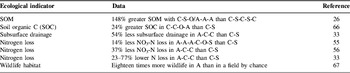
Forage legumes and grasses improve soil quality as determined by multiple indicators, including improved soil organic matter (SOM) and physical propertiesReference Gregory, Shea and Bakko26, Reference Gregory, Shea and Bakko57–Reference Russell, Laird and Mallarino66 (Table 2). Additionally, 5 years of continuous alfalfa increased the mean weight diameter of water-stable aggregates (an indicator of soil quality) from 1.5 to 2.3 mm and C content increased from 26 to 30 g/kgReference Putnam67. In comparison, 5 years of corn and fallow resulted in neither an increase nor decrease in soil qualityReference Angers68. Alfalfa, bromegrass and red clover increased soil structural quality, as indicated by a decrease in dispersible clay and an increase in wet aggregate stability, compared to continuous corn grown under either conventional or no-till conditions, which showed either no improvement or some decline in soil structural qualityReference Perfect, Kay, van Loon, Sheard and Pojasok57.
Soil quality and ecological benefits contributed by forages.

C, corn; S, soybeans; O, oats; A, alfalfa.
Ecological benefits
Recent decades have seen growing concern over the widespread damage caused by row cropping, including soil erosion, nutrient contamination of waterways and contribution to excess greenhouse gas emissionsReference Huggins, Randall and Russelle33, Reference Clark, Haverkamp and Chapman69, 70. Cropping systems that reduce or mitigate these problems are essential if agricultural systems are to be environmentally sustainable in the long term. Crop rotations that include forages can help reduce negative impacts of agriculture on the environment, as compared to rotations that only include corn and soybeans, through decreased NO3-N leaching and water drain flowsReference Huggins, Randall and Russelle33, Reference Kanwar, Cruse, Ghaffarzadeh, Bakhsh, Karlen and Bailey55, Reference Randall, Huggins, Russelle, Fuchs, Nelson and Anderson56, Reference Deng and Tabatabai71 and by increased C sequestrationReference Su59, Reference Russell, Laird and Mallarino66, Reference Angers68, Reference Gebhardt, Johnson, Mayeux and Polley72–Reference Meyer-Aurich, Weersink, Janovicek and Deen77 (Table 2). Additionally, forage crops can also play an important role in providing critical wildlife habitat for many species of migratory birds and small mammalsReference Putnam, Russelle, Orloff, Kuhn, Fitzhugh, Godfrey, Kiess and Long51, Reference Putnam67 (Table 2).
Economics
Few formal economic comparisons exist that calculate production costs and profits on Midwestern farms with corn and soybean rotations as compared to those with alternative rotations including forage crops such as alfalfaReference Karlen, Hurley, Andrews, Cambardella, Meeka, Duffy and Mallarino65, Reference Thompson and Thompson78–Reference Delate, Duffy, Chase, Holste, Friedrich and Wantate81. Case study economic analyses, however, often show alternative rotation schemes to be economically competitive with, or frequently advantageous over, rotations of only corn and soybeansReference Karlen, Hurley, Andrews, Cambardella, Meeka, Duffy and Mallarino65, Reference Thompson and Thompson78, Reference Diebel, Williams and Llewelyn79, Reference Delate, Duffy, Chase, Holste, Friedrich and Wantate81, Reference Mitchell, Vogel, Varvel, Klopfenstein, Clark and Anderson82. Additionally, a number of analyses show that forage-based livestock production systems are economically advantageous over grain-based livestock systems or row-crop systemsReference Nimrick, Oswald and Staff83, Reference Rotz, Roth, Soder and Schnabel84.
To illustrate the economic differences between a corn–soybean rotation and two alternative rotations in Iowa, we compared estimated production costs and incomes on an average-sized Iowa farm. This analysis does not pretend to be exhaustive or to take into consideration the complexity of factors influencing production costs and income on Iowa farms. Variables such as yield differences between farms, the effects of precipitation and pest stress, management differences, or the complexity and variation of incomes from government payments will affect any given farmer's bottom line. This analysis seeks solely to compare production costs and farm incomes based on average farm size, management practices, input costs, prices and government payments.
According to 2005 statistics from the Iowa Department of Agriculture20, average farm size in Iowa is 143 ha, so we set our generalized farm size equal to that figure. This analysis could be scaled up or down for other farm sizes and the income differences between the systems would change proportionally. According to 2002 statistics on land tenure rates, Iowa farmers on average rent 59% of the land they farm, so on our generalized farm we assumed 81 ha were rented and 62 ha were ownedReference Duffy and Smith85. The cropping systems analyzed were as follows:
Conventional: corn–soybean
Alternative 1: corn–soybean–oat/alfalfa
Alternative 2: corn–soybean–oat/alfalfa–alfalfa–alfalfa
The conventional system, an annual corn and soybean rotation, represents the most common cropping system found in Iowa. For our purposes, we assumed that 1/2 of the farm was planted to each crop each year. Alternative 1 includes an oats/alfalfa mix. Thus, in any given year, 1/3 of the farm is in corn, 1/3 in soybean and 1/3 in oat/alfalfa; crops would be rotated year-to-year in that order on each of the thirds. Oats would be harvested for grain and the straw baled; a single alfalfa harvest would be taken one month after oat harvest. Alfalfa regrowth would be plowed down, adding value as an N fertilizer to the succeeding corn crop, but not considered in our economic analysis. For the Alternative 2 rotation, the farm is divided into five fields, with one in corn, one in soybeans, one in oats and establishing alfalfa and two in established alfalfa in any given year. During the two post-establishment years of alfalfa production, four harvests are made each season.
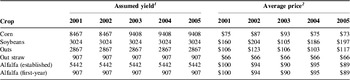
Crop production costs were obtained from Iowa State University Extension estimates, which include fixed and variable expenses such as machinery and fuel, seeds, chemical inputs (including pesticides and fertilizers), labor and landReference Duffy and Smith86. Actual crop prices were obtained from the Iowa Department of Agriculture20 (except for the average price of oat straw, which was obtained from the Hay and Forage Grower Web siteReference Hay and Forage87) (Table 3). Government payments, including direct and counter-cyclical payments (DP and CCP), were estimated as described below using formulas and figures provided by the Farm Services Agency of the United States Department of Agriculture (USDA)Reference Wisner88. DP were estimated with the formula, DP=DP rate×base acreage×85%×DP yield, where the DP rate was set in the US Farm Bill, the base acreage is based on the historical acreage in crop production (assumed to be the entire program crop area on our generalized farm), and the DP yields are equivalent to those listed in Table 3. CCP were estimated using the formula, CCP=Target price−Market price×Base acreage×85%×CCP yield, where the target price was set in the US Farm Bill, market prices are given in Table 3, and CCP yields are equivalent to those listed in Table 3.
Assumed crop yields (kg ha−1) and average crop prices (US$ Mg−1) for the years 2001 through 2005.

1 kg ha−1 for corn, soybeans, and oats, and kg ha−1 cutting−1 for oat straw and alfalfa.
2 US$ Mg−1.
Yields used in the analysis for corn, soybeans, alfalfa, oats and oat straw were the average yields used to determine production costs in the Iowa State University Extension publicationReference Duffy and Smith86 (Table 3). These yields were used for all of the systems, despite the fact that yields may differ depending on the rotation employed, as we described in earlier sections of this paper. Similarly, the various ecological benefits of a system including forage crops are not accounted in this analysis.
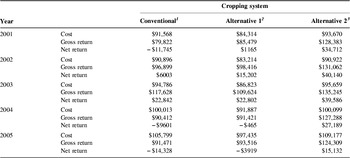
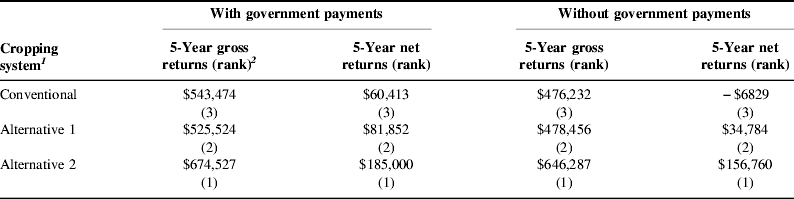
To make our estimates, we obtained average crop production costs and returns in each year for each system (Table 4) and calculated average net income across five years (the length of the longest rotation) from each production system. Government payments were also averaged across years. Net returns are equal to gross income (including deficiency payments when government programs apply) minus all production costs. Average net returns for the entire 5-year rotation were calculated with and without government program payments for each system (Table 5).
Simulated production costs, gross returns and net returns for three cropping systems on an ‘average’ 143 ha Iowa farm for the years 2001 through 2005.

1 C-S.
2 C-S-O/A.
3 C-S-O/A-A-A.
C, corn; S, soybeans; O, oats; A, alfalfa.
Whole farm gross and net returns with and without government program payments for three cropping systems on an ‘average’ 143 ha Iowa farm from the years 2001 through 2005.
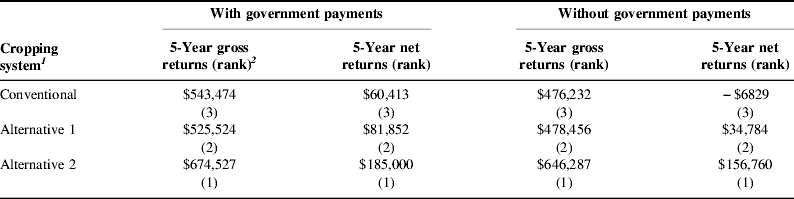
1 Conventional=C-S, Alternative 1=C-S-O/A, Alternative 2=C-S-O/A-A-A; C, corn; S, soybeans; O, oats; A, alfalfa.
2 The rank of 1 is highest value.
Profitability of the cropping systems was based on production costs, prices obtained by farmers for crops, and in some cases government program payments. Our calculations clearly show that the Alternative 2 rotation, with 3 years of alfalfa, is the most profitable, whether government payments are included or not. Alternative 1, with only 1 year of alfalfa, ranks second in profitability, both with and without government payments. The conventional system, which does not include forage, is the least profitable system, and results in a net loss without government payments.
Despite the increased costs associated with alfalfa production (which include factors such as additional machinery and labor), the price obtained for the crop makes the system with 3 years of alfalfa very profitable, 43% more than the conventional system even when including government program payments. According to our analysis, adding only 1 year of alfalfa to a corn–soybean rotation (Alternative 1) decreases profitability of the system compared to Alternative 2, due to the relatively high cost of alfalfa seed, costs associated with planting and low yield of alfalfa in the establishment year.
The most profitable cropping system in our analysis contained 3 years of alfalfa. Prices of alfalfa vary with production levels in local markets and are not eligible for government deficiency payments. An increase in alfalfa production due to inclusion of the crop on more Iowa farms could therefore lead to depressed alfalfa prices. Future studies will need to consider the lowest prices for alfalfa at which the producer would have a net income equivalent to conventional systems, both with and without government program payments. A price sensitivity analysis could also indicate the economic feasibility of increased production levels and the need to consider new markets (other than hay) for alfalfa and other forages as production increases. One possibility could be the expansion of pasture-based livestock systems, demanded by a growing consumer sectorReference Lozier, Rayburn and Shaw89 and offering many ecological services as compared to decoupled row crop and livestock systemsReference Naylor, Steinfeld, Falcon, Galloway, Smil, Bradford, Alder and Mooney90. The bottom line from our analysis showed that even without accounting the many positive externalities generated by alfalfa (or forages in general), profitability of the cropping enterprise increased with the inclusion of a forage component during the years 2001–2005.
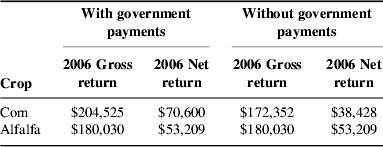
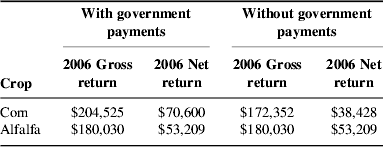
The rapid expansion of the ethanol industry has caused a recent spike in corn prices that this economic analysis does not account for. Corn prices rose to four dollars per bushel at the end of 2006 and in early 20073. Farmers have responded by increasing planned corn acreage in Iowa for 2007Reference Dougherty and Geuder91. Although alfalfa (and most other crop) prices have risen along with corn, the high corn prices of 2006 made corn, on average, more profitable than alfalfa. To examine the change to farm income from the corn price increases, we compared net income from corn versus alfalfa, with and without government payments, on our sample farm, using 2006 average prices and government pay rates, 2006 production costs, and the same size and rented versus owned land proportion assumptions as in our original analysisReference Duffy and Smith85, Reference Duffy and Smith86, Reference Wisner88. With government payments included in net income estimates, 1 year of corn in 2006 was 25% more profitable than alfalfa. When government payments were excluded, however, alfalfa was 38% more profitable than corn in 2006 (Table 6).
Whole farm gross and net returns with and without government program payments for corn versus alfalfa on an ‘average’ 143 ha Iowa farm in 2006.
Barriers to Forage Incorporation
Our review of the literature and a simple cost–benefit analysis using average input costs and output crop value demonstrate numerous agronomic, ecological and economic benefits that are being attained on Iowa farms that include forages in rotation with corn and soybeans. Why don't more farmers grow forage crops? We surmise that the combination of government policies, market dynamics, time constraints from off-farm employment, and culture has influenced the hesitancy of many farmers to diversify cropping systems.
Perhaps most importantly, US agricultural policies subsidize a narrow set of commodities in Iowa including corn, soybeans and, to a limited extent, oats. USDA subsidies for Iowa farms totaled $12.5 billion between 1995 and 2004, with corn and soybean production receiving 83% of those dollars, while only 15% went toward conservation programs (mainly the Conservation Reserve Program)92. These policies are really a means of risk management, guaranteeing farmers a return on commodity crops regardless of the many uncontrollable variables that may impinge on production. Without similar risk avoidance for other crops, farmers would naturally be loath to grow them. Further, the programs essentially reward maximization of commodity production, offering little incentive for diversification of crop rotations or incorporation of perennial crops into agricultural landscapes.
Without policy incentives to encourage cropping system diversity (or at a minimum, policies that do not encourage corn and soybean production), many Iowa farmers are unlikely to take steps to incorporate forages into their cropping systems. A survey of row crop farmers in central Iowa found that 40% of respondents would be ‘not willing at all’ to convert to a cropping system incorporating more forages. However, another 40% said they would be ‘somewhat willing’, and 20% of respondents said they would be ‘very willing’ to add forages. Of those who were not willing at all, reasons cited included preference for their corn–soybean rotation, the need for increased labor, and the need for new equipment. Survey respondents also cited a lack of market incentives as the most serious obstacle to adoption of more ecologically sound farming practicesReference Hanson, Miller and Padgitt93.
Until recently, the relatively low cost of synthetic nitrogen fertilizers and fuel has meant that farmers often did not view energy costs alone as a significant incentive to make changes in agricultural systems. Recent increases in non-renewable energy costs, however, may mean farmers will consider alternative crop production systems that require fewer energy inputs, such as forage-based rotationsReference Shoemaker, McGranahan and McBride94.
Conversely, rising energy costs may increase demands for biofuels such as corn-based ethanol and soy biodiesel. Although comprehensive economic analyses for this scenario have not yet been done, projections from the USDA and World Resources Institute show a substantial increase in corn production over the next decade to meet biofuel demandsReference Shoemaker, McGranahan and McBride94, Reference Marshall and Greenhalgh95. Recent corn price increases fueled by ethanol demand means corn has lately become as profitable as or more profitable than alfalfa (Table 6). Corn acreage will expand in the near future, a scenario that will come with very high environmental costs. On the bright side, with the advent of ethanol from cellulose, many forage crops could be dual use—livestock feed or biofuel feedstock—and thus, could contribute in a sustainable way to a bioenergy future.
Recommendations for Change
Forages offer potential ecological, economic and agronomic benefits to midwestern agricultural landscapes and producers, and many farmers already incorporate forages into their systems. We see three possible avenues toward increasing the role of forage crops in the Midwest and throughout the country: revamped farm policies that stress conservation rather than production, a reinvigorated agri-cultural research paradigm that recognizes that the public interest is not always served by industry, and a more vocal forage research sector.
Without government policies that encourage alternative agricultural systems, farmers are unlikely to make changes to their crop rotations. Future farm policy should encourage diversification of agricultural landscapes and should reward environmental services provided by farmers. US farm policies should support forage production for hay and pastures, which would increase the numbers of ruminant livestock on the land. Increased pasture-based livestock production could lead to higher net incomes for farmers while simultaneously decreasing N fertilizer use and soil erosion, thereby improving water quality and increasing carbon sequestrationReference Nimrick, Oswald and Staff83, Reference Boody, Vondracek, Andow, Krinke, Westra, Zimmerman and Welle96.
We recommend increased funding and support for two programs within US farm policy intended to promote agricultural biodiversity and conservation: the Sustainable Agriculture Research and Extension Program (SARE) and the Conservation Security Program (CSP). SARE is a competitive grant program for research and outreach that funds farmer-, citizen- and researcher-driven projects, and has been shown to be effective at increasing sustainable production practicesReference Trout, Francis and Barbuto97. The promotion of researcher–farmer collaboration with a goal of increased diversity and sustainability on agricultural landscapes that is supported by SARE is crucial both to encourage positive changes on farms and to influence research priorities within land grant universities.
The CSP offers payments to farmers and landowners for carrying out conservation practices on working agricultural land. Unlike the Conservation Reserve Program (CRP), where the government essentially rents marginal land to establish grasses or wetlands, the CSP seeks to reward farmers whose agricultural practices provide ecological services such as soil erosion reduction and increased biodiversity. While the CRP has resulted in decreased erosion and increased biodiversity on some marginal lands, its costs have included a reduction in the number of working farms as well as reduced rural community vitalityReference Keeney and Kemp98. We recommend increased funding and expansion of incentive programs like the CSP that, rather than encourage increased commodity production, promote farming practices that provide both livable incomes for farmers and ecological benefits.
Secondly, because forage-related research currently attracts little funding from the agribusiness industry and is unlikely to receive substantial industry support in the future, agricultural research at the state land-grant institutions and through the USDA Agricultural Research Service (ARS) needs to include a critical mass of forage scientists. Data for public sector forage breeding show that the number of breeders has declined by 26% across all forages and by 46% for alfalfa just in the period from 1994 to 2001Reference Traxler, Acquaye, Frey and Thro99. Therefore, encouraging universities and the USDA-ARS to hire scientists willing to investigate the full range of alternative production systems would enable forage crops to gain a higher profile. Land grant universities need to develop alternatives that help farmers remain on the land while being economically stable and environmentally sensitive, rather than simply following the lead of industrialized agriculture. Funding for agricultural research from state legislatures is declining and research support is increasingly based on extramural funds through governmental agencies like USDA or NSF. These programs need to be crafted to enable the long-term nature of perennial forage crop research to compete successfully.
Finally, forage scientists need to do a better job of relaying the importance of their research to funding agencies, the government and to the public. Although we often complain about the limitations constraining our field, we do not often take the initiative to write letters to the editor or to our congressional delegations supporting our field and on the importance of forages to esthetically pleasing, environmentally beneficial and economically sustainable farming systems.
Acknowledgements
We thank the Iowa State University Agronomy Department for a supplemental graduate fellowship from the Baker Endowment to JO. We also thank Jan Flora for his thoughtful reviews and helpful comments on this paper.