The relationship between parenting styles and children's symptomatology is often conceptualized as bidirectional and transactional (Belsky, Reference Belsky1984; Collins, Maccoby, Steinberger, Hetherington, & Bornstein, Reference Collins, Maccoby, Steinberger, Hetherington and Bornstein2000; Patterson & Reid, Reference Patterson, Reid, Neuringer and Michael1970; Sameroff, Reference Sameroff1975); however, historically, and for a variety of methodological and theoretical reasons, the majority of research focuses on the impact of parenting on children. Although some research has addressed how children's symptoms also influence parenting and how they each relate to one another over time, there are still a number of gaps in the literature. This is an important area of investigation as the parent–child relationship is frequently considered a foundation for the development of interpersonal relationships and psychological functioning throughout the life span (Cox & Harter, Reference Cox, Harter, Bornstein, Davidson, Keyes and Moore2003; Thompson, Reference Thompson2000) and may provide insights for family-based interventions that can decrease maladaptive Parent×Child interaction patterns.
In a previous paper examining the impact of maternal and paternal diagnoses of depression on co-parents’ parenting styles and child symptoms, we reported bidirectional effects between children's externalizing (but not internalizing) problems and authoritarian and permissive parenting (Kopala-Sibley, Jelinek, Allmann, & Klein, Reference Kopala-Sibley, Jelinek, Allmann and Klein2017). The present study extends that report by examining bidirectional and transactional relationships between a broader set of parenting styles (authoritarian, authoritative, permissive, and overprotective) and symptoms of specific disorders (attention-deficit hyperactivity disorder [ADHD], oppositional defiant disorder [ODD]) anxiety, and depression) in children from age 3 to age 9. Thus, this study aims to further our knowledge of the bidirectional and transactional relations between parenting styles and specific facets of internalizing and externalizing psychopathology, rather than broad internalizing and externalizing symptoms in general.
For clarity, we use the term “bidirectional” to mean a relationship in both directions over two time points. For example, an effect of age-3 authoritarian parenting on age-6 affective symptoms, and of age-3 affective symptoms on age-6 authoritarian parenting would be a bidirectional relationship. We use the term “transactional” to indicate a process that unfolds over time (i.e., a mediational process). For example, an effect of age-3 symptoms on age-9 symptoms via age-6 parenting would be transactional. Finally, we use the term “reciprocal” to refer to both bidirectional and transactional effects unfolding simultaneously within the same set of processes. So, for example, effects of parenting at age 3 on symptoms at age 6, and vice versa, as well as effect of age-3 symptoms on age-9 symptoms via age-6 parenting would be an example of reciprocal effects.
Bidirectional and Transactional Effects of Parenting and Oppositional, Conduct, and Attention Deficit Hyperactivity Disorders in Children
Although evidence is mixed, with some studies suggesting the impact of child ODD and conduct disorder (CD) on parents is stronger than the reverse relationship, parents’ behavior, especially inconsistent discipline, harsh/punitive discipline, and permissiveness, also shapes children's ODD and CD symptoms. For instance, in a longitudinal study of boys from childhood through adolescence, Burke, Pardini, and Loeber (Reference Burke, Pardini and Loeber2008) found bidirectional relationships such that timid discipline predicted increases in ODD symptoms, and ODD symptoms predicted increases in timid discipline. However, the impact of child symptoms on other types of parental behavior was stronger than the reverse relationship, as ODD and CD predicted a number of parenting outcomes. Notably, in this study, symptoms of ADHD were not significantly involved in any bidirectional relationships. More recently, Yan, Ansari, and Peng (Reference Yan, Ansari and Peng2020) conducted a meta-analysis, which suggests that the effects of parents’ functioning on children's externalizing symptoms and vice versa were statistically comparable.
Hawes, Dadds, Frost, and Hasking (Reference Hawes, Dadds, Frost and Hasking2011) found bidirectional relationships in that child callous-unemotional (CU) traits in a large community cohort of 3–10-year-olds accounted for increases in parents’ inconsistent discipline and punishment and decreases in parental involvement. In addition, positive parenting and parental involvement predicted decreased CU traits, while poor monitoring/supervision predicted increased CU traits in children. Another longitudinal study following a community sample across the transition from preschool to school-age also found evidence of bidirectional effects, whereby mothers’ negative parenting (an aggregate of self-reported harsh physical discipline and observed negative affect towards the child) predicted increases in children's externalizing behavior. Similarly, child externalizing behaviors predicted increases in negative parenting (Combs-Ronto, Olson, Lunkenheimer, & Sameroff, Reference Combs-Ronto, Olson, Lunkenheimer and Sameroff2009). Girls’ conduct problems and parents’ harsh punishments showed similar bidirectional associations (Hipwell et al., Reference Hipwell, Keenan, Kasza, Loeber, Stouthamer-Loeber and Bean2008), as did parenting and externalizing problems over one year in a sample of 13–14-year-olds (Reitz, Deković, & Meijer, Reference Reitz, Deković and Meijer2006). More recently, Trentacosta et al. (Reference Trentacosta, Waller, Neiderhiser, Shaw, Natsuaki, Ganiban and Hyde2019) found associations between CU behaviors at 27 months and adoptive mothers’ harsh parenting at 54 months, as well as adoptive fathers’ harsh parenting at 27 months and CU behaviors at 54 months, although it is noted this was true only in children who had increased inherited risk. Yan, Ansari, and Wang (Reference Yan, Ansari and Wang2019) also found children's early externalizing behaviors (from age 2 to 7 years) predicted increases in mothers’ intrusive parenting, which then predicted children's externalizing behaviors through age 15, but this effect was strongest for non-white children and mothers who were at risk socioeconomically. Langevin, Stack, Dickson, and Serbin (Reference Langevin, Stack, Dickson and Serbin2020) suggest that externalizing in 6–8-year-olds is associated with parental physical aggression, which increases externalizing into adolescence.
Finally, as noted above, we previously reported transactional but not bidirectional effects such that children's externalizing symptoms were associated with higher levels of authoritarian and permissive parenting, which were in turn associated with greater child externalizing symptoms (Kopala-Sibley et al., Reference Kopala-Sibley, Jelinek, Allmann and Klein2017).
Bidirectional and Transactional Effects of Parenting and Anxiety and Depressive Disorders in Children
While Kopala-Sibley et al. (Reference Kopala-Sibley, Jelinek, Allmann and Klein2017) found no associations between child internalizing symptoms and parenting in either direction, Gouze, Hopkins, Bryant, and Lavigne (Reference Gouze, Hopkins, Bryant and Lavigne2017) found that child anxiety and parenting interact reciprocally over time. They reported that higher levels of youth anxiety predicted later reduced respect for the child's autonomy, and parental hostility led to increases in anxiety at a later time point. Parental support was also found to predict decreased anxiety and vice versa across time. There is also suggestive evidence of bidirectional effects from separate studies indicating that parenting impacts child anxiety, and child anxiety may affect parenting. Specifically, temperament traits related to anxiety, such as fearfulness, predict parental overprotection (Hastings & Rubin, Reference Hastings and Rubin1999; Rubin, Nelson, Hastings, & Asendorpf, Reference Rubin, Nelson, Hastings and Asendorpf1999). Moreover, mothers of children with clinical anxiety disorders interact more closely and negatively with unrelated children who are anxious than they do with unrelated nonanxious children (Hudson, Doyle, & Gar, Reference Hudson, Doyle and Gar2009). Additional evidence of children's anxiety impacting parenting comes from the treatment literature. In a randomized clinical trial of cognitive behavioral therapy for anxiety in youth, Silverman, Kurtines, Jaccard, and Pina (Reference Silverman, Kurtines, Jaccard and Pina2009) found an increase in youths’ positive appraisals of their parents, which may suggest that improvements in youth anxiety led to improvements in parenting, although it is also possible that less anxious youth perceived their parents in a more positive light, rather than there being an impact of youth anxiety on parenting.
Of the few studies examining parent–child effects in families of children with symptoms of depression, a minority report bidirectional or transactional effects. Roubinov, Epel, Adler, Laraia, and Bush (Reference Roubinov, Epel, Adler, Laraia and Bush2019) examined a younger high-risk sample and found maternal depression symptoms when children were 18 months old predicted internalizing at four years of age, and children's internalizing symptoms were positively associated with maternal depressive symptoms at four years. Hipwell et al. (Reference Hipwell, Keenan, Kasza, Loeber, Stouthamer-Loeber and Bean2008) found that low parental warmth and use of harsh punishment predicted depression symptoms in girls, although depression did not predict changes in parenting. Similarly, Kopala-Sibley et al. (Reference Kopala-Sibley, Jelinek, Allmann and Klein2017) did not find associations between broad internalizing symptoms and later authoritarian or permissive parenting. In a large sample of adolescents, Reitz et al. (Reference Reitz, Deković and Meijer2006) found no significant effect of parenting behaviors on later child internalizing symptoms. However, contradicting some prior research, they found that internalizing and externalizing problems independently predicted later parental involvement. More recently, Langevin et al. (Reference Langevin, Stack, Dickson and Serbin2020) found that internalizing symptoms at 6–8 years old predicted increases in parental verbal aggression at 9–11 years. Thus, evidence for bidirectional or transactional effects of child depressive and anxiety symptoms with parenting behaviors remains mixed.
Comorbidity of Child Psychopathology and its Relationship with Parenting Behaviors
Numerous studies in clinical and community samples have demonstrated that children with psychopathology frequently exhibit multiple disorders (Angold & Costello, Reference Angold and Costello1993; Brady & Kendall, Reference Brady and Kendall1992; Lewinsohn, Rohde, & Seeley, Reference Lewinsohn, Rohde and Seeley1995). Despite the ubiquity of comorbidity, few studies consider how it may influence the results of studies examining bidirectional or transactional relationships between parenting and child symptoms. One study of 190 clinic-referred children age 7–13 found that the significant correlation between overprotective parenting and child anxiety symptoms became nonsignificant when child behavior problems were included in the model (Gere, Villabø, Torgersen, & Kendall, Reference Gere, Villabø, Torgersen and Kendall2012). However, Reitz et al. (Reference Reitz, Deković and Meijer2006) found that, when including both externalizing and internalizing symptoms in their regression models, externalizing and internalizing symptoms independently predicted later parental involvement, albeit in opposite directions. In addition, externalizing but not internalizing symptoms predicted later parental decisional autonomy. However, many studies examining bidirectional and transactional influences of parenting and child symptoms have focused on a single disorder or set of disorders and have not taken comorbidity into account. As a result, effects of symptoms on parenting and effects of parenting on symptoms may be due to their comorbidity with other forms of psychopathology.
The Structure of Parenting
While there are many subtypes and models of parenting (e.g., Skinner, Johnson, & Snyder's motivational model of six core features of parenting in 2005; Darling & Steinberg's, Reference Darling and Steinberg1993 integrative model of parenting as a context), Baumrind's (Reference Baumrind1967, Reference Baumrind1971) classic conceptualization of parenting identified three parenting subtypes that are widely replicated: authoritative, authoritarian, and permissive behaviors. Authoritative parenting is characterized by high warmth and appropriate amounts of control. Authoritative parents are emotionally supportive but also engage in appropriate limit setting and the use of reasoning and are consistent in their expectations and rules. Authoritarian parenting includes high control but low warmth. Authoritarian parents maintain high expectations of their children but are less emotionally supportive or nurturing. Permissive parenting, by contrast, is characterized by high warmth and low control. Permissive parents are emotionally supportive but fail to establish age- and developmentally appropriate boundaries or consistently follow routines. These three parenting styles, or similar constructs, emerge fairly consistently in factor analytic studies (e.g., Lee, Daniels, & Kissinger, Reference Lee, Daniels and Kissinger2006; Robinson, Mandelco, Olsen, & Hart, Reference Robinson, Mandelco, Olsen, Hart, Perlmutter, Touliatos and Holden2001; Robinson, Mandleco, Olsen, & Hart, Reference Robinson, Mandleco, Olsen and Hart1995; Schaefer, Reference Schaefer1965; Schludermann & Schludermann, Reference Schludermann and Schludermann1970). In addition, Parker has also found support for an overprotective parenting dimension (Parker, Tupling, & Brown, Reference Parker, Tupling and Brown1979), which is often studied in the context of anxiety and depressive disorders. Overprotective parents restrict their child's autonomy via physical or psychological control, encourage excessive dependence on the parent, and communicate to the child through their overprotective behavior that the world is a dangerous place. Many studies have reported associations between overprotective parenting and anxiety disorders in youth (Rapee, Reference Rapee1997; Wood, McLeod, Sigman, Hwang, & Chu, Reference Wood, McLeod, Sigman, Hwang and Chu2003), although Gere et al. (Reference Gere, Villabø, Torgersen and Kendall2012) suggest that overprotective parenting may also relate to child behavior problems. Thus, we included overprotective parenting in this study.
The Current Study
We examined bidirectional and transactional associations of children's ADHD, ODD, anxiety, and depression symptoms with both mothers’ and fathers’ permissive, authoritarian, authoritative, and overprotective parenting in a large community sample that was assessed when children were approximately 3, 6, and 9 years old. Preschool- and school-age children are still very dependent on, and spend significant amounts of time with, their parents, making this an important period for examining associations between parenting and child symptoms. We used dimensional measures of child psychopathology given their greater reliability and validity compared to categorical measures (Markon, Chmielewski, & Miller, Reference Markon, Chmielewski and Miller2011), and because diagnostic thresholds for early childhood psychopathology are less clear than for older youth and adults (Egger & Emde, Reference Egger and Emde2011). All symptom dimensions were included in the same model to examine unique effects and account for comorbidity. Finally, we explored whether the effects were moderated by child sex.
We hypothesized that authoritative parenting would be negatively associated with the four forms of child psychopathology measured, given that it generally relates to positive psychological well-being (Baumrind, Reference Baumrind1968; Larzelere, Morris, & Harrist, Reference Larzelere, Morris and Harrist2013). Permissive and authoritarian parenting were hypothesized to be positively associated with ODD, ADHD, and depressive symptoms, while overprotection was expected to be positively associated with anxiety symptoms. In addition, we hypothesized that child ODD symptoms would be positively associated with parents’ permissiveness and authoritarianism while being negatively associated with their authoritativeness. As child ADHD symptoms may be somewhat less problematic for parents than ODD symptoms, we hypothesized that it would have weaker effects on parenting. We also expected that child anxiety symptoms would be positively associated with parental overprotection. Given the contradictory findings in the few studies examining this issue, we had no a priori hypotheses regarding effects of child depressive symptoms on subsequent parenting. Finally, given that most of the literature focuses on maternal parenting, our hypotheses for fathers were more tentative than for mothers.
Method
Participants
The sample consisted of 491 families (389 fathers, 79.2%) with a 3-year-old child (55.2% male) who completed a baseline assessment including questionnaires related to parenting and child symptoms. This sample was drawn from a larger sample of 559 families from the Stony Brook Temperament Study (see Klein & Finsaas, Reference Klein and Finsaas2017 for details). Families were recruited through commercial mailing lists; those eligible for participation had at least one English-speaking biological parent and a 3-year-old child (M = 3.6, SD = 0.4 years) with no significant medical conditions or developmental disabilities. The children were predominantly non-Hispanic Caucasian (94.7%), most of the parents were married (91.4% at the initial assessment), and about half the parents graduated from college (55.6% of mothers and 44.2% of fathers). According to Hollingshead's (Reference Hollingshead1975) four-factor index of social status, which is based on a combination of parental education and occupational prestige, the average family was in social class II (M = 2.17, SD = 0.89). Written informed consent was obtained from all the families following a detailed description of the study. Child assent was also obtained. Families were financially compensated for their participation. When the children were approximately 6 years old (M = 6.1, SD = 0.4 years), 80.4% (N = 395) of the original sample participated in the follow-up. When the children were approximately nine years old (M = 9.1, SD = 0.3), 82.9% (N = 407) of the sample participated in the follow-up.
Of the 491 for whom there was complete data at age 3,208 participants had missing data on one or more variables at ages 6 or 9. Those with at least some missing data did not differ significantly from the remainder of the sample with complete data on any variables of interest (all ps > .05). Little's (Little & Rubin, Reference Little and Rubin1989) missing completely at random (MCAR) test confirmed that missingness, including socioeconomic status (SES), child sex, and all parenting and symptom variables, was unrelated to any variable in our study: χ2(399) = 394.82, p = .55.. Full information maximum likelihood (FIML) procedures were therefore considered appropriate for modeling the missing data (Schafer & Graham, Reference Schafer and Graham2002).
Measures
Child psychopathology
When children were age 3, 6, and 9, mothers and fathers completed the Child Behavior Checklist (CBCL; Achenbach, Reference Achenbach, Kreutzer, DeLuca and Caplan2018). At age 3, parents completed the CBCL for children ages 1.5–5 years (Achenbach & Rescorla, Reference Achenbach and Rescorla2000), and at ages 6 and 9, they completed the CBCL for ages 6–18 years (Achenbach & Rescorla, Reference Achenbach and Rescorla2001). We used the CBCL Diagnostic and Statistical Manual of Mental Disorders (DSM)-oriented scales for affective symptoms (10 items at age 3; 13 items at ages 6 and 9), anxiety symptoms (10 items at age 3; 6 items at ages 6 and 9), ODD symptoms (six items at age 3; five items at ages 6 and 9), and ADHD symptoms (six items at age 3; seven items at ages 6 and 9). Mean Cronbach αs across time points and informants for affective, anxiety, ODD, and ADHD symptoms were .53–.69 (M = .63), .62–.67 (M = .66), .75–.82 (M = .78), and .76–.83 (M = .80) respectively. In a large study of children and adolescents, all four DSM-oriented scales were significantly associated with the corresponding clinical diagnosis derived from parent-based structured interviews (Ebesutani et al., Reference Ebesutani, Bernstein, Nakamura, Chorpita, Higa-McMillan and Weisz2010).
Mother and father reports of child psychopathology were averaged in both models tested in the current paper. If scores for only one parent were available, that parent's scores were used. At age 3, CBCL data from both parents were averaged for 393 children, and only one parent's data were available for 98 children; at age 6, both parents’ reports were averaged for 317 children and only 1 parent's data were available for 174 children; and at age 9, parents’ reports for 365 children were averaged, and only 1 parents’ data were available for 126 children.
The means of the cross-sectional correlations at ages 3, 6, and 9 were .55 for affective and anxiety symptoms, .49 for affective and ODD symptoms .43 for affective and ADHD symptoms, .43 for anxiety and ODD symptoms, .36 for anxiety and ADHD symptoms, and .63 for ODD and ADHD symptoms.
Parenting
The Parenting Styles and Dimensions Questionnaire (PSDQ; Robinson et al., Reference Robinson, Mandelco, Olsen, Hart, Perlmutter, Touliatos and Holden2001) is a 37-item questionnaire that assesses three styles of parenting: authoritative, authoritarian, and permissive in young children. It also includes an overprotection scale that was developed subsequently and is not included in the three factors. The PSDQ was completed by both parents at the age-3 and -6 assessments. Coefficient αs across informants and time points ranged between .82–.88 (M = .86) for Authoritative (15 items), .74–.77 (M = .76) for Authoritarian (12 items), .67–.74 (M = .72) for Permissive (five items), and .66–.70 (M = .68) for Overprotective (five items). As summarized in a review of the PSDQ's psychometric properties, the scale exhibits good concurrent and predictive validity (Olivari, Tagliabue, & Confalonieri, Reference Olivari, Tagliabue and Confalonieri2013).
The Children's Report of Parental Behavior Inventory (CRPBI; Schaefer, Reference Schaefer1965; Schludermann & Schludermann, Reference Schludermann and Schludermann1970) is a 30-item questionnaire assessing parenting practices and behavior with children and adolescents from Grade 4 through college. It was originally designed for youth to complete; however, there is also a parent version that was administered to mothers and fathers in the age-9 assessment. The CRPBI assesses three parenting dimensions: acceptance versus rejection (α across parents in this sample = .74), psychological control versus psychological autonomy (α across parents = .70), and lax discipline versus firm control (α across parents = .59). The dimensions in this widely used measure of parenting styles are similar to those in Baumrind's model: acceptance versus rejection (acceptance is related to authoritative parenting), psychological control versus psychological autonomy (control is related to authoritarian parenting), and lax discipline versus firm control (lax discipline is related to permissive parenting). The CRPBI's psychometric properties are well supported in that it shows good test–retest reliability and scores on it are associated with children's psychosocial outcomes (Alderfer et al., Reference Alderfer, Fiese, Gold, Cutuli, Holmbeck, Goldbeck and Patterson2008; Schaefer, Reference Schaefer1965).
Data analyses
Analyses were conducted using AMOS 24.0. Cross-lagged panel analyses examined mother- and father-reports of the four child symptom dimensions and the parenting dimensions at each time point to assess the associations between parenting and child symptoms. All symptom dimensions were entered simultaneously in a model with all of the parenting variables in order to examine the unique relationships between parenting and symptom variables. These models were computed separately for mothers and fathers due to the difficulty of estimating and interpreting models with four parenting and four symptom dimensions over three time points.
All possible paths were included in the initial models running both from parenting to child symptoms and from child symptoms to parenting between adjacent time points (i.e., we did not include effects from age-3 to -9 assessments). Stability paths were included for all variables (e.g., from age-3 authoritarian parenting to age-6 authoritarian parenting). All variables within each time point were covaried. We also used Hollingshead's four-factor index of social status as a covariate with age-3 predictors to control for changes in parenting or psychopathology related to socioeconomic status (Leijten, Raaijmakers, de Castro, & Matthys, Reference Leijten, Raaijmakers, de Castro and Matthys2013). Indirect effects were estimated via bootstrapping procedures (Hayes & Rockwood, Reference Hayes and Rockwood2017).
Differences in effects across child sex were examined via multigroup models. Regression paths of primary theoretical interest (effects of parenting on child symptoms and of child symptoms on parenting) were initially constrained to be equal across groups. The fit of this model was then compared to the fit of a model in which these paths were free to vary across groups. A significant improvement in model fit, as measured by a chi-square difference test, would indicate that at least some paths were significantly moderated by group (i.e., child sex).
As measures of goodness of fit, chi-square, the ratio of chi-square to degrees of freedom, the comparative fit index (CFI), and the root-mean-square error of approximation (RMSEA) were used. Generally, CFI values greater than .90 (Hoyle & Panter, Reference Hoyle, Panter and Hoyle1995), a χ2/df less than 2 (Carmines & McIver, Reference Carmines, McIver, Bohrnstedt and Borgatta1981), and a RMSEA of less than .08 (Kline, Reference Kline1998) indicate acceptable fit. An imputed data set based on FIML was created to use Bollen–Stine bootstrapping (2,000 draws) to compute indirect effects (Bollen & Stine, Reference Bollen and Stine1990).
Results
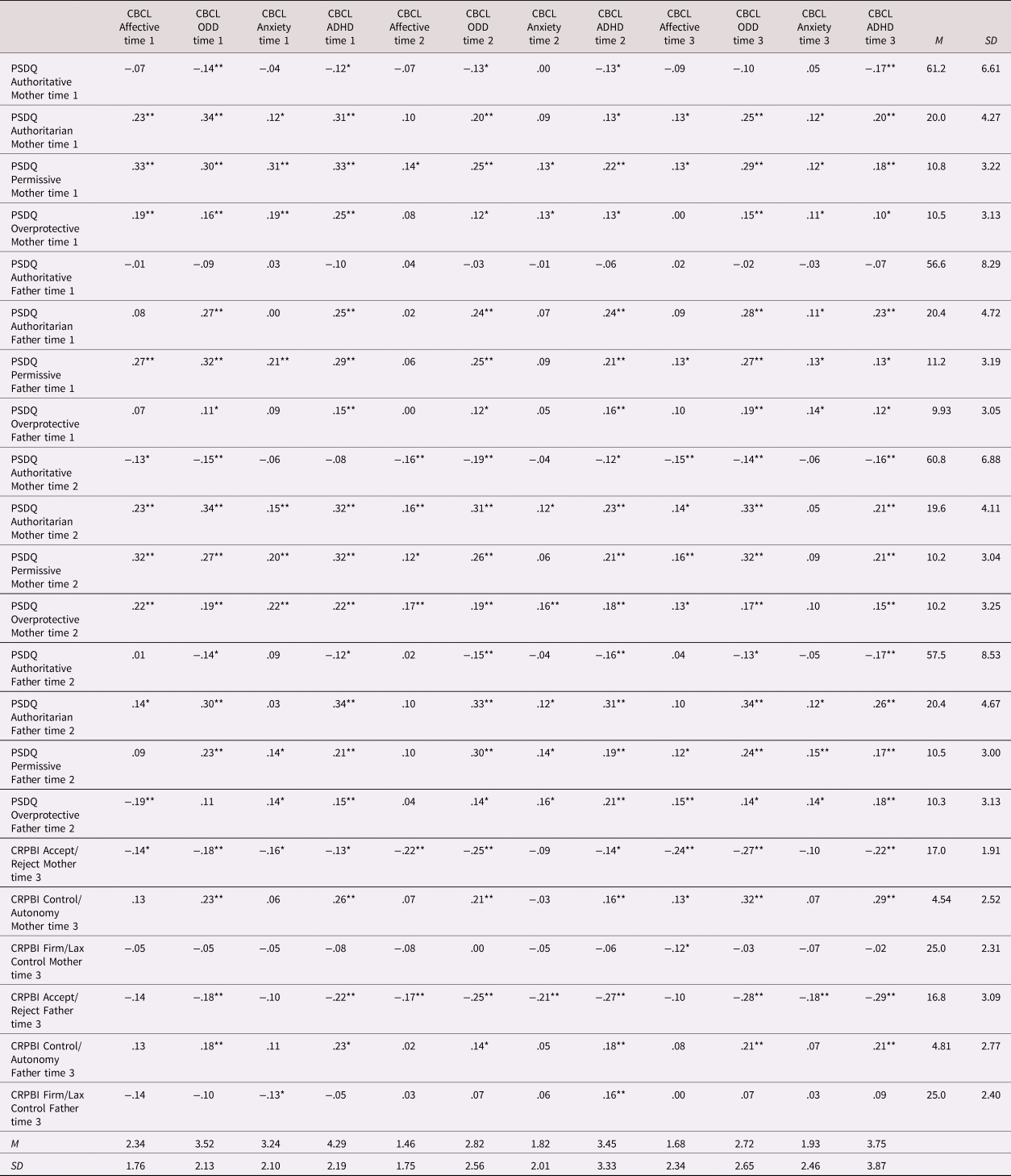
Bivariate correlations for parenting and child symptom variables are presented in Table 1. At age 3, authoritative mothering was related to lower levels of ODD and ADHD at ages 3 and 6 years. At age 3, mothers’ permissive parenting was related to greater child ADHD, ODD, affective, and anxiety symptoms at age 3 and 6. Overprotective mothering at age 3 was related to more affective symptoms at age 3. Affective symptoms at ages 3 were related to greater permissive mothering at ages 3 and 6, while affective symptoms at age 6 were related to greater permissive mothering at age 9. Anxiety at age 3 was related to more authoritarian mothering at ages 3 and 6.
Bivariate correlations between child symptoms and parenting

**p < .01, * p < .05.
ADHD = attention-deficit hyperactivity disorder; CBCL= Child Behavior Checklist; CRPBI = Children's Report of Parental Behavior Inventory; PSDQ = Parenting Styles and Dimensions Questionnaire
ODD and ADHD symptoms were related to more authoritarian parenting for both mothers and fathers over the three time points. Authoritative fathering at age 3 was also related to less ADHD and ODD at age 6.
Child sex analyses
In the mothers’ model, the constrained model yielded the following fit statistic: χ 2 (373, N = 220) = 536.65, p ≤ .001, χ2/df = 1.44, CFI = .97, RMSEA = .03. Allowing paths of theoretical interest to vary across child sexes yielded the following fit statistics: χ 2 (360, N = 220) = 515.02, p ≤ .001, χ 2/df = 1.43, CFI = .97, RMSEA = .03. A chi-square difference test revealed that this latter model did not fit the data significantly better than a model in which paths are constrained to be equal, Δχ2 (12) = 21.60, p = .07. This indicates that the paths of interest do not vary significantly as a function of the sex of the child.
In the fathers’ model, constraining paths of interest to be equal across child sexes yielded the following fit statistic: χ 2 (406, N = 220) = 602.61, p ≤ .001, χ2/df = 1.48, CFI = .97, RMSEA = .03. Allowing them to vary across child sexes yielded the following fit statistics: χ 2 (396, N = 220) = 596.95, p ≤ .001, χ2/df = 1.51, CFI = .97, RMSEA = .03. A chi-square difference test revealed that this latter model does not fit the data significantly better than a model in which paths are constrained to be equal, Δχ2 (10) = 5.65, p = .84. Thus, the paths of interest do not vary significantly by child sex.
Given the lack of differences in effects across child sex in either the maternal or paternal models, analyses were collapsed across male and female children for both models.
Continuity/stability of parenting styles and child symptoms
While not the primary focus of our analyses, it is worth noting that parenting styles and child symptoms were relatively stable over the course of the six years. Both mothers’ and fathers’ reports of parenting styles and child symptoms were moderately to highly predictive of future reports of parenting and of symptoms, respectively, from age 3 to age 6 and from age 6 to age 9 (all βs |.36–.75|, p ≤ .001, see gray lines in Figures 1 and 2).
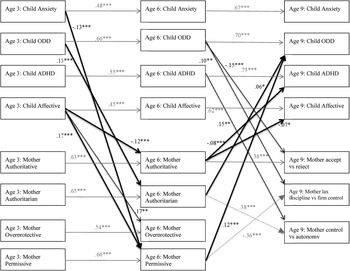
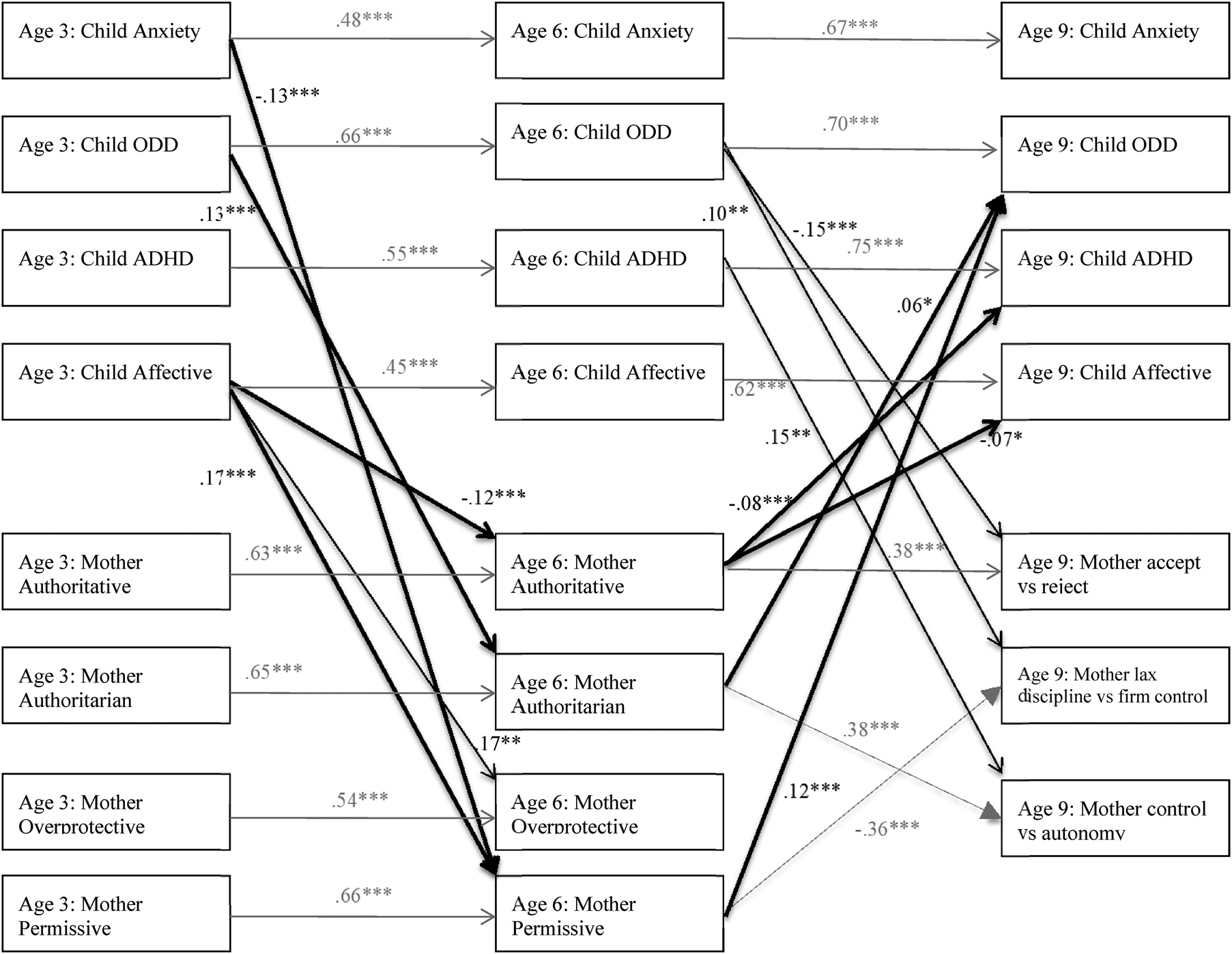
Cross-lagged panel analyses for mothers’ parenting styles and child symptoms of anxiety, oppositional defiant disorder (ODD), attention-deficit/hyperactivity disorder (ADHD), and depression. Notes: stability paths shown in gray to increase visual clarity. Bold lines indicate significant mediation. Covariances are not shown in this figure, but were included between all variables measured in the same assessment wave. *** p ≤ .001; ** p < .01, * p < .05.
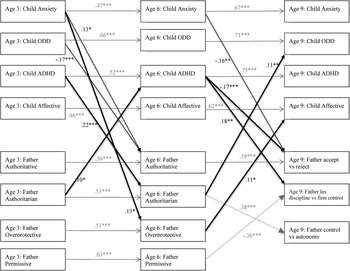
Cross-lagged panel analyses for fathers’ parenting styles and child symptoms of anxiety, oppositional defiant disorder (ODD), attention-deficit/hyperactivity disorder (ADHD)and depression. Notes: stability paths shown in gray to increase visual clarity. Bold lines indicate significant mediation. Covariances are not shown in this figure, but were included between all variables measured in the same assessment wave. *** p ≤ .001; ** p < .01, * p < .05.

Maternal parenting and child psychopathology
The initial model yielded the following fit statistics: χ 2 (116, N = 491) = 221.09, p ≤ .001, χ 2/df = 1.91, CFI = .97, RMSEA = .04. Nonsignificant regression paths were then deleted simultaneously. The final model (Figure 1), showed the following fit statistics: χ 2 (180, N = 491) = 301.89, p ≤ .001, χ2/df = 1.67, CFI = .98, RMSEA = .04, suggesting an excellent fit to the data. A chi-square difference test was performed, Δχ2 (64) = 80.81, p = .08, indicating that the initial model did not fit the data significantly better than the trimmed model. The trimmed model was therefore preferred for its parsimony. Figure 1 presents the standardized parameters for the final model, the details of which we now summarize. Supplementary Figure 1 shows results from the full models with trending paths included.
The impact of mothers’ parenting on child symptoms
Mothers’ parenting styles at age 3 did not predict child symptoms at age 6; however, parenting styles at age 6 predicted child symptoms at age 9. Authoritative mothering predicted fewer ADHD and affective symptoms at age 9, and authoritarian and permissive parenting at age 6 both predicted higher levels of ODD symptoms at age 9.
The impact of child symptoms on mothers’ parenting
All four child disorders significantly predicted later parenting. Child affective symptoms at age 3 predicted higher levels of overprotective and permissive parenting, and lower levels of authoritative parenting at child age 6. Child anxiety symptoms at age 3 predicted less permissive parenting at age 6. ODD symptoms at 3 years predicted greater authoritarian parenting by 6 years. Moreover, age-6 child ODD predicted less parental acceptance (similar to authoritative parenting), and greater firm control (nonpermissive parenting) at age 9. Lastly, child ADHD at age 6 predicted greater controlling (similar to authoritarian) parenting at age 9.
Indirect effects between mothers’ parenting and child symptoms
Several significant indirect effects emerged. The indirect path from age-3 child anxiety to greater ODD symptoms at age 9 was mediated by lower permissive parenting at age 6 (β = −.012, p ≤ .001, 95% CI [−.024, −.005]). Affective symptoms at age-3 predicted greater permissive parenting at age 6, which in turn predicted greater ODD symptoms at age 9 (β = .018, p ≤ .001, 95% CI [.008, .035]). Child affective symptoms at age 3 also predicted lower levels of authoritative parenting at age 6, lower levels of which predicted more ADHD and affective symptoms at age 9 (β = .013, p = .004, 95% CI [.003, .030]; β = .006, p = .022, 95% CI [.001, .016]). Finally, ODD symptoms in children at age 3 were related to more authoritarian parenting at age 6 which in turn predicted more symptoms of ODD at age 9 (β = .006, p = .05, 95% CI [.001, .015]).
Paternal parenting and child psychopathology
The same approach was used to examine the relationships between paternal parenting and child psychopathology. The initial model showed the following fit statistics: χ 2 (116, N = 491) = 258.94, p ≤ .001, χ 2/df = 2.23, CFI = .98, RMSEA = .05. Following the simultaneous deletion of nonsignificant paths, the final model (Figure 2) showed the following fit statistics: χ 2 (207, N = 491) = 370.82, p ≤ .001, χ 2/df = 1.79, CFI = .97, RMSEA = .04, suggesting an excellent fit to the data. A chi-square difference test, Δχ2 (91) = 111.93, p = .07, indicated that the initial model did not fit the data significantly better than the trimmed model. The trimmed model was therefore preferred for its parsimony. Figure 1 presents the standardized parameters for the final model, details of which are discussed next. Supplementary Figure 2 shows results from the full model with trending paths included.
The impact of fathers’ parenting on child symptoms
Unlike the mothers’ model, in the model for fathers, parenting predicted child symptoms at ages 6 and 9. Fathers’ authoritarian parenting at age 3 predicted greater symptoms of ADHD at age 6. From age 6 to 9, fathers’ authoritarian parenting predicted higher levels of ODD. Finally, overprotective fathering at age 6 predicted more affective symptoms in children at age 9.
The impact of child symptoms on fathers’ parenting
Child anxiety at age 3 predicted greater authoritative parenting at age 6 while child ODD at age 3 predicted lower levels of authoritative parenting at age 6. Child symptoms of ADHD at 3 years were associated with greater authoritarian parenting at 6 years. From age 6 to 9, child anxiety symptoms predicted lower levels of paternal acceptance (similar to authoritative parenting). Finally, symptoms of ADHD at age 6 predicted lower acceptance (authoritative) and greater lax discipline (permissive) at age 9.
Indirect effects between fathers’ parenting and child symptoms
Child anxiety at age 3 predicted fathers’ overprotection when children were 6, which in turn predicted more affective symptoms at age 9 (β = .009, p = .002, 95% CI [.003, .020]). In addition, child ADHD at age 3 predicted greater ODD symptoms at age 9 via higher levels of authoritarian parenting at age 6 (β = .017, p = .001, 95% CI [.008, .029]). Finally, paternal authoritarian parenting when children were age 3 predicted greater ADHD symptoms at age 6, which predicted both less acceptance-based parenting (authoritative), and more lax discipline (permissive parenting) at age 9 (β = −.011, p = .002, 95% CI [−.022, .004] and β = .009, p = .003, 95% CI [.003, .019], respectively).
Discussion
The current study examined the bidirectional and transactional relationships between children's ADHD, ODD, depression, and anxiety symptoms with authoritarian, authoritative, permissive, and overprotective parenting in both mothers and fathers over the course of three assessments when children were 3, 6, and 9 years old.
Extending our previous report (Kopala-Sibley et al., Reference Kopala-Sibley, Jelinek, Allmann and Klein2017) which focused on the effects of parental depression on a more limited number of parenting styles and children's broad internalizing and externalizing problems, we found that examining effects at the level of specific disorders and with a broader range of parenting variables provided a more nuanced view of both bidirectional and transactional effects of parenting and child symptoms. For example, for externalizing disorders, in the maternal models ODD and ADHD had different effects on parenting, while in the paternal models ADHD but not ODD predicted later parenting styles. Within internalizing disorders, findings for affective and anxiety symptoms often differed. There were also a range of specific effects of both maternal and paternal parenting on child psychopathology symptoms. In contrast, Kopala-Sibley et al. (Reference Kopala-Sibley, Jelinek, Allmann and Klein2017) found no significant effects of children's internalizing symptoms when assessed as a unitary construct, on change in any of their more limited range of parenting dimensions from age 3 to 6. Moreover, in some cases in the current study, affective and ODD symptoms had similar effects or were part of the same chain of effects. We also found a number of effects for authoritative and overprotective parenting, two styles that had not been included in our previous paper. In addition, in our previous paper, we found effects of parenting on externalizing, but not internalizing symptoms, which stands in contrast to the current report.
Results were generally consistent with hypotheses that adaptive and maladaptive parenting styles would respectively predict negative and positive associations with psychopathology, although this was largely only true from age 6 to 9. Hypotheses that child psychopathology would influence parenting were also generally supported, although our hypothesis that ADHD would have weaker effects on parenting than ODD was not confirmed.
From age 3 to 6, in our maternal analyses, there were no bidirectional effects. From age 6 to 9, however, there were multiple such effects. For example, child ODD symptoms were negatively associated with subsequent acceptance versus rejection and positively associated with later lax discipline versus firm control. Age-6 authoritarianism and permissiveness both were positively associated with subsequent ODD symptoms at age 9. Age-6 child ADHD symptoms were positively associated with later maternal control versus autonomy, while greater age-6 authoritativeness was negatively associated with subsequent ADHD symptoms at age 9. There were no bidirectional effects involving depressive or anxiety symptoms.
In our paternal analyses, there were no significant bidirectional associations from age 3 to 6 apart from that between child ADHD and paternal authoritarianism. From age 6 to 9, paternal authoritarianism and overprotection, respectively, were positively associated with subsequent ODD and affective symptoms, while child ADHD symptoms were negatively associated with later paternal acceptance versus rejection and greater lax discipline versus firm control.
We observed a number of transactional relationships between maternal parenting and child symptoms. Age-3 child affective symptoms were negatively associated with authoritative parenting, lower levels of which were, in turn, related to higher levels of affective and ADHD symptoms. The presence of affective symptoms at age 3 may lead to later difficulties by reducing children's exposure to positive parenting. Similarly, affective symptoms at age 3 were associated with greater permissive parenting at age 6, which then led to higher levels of ODD symptoms at age 9. Parents may indulge depressed children in order to raise their mood and draw them out; at the same time, however, permissive parenting may neglect to teach children self-control and emotion regulation, which in turn increases affective dysregulation and oppositional behavior. ODD symptoms at age 3 predicted a higher level of authoritarian parenting when children were 6, which, in turn, predicted greater ODD symptoms at age 9. This finding is consistent with the theory of coercive cycles in which child symptoms and maladaptive parenting styles reinforce one another over time (Patterson, Reference Patterson1982). Contrary to expectations, child anxiety at age 3 influenced maternal permissiveness, not overprotection. There were also no effects of child ADHD symptoms at age 3 on parenting at age 6, or of child anxiety or depression at age 6 on any age-9 parenting variable. Taken together, these results suggest there may be many parenting pathways to the same outcomes (i.e., equifinality), as ODD symptoms were predicted by higher levels of both permissive and authoritarian parenting styles. By contrast, anxiety symptoms at age 3 predicted lower permissive mothering at age 6, which in turn predicted higher levels of ODD symptoms at age 9. This suggests that mothers adopt a more active and structuring style in response to their children's anxiety. Finally, consistent with our hypothesis that ADHD would demonstrate weaker effects, we did not observe transactional relationships between ADHD symptoms and maternal parenting.
Transactional relationships were also observed for fathers. Results were generally consistent with hypotheses that child psychopathology would influence parenting and that parenting would, in turn, predict child psychopathology, although fewer effects of paternal parenting on child psychopathology were found compared to the maternal analyses. Unlike the mothers’ model, we observed support for the hypothesis that child anxiety at age 3 would predict a higher level of overprotective fathering at age 6, which was associated with greater affective symptoms at age 9. These findings suggest that fathers may be trying to shield anxious children from experiencing negative outcomes; however, that same overprotective parenting increases symptoms of depression, which may be because children are exposed to fewer opportunities to build self-esteem and confidence when facing challenging situations. This pattern may be one trajectory explaining the heterotypic continuity in the development of anxiety to depression (Cummings, Caporino, & Kendall, Reference Cummings, Caporino and Kendall2014). Child ADHD at age 3 predicted greater authoritarian parenting, higher levels of which were associated with greater ODD symptoms. Fathers may be more likely than mothers to parent strictly when children exhibit hyperactive or inattentive symptoms, which in turn leads to more oppositional behavior. Contrary to maternal analyses, child affective symptoms did not influence paternal parenting styles at any time point.
Unlike the mothers’ model, for fathers, not all transactional relationships began with child symptoms. Authoritarian fathering when children were age 3 predicted greater child ADHD symptoms at age 6. This, in turn, was associated with lower levels of accepting (authoritative) and higher levels of lax (permissive) parenting at age 9. Interestingly, fathers’ authoritarian parenting was associated with greater child symptoms of ADHD at age 6 and ODD at age 9, consistent with evidence suggesting that maladaptive parenting contributes to the comorbidity between these conditions (Noordermeer et al., Reference Noordermeer, Luman, Weeda, Buitelaar, Richards, Hartman and Oosterlaan2017).
Across maternal and paternal analyses, we found multiple bidirectional and transactional effects between parenting and child psychopathology. However, we found no effects of parenting on child anxiety or of maternal parenting on child ADHD symptoms. We also found no effects of maternal age-3 parenting on child age-6 symptoms, and only one such effect in our paternal analyses.
Notably, with the exception of the effect of paternal authoritarianism at age 3 predicting higher levels of ADHD symptoms in children at age 6, parenting styles with children at age 3 were generally less likely to impact later child symptoms than the reverse. However, at age 6 parenting began to predict later child symptoms, which is consistent with suggestions that middle childhood is a particularly sensitive developmental period (Callaghan & Tottenham, Reference Callaghan and Tottenham2016; Del Giudice, Reference Del Giudice2014). In contrast, child symptoms influenced parenting across all three waves.
We would also note that bidirectional and transactional relationships often involved differing parenting styles and forms of psychopathology. This highlights the equifinality and multifinality of parenting–child psychopathology relationships. For example, as mentioned previously, we found evidence of equifinality in the fact that ODD was predicted by both permissive and authoritarian parenting, while paternal acceptance versus rejection was predicted both by child anxiety and ADHD. Similarly, evidence of multifinality exists in that affective symptoms predicted lower levels of authoritative mothering and higher levels of overprotective and permissive parenting while authoritative parenting predicted lower levels of both affective and ADHD symptoms. Given the evidence for both equifinality and multifinality, we suggest the importance of considering multiple disorders and parenting styles in the same model.
Strengths and limitations
This study had several strengths and extended the current literature in several ways. First, while a handful of studies have examined the bidirectional, transactional, or both bidirectional and transactional (i.e., reciprocal) effects of either child internalizing or externalizing disorders with parenting, fewer have examined symptoms of specific disorders, and even fewer examined multiple disorders that fall into both externalizing and internalizing categories in one model alongside multiple dimensions of parenting. By including all symptom and parenting variables in a single model, we were able to examine unique effects adjusting for symptoms of other disorders, thereby taking comorbidity into account. Furthermore, we examined fathers’, as well as mothers’, parenting, extending a literature that has generally focused solely on mothers. Results also extend those from Kopala-Sibley et al. (Reference Kopala-Sibley, Jelinek, Allmann and Klein2017) by showing how specific symptoms, as opposed to broad internalizing versus externalizing symptoms, relate to parenting styles.
In addition, we used a large unselected community sample, which circumvented many of the biases associated with clinical samples. The three-wave longitudinal design provided the opportunity to examine the development of bidirectional and transactional patterns between parenting and their children's symptoms, and to preserve the temporal ordering of the variables while adjusting for the initial levels of the dependent variables (both parenting and child symptoms). Moreover, multiple informants (averaged mothers’ and fathers’ reports) were used to assess child symptoms of psychopathology.
Several limitations of the study should also be considered. First, each parent contributed to both the parenting and child symptom variables, raising the possibility that effects are inflated by shared method variance. However, mothers’ and fathers’ reports of child symptoms were aggregated, partially mitigating these effects. Second, child symptom scores rather than diagnoses were used. Although most psychopathology appears to be dimensional (Markon et al., Reference Markon, Chmielewski and Miller2011), and diagnostic criteria for early childhood psychopathology are less established than for older youth and adults (Egger & Emde, Reference Egger and Emde2011), it is unclear how results would extend to children with clinical levels of symptoms. Furthermore, the level of symptoms in community samples are low in comparison to clinical samples. Third, the sample was relatively homogeneous demographically, making it challenging to generalize the findings to other populations. Fourth, additional factors that were not considered in this study (e.g., genes, life stressors both for parents and children, marital discord), might further influence parenting styles and child symptoms (e.g., Belsky, Reference Belsky1984). Fifth, in order to use developmentally appropriate measures, we had to use different measures of parenting at different ages. As our parenting measures are not consistent across all three waves, we were forced to use cross-lagged panel analysis, rather than newer methods that can model within- in addition to between-person effects (e.g., Berry & Willoughby, Reference Berry and Willoughby2017). Sixth, despite all measures exhibiting good validity, many had modest alphas due to the small number of items on each scale. Finally, due to the complexity of the models we could not include mothers and fathers in the same analyses.
Implications
These findings may have important implications for treatment and family interventions. First, interventions that target only parenting or child symptoms may be limited in their efficacy, as our findings suggest that both factors have bidirectional and transactional effects. Moreover, early interventions may be particularly important as the transactional cycles evident in our sample emerged early and persisted over time. With appropriate and early treatment, it may be possible to reduce the occurrence of negative cycles of parenting and children's symptoms that can become entrenched over time. Our findings also suggest that mothers’ and fathers’ parenting styles differ as a function of the symptoms children exhibit at various ages. Future research should examine the mechanisms that might explain this and should strive to include fathers in research on parenting. Finally, it may be worthwhile extending this work to consider the presence of siblings to further understand the mechanisms impacting parenting strategies and family dynamics.
Overall, our findings suggest that children's symptoms are maintained or compound over time partially because they decrease exposure to adaptive, and increase exposure to negative, parenting. Likewise, maladaptive parenting may persist over time in response to children's symptoms. These reciprocal patterns of interaction are an important target in clinical settings to address parent–child relational issues, child symptom management, and maladaptive parenting.
Supplementary Material
The supplementary material for this article can be found at https://doi.org/10.1017/S0954579421000201.
Funding Statement
Support for this research was provided by funding through NIMH R01 MH069942 (Klein) as well as a postdoctoral fellowship from the Social Sciences and Humanities Research Council of Canada (Kopala-Sibley).
Conflicts of Interest
None