Introduction
Neuropsychological impairment is a core feature of major depression (Porter et al. Reference Porter, Bourke and Gallagher2007) and has been associated with impairment in general functioning, including in occupational and psychosocial domains (McIntyre et al. Reference McIntyre, Cha, Soczynska, Woldeyohannes, Gallaugher, Kudlow, Alsuwaidan and Baskaran2013).
There is ongoing debate regarding the relationship between abnormalities of neuropsychological functioning and clinical state, and, in particular, whether current treatments for depression adequately address neuropsychological impairment (Porter et al. Reference Porter, Douglas, Jordan, Bowie, Roiser and Malhi2014). A review in this area suggested that neuropsychological domains most sensitive to improvement in clinical state were verbal learning and memory, verbal fluency and psychomotor speed, whereas domains least sensitive to improvement were attention and executive functioning (Douglas & Porter, Reference Douglas and Porter2009). Regardless of the domains affected, what has become evident is that a significant degree of neuropsychological impairment remains after the resolution of mood symptoms, at least in a substantial proportion of patients (Bortolato et al. Reference Bortolato, Carvalho and McIntyre2014). It is therefore important to search for treatments for major depression that successfully target and improve neuropsychological impairment.
The impact of psychological therapy on neuropsychological functioning remains largely unknown, with only one published psychotherapy study examining this issue (Bastos et al. Reference Bastos, Guimaraes and Trentini2013). This study suggested that psychodynamic psychotherapy, and its combination with fluoxetine, improved specific areas of neuropsychological functioning, more so than fluoxetine alone. Other more common psychological therapies that involve a structured component of cognitive challenging [e.g. cognitive–behaviour therapy (CBT) and schema therapy (ST)] may target cognitive function more directly but are currently unstudied in terms of their effect of neuropsychological performance.
In the present study, neuropsychological functioning was assessed at baseline and after the first 16 weeks of psychotherapy in a randomized controlled trial comparing CBT with ST for major depression. Depressed out-patients in this study were medication-free at the beginning and end of psychotherapy. Based on our review, we hypothesized that verbal learning and memory would improve alongside improvement in clinical state, but that there would be significant residual impairment in executive functioning.
We have previously reported neuropsychological impairment at baseline in this out-patient group, compared with healthy controls, and also compared with those with social anxiety disorder (Bourke et al. Reference Bourke, Porter, Carter, McIntosh, Jordan, Bell, Carter, Colhoun and Joyce2012). Outcome of the psychotherapies has been reported elsewhere (Carter et al. Reference Carter, McIntosh, Jordan, Porter, Frampton and Joyce2013).
Method
Participants
Depressed out-patients aged between 18 and 65 years with a Diagnostic and Statistical Manual of Mental Disorders, 4th edition (DSM-IV) defined episode of major depression without psychotic features (single or recurrent major depressive disorder or bipolar II depression) were included in the study. Apart from the occasional hypnotic, depressed out-patients were psychotropic-medication-free for at least 6 weeks prior to recruitment. Diagnoses were established using the Structured Clinical Interview for DSM-IV Disorders – Patient Edition (SCID I/P) (First et al. Reference First, Spitzer, Gibbon and Williams1998). Depressed out-patients were excluded from the study if they had bipolar I disorder, schizophrenia, current moderate or severe alcohol or drug dependence, history of head injury, neurological illness or serious physical illness. Individuals with alcohol or drug abuse, or mild dependence, were not excluded. Severity of depression was evaluated using the Montgomery–Åsberg Depression Rating Scale (MADRS) (Montgomery & Åsberg, Reference Montgomery and Åsberg1979) and the 17-item Hamilton Depression Rating Scale (HDRS17) (Hamilton, Reference Hamilton1960).
Healthy control participants were recruited through newspaper and radio advertisements. Prospective controls were excluded if they met criteria for any current or past psychiatric disorder, had a history of head injury, neurological disorder, any serious physical illness, or if they had a first-degree relative with a history of any Axis I disorder. Healthy controls were assessed for psychiatric disorder using the Mini International Neuropsychiatric Interview (Sheehan et al. Reference Sheehan, Lecrubier, Sheehan, Amorim, Janavs, Weiller, Hergueta, Baker and Dunbar1998).
Depressed participants and healthy controls were matched for age, gender, estimated pre-morbid intelligence quotient (IQ) (National Adult Reading Test; NART) (Nelson, Reference Nelson1982) and years of formal education. Due to research reporting that phase of menstrual cycle can make an impact on cognitive functioning (Symonds et al. Reference Symonds, Gallagher, Thompson and Young2004), females were matched for phase of menstrual cycle at testing and completed both testing sessions in the same phase. Participants spoke English as their first language, or were bilingual from childhood and fluent in English. The study was approved by the Upper B Canterbury Regional Ethics Committee, New Zealand, and written informed consent was given by all participants.
Psychotherapy
Psychotherapy conducted in this study has been described in detail elsewhere (Carter et al. Reference Carter, McIntosh, Jordan, Porter, Frampton and Joyce2013). CBT was delivered according to Beck and colleagues’ manuals (Beck et al. Reference Beck, Rush, Shaw and Emery1979; Beck, Reference Beck1995) and ST was delivered according to Young's published manuals (Young, Reference Young1990; Young & Klosko, Reference Young and Klosko1993; Young et al. Reference Young, Klosko and Weishaar2003). A detailed explanation of the rationale and process of CBT and ST is provided in the online Supplementary material.
Neuropsychological assessment
Neuropsychological tasks used and variables reported are summarized below. For an explanation of the neuropsychological testing conditions (e.g. time of day, computer software), see online Supplementary material.
Verbal learning and memory
Rey Auditory Verbal Learning Test (RAVLT)
The RAVLT (Rey, Reference Rey1964) assesses verbal learning and memory. For the present study, words were pre-recorded and presented over computer speakers for consistency. The recognition component of the RAVLT was presented as a computerized task.
Consonant Vowel Consonant Auditory Verbal Learning Test (CVCT)
The CVCT was developed by the authors and was identical in format, administration and scoring to the RAVLT, except ‘non-words’ were presented instead of words with semantic meaning. Monosyllabic non-words selected from the ARC Non-Word Database (Rastle et al. Reference Rastle, Harrington and Coltheart2002) used in the CVCT had no semantic meaning in the English language. Two lists of 15 non-words were compiled, each non-word comprising three letters, beginning and ending with different consonants, with a vowel as the middle letter.
Visuospatial learning and memory
Pattern recognition memory – Cambridge Neuropsychological Test Automated Battery (CANTAB®)
In Pattern recognition memory, participants first learnt a series of 12 complex patterns before being presented with pairs of patterns, of which the index pattern was to be discriminated from the distracter pattern.
Spatial recognition memory – CANTAB®
Spatial recognition memory involved participants learning the spatial location of five squares presented sequentially at different on-screen locations. Pairs of squares were presented and participants identified which of the two squares was in the index location by touching the correct square.
Attention and executive functioning
Controlled Oral Word Association Test (COWAT)
In the COWAT (Benton & Hamsher, Reference Benton and Hamsher1976), participants generated words beginning with the letters ‘F’, ‘A’ and ‘S’ over a 60-s period for each letter (or ‘P’, ‘R’ and ‘W’ at follow-up testing). Rules included exclusion of proper nouns, place names or the same word with a different ending.
Digit span forwards and backwards
This task (Wechsler, Reference Wechsler1997) required participants to repeat increasing lengths of digit series, either forwards or backwards, until a pair of sequences was incorrect or a nine-digit sequence was completed correctly.
Spatial span – CANTAB®
Participants were required to remember, then replicate, the order of nine white squares on-screen that changed colour one by one. Trials progressed from two to nine squares and the task self-terminated after three successive trial failures (incorrect sequence) on a given number of squares.
Spatial working memory – CANTAB®
Spatial working memory required participants to search through on-screen boxes to find a blue token, beginning with four trials of four boxes, progressing to four trials of six, then eight boxes.
Processing speed
Motor screening – CANTAB®
This task screened for motor and visual disorders, and served as training for the CANTAB® (use of the touch screen). Participants touched a series of pink and green crosses as they appeared on the screen.
Simple reaction time task
The simple reaction time task was developed for the present study as an additional test of processing speed and as a control task for the facial expression recognition task. Participants were presented with 28 numbers from 1 to 7, followed by words (angry, happy, sad, surprised, disgusted, fearful and neutral) in random order for 500 ms each. Participants pressed the corresponding labelled key on a response pad.
Facial emotion processing
Facial expression recognition task
This task was a modified version of the facial expression recognition task developed by Harmer et al. (Reference Harmer, Perrett, Cowen and Goodwin2001). Faces displaying six basic emotions (anger, happiness, sadness, fear, disgust and surprise) were presented successively on a computer screen for 500 ms, followed immediately by a blank screen. The black and white photographs of facial expressions had been morphed in 10% steps between each prototype and neutral, using techniques similar to those developed by Young et al. (Reference Young, Rowland, Calder, Etcoff, Seth and Perrett1997). Four examples of each of the six emotional categories (portrayed by male and female actors) at each level of intensity were given (40 stimuli for each emotion). Each face was also presented in a neutral expression (24 stimuli), giving a total of 264 stimulus presentations. Upon identifying the emotional expression, participants pressed the corresponding labelled key on a response box.
Statistical analyses
Statistical analyses were conducted using SPSS, version 22-x for Windows (IBM Corporation, 2013). All variables were found to be normally distributed. Demographic and baseline clinical and neuropsychological data were assessed using χ2 tests or analysis of variance (ANOVA) with group as the between-participants factor.
After determining the mean scores and standard deviations of all neuropsychological variables in the control group at baseline, scores were converted to a Z-score using the following equation: (raw score – meancontrol group)/s.d. control group. This procedure was repeated for follow-up data using the mean scores of the control participants at follow-up.
Two main statistical methods were used to examine associations between neuropsychological functioning and changes in depressive symptoms in the current study:
-
(1) Paired t tests were conducted to examine changes between baseline and follow-up neuropsychological Z-scores in the depressed group, and
-
(2) Pearson's correlations (two-tailed) were used to examine associations between baseline depression severity and neuropsychological performance (Z-score), and associations between change in depression severity over the course of psychotherapy and change in neuropsychological performance over the same time period. Change in Z-scores for each neuropsychological variable from baseline to follow-up was calculated for this analysis.
Effect sizes (Cohen's d) were calculated for baseline comparisons between depressed and control groups, and for the difference in change between the depressed and control groups from baseline and follow-up, for all neuropsychological measures.
Independent-sample t tests were used to examine whether the type of psychotherapy given (CBT or ST) made an impact differentially on neuropsychological functioning.
In order to compare with other similar studies, secondary analyses were conducted by way of repeated-measures ANOVA for each neuropsychological variable with group (responders, non-responders, healthy controls) as the between-participants factor and time (baseline, follow-up) as the within-participants factor.
Ethical standards
All procedures contributing to this work comply with the ethical standards of the relevant national and institutional committees on human experimentation and with the Helsinki Declaration of 1975, as revised in 2008.
Results
Demographic and clinical measures
A total of 69 depressed out-patients (major depression: n = 64; bipolar II disorder: n = 5) from a baseline sample of 101 out-patients completed follow-up neuropsychological assessment after 16 weeks of psychotherapy. Of the 32 participants who did not complete follow-up, five completed treatment but were unable to attend the follow-up neuropsychological testing session, 16 had commenced antidepressant treatment during the first 16 weeks of psychotherapy and were therefore excluded, and 11 participants were lost to follow-up. Participants who completed follow-up neuropsychological assessment remained medication-free at this time-point.
Comparison of baseline demographic and clinical characteristics of participants who returned for follow-up v. those who were lost to follow-up indicated no significant group differences in age (F = 2.34, p = 0.10), gender (χ2 = 1.48, p = 0.47), age at onset of first episode of depression (F = 0.71, p = 0.49), number of previous episodes (F = 0.44, p = 0.64), HDRS17 scores (F = 2.44, p = 0.09) or MADRS scores (F = 2.10, p = 0.12). Analyses were conducted between these groups on baseline neuropsychological variables, with no significant differences found (all p > 0.05).
Of the 61 healthy control participants, 58 returned for follow-up neuropsychological assessment.
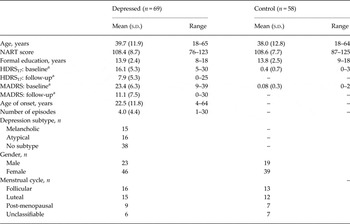
Depressed participants and healthy controls who completed follow-up testing were matched for gender (χ2 = 0.00, p = 1.0), age (F = 0.38, p = 0.68), NART estimated IQ (F = 0.01, p = 0.91), years of formal education (F = 0.00, p = 0.97) and phase of menstrual cycle at assessment (χ2 = 0.00, p = 1.0; see Table 1). The most prevalent psychiatric disorders in the depressed group were: generalized anxiety disorder (34.8%), social anxiety disorder (29.0%), panic disorder (15.9%), specific phobia (13.0%) and alcohol abuse (13.0%).
Demographic and clinical characteristics of depressed and control groups

s.d., Standard deviation; NART, National Adult Reading Test; HDRS17, Hamilton Depression Rating Scale; MADRS, Montgomery–Åsberg Depression Rating Scale.
a Higher scores on the MADRS and HDRS reflect more severe depressive symptoms.
Baseline neuropsychological functioning
Z-score comparisons
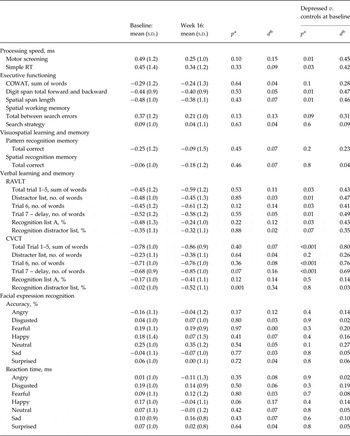
Comparison of mean Z-scores between groups at baseline (Table 2), for those participants who completed the 16-week assessment, showed the depressed group to have significantly worse performance on both measures of verbal learning and memory, both measures of processing speed and on some measures of executive functioning (digit span, spatial span; see Table 2). Groups performed similarly on measures of verbal fluency, spatial working memory, visuospatial learning and memory, and facial expression recognition at baseline.
Change in Z-scores for neuropsychological tests from baseline to follow-up in the depressed group (Z-score calculated in relation to control group performance at the same time-point)

s.d., Standard deviation; simple RT, simple reaction time task; COWAT, Controlled Oral Word Association Test; RAVLT, Rey Auditory Verbal Learning Test; CVCT, Consonant Vowel Consonant Verbal Learning Test.
a One-way analysis of variance.
b Cohen's d effect size.
Correlations
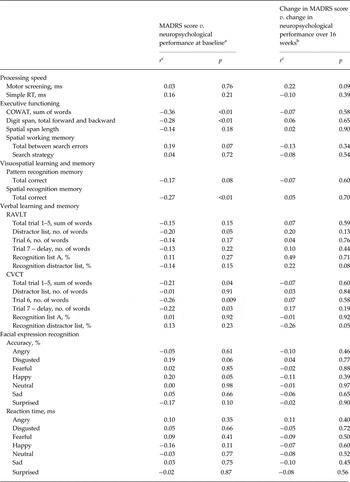
Performance on the COWAT, digit span, spatial recognition memory, and several measures of verbal learning and memory were significantly correlated with baseline severity of depressive symptoms (MADRS) in the depressed group (see Table 3). In each case, more severe depressive symptomatology was associated with poorer neuropsychological performance in the depressed group.
Correlations between MADRS score and neuropsychological performance (Z-score) at baseline and over 16 weeks in the depressed group

MADRS, Montgomery–Åsberg Depression Rating Scale; simple RT, simple reaction time task; COWAT, Controlled Oral Word Association Test; RAVLT, Rey Auditory Verbal Learning Test; CVCT, Consonant Vowel Consonant Verbal Learning Test.
a Positive correlations between baseline MADRS and neuropsychological tests measured in accuracy or total words/learning reflect an association between more severe depression and better neuropsychological performance. Positive correlations between baseline MADRS and neuropsychological tests measured in errors or reaction time reflect an association between more severe depression and poorer neuropsychological performance.
b Reduction in MADRS score over time reflects an improvement in clinical state (i.e. less severe depressive symptoms). Reduction in neuropsychological test score over time reflects improvement for tests measured in errors or reaction time but a worsening for tests measured in accuracy or total words/learning. Positive correlations between change in MADRS and neuropsychological tests measured in accuracy or recall indicate that improvement in depression is associated with reduced accuracy or recall. Positive correlations between change in MADRS and neuropsychological tests measured in errors or reaction time indicate that improvement in depression is associated with faster reaction times.
c Pearson's r correlation.
Neuropsychological functioning over time
Z-score comparisons
Paired t tests comparing Z-scores of the depressed group at baseline and at 16 weeks are presented in Table 2. Of all comparisons, only CVCT distractor list recognition was significantly different between baseline and follow-up, with a significantly greater Z-score (worse performance compared with controls) at follow-up.
Correlations
Associations between change in neuropsychological variable Z-scores between baseline and follow-up and change in MADRS scores between baseline and follow-up in the depressed group were analysed using Pearson's correlations. None of the 35 correlations was significant, but two measures (RAVLT distractor list recognition, CVCT distractor list recognition) reached trend level. However, these two measures produced correlations in opposite directions, with improvement on the RAVLT measure being related to improved depressive symptoms, while improvement on the CVCT measure was related to worsening depressive symptoms over the course of psychotherapy.
Comparison of treatments
Independent-sample t tests were conducted to compare change in neuropsychological performance between treatment groups. Of 35 neuropsychological variables, only CVCT distractor list recall was significantly different between groups, with performance in the ST group improving and that of the CBT group worsening after 16 weeks (t = 2.3, p = 0.02).
Effect of depression subtype
Baseline Z-scores of neuropsychological data were recalculated after omitting the five patients diagnosed with bipolar II depression. All Z-scores remained within 0.05 of the original values shown in Table 2.
Secondary analyses
Findings from repeated-measures ANOVA with group (responder, non-responder, control) as the between-participants factor and time as the within-participants factor for each neuropsychological variable are presented in online Supplementary Table S1 (see online Supplementary material). Treatment response was defined as a greater than 50% reduction in MADRS score from baseline to follow-up testing. In all, 37 patients were categorized as treatment responders and 32 as treatment non-responders. In brief, no significant group x time interactions were observed for any neuropsychological variable, indicating a lack of a differential change in neuropsychological functioning in relation to treatment response over time.
Discussion
This study examined changes in neuropsychological functioning between baseline and 16 weeks in unmedicated depressed out-patients who were randomized to receive CBT or ST. The purpose of the study was to determine if and how neuropsychological functioning relates to clinical state in individuals treated with psychotherapy for major depression.
The main outcomes of this study were that:
-
(1) Of the neuropsychological tasks that were impaired in the depressed group at baseline, only performance on digit span and recall of list A on the CVCT (total learning, trial 6 and delayed recall) significantly correlated with depression severity, and
-
(2) Despite impaired neuropsychological functioning in a number of domains at baseline, and despite significant clinical improvement with psychotherapy (Carter et al. Reference Carter, McIntosh, Jordan, Porter, Frampton and Joyce2013), there was no strong evidence that neuropsychological functioning improved as depressive symptoms reduced over the first 16 weeks of psychotherapy.
It appears, therefore, that in this group of out-patients with moderately severe depression, significant impairment in neuropsychological functioning was predominantly unrelated to severity of depressive symptoms at baseline, and persisted after response to treatment with CBT and ST.
Association between neuropsychological functioning and clinical state in depression
Of the 35 neuropsychological variables measured in the current study, four were both significantly different between the depressed and healthy control groups, and significantly correlated with depression severity at baseline. These variables were in the domains of verbal learning and memory and executive functioning, which is partly in line with McDermott & Ebmeier's (Reference McDermott and Ebmeier2009) meta-analysis that reported these domains, as well as processing speed, to be related to depression severity in cross-sectional studies. However, several other measures of verbal learning and memory and executive functioning were unrelated to depression severity in the current study. The fact that CVCT measures, but not RAVLT measures, related to depression severity may be a function of task difficulty. The CVCT involved recalling non-words with no semantic meaning, whereas the RAVLT involved recalling words, which allowed for more easily accessible learning and mnemonic strategies. In addition, McDermott & Ebmeier's samples in their episodic memory and executive function composites were more severely depressed than in the current sample, and measures included in their processing speed composite involved more complex cognitive skills than the simple motor speed tests included in the current study. These key differences may help to explain the discrepancy in findings.
The lack of association between clinical improvement and neuropsychological functioning in the current study appears to contradict findings from previous studies of neuropsychological functioning over the course of treatment for depression. To our knowledge, however, there has been only one other study to examine neuropsychological changes following psychotherapy for major depression. Bastos et al. (Reference Bastos, Guimaraes and Trentini2013) reported improvement on measures of working memory, processing speed and executive functioning (verbal memory was not assessed) in their study of psychodynamic psychotherapy for depression, with these improvements being greater than for those treated with fluoxetine. Bastos et al.'s sample was intentionally young (26–34 years) to minimize the number with chronic depression, while in the current sample, participants were older, and 34% had been depressed for 50% or more of the previous 5 years. On the only task in common with the current study (digit span), Bastos et al.'s sample showed an improvement of 11%, which was much in excess of the 2–3% improvement found in the current study, either in the control or depressed group. Follow-up testing in Bastos et al.'s study continued every 6 months until 24 months, making it possible that improvement related to longer-term wellness.
Neuropsychological functioning as it relates to changes in clinical state in depression has been more extensively studied in pharmacological treatment studies. Two short-term naturalistic studies in depressed in-patient samples found that antidepressant treatment response was related to improvement in processing speed, but not measures of verbal and visuospatial learning and memory, executive functioning, or facial emotion processing (Reppermund et al. Reference Reppermund, Zihl, Lucae, Horstmann, Kloiber, Holsboer and Ising2007; Douglas et al. Reference Douglas, Porter, Knight and Maruff2011). However, in Reppermund's study, the follow-up interval was different between remitters (average 1.6 months) and non-remitters (average 3 months). Furthermore, an issue with short-term follow-up studies is that failure to find neuropsychological improvement may not indicate persisting neuropsychological impairment, but, rather, a lack of time to return to relatively normal functioning and to increase cognitive load in everyday life.
Longer-term pharmacological treatment studies have tended to show that verbal memory relates most strongly to clinical state in depression. Gallagher et al. (Reference Gallagher, Robinson, Gray, Porter and Young2007) compared treatment responders with non-responders and found a significant difference in verbal memory in depressed individuals treated with antidepressants, most frequently fluoxetine, over 6 months. Two further studies have shown improvements in verbal learning and memory with reduction in symptoms of depression (Vythilingam et al. Reference Vythilingam, Vermetten, Anderson, Luckenbaugh, Anderson, Snow, Staib, Charney and Bremner2004; Biringer et al. Reference Biringer, Mykletun, Sundet, Kroken, Stordal and Lund2007). These studies involved considerably longer follow-up periods (7 months and 2 years) than the current study.
In short, research on neuropsychological functioning in treatment studies of depression is inconsistent. Studies often report specific, but inconsistent, neuropsychological domains to be most greatly affected by clinical state in depression. The current study contributes to this inconsistency by suggesting that none of the broad range of neuropsychological domains measured relates to changes in clinical state in psychotherapy for depression. Methodological differences between studies may help to explain the variance in findings, including: severity of depression, treatments used, neuropsychological tests used, length of follow-up, inclusion of control groups, and statistical analyses conducted (Douglas & Porter, Reference Douglas and Porter2009).
Interpretation of statistical analyses
Throughout the current study we chose not to correct for multiple comparisons, taking the decision a priori that we would examine the pattern of results based on domains of functioning and if isolated results occurred, to treat them cautiously. For the multiple correlation analyses conducted examining change in mood and change in neuropsychological functioning over the course of treatment, a single significant finding was produced (CVCT distracter list recognition). We believe that this isolated finding was probably a chance type 1 error and we have not discussed this result as a significant finding. Had a Bonferroni correction been applied to the 21 analyses conducted on traditional neuropsychological variables described above, the resulting significance level of p < 0.01 would have meant that this single significant finding no longer reached statistical significance.
Facial emotion processing in depression
There was no evidence of impairment in recognizing facial expressions of emotion in the depressed group in the current study, nor did facial emotion processing change over the course of psychotherapy in the depressed group, compared with the healthy control group. Few studies have examined accuracy of recognizing specific facial expressions of emotion in depression. Some studies have shown reduced general accuracy in recognizing happy and sad faces in depression, but these studies often do not include other facial expressions of emotion, and, thus, specificity to happy and sad faces is unknown (Bourke et al. Reference Bourke, Douglas and Porter2010). A recent naturalistic study in severe depression found that impairment in recognizing angry facial expressions improved in in-patients who were successfully treated with antidepressant medication, compared with treatment non-responders (Douglas et al. Reference Douglas, Porter, Knight and Maruff2011). Impairment in the recognition of disgusted facial expressions persisted, regardless of treatment response in this study. Hayward et al. (Reference Hayward, Goodwin, Cowen and Harmer2005), on the other hand, reported enhanced disgust recognition in their unmedicated recovered depressed sample.
Antidepressant medication and serotonin manipulation do appear to influence recognition of facial expressions of emotions. For example, Bhagwagar et al. (Reference Bhagwagar, Cowen, Goodwin and Harmer2004) found enhanced fear recognition in remitted unmedicated depressed females, which normalized with a single dose of antidepressant medication. Conversely, Merens et al. (Reference Merens, Booij, Haffmans and van der Does2008) found acute tryptophan depletion (which reduces serotonin levels) also reduced fear recognition in remitted depressed individuals. Regardless of the direction of this effect, which is unclear from research to date, the unmedicated status of the current depressed sample was a strength. The lack of impairment in facial emotion recognition in the current study may suggest that this ability was unaffected in this sample. However, the possibility that the task used was not sensitive enough to detect subtle impairment in facial emotion recognition remains.
Limitations
There are limitations of the current study. First, although the sample size was relatively large compared with others in the field, the group sizes were sufficiently large to show differences of 0.5 standard deviations between groups or between occasions. This means that more subtle differences may not have been shown as statistically significant. There was no suggestion, however, of improvement in neuropsychological function, with small effect sizes (d = 0.0–0.3). Second, the depressed group represented a typical psychotherapy population in that it was heterogeneous in some clinical aspects, including depression severity and psychiatric co-morbidity. These factors may have influenced the extent of neuropsychological change seen in the depressed sample, but sample size restricted the statistical analyses that could reasonably be conducted. With regards to depression severity, there was no lower cut-off for severity, meaning that relatively milder severities were included. However, we note that advantages of having no cut-off include more accurate measurement of severity, given the well-known phenomenon of baseline inflation when minimum severity is a criterion for entering a study (Sachs et al. Reference Sachs, Ice, Chappell, Schwartz, Gurtovaya, Vanderburg and Kasuba2011).
Strengths
There are a number of strengths of the current study. First, the depressed sample was unmedicated throughout the study, which eliminates possible confounding effects of antidepressant medication on neuropsychological functioning. Second, a healthy control group was included and completed identical neuropsychological testing. Surprisingly few follow-up studies of neuropsychological functioning in depression have done this (Douglas et al. Reference Douglas, Porter, Knight and Maruff2011); however, it is important since the development of strategies in, and familiarity with, the neuropsychological tasks is a phenomenon which applies to a number of tasks. In this study, this phenomenon was controlled for by creating scores related to the control participants’ performance at each time point. Lack of improvement, or even deterioration, implied lack of the improvement demonstrated by a matched healthy person.
Implications and conclusions
Findings from the current study suggest that while improving depressive symptoms, CBT and ST have no effect on neuropsychological functioning in the short term. Evidence of the effects of antidepressants on neuropsychological functioning in the treatment of depression is equivocal and it cannot be definitively concluded at this stage that this is a lack of effect specific to CBT and ST.
Study findings do not support the general assumption that neuropsychological dysfunction in depression is ‘pseudospecific’, i.e. that if depression improves neuropsychological function will as well. Research has shown that residual neuropsychological dysfunction contributes to poor functional outcome in depression (Bortolato et al. Reference Bortolato, Carvalho and McIntyre2014) and it is thus important to search for treatments that specifically target neuropsychological impairment in order to improve functional recovery.
Newer forms of psychotherapy have specific cognitive training components (Wells et al. Reference Wells, Fisher, Myers, Wheatley, Patel and Brewin2009). We have recently reported that meta-cognitive therapy for depression, compared with CBT, had a positive effect on some aspects of cognitive functioning (Groves et al. Reference Groves, Porter, Jordan, Knight, Carter, McIntosh, Fernando, Frampton, Mulder, Lacey and Joyce2015). Meta-cognitive therapy does have a specific attentional training component, possibly accounting for this difference. In addition, there are several studies suggesting an improvement in cognitive functioning following various types of cognitive practice in depression (Siegle et al. Reference Siegle, Ghinassi and Thase2007; Naismith et al. Reference Naismith, Redoblado-Hodge, Lewis, Scott and Hickie2010, Reference Naismith, Diamond, Carter, Norrie, Redoblado-Hodge, Lewis and Hickie2011; Bowie et al. Reference Bowie, Gupta, Holshausen, Jokic, Best and Milev2013; Porter et al. Reference Porter, Bowie, Jordan and Malhi2013, Reference Porter, Douglas, Jordan, Bowie, Roiser and Malhi2014). It may be that a cognitive training component is necessary to achieve optimal improvement in cognitive functioning in those being treated with cognitive therapy for depression.
Supplementary material
For supplementary material accompanying this paper visit http://dx.doi.org/10.1017/S0033291715001907
Acknowledgements
This research was funded by grants from the Health Research Council of New Zealand (HRC). The HRC had no further role in any aspect of the study.
Declaration of Interest
None.