The blood of women, children and old people shall not stain your victory. Do not destroy a palm tree, nor burn houses and cornfields with fire, and do not cut any fruitful tree.
The First Caliph, Abu BakrFootnote 1In April 2007, the author attended a four-day training course on international humanitarian law (IHL) for US Army judge advocatesFootnote 2 in preparation for a fifteen-month deployment to Iraq. After a briefing concerning Israel's air strikes in the 2006 Israel-Lebanon War, a panel discussion followed with a senior legal planner from the Israeli military, a legal adviser from the International Committee of the Red Cross (ICRC), and a prominent US humanitarian law commentator. Concerning Additional Protocol I's (API) jus in bello proportionality standard,Footnote 3 the author asked: ‘When weighing the anticipated military advantage against the expected collateral damage, is there any consensus on what is “excessive”?’ The answers from the panel varied considerably: from damage that would ‘shock the conscience’, to ‘clearly unreasonable’, to just plain ‘unreasonable’.
The conceptual confusion offered by these differing opinions led to this current study. Another motivation stemmed from the author's subsequent experience trying to make sense of this confusion during the height of the Iraqi insurgency in 2007 and 2008 as a staff legal adviser to a multinational division headquarters. But most importantly, this question is not some legal nicety that exists in a vacuum. The very lives of civilians hang in this balance. The author has personally seen the human costs of so-called collateral damage and like all legal advisers, practitioners, and commanders, appreciates what is at stake, which is nothing less than the potential life, death, or other sufferings, both unspeakable and untold, of innocents.
For US state practice, there is a great deal of staff coordination in getting this answer right. However, when advising the division headquarters’ planning cell and the fire and effects coordination cell on operational and international law issues, the author realized immediately that the legal adviser position required knowledge and expertise on the framework for conducting lawful attacks beyond the existing training provided to judge advocates.Footnote 4 In short, it became apparent that there were insufficient institutional mechanisms and standards in place despite the good faith efforts by commanders, legal advisers, and staff officers.
Military commanders and staff officers generally want to do what is right – ethically, morally, and legally. For this reason, they demand exacting and sound advice from their legal advisers, who are often in the position of being the first-line defenders of human rights in combat environments. Codified rules of engagement are necessary, but only sufficient when applied subordinate to the overarching conventional and customary legal obligations for the conduct of hostilities.
The intent of this article is to assist state practitioners, as well as other actors engaged in hostilities, providing advice on the legality of planned, lethal attacks under modern IHL. The author examines the current principles and rules relating to the jus in bello proportionality standard, and, as an analytical construct, critically assesses US policy as an applicable state practice. Because all states and non-state actors engaged in the conduct of hostilities must comply with international humanitarian law, the principles and institutional framework proposed below may readily assist all states – not just the US. As the seemingly simple question to the panel suggests, the field would benefit from further refinement on the legal considerations for lethal targeting, the jus in bello proportionality standard, and practical humanitarian law guidance on protecting civilians from the effects of lawful attacks within the conduct of hostilities – whether international or non-international armed conflict.
This article begins with a brief discussion of the pertinent treaty-based and customary international law standards governing the protections of civilians and civilian objects from attack. Thereafter, US state practice is examined to provide some context for the argument that institutional mechanisms should be in place concerning this critical question about assessing what is ‘excessive’ collateral damage. The legal development of the proportionality standard is then discussed, and a review of commentaries, scholarly works, and judicial treatment concludes that ‘excessiveness’ cannot be defined. Notably, there is some academic discord on the applicable standard for its determination – whether subjective to the mind of the commander, an objective ‘reasonable commander’ approach, or a combination of both. The concluding section then places the debate within the conduct of hostilities – using the US approach as applied to a type of non-international armed conflict, counterinsurgency (COIN) warfare, as the chief example. The article concludes by reconciling the discord, refining the proportionality standard, and framing the question of ‘what is excessive collateral damage’ within a seven-step targeting methodology.
Protecting civilians from attacks: international humanitarian law obligations and US opinio juris examined
[K]illing of the innocent in war can be licit only when it is done either accidentally or unintentionally (i.e., foreseen but not intended), but even then it is licit only where there is no alternative to it.Footnote 5
API to the Geneva Conventions remains the most authoritative codification of existing customary international law on the protection of civilians during armed conflict. Although the US has not ratified API, it considers most of its provisions to be binding as a matter of customary international law.Footnote 6 To protect civilians, API refined the customary concepts of what constitutes a military objective, when civilians lose protection from direct attacks, what type of incidental damage is lawful in an attack, and what precautions planners and commanders must take prior to and during an attack.Footnote 7
Distinction and directing attacks only against legitimate military objectives
The parties to a conflict must distinguish between combatants and civilians, and between military and civilian objects.Footnote 8 Belligerents must only direct attacks against legitimate military objectives.Footnote 9 Under API, attacks ‘mean acts of violence against the adversary, whether in offense or defense’.Footnote 10
There is a two-pronged test for military objectives: (a) does the object, based on its nature, location, purpose, or use, make an effective contribution to the enemy's military action, and (b) does its neutralization present a definite military advantage based on the current circumstances?Footnote 11
An objective analysis of the object's nature, location, current use, or future intended purpose satisfies the first prong.Footnote 12 Definite military advantage, on the other hand, involves the commander's subjective determination.Footnote 13 This means that the commander must evaluate whether neutralizing this object presents a concrete and direct military benefit to the military interests at stake:
Even if this system is based to some extent on a subjective evaluation, the interpretation must above all be a question of common sense and good faith for military commanders. In every attack they must carefully weigh up the humanitarian and military interests at stake.Footnote 14
For instance, a missile strike on an enemy tank degrades the enemy's war-fighting capability generally, and depending on where the tank is situated on the battlefield, it might present further concrete and direct tactical advantages were it neutralized. As an example of a state's practice, US policy advances that the military advantage in the prevailing circumstances may be specific to the military objective or cumulative:
[W]hile the anticipated military advantage must be concrete and direct, it may nonetheless include more than immediate tactical gain from the attack looked at in isolation; it may be calculated in light of other related actions, and it may arise in the future.Footnote 15
However, this approach is not in conformity with the prevailing norm according to the Commentary on the Additional Protocols to the Geneva Conventions:
The expression ‘concrete and direct’ was intended to show that the advantage concerned should be substantial and relatively close, and that advantages which are hardly perceptible and those which would only appear in the long term should be disregarded.Footnote 16
Any object that is not a military objective is a civilian object and, as such, is protected from attack.Footnote 17
Civilians, like civilian objects, must receive protection from direct attack.Footnote 18 Under conventional law, when there is doubt as to ‘whether a person is a civilian, that person shall be considered to be a civilian’.Footnote 19 However, as explained below, both combatants and civilians taking a direct part in the hostilities lose protection from direct attack.Footnote 20 For international armed conflicts, combatants are inter alia (a) members of the armed forces of a party to the conflict (other than medical personnel and chaplains) or (b) members of militias or other voluntary corps belonging to a party to the conflict, operating under responsible command, having distinctive uniforms, signs, or insignia, carrying their arms openly, and conducting their operations consistently with the laws and custom of war.Footnote 21 Additional Protocol II (APII), which governs non-international armed conflicts, does not use the term combatants, but when referring to belligerents other than state armed forces it refers instead to ‘dissident armed forces and other organized armed groups’.Footnote 22
Civilians, as distinct from combatants, are entitled to protection from attack ‘unless and for such time as they take a direct part in hostilities’.Footnote 23 Such individuals remain classified as civilians, but do become legitimate military targets for the time when they are actively engaged in hostile actions.Footnote 24 The ICRC has advanced a three-part test for determining when a civilian takes a direct part in the hostilities, which has likewise been cited by a US Army law of war manual:
a) a harmful act,
b) a direct causal connection between the act and the likely harm resulting from the act, and
c) a belligerent nexus between the act and the support of a party to the conflict.Footnote 25
There are status distinctions for actors in international and non-international armed conflict relative to the protection from direct attack. For international armed conflicts, combatants are legitimate military objectives, and civilians are legitimate military objectives only when, and for such time as, they take a direct part hostilities.Footnote 26 For non-international armed conflict these rules apply, but a brief disparity bears mentioning – as the phrase combatants is not used in APII: ‘While State armed forces are not considered civilians, practice is not clear as to whether members of armed opposition groups are civilians.’Footnote 27 The question arises whether members of armed opposition groups lose protection from attack based generally on continuous membership in such a group or whether some direct hostile act is required:
To the extent that members of armed opposition groups can be considered civilians … [a]pplication of this rule would imply that an attack on members of armed opposition groups is only lawful for ‘such time as they take a direct part in hostilities’ while an attack on members of governmental armed forces would be lawful at any time. Such imbalance would not exist if members of armed opposition groups were, due to their membership, either considered to be continuously taking a direct part in hostilities or not considered to be civilians.Footnote 28
There is growing support for the proposition that active, continuous membership in an armed opposition group that conducts hostilities may render that fighting civilian a legitimate military objective even when the civilian is not directly participating in a hostile act.Footnote 29
Distinction and avoiding indiscriminate attacks
The fundamental principle of distinction also prohibits indiscriminate attacks, ‘attacks of a nature to strike military objectives and protected persons and objects without distinction’.Footnote 30 API defines indiscriminate attacks as those which:
[a] ‘are not directed at a specific military objective …; [b] employ a method or means of combat which cannot be directed at a specific military objective’; or … [c] whose effects ‘are of a nature to strike military objectives and civilians and civilian objections without distinction’.Footnote 31
For lethal targeting, belligerents must take reasonable care in executing the attack to ensure that only the military objective is attacked.Footnote 32 The essential elements of this conventional obligation include positively identifying the military objective, directing the method of attack to that target, and ensuring that the weapon hits the target ‘with some degree of likelihood’.Footnote 33 Examples of indiscriminate attacks include firing blindly, randomly releasing bombs without positive target identification, and firing imprecise missiles at military objectives that are co-located with civilians or civilian objects.Footnote 34 For example, consistent with these obligations, coalition aircrews in the Gulf War were properly ‘directed not to expend their munitions if they lacked positive identification of their targets’.Footnote 35 For APII governing non-international armed conflicts, there is no express treaty recognition of the obligation to avoid indiscriminate attacks similar to Articles 51 and 57 of API, but Article 13(2)'s requirement that the civilian population ‘shall not be the object of attack’ embraces the duty to avoid indiscriminate attacks.Footnote 36
Proportionality in attack
‘Proportionality’ as a term transcends international law and has a specific meaning depending on its reference in international law, IHL, or international human rights law. Proportionality refers generally to four distinct concepts: (a) the requirement of proportionate force under the jus ad bellum relating to a state's resort to the use of force in self-defence under Article 51 of the UN Charter; (b) the concept of a proportionate, belligerent response in reprisal against an adversary's violation of IHL; (c) the jus in bello obligation to ensure that an attack does not cause disproportionate collateral damage;Footnote 37 and (d) a state's duty under international human rights law to ensure that the use of lethal force for law enforcement purposes is restrained and in proportion to the harm presented: ‘[w]henever the lawful use of force and firearms is unavoidable, law enforcement officials shall … [e]xercise restraint in such use and act in proportion to the seriousness of the offence and the legitimate objective to be achieved.’Footnote 38
A discussion of the philosophical origins of this transcendental concept of proportionality and its intersections between international human rights law and IHL is beyond the scope of this article.Footnote 39 Proportionality in attack within the conduct of hostilities is discussed in greater detail below.
Precautions in attack
Conventional and customary IHL obligates the attacking party to take sufficient precautions prior to an attack.Footnote 40 API codifies the current conventional and customary international law provisions relating to the necessary precautions in an attack. It specifies that ‘constant care shall be taken to spare the civilian population, civilians and civilian objects’.Footnote 41 Pursuant to this affirmative duty, those who plan and approve attacks must:
a) verify military objectives. Do ‘everything feasible to verify’ that the target is a military objective, and not civilians, civilian objects, or other protected persons or places;
b) avoid or minimize collateral damage. ‘Take all feasible precautions’ in choosing both the ‘means and methods of attack’ with a ‘view to avoiding, and in any event minimizing, incidental loss or civilian life, injury to civilians and damage to civilian objects’; and
c) refrain from excessive collateral damage. ‘Refrain from deciding to launch an attack which may be expected to cause’ collateral damage ‘which would be excessive’ relative to the ‘concrete and direct military advantage anticipated’.Footnote 42
Although current US Army legal doctrine fails to direct critical attention to such precautions, the Army's 1956 Law of Land Warfare guide obligates the planners of an attack to verify the military objective reasonably prior to an attack, to avoid attacks creating ‘probable losses in lives and damage to property disproportionate to the military advantage anticipated’, and to provide warnings prior to a bombardment to facilitate the evacuation of civilians from the impact area.Footnote 43 Generally, feasibility determinations depend on multiple factors, such as the availability of intelligence concerning the target and target area, availability of weapons, assets, and different means of attack, level of control over the territory to be attacked, urgency of attack, and ‘additional security risks which precautionary measures may entail for the attacking forces or the civilian population’.Footnote 44
This obligation to minimize collateral damage in planning the attack precedes the subsequent obligation to refrain from disproportionate attacks: ‘In other words, there is a requirement to minimize collateral damage and not merely to cause no more than proportional collateral damage.’Footnote 45 For instance, even when choosing a plan of attack that minimizes collateral damage, planners must still refrain from the attack if the expected collateral damage would be excessive to the military advantage anticipated.
Planners, commanders, operators who execute an attack, and anyone who exercises effective control over the attack must cancel or suspend it if ‘it becomes apparent’ that: (a) the object is no longer a military objective, (b) the object is subject to special protection, or (c) the expected collateral damage would be excessive relative to the anticipated military advantage.Footnote 46
For attacks affecting the civilian population, planners and operators must give ‘effective advance warning’ unless the circumstances do not permit, such as assaults necessitating surprise.Footnote 47 Planners have a duty to consider and comply with the notice requirement where some harm to civilians or civilian objects is anticipated. There can be no general policy of not giving advance warning of attacks because the circumstances of each attack must be considered.Footnote 48 Where the circumstances do not permit effective advance warning, such as those that do require surprise in the attack, a commander should take other measures to ensure that civilians have a chance to protect themselves. On this point, the ICRC Commentary to API illustrates that providing a warning of a missile strike ‘may be inconvenient when the element of surprise in the attack is a condition of success’; however, civilians must still be on notice as to the types of facilities, objects, or objectives that are likely to be subject to attack.Footnote 49
Finally, there is a ‘lesser of two evils’ rule.Footnote 50 Where there is a choice among different military objectives for obtaining a ‘similar military advantage’, commanders must attack that objective ‘which may be expected to cause the least danger to civilian lives and civilian objects’.Footnote 51
To establish a baseline of understanding, the foregoing has provided a brief restatement of the IHL principles that govern targeting and the protection of the civilian population. A critical examination of US doctrine and policy on targeting follows to evidence just one state's practice for the purposes of exposing the difficulties of determining what constitutes ‘excessive’ collateral damage.
A state practice examined: US expressions of IHL doctrine
From personal experiences, both in US-sponsored training opportunities, multiple war game exercises, and real-life situations in Iraq as a lawyer advising on IHL, the author found that US practice almost exclusively relies on its own rules of engagement (ROE) when making targeting and proportionality assessments.Footnote 52 Rarely were legal advisers directed or encouraged in their training to apply the governing standards under conventional or customary IHL before examining whether a particular course of action was consistent with any controlling rules of engagement. This shortcoming, in many respects, is likely due to the cursory nature of the explanations of IHL provisions that are provided to new judge advocates during initial training and pre-deployment training, and to the under reliance on the treaty provisions in authoritative, US law of war manuals. In short, the author determined that ROE were necessary, but far from sufficient. The following highlights the US view on the governing IHL provisions, and then discusses ROE and targeting doctrine in greater detail.
The US Department of Defense (DoD) obligates its service components (that is, the Army, Navy, Air Force, and Marines) and service members to comply with the laws of war during all military operations and armed conflicts.Footnote 53 Per DoD policy, the law of war comprises the international legal standards regulating the conduct of hostilities and all binding treaties and applicable customary international law.Footnote 54
As contended, training modules and doctrine would be much improved if judge advocates were trained to refer to the primary, authoritative sources, such as the Geneva Conventions and its Additional Protocols, prior to examining whether a course of action complies with the ROE. The following captures the US doctrinal attempts to address conventional and customary obligations for practitioners.
Current doctrine from the US Army's accredited Judge Advocate General's (JAGC) Legal Center and SchoolFootnote 55 emphasizes the following fundamental elements of the laws of war for military lawyers to consider: military necessity, distinction, proportionality, and no unnecessary suffering.Footnote 56 Army lawyers are instructed to address these elements in all circumstances and to follow specific international legal obligations, such as ‘treaties and international agreements to which the United States is a party, and applicable customary international law’.Footnote 57
Military necessity as codified in Article 23 of the Hague Regulation of 1907 and expressed in doctrine allows the destruction and seizure of the enemy's property where ‘such destruction or seizure be imperatively demanded by the necessities of war’.Footnote 58 The principle of military necessity, while allowing the use of lethal force, ‘does not authorize acts otherwise prohibited by the [laws of war]’.Footnote 59 Prohibited acts include the intentional targeting of protected persons or objects, such as civilians taking no direct part in the hostilities.Footnote 60
The element of distinction, qualified by doctrine as the principle of discrimination, requires that combatants and military objectives be distinguished from civilians and civilian objects; accordingly, ‘parties to a conflict must direct their operations only against combatants and military objectives’.Footnote 61 Doctrine does incorporate API's definition of military objectives.Footnote 62 When a belligerent commits an indiscriminate attack in violation of customary international law and API, its actions violate this principle of distinction.Footnote 63
Current Army doctrine indicates that the proportionality principle is not a separate legal requirement, but fundamentally a balancing test between the principles of military necessity and ‘unnecessary suffering in circumstances when an attack may cause incidental damage to civilian personnel or property’.Footnote 64 Since 1956, and updated in 1976, the Army's law of war compendium has included a specific proportionality formula in relation to lawful attacks:
loss of life and damage to property incidental to attacks must not be excessive in relation to the concrete and direct military advantage expected to be gained. Those who plan or decide upon an attack, therefore, must take all reasonable steps to ensure not only that the objectives are identified as military objectives … but also that these objectives may be attacked without probable losses in lives and damage to property disproportionate to the military advantage anticipated.Footnote 65
Recent doctrine changes the terminology from ‘probable losses’ to the ‘anticipated’ harm.Footnote 66 Incidental damage is defined as lawful when ‘unavoidable and unintentional damage to civilian personnel and property incurred while attacking a military objective’.Footnote 67 A ‘military advantage’ may constitute a specific tactical or (controversially as discussed below) overall strategic gain.Footnote 68 Per doctrine, there is no clarification or guidance as to what constitutes ‘excessive’ damage. While doctrine notes that proportionality balancing involves a ‘variety’ of considerations, it fails to outline such considerations with any particularity:
Balancing … may be done on a target-by-target basis but also … in an overall sense against campaign objectives … [p]roportionality balancing typically involves a variety of considerations, including the security of the attacking force.Footnote 69
Finally, the principle of minimizing unnecessary suffering applies to combatants, and as codified in the early twentieth century, expressly forbids the use of ‘arms, projectiles or material calculated to cause unnecessary suffering’.Footnote 70 Otherwise construed as a principle stemming from the requirements of humanity, no generally agreed-upon definition of this principle exists, but the US applies it when reviewing the legal uses of weapons.Footnote 71
A state practice examined: US legal considerations in targeting
The DoD regulates the use of force by its components and members through classified standing ROE.Footnote 72 ROE are ‘[d]irectives issued by competent military authority that delineate the circumstances and limitations under which United States forces will initiate and/or continue combat engagement with other forces’.Footnote 73
Subordinate commanders ensure that the DoD's standing ROE are promulgated to their units and members, and may generate additional, more restrictive, mission-specific ROE for their operational environment.Footnote 74 These standing and mission-specific ROE derive from conventional and customary international law principles and may contain constraints based on policy objectives, mission requirements, US domestic law, and host-nation law.Footnote 75
Targeting is defined as the ‘process of selecting and prioritizing targets and matching the appropriate response to them, considering operational requirements and capabilities’.Footnote 76 Per doctrine, all targeting decisions involving attacks must comply with controlling ROE and IHL to include the ‘fundamental principles of military necessity, unnecessary suffering, proportionality, and distinction (discrimination)’.Footnote 77
Targeting doctrine warns planners that, in relation to avoiding collateral damage, the primary threats to the civilian population depend on ‘engagement techniques, weapon used, nature of conflict, commingling of civilian and military objects, and armed resistance encountered’.Footnote 78 Planners should further verify with sound intelligence that attacks are directed only against military targets and that any incidental ‘civilian injury or collateral damage to civilian objects must not be excessive in relation to the concrete and direct military advantage expected to be gained’.Footnote 79 Additionally, when the circumstances permit, advance warning of the attack should be given to allow civilians to depart the targeted area.Footnote 80 Finally, doctrine provides that the attack must be cancelled or suspended when ‘it becomes apparent that a target is no longer a lawful military objective’.Footnote 81
To assist planners and commanders, classified DoD methodology on the targeting process – to include a method for assessing collateral damage – is contained in a companion regulation to the DoD's standing ROE entitled Joint Methodology for Estimating Collateral Damage for Conventional Weapons, Precision, Unguided, and Cluster.Footnote 82 Beyond this controlling regulation, mission-specific ROE likewise may contain specific constraints on planning and executing lawful attacks based on IHL, policy and mission objectives, host-nation requirements, and other military considerations.Footnote 83
The classified joint methodology codifies standards for estimating the expected collateral damage in an attack, provides means and recommendations to mitigate any expected damage, and assists commanders with ‘weighing collateral risk against military necessity and assessing proportionality within the framework of the military decision-making process’.Footnote 84 The classified collateral damage estimate (CDE) methodology consists of a five-step process, summarized in an unclassified format as follows:
As the methodology … moves through the CDE levels, the level of analysis and risk the commander accepts increases.
CDE 1 determines whether the target can be positively identified and is a valid military target. CDE 1 also provides an initial collateral damage estimate for the employment of all conventional munitions …
CDE 2 provides an estimate for precision-guided unitary and cluster munitions based on nominal weaponeering restrictions. CDE 2 also provides an assessment of whether a target meets the minimum requirements for employment of air-to-surface and surface-to-surface unguided munitions …
CDE 3 provides specific [effective miss distance] values and weaponeering assessments for all precision and unguided munitions to ensure the desired effect is achieved while mitigating collateral damage …
CDE 4 further refines the CDE 3 assessment by incorporating collateral structure type with the goal of achieving a low CDE while minimizing tactical restrictions …
CDE 5, casualty estimation, is employed when some level of collateral damage is unavoidable.Footnote 85
This five-step CDE process begins at target development and continues until the execution of the attack.Footnote 86 Planners use the CDE methodology for deliberate targets, that is, targets that have been planned for future execution.Footnote 87 Deliberate targeting is subject to a staff process with input from many stakeholders beyond the legal adviser. It involves coordinating historical and real-time intelligence, weaponeering, and logistical constraints, and the planning horizon is dependent on the battlefield circumstances that are ruling at the time.
Dynamic targeting, conversely, ‘prosecutes targets of opportunity and changes to planned targets or objectives’.Footnote 88 For planning and assessing the legality of planned strikes by aircraft or artillery this CDE methodology assists staff officers and commanders in complying with IHL and applicable ROE to minimize expected harm to civilians.Footnote 89
In conclusion, conventional and customary international law must be the starting point in any targeting analysis and proportionality assessment. US Army legal doctrine does provide that the legality of any attack under the jus in bello must satisfy fundamental principles of the laws of war, such as those of military necessity, distinction, proportionality, and humanity (that is, no unnecessary suffering). Additional guidance related to the protection of the civilian population when targeting military objectives and estimating collateral damage is provided to practitioners by DoD doctrine; however, there remains ambiguity as to the application of the jus in bello proportionality standard.Footnote 90
The five-step collateral damage estimate methodology provides a useful institutional mechanism, but it fails to answer what constitutes excessive collateral damage and otherwise does not incorporate a fully integrated targeting analysis that applies IHL in the first instance. Considering conventional and customary IHL and US doctrine as a model of a particular state's practice, legal advisers and other practitioners are still left with the central question concerning collateral damage – what is excessive?
Deconstructing the jus in bello proportionality standard
‘Wilt thou also destroy the righteous with the wicked? … [If] there be fifty righteous within the city: wilt thou also destroy and not spare the place for the fifty righteous that are therein?’ … ‘I will not destroy it for ten's sake.’
Abraham and the LordFootnote 91The jus in bello proportionality standard is a conventional and customary law standard that prohibits attacks where the expected incidental loss of civilian life, injury to civilians or damage to civilian objects would be excessive in relation to the concrete and direct military advantage anticipated.Footnote 92 Intentionally causing an attack with the knowledge that it will result in excessive collateral damage in comparison to the anticipated military advantage is a grave breach of API when causing death or serious injury to body or health.Footnote 93 The International Criminal Court (ICC) also has subject matter jurisdiction for States Party to the Rome Statute where such damage is ‘clearly’ excessive in relation to the concrete and direct ‘overall’ military advantage anticipated.Footnote 94
With respect to targeting, ‘the fundamental issue remains that it is difficult to determine exactly what is excessive in any given case’.Footnote 95 The following analysis presents a brief historical backdrop for the jus in bello proportionality standard and as an example of a state practice, the US’ modern treaty recognition. The article then considers both interpretative commentaries and judicial treatment of the standard.
Historical development: from the Lieber Code to customary international law
The origins of the proportionality standard in the conduct of hostilities can be traced to US Army's Lieber Code of 1863.Footnote 96 In embracing the principle of military necessity, the Lieber Code implies that incidental and unavoidable collateral damage is permissible subject to military exigencies.Footnote 97
The St. Petersburg Declaration of 1868 further embraces the principle of military necessity and declares that the only purpose of war should be to ‘weaken the military forces of the enemy’.Footnote 98 The Hague Regulation IV of 1907 similarly codifies this principle: ‘it is especially forbidden … [t]o destroy or seize the enemy's property, unless such destruction or seizure be imperatively demanded by the necessities of war’.Footnote 99 A logical deduction from the principle of military necessity, therefore, is the obligation to observe the requirements of humanity, such as minimizing collateral damage to the greatest extent possible.Footnote 100
Following the first systematic use of aerial warfare as a means of attack during World War I, a commission of jurists drafted the ‘Rules of Air Warfare’ from 1922 to 1923.Footnote 101 Although never formally adopted, these rules signal the developing tension between military necessity and the protection of the civilian population during air attacks. In particular, Article 24 bans air attacks on military objectives within populated areas where ‘an undiscriminating bombardment of the civil population would result therefrom’.Footnote 102 This article signifies the initial development of the modern jus in bello proportionality standard:
[Within populated areas, bombardments of military objectives is legitimate] ‘provided there is a reasonable presumption that the military concentration is important enough to justify the bombardment, taking into account the danger to which the civil population will thus be exposed’.Footnote 103
In 1956, following the high non-combatant casualty rates in World War II due to strategic area bombing, the ICRC attempted to advance the protection of civilians in war by presenting the ‘Draft Rules for the Limitation of the Dangers Incurred by the Civilian Population in Time of War’.Footnote 104 The Draft Rules, which were never formally adopted, oblige commanders to refrain from launching an attack where the collateral damage would be ‘disproportionate to the military advantage anticipated’:
The person responsible for ordering or launching an attack shall … take into account the loss and destruction which the attack … is liable to inflict upon the civilian population. He is required to refrain from the attack if, after due consideration, it is apparent that the loss and destruction would be disproportionate to the military advantage anticipated.Footnote 105
Under the Draft Rules, those who execute the attack must minimize the damage to the civilian population in carrying out the attack and suspend it if necessary.Footnote 106
The development of the principle of proportionality led to API, the first treaty that attempts to define for international armed conflict ‘what level of incidental damage is lawful when conducting an attack, and what other precautions must be taken when conducting an attack’.Footnote 107
For non-international armed conflicts, APII does not specifically reference a proportionality standard similar to Articles 51 and 57 of API, but its preamble recognizes that ‘the human person remains under the protection of the principles of humanity and the dictates of the public conscience’, and Article 13(2) stresses that ‘the civilian population as such, as well as individual civilians, shall not be the object of attack’.Footnote 108 Consequently, there appears to be no question that the jus in bello principle of proportionality is applicable to both international and non-international armed conflict and that it is a rule of customary international law.Footnote 109
US recognition and other treaty provisions
As previously stated, the US, which has signed but not ratified API, considers most of its provisions, including the jus in bello proportionality principle, to be authoritative of customary IHL.Footnote 110 Aside from attaining status as a customary norm, a proportionality criminal standard has been incorporated in Article 8(2)(b)(iv) of the Rome Statute for the International Criminal Court (discussed in greater detail below).Footnote 111 As discussed above, API likewise criminalizes violations of the proportionality standard when committed wilfully in the knowledge that the attack would cause excessive collateral damage.Footnote 112
Subject to reservations and declarations, the US has ratified the 1980 Certain Conventional Weapons (CCW) Treaty and its subsequent Protocols.Footnote 113 In 1995 the US ratified Protocol II to CCW, which contains a proportionality standard with terminology identical to Articles 51 and 57 of API.Footnote 114 In 1999 the US ratified Amended Protocol II, which also included the proportionality standard without change.Footnote 115 However, Article 3(10) of Amended Protocol II in relation to precautionary measures does modify the temporal element tactically where, for the use of mines, planners must consider both the short- and long-term military requirements and short- and long-term effects on the civilian population.Footnote 116
Modern commentaries
In 1987 the ICRC published a Commentary to API that summarizes and analyses the drafting history of the Protocols.Footnote 117 During the Protocols’ negotiations, states significantly disagreed on both the terminology and formula for the proportionality standard.Footnote 118 This disagreement derived from the ‘delicate problem’ of specifically comparing the dissimilar values of collateral damage and military advantage in an attack and, from a broader perspective, generally balancing humanitarian and military interests in the conduct of hostilities.Footnote 119
For the application of the standard, the ICRC analysis suggests, to some extent, a subjective standard as it ‘allows for a fairly broad margin of judgement’ to commanders.Footnote 120 Although a ‘subjective evaluation’, commanders must still exercise common sense and good faith in weighing the humanitarian and military values for an attack.Footnote 121 With respect to determining what is ‘excessive’, the ICRC Commentary asserts that API ‘does not provide any justification for attacks which cause extensive civilian losses and damages’, irrespective of a comparative anticipated military advantage.Footnote 122
The 2005 ICRC customary law study offers state summaries on ‘Determination of the Anticipated military advantage’ and ‘Information Required for Judging Proportionality in Attack’,Footnote 123 but the analysis does not present a direct rule or standard for determining what amounts to excessive collateral damage.
In March 2010 the Program on Humanitarian Policy and Conflict Research (HPCR) at Harvard University, in collaboration with a group of humanitarian law experts, approached this issue.Footnote 124 The experts, at variance with the ICRC's commentary subjective characterization of the standard, declared the standard for proportionality to be ‘objective in that the expectations must be reasonable … “expected” collateral damage and “anticipated” military advantage, for these purposes, mean that that outcome is probable, i.e. more likely than not’.Footnote 125 Concerning the conceptual confusion regarding ‘excessive’, the experts write:
The term ‘excessive’ is often misinterpreted. It is not a matter of counting civilian casualties and comparing them to the number of enemy combatants that have been put out of action. It applies when there is a significant imbalance between the military advantage anticipated … and the expected collateral damage to civilians and civilian objects.Footnote 126
Turning to the application of the proportionality test, the experts suggest a scaled approach, with qualifiers such as marginal, substantial, and high:
The fact that collateral damage is extensive does not necessarily render it excessive. The concept of excessiveness is not an absolute one. Excessiveness is always measured in light of the military advantage that the attacker anticipates to attain through the attack. If the military advantage anticipated is marginal, the collateral damage expected need not be substantial in order to be excessive. Conversely, extensive collateral damage may be legally justified by the military value of the target struck, because of the high military advantage anticipated by the attack.Footnote 127
Accordingly, the HPCR experts disagree with the ICRC's assertion that ‘extensive’ collateral damage is prohibited in all circumstances.Footnote 128 The HPCR experts could not agree as to whether an attack's indirect effects on the civilian population must be included in the collateral damage assessment, an issue relevant to the potential suffering of a civilian population.Footnote 129 However, there is agreement that remote or unforeseen indirect effects should not be factored in.Footnote 130 Although beyond the scope of this article, it bears mentioning that this debate is now squarely at issue with the US's increased used of drone attacks in Pakistan and elsewhere – what about psychological suffering especially when it is no longer remote or unforeseen?
US drone strike policies cause considerable and under-accounted for harm to the daily lives of ordinary civilians, beyond death and physical injury. Drones hover twenty-four hours a day over communities in northwest Pakistan, striking homes, vehicles, and public spaces without warning. Their presence terrorizes men, women, and children, giving rise to anxiety and psychological trauma among civilian communities. Those living under drones have to face the constant worry that a deadly strike may be fired at any moment, and the knowledge that they are powerless to protect themselves. These fears have affected behavior.Footnote 131
Finally, the HPCR experts conclude that national or policy constraints (for example, ROE) that require authorization at certain levels of command when collateral damage reaches a pre-determined threshold do not obviate the requirement to conduct a proportionality assessment or otherwise make the attack lawful.Footnote 132
Literature review
In 1990, W. Hays Parks wrote: ‘at this point, the standard cannot be defined in a way that is entirely satisfactory.’Footnote 133 In recent works, commentators such as Leslie Green, Judith Gardam, Ian Henderson, Dieter Fleck, Nils Melzer, and others have addressed both the definition of ‘excessive’ and the applicable standard – whether subjective to the mind of the commander, objective based on what a reasonable commander would do, or a combination of both.Footnote 134
There is consensus that ‘excessive’ cannot be defined.Footnote 135 Because there is no conventional or customary definition, ‘the decision must be made in accordance with reasonable military assessments and expectations, taking into account potential collateral damage’.Footnote 136 Excessiveness, therefore, must have an applicable standard for its determination.
A subjective standard has traditionally been the dominant viewpoint. This subjective standard asserts that a determination of excessiveness depends on that commander's good faith assessment based on the prevailing circumstances.Footnote 137 The subjective standard holds that commanders have a considerable margin of appreciation and discretion in balancing the anticipated military advantage against the expected collateral damage.Footnote 138 Accordingly, this view of the standard for determining excessiveness relies solely on that commander's available information and good faith judgement:
[T]he rule refers to the expected rather than the actual civilian loss and the anticipated rather than the actual military advantage. In other words, the test is subjective in the sense that in judging the commander's actions one must look at the situation as he saw it and in the light of the information that was available to him.Footnote 139
A purely objective standard – what a ‘reasonable’ commander's evaluation of the anticipated military advantage, expected collateral damage, and subsequent proportionality determination would be – appears to have little support in the existing academic literature.Footnote 140 However, proponents of the subjective standard do highlight the criticism inherent in a purely subjective standard:
The whole assessment of what is ‘excessive’ in the circumstances … is not an exact science … This ‘subjective’ evaluation of proportionality is viewed with a jaundiced eye by certain scholars, but there is no serious alternative.Footnote 141
A subjective-objective hybrid standard provides one serious alternative. This standard asserts that while the (1) assessment of the anticipated military advantage and expected collateral damage is subjective to that commander, the (2) subsequent proportionality determination from that subjective assessment is objective:
An assessment of the proportionality of an attack is based on the circumstances of the commander and the information available to him or her. However, the conclusions to be reached on whether collateral damage is expected and whether it is proportional is then based on what a reasonable person would have concluded from that information.Footnote 142
While an objective determination from the subjective assessments is possible, the assessments nonetheless remain problematically elusive because individuals likely still: (1) value human life differently, and (2) generally value military and humanitarian interests differently.Footnote 143 Despite these problems, commanders must still make the assessments and proportionality determination with common sense and good faith, and courts may indeed hold them accountable.Footnote 144 Because an attack with excessive collateral damage engages both state and individual responsibility, there must be an objective quality to the assessment.
Judicial treatment
Recent opinions from the International Criminal Tribunal for the Former Yugoslavia (ICTY) and the Israeli Supreme Court discuss the jus in bello proportionality standard and the determination of ‘excessiveness’.Footnote 145
The International Criminal Tribunal for the former Yugoslavia (ICTY)
In 2000 a Committee from the Office of the Prosecutor (OTP) for the ICTY investigated the North Atlantic Treaty Organization's (NATO) bombing campaign in Kosovo from March to June 1999 during Operation Allied Force.Footnote 146 Concerning allegations that NATO had ‘disregarded the rule of proportionality by trying to fight a “zero casualty” war for their own side’, the Prosecutor's Committee determined that NATO did not conduct an air campaign that caused ‘substantial civilian casualties either directly or incidentally’.Footnote 147
In its analysis the Committee identified, but did not solve, the following challenges to the concept of proportionality: (a) assessing the relative values between collateral damage and military advantage; (b) determining what is included or excluded in the sum totals; (c) defining the geographical and temporal limits; and (d) ascertaining whether the security of the attacking force is a factor, if any.Footnote 148 Regarding the ‘excessiveness’ determination, the Committee implied that it should be an objective standard based on the mind of a ‘reasonable military commander’.Footnote 149
With this framework, the Committee analysed, among other attacks, an April 1999 missile strike on the Serbian TV and Radio Station in Belgrade, which formed part of a coordinated, overall attack on the Yugoslavian command, control, and communications network.Footnote 150 NATO anticipated that the military advantage in the overall attack would be a disruption of Serbian military operations.Footnote 151 Although the analysis failed to mention NATO's ‘expected’ collateral damage, the actual collateral damage of this single attack consisted of between ten and seventeen civilian casualties.Footnote 152 Relative to the anticipated military advantage, the Committee determined the ‘civilian casualties were unfortunately high but do not appear to be clearly disproportionate’.Footnote 153
The Committee did not refer this attack for prosecution because it was not ‘clearly disproportionate’.Footnote 154 Notably, the OTP Committee appears to have applied the Rome Statute's higher threshold of ‘clearly excessive’, and did not address the question of whether the attack was plainly excessive or disproportionate in violation of API.Footnote 155
The ICTY's first detailed judicial inquiry into the concept of proportionality occurred in Prosecutor v. Galić. In 2003 the ICTY found Major-General Stanislav Galić guilty of war crimes and crimes against humanity, for inter alia, violating the proportionality standard during his command of the Bosnian Serb Army's twenty-three-month siege of Sarajevo, which involved a protracted sniper and shelling campaign that resulted in thousands of civilian deaths and injuries.Footnote 156 The Court adopted the OTP's objective standard for the determination of ‘excessiveness’:
In determining whether an attack was proportionate it is necessary to examine whether a reasonably well-informed person in the circumstances of the actual perpetrator, making reasonable use of the information available to him or her, could have expected excessive civilian casualties to result from the attack.Footnote 157
For the mens rea element in a disproportionate attack, the Court incorporated API's standard in Article 85(3)(b) by requiring evidence that the attack was launched wilfully and in the knowledge that excessive civilian casualties would result.Footnote 158 Contrary to the OTP Committee, the Court did not hold that attacks must be ‘clearly’ excessive to justify prosecution, only excessive.
The Israeli Supreme Court
In 2006 the Israeli Supreme Court, sitting as the High Court of Justice, issued a judgment concerning the legality of the Israeli government's targeted killing policy that involves lethal strikes against government-labelled terrorists that incidentally killed and injured innocent civilians.Footnote 159 From 2000 to 2005 the Israeli government had killed approximately 300 ‘terrorists’ as compared to 150 civilian deaths and hundreds of injuries.Footnote 160
In determining that the targeted killings of Palestinian militants were legal under certain conditions, the Court held that Israel must undertake a meticulous case-by-case assessment for each attack.Footnote 161 The Court emphasized that in the targeting assessment the proportionality standard is essentially a values-based test contingent on ‘balancing between conflicting values and interests’.Footnote 162 For the determination of ‘excessiveness’, the Court, like the ICTY, applied an objective test based on the mind of the reasonable commander: ‘the question is … whether the decision which the military commander made is a decision that a reasonable military commander was permitted to make’.Footnote 163
According to the Court, some cases are easy: a missile strike on a building to take out a single combatant that kills and injures scores of civilians or bystanders would be disproportionate.Footnote 164 The hard cases are ‘those which are in the space between the extreme examples’.Footnote 165 A concurring opinion also found that there may be cases where the collateral damage is ‘so severe that even a military objective with very substantial benefit cannot justify it’.Footnote 166
The International Criminal Court
The ICC's Rome Statute furthers API's criminal standard for wilful and knowing violations of the proportionality standard but, to date, this author is unaware of any successful prosecutions before the Court dealing with the principle of proportionality. Subject to other provisions of this treaty, States Party to the Rome Statute accede jurisdiction to the ICC for violations of the proportionality standard when launching an attack in the knowledge that the collateral damage would be ‘clearly excessive’ compared to the ‘overall’ military advantage anticipated.Footnote 167 This raises the threshold for the Court's prosecution beyond API's test of ‘excessive’ collateral damage relative to just the concrete and direct military advantage anticipated. However, the ICC's subject matter jurisdiction for attacks involving clearly excessive collateral damage is not authoritative of conventional or customary IHL.Footnote 168
Notably, during the ICC preparatory negotiations, the US did propose a subjective-objective approach.Footnote 169 The US State Department submitted that the evaluation is ‘necessarily subjective … based on the perspective of the accused prior to the attack’, but the collateral damage must be ‘manifestly excessive’ (an objective standard) for criminal liability to attach.Footnote 170 The influence, if any, of this proposal, is unclear.
In conclusion, this section has traced the development of the proportionality standard and discussed its current treatment by humanitarian law experts, scholars, and jurists. The proportionality standard is critically important for the protection of civilians during armed conflict; yet the existing literature fails to provide clarity or an adequate framework for determining what would be excessive in a given attack. Nonetheless, for planners, legal advisers, and commanders, ‘[d]espite the difficulty of that balancing, there's no choice but to perform it’.Footnote 171
The courts and HPCR suggest an objective ‘reasonable commander’ standard, whereas the ICRC Commentary of API appears to propose a subjective standard, and several scholars propose a subjective standard relative to the mind of that commander. The final section reconciles the viewpoints on the standard for determining what is excessive and presents the subjective-objective test as the preferred model. A targeting checklist for deliberate (or planned) lethal targeting missions is then provided for the jus in bello.Footnote 172
While the legal analysis remains the same for international and non-international armed conflicts, additional attention is devoted to counter-insurgencies as a type of non-international armed conflict. Even though a comprehensive analysis of comparative state practice is beyond the scope of this article, evaluation of US state practice presents a useful example of a state that has been actively engaged in targeting. For more than a decade, the US has conducted counter-insurgencies operations in Afghanistan, and recently concluded such operations in Iraq. Consideration of modern US state practice, therefore, may assist in framing the argument that all states (and belligerents other than armed forces of a state) would benefit from refining their institutional mechanisms and methodology for targeting and proportionality assessments.
Operational framework: a proposed methodology for determining what is excessive
Wherever an army is stationed, briars and thorns spring up … A skilful commander strikes a decisive blow, and stops … but will be on his guard against being vain or boastful or arrogant in consequence of it. He strikes it as a matter of necessity; he strikes it, but not from a wish for mastery.
Tao Te ChingFootnote 173Military lawyers advising planners and commanders on lethal targeting decisions must be experts in IHL and the specific provisions governing attacks and the protection of the civilian population for international and non-international armed conflicts. For COIN operations as a type of non-international armed conflict, legal advisers should also understand COIN theory and doctrine. The US has engaged in significant COIN operations for the past decade and, therefore, its doctrine has been refined by practice. Most importantly for present purposes, COIN doctrine provides specific targeting guidance with a stated aim of protecting the civilian population. Its emphasis on minimizing civilian harm provides a useful application of operational theory heeding the tenets of core international humanitarian law principles.
Lethal targeting in counterinsurgencies: US doctrine examined
COIN is an extremely complex type of warfare where the fundamental purpose is to win the trust and confidence of the population; therefore, ‘[t]he protection, welfare, and support of the people are vital to success’.Footnote 174 To achieve these desired effects, a synchronized targeting staff cell (which includes a legal adviser) is one tool that a commander uses to develop and prioritize lethal and non-lethal target sets:
Effective targeting identifies the targeting options, both lethal and non-lethal, to achieve effects that support the commander's objectives. Lethal targets are best addressed with operations to capture or kill; non-lethal targets are best engaged with [civil-military operations, information operations], negotiation, political programs, economic programs, social programs and other non-combat methods.Footnote 175
For instance, an example of a proposed lethal target could be a member of the enemy state's armed forces. An example of a non-lethal target could be supporting a job-growth programme for disenfranchised youth or developing a disarmament, demobilization, and reintegration programme for insurgents who have laid down their arms. Specific to lethal targeting, COIN theory provides that a state's own combatants must not only minimize harm to the civilian population, but should ‘[a]ssume additional risk to minimize potential harm’.Footnote 176
The Army's COIN manual characterizes the proportionality test in conventional operations as ‘usually calculated in simple utilitarian terms: civilian lives and property lost versus enemy destroyed and military advantage gained’.Footnote 177 For COIN operations, the assessed military advantage should not be how many insurgents are killed or captured, but which insurgents.Footnote 178 Consequently, in the COIN context, the proportionality balance for attacks against an individual insurgent should be: ‘the number of civilian lives lost and property destroyed … measured against how much harm the targeted insurgent could do if allowed to escape’.Footnote 179 Because the military advantage may be lessened for a relatively inconsequential insurgent, ‘then proportionality requires combatants to forego severe action, or seek non-combative means of engagement’.Footnote 180
Where lethal force is used, COIN commanders should evaluate not only the desired effects of the action, but also possible undesired secondary and tertiary outcomes:
For example, bombs delivered by fixed-wing close air support may effectively destroy the source of small arms fire from a building in an urban area; however, direct-fire weapons may be more appropriate due to the risk of collateral damage to nearby buildings and non-combatants.Footnote 181
Consequently, COIN operations should avoid ‘the use of area munitions to minimize the potential harm inflicted on non-combatants located nearby’.Footnote 182
Nevertheless, the COIN manual specifies that precision air attacks are a valuable asset, but commanders must weigh the benefits of each air strike against the potential risks.Footnote 183 Beyond causing non-combatant casualties as an undesired effect, the secondary effects could consist of (a) alienating the populace against the pro-government forces, (b) providing a major propaganda victory for insurgents, and (c) generating ‘media coverage that works to the insurgents’ benefit’.Footnote 184 Finally, a tertiary effect could ultimately be a strengthened insurgency: ‘[Lethal f]ires that cause unnecessary harm or death to non-combatants may create more resistance and increase the insurgency's appeal – especially if the populace perceives a lack of discrimination in their use’.Footnote 185
For these reasons, COIN theory requires commanders to evaluate the ethical, moral, and practical implications of the use of force and the proportionality standard in action.Footnote 186 Concerning the efficacy of air strikes, commanders ‘should consider the use of air strikes carefully during COIN operations, neither disregarding them outright nor employing them excessively’.Footnote 187
COIN theory, in sum, is fundamentally a macro-prospective on how practitioners should think about targeting and proportionality assessments; it is a balance of military interests versus humanitarian interests where the scale should always tip in favour of humanity.
What is ‘excessive’?
As the commentaries, scholars, and jurists convey, ‘excessive’ cannot be defined or quantified, but may be qualitatively assessed based on an applicable standard – whether subjective to the mind of the commander, objective based on a reasonable commander approach, or a hybrid of the two. This author believes that Henderson's hybrid approach, the subjective-objective model, functionally reconciles the discord among the ICRC, HPCR experts, commentators, and courts, and provides a legally sufficient framework for both international and non-international armed conflicts.
Henderson's subjective-objective model deconstructs the proportionality test into two parts: (1) a subjective assessment by the commander of the anticipated military advantage (AMA) and the expected collateral damage (ECD) and (2) an objective determination based on the balancing of these interests from the perspective of a ‘reasonable military commander’.Footnote 188 In other words, planners and commanders must evaluate in good faith the anticipated military advantage and expected collateral damage in light of the circumstances prevailing at the time. Based on this subjective assessment, the resulting balancing must be objectively reasonable in ensuring that the civilian deaths, injury, or property destruction are not excessive.
Aside from the importance of having a standard to apply in furthering the protection of the civilian population, belligerents should be on notice as to when criminal liability attaches. In this respect it is worth noting that the IHL rule differs slightly from its international criminal law counterpart in the Rome Statute.Footnote 189 For state responsibility under IHL, the attack need only be disproportionate, and an individual may be prosecuted for a grave beach where the attack is launched with the knowledge that such disproportionate effects would result.Footnote 190 The ICC criminal standard, on the other hand, requires the effects to be ‘clearly’ disproportionate (relative to the overall anticipated military advantage) before an individual may be prosecuted for a disproportionate attack.Footnote 191
Determining ‘excessiveness’: a proposed institutional model
This author believes that Henderson's model may be extended further. Using the preferred, hybrid subjective-objective standard, common reference points could assist legal advisers in classifying both the anticipated military advantage and the expected collateral damage to determine what is excessive for a grave breach in international humanitarian law or ‘clearly excessive’ per the ICC.
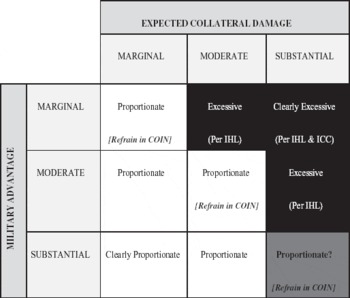
For part one of the subjective-objective approach – the good faith subjective assessment of both the anticipated military advantage and the expected collateral damage – both variables could be scaled or given ranges to determine whether the respective values are marginal, moderate, or substantial. Once the anticipated military advantage and the expected collateral damage have subjective values, then these values may be objectively weighed.
For instance, consider a scenario where there are thirty-five, fortified enemy soldiers with four light-armoured vehicles, and one tank blocking a critical bridge crossing in a major city where enemy forces control 35 per cent of the city. There is three-story apartment building next to the bridge and enemy emplacement. Based on human geography trends for the area and other intelligence (for example, geospatial imagery, etc.) there is a good faith basis to believe that the apartment building contains at least nine apartment units, and that anywhere from thirty-six to seventy-two civilians may be inside at any given time of the day.
Neutralizing these enemy soldiers and their armoured assets allows for freedom of movement for allied forces and will set the conditions for allied forces to take clear the area of enemy forces, hold the territory, and build on the gains. It is expected that a lethal strike on this emplacement by air poses the smallest risk of incidental harm to the civilian population, and that based on the weaponeering assessment and likely structural integrity of the building, the blast radius could damage 15 per cent of the building and potentially kill or seriously wound any residents on the blast side of the building – anywhere from four to nine civilians.
What decision should the commander make? What is the legal advice? Clearly, targeting and proportionality assessments must be made on a case-by-case basis, in good faith, and in light of the circumstances prevailing at the time. What is generally lacking from state practice, however, is a method for this life and death decision. The following table proposes a method.
The assumption underlying this table is that a commander will apply good faith and common sense when attributing values in the assessment.Footnote 192 Nonetheless, providing some semblance of order and objectivity in a proportionality assessment would provide useful clarity on this difficult question. On these assumptions, where there is an imbalance in the values (assessed in good faith and with common sense), such as a moderate anticipated military advantage versus a substantial expected collateral damage, the attack would be objectively ‘excessive’ under IHL and the attacking force must refrain from the attack. If the attack is nonetheless carried out wilfully in the knowledge that it is disproportionate, the state and responsible individual(s) will have committed a grave breach of API.
Where a significant imbalance between the values exists, such as a marginal anticipated advantage and a substantial expected collateral damage, the attack would be ‘clearly excessive’; if carried out, the state and responsible individual(s) would certainly have committed a grave breach, and the individuals ordering the attack may be criminally liable.
A legally complex issue arises where both the anticipated military advantage and expected collateral damage would be substantial. Recall again that with respect to determining what is ‘excessive’ the ICRC Commentary asserts that API ‘does not provide any justification for attacks which cause extensive civilian losses and damages’, irrespective of a comparative anticipated military advantage, because ‘[i]ncidental losses and damages should never be extensive’.Footnote 193 A concurring justice from the Israeli High Court of Justice also holds this view, that there may be cases where the collateral damage is ‘so severe that even a military objective with very substantial benefit cannot justify it’.Footnote 194 However, the HPCR experts disagree with these assertions that ‘extensive’ collateral damage is prohibited in all circumstances: ‘extensive collateral damage may be legally justified by the military value of the target struck, because of the high military advantage anticipated by the attack’.Footnote 195
To the extent there exists debate, the answer should err on the side of maximizing the protections of the civilian population – in accordance with the principles of humanity and dictates of public conscience. These rules exist to strike a balance between the military exigencies of war and the requirements of humanity. War should never trump our humanity. In other words, ‘if it comes to a choice between being a good soldier and a good human being – try to be a good human being’.Footnote 196
Turning now to the analysis for COIN warfare, where the values between the anticipated military advantage and the expected collateral damage remain the same and thus proportionate, US state practice would oblige commanders to refrain from launching the attack. For operational reasons, doctrine would permit commanders in COIN environments to consider lethal attacks where the anticipated military advantage is substantial and the expected collateral damage is either marginal or moderate, and where the anticipated military advantage is moderate and the expected collateral damage is marginal.
There is no easy answer to the question posed at the outset of this section, but – ‘[d]espite the difficulty of that balancing, there's no choice but to perform it’.Footnote 197 As a matter of state practice, institutional mechanisms, such as clarifying the definition for what constitutes excessive collateral damage and adopting a framework to assist in resolving real-life situations like the hypothetical ones advanced above, would assist those involved in these difficult life and death decisions on a case-by-case basis and overall in lessening the conceptual confusion.
Determining ‘excessiveness’ is only one of the crucial steps in a targeting process that starts with applying international humanitarian law (as opposed to starting off and relying nearly exclusively on rules of engagement). The following section provides a consolidated checklist to apply to assist legal advisers and other practitioners.
Targeting legal analysis: seven steps
Military practitioners cannot rely solely on any applicable rules of engagement or collateral damage methodology when legally reviewing a planned lethal attack. When conducting a legal review for staff officers and commanders, legal advisers must apply the international legal rules that govern attacks. The following steps may guide such an analysis.Footnote 198
Step 1: valid military objectiveFootnote 199
Ensure the target is a valid military objective that is not otherwise protected from attack under IHL.Footnote 200 Though there are nuances in status determinations for belligerents engaged in either international armed conflict and non-international armed conflict, this generally includes a determination as to whether an individual is subject to attack, such as a soldier who is part of the armed forces of an enemy, or a civilian who has lost immunity from attack by taking direct part in the hostilities.Footnote 201
Determination of a military object involves a two-part test: (a) does the object, based on its nature, location, purpose, or use, make an effective contribution to the enemy's military action (objective analysis); and (b) does its neutralization present a definite military advantage based on the current circumstances (subjective analysis)?Footnote 202
Step 2: distinction/intelligence gatheringFootnote 203
Assess the intelligence on the target, its location, and surroundings (that is, civilians and civilian objects), ensure the intelligence is continually updated and review any updated intelligence prior to any attack.
Step 3: non-lethal alternativeFootnote 204
For this ‘lesser of two evils’ rule, determine whether there is a non-lethal alternative (that is, other courses of action) to the lethal attack that will achieve the same concrete and direct anticipated military advantage. Consistent with recent US state practice, ask: ‘can action be taken without endangering civilians … [and] are other options available?’Footnote 205
Step 4: feasible precautionsFootnote 206
Undertake all feasible precautions to minimize the expected collateral damage. This includes warning the civilian population of an attack to facilitate evacuation and considering the choice of weapons and method of attack. If the element of surprise is required for the attack, then the attacking force should put the civilian population on notice as to what types of facilities or conduct would potentially subject them to direct attack. Other variables that bear on this step include:
Their location (possibly within or in the vicinity of a military objective), the terrain (landslides, floods etc.), accuracy of the weapons used (greater or lesser dispersion, depending on the trajectory, the range, the ammunition used etc.), weather conditions (visibility, wind etc.), the specific nature of the military objectives concerned (ammunition depots, fuel reservoirs, main roads of military importance at or in the vicinity of inhabited areas etc.), technical skill of the combatants (random dropping of bombs when unable to hit the intended target).Footnote 207
Step 5: proportionality testFootnote 208
Perform the proportionality test by determining whether the expected collateral damage would be excessive or disproportionate to the anticipated military advantage. This is a two-part test using the subjective-objective approach.
For part one, the subjective assessment, in good faith and in light of the available information at the time, place a subjective value (for example, marginal, moderate, or substantial) on both the anticipated military advantage and the expected collateral damage. For the temporal element, consider from both the short- and long-term perspective, taking into account secondary and tertiary effects. Foreseen indirect effects on the civilian population should be factored into the analysis.Footnote 209
For part two, the objective determination, refer to the Table 1 hereafter and compare these values to determine whether the result would be proportionate or excessive from the perspective of a ‘reasonable military commander’. As an institutional mechanism, belligerents should attempt to define or otherwise provide useful reference points for attempting to define these values (such as marginal, moderate, or substantial). Absent an institutional model, this approach may be used on a case-by-case basis, but it is recommended that ‘commanders at higher levels may want to reserve for themselves the approval authority for operations that have an excessively high risk of civilian casualties’.Footnote 210 To put the consequences into perspective, it may be useful to encourage decision-makers to imagine that those civilians subject to potential harm are those from their very own hometown, or their high school, or even their own family and friends.
A model for qualifying the anticipated military advantage and the expected collateral damage under international humanitarian law

Step 6: cancellation or suspensionFootnote 211
Ensure the tactical operators know to cancel or suspend the attack if the target is no longer a valid military objective (for example, hors de combat), if the target cannot be positively identified, or if other circumstances would make the attack disproportionate (for example, earlier assessment of collateral damage changes with increased civilian presence).
Step 7: diligent executionFootnote 212
Ensure the tactical operators, such as air pilots, artillerymen or drone pilots, diligently execute the attack by taking appropriate care to hit the desired aim point with the least amount of collateral damage.
Conclusion
If a man is slain unjustly, his heir shall be entitled to satisfaction. But let him not carry his vengeance to excess, for his victim is sure to be assisted and avenged.
The Qur'anFootnote 213To answer the question posed at the outset: there is no overarching definition of ‘excessive’ because the variables in the proportionality standard are relative to each other. Commanders must consider each attack on a case-by-case basis, and for this reason, there can be no bright-line rule.
However, a standard for determining what is excessive may be defined. As this analysis reveals, the proposed standard would find any outcome excessive that is objectively ‘unreasonable’ based on a commander's subjective assessment of the anticipated military advantage and the expected collateral damage. Commanders, military planners, and legal advisers would benefit from employing this subjective-objective hybrid model in deciding whether an attack is proportionate. Because objectivity varies, institutions should consider applying a common lexicon in weighting the subjective values of the anticipated military advantage and the expected collateral damage along a scale, such as marginal, moderate, or substantial.
While the proportionality standard provides constructive ambiguity, the scale should always be tilted in favour of furthering the protection of the civilian population. To accomplish this, military practitioners who provide legal advice on lethal targeting decisions must develop a keen understanding of IHL. Knowing the four basic principles of IHL is necessary, but far from sufficient. Deliberate targeting with lethal force not only requires the application of any relevant rules of engagement and collateral damage methodology, but also adherence to the specific IHL rules that govern attacks and the protection of the civilian population. Beyond complying with these legal and policy obligations, military lawyers advising in COIN operations must understand COIN theory. Excessive collateral damage not only increases human suffering, but it undermines strategic military aims.
Clearly, the most difficult question in any targeting analysis occurs when some unfortunate, incidental civilian death, injury, or property damage is anticipated in an attack on a valid military objective. As Abraham asked the Lord, what amount of death and destruction is excessive? Because this is fundamentally an abhorrent question, it defies an easy answer – but this answer, regrettably, must be reached.
A standard for determining what is excessive collateral damage has evolved since its initial formulation in the Lieber Code, and it will continue to evolve. With the rise of international criminal law, it can no longer be argued that the proportionality analysis is purely subjective in the mind of the commander. Because the fog of war will always remain an inextricable aspect of armed conflict, commanders in the heat of battle will place different values on military objectives based on the information available to them at the time. For this reason the proportionality analysis cannot be wholly objective. The standard, therefore, is a hybrid subjective-objective test.
To assist in the analysis, it is possible to assign basic values – such as marginal, moderate, and substantial – to both variables throughout the analysis. Although described above in antiseptic, legal language, what is at stake is nothing less than the horrendous suffering of ordinary innocent people. Modern warfare – whether international or non-international armed conflict – has the potential to magnify this suffering because belligerents often operate from within population centres. The use of the hollow term ‘collateral damage’ for civilian deaths fails to incorporate the key concept that it justifies killing the very people who should be protected. This deficiency is not lost on military strategists, such as COIN strategists, or on the civilian population – ‘collateral damage’, quite simply, has the capacity to fuel further violence.
To this end, this article has attempted to assist fellow counsellors at law and in arms in applying greater fidelity to the overall targeting analysis while paying critical attention to the difficult proportionality standard. As the first-line defenders of human rights in combat environments, commanders want your counsel. Stand up and be heard.