Background
Research findings, most originating from the USA, have generally reported a positive, albeit weak, relationship between higher levels of religious involvement and better health once other influences, such as age, sex and social support, have been taken into account (Koenig et al. Reference Koenig, George and Peterson1998, Reference Koenig, McCullough and Larson2001; McCullough & Larson, Reference McCullough and Larson1999; Johnstone et al. Reference Johnstone, Franklin, Yoon, Burris and Shigaki2008). Nevertheless, many other studies do not find such an association (Payne et al. Reference Payne, Bergin, Bielema and Jenkins1991; Schaefer, Reference Schaefer1997; Lewis et al. Reference Lewis, Maltby and Burkinshaw2000; Gartner et al. Reference Gartner, Larson and Allen2012). There have been at least two meta-analyses of relevant studies. The first examined the relationship between religiosity and psychological adjustment (Hackney & Sanders, Reference Hackney and Sanders2003), while excluding studies measuring a wider concept of spirituality or those examining the relationship with mental disorders. A small positive correlation between religiosity and psychological status was found (r = 0.10, p < 0.0001) when combining all effect sizes from 35 cross-sectional studies. Seventy-eight negative relationships were found in the data set of 264 effect sizes. Greater effects were seen with institutional religiosity than personal devotion, and with psychological distress rather than of life satisfaction. The authors concluded that greater ‘internality’ of religious belief was associated with more positive psychological outcomes. A second meta-analysis of 147 studies (of which 15 were longitudinal) examined associations between religiosity and/or spirituality and depressive symptoms and/or depressive disorder (Smith et al. Reference Smith, McCullough and Poll2003). Religious/spiritual belief seemed to have a small negative (−0.096) correlation with depressive symptoms but the protective effect of belief was stronger on risk of major depression after significant life events. Unfortunately, the authors did not distinguish evidence from longitudinal versus cross-sectional studies in their analysis.
Numerous cross-sectional studies have been conducted since 2003, including some outside the USA. In one very large Canadian community health study, greater participation in worship was associated with lower odds of psychiatric disorders but people who placed greater importance on spiritual values had higher odds of most psychiatric disorders (Baetz et al. Reference Baetz, Bowen, Jones and Koru-Sengul2006). A further cross-sectional study of more than 6000 people in Korea also reported that strong spiritual values were associated with increased rates of current depressive disorder (Park et al. Reference Park, Hong, Park and Cho2012).
Most of the studies in the meta-analyses described above (Hackney & Sanders, Reference Hackney and Sanders2003; Smith et al. Reference Smith, McCullough and Poll2003) were cross-sectional in nature and thus we need more prospective research in a variety of cultures and societies. Recent prospective studies have been small scale but generally positive in their findings. Kasen et al. (Reference Kasen, Wickramaratne, Gameroff and Weissman2012) and Miller et al. (Reference Miller, Wickramaratne, Gameroff, Sage, Tenke and Weissman2012) reported data on 114 adults who were the grown-up children of a cohort of people at high risk of depression, and matched controls, enrolled in a multi-generational 10-year longitudinal study. Participants for whom religion or spirituality was highly important seemed to be protected from major depression, especially relapse in those with a history of depression (Miller et al. Reference Miller, Wickramaratne, Gameroff, Sage, Tenke and Weissman2012). Religion was also more protective in participants exposed to negative life events (Kasen et al. Reference Kasen, Wickramaratne, Gameroff and Weissman2012). However, there were few participants, the sample was very specific (catholic or protestant Caucasians, who were offspring of depressed parents for the exposed cohort) and findings were of borderline significance.
In earlier cross-sectional work in a large sample of people from a range of ethnic groups in England and Wales, we reported that holding a spiritual life view without religious affiliation was associated with a higher prevalence of anxiety and depression (King et al. Reference King, Weich, Nazroo and Blizard2006a). However, the direction of this association was unclear. Lack of religion may lead to common mental disorders in vulnerable people who seek meaning in their lives. Conversely, people developing a common mental disorder who are not affiliated to any religious group may become involved in a search for meaning for relief from symptoms. The New Age movements and other non-traditional faiths in Western Europe may reflect a search for meaning in societies such as the UK, where religious practice has declined steeply in recent decades. We previously undertook a prospective study to develop a risk prediction algorithm for the onset of major depression in general practice attendees in seven countries: six European and one Latin American (King et al. Reference King, Walker, Levy, Bottomley, Royston, Weich, Bellón-Saameño, Moreno, Svab, Rotar, Rifel, Maaroos, Aluoja, Kalda, Neeleman, Geerlings, Xavier, Carraça, Gonçalves-Pereira, Vicente, Saldivia, Melipillan, Torres-Gonzalez and Nazareth2008). These data provided an opportunity to examine the impact of spiritual and religious beliefs on the development of depression. Our aims were to: (1) examine the impact of a religious or spiritual life view on onset of major depression over 12 months; (2) assess whether this impact varied for first or recurrent episodes of depression; (3) examine how the impact varied by religious denomination, change in life view and change in strength of belief over the 12 months; and (4) determine whether the form of life view mediated the impact of significant life events on onset of major depression. Our principal hypothesis was that people expressing a spiritual life view in the absence of religious affiliation or practice are more likely to develop DSM-IV major depression than those who have a religious life view or are secular in outlook.
Method
Study setting and design
The study, described in detail elsewhere (King et al. Reference King, Weich, Torres-González, Svab, Maaroos, Neeleman, Xavier, Morris, Walker, Bellón-Saameño, Moreno-Küstner, Rotar, Rifel, Aluoja, Kalda, Geerlings, Carraça, de Almeida, Vicente, Saldivia, Rioseco and Nazareth2006b, Reference King, Walker, Levy, Bottomley, Royston, Weich, Bellón-Saameño, Moreno, Svab, Rotar, Rifel, Maaroos, Aluoja, Kalda, Neeleman, Geerlings, Xavier, Carraça, Gonçalves-Pereira, Vicente, Saldivia, Melipillan, Torres-Gonzalez and Nazareth2008), was approved by research ethics committees in each country. It was a prospective cohort study conducted in (1) 25 general practices in the Medical Research Council (MRC) General Practice Research Framework (GPRF) in the UK; (2) nine large primary care centres in Andalucía, Spain; (3) 74 general practices nationwide in Slovenia; (4) 23 general practices nationwide in Estonia; (5) seven large general practice centres near Utrecht, The Netherlands; (6) two large primary care centres in the Lisbon area of Portugal; and (7) 78 general practices in Concepción and Talcahuano in the Eighth Region of Chile. General practices covered urban and rural populations with considerable socio-economic variation.
Study participants
Consecutive attendees aged 18–75 years were recruited in Europe between April 2003 and September 2004 and in Chile between October 2003 and February 2005. Exclusion criteria were inability to understand the country's main language, psychosis, dementia and incapacitating physical illness. Recruitment varied slightly because of local service differences. In the UK and The Netherlands, researchers spoke to patients while they waited in the practices. In the remaining European countries, general practitioners (GPs) introduced the study before contact with researchers. In Chile, attendees were stratified on age and gender on the basis of local figures and participants were selected randomly within each stratum. Participants gave informed consent and undertook a research evaluation within 2 weeks. Only attenders without a DSM-IV diagnosis of major depressive disorder at baseline were part of this analysis.
Assessments at baseline
Each instrument or question not available in the relevant languages was translated from English and back-translated by professional translators (King et al. Reference King, Weich, Torres-González, Svab, Maaroos, Neeleman, Xavier, Morris, Walker, Bellón-Saameño, Moreno-Küstner, Rotar, Rifel, Aluoja, Kalda, Geerlings, Carraça, de Almeida, Vicente, Saldivia, Rioseco and Nazareth2006b).
Demography
We collected standard information on participants' sex, age, education, marital status, employment and ethnicity.
Religious and spiritual beliefs
The self-report version of the Royal Free Interview for Spiritual and Religious Beliefs (King et al. Reference King, Speck and Thomas2001) examines religious affiliation and practice, and spiritual beliefs whether or not in the context of religion. In this study only the first three items of the questionnaire were used. Before the questions are posed the respondent reads an introductory statement: ‘In using the word religion, we mean the actual practice of a faith, e.g. going to a temple, mosque, church or synagogue. Some people do not follow a religion but do have spiritual beliefs or experiences. For example, they believe that there is some power or force other than themselves, which might influence their life. Some people think of this as God or gods, others do not. Some people make sense of their lives without any religious or spiritual belief’. On the basis of this statement, respondents were asked to indicate whether their understanding of life was primarily religious, spiritual, or neither religious nor spiritual (this latter category will be referred to as ‘secular’). If religious or spiritual they were then asked to indicate whether they regarded themselves as having a specific religion. People with a spiritual life view may identify themselves with a religion, even if they do not practice it. Finally, religious and spiritual participants were asked to indicate on scale from 1 to 6 how strongly they held their life view.
Diagnosis of depression
A DSM-IV diagnosis of major depression in the preceding 6 months was made using the Depression Section of the Composite International Diagnostic Interview (CIDI; Robins et al. Reference Robins, Wing, Wittchen, Helzer, Babor, Burke, Farmer, Jablenski, Pickens, Regier, Sartorius and Towle1988; WHO, 1997).
Screen for lifetime history of depression
Lifetime depression was considered possible if the respondent answered affirmatively to both of the first two questions of the CIDI Depression Section (WHO, 1997).
Life events
The List of Threatening Experiences questionnaire (Brugha et al. Reference Brugha, Bebbington, Tennant and Hurry1985) enquired about major life events in the preceding 6 months.
Social support
Adequacy of support from family and friends was measured using brief standardized questions (Blaxter, Reference Blaxter1990).
Follow-up assessments at 6 and 12 months
All participants were re-evaluated for DSM-IV major depression after 6 and 12 months. At 6 months they also completed the Royal Free Interview for Spiritual and Religious Beliefs and the questions on life events.
Statistical analysis
To manage missing data we undertook multiple imputation by chained equation, using the ice procedure in Stata (Royston, Reference Royston2005). We generated two imputed databases each containing 30 imputed versions using all relevant variables predicting depression or missingness; one database was used for the analysis of the understanding of life and the other for the analysis of religious denomination and strength of belief in religious or spiritual participants. Regression results were combined using Rubin's rule (mim command in Stata). We explored the pattern of missing data and performed sensitivity analyses on complete cases. t tests and χ2 tests were used to compare groups at baseline. Incidence rates of major depression were obtained on imputed data by univariable logistic regression and presented graphically. Odds ratios (ORs) unadjusted and adjusted for age, sex, education, employment, social support, past history of depression and country were computed using logistic regression. Interactions between the predictor and each covariate were tested and the model was stratified if an interaction was found. In view of multiple testing, we considered an interaction significant at the level of p < 0.01. All other p values reported are two-sided, and considered significant at the level of p < 0.05. Incidence rates and ORs are reported along with their 95% confidence intervals (CIs). Standard errors are based on robust sandwich estimates to account for the clustering effect of each general practice (Huber, Reference Huber1967). For the analyses on imputed data, the exact number of participants in each category of the exposure variables cannot be reported as it varied slightly with each imputation. In the presence of missing data, CIs are a more reliable guide to the precision around estimates than estimated frequencies. Statistical analyses were performed using Stata Release 11 (Stata Corp, 2009).
Results
Response rates and prevalence of DSM-IV major depression at recruitment
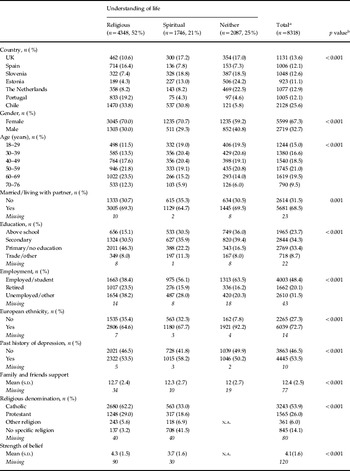
Response to recruitment was high in Portugal (76%), Estonia (80%), Slovenia (80%) and Chile (97%) but lower in the UK (44%) and The Netherlands (45%). Ethical constraints did not allow collection of data on non-responders at baseline. Across all countries the response to follow-up at 6 months was at 89.5%. A total of 10045 people took part: 219 were excluded on grounds of age, 143 had a missing CIDI diagnosis and five a missing practice identification at baseline. Of the remaining 9678, 8318 without DSM-IV major depression (86%) at baseline were analysed. The median age was 49 years, two-thirds were women, and 75% of participants held a religious or spiritual understanding of life. Women were more likely than men to have a religious or spiritual understanding of life, and a past history of depression was least common in people with a spiritual understanding (Table 1). The characteristics of participants by country are reported in Supplementary Table S1 (available online). Eleven per cent of participants did not complete the 6-month follow-up and 16% did not complete the 12-month follow-up. Non-completers tended to be younger and less educated and had experienced more serious life events in the 6 months before baseline.
Demographic characteristics and understanding of life

s.d., Standard deviation; n.a., not applicable.
a Including 137 missing understanding of life.
b p value for difference between understanding of life, from t tests or χ2 tests, as appropriate.
Understanding of life and onset of DSM-IV major depression over 12 months
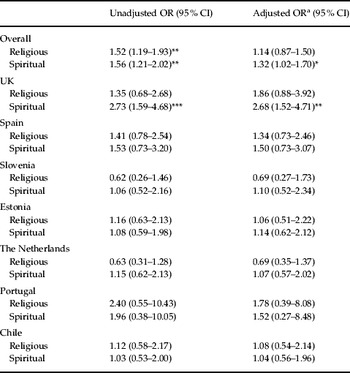
Of participants reporting a religious understanding of life, 10.3% experienced an episode of major depression over the subsequent 12 months, compared to 10.5% of participants with a spiritual life view and 7.0% of the secular group (p < 0.001). This finding was examined more closely in a logistic regression with secular participants as the reference group. The results are reported unadjusted and adjusted for age, sex, education, employment, social support, past history of depression and country. Participants with a spiritual understanding of life had a greater risk of major depression at 6 or 12 months than participants with neither a spiritual nor a religious life view (Table 2). Participants holding a religious understanding of life were also more at risk than secular participants, but this finding lost statistical significance after adjustment. When stratified by country, however, our finding that a spiritual life view predisposed people to major depression was significant only in the UK, where spiritual participants were nearly three times more likely to experience an episode of depression than the secular group (OR 2.73, 95% CI 1.59–4.68) (Table 2). In a post-hoc analysis, using international surveys (European Values Study, 2012; World Values Survey, 2012) we ranked the countries on the proportion of people considering themselves religious (from least to most: the UK, Estonia, The Netherlands, Spain, Chile, Slovenia, Portugal). The variation in results between countries was not explained by the importance of religion in each country (results available from the authors on request).
Odds ratios (ORs) for onset of major depression over 12 months by understanding of life, compared to neither religious nor spiritual

CI, Confidence interval.
Values based on imputed data.
a Adjusted for age, sex, education, employment, social support, past history of depression, and country.
* p <0.05, ** p<0.01, *** p<0.001.
Understanding of life and onset of first episode or recurrence of major depression over 12 months
To investigate the effect of religion on first episode versus recurrence of depression, we stratified the analysis by lifetime history of depression. The effect of a religious versus a secular understanding of life was similar in predicting new onset (OR 1.60, 95% CI 1.05–2.42) and recurrence (OR 1.44, 95% CI 1.07–1.93). A spiritual view of life did not predict onset of depression in participants with no history of depression (OR 1.04, 95% CI 0.63–1.73) but was related to new occurrence for participants with a past history of depression (OR 1.61, 95% CI 1.19–2.17). However, this interaction was not significant (p = 0.15).
Religious denomination and onset of major depression
In the 6094 participants with a spiritual or religious understanding of life, the incidence of major depression over the subsequent 12 months was similar across the different religious denominations (Catholic 9.8%, Protestant 10.9%, other religion 11.5%, no specific religion 10.8%, p = 0.65). In a post-hoc analysis in the 1746 participants who reported a spiritual understanding of life, a similar incidence of major depression over the subsequent 12 months was found between those who were able to nominate a religious affiliation and those who were not (10.7% v. 11.1%, p = 0.41).
Strength of belief at baseline and onset of major depression
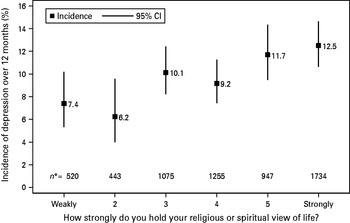
Higher strength of belief in the 6094 participants who reported a spiritual or religious life view was associated with a greater likelihood of DSM-IV major depression over the subsequent 12 months after adjustment for age, sex, education, employment, social support, past history of depression, and country (unadjusted OR per unit increase on the scale of strength of belief 1.14, 95% CI 1.07–1.21; adjusted OR 1.08, 95% CI 1.00–1.15) (Fig. 1). There was no interaction between country and strength of belief (p = 0.16). Those with a strongly held belief were twice as likely to experience major depression in the subsequent 12 months as those with a weakly held belief.
Incidence of major depression versus strength of spiritual or religious belief. Based on imputed data. * Frequencies based on observed data, not numbers included in analysis. CI, Confidence interval.

Change in strength of belief and subsequent onset of major depression
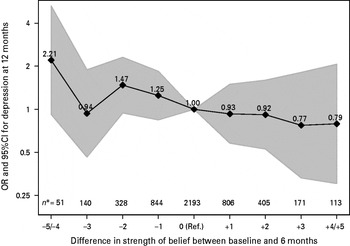
The incidence rate of depression between 6 and 12 months was 5.5%. We examined whether change over the first 6-month follow-up in the strength of spiritual or religious belief (strength score at 6 months minus score at baseline) was associated with onset of major depression between 6 and 12 months, after adjustment for strength of belief at baseline and other covariates. Those whose belief decreased seemed to be at greater risk of depression whereas those whose belief increased had slightly less risk (Fig. 2). However, CIs were wide, especially for the larger degrees of change.
Adjusted odds ratio (OR) for onset of major depression between 6 and 12 months after a change in strength of belief between baseline and 6 months. OR adjusted for strength of belief at baseline, age, sex, education, employment, social support, past history of depression, and country. Values based on imputed data. * Frequencies based on observed data, not numbers included in analysis. CI, Confidence interval.

Change in the nature of life view and subsequent onset of major depression
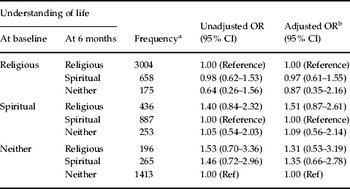
Although an understanding of life (religious, spiritual or secular) is relatively stable in most people (King et al. Reference King, Speck and Thomas1999), 27.1% of participants in this study changed their life view between baseline and the 6-month interview. Thus, we examined whether change in the nature of the life view between baseline and 6 months had any association with onset major depression between 6 and 12 months. Point estimates were in the direction of higher risk of depression for change in a religious direction and lower risk for change in a secular direction, but the CIs were wide and no significant difference was found (Table 3).
Odds ratios (ORs) for onset of major depression between 6 and 12 months, after a change in understanding of life between baseline and 6 months

CI, Confidence interval.
Values based on imputed data.
a Frequencies based on observed data, not numbers included in analysis.
b Adjusted for age, sex, education, employment, social support, past history of depression, and country.
Impact of belief on the relationship between serious life events and onset of major depression
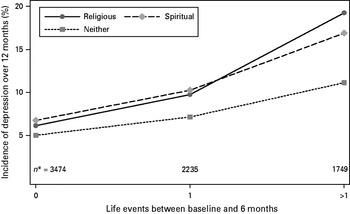
Finally, we examined whether a religious or spiritual understanding of life modified the risk of major depression following a serious life event. As expected, the incidence of major depression between baseline and 12 months was higher for patients who experienced serious life events (Fig. 3). Understanding of life was not a significant modifying factor of the effect of life events on depression (unadjusted p = 0.57, adjusted p = 0.48).
Modifying effect of life understanding on major depression after serious life events. Values based on imputed data. * Frequencies based on observed data, not numbers included in analysis.

Sensitivity of the analysis to imputation of missing data
When imputed data were compared to the observed data we found a similar distribution between understanding of life categories, but the incidence of major depression at 6 or 12 months was higher in the imputed data (8.7% v. 9.5%), reflecting the higher likelihood of dropping out for patients at risk of depression at baseline. No major discrepancy was found between imputed data and complete-case analyses. For example, the OR of developing major depression by 6 or 12 months was 1.64 (95% CI 1.26–2.15) for people with a religious understanding and 1.74 (95% CI 1.34–2.26) for people with a spiritual understanding of life, compared to 1.52 and 1.56 respectively on imputed data (Table 2).
Discussion
Main findings
We found that people who held a religious or spiritual understanding of life had a higher incidence of depression than those with a secular life view. However, this finding varied by country; in particular, people in the UK who had a spiritual understanding of life were the most vulnerable to the onset of major depression. Regardless of country, the stronger the spiritual or religious belief at baseline, the higher the risk of onset of depression. Although our main finding of an association between religious life understanding and onset of depression varied by country, we found no evidence that spirituality may protect people, and only weak evidence that a religious life view was possibly protective in two countries (Slovenia and The Netherlands). Finally, there was no moderating effect of religious and spiritual understanding of life on the impact of life events on onset of major depression.
Strengths and limitations
The main strengths of our study are its prospective cohort design, the involvement of several countries, the large sample size and the use of standardized assessments of religious/spiritual belief, other risk variables and major depression. However, combining people from different cultures creates heterogeneity and runs the risk of missing real differences within countries. Despite a large sample size, we lacked power for some of the analyses, particularly the assessment of statistical interactions. However, to our knowledge there are very few data sets available containing variables on spiritual and religious beliefs that are large enough to undertake interaction analyses. Thus we consider it is important to show the results to avoid a reporting bias that favours statistically significant results (Dwan et al. Reference Dwan, Altman, Arnaiz, Bloom, Chan, Cronin, Decullier, Easterbrook, Von Elm, Gamble, Ghersi, Ioannidis, Simes and Williamson2008). Another strength of this study is the use of multiple imputation to take account of participants who dropped out. Assuming predictors of missingness have been examined at baseline, this should give unbiased findings, as opposed to restricting the analysis to participants who completed both follow-ups only, which may represent a sample at lesser risk of depression than the original one. However, participations rates were low in some countries, and we cannot assume that findings in general practice attendees can be generalized to the whole population. Our study sample is likely to have a more complex medical history; for example, 53% reported a lifetime history of depression although other evidence would suggest this figure is usually in the range 30–40% (Kruijshaar et al. Reference Kruijshaar, Barendregt, Vos, de Graaf, Spijker and Andrews2005). However, our population may be more representative of life views than those who might participate in a study of religion. The original aim of this study was to develop a risk prediction algorithm for depression (PredictD; King et al. Reference King, Walker, Levy, Bottomley, Royston, Weich, Bellón-Saameño, Moreno, Svab, Rotar, Rifel, Maaroos, Aluoja, Kalda, Neeleman, Geerlings, Xavier, Carraça, Gonçalves-Pereira, Vicente, Saldivia, Melipillan, Torres-Gonzalez and Nazareth2008), and thus our analysis is limited to the religiosity data available. Religion did not appear as a variable in the final prediction algorithm PredictD, which included only the most parsimonious combination of risk factors of depression, but this does not imply the absence of a relationship between religiosity and depression. Although our questions were limited to people's overall view of religion and spirituality, rather than the detail of any specific belief, they applied to all people and not just those with a Christian background, which is often the case in North American research. Another limitation is the difficulty distinguishing religion and spirituality and the trouble respondents may have in placing themselves in one of the two categories. This may account for a proportion of the 27% of participants who changed their life view between baseline and 6 months. However, the questions have high repeatability (King et al. Reference King, Speck and Thomas2001) and clear definitions were given in a short note preceding the question, ensuring a universal understanding of the term across the different countries and cultures. Furthermore, they avoided the common pitfall in religion studies of conflating questions on religion and spiritual belief with those on psychological well-being (Koenig, Reference Koenig2008). Finally, the relationship between religion, spirituality and mental symptoms should not necessarily be interpreted as causal in nature. Although the longitudinal design removes the possibility of reverse causation, unmeasured confounders in the complex relationship between religiosity and depression are likely to remain, even after adjustment for main risk factors of depression.
Relationship to other findings
Our work adds to a growing body of evidence that spiritual beliefs in the absence of a clear religious affiliation or practice increase vulnerability to depression (Baetz et al. Reference Baetz, Bowen, Jones and Koru-Sengul2006; Braam et al. Reference Braam, Deeg, Poppelaars, Beekman and van Tilburg2007; Park et al. Reference Park, Hong, Park and Cho2012); it also contrasts with many studies where religious and spiritual beliefs and practice have been found to be associated with better mental health. An explanation for this disparity could be the complex relationship between the concepts of religiosity and well-being, and that findings in any specific population may not generalize to another. Research in this field has been dominated by North American studies, whereas in the more secular cultures of Europe, religious people may feel less supported in their faith. Alternatively, it may relate to the ways in which such beliefs are measured in research. In their meta-analysis, Hackney & Sanders (Reference Hackney and Sanders2003) criticized many studies for measuring religion and spirituality with insufficient depth and suggested that a multi-faceted concept such as religious belief and practice may have complex associations with mental health.
In their meta-analysis of 147 studies on religious belief and depression, Smith et al. (Reference Smith, McCullough and Poll2003) found that extrinsic religious orientation and so-called negative religious coping were associated with higher levels of depressive symptoms. However, they also reported that the negative correlation between religiousness and depressive symptoms was at its greatest in the presence of life stress and suggested that religion may have a buffering effect on the impact of life events. We did not find evidence of such buffering. They speculated that social desirability of response (exaggerating religiousness and downrating depressive symptoms), or the possibility that religious people might be better at expressing emotion and thus coping with stress, might explain some of the correlation in their studies that were mainly cross-sectional in nature.
Recent longitudinal research suggests that attaching a high importance to religion was associated with lower risk of recurrence of depression in the subsequent 10 years (Miller et al. Reference Miller, Wickramaratne, Gameroff, Sage, Tenke and Weissman2012) and had a protective effect after negative life events (Kasen et al. Reference Kasen, Wickramaratne, Gameroff and Weissman2012). We have not been able to replicate either of these findings in this cohort. Our study was, however, consistent with their finding of no clear relationship between religious denomination and depression.
The disparity in the findings suggests that, if there is an association between religion/spirituality and psychological well-being, it is likely to be weak. If religious belief has a powerful positive effect on mental health, we would expect to detect it in most studies.
Implications
Why a religious or spiritual life view might place people at risk of depression remains unclear. One explanation is that people predisposed to depression at baseline may seek meaning in spiritual or religious sources. The possibility that people predisposed to depression increase their search for existential meaning in religion and spirituality is supported by our finding that change in belief over time towards greater religiosity did seem to be related to greater risk of depression.
In conclusion, we found that holding a religious or spiritual life view, in contrast to a secular outlook, predisposed people to the onset of major depression and that such beliefs and practice did not act as a buffer to adverse life events. Our findings highlight the complexity of the relationship between religion, spirituality and mental health and offer a challenge to an increasing tendency to regard religion and spirituality as being good for mental well-being (Schumann & Meador, Reference Schumann and Meador2003).
Supplementary material
For supplementary material accompanying this paper visit http://dx.doi.org/10.1017/S0033291713003066.
Acknowledgements
The study in Europe was funded by a European Commission Vth Framework grant (PREDICT-QL4-CT2002-00683). Funding in Chile was provided by project FONDEF DO2I-1140. We are grateful for part support in Europe from: the Estonian Scientific Foundation (grant 5696); the Slovenian Ministry for Research (grant 4369-1027); the Spanish Ministry of Health (FIS references: PI041980, PI041771, PI042450) and the Spanish Network of Primary Care Research, redIAPP (ISCIII-RETIC RD06/0018) and SAMSERAP group; and the UK NHS Research and Development office for service support costs in the UK. The funders had no direct role in the design or conduct of the study, interpretation of the data or review of the manuscript.
M. King had full access to the data and takes responsibility for their integrity and the accuracy of the data analysis. We thank all patients and general practice staff who took part; the European Office at University College London for their administrative assistance at the coordinating centre; K. McCarthy, the project's scientific officer in the European Commission, Brussels, for his helpful support and guidance; the UK MRC GPRF; L. Letley from the MRC GPRF; the GPs of the Utrecht General Practitioners' Network; and the Camden and Islington Mental Health and Social Care Trust. We also acknowledge the Maristán network, through which the collaboration in Spain, Portugal, the UK and Chile first developed.
Declaration of Interest
None.