Introduction
Social cognition (SC) refers broadly to the domains of cognitive functions that are employed in socially relevant situations (Harvey & Penn, Reference Harvey and Penn2010). These include emotion processing, social perception, theory of mind (TOM)/mental state attribution, and attributional style/bias, as well as more complex and developing concepts such as social metacognition (Pinkham et al. Reference Pinkham, Penn, Green and Harvey2016).
Schizophrenia patients demonstrate significant deficits across multiple dimensions of SC (Savla et al. Reference Savla, Vella, Armstrong, Penn and Twamley2013). Growing evidence indicates that SC impairment is large in effect size, appears to be present in the prodrome (or high-risk samples), in first-degree relatives of patients with schizophrenia, during early course, and during periods of symptom remission (de Achával et al. Reference de Achával, Costanzo, Villarreal, Jáuregui, Chiodi, Castro, Fahrer, Leiguarda, Chu and Guinjoan2010; Kohler et al. Reference Kohler, Walker, Martin, Healey and Moberg2010; Fett et al. Reference Fett, Viechtbauer, Dominguez, Penn, van Os and Krabbendam2011; Green et al. Reference Green, Bearden, Cannon, Fiske, Hellemann, Horan, Kee, Kern, Lee, Sergi, Subotnik, Sugar, Ventura, Yee and Nuechterlein2012; Bora & Pantelis, Reference Bora and Pantelis2013), suggesting that SC deficits in schizophrenia are likely core features of the illness and not simply a result of medication side-effects or clinical episodes (Ventura et al. Reference Ventura, Wood and Hellemann2013).
These disturbances have been found to be largely independent of positive symptoms but may be more strongly related to disorganized and negative symptoms (Fett et al. Reference Fett and Maat2013; Ventura et al. Reference Ventura, Wood and Hellemann2013). Though neurocognitive (NC) and SC tasks share some cognitive processes and therefore are often correlated, NC and SC have been observed to exist as distinct constructs (Sergi et al. Reference Sergi, Rassovsky, Widmark, Reist, Erhart, Braff, Marder and Green2007; Mehta et al. Reference Mehta, Thirthalli, Subbakrishna, Gangadhar, Eack and Keshavan2013).
Numerous studies have corroborated that both SC and NC are related to everyday functioning (Fett et al. Reference Fett, Viechtbauer, Dominguez, Penn, van Os and Krabbendam2011). SC impairments in schizophrenia have recently been explored as potential mediators of the relationship between NC and functioning (Brekke et al. Reference Brekke, Kay, Lee and Green2005; Horton & Silverstein, Reference Horton and Silverstein2008; Schmidt et al. Reference Schmidt, Mueller and Roder2011; Galderisi et al. Reference Galderisi, Rossi, Rocca, Bertolino, Mucci, Bucci, Rucci, Gibertoni, Aguglia, more, Bellomo, Biondi, Brugnoli, Dell'Osso, De Ronchi, Di Emidio, Di Giannantonio, Fagiolini, Marchesi, Monteleone, Oldani, Pinna, Roncone, Sacchetti, Santonastaso, Siracusano, Vita, Zeppegno and Maj2014). Recent findings from a meta-analysis indicate that SC has a stronger relationship with functional outcome than NC (Fett et al. Reference Fett, Viechtbauer, Dominguez, Penn, van Os and Krabbendam2011).
It appears that considerable heterogeneity exists in the area of SC. Thus, it is possible that subtypes with different levels and patterns of SC performance may exist, but little research has been conducted to identify these subtypes (Nelson et al. Reference Nelson, Combs, Penn and Basso2007; Bell et al. Reference Bell, Corbera, Johannesen, Fiszdon and Wexler2013). One method that may be useful in identifying subtypes is cluster analysis. Cluster analysis provides an opportunity to group individuals using a data-driven approach rather than predetermined grouping criteria (e.g. diagnosis). Such approaches permit individuals to be classified based not on single variables or factors but on patterns or profiles of traits, creating the potential for more homogeneous groupings than single domains or predefined categories. Cluster-analytic studies on NC in patients with schizophrenia have identified different clusters with differing levels of NC dysfunction, i.e. one neuropsychologically normal cluster, one severely and broadly impaired cluster, and one to three intermediate profiles of mixed NC deficits (Palmer et al. Reference Palmer, Dawes and Heaton2009). Few analytic studies on SC have been conducted in schizophrenia (Nelson et al. Reference Nelson, Combs, Penn and Basso2007; Bell et al. Reference Bell, Corbera, Johannesen, Fiszdon and Wexler2013). The first one on 100 in-patients with schizophrenia identified two homogeneous subtypes, that showed performance deficits across measures of emotion, face and general perception compared with normative data, supporting the presence of a generalized deficit model as regards social and general perception tasks in schizophrenia (Nelson et al. Reference Nelson, Combs, Penn and Basso2007). Cluster 1 included the most severely impaired patients, who showed scores roughly 3 s.d. below that of normal controls on visual perception. Moreover, they showed higher levels of thought disorder than cluster 2; cluster 2 showed mild to moderate levels of impairment with scores about 1 s.d. below normal.
The second study, carried out in a sample of 77 out-patients with schizophrenia (Bell et al. Reference Bell, Corbera, Johannesen, Fiszdon and Wexler2013), identified three clusters: one with high negative symptoms (HN), one with low negative symptom and higher SC (HSC), and one with low negative symptoms and poorer SC (LSC). The HSC cluster had a significantly higher proportion of patients ever being married compared with the other two clusters, and the LSC cluster had a higher proportion of married than the HN clusters. The LSC cluster contained more patients with more than two arrests. Moreover, the HSC cluster had an earlier reported age of onset and significantly more hospitalizations. Global Assessment of Functioning scores were significantly better for the HSC cluster compared with the other two groups. Lifetime substance abuse also differed significantly among clusters, with the LSC cluster having the highest proportion and the HN group the lowest.
The goals of this study are to analyse the pattern of SC variables in schizophrenia using cluster analysis, to examine the relationship of real-life functioning, demographic characteristics, and psychopathology with cluster membership, and to identify cut-offs that best discriminate among clusters.
Several limitations of previous studies are addressed in the present investigation. We investigated a large and well-characterized sample of patients with schizophrenia recruited in the context of a multicentre study of the Italian Network for Research on Psychoses (NIRP). A full assessment of different aspects of SC was carried out, including emotional intelligence, emotion recognition and TOM. The MATRICS (Measurement and Treatment Research to Improve Cognition in Schizophrenia) Consensus Cognitive Battery (MCCB) was chosen for NC assessment, as it is regarded as the ‘state-of-the-art’ neuropsychological battery for research purposes in schizophrenia (Kern et al. Reference Kern, Nuechterlein, Green, Baade, Fenton, Gold, Keefe, Mesholam-Gately, Mintz, Seidman, Stover and Marder2008; Nuechterlein et al. Reference Nuechterlein, Green, Kern, Baade, Barch, Cohen, Essock, Fenton, Frese, Gold, Goldberg, Heaton, Keefe, Kraemer, Mesholam-Gately, Seidman, Stover, Weinberger, Young, Zalcman and Marder2008; Nuechterlein & Green, Reference Nuechterlein and Green2013a , Reference Nuechterlein and Green b ).
Measurement of everyday functioning was accomplished through two general approaches: ratings of real-life functioning using the Specific Levels of Functioning Scale (SLOF) (Schneider & Struening, Reference Schneider and Struening1983; Mucci et al. Reference Mucci, Rucci, Rocca, Bucci, Gibertoni, Merlotti, Galderisi and Maj2014), and objective measures of functioning, including the achievement of specific milestones (stable relationship, employment, and residential status) (Harvey et al. Reference Harvey, Sabbag, Prestia, Durand, Twamley and Patterson2012; Harvey, Reference Harvey2013). The SLOF was endorsed by the panel of experts involved in the Validation of Everyday Real-Life Outcomes (VALERO) initiative as a suitable measure of real-life functioning (Harvey et al. Reference Harvey, Raykov, Twamley, Vella, Heaton and Patterson2011; Leifker et al. Reference Leifker, Patterson, Heaton and Harvey2011).
Method
Participants
A total of 809 study participants were recruited from patients with a diagnosis of schizophrenia according to the Diagnostic and Statistical Manual of Mental Disorders, 4th edition (DSM-IV; American Psychiatric Association, 2000), living in the community and consecutively seen at the out-patient units of 26 Italian university psychiatric clinics and/or mental health departments (Galderisi et al. Reference Galderisi, Rossi, Rocca, Bertolino, Mucci, Bucci, Rucci, Gibertoni, Aguglia, more, Bellomo, Biondi, Brugnoli, Dell'Osso, De Ronchi, Di Emidio, Di Giannantonio, Fagiolini, Marchesi, Monteleone, Oldani, Pinna, Roncone, Sacchetti, Santonastaso, Siracusano, Vita, Zeppegno and Maj2014). Inclusion and exclusion criteria have been described in a previous paper (Galderisi et al. Reference Galderisi, Rossi, Rocca, Bertolino, Mucci, Bucci, Rucci, Gibertoni, Aguglia, more, Bellomo, Biondi, Brugnoli, Dell'Osso, De Ronchi, Di Emidio, Di Giannantonio, Fagiolini, Marchesi, Monteleone, Oldani, Pinna, Roncone, Sacchetti, Santonastaso, Siracusano, Vita, Zeppegno and Maj2014). The control group included 780 healthy subjects matched with patients by gender, age range and geographical area of origin and recruited through flyers from the community at the same sites as the patient sample. Inclusion criteria were the absence of a current or lifetime Axis I or II diagnosis and exclusion criteria were: (a) a history of head trauma with loss of consciousness; (b) a history of moderate to severe mental retardation or of neurological diseases; (c) a history of alcohol and/or substance abuse in the last 6 months; (d) current pregnancy or lactation; (e) inability to provide an informed consent.
All participants signed a written informed consent to participate after receiving a detailed explanation of the study procedures and goals.
Measures
Psychopathology
The Positive and Negative Syndrome Scale (PANSS) was used to rate symptom severity. Scores for the dimensions ‘disorganization’ and ‘positive symptoms’ were calculated based on the consensus five-factor solution proposed by Wallwork et al. (Reference Wallwork, Fortgang, Hashimoto, Weinberger and Dickinson2012).
Negative symptoms were assessed using the Brief Negative Symptom Scale (BNSS). The Italian version of the scale was validated as part of the NIRP project (Mucci et al. Reference Mucci, Galderisi, Merlotti, Rossi, Rocca, Bucci, Piegari, Chieffi, Vignapiano and Maj2015). In line with previous research (Kirkpatrick et al. Reference Kirkpatrick, Strauss, Nguyen, Fischer, Daniel, Cienfuegos and Marder2011; Strauss et al. Reference Strauss, Keller, Buchanan, Gold, Fischer, McMahon, Catalano, Culbreth, Carpenter and Kirkpatrick2012) domains evaluated by the scale loaded on two factors: ‘avolition’ (A), consisting of anhedonia, asociality and avolition; and ‘poor emotional expression’ (DE), including blunted affect and alogia.
SC
The assessment of SC included a test contained in the MCCB: the Mayer–Salovey–Caruso Emotional Intelligence Test (MSCEIT) (Mayer et al. Reference Mayer, Salovey and Caruso2002), managing emotion section, which examines the regulation of emotions in oneself and in one's relationships with others by presenting vignettes of various situations, along with ways to cope with the emotions depicted in these vignettes. It was integrated by the Facial Emotion Identification Test (FEIT) (Kerr & Neale, Reference Kerr and Neale1993), which examines emotion perception, and The Awareness of Social Inference Test (TASIT) (McDonald et al. Reference McDonald, Bornhofen, Shum, Long, Saunders and Neulinger2006), which is a TOM test consisting of seven scales (positive emotions, negative emotions, sincere, simple sarcasm, paradoxical sarcasm, sarcasm enriched, lie), organized into three sections: emotion recognition; social inference (minimal); social inference (enriched). The manual of the TASIT was translated into Italian by a psychiatrist of the Department of Psychiatry of the University of Naples SUN who gained experience in the use of the English version of the instrument during his stage at the Department of Psychiatry and Biobehavioral Sciences at the University of California, Los Angeles (UCLA), as part of his Ph.D. course. The videotaped vignettes of the TASIT were dubbed in Italian at the Fono Roma Studios (http://www.fonoroma.com), a prestigious society in the field of film industry. As to the FEIT, the adaptation of the Italian version required the translations of the six emotions reported on the screen above the stimuli.
Neurocognition
The MCCB includes tests for the assessment of six distinct cognitive domains: processing speed, attention/vigilance, working memory, verbal learning, visual learning, reasoning and problem solving.
Real-life functioning
The SLOF includes the following domains: physical efficiency, skills in self-care, interpersonal relationships, social acceptability, community activities, and working skills. The Italian version of the scale has recently been validated (Mucci et al. Reference Mucci, Rucci, Rocca, Bucci, Gibertoni, Merlotti, Galderisi and Maj2014) in the context of the NIRP.
Definition of milestones
Functional milestones were defined in line with Harvey et al. (Reference Harvey, Sabbag, Prestia, Durand, Twamley and Patterson2012) and included social outcomes such as ever being married, living with spouse/partner, currently or previously engaged, which we categorized as current or former relationship v. none.
Vocational outcome was categorized as employed v. not employed and residential outcome was defined as living without supervision.
Statistical analysis
A two-step cluster analysis of the seven TASIT scale scores and the FEIT and MSCEIT scores was performed to identify patient subgroups with different SC profiles. The two-step algorithm has several desirable features that differentiate it from the traditional hierarchical cluster analysis or k-means cluster analysis: first, its ability to analyse large datasets efficiently; second, the selection of the number of clusters based on a goodness-of-fit index; third, its ability to use categorical and continuous variables. Given the large sample size, we chose to use this technique rather than hierarchical cluster analysis. In two-step cluster analysis, cases are first assigned to ‘preclusters’ and then preclusters are used for a second-step hierarchical analysis. Variables were transformed to z-scores using the Italian normative sample data. The normative sample was recruited from each geographic macro-area (Northern, Central and Southern Italy) and was stratified by age, gender and education in order to have a demographic composition similar to that described in the last published census by the Italian National Census Bureau (2015). The two-step cluster analysis procedure uses a likelihood distance measure which assumes that variables in the cluster model are independent. Further, each continuous variable is assumed to have a normal (Gaussian) distribution. However, this procedure is fairly robust to violations of both the independence and the distributional assumptions (Norušis, Reference Norušis2005). In addition, the Euclidean distance can be used, which is suitable when variables are continuous.
In the first step, the procedure builds a cluster features (CF) tree. The tree begins by placing the first case at the root of the tree in a leaf node that contains variable information about that case. Each successive case is then added to an existing node or forms a new node, based upon its similarity to existing nodes and using the distance measure as the similarity criterion. In the second step, the leaf nodes of the CF tree are then grouped using an agglomerative clustering algorithm. The agglomerative clustering can be used to produce a range of solutions. To determine which number of clusters was ‘best’, each of these cluster solutions was compared using Schwarz's Bayesian information criterion (BIC) as the clustering criterion.
Functioning, psychopathology, NC scale scores and demographic characteristics were compared among clusters using analysis of variance (ANOVA), followed by Tamhane post-hoc tests, to allow for heterogeneity of variance, and categorical variables were compared among clusters using the χ2 test. Bonferroni correction was applied to the significance level to adjust for multiple comparisons. The correlation between milestones was examined using the φ correlation coefficient and the correlation between milestones and clusters was analysed using Cramer's V.
Classification and regression tree (CRT) analysis was used to identify the cut-offs of variables that best discriminated among clusters. Analyses were carried out using IBM SPSS Statistics, version 20 (USA) and Stata, version 13 (USA).
Results
Of the 921 patients participating in the study, 809 completed all SC assessments. Completers were compared with non-completers using the t test and χ2 test. No difference was found between the two groups on the 29 variables examined except for SLOF interpersonal relationships, that was about two points lower among those who did not complete the SC assessment (20.6 v. 22.5, t test = −2.99, p < 0.01). Therefore, completers can be considered representative of the overall sample.
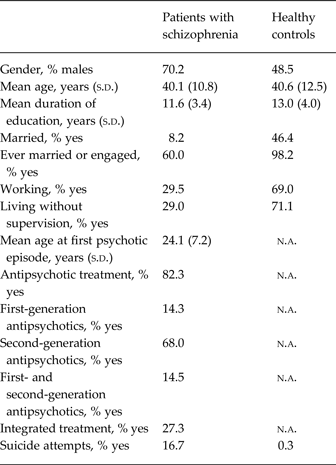
Clinical characteristics of completers are provided in Table 1. Concerning milestone achievement, being ever married/engaged was significantly associated with living independently (φ = 0.249, p < 0.001) and with being employed (φ = 0.102, p = 0.005). Although correlations were weak in absolute value, according to Cohen's definition (Cohen, Reference Cohen1988), they were in the expected direction. Specifically, being ever married was more strongly associated with living independently than with being employed, as expected.
Demographic and clinical characteristics of study participants (n = 809) and of healthy controls (n = 780)

s.d., Standard deviation; n.a., not applicable.
Similarly, being employed and living independently were related to each other (φ = 0.126, p < 0.001). Achievement of one, two and three milestones was found in 38.1%, 26.3% and 9.4% of patients; 26.3% did not achieve any milestone.
Cluster selection
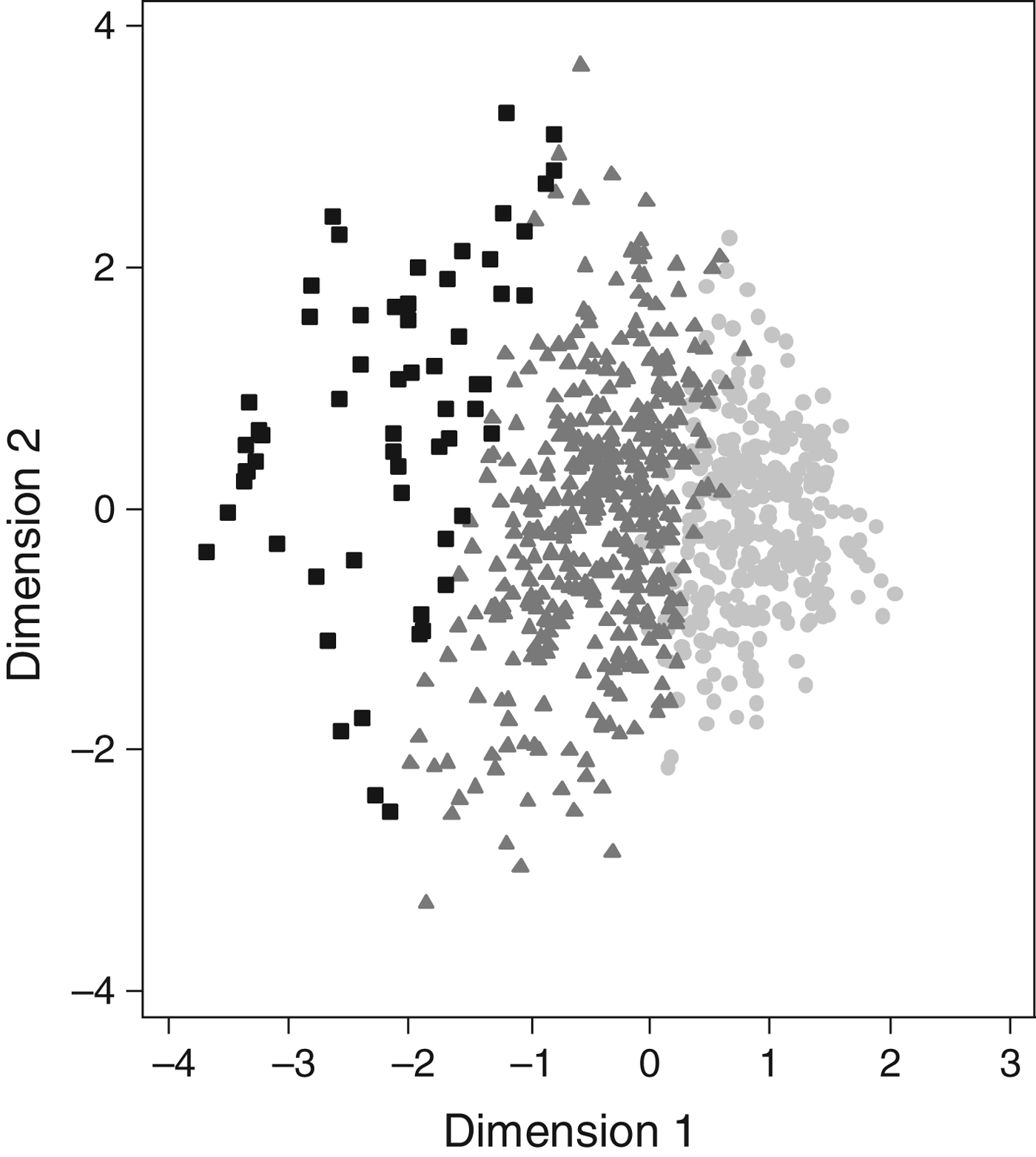
The cluster analysis of the nine SC variables based on the likelihood distance yielded three clusters including 340 (42%), 408 (50%) and 61 (8%) patients. The three-cluster solution, depicted in Fig. 1 in a biplot graph, proved to be the best in terms of goodness of fit, yielding a lower value (BIC = 7283) as compared with the two- and one-cluster solutions (BIC = 7654 and BIC = 8707). An identical solution was found when the Euclidean distance was used.
Biplot showing the three-cluster solution: ■, very impaired social cognition (SC);  , impaired SC;
 , unimpaired SC.

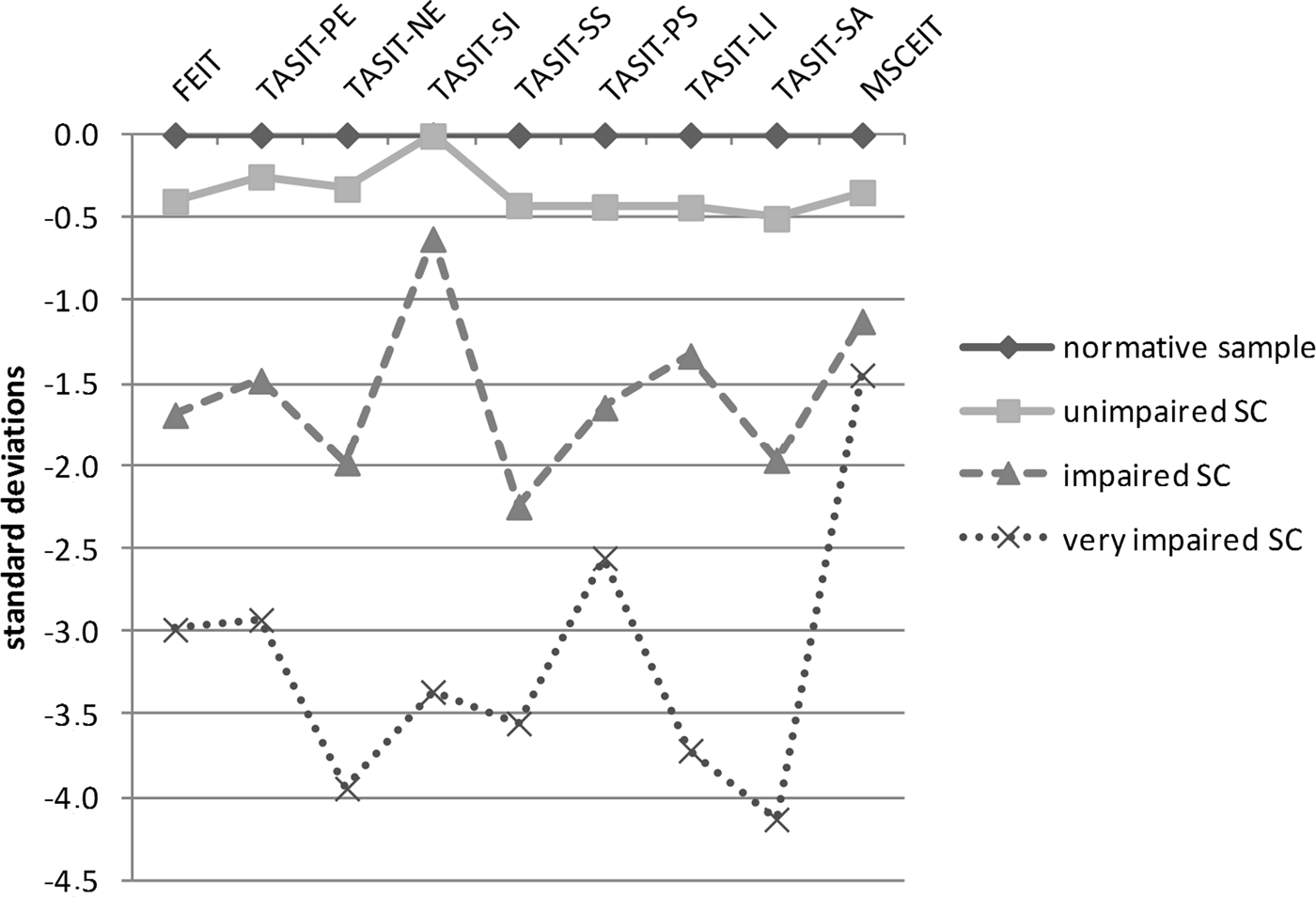
The three clusters were labelled as unimpaired, impaired, and very impaired SC. TASIT-LI (lie), -SS (simple sarcasm) and -SA (sarcasm enriched) were the most important variables contributing to the cluster definition. The cluster profile on the nine standardized variables is depicted in Fig. 2, with respect to the reference line of 0 in the control group. This graph shows that mean TASIT and FEIT scales provide a better discrimination among clusters than MSCEIT scores, which tend to be similar in the intermediate and low SC cluster. Moreover, patients in the unimpaired SC cluster exhibited SC impairment in all dimensions investigated, except for TASIT-SI scores, which did not differ significantly between patients and the normative sample.
Profile of the nine social cognition (SC) scales in the three clusters. All variables were standardized with respect to the normative sample. The reference line of 0 represents the normative sample. Values are expressed as z-scores, i.e. in standard deviation units with respect to the normative sample. Negative values denote poorer SC with respect to the normative sample. FEIT, Facial Emotion Identification Test; TASIT, The Awareness of Social Inference Test; PE, positive emotions; NE, negative emotions; SI, sincere; SS, simple sarcasm; PS, paradoxical sarcasm; LI, lie; SA, sarcasm enriched; MSCEIT, Mayer–Salovey–Caruso Emotional Intelligence Test.

Correlates of cluster membership
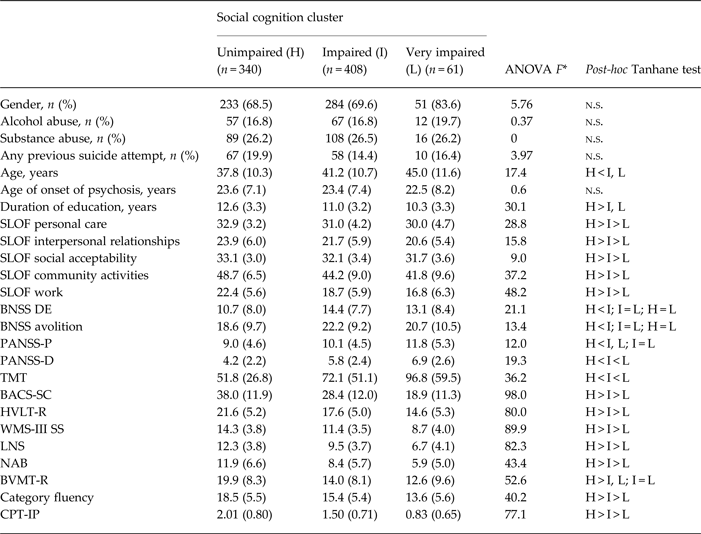
We found that deficits in SC were associated with older age and lower education, but not with age at onset of psychosis or with gender, alcohol or substance abuse and suicide attempts (Table 2).
Comparison of demographic characteristics and functioning, psychopathology and neurocognition among social cognition clusters

Data are given as mean (standard deviation) unless otherwise indicated.
ANOVA, analysis of variance; n.s., non-significant; SLOF, Specific Level of Functioning Scale; BNSS, Brief Negative Symptom Scale; DE, ‘poor emotional expression’; PANSS-P, Positive and Negative Syndrome Scale, positive symptoms; PANSS-D, Positive and Negative Syndrome Scale, disorganization; TMT, Trail Making Test – Part A; BACS-SC, Brief Assessment of Cognition in Schizophrenia Symbol Coding; HVLT-R, Hopkins Verbal Learning Test–Revised; WMS-III SS, Wechsler Memory Scale Spatial Span; LNS, Letter–Number Span; NAB, Neuropsychological Assessment Battery; BVMT-R, Brief Visuospatial Memory Test–Revised; CPT-IP, Continuous Performance Test, Identical Pairs.
* All ANOVA F tests were significant (p < 0.001).
Comparison of SLOF scores among the three clusters using ANOVA revealed that functioning declined significantly from the unimpaired to the impaired and very impaired SC cluster, suggesting a linear correlation between SC and functioning (Table 2). Work and community activities domains were the functioning domains more strongly associated with SC. Moreover, we found that SC had a stronger and positive association with vocational (ever employed, V = 0.142, p < 0.001) than with social milestones (V = 0.090, p = 0.042) and was unrelated with living independently (V = 0.061, p = 0.230).
The PANSS disorganization score increased significantly from the unimpaired to the impaired and very impaired SC cluster. The PANSS positive symptoms domain score was significantly lower in the unimpaired SC cluster as compared with the impaired and very impaired ones, with no differences between them, whereas both BNSS A and DE scores were significantly higher in patients with impaired SC compared with patients in the unimpaired SC cluster, with no differences from the very impaired SC cluster (Table 2).
Comparison of NC scales scores among clusters showed that NC and SC impairment was strongly related (higher NC impairment, poorer SC) in all the dimensions investigated, except for visuospatial memory (Brief Visuospatial Memory Test–Revised; BVMT-R) scores, which did not differ significantly between patients with very impaired and impaired SC (Table 2).
CRT analysis
Although the clusters were defined using nine scales, the scales were highly correlated with each other; therefore we tested the hypothesis that a smaller number of variables would be sufficient to characterize the clusters. To identify the minimum set of variables and the cut-offs for defining the three clusters, we used CRT.
This analysis revealed that two TASIT variables (SS and LI) were sufficient to discriminate among the three clusters. Patients with a cut-off score ⩾14 for TASIT-SS were more likely to have unimpaired SC, those with a TASIT-SS < 14 and a TASIT-LI ≥ 10 were more likely to have impaired SC and those with a TASIT-SS < 14 and a TASIT-LI < 10 were more likely to have very impaired SC (Fig. 3).
Classification tree analysis showing the minimum set of social cognition (SC) variables and their cut-offs that best discriminate among clusters. TASIT, The Awareness of Social Inference Test; SS, simple sarcasm; LI, lie.

Discussion
To the best of our knowledge, this is the largest study carried out to subtype patients with schizophrenia on the basis of SC.
This study shows several key results relevant to clinical practice.
First, using cross-sectional data, our analysis identified three distinct clusters, characterized by unimpaired (42%), impaired (50.4%) and very impaired (7.5%) SC. Three TOM domains were more important for the cluster definition as compared with emotion perception and emotional intelligence. Moreover, we found specific cut-offs based on levels of impairment on SC measures that can be used in clinical practice.
Second, the three clusters were associated with distinct patterns of real-life functioning, sociodemographic, clinical and NC variables.
SC clusters
In our study two main findings emerged regarding the SC cluster membership.
First, although the three clusters showed SC performance deficits across all measures when compared with healthy controls, except for TASIT-SI, TOM (TASIT-LI, -SS, -SA) was more important for the cluster definition as compared with emotion perception and emotional intelligence. TOM involves the ability to ascertain the mental states of others, and accordingly is likely to affect functioning behaviours to a great extent (Couture et al. Reference Couture, Penn and Roberts2006, Reference Couture, Granholm and Fish2011; Biedermann et al. Reference Biedermann, Frajo-Apor and Hofer2012).
Second, using the CRT analysis we identified two TASIT scales (SS and LI) and their cut-off values that may provide a useful guidance to clinicians about the patients' degree of impairment in SC. Patients more able to understand simple sarcasm (⩾14 for TASIT-SS) are very likely to belong to the unimpaired SC cluster. Compared with patients in the impaired SC cluster, those in the very impaired SC cluster performed significantly worse in lie scenes (TASIT-LI <10), but not in simple sarcasm. Thus, our findings suggest that patients in the unimpaired cluster differ from patients in the impaired and in the very impaired ones in a higher ability to grasp sarcasm, while patients in the impaired cluster differ from those in the very impaired cluster as regards their higher ability to understand lies. This result was not surprising given the findings of studies showing that comprehension of lies/deceit is acquired before sarcasm/irony and is based on a less complex inferential chain, reflecting first-order mental representation, whereas comprehension of sarcasm requires refined emotional skills such as empathic appreciation of the listener's emotional state (Mancuso et al. Reference Mancuso, Horan, Kern and Green2011; Biedermann et al. Reference Biedermann, Frajo-Apor and Hofer2012), reflecting second-order mental representation and hierarchically higher-level SC ability. This distinction between lies and sarcasm may have been enhanced by the way that the TASIT evaluates detection of lies as it provides all of the information about deceit in the scene and does not require much inference.
SC and functioning
Functioning was highest in the unimpaired cluster and deteriorated from the unimpaired to the impaired and very impaired cluster, suggesting a linear correlation between SC and functioning. Work and activities domains were the functioning domains more strongly associated with SC. Our result was confirmed by the findings that patients with high levels of SC were more likely to achieve vocational and social milestones compared with those with lower levels of SC. Moreover, our findings are in line with those of previous meta-analyses, showing that the correlation between SC and real-life functioning ranged from small to large, mainly depending on the examined aspect of SC, with largest effects observed for TOM (Couture et al. Reference Couture, Penn and Roberts2006, Reference Couture, Granholm and Fish2011; Fett et al. Reference Fett, Viechtbauer, Dominguez, Penn, van Os and Krabbendam2011). The studies reviewed by the Fett meta-analyses evaluated four domains of outcome: community functioning (reported in 33 studies), social behaviour in the milieu (reported in nine studies), social problem solving (reported in seven studies) and social skills (reported in nine studies). As regards SC domains, five studies investigated TOM, 14 investigated emotion perception and processing (EP), and eight studies social perception and knowledge (SP). However, the various SC–outcome associations differed in strength. The largest mean correlation was found for the relationship between TOM and community functioning, followed by the association between EP and social behaviour and the correlation between SP and social skills. No meta-analyses could be performed on social-problem solving and any SC domain due to lack of data. Moreover, it should be noted that in the present study we measured different SC constructs (i.e. emotional intelligence, emotional recognition and TOM) and everyday functioning (ratings of real-life functioning and the achievement of specific milestones) with state-of-the-art assessments.
The findings of a previous study (Galderisi et al. Reference Galderisi, Rossi, Rocca, Bertolino, Mucci, Bucci, Rucci, Gibertoni, Aguglia, more, Bellomo, Biondi, Brugnoli, Dell'Osso, De Ronchi, Di Emidio, Di Giannantonio, Fagiolini, Marchesi, Monteleone, Oldani, Pinna, Roncone, Sacchetti, Santonastaso, Siracusano, Vita, Zeppegno and Maj2014) confirm that SC accounts for a unique proportion of functioning variance, independent of NC. Moreover, SC appears to act as a mediator between non-social basic NC cognition and community functioning (Schmidt et al. Reference Schmidt, Mueller and Roder2011; Galderisi et al. Reference Galderisi, Rossi, Rocca, Bertolino, Mucci, Bucci, Rucci, Gibertoni, Aguglia, more, Bellomo, Biondi, Brugnoli, Dell'Osso, De Ronchi, Di Emidio, Di Giannantonio, Fagiolini, Marchesi, Monteleone, Oldani, Pinna, Roncone, Sacchetti, Santonastaso, Siracusano, Vita, Zeppegno and Maj2014). Last, it has been suggested that TOM difficulties play a major role in work functioning as they are important in forming and maintaining social relationships, and in achieving social support and personal resources, leading to interpersonal difficulties at work. These disturbances may lead to social misperceptions that influence how an individual reacts to others, which in turn may lead to maladaptive social patterns and/or social withdrawal, which both may influence real-life vocational outcome more than NC abilities (Couture et al. Reference Couture, Penn and Roberts2006; Fett et al. Reference Fett, Viechtbauer, Dominguez, Penn, van Os and Krabbendam2011).
SC and NC
A gradient of deterioration across SC clusters was also found for the NC functions, except for visual learning, that was highest in the unimpaired cluster, and did not differ between the impaired and very impaired SC clusters. The relationship between SC and NC functioning is somewhat unclear. A crucial issue that the field is currently facing is about how closely SC processes overlap with NC (Mehta et al. Reference Mehta, Thirthalli, Subbakrishna, Gangadhar, Eack and Keshavan2013). Despite the fact that basic NC abilities may underlie rapid interpretation of complex social stimuli to inform the moment-to-moment generation, refinement and selection of models for thoughts and emotions of others, which underlie diverse SC abilities (Mehta et al. Reference Mehta, Bhagyavathi, Thirthalli, Kumar and Gangadhar2014), there is some evidence suggesting that a certain level of NC function may be necessary though not sufficient for good SC (Fanning et al. Reference Fanning, Bell and Fiszdon2012; Hoe et al. Reference Hoe, Nakagami, Green and Brekke2012). Indeed, conceptually SC involves the interface of socio-emotional and cognitive processing, whereas NC is considered to be affect-neutral (Adolphs, Reference Adolphs2009). A recent meta-analysis has shown small- to medium-range non-specific correlations among different dimensions of these two constructs (Ventura et al. Reference Ventura, Wood and Hellemann2013).
Notably, we found that patients in the unimpaired SC cluster performed better in visuospatial memory as compared with patients in the other two SC clusters. Visual working memory tasks involve keeping a visuospatial stimulus, while working on a related or unrelated task. Thus it is a cognitive process which is the foundation of a variety of high-level functions like thinking, language and planned behaviours. Accordingly, these findings indicate that individuals in the unimpaired SC cluster could have lower difficulty with higher-level control of visual memory processes, such as use of strategies to enhance encoding and retrieval of novel visual information. Indeed, a visual memory deficit may have several potential negative effects on a range of instrumental activities of daily living from the most common, such as watching television or reading a book, to the most complex, including social interactions (visual recognition of social signals), recognition of territorial boundaries (interpersonal space) (Cummings & Mega, Reference Cummings, Mega, Cummings and Mega2003), autonomy in daily living, and treatment compliance (Prouteau et al. Reference Prouteau, Verdoux, Briand, Lesage, Lalonde, Nicole, Reinharz and Stip2005).
Early visual processing was found to have a significant association with emotion recognition and social perception (Kee et al. Reference Kee, Kern and Green1998; Sergi et al. Reference Sergi, Rassovsky, Nuechterlein and Green2006) in schizophrenia. Some authors reported that social perception mediated the relationship between visual perception and functioning (Sergi et al. Reference Sergi, Rassovsky, Nuechterlein and Green2006; Rassovsky et al. Reference Rassovsky, Horan, Lee, Sergi and Green2011). Other studies found that an early visual process (contour integration) is related to the higher-level SC construct of TOM (Schenkel et al. Reference Schenkel, Spaulding and Silverstein2005; Uhlhaas et al. Reference Uhlhaas, Phillips, Schenkel and Silverstein2006). This supports the theoretical connection between perceptual processes and SC based on a cascade model, in which poor perceptual information contributes to inaccurate higher-level information (Javitt, Reference Javitt2009).
SC and psychopathology
SC deficits have been previously suggested to be a crucial component in the development of schizophrenia symptoms (Brekke et al. Reference Brekke, Kay, Lee and Green2005; Couture et al. Reference Couture, Penn and Roberts2006; Sergi et al. Reference Sergi, Rassovsky, Widmark, Reist, Erhart, Braff, Marder and Green2007; Addington et al. Reference Addington, Girard, Christensen and Addington2010). A meta-analysis of 154 studies (Ventura et al. Reference Ventura, Wood and Hellemann2013) has shown that fluctuations in SC impairments seem to be poorly related to symptoms of reality distortion, but have fairly strong relationships with disorganization and negative symptoms.
Research on the relationship between positive symptoms and SC is complicated by the fact that many studies combine reality distortion and disorganization in their definition of positive symptoms, obscuring which positive symptom is most relevant to which SC process and by the sensitivity of the TOM measurement used.
As regards negative symptoms, several articles have highlighted their role in understanding various SC domains (Mazza et al. Reference Mazza, Costagliola, Di Michele, Magliani, Pollice, Ricci, Di Giovanbattista, Roncone, Casacchia and Galzio2007; Sergi et al. Reference Sergi, Rassovsky, Widmark, Reist, Erhart, Braff, Marder and Green2007; Green et al. Reference Green, Penn, Bentall, Carpenter, Gaebel, Gur, Kring, Park, Silverstein and Heinssen2008; Green & Horan, Reference Green and Horan2010). One possibility is that negative symptoms that involve reduced emotional experience (i.e. anhedonia) or expression (i.e. affective flattening) might be more associated with the development or maintenance of SC deficits (Sergi et al. Reference Sergi, Rassovsky, Widmark, Reist, Erhart, Braff, Marder and Green2007), apparently because of difficulties representing the mental states of others as well as themselves. Negative symptoms are also associated with lower levels of complexity of social representations, poor social adjustment and impaired capacity for emotional investment (Biedermann et al. Reference Biedermann, Frajo-Apor and Hofer2012). The current finding that negative symptoms were highest in patients with impaired SC, with no difference between the unimpaired SC and very impaired SC clusters, may be partly explained by the small size of this latter group and its the large variability.
As for disorganization, the correlation with SC in our study is in line with the literature (Hardy-Baylé et al. Reference Hardy-Baylé, Sarfati and Passerieux2003; Abdel-Hamid et al. Reference Abdel-Hamid, Lehmkämper, Sonntag, Juckel, Daum and Brüne2009). Symptoms of disorganization have been associated with failure to take into account the intentions of others, as well as impairments in causal attributions, accuracy of character ascriptions, and integration of social episodes. Moreover, patients with disorganized schizophrenia have difficulty in using contextual information to select an appropriate response in a way that is appropriate to the situation. On the other hand, it has been suggested that a difficulty in understanding other people's mental states, i.e. a TOM deficit, could induce signs such as poor, incoherent or inappropriate speech, i.e. disorganized symptoms. Of all the situations encountered in everyday life, communication with others requires the greatest ability to adapt to the context and to attribute mental states: a conversation, consisting as it does of verbal and non-verbal exchanges with other people, is by definition a shifting and uncertain context, and the data associated with it must be constantly inferred and updated on the basis of peripheral information (Leslie & Frith, Reference Leslie and Frith1987). Taken together, our results provide support for the notion that positive symptoms and disorganization represent separate dimensions with differential links to SC in schizophrenia.
Strengths and limitations
The study had some limitations that should be highlighted. First, because of the cross-sectional design, we were not able to determine the natural stability of these SC subtypes over the course of illness. Second, to be eligible for this study patients had to be out-patients meeting criteria for psychiatric stability; consequently they were not representative of patients in acute phases or in other clinical settings. Third, it should be noted that cluster analysis is exploratory in nature and the results are highly dependent on the method used to aggregate individuals by similarity measures. Still, the clusters proved to be robust and to be associated with specific sociodemographic, psychopathology and functioning profiles.
Despite these limitations, there are some strengths: the large sample size, the use of state-of-the-art instruments to assess real-life functioning, NC, psychopathological, SC variables, and the naturalistic design without selection bias related to randomized controlled designs. Indeed, since data from randomized controlled trials provide efficacy data in a relatively homogeneous population under artificial circumstances, it is reassuring to find that these results are confirmed in usual-practice real-life settings. Indeed, as underlined by Aldenderfer & Blashfield (Reference Aldenderfer and Blashfield1984), if a cluster solution is repeatedly discovered across different samples from the same general population, it is reasonable to conclude that it has some kind of general utility.
Conclusions
In conclusion, we identified three distinct clusters of SC performance in patients with schizophrenia. Moreover, we identified a parsimonious subset of TOM (TASIT-SS and TASIT-LI) and their specific cut-off scores that can be used in clinical practice to discriminate patients with different levels of SC impairment.
Acknowledgements
None.
Declaration of Interest
None.
Appendix
Members of the Italian Network for Research on Psychoses include: Marcello Chieffi, Giuseppe Piegari, Annarita Vignapiano, Eleonora Merlotti, Giuseppe Plescia, Valentina Montefusco (University of Naples SUN); Irene Bava, Irene Mancini, Luisa Sandei (University of Turin); Maria Antonietta Nettis, Giuseppe Rizzo, Marina Mancini (University of Bari); Stefano Porcelli, Raffaele Salfi, Oriana Bianchini (University of Bologna); Antonio Vita, Alessandro Galluzzo, Stefano Barlati (University of Brescia); Bernardo Carpiniello, Diego Primavera, Stefania Floris (University of Cagliari); Maria Salvina Signorelli, Giuseppe Minutolo, Dario Cannavò (University of Catania); Mariangela Corbo, Federica Vellante, Marco Alessandrini (University of Chieti); Lorenzo Poli (University of Florence); Mario Altamura, Annamaria Petito, Daniele Marasco (University of Foggia); Marco Vaggi, Pietro Calcagno, Valentina Marozzi (University of Genoa); Donatella Ussorio, Laura Giusti, Maurizio Malavolta, Gabriella Di Emidio, Paolo Stratta, Alberto Collazzoni (University of L'Aquila); Andrea De Bartolomeis (University of Naples Federico II); Carla Gramaglia, Sabrina Gili, Eleonora Gattoni (University of Eastern Piedmont, Novara); Luisa Ferronato, Valeria Giannunzio, Elena Tenconi (University of Padua); Matteo Tonna, Paolo Ossola, Annalisa Camerlengo (University of Parma); Paola Landi, Grazia Rutigliano, Benedetta Berti (University of Pisa); Antonino Buzzanca, Marco Paolemili, Marianna Frascarelli, Anna Comparelli, Valentina Corigliano, Roberto Brugnoli (Sapienza University of Rome); Alberto Siracusano, Alfonso Troisi, Giorgio Di Lorenzo (Tor Vergata University of Rome); Carmela Di Filippo, Nicola Longobardi, Eloisa Castaldo (Department of Mental Health, Salerno); Andrea Fagiolini, Simone Bolognesi, Alberto De Capua (University of Siena).