In its anonymous review of Christina Rossetti's Speaking Likenesses (1874), the Academy notes rather hopelessly: “this will probably be one of the most popular children's books this winter. We wish we could understand it” (606). The reviewer – who later dwells on the “uncomfortable feeling” generated by this children's tale and its accompanying images – still counts as the most generous among the largely puzzled and horrified readership of Rossetti's story about three sets of girls experiencing violence and failure in their respective fantasy worlds (606). While clearly such dystopic plots are not out of place in Victorian literature about children, something about Rossetti's unusual narrative bothered her contemporaries. John Ruskin, for instance, bluntly wondered how Rossetti and Arthur Hughes, who illustrated the story, together could “sink so low” (qtd. in Auerbach and Knoepflmacher 318). In any case, the book still sold on the Christmas market, and a few months later, Rossetti would publish Annus Domini, a benign pocketbook of daily prayers that stands in stark contrast to the grim prose of Speaking Likenesses. It is therefore tempting to cast this work of children's fiction as a strange anomaly in Rossetti's oeuvre, which from the 1870s, beginning with Annus Domini, to her death in 1894, became almost exclusively dominated by devotional prose and poetry. In contrast, I argue in the following essay that Speaking Likenesses points to a widespread interest throughout Rossetti's writing – but especially in her most well-known poems from Goblin Market and Other Poems (1862) and A Prince's Progress (1866) – in alternative modes of sociality that refract a conceptual preoccupation with likeness, rather than difference. Following traditions of critical thought that have paid increasing attention to relations that resist oppositional logic – Stephanie Engelstein and Eve Kosovsky Sedgwick's late work comes to mind here – I establish the primacy of a horizontal axis of similarity in both Speaking Likenesses and Rossetti's most canonical poem, “Goblin Market.” For Rossetti, the lure of similarity, or minimal difference, manifests itself most often in siblinghood and more specifically, sisterhood, the dominant kinship relation throughout her lyrics from Goblin Market and Other Poems. Sisterhood anchors the title poem I will examine in this essay, as well as shorter verses such as “Noble Sisters” and “Sister Maude.” At issue in such relations of likeness is the discreteness of a (typically) feminine self. For Rossetti, shunning oppositional structures of desire and difference that typically produce individuation (exemplified in the heterosexual couple form and the titles of her uneasy lyrics “He and She” and “Wife to Husband”) allows for a new (albeit perilous) space to carve out one's particularity as a gendered being.
1. Speaking Likenesses and the Refusal of Difference
Individuation as a problem of form bothered Rossetti from her earliest literary beginnings: this is evident from her oft-quoted early poem, “The Lowest Room” (composed in 1856). In this lyric being a singular self – whether in front of one's God, one's family, or one's social world – troubles Rossetti's speaker who, seemingly on the brink of death, wonders:
The speaker follows by narrating a conversation, that delves into Homer's Iliad among other topics, with her sister whose “tresses showed a richer mass,” and issues the pointed refrain that “some must be second and not first; / All cannot be the first of all” (194). Recently, scholars have tended to interpret this striking poetic statement – that “all” cannot be “first,” – as a sign of Rossetti's deep resignation, particularly a form of “reserve” derived from John Keble's lectures on religion and poetics, and generally influenced by Rossetti's Tractarian beliefs and early exposure to the Oxford Movement. According to Emma Mason,
Reserve also indicated that some of God's tenets were simply beyond all human comprehension, only to be revealed to the faithful in heaven. Reserve allowed a writer like Rossetti to adopt reticently the role of theological commentator in her writing while exempting her from accusations of vainly flaunting religious learning unsuitable for a middle-class woman. (198)
That Rossetti's poetry and prose inherits aesthetic and religious paradigms from the Tractarian poetics of Edward Pusey and Keble is unquestionable.Footnote 1 But as Virginia Woolf herself announced on the poet's centenary, religion contributed to rather than smoothed over the fissures in Rossetti's construction of selfhood: “Something dark and hard, like a kernel, had already formed in the centre of Christina Rossetti's being” (239). “The Lowest Room” therefore carefully rejects being “first” within a vertical structure that produces a “one” as part of a knowable “all,” in this case, being “first” within a psychosocial dynamic in which the speaker's sister seems to have eclipsed her. The observation that “all cannot be the first of all” pulls us toward the prospect of radical incompleteness in the failed circularity of “all,” the possibility that one could acquire partial meaning outside of the rigidity of clear forms of difference. These are modes of difference that, incidentally, produce marital and worldly success for the speaker's sister, rather than for herself. There appears then to be pleasure in refuting “firstness” and thereby the totality of recognition as well as self-recognition in Rossetti's account. We therefore find the murmurs of a different architecture of selfhood – untethered to the typical dyad of self and other – unfolding in “The Lowest Room.”
Literary critics drawing on queer theory have been concerned with the power of minimal difference and unaccounted-for social relations that offer new ways to rethink individuation and collectivity, but the relationship between such structures and gendered difference requires more elaboration. In Open Secrets, Anne-Lise François describes “spatial and temporal nearness as a mode of knowledge” (67), while Mary Jean Corbett's Family Likenesses, following critics such as Sharon Marcus's influential work Between Women, traces the different intimacies explored by Victorian writers outside of the heterosexual bond. Many of these accounts are implicitly poised against the verticality of classic psychoanalytic thinking in the form of Oedipal configurations. According to Freud, unlike the figural mother who must always remain an imaginary whole (a nostalgic ideal of self-sameness) and a figural father who initiates a subject into difference through prohibition, the sibling or lateral figure of kin does not factor into the difficult question of sexual difference. While this schema does not encompass the entirety of Freud's thought of the social and its relationship to psychic life – he also proposed throughout his work a keen interest in identification, for instance, in Group Psychology and the Analysis of the Ego (1921), as a process that might also occur laterally – the primary of paternal, vertically-organized lines of kinship have cemented themselves in theoretical understandings of gender and subjectivity, as Judith Butler has observed, as well as in our modern perspective on community and politics.Footnote 2
Psychoanalyst Juliet Mitchell consequently writes in Siblings: “we need such a paradigm shift from the near-exclusive dominance of vertical comprehension to the interaction of the horizontal and the vertical in our social and in our psychological understanding,” a paradigm shift that might begin by devoting attention to siblings or sibling-like figures of likeness to a subject's gender formation (10). Mitchell suggests that “the sibling is par excellence someone who threatens the subject's uniqueness. The ecstasy of loving one who is like oneself is experienced at the same time as the trauma of being annihilated by one who stands in one place” (10). This ambivalent psychic space between laterally-affiliated selves can foreground a precarious form of individuality as much as it can destroy it, electrifying anew what Sedgwick has described in “Tales of the Avunculate” as “the vertiginous oscillation of ‘same’ and ‘different’” (Tendencies 54). “Tales” concentrates on Oscar Wilde and the importance of disaggregating vertical ideas of kinship from cultural value, but Sedgwick's inquiry into nineteenth-century social bonds at times could easily describe Speaking Likenesses, with its glaring omission of parental authority and its subsequent replacement by a world of aunts, cousins, siblings, and phantasmagoric likenesses. Moments from Rossetti's story register her sharp understanding of likeness as a motor for different kinds of possibility; “Goblin Market” culminates this set of ideas around likeness in poetic form.
In Speaking Likenesses, recognizing oneself as a “girl” or nascent gendered self initially seems influenced by Lewis Carroll's Alice's Adventures in Wonderland (1865) and Through the Looking Glass and What Alice Found There (1871). Critics have remarked that Rossetti's story is a rather confrontational response to the “deficiencies” of the Alice stories: Rossetti wrote to her brother, Dante Gabriel Rossetti, that Speaking Likenesses was a “Christmas trifle, would-be in the Alice style” (Family Letters 44). A reviewer from the Athenaeum additionally writes “if Alice had never been to Wonderland” the story would have been more enjoyable (877–78). Certainly, Rossetti's story contains a number of direct references to Carroll's canonical work – notably, the young protagonist Flora's knowledge on her birthday that, unlike Alice (who is seven years old in Wonderland), “to be eight years old when last night one was merely seven, this is pleasure” (Forbidden Journeys 326). Yet Speaking Likenesses represents in much more lurid detail what Carroll's fiction merely suggests. In both of the Alice stories, Alice's age becomes a pivot around which the narratives explore girlhood's possibilities for different forms of growth and change, as well as the vexed questions of self-recognition and being. In Rossetti's story, by comparison, Flora seizes upon Humpty Dumpty's threat to the seven-and-a-half-year-old Alice from Looking-Glass that “with proper assistance you might have left off at seven” (The Annotated Alice 211). While warnings such as the one issued by Humpty Dumpty suggest that girlhood in the Alice books veers quite close to the existential threat of death and annihilation, Rossetti's fiction, by contrast, addresses limit conditions in a much more dangerous fashion, using child characters to explore the extremes of pain, isolation, violence, and failure throughout. To be sure, all of these bleak topics seem latent in Wonderland, but they subsequently become the only reality for girlhood in Speaking Likenesses.
What might be the connection between the punishing extremes of violence and the preoccupation with different kinds likeness in this set of tales? As Nina Auerbach and U. C. Knoepflmacher point out, Speaking Likenesses originally had a much vaguer (and bleaker) title: “Nowhere” (Forbidden Journeys 318). The story narrates the encounters of three separate girls with various likenesses of themselves, ones that usually take the form of other children and siblings, both real and imagined. Rather than transcend these various likenesses through more normative modes of relating through difference, such as heterosexual desire or parental authority, Rossetti's protagonists are forced to inhabit the minimal difference that likeness inaugurates in order to recognize their personhood at all. These violent negotiations of their identity usually happen in the absence of a parent, while the narrator, an unnamed, spinster aunt, equates nostalgic ideas like a “mother's kiss” with an “unattainable gift”: impossible and redundant (326). Furthermore, unlike Rossetti's earlier short fiction, such as “Nick,” in which religious piety reigns supreme, and fantasy itself must be guarded against, Speaking Likenesses has a considerably more muted moral thrust. The “lessons” Flora, Edith, and Maggie (the three girl protagonists of Speaking Likenesses) must learn ultimately pale in comparison with the desiring dialectics of likeness that the stories stage at length. Thus it becomes difficult to ignore the fact that while likeness appears antagonistic for Rossetti, it is simultaneously deeply generative of feminine identity.
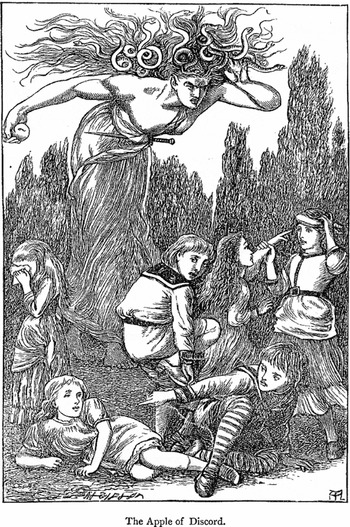
We find, for instance, the tale of Flora's birthday, in which she is made to play with other children, real and imaginary, that involve her in ghastly games such as “Hunt the Pincushion,” a game that instructs children to “select the smallest and weakest player” and chase her around with pins (336). The story vividly recounts a community built on antagonism, in which “play” repeatedly refers to situations of absurd violence, but violence seemingly oriented around the claustrophobic interchangeability between the children (the story frequently refers to a mass of “ugly faces” to describe them). The uncanny marker of difference – an “apple of discord” that the children “tossed. . . to and fro as if it had been a pretty plaything” – suggests a non-pedagogic void around gendered distinction that the Aunt cryptically alludes to in an aside: “[What apple, Aunt? – The Apple of Discord, Clara, which is the famous apple your brothers would know all about, and you may ask them some day. Now I go on]” (328). The apple of discord's origins in Greek mythology involves a dispute between Hera, Athena, and Aphrodite that eventually led to the Trojan War. Here Rossetti has carefully redirected this mythological symbol of thinly-veiled carnal strife to the volatile relationships between children.
The accompanying illustration by Hughes portrays the children cowering under a monstrous, Medusa-like figure, who holds an apple in one hand and a dagger at her waist (Figure 11). This illustration links the apple of discord to two other intersecting references: the apple of carnal knowledge plucked by Eve in the Biblical story of Genesis, and the mythical form of the femme fatale. Both situate femininity at the uneasy border of violence and rebellion, rather than redemption and purity. Interestingly enough, it is Flora's “brothers” who “would know all about” a signifier of the “discord” at the heart of gendered difference (328). Here Rossetti displaces the non-knowledge surrounding the marker between masculinity and femininity onto a violent children's game between siblings.
Arthur Hughes, “The Apple of Discord,” illustration from Christina Rossetti's Speaking Likenesses (London: Macmillan, 1874). University of Michigan Library.

The struggle to distinguish oneself, then, in a world of seemingly endless torment prompts Flora to ask: “Was this the end of her birthday? Was she eight years old at last only for this?” (330). Rossetti offers no clear lesson, religious or not, for her girl-protagonist here. Instead, Flora finds herself entering a dark world of fantasy after she knocks on the door of a yew tree and is ushered into “a large and lofty apartment, very handsomely furnished” (332). This world then transforms into a pastiche of elements from the Alice books, where Flora notes that “the only uncomfortable point in the room, that is, as to furniture, was that both ceiling and walls were lined throughout with looking-glasses: but at first this did not strike Flora as any disadvantage; indeed she thought it quite delightful, and took a long look at her little self full length” (332). Not only do these looking-glasses reflect one's image to infinity, they seem also to spiral outward and generate a separate multiplicity, since Flora finds that she is in a room “full of boys and girls, older and younger, big and little” (333). Rossetti literalizes the thoughts and subsequent fears of Carroll's Alice by seating the children at “tables like telescope tables; only they expanded and contracted of themselves without extra pieces, and seemed to study everybody's convenience” (333). These boys and girls “stared hard” “with so many eyes upon her” (333), a kind of alienated mass produced by the multiple looking-glasses. The many hostile boys and girls of Rossetti's anti-Wonderland reorganize difference to an extreme, such that when Flora's terrifying other, the “Birthday Queen,” finally speaks, the Aunt asks: “[Who was it? Was it a boy or a girl?]” (333).
Not content to have her protagonist confront a merely conventional idea of self-image, Rossetti suggests that Flora's “speaking likenesses” approach each other to infinite degrees of closeness:
The birthday Queen, reflected over and over again in five hundred mirrors, looked frightful, I do assure you: and for one minute I am sorry to say that Flora's fifty million-fold face appeared flushed and angry too; but she soon tried to smile good-humouredly and succeeded, though she could not manage to feel very merry.
[But Aunt, how came she to have fifty million faces? I don't understand—Because in such a number of mirrors there were not merely simple reflections, but reflections of reflections, and so on and on and on, over and over again, Maude: don't you see?]. (334)
These endlessly reflected children rehearse the earlier games of Flora's party, except in crueler and more violent ways. Violence and pleasure occupy the same, necessary space in this fantasy world, and as the games continue, the narrative resembles less of a moral lesson and more of an aesthetic exercise in testing the extreme bounds of likeness. The last game follows a banquet in which Flora, starving, watches the other children consume a buffet of food. The children start to build glass houses that they “built from within” (339), enclosing themselves within their creations. While “a very gay effect indeed was produced. . . some houses glowed like masses of ruby, and others shone like enormous chrysolites or sapphires” (340), the reigning effect on a psychic level is clearly claustrophobia. Flora finds that “she was being built in with the Queen” (340), made not only to confront her terrifying likeness, but also to be housed with her in a kind of psychic prison. In this final moment before a child hurls a stone at the houses and a climactic scene of warfare ensues, the Aunt's earlier aside to “look at home” (338) for similar signs of violence re-emerges in a literal and uncanny context.
In the third “winter story” of Speaking Likenesses, Maggie, an orphan, must deliver some Christmas tapers for her grandmother, Dame Margaret. A descendant of Charles Perrault's Red Riding-Hood, Maggie traverses a sinister wood populated by all manner of fearsome elements. In Rossetti's story, however, what troubles Maggie in the woods resembles monstrous “likenesses” of her isolation (children not unlike those from Flora's dream world), hunger (a figure named the “Mouth Boy”), and desire for rest (fantastic creatures named “Sleepers in the Wood”). And in the vein of Speaking Likenesses’ previous tales, Maggie appears drastically isolated in a world without a clear family structure. The Aunt tells us that Dame Margaret took home “little Maggie, her orphan granddaughter, when the child was left almost without kith or kin to care for her. These two were quite alone in the world: each was the other's only living relation, and they loved each other very dearly” (351).
Dame Margaret operates a shop, and Maggie ventures into a forest to deliver the goods to a doctor on the other side of the village. Though she “set off on her journey with a jump and a run,” (352), Maggie's adventure begins with an aggressive fall on winter ice. The Aunt addresses this in her usual tone of nonchalance, noting that “whether her brain got damaged by the blow, or how else it may have been, I know not; I only know that the thwack seemed in one moment to fill the atmosphere around her with sparks, flames and flashes of lightning; and that from this identical point of time commenced her marvelous adventures” (352). Maggie's imagination subsequently produces a different kind of sociality in her fantasy world. As she journeys into the cold, a swarm of chanting, “monstrous” children surround her, seducing her into their game and making her forget her “fatal promise” to deliver her goods (354). For Maggie, her lack of “kith and kin” means she has to imagine these children, and as the narrator reminds us, “we must bear in mind that Maggie had no playfellows at home” (354). Later, Maggie runs into a group of “sleepers” resting around a fire, and the Aunt remarks: “Do you know, children, what would most likely have happened to Maggie if she had yielded to drowsiness and slept out there in the cold?. . . Most likely she would never have woke again. And then there would have been an abrupt end to my story” (356). The narrator suggests that the stakes here are much greater than the moral lesson of denying one's desires, or as Julia Briggs argues, the redeeming force of a “spiritual journey” (212).
The most striking likeness in the story is the Mouth Boy, who ostensibly reflects Maggie's hunger and desire to eat the chocolate from her basket of goods she is delivering. The Aunt asks: “Or was it a real boy? He had indeed arms, legs, a head, like ordinary people, but his face exhibited only one feature, and that was a wide mouth. He had no eyes; so how he came to know that Maggie and a basket were standing in his way I cannot say” (356). The gendered dynamic of this moment seems quite clear: thus far the story's focus on these feminine “small heroines” (in Rossetti's own words) shifts to a grotesque boy figure, himself a likeness of Maggie, but also an important marker of difference (qtd. in Kooistra 129). Hughes's illustration additionally reveals a portly boy with exaggerated lips and sharp teeth, holding his arms out to her (Figure 12). Not only is this boy of the opposite sex, he is also impotent and incomplete, since he is notably missing his eyes (and can thus be read as metaphorically castrated). Maggie's “appetite” therefore generates a stilted form of desire, refusing clear gendered opposition in favor of this frightening physical asymmetry. This is an interesting disjunction that, in many ways, recalls the Lacanian account of such asymmetry as the bedrock of sexual difference. Jacqueline Rose glosses Lacan in her introduction to Feminine Sexuality: “sexuality belongs in this area of instability played out in the register of demand and desire, each sex coming to stand, mythically and exclusively, for that which could satisfy and complete the other” (Lacan, Mitchell, and Rose 33). In her only confrontation with the opposite sex in this story, Maggie can only experience the loss of any such myth of completeness through gendered opposition. Maggie's desires, culminating in this projection of the Mouth Boy, ultimately refract the failure of clear forms of gendered opposition or complementarity and their replacement with an uncanny aesthetic of likeness.
Arthur Hughes, “Mouth Boy,” illustration from Christina Rossetti's Speaking Likenesses (London: Macmillan, 1874). University of Michigan Library.

In parsing out the manner by which “Mouth Boy” – both text and image – is in dialogue with the question of gendered self-recognition, it is useful to remember the older etymology of the word “image” (eikôn in Greek) as “semblance or likeness.” Rather than denoting pure difference, “image,” as part of the general constellation of terms falling under representation, draws out difference from similitude, rather than separating them altogether (Cassin et al. 478). The dialectics of Rossetti's illustrated narrative work similarly: in the vein of Adorno's concern with non-identity, or the way in which “objects do not go into their concepts without leaving a remainder” (5), girlhood's gendered self-recognition implies an impossible desire for either complete mimesis or clear-cut difference that always leaves something unresolved. Difference in the fantasy worlds of this particular story operates as the excess of likeness, as it is Maggie's own desires, for example, that project minimal but threatening forms of difference, rather than any functional form of gender complementarity or opposition. The image of the Mouth Boy renders such structures profoundly disfigured, and profoundly flawed. Rossetti has therefore taken us beyond the limits of an easily defined binary of a girl and a boy, and by extension, femininity and masculinity. In Speaking Likenesses, the projection of otherness always fails to reinforce even an imagined wholeness through clear distinctions, and this psychic operation transgresses the limits of fantasy. Andrea J. Kaston's remarks on Hughes’ illustrations are helpful here: she reminds us that these images – most notably the grotesque figure of the Mouth Boy – render the world of “real” children more terrifying than any fictionalized monster (307). Maggie's determination eventually thwarts her likenesses and causes them to evaporate, and to be sure, this is a happier ending to her story than that of Flora's. Her ostensible success, however, is ultimately far less memorable than the perverse activity of girlhood perpetually discovering that projected differences are really forms of likeness. These likenesses, furthermore, can never reflect a preexisting idea of what girlhood and femininity should be. Ultimately, Maggie inhabits a world in which predictable forms of differentiation remain impossible.
2. “Like Two”: Counting Difference in “Goblin Market”
Speaking Likenesses’ near-exhaustive negotiation of the horizontal sphere of likeness allows us to revisit Rossetti's most canonical poem, “Goblin Market,” from a different perspective. The poem narrates the encounter between the near-homonymic sisters, Lizzie and Laura, and the goblin men who sell fruits with a “shrill repeated cry” of “Come buy, come buy” (The Complete Poems 6). As countless readers will recall, Laura is successfully lured by the goblins and eats their fruit, withering away until Lizzie, who “could not bear / To watch her sister's cankerous care / Yet not to share” (13) offers herself to the goblins who “coaxed and fought her / Bullied and besought her” (16). Lizzie's violent sacrifice leads to a “life out of death” (19) for Laura who “kissed and kissed and kissed her” (18), and eventually to the seeming restoration of order at the poem's conclusion. The rhetoric of “Goblin Market” remains memorable largely because of the faux naivety implicated in these three, four, and five beat lines that expand and contract. Further, the stresses more often than not render the meter irregular, and therefore the poem appears, in parts, to be somewhat randomized. These and other prosodic features have tempted readers to think that the poem might be more suited for the nursery than for the adult reader. Yet it is clear that “Goblin Market”’s whimsical prosody allows us to focus on points where it does organize itself: usually in structures of parallelism, listing and inventory, and finally, through simile, all of which draw attention to patterns of likeness on a figural level that might otherwise escape notice. For Victorian readers, the poem was on the whole, found to be aesthetically redeeming – “most purely and completely a work of art,” – though finally, a bit dark (British Quarterly Review 230–31). In the twentieth century this rather shadowy undertow became the dominant frame through which “Goblin Market” has been viewed: largely as an allegory of sexual corruption and fallenness. This reading is not difficult to grasp given the cycle of temptation, death, and redemption that the poem invites us to see on a surface level. Rossetti's involvement with Anglican sisterhoods has further provided scholars like D'Amico, Mary Arseneau, and Jill Rappoport with an intriguing context for this perspective: along with her equally devoted older sister, Rossetti was an associate of St Mary Magdalene's Penitentiary at Highgate, which worked to rescue women branded “fallen” by the norms of Victorian society. Jan Marsh for instance, notes the parallels between “Goblin Market” and a religious parable from the Englishwomen's Journal in 1857 about a “penitent who falls ill from distress of mind” after eating a forbidden apple (242). Other suggestive approaches implicate the economics of the market alongside the economics of desire in the poem, reading sisterly sacrifice as a particular kind of gift economy that pushes against the goblins’ more modernized consumer culture.Footnote 3
Despite “Goblin Market”’s seemingly endless allegorical offerings then, most analyses have glossed over the poem's central relationship – that of sisterhood – in favor of seemingly larger questions, and therefore overlooked the poem's basic formal reliance on likeness to produce a form of difference that resists enfolding by a given context.Footnote 4 Janet Casey, for instance, astutely notes: “Goblin Market celebrates a dynamism – a ‘sisterhood’ – between polarities, and allows Laura and Lizzie to embody this interdependence in both narrative and metaphoric terms” (66). But she also posits an ideal of “completeness” and “wholeness” in the poem that sisterhood encompasses, a term that flattens a less than universal oneness we find at the end of the work (75).
One of the ways in which the poem begins to sidestep entrenched notions of individualism and completeness is by a very simple mathematical formalism. In other words, it is not difficult to grasp that the poem counts: it places emphasis immediately on “ones” and “twos” in order to distinguish the goblins from the sisters. Early verses describe each goblin as follows:
The sisters, meanwhile, seem to represent an intimate twoness:
This distinction between ones and twos, however, is not as polarized as the poem would lead us to believe. By its conclusion, oneness falls on the side of the sisters, and we find that the deceptively simple twoness of their sororal relationality has effectively un-duplicated itself. The resulting oneness of sisterly femininity decouples from the primacy of a totalizing One. Indeed, the much-discussed conclusion to the poem, in which the girls have transformed into wives and mothers, demonstrates a form of singularity that not only distinguishes itself from the particularized oneness of the goblin men, as I will discuss here, but also depends on their twoness to exist:
Here, the poem shows us quite clearly that likeness cannot be mimesis, or in Jean Luc Nancy's words, that “the like is not the same (le semblable n'est pas le pareil)” (The Inoperative Community 33). My choice of Nancy here is quite deliberate, as I want to foreground the move the poem makes to a tenuous form of community that is no longer wed to a petrified notion of the solitary individual, or the isolated one. Rather, we have moved from the “onenesss” of the goblin men, which is particularized, discrete, and only operates on a descriptive level, to the “oneness” ascribed to the sisters that involves action and possibility (“to cheer one,” “to fetch one,” “to lift one”). The decisive shift in the poem from “like two” to “one” negates erotic complementarity produced through gender binaries. This is because the likeness between Lizzie and Laura has led to a form of individual distinction that bears little relation to the forms of difference that previously carved out and defined the sisters’ apparent sameness.
Helena Michie, who has looked at sisterly difference in her reading of Rossetti's lyrics, notably invokes these ones and twos to suggest that “Goblin Market” moves from the twoness of sisterly intimacy to the oneness of sexual knowledge. According to Michie, Victorian texts exhibit a form of “sororophobia”: the simultaneous desire for and aversion to the representation of sisters. Such literary works “frequently enrich and complicate feminist notions of sisterhood, as they undermine our most dearly cherished tropes of female unity” (Sororophobia 21). Michie quite aptly suggests that “Goblin Market” “is perhaps more accurately also a poem about sexual difference” (Sororophobia 33). Michie, however, goes further by drawing attention to a complex dichotomy in the poem between domestic sameness, the “undifferentiation” of the state of virginity that Lizzie, the “good sister” operates in, and the goblin men's trade in difference, or more precisely, the individuation produced by sexual knowledge and sexual difference. Yet aligning difference, or “ones” – a term that is distinctly non-homogenous in the poem – exclusively with the goblin men, and sameness, or “twos” with the domestic safety of the sororal, does not adequately capture the poem's ultimate emphasis on a oneness that escapes both of these categorical distinctions.
In what follows, I analyze the ways in which “Goblin Market” navigates various forms of difference – economic, sexual, and aesthetic, all of which scholars have studied in some detail – as means for examining seemingly hard and fast distinctions between masculinity and femininity. To be sure, the gendered distinction between goblin men on the one hand, and Lizzie and Laura on the other hand, has been the main binary through which critics have sought to understand this poem. It is clear from the onset that the goblins represent some form of racialized masculinity. They are “merchant men” (7) and animal-like: “the cat-face purr'd / The rat-paced spoke a word” (8). Lizzie and Laura, of course, represent the only recognizable femininity in the poem (although they do allude to their deceased friend Jeannie). What remains absent from the conclusion of this work is an affirmation of a form of femininity by or within these gendered polarities. The feminine ones we find in the poem's conclusion arises unexpectedly from an uncanny likeness that characterizes sisterhood. This sisterhood runs against the grain of Michie's claim that “sisterhood, like the Oedipus complex, is fundamentally family drama” (Sororophobia 20). Rather, “Goblin Market” takes great pains to distinguish sisterhood from the container of the patriarchal family and explore its potential as a generative structure in its own right.
Sisterhood here stands in a relationship of complete alterity to precisely those vertical lines of kinship that a simplified reading of the Oedipus complex might suggest. No sooner have we read the opening lines that we realize that parents, lineage, and history are absent from “Goblin Market,” since the poem begins by notably representing “maids” and “goblins” in a shared form of generality, one that suggests no point of origin for either: “Morning and evening / Maids heard the goblin cry: ‘Come buy our orchard fruits, Come buy, come buy’” (5). While “maids and goblins” might certainly refer to a gendered distinction, “morning and evening” only connote cyclicality, without patrilineal or generational history. Further, the sisters Lizzie and Laura bear no relation to anyone but each other. When we first hear of their individual names, they appear isolated from any clear context:
Lizzie veiled her blushes:
By stark contrast, the goblin men demonstrate a clear form of fraternity that preserves their differences through the familial bond of “brothers”:
The goblins here represent an order predicated on replication that is seemingly endless. Therefore, distinction between the goblins on the order of the “one” is also blatantly non-distinctive, slipping easily into the mass of “they” and the inclusive “voice and stir.” The goblins, then, possess an individuality that only represents a part of a whole: their difference belies universal sameness.
The sisters, however, initiate the reverse movement in the poem, in which seeming likeness becomes the vehicle for difference:
They lay down in their curtained bed:
Despite their differing approaches to the Goblin men, (Lizzie plugs her ears to their cries, while Laura goes to meet them) here Lizzie and Laura are framed by the poem as commensurable; they are yoked together by the rhythm of this stanza and the rhetorical logic of simile. The poem seems to affirm a state of perfect complementarity between the women, as do the illustrations from Dante Gabriel Rossetti that accompanied the poem's original printing. Yet these few lines, unlike the majority of the poem, do not rhyme: the anaphora of “like two” substitutes for the propelling force of rhyme to carry the lines forward, making these words striking both formally and thematically. These lines also frame the intimacy between the sisters through a series of images that, upon closer inspection, reveals subtle distinctions: the mirroring that occurs through Laura and Lizzie's pairing is refracted through related kinds of particularity: colonial (as in the “two wands of ivory”), phallic (suggested by the wands “tipped with gold”), and economic (as we can see through the words “ivory and gold”). Unlike Dorothy Mermin's claim that the poem “shows women testing the allurements of male sexuality and exploring the imaginative world that male eroticism has created” (117), male eroticism cannot seem to generate anything but sameness, while sororal likeness functions to produce imaginative difference through simile.
The point becomes even clearer when we hear about Jeannie, a third, spectral friend figure of the sisters, who “took their [the goblins’] gifts both choice and many, / Ate their fruits and wore their flowers” (14). Jeannie represents Lizzie's cautionary tale to Laura, since she “fell with the first snow” after eating goblin fruit and “While to this day no grass will grow / Where she lies low” (14). As a third figure, Jeannie subsequently haunts any kind of perfect dualism between Lizzie and Laura. But she also haunts complementarity between the goblin men and sisterly femininity, such that she forecloses generative possibility in the poem out of sexual difference. Jeannie's story shadows the later, more violent demonstration in the poem of sexual opposition, that of Lizzie's symbolic rape at the hands of the goblins. In this later scene, Lizzie, wary of her sister's condition, proposes an exchange to the goblins: “‘Good folk,’ said Lizzie, / Mindful of Jeannie: / ‘Give me much and many:’— / Held out her apron, / Tossed them her penny” (365-367). While much has been made of Lizzie's knowledge of the market, compared to Laura's lack of exchangeable coins (Laura gives the goblins a lock of her hair instead), on a much simpler level, both the market and the goblins’ violence traffic in the clear oppositions between sameness and difference.
In other words, objectification, either through economic or sexual means, requires a suppression of likeness in favor of clear othering, and the goblin men only operate in terms of these binary classifications. Thus they tell Lizzie that “Such fruits as these / No man can carry; / Half their bloom would fly, / Half their dew would dry, / Half their flavour would pass by” (15). The goblins’ logic of the “half,” the logic of classification and opposition, can easily slide into violence, as the poem suggests when Lizzie's encounter with the goblins culminates in the form of a rape: the goblins “hugged her and kissed her: / Squeezed and caressed her,” then “held her hands and squeezed their fruits / Against her mouth to make her eat” (14–15). As scholars have noted, because her sacrifice produces an antidote that then saves Laura and brings the ailing sister a “life out of a death,” this moment conflates erotic imagery with the distinctly Christ-like vision of redemption. But Lizzie's sacrifice to the ultimate expression of the violence of gendered opposition – rape – also nullifies the force of this difference in the poem. Lizzie's endurance of the goblin men amounts to gender confusion. She alternately inhabits a phallic position, one “like a rock of blue-veined stone,” and Christ-like strength: “like a lily in a flood.” The similes proliferate again when Laura drinks from the “hungry mouth” of her sister:
It is of course no accident that simile, rather than metaphor, flourishes at this crucial moment of resurrection, because unlike the latter, simile reinforces likeness without sliding into vertical forms of sameness. Similes cannot express discernible identities or opposites, but they preserve a form of minimal difference in the figural act of announcing similarity. Erik Gray writes that these similes eclipse Laura's individuality because each rhetorical figure is “impoverishing”; Rossetti consequently “seems to be admitting her own incapacity to discover a single sufficient likeness” (293). Yet can we confidently assess Rossetti's similes in a strict economy of likeness and difference, one handed down by a largely masculine lyric tradition (of which Petrarch, Milton, and Shelley are notable representatives), an economy that “Goblin Market” itself purports to unravel? The diminishment of clear likeness suggests a desirable incompleteness, a rhetorical pleasure we have encountered already in “The Lowest Room.” In my reading, the space of minimal difference between Lizzie and Laura in these proliferating similes produces a new kind of life – precarious and impossible to quantify – out of the death of gendered opposition. The poem thus begins to theorize sexual difference along different lines than goblin men and maids, relocating it to the space between sisters.
In the final lines, the poem glances toward a future in which the sisters move from “maidens” to “wives” and finally “mother-hearts”:
Critics have long puzzled over the fact that no men remain at the end of this poem besides the memory of the goblins’ grotesque masculinity; further, the sisters’ claim to motherhood seems oddly devoid of any patrilineal authority. The conclusion continues with an even stranger shift in tone:
This conclusion to “Goblin Market,” framed by the cheery motto, “there is no friend like a sister,” has raised considerable critical attention regarding Rossetti's seemingly straightforward support of a domestic sororal world unconcerned with sexual knowledge. However, according to the poem, femininity does not signify in any meaningful way through the norms of kinship we associate with this division between knowledge and innocence, sameness and difference, and masculinity and femininity. The sisterly “ones” that conclude the poem strike an utterly different note from the “ones” of cat-faced and rat-paced goblins. This form of oneness, as I have noted before, transcends description to evoke potential, and since there are effectively no other relations in “Goblin Market” that persist besides sisterhood, this notion of oneness can only carve out difference through the peculiar form of likeness that sororal relationships – or the difference between two “ones” – produces. Further, when we read the final lines out loud, the phrase “to lift one” invokes the shadow of “like two”: the preposition “to” – with its implications of moving forward, is ghosted by the numeric energy of “two,” the number. The conclusion of the poem thus affirms a singularity that draws from the complicated realm of sisterhood rather than the final, secure image of mothers and children, or the oppositional relation between goblin men and women. In effect, the poem's representation of a distinctly feminine singularity is one of accession to a space between the possible and the impossible: in its final lines, femininity can operate freely in a landscape that has neutralized certain forms of difference that result in stringent dualisms, but has its origins in a likeness that is ultimately irreproducible.
In “Sibling Logic, Or, Antigone Again,” Engelstein makes a claim for “a logic of differential degrees of likeness [that] provides the foundation for less confrontational formulations of belonging, identity, and agency” (40). Looking closely at Rossetti's concern with likeness reveals a charged set of ideas around femininity and subjectivity, one that appears confrontational at best, violent at worst. Yet both Speaking Likenesses and “Goblin Market” suggest that likeness offers a much richer, more nuanced terrain on which to carve out an idea of feminine selfhood, one that defies many of the vectors of difference to which Rossetti herself was subjected to on the Victorian literary market. The starkness by which these works resist defining femininity and individuality along recognizable lines also reorients us to new logics of gendered difference that may be partial and laterally organized, a much-needed shift in critical perspective in our contemporary moment.