Implications
The adrenocortical axis, the main stress-responsive neuroendocrine system, is strongly influenced by genetic factors, as shown here with the cortisol response to ACTH in pigs. This response will be used to select animals with a stronger stress response and study the consequences on production and robustness traits.
Introduction
Adrenal hormones, essential for survival, play important roles in metabolism regulation, immunity, reproduction, water and salt balance and various brain functions, as well as in stress responses. A hyperactive or hyper-reactive hypothalamic–pituitary–adrenocortical (HPA) axis has an unfavorable effect on production traits such as growth rate and feed efficiency (Hennessy and Jackson, Reference Hennessy and Jackson1987) or body composition with an increased lipids/proteins ratio (Foury et al., Reference Foury, Devillers, Sanchez, Griffon, Le Roy and Mormede2005 and Reference Foury, Geverink, Gil, Gispert, Hortos, Furnols, Carrion, Blott, Plastow and Mormede2007). A few studies established a positive relationship between HPA axis activity and robustness traits such as newborn survival, heat tolerance and resistance to diseases (see Mormede et al., Reference Mormede, Foury, Terenina and Knap2011b and Mormede and Terenina, Reference Mormede and Terenina2012, for review). It has been shown in several species that the HPA axis activity has been largely reduced during the domestication process (e.g. Weiler et al., Reference Weiler, Claus, Schnoebelen-Combes and Louveau1998 in pigs) and more recently by selection for production traits (Foury et al., Reference Foury, Tribout, Bazin, Billon, Bouffaud, Gogué, Bidanel and Mormede2009). This decrease in adrenocortical axis activity may partly explain the compromised robustness that coincides with over-focused genetic improvement of production traits in farm animals. The large individual variation in HPA axis activity and reactivity, and the importance of genetic factors are well documented (Kadarmideen and Janss, Reference Kadarmideen and Janss2007; Mormede et al., Reference Mormede, Foury, Barat, Corcuff, Terenina, Marissal-Arvy and Moisan2011a). We have therefore hypothesized that genetic selection for a more active HPA axis activity could improve robustness (Mormede et al., Reference Mormede, Foury, Terenina and Knap2011b; Mormede and Terenina, Reference Mormede and Terenina2012).
The adrenal sensitivity to ACTH is an important factor regulating cortisol production. In pigs as in humans, the cortisol response to ACTH was shown to differ largely among individuals but to be stable through time (Hennessy et al., Reference Hennessy, Stelmasiak, Johnston, Jackson and Outch1988) and extensive functional exploration showed that a large part of the variability in the cortisol response to ACTH is due to differential sensitivity of the adrenal gland to ACTH (Hennessy, Reference Hennessy1986; Zhang et al., Reference Zhang, Hennessy and Cranwell1990). Although the cortisol response to ACTH can be influenced by the life history of the animals, the role of genetic factors is shown by differences between genetic stocks in pigs (Desautes et al., Reference Desautes, Bidanel and Mormede1997) and several other species (see Mormede and Terenina, Reference Mormede and Terenina2012 for review). Selected lines of chickens could be established on the basis of their corticosterone response to ACTH (Edens and Siegel, Reference Edens and Siegel1975). Therefore, the adrenal response to ACTH could be an efficient phenotype for a genetic selection of a more active HPA axis.
The aim of this study was to estimate the genetic variability of cortisol secretion in response to ACTH stimulation in pigs. In the same samples were also measured the levels of several endocrine parameters related to HPA axis: corticosteroid-binding globulin (CBG), as a regulator of blood cortisol concentration (Moisan, Reference Moisan2010 and Reference Moisan2013), glucose and IGF-I as representatives of metabolic action of cortisol (Mazziotti and Giustina, Reference Mazziotti and Giustina2013), and haptoglobin for inflammatory processes (Heegaard et al., Reference Heegaard, Stockmarr, Piñeiro, Carpintero, Lampreave, Campbell, Eckersall, Toussaint, Gruys and Sorensen2011).
Material and methods
All animal experiments were conducted according to the INRA Quality Reference System, and to relevant French (Directive 87/148, Ministère de l’Agriculture et de la Pêche) and international (Directive 2010/63/EU, European Community) legislation. They adhered to protocols approved by Région Aquitaine Veterinary Services (approval ID: 33 00681).
Animals
A total of 30 Large White sows bred in an INRA experimental farm were inseminated each once with semen from 30 Large White boars. This design was chosen to obtain a G0 generation with a maximal genetic diversity for divergent selection based on the cortisol response to ACTH. A total of 298 intact male and female piglets were weaned at the age of 4 weeks and studied at 6 weeks, in four successive experimental batches. They received food and water ad libitum. Starter diet (18.6% protein and 10.8 MJ/kg net energy (NE) on a dry matter basis) was given during the last week before and the first 2 weeks after weaning and weaner diet (17.5% protein and 10.0 MJ/kg NE) was given from the 2nd week after weaning on. All piglets were weighed at birth and at weaning.
Experimental protocol
Experiments were done in the morning (0800 to 1200 h). An initial blood sample was collected in tubes with sodium heparin (Vacutainer®, Becton-Dickinson, Le Pont de Claix, France) by direct puncture from the jugular vein, the piglets being maintained on their back by light restraint. The procedure does not take more than 30 s after catching the animal in the pen. Piglets were then injected in the neck muscles with mammalian ACTH(1–24) (Immediate Synacten; Novartis, Rueil-Malmaison, France) at the dose of 250 μg/animal and put back in their pen. A second blood sample was collected 1 h after ACTH injection. The blood samples were centrifuged and plasma frozen at −80°C until assay. The dose of ACTH was chosen to be maximally stimulating the adrenal cortex. The time for blood collection after ACTH injection (1 h) corresponds to the peak of the response (Hennessy et al., Reference Hennessy, Stelmasiak, Johnston, Jackson and Outch1988).
Biological assays
Plasma total cortisol was measured using a specific direct radio immunoassay (RIA) (GammaCoatTM Cortisol; DiaSorin, Antony, France). The CBG capacity to bind cortisol was measured by radiocompetitive binding after concanavallin A – sepharose extraction as described (Pugeat et al., Reference Pugeat, Chrousos, Nisula, Loriaux, Brandon and Lipsett1984; Ousova et al., Reference Ousova, Guyonnet-Duperat, Iannuccelli, Bidanel, Milan, Genet, Llamas, Yerle, Gellin, Chardon, Emptoz-Bonneton, Pugeat, Mormede and Moisan2004). Glucose was measured by spectrophotometry with the glucose oxidase technique. The plasma concentration of haptoglobin was measured using a colorimetric method and haptoglobin assay kit based on binding of haptoglobin to hemoglobin (Tridelta Ltd, Maynooth, Co. Kildare, Ireland). Plasma IGF-I concentration was measured using a double-antibody RIA (Louveau and Bonneau, Reference Louveau and Bonneau1996) after an acid–ethanol extraction. CBG, haptoglobin and IGF-I concentrations were measured in basal blood samples only.
Statistical analyses
Normality of distribution was analyzed with the Shapiro and Wilk test. Despite significant departures from normality, all biological variables except glucose levels were transformed to their logarithmic scores. A linear model (GLM procedure; SAS Institute Inc., Cary, NC, USA) was used to study the fixed effects of batch and sex. Birth and weaning weights were also tested as covariates in two different models. In addition, the Pearson correlations were estimated between variables and both birth and weaning weights, after correction for batch and sex effects. Residual Pearson correlations among variables, after correction for batch effect and birth or weaning weight, were calculated. Correlations were estimated with the CORR procedure (SAS) and compared between males and females with the Fisher’s z transformation. Data are given as arithmetic means±SD. Significance threshold was set at P<0.05.
Genetic parameters were estimated using restricted maximum likelihood methodology applied to a multiple trait animal model, with the VCE6 software (Neumaier and Groeneveld, Reference Neumaier and Groeneveld1998). The model of analysis included the effect of batch and sex, and animal additive effect as a random effect. Random effect of litter was estimated. The part of variance estimated for this effect was low thus litter effect was removed from the final analysis. Pedigree, up to six generations of ancestors for both sires and dams, included a total of 1556 animals. Owing to lack of precision for genetic parameter estimation, only results for cortisol and CBG are reported here.
Results
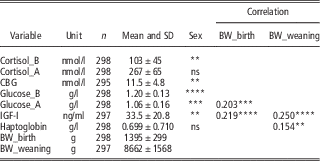
Descriptive statistics are given in Table 1 and Pearson correlations by sex in Table 2.
Descriptive statistics

CBG=corticosteroid-binding globulin.
Variables: the letter B refers to basal and A to post-ACTH values.
Correlation coefficient of variables corrected for fixed effects (batch and sex) with BW at birth and weaning.
ns=P>0.05, **P<0.01, ***P<0.001, ****P<0.0001.
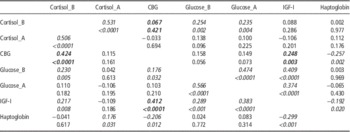
Phenotypic correlations among variables

CBG=corticosteroid-binding globulin.
Variables: the letter B refers to basal and A to post-ACTH values.
Pearson correlation coefficients on the first line and P values on the second line. Females (n=146 to 148) over and males (n=149 to 150) under the diagonal. Significant correlations in italics; coefficients of correlation significantly different between males and females in boldface. These parameters were computed after correction for significant fixed effects, batch for all variables, BW at weaning for haptoglobin and BW at birth for glucose_A and IGF-I.
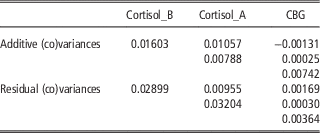
As expected, plasma cortisol concentration increased after ACTH injection (2.8-fold, P<0.0001). The effect of sex (P=0.02) and the sex×treatment interaction (P<0.05) were also significant. Although basal levels were slightly higher in males (107±44 v. 98±46 nmol/l; P<0.01), the sex difference was no longer significant after ACTH injection (267±65 nmol/l). Plasma cortisol concentrations measured before and after ACTH were highly correlated (r=0.539; P<0.0001), with no sex difference (Table 2 and Figure 1). CBG binding capacity measured in basal samples was higher in females (12.7±5.6 v. 10.5±4.0 nmol/l, P<0.01). Basal cortisol levels were positively correlated with CBG in males (r=0.424, P<0.0001) but not in females (r=0.067), and these correlation coefficients were different (P=0.001). The correlation between CBG and cortisol levels after ACTH was not significant (r=0.028). There was no significant correlation of cortisol and CBG binding capacity with BW at birth or at weaning (Table 1). The values of the variance and covariance components for cortisol and CBG levels are given in Table 3. A high heritability value was estimated for cortisol concentration after ACTH (h 2=0.68±0.12), as compared with basal cortisol levels (h 2=0.36±0.09) and CBG binding capacity (h 2=0.19±0.06). A high genetic correlation was also estimated between basal and post-ACTH cortisol levels (r g =0.94±0.04).
Observed associations between plasma cortisol concentrations measured before and after ACTH injection (a; white dots, females and black dots, males), and between plasma cortisol concentration and CBG binding activity in females (b) and males (c; black dots, before and white dots, after ACTH injection). All axes in log scale. CBG=corticosteroid-binding globulin.

Additive and residual variances (on the diagonal) and covariances (above the diagonal) for cortisol before and after ACTH injection and CBG levels

CBG=corticosteroid-binding globulin.
Plasma glucose concentrations were higher in males (1.26±0.11 v. 1.15±0.13 g/l; P<0.0001) and decreased after ACTH injection (1.10±0.16 g/l in males v. 1.03±0.16 g/l in females, P<0.0001) with a significant sex×treatment interaction (P<0.005, the decrease being less important in females). Pre- and post-ACTH glucose concentrations were highly correlated with no significant sex difference (r=0.489, P<0.0001). Cortisol and glucose concentrations were moderately correlated in basal conditions (r=0.240, P<0.0001) but not after ACTH (r=0.032).
Plasma IGF-I concentrations were higher in males (39.3±21.7 v. 28.3±19.6 ng/ml) and positively correlated with circulating glucose concentrations before (r=0.327, P<0.0001) and after (r=0.321, P<0.0001) ACTH injection, with no significant sex difference. IGF-I concentrations showed a high correlation with CBG binding capacity with a strong sexual dimorphism (P=0.001), the correlation being much higher in males (r=0.412, P<0.0001) than in females (r=0.248, P=0.003). IGF-I concentrations were also correlated with BWs at birth and weaning (Table 1). Haptoglobin concentrations were not influenced by sex and BW at birth but positively correlated with BW at weaning (Tables 1 and 2); they were negatively correlated with CBG binding capacity (r=−0.236, P<0.0001).
Discussion
In the present family study in Large White pigs, we show that the heritability of post-ACTH cortisol concentration in plasma is very high, and the strong genetic correlation between basal and post-ACTH plasma cortisol concentrations shows that the same genetic factors regulate individual differences in cortisol concentrations in these two states. Various results have been obtained on the relationships between CBG binding activity and plasma cortisol levels in pigs, depending on the genetic type (Geverink et al., Reference Geverink, Foury, Plastow, Gil, Gispert, Hortos, Furnols, Gort and Moisan2006). We show here that sex is an important factor to consider and that post-ACTH cortisol levels are independent from CBG. Other factors like age should also be studied more thoroughly (Roberts et al., Reference Roberts, Kattesh, Baumbach, Gillespie, Godkin, Schneider and Saxton2003).
We show here that IGF-I levels measured at 6 weeks are correlated with BW at birth and at weaning. In humans, both fetal and neonatal IGF-I circulating levels are correlated with BW (Lassarre et al., Reference Lassarre, Hardouin, Daffos, Forestier, Frankenne and Binoux1991). The reciprocal interactions between the GH/IGF and the HPA axis are well documented (Neggers and van der Lely, Reference Neggers and van der Lely2011; Mazziotti and Giustina, Reference Mazziotti and Giustina2013), including during fetal development (Braun et al., Reference Braun, Challis, Newnham and Sloboda2013), but little is known on the relationships between cortisol and IGF-I in juvenile pigs. We show here that CBG may play an important role in these relationships with a strong sex difference. Indeed, the correlation between cortisol and IGF-I concentrations was significant in basal samples in males only (just like the correlation between cortisol concentrations and CBG binding activity) and the correlation between IGF-I concentrations and CBG binding activity was much higher than with cortisol concentrations in males than in females. Sex differences in HPA axis activity and response to stress has been documented previously in juvenile pigs (e.g. Cooper et al., Reference Cooper, Roberts, Kattesh and Kojima2009) but their biological mechanisms have not been thoroughly investigated. It is worth noting, however, that several authors have shown that the HPA axis activity was shaped by prenatal influences in a sex-specific manner (Kanitz et al., Reference Kanitz, Otten and Tuchscherer2006; Kranendonck et al., Reference Kranendonk, Mulder, Parvizi and Taverne2008; Collier et al., Reference Collier, Williams, Carroll, Welsh and Laurenz2011; Óvilo et al., Reference Óvilo, González-Bulnes, Benítez, Ayuso, Barbero, Pérez-Solana, Barragan, Astiz, Fernandez and López-Bote2014).
Both cortisol and IGF-I are important components of glucose metabolism regulation (Dallman et al., Reference Dallman, Akana, Pecoraro, Warne, la Fleur and Foster2007; Berryman et al., Reference Berryman, Glad, List and Johannsson2013). Several clinical studies have shown a relationship between CBG levels or CBG gene polymorphisms and metabolic parameters related to insulin resistance syndrome (e.g. Fernandez-Real et al., Reference Fernandez-Real, Pugeat, Grasa, Broch, Vendrell, Brun and Ricart2002; Barat et al., Reference Barat, Duclos, Gatta, Roger, Mormede and Moisan2005; Richard et al., Reference Richard, Fernandez-Real, Lopez-Bermejo, Ricart, Dechaud, Pugeat and Moisan2009), and the CBG locus has been shown to be linked with metabolic traits in several studies (see Moisan, Reference Moisan2010 and Mormede et al., 2011a and Reference Mormede, Foury, Terenina and Knap2011b for review), including in pigs (Desautes et al., Reference Desautes, Bidanel, Milan, Iannuccelli, Amigues, Bourgeois, Caritez, Renard, Chevalet and Mormede2002; Ousova et al., Reference Ousova, Guyonnet-Duperat, Iannuccelli, Bidanel, Milan, Genet, Llamas, Yerle, Gellin, Chardon, Emptoz-Bonneton, Pugeat, Mormede and Moisan2004), and we showed previously that CBG was a better predictor of carcass composition than cortisol levels (Ousova et al., Reference Ousova, Guyonnet-Duperat, Iannuccelli, Bidanel, Milan, Genet, Llamas, Yerle, Gellin, Chardon, Emptoz-Bonneton, Pugeat, Mormede and Moisan2004). In most cases, the physiological effects of CBG have been interpreted as resulting from the influence of CBG on the level and bioavailability of cortisol (Perogamvros et al., Reference Perogamvros, Ray and Trainer2012; Moisan, Reference Moisan2013). The precise interplay between these different parameters and the mechanisms of CBG influence on metabolic parameters remains to be explored.
Haptoglobin is a positive acute phase protein, which levels increase in response to pro-inflammatory situations such as microbial challenges (Heegaard et al., Reference Heegaard, Stockmarr, Piñeiro, Carpintero, Lampreave, Campbell, Eckersall, Toussaint, Gruys and Sorensen2011) and poor environmental sanitary conditions (Pastorelli et al., Reference Pastorelli, Le Floc’h, Merlot, Meunier-Salaün, van Milgen and Montagne2012). Apart from immune stimuli, haptoglobin can also be released in response to other stressors like hot ambient temperature (Heo et al., Reference Heo, Kattesh, Roberts, Morrow, Dailey and Saxton2005), transport (Piñeiro et al., Reference Piñeiro, Piñeiro, Carpintero, Morales, Campbell, Eckersall, Toussaint and Lampreave2007b) or unpredictable feeding practices (Piñeiro et al., Reference Piñeiro, Piñeiro, Morales, Carpintero, Campbell, Eckersall, Toussaint, Alava and Lampreave2007a). In the present study, haptoglobin levels were unrelated to cortisol levels. Interestingly, they were negatively correlated with CBG levels. It is noteworthy that CBG, which is a protein of hepatic origin like positive and negative acute phase proteins, displays reduced concentrations in cases of inflammatory conditions (Garrel, Reference Garrel1996), and thus varies in the opposite way to haptoglobin. These opposite variations have also been observed in pigs, in inflammatory (Carroll et al., Reference Carroll, Gaines, Spencer, Allee, Kattesh, Roberts and Zannelli2003) as well as in other stressful conditions (Heo et al., Reference Heo, Kattesh, Roberts, Morrow, Dailey and Saxton2005; Piñeiro et al., Reference Piñeiro, Piñeiro, Morales, Carpintero, Campbell, Eckersall, Toussaint, Alava and Lampreave2007a and Reference Piñeiro, Piñeiro, Carpintero, Morales, Campbell, Eckersall, Toussaint and Lampreave2007b).
Conclusion
The plasma cortisol response to ACTH in juvenile pigs is highly heritable and could therefore be used to select animals with a more active HPA axis, independently from CBG binding capacity. Although plasma CBG binding capacity is correlated only with basal cortisol levels in males, it plays a critical role in the network between the HPA axis and its metabolic (IGF-I, glucose) and innate immune system (haptoglobin) targets. A system genetics approach will be necessary to understand the relationships between these metabolic endocrine components and production traits in pigs as well as the metabolic syndrome in humans.
Acknowledgments
The authors wish to thank C. Tréfeu and F. Thomas for their expert technical assistance in IGF-I and haptoglobin assays, and M.-P. Moisan for her comments on a previous version of the manuscript. This work was supported by INRA, including a special grant from the Animal Genetics Division.