

Introduction
Evolutionary psychiatry (EP) applies principles of evolutionary biology to understanding mental disorders and human vulnerability to psychopathology (Abed and St John-Smith Reference Abed and St John-Smith2022; Nesse Reference Nesse2023). Although evolutionary perspectives have increasingly influenced research and theory, their integration into psychiatric education remains limited. Calls to incorporate evolutionary biology into medical and psychiatric training have persisted for more than two decades, with proponents arguing that evolutionary thinking provides an important framework for integrating biological, psychological, developmental, and social approaches to illness (Abed et al. Reference Abed, Ayton, St John-Smith, Swanepoel and Tracy2019; Nesse et al. Reference Nesse, Bergstrom, Ellison, Flier, Gluckman, Govindaraju, Niethammer, Omenn, Perlman, Schwartz, Thomas, Stearns and Valle2010). Despite this, evolutionary medicine and psychiatry remain inconsistently represented within medical curricula, with teaching often fragmented, optional, or dependent on individual faculty expertise (Brar et al. Reference Brar, Ní Mhuircheartaigh, Poobalan, McFarland and O’Connell2026).
In psychiatry, the case for integration may be particularly strong because the discipline already operates across biological, psychological, and social explanatory levels. Evolutionary psychiatry adds an additional “ultimate” level of analysis by addressing why vulnerabilities to mental disorders exist, complementing proximate accounts of neurobiology and symptomatology (Abed and St John-Smith Reference Abed and St John-Smith2022; Nesse Reference Nesse2023; Swanepoel et al. Reference Swanepoel, Abed, Brar, St John-Smith and O’Connell2025). Evolutionary perspectives have been applied to conditions including anxiety, depression, and neurodevelopmental disorders, emphasising concepts such as adaptive function, environmental mismatch, and life-history trade-offs (Crespi Reference Crespi2016; Hagen Reference Hagen2011; Marks and Nesse Reference Marks and Nesse1994). Explanatory models in psychiatry also influence stigma and treatment attitudes. Although biological explanations may reduce blame, they can increase essentialist beliefs and pessimism regarding recovery (Kvaale et al. Reference Kvaale, Haslam and Gottdiener2013; Lebowitz and Ahn Reference Lebowitz and Ahn2014; Loughman and Haslam Reference Loughman and Haslam2018). By contrast, evolutionary explanations emphasise function and context rather than defect alone and have been associated with less stigmatising and more optimistic clinician attitudes towards anxiety, disclosure, help-seeking, and recovery (Hunt et al. Reference Hunt, Carpenter, Brar, Katiyar, Al-Shawaf, Gillett, Chaudhary, Boyle, Butler, Das, de Blaquiere, Eaton, Golchinheydari, Griffin, Ibrahim, Ionita, Jalal, Kamran, Kelly, O’Connell, Pye, Rollie, Savva, Saxena, Titova-Chaudhry, Vartukapteine, Verma, Walker and Jaeggi2026).
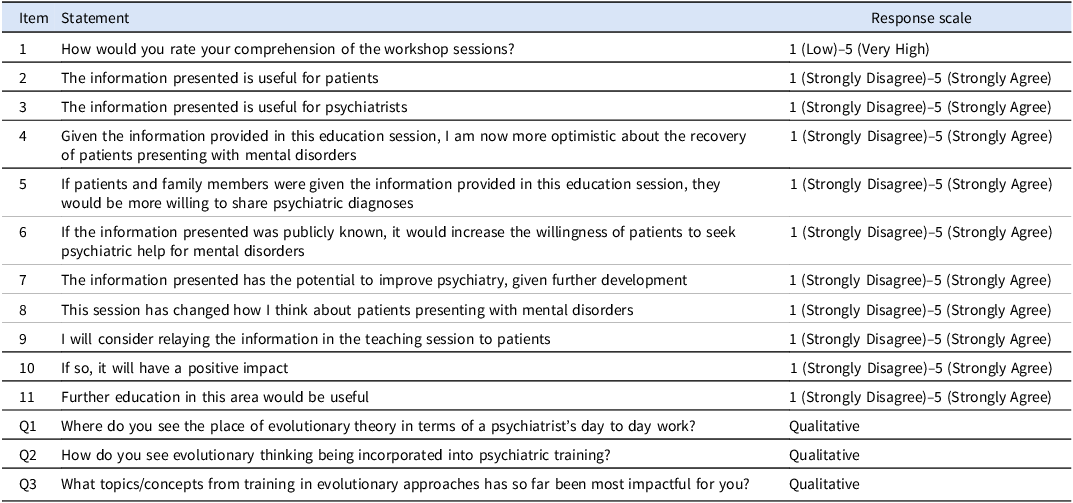
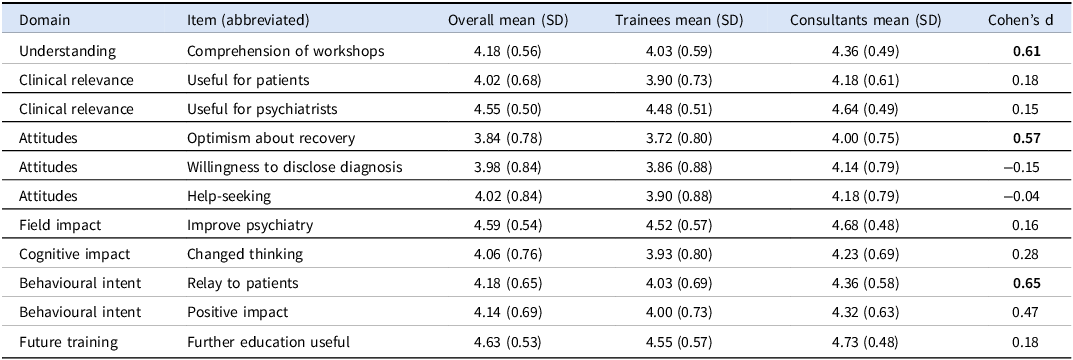
We conducted a mixed-methods educational evaluation examining clinicians’ responses to a series of workshops on EP delivered to psychiatric trainees and consultants. Fifty-one participants (29 trainees and 22 consultants) completed an anonymous post-workshop questionnaire comprising 11 Likert-scale items assessing understanding, perceived clinical utility, attitudinal impact, and intended application, alongside open-ended qualitative questions (Table 1). Overall responses were highly positive, with mean ratings ranging from 4.02 to 4.63 across domains. Participants reported strong perceived understanding of evolutionary concepts, high clinical relevance, and intention to apply ideas in practice. Consultants rated several items slightly more favourably than trainees, with moderate effect sizes observed for comprehension (d = 0.61) and intention to relay concepts to patients (d = 0.65) (Table 2).
Questionnaires

Table 1. Long description
A table summarizing the results of a questionnaire on workshops about evolutionary psychiatry for psychiatric trainees and consultants. The table has 11 rows and 3 columns. The columns are labeled Item, Statement, and Response scale. The rows list the items, statements, and response scales from the questionnaire. Row 1: Item 1, Statement How would you rate your comprehension of the workshop sessions?, Response scale 1 (Low)–5 (Very High). Row 2: Item 2, Statement The information presented is useful for patients, Response scale 1 (Strongly Disagree)–5 (Strongly Agree). Row 3: Item 3, Statement The information presented is useful for psychiatrists, Response scale 1 (Strongly Disagree)–5 (Strongly Agree). Row 4: Item 4, Statement Given the information provided in this education session, I am now more optimistic about the recovery of patients presenting with mental disorders, Response scale 1 (Strongly Disagree)–5 (Strongly Agree). Row 5: Item 5, Statement If patients and family members were given the information provided in this education session, they would be more willing to share psychiatric diagnoses, Response scale 1 (Strongly Disagree)–5 (Strongly Agree). Row 6: Item 6, Statement If the information presented was publicly known, it would increase the willingness of patients to seek psychiatric help for mental disorders, Response scale 1 (Strongly Disagree)–5 (Strongly Agree). Row 7: Item 7, Statement The information presented has the potential to improve psychiatry, given further development, Response scale 1 (Strongly Disagree)–5 (Strongly Agree). Row 8: Item 8, Statement This session has changed how I think about patients presenting with mental disorders, Response scale 1 (Strongly Disagree)–5 (Strongly Agree). Row 9: Item 9, Statement I will consider relaying the information in the teaching session to patients, Response scale 1 (Strongly Disagree)–5 (Strongly Agree). Row 10: Item 10, Statement If so, it will have a positive impact, Response scale 1 (Strongly Disagree)–5 (Strongly Agree). Row 11: Item 11, Statement Further education in this area would be useful, Response scale 1 (Strongly Disagree)–5 (Strongly Agree). Row Q1: Item Q1, Statement Where do you see the place of evolutionary theory in terms of a psychiatrist’s day to day work?, Response scale Qualitative. Row Q2: Item Q2, Statement How do you see evolutionary thinking being incorporated into psychiatric training?, Response scale Qualitative. Row Q3: Item Q3, Statement What topics/concepts from training in evolutionary approaches has so far been most impactful for you?, Response scale Qualitative.
Participant responses to workshop evaluation items (Likert scale 1–5)

Table 2. Long description
A table with 11 rows and 6 columns comparing participant responses to workshop evaluation items across different domains. The columns are labeled Domain, Item (abbreviated), Overall mean (SD), Trainees mean (SD), Consultants mean (SD), and Cohen’s d. The rows list different items evaluated in the workshop, such as Comprehension of workshops, Useful for patients, Useful for psychiatrists, Optimism about recovery, Willingness to disclose diagnosis, Help-seeking, Improve psychiatry, Changed thinking, Relay to patients, Positive impact, and Further education useful. Each row provides the overall mean and standard deviation, trainees mean and standard deviation, consultants mean and standard deviation, and Cohen’s d value for the respective item.
Values are mean (standard deviation). All items were rated on a 5-point Likert scale, with higher scores indicating greater agreement or more positive evaluation. Cohen’s d represents the standardised difference between consultants and trainees (positive values indicate higher scores among consultants).
Cohen’s d represents the standardised mean difference between consultants and trainees, with values of approximately 0.2, 0.5, and 0.8 indicating small, medium, and large effect sizes, respectively.
Qualitative responses suggested that participants particularly valued EP as a framework for integrating proximate and ultimate explanations of psychopathology. Clinicians described evolutionary perspectives as helping contextualise symptoms within broader adaptive or functional frameworks rather than viewing distress solely through disease-based models. Anxiety and mood symptoms were frequently reframed as potentially adaptive defence responses that may become dysregulated under certain conditions. This aligns with longstanding evolutionary models of anxiety and emotional disorders, including concepts such as evolved defence mechanisms (Abed and St John-Smith Reference Abed and St John-Smith2022; Nesse Reference Nesse2023) and Wakefield’s “harmful dysfunction” account of psychiatric disorder (Wakefield Reference Wakefield1992). Participants also described evolutionary explanations as clinically useful in psychoeducation and communication with patients, particularly for reducing shame, normalising symptoms, and improving engagement. These findings are broadly consistent with emerging literature suggesting that evolutionary explanations may be perceived more positively than reductionistic biological explanations in some psychiatric contexts (Brar et al. Reference Brar, Swanepoel, O’Connell and McFarland2025; Hunt et al. Reference Hunt, Carpenter, Brar, Katiyar, Al-Shawaf, Gillett, Chaudhary, Boyle, Butler, Das, de Blaquiere, Eaton, Golchinheydari, Griffin, Ibrahim, Ionita, Jalal, Kamran, Kelly, O’Connell, Pye, Rollie, Savva, Saxena, Titova-Chaudhry, Vartukapteine, Verma, Walker and Jaeggi2026).
Importantly, the present findings suggest that the major barrier to integration of EP may not be attitudinal resistance, but rather a translation gap between conceptual endorsement and practical application. Educational studies in evolutionary medicine repeatedly demonstrate that learners and clinicians are generally receptive to evolutionary ideas while simultaneously reporting limited exposure, low confidence, and insufficient curricular integration (Brar et al. Reference Brar, Ní Mhuircheartaigh, Poobalan, McFarland and O’Connell2026; Hidaka et al. Reference Hidaka, Asghar, Aktipis, Nesse, Wolpaw, Skursky, Bennett, Beyrouty and Schwartz2015). Prior work has also identified lack of faculty expertise and pressures within already crowded curricula as major obstacles to implementation (Downie Reference Downie2004; Nesse and Schiffman Reference Nesse and Schiffman2003). At the same time, advocates of evolutionary medicine have argued that evolutionary reasoning may facilitate higher-order integrative thinking in medical education by helping learners connect disparate concepts across biological and psychosocial domains (Bolnick et al. Reference Bolnick, Steinel, Reynolds and Bolnick2017; Graves et al. Reference Graves, Reiber, Thanukos, Hurtado and Wolpaw2016; Grunspan et al. Reference Grunspan, Moeller, Nesse and Brownell2019).
The present findings support this interpretation. Participants did not primarily describe EP as a source of novel treatments or discrete intervention protocols. Rather, they described it as a clinically useful framework for contextualisation, formulation, psychoeducation, and conceptual integration. This distinction is important. Many influential psychiatric frameworks contribute value not through direct treatment selection alone, but through improving explanatory coherence, communication, and reflective understanding of patients’ experiences (Engel Reference Engel1977; Hunt et al. Reference Hunt, St-John Smith and Abed2023; Kendler Reference Kendler2008). EP may currently be most clinically valuable in this integrative capacity.
The findings also align with broader educational efforts within evolutionary medicine. Consensus work has increasingly sought to define core principles and learning objectives for integrating evolutionary thinking into medical curricula (Grunspan et al. Reference Grunspan, Nesse, Barnes and Brownell2018). Educational initiatives have included undergraduate teaching modules (Abbott and Abboud Reference Abbott and Abboud2006; Rühli et al. Reference Rühli, Häusler, Saniotis and Henneberg2016), specialty-specific proposals, digital learning tools (Furtwängler et al. Reference Furtwängler, Baumann, Majander, Wilkin, Tomoum, Rühli, Jaeggi, Eppenberger, Bender and Schuenemann2023), and assessment frameworks aimed at improving conceptual understanding and application (Misheva et al. Reference Misheva, Nesse, Grunspan and Brownell2023). Yet psychiatry-specific educational evaluation remains limited (Baptista et al. Reference Baptista, Aldana, Angeles and Delgado2012; Brar et al. Reference Brar, Swanepoel, O’Connell and McFarland2025). Our findings suggest that even brief workshop-based interventions may improve clinicians’ confidence in engaging with evolutionary concepts and increase perceived clinical applicability.
Several limitations should be acknowledged. The sample was modest and self-selected, outcomes were based primarily on self-report, and the cross-sectional design precludes conclusions regarding sustained behavioural change or clinical outcomes. Nonetheless, the consistency of responses across trainees and consultants suggests that evolutionary perspectives may be both intellectually accessible and clinically meaningful across different stages of psychiatric training.
Evolutionary psychiatry remains a marginal component of most psychiatric curricula despite growing theoretical and educational interest. Brief workshop-based teaching appears feasible, acceptable, and associated with perceived improvements in clinical understanding and reasoning. Further work should examine longitudinal educational outcomes, integration into formal curricula, and whether evolutionary frameworks can meaningfully influence formulation, psychoeducation, and patient care within routine psychiatric practice.
Funding statement
This research received no specific grant from any funding agency, commercial or not-for-profit sectors.
Competing interests
The authors declare no competing interests.
Ethical standards
The authors assert that all procedures contributing to this work comply with the ethical standards of the relevant national and institutional committee on human experimentation and with the Helsinki Declaration of 1975, as revised in 2008.
The study protocol was approved by the ethics committee of University of Limerick.