Introduction
Maintaining competitive advantage in the current dynamic environment is becoming increasingly difficult for many companies. The rapid development of technologies, globalisation and increased staff diversity are examples of challenges that require organisations to learn better and faster to survive (Peroune, Reference Peroune2009) and innovate (Men, Fong, Luo, Zhong, & Huo, Reference Men, Fong, Luo, Zhong and Huo2019; Shamim, Gang, & Yu, Reference Shamim, Gang and Yu2016). Changes in the environment have also transformed the nature of work. In many cases, it is necessary for employees to think, plan, decide and not to perform routine tasks (Jackson, Hitt, & DeNisi, Reference Jackson, Hitt and DeNisi2003). Therefore, creative and flexible staff members who are willing to learn more are required (Agolla, Reference Agolla, Petrillo, Cioffi and Felice2018; Land, Reference Land2016). All these factors lead to a more intensive focus on the aspects of people's competitive advantage.
Several new theoretical concepts are closely related to the described change and the understanding of the staff essence to competitiveness. One interesting concept is the knowledge-based view of a firm, according to which a company's ability to gain and maintain a competitive advantage in a highly competitive environment is based on employee knowledge and its use, creation and dissemination (Bock, Zmud, Kim, & Lee, Reference Bock, Zmud, Kim and Lee2005; Jackson, Hitt, & DeNisi, Reference Jackson, Hitt and DeNisi2003). The research focus has been on knowledge sharing among employees and its promotion, which appears to be critical (Crhová & Matošková, Reference Crhová and Matošková2019; Yuliansyah & Alvia, Reference Yuliansyah and Alvia2016).
Previous studies have already demonstrated a close relationship between firm innovativeness and employee knowledge sharing (Camelo-Ordaz, García-Cruz, Sousa-Ginel, & Valle-Cabrera, Reference Camelo-Ordaz, García-Cruz, Sousa-Ginel and Valle-Cabrera2011; Chiang, Han, & Chuang, Reference Chiang, Han and Chuang2011). The findings in them are similar: if employees share their knowledge with their colleagues, organisational innovativeness is higher. However, knowledge is a specific asset – it does not belong to the company but to the employees, implying that this knowledge can be lost at any time (Pasher & Ronen, Reference Pasher and Ronen2011). Additionally, knowledge sharing is considered part of ‘extra-role’ behaviour (Son, Cho, & Kang, Reference Son, Cho and Kang2017). Extra-role behaviour is not (1) predefined in the job description, (2) accounted for by formal reward systems and (3) a source of punitive consequences if employees do not comply (Dyne & LePine, Reference Dyne and LePine1998). Thus, knowledge sharing depends on an employee's willingness to share what they know and the others' willingness to learn and absorb new knowledge.
Previous research has recognised that using knowledge from human resource management (HRM) could be useful in knowledge management (Kianto, Sáenz, & Aramburu, Reference Kianto, Sáenz and Aramburu2017; Malik, Froese, & Sharma, Reference Malik, Froese and Sharma2020; Than, Le, & Le, Reference Than, Le and Le2023). An appropriate HRM setting can be vital to support and direct employee behaviour towards the creation, utilisation and sharing of knowledge (Camelo-Ordaz et al., Reference Camelo-Ordaz, García-Cruz, Sousa-Ginel and Valle-Cabrera2011; Jackson, Hitt, & DeNisi, Reference Jackson, Hitt and DeNisi2003). However, there is still a lack of empirical research on the relationship between HRM and knowledge sharing (Chiang, Han, & Chuang, Reference Chiang, Han and Chuang2011; Kim & Ko, Reference Kim and Ko2014; Than, Le, & Le, Reference Than, Le and Le2023). Of course, some studies have attempted to identify human practices that are important for knowledge sharing. However, most of them are only theoretical (e.g., Cabrera & Cabrera, Reference Cabrera and Cabrera2005; Matošková & Směšná, Reference Matošková and Směšná2017) or concentrate only on a single human practice and not on the entire setting of HRM (e.g., Lee & Ahn, Reference Lee and Ahn2007).
This study's objective is to contribute to a better understanding of the relationship between staff knowledge sharing and HRM. In this relationship, high-commitment HRM seems promising because this adjustment of human practices involves intensive work with human capital, supporting internal employee motivation and emotional commitment to the organisation. These factors may also be essential for knowledge sharing. Therefore, this study aims to examine whether high-commitment HRM supports the exchange of knowledge in an organisation.
The remainder of this paper is organised as follows. The first section reviews and analyses the relevant empirical literature on knowledge sharing and high-commitment HRM. In the next section, an empirical study is designed to validate the two proposed constructs, knowledge sharing in the organisation and high-commitment HRM, and test their relationship. The findings are then presented and discussed in terms of their academic and practical implications. Finally, the conclusions are presented.
Literature review
Knowledge and a knowledge-based view of the firm
Knowledge can be defined as a changing mix of experiences, values, contextual information and understanding of the nature of phenomena that provides a framework for evaluating and incorporating new experiences and information (Davenport & Prusak, Reference Davenport and Prusak1998). The basis of knowledge is information (Wang & Noe, Reference Wang and Noe2010). However, this is ‘processed’ in the human mind based on the individual's prior knowledge, experiences, values and mental models (Shin, Holden, & Schmidt, Reference Shin, Holden and Schmidt2001).
Knowledge is not all of the same kind. One of the critical distinctions between the different types of knowledge is transferability and the transfer mechanisms across people, space and time (Grant, Reference Grant1996). For example, Blackler (Reference Blackler1995) distinguished several types of knowledge: embrained (knowledge that is dependent on conceptual skills and cognitive abilities, called also ‘knowledge that’, ‘knowledge about’), embodied (action-oriented knowledge, called also ‘knowledge how’, ‘knowledge of acquaintance’), encultured (refers to the process of achieving shared understanding based on processes of socialization and acculturation), embedded (knowledge residing in an organization's taken-for-granted routines and interactions) and encoded (information conveyed by signs and symbols, e.g., in books, manuals, and codes of practice). However, a practice-based perspective suggests that all knowledge includes tacit dimensions. Therefore, it is impossible to completely disembody an individual's knowledge in an entirely explicit form (Hislop, Reference Hislop2013).
One theory that has put knowledge at the centre of research interest is the knowledge-based theory of the firm. This theory implies that work in today's companies is often non-repetitive, result-oriented and requires dealing with problems. Task fulfilment requires employees to exercise experience, intuition and imagination and involves continuous learning (Ras, Wild, Stahl, & Baudet, Reference Ras, Wild, Stahl and Baudet2017). Therefore, knowledge is an essential productive resource in terms of its strategic significance and its contribution to value-addition (Barão, de Vasconcelos, Rocha, & Pereira, Reference Barão, de Vasconcelos, Rocha and Pereira2017; Grant, Reference Grant1997). Consequently, the sustained competitive advantage of many organisations depends on well-qualified employees and their intellectual work. Therefore, such organisations employ experts who specialise in particular areas of knowledge, coordinate their efforts and, finally, integrate the specialised knowledge possessed by individuals to perform efficiently across markets (Grant, Reference Grant1996, Reference Grant1997). Additionally, many processes in current companies need the cooperation of several employees who contribute their particular expertise (Kock & Davison, Reference Kock and Davison2003), which would not be possible without knowledge sharing.
Knowledge sharing
There are more ways how to gain knowledge, but this paper focuses on the situation when an employee who has knowledge shares it with others. Bartol and Srivastava (Reference Bartol and Srivastava2002) and Davenport and Prusak (Reference Davenport and Prusak1998) define knowledge sharing as an exchange of relevant information, ideas, suggestions and expertise among staff members. Similarly, according to Wang and Noe (Reference Wang and Noe2010), knowledge sharing refers to providing information and know-how about a task to cooperate in problem-solving, developing ideas or implementing strategies and procedures. According to Ipe (Reference Ipe2003), knowledge sharing makes knowledge accessible to other people in the organisation voluntarily and transforms it to enable the receiver's understanding. Receivers can then absorb knowledge and use it for better performance (Camelo-Ordaz et al., Reference Camelo-Ordaz, García-Cruz, Sousa-Ginel and Valle-Cabrera2011; Savolainen, Reference Savolainen2017). What these definitions have in common is the fact that the knower attempts to express the knowledge, and thus it becomes de facto information, or a mixture of data in the case it does not make sense to the receiver (Leistner, Reference Leistner2010; Pathirage, Amaratunga, & Haigh, Reference Pathirage, Amaratunga and Haigh2007; Shin, Holden, & Schmidt, Reference Shin, Holden and Schmidt2001). At its core, then, knowledge sharing is about sharing information (Savolainen, Reference Savolainen2017) and communication (van den Hooff & de Ridder, Reference van den Hooff and de Ridder2004).
van den Hooff and de Ridder (Reference van den Hooff and de Ridder2004) point out that every knowledge-sharing process actually contains two related processes, namely bringing (or ‘donating’) knowledge and getting (or ‘collecting’ knowledge), and they can be influenced by different factors. Although this study registers the aforementioned fact, it mainly focuses on knowledge holders and knowledge donating, and in this sense, the term knowledge sharing is also used. In this sense, knowledge sharing can take the form of answering a question or providing advice or commentary (Almehmadi, Hepworth, & Maynard, Reference Almehmadi, Hepworth and Maynard2014).
Knowledge sharing among employees is essential for many companies for several reasons. It contributes to individual and organisational learning (Fong, Ooi, Tan, Lee, & Chong, Reference Fong, Ooi, Tan, Lee and Chong2011) because people gain knowledge more quickly and comfortably (Chiang, Han, & Chuang, Reference Chiang, Han and Chuang2011; Foss, Pedersen, Reinholt Fosgaard, & Stea, Reference Foss, Pedersen, Reinholt Fosgaard and Stea2015). Furthermore, it leads to higher organisational innovativeness (Azeem, Ahmed, Haider, & Sajjad, Reference Azeem, Ahmed, Haider and Sajjad2021; Camelo-Ordaz et al., Reference Camelo-Ordaz, García-Cruz, Sousa-Ginel and Valle-Cabrera2011) through process improvements (Chen, Chuang, & Chen, Reference Chen, Chuang and Chen2012; Fong et al., Reference Fong, Ooi, Tan, Lee and Chong2011), the promotion of creativity (Azeem et al., Reference Azeem, Ahmed, Haider and Sajjad2021; Men et al., Reference Men, Fong, Luo, Zhong and Huo2019), prompt reactions to changes in customer needs (Chen, Chuang, & Chen, Reference Chen, Chuang and Chen2012), better team coordination (Srivastava, Bartol, & Locke, Reference Srivastava, Bartol and Locke2006) and the development of better products (Fong et al., Reference Fong, Ooi, Tan, Lee and Chong2011), with faster availability in the target market (Riege, Reference Riege2005). Additionally, knowledge sharing leads to higher productivity (Foss et al., Reference Foss, Pedersen, Reinholt Fosgaard and Stea2015). According to Davenport and Prusak (Reference Davenport and Prusak1998), functional knowledge sharing also manifests itself as higher employee satisfaction or better staff cohesiveness. Additionally, knowledge sharing decreases the probability of wasting resources by repeating and solving the same problem (Jackson, Hitt, & DeNisi, Reference Jackson, Hitt and DeNisi2003). Thus, employees should not only retain knowledge in their minds but also share it with others, and knowledge sharing should become a natural part of their work (Benyahya & Matošková, Reference Benyahya and Matošková2021). Thus, cognition in which organisational and individual factors encourage employee knowledge sharing is valuable (Li, Liu, Shang, & Xi, Reference Li, Liu, Shang and Xi2014).
According to Haas and Hansen (Reference Haas and Hansen2007) and Bock et al. (Reference Bock, Zmud, Kim and Lee2005), knowledge sharing can be either direct or indirect. Direct knowledge sharing requires first-hand contact between the knowledge holder and knowledge receiver, whether in person or via telephone or e-mail. Matošková (Reference Matošková2020) claims that meetings seem to be vital and are welcomed by employees because they offer a rich, direct, formal and synchronous way of knowledge sharing. In contrast, indirect knowledge sharing is mediated via a knowledge database or documentation, where the knowledge is placed or stored by the knowledge holder and retrieved by the recipients when needed. Additionally, Crhová and Matošková (Reference Crhová and Matošková2019) suggest that ‘supportive knowledge sharing’, that is, the employee trying to help colleagues with their knowledge, belongs to the dimension of knowledge sharing. Finally, if the share of intellectual tasks related to the job position is high, knowledge dissemination is probably a common part of the work, even though it is not officially prescribed (Liao, Reference Liao2021). Based on these facts, this study hypothesizes that manifestations of knowledge sharing in an organization may include (a) capturing knowledge by the knower in a document or database, (b) direct transfer of information to others as an expected part of job duties, (c) participation in meetings and (d) voluntary knowledge donating to others to help them.
In general, knowledge sharing is voluntary and cannot be mandated by the management. This is simply because knowledge is created, stored and applied in the holder's mind (Dalkir, Reference Dalkir2011). Thus, managers do not have direct control over it. Knowledge sharing can only be supported and facilitated (Bock et al., Reference Bock, Zmud, Kim and Lee2005) through conscious work with employees and work conditions.
Drawing upon the ability–motivation–opportunity theory (Appelbaum, Bailey, Berg, & Kalleberg, Reference Appelbaum, Bailey, Berg and Kalleberg1999), employees need appropriate skills, knowledge and abilities, motivation and opportunities to share their knowledge. Thus, knowledge dissemination in the firm depends on the knowledge holders' awareness that they have valuable knowledge (Alavi & Leidner, Reference Alavi and Leidner2001; Vuori & Okkonen, Reference Vuori and Okkonen2012), their abilities to signal it to others, their willingness to share it (Hislop, Reference Hislop2013) and the appropriate conditions to do so. These elements are interrelated and must exist (Mat, Wan Norhayati, Salleh, & Yusof, Reference Mat, Wan Norhayati, Salleh and Yusof2021). However, at least in part, all these conditions could be influenced by HRM. Therefore, HRM may be vital for knowledge sharing (Kim & Ko, Reference Kim and Ko2014; Malik, Froese, & Sharma, Reference Malik, Froese and Sharma2020; Qamari, Dewayani, & Ferdinand, Reference Qamari, Dewayani and Ferdinand2019). However, there is still a lack of research on the antecedents that influence employee knowledge sharing (Than, Le, & Le, Reference Than, Le and Le2023).
HRM
The primary organisational mean to shape and develop employees' skills, attitudes and behaviour is HRM (Than, Le, & Le, Reference Than, Le and Le2023). HRM can be defined as a system of mutually connected practices, procedures and processes that focus on the support and management of organisational human capital (Jafari, Akhavan, & Nourizadeh, Reference Jafari, Akhavan and Nourizadeh2013) to achieve strategic objectives (Fong et al., Reference Fong, Ooi, Tan, Lee and Chong2011; Michaelis, Wagner, & Schweizer, Reference Michaelis, Wagner and Schweizer2015). Concurrently, human capital is understood as a combination of staff knowledge, skills, abilities and ways of thinking (Bontis, Reference Bontis2001; Cabrera & Cabrera, Reference Cabrera and Cabrera2005; Hendriks & Sousa, Reference Hendriks and Sousa2013).
Derived from its definition, the core of HRM is a suitable setting of human resource (HR) practices. These could be explained as organisational activities that direct the management of human capital and ensure that it is used to fulfil organisational goals (Wright, McMahan, & McWilliams, Reference Wright, McMahan and McWilliams1994). In other words, HR practices develop employees' skills, knowledge, attitudes and motivation to employees behave in such a way that supports implementing a particular organisational strategy and achieving its goals (Bowen & Ostroff, Reference Bowen and Ostroff2004).
The employer communicates to employees via HR practices what employee behaviours are expected, supported and rewarded (Bowen & Ostroff, Reference Bowen and Ostroff2004). For these messages to have the intended effect on employees, they must, among other things, be internally consistent and not contradict each other (Bowen & Ostroff, Reference Bowen and Ostroff2004; Foss et al., Reference Foss, Pedersen, Reinholt Fosgaard and Stea2015; Hayton, Reference Hayton2003). For HR practices to influence human capital in the desired direction, they must work as a whole (Foss et al., Reference Foss, Pedersen, Reinholt Fosgaard and Stea2015).
Generally, two distinct ways are used to establish HR practices: low-cost and high-commitment (Chiang, Han, & Chuang, Reference Chiang, Han and Chuang2011). Firms that base their competitive advantage on low cost should choose the first variant because it focuses on cost minimisation (Hayton, Reference Hayton2003) and efficiency of activities (Chiang, Han, & Chuang, Reference Chiang, Han and Chuang2011) by enforcing employee compliance with specified rules and procedures and basing employee rewards on some measurable output criteria (Arthur, Reference Arthur1994). The second variant is preferred by organisations that need to be innovative to maintain their competitive advantage (Chiang, Han, & Chuang, Reference Chiang, Han and Chuang2011; Hayton, Reference Hayton2003). Its essence is the formation of a psychological link between the goals of the organisation and the goals of the employee (Arthur, Reference Arthur1994). Therefore, employees are significantly more involved in decision-making, and their development and socialization activities are more supported (Arthur, Reference Arthur1994).
Implementing high-commitment HR practices means that the organisation decides to invest in employees (Mostafa, Gould-Williams, & Bottomley, Reference Mostafa, Gould-Williams and Bottomley2015). Therefore, this HRM approach is expensive (Hayton, Reference Hayton2003). In contrast, high-commitment HR practices utilise employee knowledge, skills and abilities better (Prieto Pastor, Pérez Santana, & Martín Sierra, Reference Prieto Pastor, Pérez Santana and Martín Sierra2010) than low-cost ones. So, they support organisational flexibility and learning (Hayton, Reference Hayton2003).
Furthermore, as it involves less control than low-cost HR practices, it helps maintain employees' internal motivation (Foss et al., Reference Foss, Pedersen, Reinholt Fosgaard and Stea2015; Gagné, Reference Gagné2009). High-commitment HR practices are also useful for retaining top workers, as Kwon, Bae, and Lawler (Reference Kwon, Bae and Lawler2010) found that the affective organizational commitment of top workers is significantly more affected by these practices than that of other workers. Previous studies (see, e.g., Collins & Smith, Reference Collins and Smith2006) indicate that a suitable way of setting HR practices for knowledge dissemination in a firm could be high-commitment HRM.
High-commitment HR practices and their relationship to knowledge sharing in the organisation
High-commitment HR practices can be described as a set of distinct but interrelated HR practices that increase employee commitment towards the goals of the organisation as well as organisational performance. The core objective of high-commitment HRM is to intensify employee psychological bond to the organization (Boon & Kalshoven, Reference Boon and Kalshoven2014). Some authors have used different labels, such as high-involvement work systems, high-commitment work systems and high-performance HR practices (Michaelis, Wagner, & Schweizer, Reference Michaelis, Wagner and Schweizer2015), but the essence remains the same.
Social exchange theory (Blau, Reference Blau1964) suggests that people positively reciprocate when they are positively treated. As employees typically perceive high-commitment HR practices as an expression of the organisation's trust and appreciation of their work (Mostafa, Gould-Williams, & Bottomley, Reference Mostafa, Gould-Williams and Bottomley2015), they feel the need to return it, which positively influences their attitudes and thinking towards their employer and their behaviour. Thus, such practices can positively influence employee motivation (Whitener, Reference Whitener2001) and motivate employees' discretionary effort (Vazquez-Bustelo & Avella, Reference Vazquez-Bustelo and Avella2019). So, it is not surprising that high-commitment HR practices can lead to lower turnover, higher productivity, and better financial outcomes (Arthur, Reference Arthur1994; Michaelis, Wagner, & Schweizer, Reference Michaelis, Wagner and Schweizer2015). They also help in reducing deviant behaviours towards the organization (Mostafa, Boon, Abouarghoub, & Cai, Reference Mostafa, Boon, Abouarghoub and Cain.d.).
The positive impact of high-commitment HR practices on employee motivation is also important in relation to knowledge sharing. High-commitment HR practices are supposed to help overcome the natural reluctance to share what the individual knows (Camelo-Ordaz et al., Reference Camelo-Ordaz, García-Cruz, Sousa-Ginel and Valle-Cabrera2011). Additionally, they reinforce the qualities attributed to high-commitment culture (Xiao & Tsui, Reference Xiao and Tsui2007) and knowledge-sharing culture (Collins & Smith, Reference Collins and Smith2006; Marouf, Reference Marouf2016; Than, Le, & Le, Reference Than, Le and Le2023), such as trust, collaboration, open communication and peer pressure to invest high levels of effort. As there is still a lack of empirical evidence, this paper attempts to address it and clarify the influence of high-commitment HRM practices on knowledge sharing.
Particular high-commitment HR practices to facilitate intra-organisational knowledge sharing
There is no consensus on which high-involvement HR practices support knowledge sharing. However, it seems that (i) selective hiring; (ii) job design, considering internal motivation and employee autonomy; (iii) functional performance management; (iv) extensive training and development or (v) career management could be welcome (see, e.g., Matošková & Směšná, Reference Matošková and Směšná2017; Perello-Marin & Ribes-Giner, Reference Perello-Marin and Ribes-Giner2014).
The first promising HR practice to promote knowledge sharing is selective hiring. The selection focuses on predicting the best applicant who meets the job specifications, work group and company culture (Kianto, Sáenz, & Aramburu, Reference Kianto, Sáenz and Aramburu2017). It is advisable to select candidates whose knowledge, skills, attitudes and cultural and linguistic backgrounds fit the company's organisational culture and are compatible with the social norm that ‘sharing one's knowledge is natural’, as noted by Chen and Huang (Reference Chen and Huang2009), Camelo-Ordaz et al. (Reference Camelo-Ordaz, García-Cruz, Sousa-Ginel and Valle-Cabrera2011) and Perello-Marin and Ribes-Giner (Reference Perello-Marin and Ribes-Giner2014). Willingness to communicate (Camelo-Ordaz et al., Reference Camelo-Ordaz, García-Cruz, Sousa-Ginel and Valle-Cabrera2011), the ability to work in a team (Camelo-Ordaz et al., Reference Camelo-Ordaz, García-Cruz, Sousa-Ginel and Valle-Cabrera2011; Kianto, Sáenz, & Aramburu, Reference Kianto, Sáenz and Aramburu2017; López, Peón, & Ordás, Reference López, Peón and Ordás2006) and readiness for further learning (Leistner, Reference Leistner2010; López, Peón, & Ordás, Reference López, Peón and Ordás2006) are considered welcome characteristics in newcomers.
Another interesting HR practice concerning knowledge sharing is job design. Knowledge sharing is positively affected if a job is associated with a certain degree of autonomy (Hislop, Reference Hislop2013; Kaffashan Kakhki, Rajabi, Naji, AsemanDoreh, & Harati, Reference Kaffashan Kakhki, Rajabi, Naji, AsemanDoreh and Harati2020). Work should be interesting and challenging for employees (Hislop, Reference Hislop2013), and job tasks should be varied to promote intrinsic employee motivation (Foss et al., Reference Foss, Pedersen, Reinholt Fosgaard and Stea2015).
Performance management may be the third HR practice to increase knowledge sharing among employees. This is defined as the process through which managers verify the contribution of employees' activities and outputs to achieving organisational goals (Noe, Hollenbeck, Gerhart, & Wright, Reference Noe, Hollenbeck, Gerhart and Wright2011). Performance management involves several activities, such as setting evaluation criteria or giving feedback. Performance evaluation criteria are closely related to the setting of so-called social norms that can affect employee behaviour. Indeed, individuals are more likely to share knowledge if colleagues and supervisors expect and value such behaviour (Cabrera, Collins, & Salgado, Reference Cabrera, Collins and Salgado2006; Foss et al., Reference Foss, Pedersen, Reinholt Fosgaard and Stea2015; Gagné, Reference Gagné2009; van den Hooff & de Ridder, Reference van den Hooff and de Ridder2004). Thus, the set performance evaluation criteria should contain aspects related to knowledge sharing (Camelo-Ordaz et al., Reference Camelo-Ordaz, García-Cruz, Sousa-Ginel and Valle-Cabrera2011; Kianto, Sáenz, & Aramburu, Reference Kianto, Sáenz and Aramburu2017; Pham, Nguyen, & Nguyen, Reference Pham, Nguyen and Nguyen2015). Providing feedback through the performance appraisal framework helps identify gaps between performance and goals and inspires improvements (Kianto, Sáenz, & Aramburu, Reference Kianto, Sáenz and Aramburu2017). Being able to give feedback to one's supervisor communicates, among other things, that the organization cares about the opinions of subordinates, which can encourage employee commitment to the organization. Zhang and Liu (Reference Zhang and Liu2009) emphasise the importance of fairness in performance management.
Employee career management is the next HR practice that is vital for knowledge sharing. It provides opportunities for career advancement, ensuring a supply of talented employees to cater to the organisation's needs (Armstrong, Reference Armstrong2017). A well-designed career management system, especially the setup of succession system for key positions, can reduce the risk of knowledge loss and, in turn, facilitate knowledge sharing in the organisation (Cabrera & Cabrera, Reference Cabrera and Cabrera2005). Generally, career management contributes to better employee utilisation, promotes employee motivation, increases employee satisfaction and reduces the risk of employee turnover (Jackson, Hitt, & DeNisi, Reference Jackson, Hitt and DeNisi2003; Pasher & Ronen, Reference Pasher and Ronen2011). Furthermore, it enables employees to establish a more extensive network for knowledge sharing (Liu, Chow, Gong, & Wang, Reference Liu, Chow, Gong and Wang2019).
Finally, employee training and development may also significantly impact knowledge sharing (Manafi & Subramaniam, Reference Manafi and Subramaniam2015; Pham, Nguyen, & Nguyen, Reference Pham, Nguyen and Nguyen2015; Yakun, Reference Yakun2016). Employee training and development can be defined as an organisation's focused efforts to help employees acquire the knowledge, skills, abilities or behaviours required for their work and to apply these competencies in their job tasks (Noe et al., Reference Noe, Hollenbeck, Gerhart and Wright2011). Such activities positively influence not only employees' knowledge but also their skills and attitudes (Prieto Pastor, Pérez Santana, & Martín Sierra, Reference Prieto Pastor, Pérez Santana and Martín Sierra2010). Personalised training and development programmes indicate that the organisation invests in employees' future, improving their perception of being valued members of the organisation (Mostafa, Gould-Williams, & Bottomley, Reference Mostafa, Gould-Williams and Bottomley2015) and consequently generating a higher willingness to share their knowledge (Yu & Takahashi, Reference Yu and Takahashi2021). Employee training and development can also help overcome some barriers to knowledge sharing, such as a lack of motivation or low absorptive capacity in the knowledge recipient (Fong et al., Reference Fong, Ooi, Tan, Lee and Chong2011).
In summary, this study perceives high-involvement HR practices as a multidimensional factor, which could include at least aspects as follows: (a) selective hiring; (b) job design supporting (i) employee autonomy and (ii) offering internally motivating tasks; (c) functional performance management; (d) extensive training and development; (e) career management.
The conceptual model
Although some researchers have discussed the relationship between knowledge sharing and HRM, most previous studies have not empirically estimated the extent to which HRM positively affects knowledge exchange in the organisation. Following the line of thought developed in this section, and inspired by previous studies and the definitions of constructs, a research model was developed to address this lack of knowledge, as depicted in Figure 1. High-commitment HRM and knowledge sharing in the organisation were defined as higher-order constructs. This study was to validate four components of knowledge sharing in the organisation, namely (1) helping others with knowledge, (2) knowledge documentation, (3) working with knowledge as a part of the job and (4) the use of meetings. Next, the study was to confirm six components of high-commitment HRM, namely (1) selective hiring, (2) employee autonomy, (3) motivating work tasks, (4) performance management, (5) career management and (6) training and development. Finally, this study was to analyse the relationship between high-commitment HRM and knowledge sharing in the organisation. Considering that high-commitment HRM is supposed to contribute to knowledge sharing in the organisation, the following research hypothesis was formulated:
Hypothesis 1: High-commitment HRM positively influences knowledge sharing in the organisation.
Conceptual model. HC_HRM, high-commitment HRM.

Methods
Sample
Data were collected from the permanent workers employed by organisations with at least one worker. A total of 480 completed questionnaires were analysed. Of the participants, 62% were women, 49% had a university education, 33% had worked for the company for more than 10 years and 25% had worked for less than 2 years. Regarding the employer's size, 32% were small organisations with less than 50 employees, and 40% were large organisations employing more than 250 employees.
Measures
This study measured two constructs: knowledge sharing in the organisation and high-commitment HRM. Knowledge sharing in the organisation is defined as the degree to which an employee perceives that they share knowledge with other employees. High-commitment HRM is described as the degree to which an employee perceives that high-commitment HR practices are implemented in the given organisation. As Mat et al. (Reference Mat, Wan Norhayati, Salleh and Yusof2021) explain, most studies neglect employees' perceptions, but it is these perceptions that influence employee attitudes and job behaviour. Both constructs were measured using multiple items, derived from existing studies, and had an underlying factor structure.
First, the underlying factor structure of the 11 items of knowledge sharing in the organisation was examined. The measurement of knowledge sharing among employees involves four underlying variables: knowledge externalisation, working with knowledge, helping others with knowledge and frequency of meetings.
Then, the underlying factor structure of the 19 high-commitment HRM items was explored. This construct consists of six underlying variables: employee selection, work autonomy, motivation towards work tasks, performance evaluation, career management and development.
Procedure
A cross-sectional survey was designed. A self-report questionnaire was developed using items adapted from previous research (Cabrera & Cabrera, Reference Cabrera and Cabrera2005; Camelo-Ordaz et al., Reference Camelo-Ordaz, García-Cruz, Sousa-Ginel and Valle-Cabrera2011; Chen & Huang, Reference Chen and Huang2009; Collins & Smith, Reference Collins and Smith2006; Donate & Guadamillas, Reference Donate and Guadamillas2011; Foss et al., Reference Foss, Pedersen, Reinholt Fosgaard and Stea2015; Guo-bao, Reference Guo-bao2013; Hayton, Reference Hayton2003; Hislop, Reference Hislop2013; Jackson, Wall, Martin, & Davids, Reference Jackson, Wall, Martin and Davids1993; Kim & Ko, Reference Kim and Ko2014; López-Nicolás & Meroño-Cerdán, Reference López-Nicolás and Meroño-Cerdán2011; Parker, Reference Parker1998; Pham, Nguyen, & Nguyen, Reference Pham, Nguyen and Nguyen2015; Razmerita, Kirchner, & Nielsen, Reference Razmerita, Kirchner and Nielsen2016; Son, Cho, & Kang, Reference Son, Cho and Kang2017) and by transforming the definitions of constructs into a questionnaire design. Although not ideal, self-reports are used in organisational and management research very often to understand employee behaviour and attitudes (Donaldson & Grant-Vallone, Reference Donaldson and Grant-Vallone2002; Gupta & Beehr, Reference Gupta and Beehr1982; Podsakoff & Organ, Reference Podsakoff and Organ1986). Moreover, in the case of HR practices, how employees interpret them is more important than what was the intention behind their introduction (Boon & Kalshoven, Reference Boon and Kalshoven2014).
The questionnaire used a 5-point Likert scale, ranging from 1 (strongly disagree) to 5 (strongly agree) to obtain the reliability score values of the items. Only the items used to measure the frequency of meetings used a 6-point scale, ranging from 0 (not at all) to 6 (very often).
Information about the objectives and focus of the research and the consent form were presented at the beginning of the questionnaire. The consent form emphasised that the respondents' participation was voluntary and guaranteed secrecy, and no identifiable personal data were collected. The questionnaire was anonymous and self-administered.
The questionnaire was prepared in both electronic and paper forms. The announcement about the survey was made on the social networks Facebook and LinkedIn and a project website. Furthermore, university students were involved in questionnaire distribution – their help was voluntary, but they could gain extra credit if their efforts to contact potential participants were successful. At the end of the questionnaire, an ‘appreciation note’ was included to express gratitude for participation in the study, according to the recommendations of Messer and Dillman (Reference Messer and Dillman2011) to maximise the response rate.
All data were transformed into an electronic version and examined using IBM® SPSS® Statistics version 25 and IBM® SPSS® AMOS version 25. The missing value regression imputation of AMOS was performed for any missing values.
Data analysis
First, a generic model was developed for each construct. Then, the suitability of the secondary constructs, that is, knowledge sharing in the organisation and high-commitment HRM, was examined. After the previous step, second-order confirmatory factor analysis (CFA) techniques were employed on the hypothesised models, and convergent validity was explored. Convergent validity refers to the extent to which each item in a specific underlying construct shares a proportion of variance similar to other items in the same construct (Hair, Babin, Anderson, & Black, Reference Hair, Babin, Anderson and Black2018). According to Hair et al. (Reference Hair, Babin, Anderson and Black2018), the standard factor loading, average variance extracted (AVE) and construct reliability are included in the basic statistical methodology of setting convergent validity in structural equation modelling (SEM). The standardised factor loading signifies the relationship between variables. The AVE indicates the degree to which the items join the same construct. Construct reliability was employed to quantify the level to which an underlying construct's variable and its items were represented by SEM. Hair et al. (Reference Hair, Babin, Anderson and Black2018) suggest the following limits for the analysis: standard factor loading – .50, AVE – .50 and composite reliability – .60. In addition, model fit evaluation was used to examine whether the second-order CFA models fit the data (Kline, Reference Kline2010).
Second, a generic SEM was developed. The discriminant validity of both the secondary constructs was also evaluated. The discriminant validity measure is the level at which specific construct items vary based on their indicators (Sekaran & Bougie, Reference Sekaran and Bougie2016). As recommended by Fornell and Larcker (Reference Fornell and Larcker1981), discriminant validity was based on the AVE from the variables and examined whether a correlation existed with another variable. Finally, the model fit was examined. Certain indicators were used to verify the validity of the models: The goodness-of-fit index (GFI), adjusted goodness-of-fit index (AGFI), comparative fit index (CFI) and Tucker–Lewis index (TLI) must be greater than .09, and the root mean square error of approximation (RMSEA) must be less than .08 (ideally less than .05) to justify the model fit (Maydeu-Olivares & Forero, Reference Maydeu-Olivares, Forero, Peterson, Baker and McGaw2010; Wan, Reference Wan2012). This study also adopted Hoelter's critical N, which indicates whether the study's sample size is sufficient for the evaluation of model fit (Wan, Reference Wan2012). If Hoelter's critical N is estimated to be greater than 200, the study has an adequate sample size, and if it lies between 75 and 200, the sample size is acceptable (Wan, Reference Wan2012).
Several revisions were made by excluding items with low factor loading from the subscale and each latent construct and considering the suggested modification indices because the model did not fit the data set well, in line with Wan's (Reference Wan2012) recommendations.
Results
First, a second-order CFA was used to examine knowledge sharing in the organisation and high-commitment HRM scales.
CFA analysis of knowledge sharing in the organisation
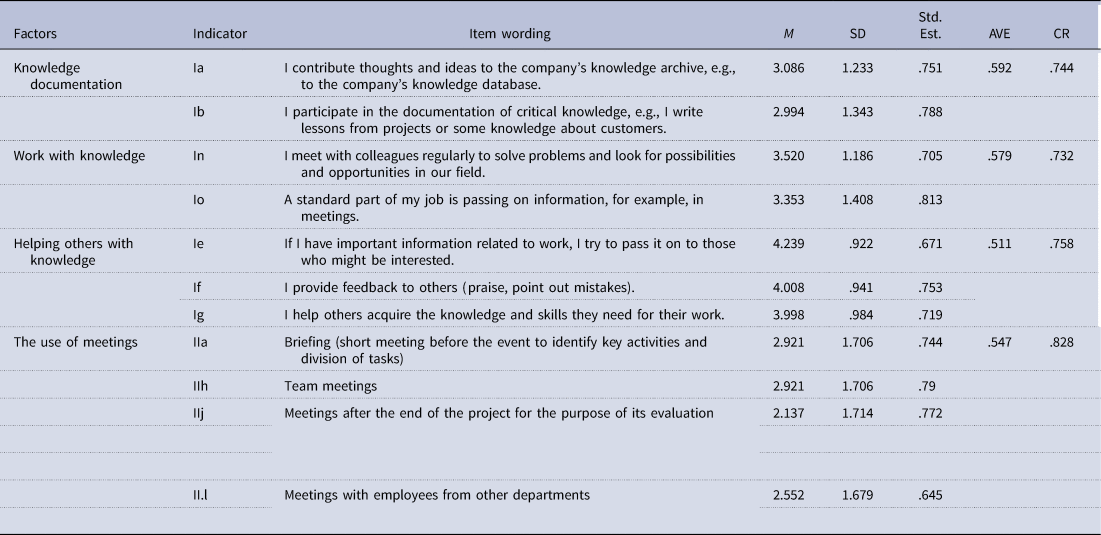
Regarding knowledge sharing in the organisation, the result of the second-order CFA demonstrates that the standardised parameter loadings, using AMOS 25.0, ranged from .751 to .788 for knowledge externalisation, from .705 to .813 for work with knowledge, from .671 to .753 for helping others with knowledge and from .645 to .790 for frequency of meetings. The AVE approximations for all four components were above the .50 threshold limit (Kline, Reference Kline2010). Therefore, the finding signifies that the four constructs share more than half of the variance with knowledge sharing in the organisation. Additionally, the composite reliability approximations for the four underlying variables were loaded above the recommended threshold limit of .6, with values ranging from .732 to .828. To conclude, the results showed a meaningful and reliable measure of the convergent validity of knowledge sharing in the organisation. Table 1 lists these details.
Structure of the underlying factor of knowledge sharing in the organisation

The four identified variables of knowledge sharing in the organisation had satisfactory goodness-of-fit indices above the threshold suggested by Hair et al. (Reference Hair, Babin, Anderson and Black2018). The model assessment benchmarks used were CFI = .984, TLI = .977, GFI = .973, AGFI = .956 and RMSEA = .042, with the corresponding 95% confidence interval. The χ2 statistics were as follows: χ2 = 73.019, df = 40, p = .001. Therefore, statistical significance was set at p < .05. Hoelter's critical N value was 363, which was above the required limit. The general evaluation of the model fit criteria deemed the model appropriate for the 11 items of knowledge sharing on the organisation scale, employing second-order CFA in its validation. The details are shown in Figure 2.
Factor structure of knowledge sharing in the organisation.

CFA analysis of high-commitment HRM
Concerning high-commitment HRM, the findings of the second-order CFA show that the standardised parameter loadings using AMOS 25.0 ranged from .738 to .756 for employee selection, from .740 to .774 for work autonomy, from .696 to .792 for motivating work tasks, from .752 to .924 for performance evaluation, from .732 to .800 for career management and from .713 to .829 for development. The AVE approximations for all six components were above the .50 recommended limit (Kline, Reference Kline2010). Therefore, the findings show that the six variables share more than half the variance with high-commitment HRM. Additionally, the composite reliability approximations for the six underlying variables were identified to load above the recommended limit of .6, with values ranging from .729 to .874. Overall, the results indicate a meaningful and reliable measure of the convergent validity of high-commitment HRM. The details are presented in Table 2.
Structure of the underlying factors of high-commitment human resource management

The six identified variables of high-commitment HRM achieved appropriate goodness-of-fit indices at the level recommended by Hair et al. (Reference Hair, Babin, Anderson and Black2018). The model assessment criteria were as follows: CFI = .959, TLI = .951, GFI = .934, AGFI = .913 and RMSEA = .052, with a 95% confidence interval. The χ2 statistics were as follows: χ2 = 330.56, df = 144 and p < .001. Therefore, statistical significance was set at p < .05. Hoelter's critical N was 251, which was above the threshold. Thus, the model fit was deemed appropriate for the 19 elements of the high-commitment HRM scale by employing second-order CFA. Figure 3 shows these details.
Structure of factors of high-commitment human resource management.

Discriminant validity of constructs
As the results of CFA analyses revealed that the goodness-of-fit indicators were satisfactory for the hypothesised models based on the fit indices' criteria, the discriminant validity between both constructs was evaluated. As their mutual correlation was lower than the square root of the AVE, the discriminant validity was considered adequate. For further details, see Table 3.
Discriminant validity of second-order factors

Structural model
Finally, the fit of the SEM of the mutual relationship between high-commitment HRM and knowledge sharing in the organisation was examined (Figure 4). The estimation criteria employed were CFI = .951, TLI = .946 and RMSEA = .042 with a 95% confidence interval. The χ2 statistics were χ2 = 725.458, df = 392 and p < .001. Hoelter's critical N was 290, which was above the required threshold. Together, these results suggested that the model is appropriate.
SEM model.

The bundle of high-commitment HR practices affects knowledge sharing in the organisation in a strongly positive way (β = .62). The more participants perceive that high-commitment HRM is implemented in the organisation, the greater their perception that they share their knowledge with other members of the organisation. Thus, intensive application of high-commitment HRM positively affects employee knowledge dissemination in the organisation.
Discussion
Knowledge flow and sharing within an organisation support a sustainable competitive advantage (Michaelis, Wagner, & Schweizer, Reference Michaelis, Wagner and Schweizer2015). However, a vital question, not entirely confirmed empirically by previous research, is how to facilitate the exchange of knowledge among staff members. Thus, this study aimed to examine whether high-commitment HRM is a way to enhance knowledge sharing among employees. Empirical data were obtained through a questionnaire survey administered to 480 permanent employees. The data analysis showed three important findings.
First, the study confirmed four suggested components of knowledge sharing in the organisation. It means the knowledge holder may donate his/her knowledge in several ways – indirectly by describing it in a document and/or putting it into a database or directly by communicating with others, as Haas and Hansen (Reference Haas and Hansen2007) and Bock et al. (Reference Bock, Zmud, Kim and Lee2005) suggested. Moreover, knowledge sharing can be extra-role behaviour (for instance, voluntarily helping others with my knowledge), as Son, Cho, and Kang (Reference Son, Cho and Kang2017) mentioned. However, the items indicate that knowledge sharing can also be a part of job/role tasks (e.g., participation in meetings), so in-role behaviour. In other words, knowledge sharing can be at least partly required and expected and be a basis of regular and ongoing job performance.
Second, five HR practices belonging to high-commitment HRM were examined: selective hiring, job design that allows (a) employee autonomy, and (b) motivating work tasks, performance management, career management and employee training and development. The CFA confirmed that they are valid components of a higher-order construct. What is worth noting is the existence of a link between motivating work tasks and employee autonomy has emerged. However, this finding is probably not so surprising. Both of them are related to job design and should support high commitment, so their proximity is understandable. Additionally, Gagné and Deci (Reference Gagné and Deci2005) have shown that autonomy enhances both intrinsic motivation and autonomous extrinsic motivation. Similarly, Morgeson, Delaney-Klinger, and Hemingway (Reference Morgeson, Delaney-Klinger and Hemingway2005) mention that increased employee control concerning work tasks increases employee motivation. Thus, employees can perceive tasks with higher autonomy as more motivating.
Third, the results indicate that high-commitment HR practices strongly support an individual's tendency to share knowledge in the organisation. One possible explanation for this relationship is that HRM influences employees' attitudes, beliefs and subjective norms (Chen & Huang, Reference Chen and Huang2009; Hislop, Reference Hislop2013). For instance, HRM affects perceived organisational support (Chiang, Han, & Chuang, Reference Chiang, Han and Chuang2011; Kim & Ko, Reference Kim and Ko2014; Tremblay, Cloutier, Simard, Chênevert, & Vandenberghe, Reference Tremblay, Cloutier, Simard, Chênevert and Vandenberghe2010), psychological empowerment (Liu et al., Reference Liu, Chow, Gong and Wang2019), procedural justice (Tremblay et al., Reference Tremblay, Cloutier, Simard, Chênevert and Vandenberghe2010) and commitment to the organisation (Kim & Ko, Reference Kim and Ko2014) which are vital for employees' willingness to share what they know (Alnaimi & Rjoub, Reference Alnaimi and Rjoub2021; Benyahya & Matošková, Reference Benyahya and Matošková2021; Wu & Lee, Reference Wu and Lee2017). Furthermore, HR practices can also affect employees' opportunities and knowledge-sharing capabilities (Prieto Pastor, Pérez Santana, & Martín Sierra, Reference Prieto Pastor, Pérez Santana and Martín Sierra2010), which may lead to higher knowledge dissemination.
Based on findings by Collins and Smith (Reference Collins and Smith2006), Bowen and Ostroff (Reference Bowen and Ostroff2004) and Benyahya and Matošková (Reference Benyahya and Matošková2021), we can suppose that commitment-based HR practices enhance such values as trust, cooperation, fairness and openness and reinforce cultural norms and routines of mutual collaboration. Organisational culture also influences the understanding of what knowledge is important and valuable (Long & Fahey, Reference Long and Fahey2000). So, high-commitment HR practices create social environments conducive to knowledge exchange and affect employees' attitudes and beliefs (Chen, Chuang, & Chen, Reference Chen, Chuang and Chen2012; Vuori & Okkonen, Reference Vuori and Okkonen2012) and motivation (Foss et al., Reference Foss, Pedersen, Reinholt Fosgaard and Stea2015).
Theoretical and practical implications
Regarding theoretical implications, the current study extends previous research by examining the relationships between HRM and knowledge sharing in organisations. The study responds to the call that HR practices need to be examined as a whole as they do not affect individuals in isolation (for instance, Laursen & Mahnke, Reference Laursen and Mahnke2001). The results clearly indicate that highly committed HRM positively impacts knowledge dissemination in the organisation. One of the significant theoretical contributions of this study is the formation of a theory-based model that integrates the various constructs of HRM and knowledge sharing. This suggests a number of HR practices that stimulate employee knowledge-sharing behaviour. Building on previous research (see, e.g., Kianto, Sáenz, & Aramburu, Reference Kianto, Sáenz and Aramburu2017), the findings contribute to the knowledge-based view of firms, a theoretical perspective in HRM–firm performance linkage research as well as to discussions on strategic HR management and innovation management.
This study's findings have several practical implications. Previous research (e.g., Azeem et al., Reference Azeem, Ahmed, Haider and Sajjad2021; Liu & Phillips, Reference Liu and Phillips2011; Wickramasinghe, Reference Wickramasinghe2015) has shown a strong link between knowledge sharing and innovativeness, which is vital for many organisations. This study demonstrated the importance of high-commitment HR practices that positively impact the intensity of intra-organisational knowledge exchange. So, it can be assumed that high-commitment HRM indirectly contributes to the innovativeness of the organization. In addition, this study provided valuable insights that could help managers recognise weaknesses related to the support of knowledge sharing among staff in their own companies and decide on remedial measures. If knowledge sharing is vital for firms (e.g., because of its impact on organisational innovativeness), companies should pay special attention to the HR practices described in this study. First, the ability to engage in team work, communication skills and willingness to learn more should be added to the criteria for employee selection. Second, employees should have sufficient autonomy to decide on matters related to their work. Third, employees appreciate job tasks that are non-routine and challenging and just such tasks boost knowledge sharing. Fourth, cooperation with others and previous self-development should be added to performance criteria, and subordinates should be included in the superiors' performance assessment. Fifth, the sharing of knowledge and helping others develop should be added among the necessary criteria for career promotion. Finally, the firm should support employee training and development, and develop skills useful for knowledge sharing, such as communication, information technology and problem-solving. In sum, it is important to show employees that their contributions towards knowledge dissemination are valuable and thus recognised and appreciated by the organisation.
Moreover, HR employees could use these results as evidence of the usefulness of strengthening the strategic role of HRM. Implementing high-commitment HRM can be seen as a clear message from the employer to employees that extra-role behaviours (e.g., sharing knowledge with others) are instrumental to achieving organisational goals and thus expected, supported and rewarded. Close collaboration between HR professionals, managers and top management is essential if the successful implementation of high-commitment HRM is to be achieved.
Research limitations and directions for future research
Before discussing the implications of these findings, several important limitations of this study need to be mentioned. First, self-reported measures were used, and their potential limits (e.g., the need to rely on the participants' honesty) are well known. For example, Gupta and Beehr (Reference Gupta and Beehr1982) found only moderate correspondence between self-reports and other data sources (on-the-job observations, personnel records). However, self-reporting is quite common in social research applied in an organisational setting (Gupta & Beehr, Reference Gupta and Beehr1982; Podsakoff & Organ, Reference Podsakoff and Organ1986) because it saves time and money (Howard, Maxwell, Wiener, Boynton, & Rooney, Reference Howard, Maxwell, Wiener, Boynton and Rooney1980). It is also a more convenient method for participants who face time constraints (as they can complete the questionnaire at any time), which is generally the case. Sometimes, it is also the only way to obtain data from the corporate environment (Donaldson & Grant-Vallone, Reference Donaldson and Grant-Vallone2002; Gupta & Beehr, Reference Gupta and Beehr1982) because management tends to be distrustful and sceptical of research, and the researcher cannot enter the company without their permission. Additionally, Howard et al. (Reference Howard, Maxwell, Wiener, Boynton and Rooney1980) also claim that self-reports can sometimes be more valid than behavioural measures. However, an alternative to self-reported measures can be used in the future.
Furthermore, no facilitator was present to help the participants, which could have led to misunderstanding the questions. However, this risk was very low. The individual items in the questionnaire were consulted in advance, and their clarity was also confirmed in previous research.
This study used a cross-sectional survey design. A limitation of this study design is that causality findings cannot be properly judged, and conclusions depend mainly on theoretical considerations. In addition, the respondents were chosen based on convenience, but the administration of the questionnaire was somewhat random. As a non-random sampling method was employed to recruit respondents, some were concerned about the generalisability of the study findings. The high internal consistency shown by the construct scales indicates that their setting was appropriate. To further increase the reliability of the study findings and achieve better statistical generalisation, more studies should be conducted to confirm the conclusions outlined above by employing more random sampling practices for data collection. A longitudinal study that examines the impact of implementing high-commitment HR practices on employee knowledge sharing could also be welcome.
Additionally, this study deals with only several HR practices under high-commitment HR management. Therefore, more practices should be considered in future studies.
Finally, the study was conducted in a single-country setting, which could lead to a possible cultural impact. Previous research has indicated that individuals' knowledge-sharing patterns may be influenced by several national cultural characteristics, such as degree of collectivism, competitiveness, the importance of saving face, in-group orientation, attention paid to power and hierarchy and culture-specific preferences for communication modes (Ardichvili, Maurer, Li, Wentling, & Stuedemann, Reference Ardichvili, Maurer, Li, Wentling and Stuedemann2006).
Conclusions
Recent studies (Jafari, Akhavan, & Nourizadeh, Reference Jafari, Akhavan and Nourizadeh2013; Kim & Ko, Reference Kim and Ko2014; Qamari, Dewayani, & Ferdinand, Reference Qamari, Dewayani and Ferdinand2019) have shown that a suitable setting for HR practices can impact organisational knowledge sharing. However, a lack of empirical evidence makes it difficult to answer the question of an appropriate setting for HR practices. Thus, this study aimed to investigate whether high-commitment HRM supports disseminating knowledge within the organisation.
This study confirmed the importance of HR practices in intensifying intra-organisational knowledge exchange. Empirical evidence indicates that implementing high-commitment HR practices could significantly increase knowledge dissemination in the organisation. The findings suggested several high-commitment HR practices that have the potential to increase knowledge dissemination in the organisation. The results indicate that firms should concentrate on selective hiring, offering autonomy and motivating work tasks to employees, implementing performance management that considers teamwork and knowledge sharing with others, helping employees fulfil their career expectations, and investing in employee training and development.
Acknowledgement
This research was supported by the internal project of Tomas Bata University in Zlín RO/2020/03 ‘Knowledge-based View of the Organization’. I would like to thank Editage (https://www.editage.com) for English language editing.
Competing interests
None.
Doc. Ing. Jana Matošková, Ph.D., works as an associate professor at the Department of Management and Marketing, Faculty of Management and Economics, Tomas Bata University in Zlín, Zlín, Czech Republic. She is responsible for leading courses on human resource management, managerial skills and methods, and coaching. Her research interests focus on human resource management, leadership and knowledge sharing by applying qualitative and quantitative methods.