THE PHYLUM MICROSPORA: AN ANCIENT AND DIVERSE GROUP
Microsporidia are very common parasites which are widespread among animal hosts. They are best known as parasites of insects but are not restricted to this host group and are in fact found across a vast range of host taxa including, protists, bryozoa, nematodes, oligochaete worms, insects, fish and mammals including humans (Becnel and Andreadis, Reference Becnel, Andreadis, Wittner and Weiss2001; Canning et al. Reference Canning, Refardt, Vossbrinck, Okamura and Curry2002; Lom and Nilsen, Reference Lom and Nilsen2003; Didier, Reference Didier2005; Morris et al. Reference Morris, Terry, Ferguson, Smith and Adams2005; Fokin et al. Reference Fokin, Di Giuseppe, Erra and Dini2008; Troemel et al. Reference Troemel, Felix, Whiteman, Barriere and Asubel2008). This widespread distribution in nature is consistent with an ancient origin for the phylum Microspora. Phylogenetic analysis places the group as early branching eukaryotes. Microsporidia have 16S rather than 18S ribosomes and lack 5·8S ribosomal RNA and on this basis were originally considered to be primitive eukaryotes (Curgy et al. Reference Curgy, Vavra and Vivares1980). Although this assertion was initially supported by molecular phylogeny of SSUrDNA (Vossbrink et al. 1987) subsequent analysis, based on multiple genes, placed the group closer to the fungi (Hirt et al. Reference Hirt, John, Logsdon, Healy, Dorey, Doolittle and Embley1999; Keeling et al. Reference Keeling, Luker and Palmer2000; James et al. Reference James, Kauff, Schoch, Matheny, Hofstetter, Cox, Celio, Gueidan, Fraker, Miadlikowska, Lumbsch, Rauhut, Reeb, Arnold, Amtoft, Stajich, Hosaka, Sung, Johnson, O'Rourke, Crockett, Binder, Curtis, Slot, Wang, Wilson, Schüssler, Longcore, O'Donnell, Mozley-Standridge, Porter, Letcher, Powell, Taylor, White, Griffith, Davies, Humber, Morton, Sugiyama, Rossman, Rogers, Pfister, Hewitt, Hansen, Hambleton, Shoemaker, Kohlmeyer, Volkmann-Kohlmeyer, Spotts, Serdani, Crous, Hughes, Matsuura, Langer, Langer, Untereiner, Lücking, Büdel, Geiser, Aptroot, Diederich, Schmitt, Schultz, Yahr, Hibbett, Lutzoni, McLaughlin, Spatafora and Vilgalys2006). Recently Lee et al. (Reference Lee, Corradi, Byrnes, Torres-Martinez, Dietrich, Keeling and Heitmam2008) compared both the identity and synteny of multiple loci across the genomes of microsporidian and fungal species and concluded that the Microspora are highly derived fungi descended from a zygomycete ancestor.
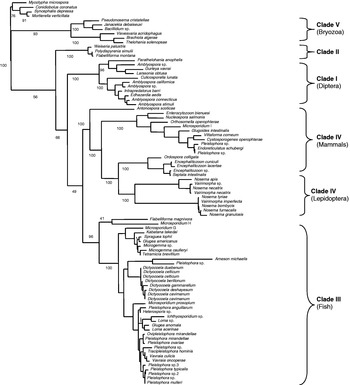
The diversity of the phylum indicated by phylogenetic analysis is currently based on analysis of SSUrDNA with approximately 200 sequences available from microsporidia infecting a wide range of hosts. Reconstruction of the phylogeny (Fig. 1) indicates the presence of five major, deep-rooted clades each of which shows considerable divergence (Terry et al. Reference Terry, Smith, Sharpe, Rigaud, Littlewood, Ironside, Rollinson, Bouchon, MacNeil, Dick and Dunn2004; Vossbrinck and Debrunner-Vossbrinck, Reference Vossbrinck and Debrunner-Vossbrinck2005). The level of variation in ribosomal RNA sequence across the phylum is very high (Keeling and Fast, Reference Keeling and Fast2002) and analysis of sequence divergence reveals major insertions and deletions within each clade. Within each major lineage SSU rRNA is sufficiently polymorphic to discriminate between microsporidian genera, as for example in clade IV where the mammalian infective genus Encephalitozoon is very clearly separated from related genera such as Ordospora, Enterocytozoon and Vitaforma and Endoreticulatus and Nosema (Fig. 1). Similarly, clear separation of taxa is seen within Clade I which mainly contains parasites of Diptera (Vossbrinck et al. Reference Vossbrinck, Maddox, Friedman, Debruner-Vossbrink, Vossbrinck, Andreadis, Vavra and Becnel2004) and Clade III, which is dominated by species infecting fish (Lom and Nilsen, Reference Lom and Nilsen2003).
Microsporidian phylogenetic tree. The tree is based on around 800 bp 800 bp SSU rDNA sequences were used to reconstruct a phylogenetic tree of 315 microsporidian parasites with 4 species of fungi representing Chytridiomycota, Zygomycota, Ascomycota as outgroups. MrBayes v 3.1.1 (Huelsenbeck and Ronquist, 2001) was used to infer these Bayesian analyses over 8,000,000 generations, and nodal support was assessed by posterior probabilities estimated from the final 75% (60,000) sampled trees.

The high divergence apparent from phylogenetic analysis is echoed in the size and structure of microsporidian genomes. Encephalitozoon cuniculi, the first microsporidian parasite to be sequenced, famously has the smallest genome of any eukaryote with eleven chromosomes of 2–300 kb and a total genome size of 2·9 Mb (Katinka et al. Reference Katinka, Duprat, Cornillot, Metenier, Thomarat, Prensier, Barbe, Peyretaillade, Brottier, Wincker, Delbac, El Alaoui, Peyret, Saurin, Gouy, Weissenbach and Vivares2001). There is evidence that the reduced genome size is associated with loss of metabolic function. E. cuniculi has only 1,997 predicted proteins and lacks many enzymes, such as those involved in the tricarboxylic acid cycle, or in de novo synthesis of amino acids, purines and pyrimidines. Encephalitozoon is not, however, a typical representative of the phylum and other microsporidia have substantially larger genome sizes. The mammal-infective species Enterocytozoon bieneusi has a predicted genome size of 6 Mb predicted to encode 3,800 genes (Akiyoshi et al. Reference Akiyoshi, Morrison, Lei, Feng, Zhang, Corradi, Mayanja, Tumwine, Keeling, Weiss and Tzipori2009), Paranosema locusta (synonymous with Antonospora/Nosema locusta) is estimated at 5·4 Mb (Streett, Reference Streett1984). The genome sizes of several parasites from the Nosema/Vairimorpha clade have been estimated by pulsed field methodology to be around 10 Mb (Malone and McIvor, Reference Malone and McIvor1993) while Nosema bombycis at 15·6 Mb (Xu et al. Reference Xu, Pan, Fang, Li, Tian, Li, Zhou and Xiang2006) and Brachiola algerae at approximately 23 Mb (Belkorchia et al. Reference Belkorchia, Biderre, Militon, Polonais, Wincker, Jubin, Delbac, Peyretaillade and Peyret2008) have much larger genomes. One of the fascinating aspects of microsporidian genomes is their high degree of compaction. This was first noted in Encephalitozoon where gene prediction models suggested there were no introns and many overlapping transcripts (Katinka et al. Reference Katinka, Duprat, Cornillot, Metenier, Thomarat, Prensier, Barbe, Peyretaillade, Brottier, Wincker, Delbac, El Alaoui, Peyret, Saurin, Gouy, Weissenbach and Vivares2001). This unusual feature is seen in other microsporidia with small genomes and may a be general characteristic of compacted eukaryotic genomes (Williams et al. Reference Williams, Slamovits, Patron, Fast and Keeling2005). Emerging evidence indicates that multigene transcripts are not common among microsporidia with larger genomes (Belkorchia et al. Reference Belkorchia, Biderre, Militon, Polonais, Wincker, Jubin, Delbac, Peyretaillade and Peyret2008, Corradi et al. Reference Corradi, Gangaeva and Keeling2008, Gill et al. Reference Gill, Becnel and Fast2008).
Microsporidia exhibit some morphological traits that are consistent with their fungal origins, such as the formation of an intranuclear spindle during mitosis (Bigliardi et al. Reference Bigliardi, Riparbelli, Selmi, Lanzarini, Corona, Gatti, Scaglia and L. Sacchi1998) and the chitin-rich wall of the spore stage: however, their cellular structure is unusual. There are two basic life-cycle stages, the proliferative stage, the intracellular meront which lies directly within the host cell cytoplasm and spore stage which mediates transmission (Dunn et al. Reference Dunn, Terry and Smith2001). The meront is adapted to scavenge nutrients directly from the host cell: it lies directly in the host cell cytoplasm and thus has direct access to nutrients. Microsporidia have a vestigial mitochondrial organelle, or mitosome, which does not have support oxidative phosphorylation but retains a role in iron sulphur cluster assembly (Williams et al. Reference Williams, Hirt, Lucocq and Embley2002, Goldberg et al. Reference Goldberg, Molik, Tsaousis, Neumann, Kuhnke, Delbac, Vivares, Hirt, Lill and Embley2008). The parasites scavenge ATP from the host cell through the activity of nucleotide transporters (Tsaousis et al. Reference Tsaousis, Kunji, Goldberg, Lucocq, Hirt and Embley2008) and close interactions between the meront plasma membrane and host cell mitochondria may enhance this energy scavenging (Terry et al. Reference Terry, Dunn and Smith1997). In species such as Encephalitozoon, meronts divide within a parasitophorous vacuole. Evidence suggests that this vacuolar membrane is of host origin and, similar to the vertebrate pathogen Toxoplasma gondii, is porous to small molecules (Ronnebaumer et al. Reference Ronnebaumer, Gross and Bonhe2008). Interaction with mitochondria is preserved and they are tethered to the vacuolar membrane (Scanlon et al. Reference Scanlon, Leitch, Visvesvara and Shaw2004).
The spore stage is highly adapted for transmission and has an elaborate structure designed to deliver the parasite directly into the host cell cytoplasm (Dissanaike and Canning, Reference Dissanaike and Canning1957; Vavra, Reference Vavra, Bulla and Cheng1976). The nucleus and cytoplasm, which is densely packed with ribosomes, are enclosed within by multilayered endosprore and exospore walls. The anterior section of the spore contains a membranous organelle, the polaroplast and the hollow coiled polar filament attached via an anchoring disc to the spore wall (Sinden and Canning, Reference Sinden and Canning1974). Once triggered to hatch, the spore absorbs water and the polaroplast swells, increasing pressure in the cell which causes the polar filament to shoot out to penetrating the host cell membrane and allowing the sporoplasm to enter the cytoplasm of the host cell (Undeen and Vandermeer, Reference Undeen and Vandermeer1994; Xu and Weiss, Reference Xu and Weiss2008). The spore, with its tough external wall and specialised ‘injection mechanism’, appears highly adapted for survival and dissemination in the extracellular environment but, in fact, certain spore types are also adapted to mediate cell to cell transmission within the host (Iwano and Kurtti, Reference Iwano and Kurtti1995; Terry et al. Reference Terry, Dunn and Smith1999).
The core life-cycle stages, the meront and spore found in all microsporidian parasites but both the structure of these stages and the way the complexity of the parasite life cycle may vary. For example, the spore can vary massively in size and structure, i.e. Bacillidium vesiculoformis produces rod-like spores 12·2×1·3 μm while the mollusc-infective species Steinhausia mytilovum produces spherical spores of approximately 1·5 μm in diameter (Sagrista et al. 1998; Morris et al. Reference Morris, Terry, Ferguson, Smith and Adams2005). The fine structure of the spore, including the presence of a monokaryotic or diplokaryotic nucleus, the organisation of endospore and exospore walls, the morphology of the polaroplast and the structure and number of coils in the polar filament all show many differences (Vavra and Larsson, 2001). These phenotypic traits have been the basis for taxonomic classification of the phylum Microspora, together with information on the life cycle and on the host species infected. The complexity of the life cycle varies greatly: among the most straightforward examples is the parasite Brachiola algerae, (synonymous with Nosema algerae) which was first isolated from mosquitoes, but has the potential to infect humans. Diplokaryotic meronts divide directly in host cell cytoplasm and enter disporous sporogony, leading to the production of a single diplokaryotic spore type. Multiplication of the parasite is rapid and asynchronous causing severe disruption of infected muscle cells (Vavra and Undeen, Reference Vavra and Undeen1970; Cali et al. Reference Cali, Weiss and Takvorian2004). The most complex life cycle is potentially that of Eharzardia aedis which has four different sporulation sequences (Becnel et al. Reference Becnel, Sprague, Fukada and Hazard1989; Johnson et al. Reference Johnson, Becnel and Undeen1997).
In terms of alpha taxonomy, approximately 140 genera of microsporidia have been described (Sprague et al. Reference Sprague, Becnel and Hazard1992) on the basis of morphological data. There are ongoing efforts to resolve the relationships between molecular phylogeny and alpha taxonomy. These studies suggest that while phenotypic data are often support phylogenetic relationships they are insufficient for taxonomic assignment. An example of this is seen in polyphyletic origins of parasites assigned to the genus Nosema. Many parasites were designated to this genus on the basis of structural similarity to the type species N. bombycis, which falls into Clade IV of the phylum, but it is clear from molecular studies that this phenotype is also widespread in Clade V. Three branches can be resolved in clade V one of which contains Brachiola algerae, originally N. algerae (Vavra and Undeen, Reference Vavra and Undeen1970), together with the crustacean parasite Fibrillonosema crangonycis (Slothauber-Galbreath et al. Reference Slothouber-Galbreath, Smith, Terry, Becnel and Dunn2004). A second branch contains the orthoptera-infective parasites Paranosema locusta, originally Nosema locusta (Canning, Reference Canning1953), and Paranosema whiteii (Soklova et al. Reference Sokolova, Dolgikh, Morzhina, Nassonova, Issi, Terry, Ironside, Smith and Vossbrinck2003, Reference Soklova, Issi, Morzina, Tokarev and Vossbrink2005) while the third branch also contains Nosema-like parasites infecting bryozoans, designated Pseudonosema, Trichonosema and Bryonosema (Canning et al. Reference Canning, Refardt, Vossbrinck, Okamura and Curry2002). Although the systematics of phylum Microspora is under active review, additional sequence data from new host groups continues to support division of the phylum into five major clades (Terry et al. Reference Terry, Smith, Sharpe, Rigaud, Littlewood, Ironside, Rollinson, Bouchon, MacNeil, Dick and Dunn2004; Vossbrinck and Debrunner-Vossbrinck, Reference Vossbrinck and Debrunner-Vossbrinck2005), while integration of morphological and molecular data adds to the resolution of these lineages.
In conclusion, the phylum Microspora contains a group of unusual and highly derived fungi that they have a range of unusual structural adaptations and high dependency on their hosts. They are highly diverse with significant differences in their structure, life cycle, genome organisation and cellular biology. Their presence as pathogens across all animal taxa is consistent with ancient origins and makes them an excellent model to study the host parasite evolution and transmission.
FROM PASTEUR TO POLLINATORS: TRANSMISSION AND DISEASE IN BENEFICIAL INSECTS
The first microsporidian parasite to be described was Nosema bombycis the causative agent of pebrine disease in the silkworm Bombyx mori. Pasteur's experiments noted the presence of ‘corpuscules’ in the egg, the first description of the parasite linked with Vertical Transmission (VT) (Pasteur, Reference Pasteur1870). The life cycle of the parasite is described from both in vitro and in vivo studies and is relatively straightforward (Ishihara, Reference Ishihara1969; Iwano and Ishihara, Reference Iwano and Ishihara1991). In the silkworm larva, infection begins when spores infect the midgut epithelium, the diplokaryotic meront divides directly in the cytoplasm and generates sporonts which undergo disporoblastic development to produce spores. Two types of spores are formed, those with a long polar filament with thirteen coils, which are destined to transmit the infection between hosts and those with a short polar filament of only three coils which are responsible for disseminating infection from the midgut to muscle and other tissues. The parasite has a mixed transmission strategy with and disease can be spread horizontally between larvae during sericulture (Ishihara and Fujiwara, 1965) but can also be transmitted vertically from the adult silkworm to the egg (Han and Watanabe, Reference Han and Watanabe1988). Infection of larvae is most severe in the first second and fifth instars and can cause significant mortality in production systems, but larvae infected in late instars are likely to progress to adults and transmit the disease vertically. This mixed strategy both maximises transmission between individuals in phase of population growth and enables to shift to next generation in a discontinuous production system.
The impact of Nosema infection in sericulture is massive as the profit margin is tied to the number of cycles of production and repeated crashes can decimate productivity. Serious steps are taken to control the infection in the industry by trying to eradicate vertical transmission. Silkworm eggs are produced centrally by crossing different genetic stocks of Bombyx. In the initial cross adult females are screened for the presence of parasites and any eggs from infected batches are discarded, thus providing ‘sterile’ material for the regional sericulture industry (Hatakeyama and Hyasake, 2003; Liu et al. Reference Liu, Cao, Smith and Xu2004). Clearly outbreaks do still occur and these could be due either to vertical transmission through low level contamination of eggs, below the limit of detection of current diagnostic methods, or horizontally through introduction of parasites deposited on Mulberry leaves by indigenous host species.
There are many unresolved questions about the diversity and host range of microsporidia causing pebrine disease. It is uncontroversial that the type species for the genus Nosema bombycis is responsible for much of the disease seen in sericulture, but it has been shown that a number of lepidopteran species are susceptible to this species (Kashkarova and Khakhanov, 1980) raising the possibility that reservoirs of disease may exist in wild hosts. It has also been noted that there is genetic diversity among parasites causing the disease, (Rao et al. Reference Rao, Nath and Saratchandra2005, Reference Rao, Nath, Bhuvaneswari and Urs2007). The genus Nosema is subdivided into two clades, the ‘true Nosemas’, including Nosema bombycis, and the Vairimorpha clade (Baker et al. Reference Baker, Vossbrinck, Maddox and Undeen1994). Members of the Vairimorpha clade have a second developmental cycle in which haploid octospores are produced within a sporophorous vesicle (Vavra et al. Reference Vavra, Hylis, Vossbrinck, Pilarska, Weiser, McManus, Hoch and Solter2006). Studies on disease phenotype and the phylogenetic relationships of silkworm isolates reveal that both the virulence and the capacity for vertical transmission may vary and parasites from either of the two Nosema clades can be responsible for disease (Rao et al. Reference Rao, Nath and Saratchandra2005, Reference Rao, Nath, Bhuvaneswari and Urs2007).
Microsporidian infection is also of concern in other beneficial insects, particularly pollinator species. There are three species of high importance Nosema apis, N. ceranae and N. bombi, all of which fall into the Nosema/Vairimorpha clade. N. apis has long been known as a parasite of the honey bee Apis mellifora (Fantham and Porter, Reference Fantham and Porter1912). The parasite is primarily transmitted horizontally through ingestion of spores that establish infection in the midgut (Fries, Reference Fries1989, Reference Fries, Granados and Morse1992). The severity of infection clearly varies but the parasite infects both workers and queens (Webster et al. 2004) and can cause mortality of adult bees (Malone and Giacon, Reference Malone and Giacon1996) and regression in the ovaries of queens (Liu, Reference Liu1992). In social insects, such as bees, infection of the queen is critical in disseminating infection both within the colony and to new colonies during reproductive swarming (Czekonska, Reference Czekonska2000; Fries and Camazine, Reference Fries and Camazine2001). There is no evidence of transovarial transmission in infected queens (Webster et al. Reference Webster, Miller and Vemulapalli2008) but their role in infecting new colonies which might be regarded as a form of vertical transmission. A second species, N. ceranae, originally from the Asian honey bee Apis ceranae (Fries et al. Reference Fries, Feng, Da Silva, Slemenda and Pieniazek1996), has recently spread into Apis mellifera and appears to be more pathogenic than N. apis (Klee et al. Reference Klee, Besana, Genersch, Gisder, Nanetti, Tam, Chinh, Puerta, Ruz, Kryger, Message, Hatjina, Korpela, Fries and Paxton2007, Paxton et al. Reference Paxton, Klee, Korpela and Fries2007). This parasite has been proposed as a cause of colony collapse disorder (Higes et al. Reference Higes, Martín-Hernández, Botías, Bailón, González-Porto, Barrios, Del Nozal, Bernal, Jiménez, Palencia and Meana2008) but this syndrome, which is currently so damaging to honey bee populations, is likely to have multifactorial origins (Cox-Foster et al. Reference Cox-Foster, Conlan, Holmes, Palacios, Evans, Moran, Quan, Briese, Hornig, Geiser, Martinson, Vanengelsdorp, Kalkstein, Drysdale, Hui, Zhai, Cui, Hutchison, Simons, Egholm, Pettis and Lipkin2007; Watanabe, 2008).
It is not only the honey bee which is affected by Nosema parasites since commercially-reared and wild bumblebees are also affected. N. bombi causus disseminated infection in the host (Fries et al. Reference Fries, De Ruijter, Paxton, Da Silva, Slemenda and Pieniazek2001) and is widespread in Bombus spp. (Larsson, Reference Larsson2007). Experimental studies show that the parasite can be highly detrimental causing mortality in workers and almost complete loss reproductive capacity in infected gynes (Otti and Schmid-Hempel, 2007). Such high virulence might be deemed to lead to extinction of the parasite but it seems that parasite virulence may vary between different bumble bee species sustaining the parasite in the environment (Rutrecht and Brown, Reference Rutrecht and Brown2009). There is some evidence to suggest that N. bombi is transovarially transmitted but the importance of this in disease epidemiology is not fully understood (Rutrecht and Brown, Reference Rutrecht and Brown2007).
The key challenges in microsporidiosis of beneficial insects lie in understanding the role or vertical and horizontal transmission in relation to disease pathogenesis. Control of vertical transmission should focus on screening of reproductive females. This is well established in the sericulture industry but less rigorously applied in managed pollinator species. Control of horizontal transmission currently relies on the use of antifungal agents such as fumagillin (Katznelson and Jamieson, Reference Katznelson and Jamieson1952; Pajuelo et al. Reference Pajuelo, Torres and Bermejo2008) which continues to be used despite its potential genotoxic effects to (Stanimirovic et al. Reference Stanimirovic, Stevanovic, Bajic and Radovic2007). Greater understanding of disease epidemiology and identification of reservoirs of infection are essential to improve disease management and prevent damaging spillover into wild populations (Otterstatter and Thompson, 2008).
MANIPULATING MORTALITY: TRANSMISSION AND DISEASE IN PEST SPECIES
While in beneficial insect species our focus is on control of microsporidiosis in pest species the perspective is different. The high virulence associated with some microsporidian infections has long been cited as a useful trait in biological control. There are several instances where this has been successfully employed. Nosema pyracusta is a parasite of the corn borer (Ostrinia nubilalis). Transovarial transmission is critical to epidemiology of this parasite as Ostrinia has discontinuous generations and overwinters as a fifth instar larva. The parasite is found in the larval gonad and infects the developing oocysts produced by the resulting adult (Sajap and Lewis, 1988). The parasite has significant effects on the development and survival of larvae and on the reproductive success of adults (Sajap and Lewis, Reference Sajap and Lewis1992) and its influence is maintained by further horizontal transmission between hosts (Andreadis, Reference Andreadis1987). The role of N. pyracusta in biocontrol is well established (Lewis et al. Reference Lewis, Bruck, Prasifka and Raun2009) but the use of microsporidia more widely has also been considered for many other pest species. Among the Lepidoptera Endoreticulatus schubergi, N. lymantriae and Vairimorpha disparis have been proposed for control of the Gypsy moth Lymantria dispar (Goetz and Hoch, Reference Goertz and Hoch2008, Reference Goertz and Hoch2009), Vairimorpha ephestiae for the wax moth Galleria mellonella (Vorontsova et al. Reference Vorontsova, Tokarev, Sokolova and Glupov2004) and Vairimorpha necatrix for the tomato moth Lacanobia oleracea (Down et al. Reference Down, Bell, Kirkbride-Smith and Edwards2004). Paranosema locusta used for control of locust and other orthopteran pests (Lomer et al. Reference Lomer, Bateman, Johnson, Langewald and Thomas2001; Tounou et al. Reference Tounou, Kooyman, Douro-Kplndou and Poehling2008) and Thelohania solenopsae has been proposed for control of the fire ant Solenopsis invicta (Fuxa et al. Reference Fuxa, Milks, Sokolova and Richter2005).
In employing microsporidia for biological control one clear aim is to maximize the impact of the parasite on the target population. Although efficient horizontal transmission is an important characteristic here, in the majority of the cases cited vertical transmission is critical for the introduction and maintenance of the parasite in the environment and for perpetuation of disease across generations of hosts (Sajap and Lewis, 1988; Raina et al. Reference Raina, Das, Rai and Khurad1995; Briano et al. Reference Briano, Patterson, Becnel and Cordo1996; Goetz and Hoch, Reference Goertz and Hoch2008). In bio-control it is also important to ensure that the control agent does not have detrimental effects on non-target species. Solter, Maddox and McManus (Reference Solter, Maddox and McManus1997) tested the host range of microsporidia isolated from European populations of the Gypsy moth in a range of American lepidopteran species and found that the majority of isolates had broad host specificity when spores were fed directly to larvae. Similarly Microsporidia isolated from US hosts were infective to the Gypsy moth (Solter and Maddox, Reference Solter and Maddox1998). However, although direct feeding resulted in transmission, few isolates were sustained by horizontal transmission in non-native hosts, implying that artificial infection experiments could not be extrapolated to evaluate environmental transmission risks (Solter and Maddox, Reference Solter and Maddox1998; Solter, Reference Solter2006). Paranosema locusta, used for control of locusts, is now known to occur in over 120 species of orthoptera (Lange, Reference Lange2005), so consideration of impacts on non-target species is clearly appropriate.
PARASITES WHICH DICTATE HOST SEX: TRANSMISSION AND REPRODUCTIVE MANIPULATION
In some cases vertical transmission has been associated with reproductive manipulation of the host (Dunn and Smith, 2001). Bacterial endosimbionts are known to induce a range of such manipulations including cytoplasmic incompatibility, parthenogenesis and sex ratio distortion (SRD) (Duron et al. 2008) but the microsporidia are the only group of eukaryotes in which SRD has been unequivocally demonstrated (Dunn, Terry and Smith, Reference Dunn, Terry and Smith2001). The first SRD microsporidian described was Nosema granulosis, a parasite which is closely related to N. bombycis but infects the amphipod crustacean Gammarus duebeni. N. granulosis had a high rate of transovarial transmission (91%) and was estimated to feminise 66% of offspring leading to a highly female biased sex ratio (72–82%). The parasite had no impact on the survival of offspring although infected females were smaller than uninfected females (Terry et al. Reference Terry, Smith and Dunn1998). The parasite life cycle, like that of N. bombycis, consists of a single cycle of meronts producing diplokaryotic spores, but the spore is unusual in having a short polar filament, similar to autoinfection spores (Terry et al. Reference Terry, Dunn and Smith1999). On closer examination, many adaptations can be found for efficient transovarial transmission. In the adult female host, parasites are at low density and via EM were concentrated in the follicle cells surrounding the ovary. The parasite life cycle appears to be co-ordinated by host endocrine cues and sporulation is triggered in synchrony with the reproductive cycle producing spores which germinate to infect the oocytes (Terry et al. Reference Terry, Dunn and Smith1997). The embryo has a relatively low burden of parasites and these are associated with host mitochondria and microtubules and segregate to a subset of cells during embryogenesis (Terry et al. Reference Terry, Dunn and Smith1999a; Weedall et al. Reference Weedall, Robinson, Smith and Dunn2006). The molecular mechanism of feminisation is currently unclear but it is likely that the parasite causes endocrine interference. In crustaceans, sexual differentiation controlled by the androgenic gland which forms and a masculinising hormone (AGH). Studies have shown that this gland does not mature in infected females and intersexes and no hormone is produced (Rodgers-Gray et al. Reference Rodgers-Gray, Smith, Ashcroft, Isaac and Dunn2004).
Although N. granulosis was the first feminising microsporidian to be studied there is accumulating evidence for a relationship between vertical transmission and sex ratio distortion in amphipod hosts. Terry et al. (Reference Terry, Smith, Sharpe, Rigaud, Littlewood, Ironside, Rollinson, Bouchon, MacNeil, Dick and Dunn2004) surveyed 17 amphipod species discovering eight species of microsporidia four of which were associated with SRD in one or more hosts. Supportive evidence for sex ratio distortion has come from breeding experiments which show that shown that Dictyocoela duebenum feminises Gammarus duebeni (Dunn et al. Reference Dunn, Hogg and Hatcher2006) and from field studies which indicate an association between sex ratio distortion and infection with Fibrillonosema crangonycis in Crangonyx pseudogracilis (Slothauber-Galbreath et al. Reference Slothouber-Galbreath, Smith, Terry, Becnel and Dunn2004), for two species of Dictyocoela in Gammarus roeseli (Haine et al. Reference Haine, Brondani, Hume, Perrot-Minnot, Gaillard and Rigaud2004) and for a novel, clade V, microsporidian in Corophium volutatur (Mautner et al. Reference Mautner, Cook, Forbes, McCurdy and Dunn2007). These data suggest the SRD phenotype may be widespread but it is notable that it occurs in amphipods and not in insects where the mechanism of sexual differentiation is different.
Nosema granulosis and other SRD microsporidia have very efficient vertical transmission but the question arises as to whether they could sustain themselves in the population with no horizontal transmission. The low burden and limited disease pathogenesis would limit the detrimental effects of the infection, but in fact there is evidence that the parasite may be able to offset these negative effects by conferring survival advantage to infected offspring (Haine et al. Reference Haine, Motreuil and Rigaud2007). It has also been suggested that a bias in the sex ratio towards females enhances the growth rate of infected host populations and that this might confer advantages in colonisation of new habitats (Slothauber-Galbreath et al. Reference Slothouber-Galbreath, Smith, Terry, Becnel and Dunn2004, Reference Slothouber-Galbreath, Smith, Becnel, Butlin and Dunn2009).
LIFE CYCLE COMPLEXITY AND THE ROLE OF VERTICAL TRANSMISSION
The life cycles of microsporidian parasites can be quite complex and elaborate involving several sporulation cycles in multiple hosts. Complex life cycles are common among the Amblyosporidae which form clade I of the phylum Microspora and largely infect dipteran host species, including mosquitoes (Vossbrinck et al. Reference Vossbrinck, Maddox, Friedman, Debruner-Vossbrink, Vossbrinck, Andreadis, Vavra and Becnel2004). With Edharzardia aedis, mosquito larvae are infected by ingesting uninucleate spores, which penetrate the midgut and undergo shizogony before differentiating into gametes, which fuse to produce binucleate spores within four days of infection. These binucleate spores are responsible for disseminating the infection from the midgut but infection is limited and does not kill the developing host. When the host reaches the adult stage and takes a blood meal the parasite is stimulated to produce a second binucleate spore that is responsible for transovarial transmission to the next generation of larvae. In these larvae there a two separate sporulation sequences, one leading to the formation of meiospores, the second leading to the production of large numbers of uninucleate spores (Becnel et al. Reference Becnel, Sprague, Fukada and Hazard1989; Johnson et al. Reference Johnson, Becnel and Undeen1997). In this host-parasite system there is a strong relationship between infection route and disease: larvae that have acquired the infection transovarially die while those that are horizontally infected survive. In several species there is an alternation of hosts with the uninucleate spore stages being found within a copepod rather than in the mosquito (Andreadis, Reference Andreadis1985) parasites, such as Amblyospora connecticus in the saltmarsh mosquito, Aedes cantator (Andreadis, Reference Andreadis1990), Amblyospora albifasciati in the neotropical mosquito, Aedes albifasciatus (Micieli et al. Reference Micieli, Garcia and Becnel2000), or Amblyospora camposi in the bromeliad-inhabiting mosquito, Culex renatoi (Micieli et al. Reference Micieli, Marti, Garcia, Tranchida and Becnel2007). In these systems the vertical transmission cycle is constrained and occurs in a single species of mosquito but a single copepod species can harbour multiple microsporidian parasites.
In the Amblyosporidae we see both vertical and horizontal cycles employed to ensure transmission of parasites between alternate hosts. It is possible that there are many other examples of complex life cycles across the phylum Microspora, as there are many cases where our understanding of transmission is very basic. With the advent of improved molecular systematics, it is now possible to match parasite sequences retrieved from different hosts allowing reconstruction of life cycles. For example, a recent analysis of Pleistophora sequences revealed likely overlap between P. mulleri, found in the amphipod Gammarus duebeni and P. typicalis from the cottoid fish Myoxocephalus scorpius leading to the proposal that these represent alternate hosts (Ironside et al. Reference Ironside, Wilkinson and Rock2008).
ADAPTIVE TRANSMISSION STRATEGIES: GENETICS VS ENVIRONMENTAL CUES
A survey of the phylum Microspora shows that both vertical and horizontal transmission are extensively used by microsporidian parasites (refer to Fig. 1). Terry et al. (Reference Terry, Smith, Sharpe, Rigaud, Littlewood, Ironside, Rollinson, Bouchon, MacNeil, Dick and Dunn2004) proposed that vertical transmission was an ancestral trait which occurred throughout the phylum. While horizontal transmission is well reported, vertical transmission requires screening of reproductive tissue and eggs so is likely to be underestimated. In fact, in addition to the well studied examples discussed above we find evidence of vertical transmission strategies in many host taxa. The mammal-infective Encephalitozoon species are zoonotic parasites horizontally transmitted between hosts (Didier, Reference Didier2005), but there are reports that transplacental transmission can occur in some host species (Baneaux and Pognan, Reference Baneux and Pognan2003; Webster et al. Reference Webster, Miller and Vemulapalli2008). A number of microsporidia infecting fish are also thought to be vertically transmitted including Oviepleistophora ovale in the golden shiner Notemigonus crysoleucas (Phelps and Goodwin, Reference Phelps and Goodwin2008) and Pseudoloma neurophilia in the zebrafish, Danio rerio (Kent and Bishop-Stewart, Reference Kent and Bishop-Stewart2003). Screening of the aquatic snail Bulinus globosus also revealed the presence of Microsporidia in the gonad and egg sacs (McClymont et al. Reference McClymont, Dunn, Terry, Rollinson, Littlewood and Smith2005) while a parasite morphologically described as Steinhausia sp. in the marine bivalve Eurhomalea lenticularis was transoverially transmitted to 88% of oocytes (Olivares, Reference Olivares2005).
The majority of Microsporidia use a combination of vertical and horizontal transmission in their life cycles. This presents a conflict for the parasite as adaptations that favour the horizontal route would be very different from those that supported vertical transmission (Dunn and Smith, Reference Dunn and Smith2001). Horizontal transmission would be enhanced by the production and dissemination of large numbers of infective stages and this is likely to be associated with severe pathogenesis or with the death of infected hosts. In contrast, vertical transmission would favour low parasite burden to ensure the hosts survival and reproductive manipulation to increase the frequency of transmission to the next generation. Strong selective pressures might, for example lead to parasites with high or sole VT strategies which had lost the genes required for horizontal transmission. Similarly parasites could be selected for high horizontal transmission. There is evidence to suggest that this might happen: for example, N. granulosis is a transovarially transmitted feminising parasite and artificial infection experiments show that horizontal transmission is inefficient (Dunn et al. Reference Dunn, Adams and Smith1993) and the non-random association with host mitochondrial haplotypes argues that it is little horizontal transmission in the field (Ironside et al. Reference Ironside, Dunn, Rollinson and Smith2003). On the other hand, Vairimorpha disparis, proposed for control of the Gypsy moth, has no vertical transmission and spores can survive through the winter in cadavers and horizontal transmission among larvae is efficient (Goertz and Hoch, Reference Goertz and Hoch2008). The majority of microsporidian species use both routes and must therefore have complex mechanisms to control the phenotype.
One possibility is that the phenotype is primarily determined by host and parasite genetic factors, in which case we would predict fixed relationships between parasite strain diversity and transmission route. An alternative hypothesis is that control of the parasite phenotype and life cycle could be largely epigenetic and the relevant phenotype would be induced by environmental conditions. These might include external signals such as temperature, pH and salinity or host-related factors such as endocrine signals, the immune response, and nutritional or physiological status. It is important to understand the relative importance of genetic and environmental factors as this has significant implications for disease ecology.
It is currently difficult to discriminate between ‘genetic’ and ‘environmental’ effects but evidence from experimental studies gives support to both. There clearly are intrinsic differences between microsporidian isolates as revealed by comparison of disease phenotype in a single host, such as the silkworm (Rao et al. Reference Rao, Nath, Bhuvaneswari and Urs2007) or the Gypsy moth (Solter and Maddox, Reference Solter and Maddox1998; Goetz and Hoch, Reference Goertz and Hoch2009). There is also evidence that the parasite phenotype varies according to host species (Solter, Reference Solter, Maddox and McManus1997). In terms of environmental factors, Vizoso and Ebert (Reference Vizoso and Ebert2005) found evidence of phenotypic plasticity in studies of the infection route of Octosporea bayeri in Daphnia magna. This research demonstrated a trade-off between spore production (HT trait) and the production of infected host offspring (VT trait). There is also evidence that temperature affects the dynamics of infection and the disease phenotype: for example, N. ceranae can complete its life cycle over a much wider temperature range (25–37°C) than N. apis (Martin-Fernandez et al. Reference Martin-Hernandez, Meana, Garcia-Palencia, Marin, Botias, Garido-Bailon, Barrios and Higes2009).
ECOLOGICAL AND EVOLUTIONARY INTERACTIONS AND EMERGING DISEASE RISK
Given the widespread use of VT among microsporidian parasites it is interesting to question to whether it influences the evolutionary relationships between these parasites and their hosts (Terry et al. Reference Terry, Smith, Sharpe, Rigaud, Littlewood, Ironside, Rollinson, Bouchon, MacNeil, Dick and Dunn2004). A high degree of adaptation is required to mediate transovarial or transplacental transmission and this might require specific molecular interactions. In addition, vertical transmission leads to clonal segregation of the parasite within a subset of hosts and this could potentially drive co-speciation. If the influence of vertical transmission is strong we would predict close association between host and parasite taxa and closely tied to their hosts and lineage switching between unrelated taxa would be rare.
We can evaluate the relationships between microsporidia and their hosts on an ‘ecological’ time-scale through studies of trans-continental invasion. The amphipod Crangonyx pseudogracilus was introduced to Europe from North America over seventy years ago (Crawford, 1937) and has since spread throughout European waterways. In its native range this species harbours at least seven different species of microsporidia that do not overlap parasites found in European amphipod species. During invasion, a subset of these parasites has been introduced but one species Fibrillonosema crangonycis dominates in the invasive range (Slothauber-Galbreath et al. Reference Slothouber-Galbreath, Smith, Terry, Becnel and Dunn2004, Reference Slothouber-Galbreath, Smith, Becnel, Butlin and Dunn2009). Interestingly, this species is a vertically transmitted SRD parasite and it is proposed that it may have contributed to the success of the invasion through overproduction of females and enhanced population growth rate. While the amphipod is sympatric with many European amphipod species there has been no transfer of Fibrillonosema to these native amphipods, nor have there been any introductions of microsporidia from European amphipods into populations of Crangonyx (Terry et al. Reference Terry, Smith, Sharpe, Rigaud, Littlewood, Ironside, Rollinson, Bouchon, MacNeil, Dick and Dunn2004; Slothauber-Galbreath et al. 2009). Evidence from other crustacean invasions is less easy to interpret, the pontocaspian gammarid Dikerogammarus villosus has spread across Western Europe from its Ponto-Caspian origins over the last ninety years. Characterization of its parasite fauna (Wattier et al. 2007) reveals one dominant species, Microsporidium sp. D, which was abundant across the invasive range and may have been introduced with source populations together with three further parasites which were very rare and were similar but not identical to N. granulosis and Dictyocoela spp. found in European amphipods (Haine et al. Reference Haine, Brondani, Hume, Perrot-Minnot, Gaillard and Rigaud2004; Terry et al. Reference Terry, Smith, Sharpe, Rigaud, Littlewood, Ironside, Rollinson, Bouchon, MacNeil, Dick and Dunn2004). It is not clear whether these parasites have been acquired from sympatric amphipod species or are close relatives derived from Ponto-Caspian Dikerogammarus. Studies reveal that populations of the invasive signal crayfish Pacifastacus leniusculus and the native white clawed crayfish Austropotamobius pallipes in the UK are both infected with Thelohania contejeani (Dunn et al. Reference Dunn, McClymont, Christmas and Dunn2009). However, it is difficult to map the origins of this microsporidian parasite, which may have cosmopolitan distribution among crayfish species (Lom et al. Reference Lom, Nilsen and Dykova2001). Attempts have also been made to analyse the likelihood of switching in Lepidopteran hosts. Solter and Maddox (Reference Solter and Maddox1998) reported that the Gypsy moth had failed to acquire microsporidia from sympatric Lepidoptera in its invasive North American range. They also found that microsporidia infecting the Gypsy moth in its native range were distinct from species affecting sympatric Lepidoptera (Solter et al. Reference Solter, Pilarska and Vossbrinck2000). These studies imply that microsporidia are ‘ecologically segregated’ within the environment and that transfer between host taxa is rare (Solter, Reference Solter2006). Some caution should be exercised in interpreting these data as the isolates retrieved from Lymantria were very closely related to those from sympatric hosts and a number were able to cross-infect when tested in bioassay (Solter et al. Reference Solter, Pilarska and Vossbrinck2000). Taking these ecological studies at face value, there is very little evidence for host switching in microsporidian parasites, consistent with the concept that these parasites are closely linked to their hosts. Our understanding is however very incomplete. Only a handful of studies have employed molecular methods to identify microsporidian species and these rely on the use of ribosomal DNA as a phylogenetic tool. This means that we can only evaluate host parasite associations at a relatively high taxonomic level.
It is also possible to consider interactions between microsporidia and their hosts on an evolutionary time-scale. One of the striking facts about the large-scale phylogenetic analysis of the phylum Microspora is that there are quite strong links between parasite lineages and host groups (Fig. 1). For example, clade V, which is often basal to the tree contains parasites such as Bacillidium and Pseudonosema and found in primitive animals such as bryozoans and oligochetes (Canning et al. Reference Canning, Refardt, Vossbrinck, Okamura and Curry2002; Morris et al. Reference Morris, Terry, Ferguson, Smith and Adams2005). The majority of Microsporidia in Clade I fall within the Amblosporidae which infect dipteran hosts and within this further separate into species infecting Anopholine or Culicine mosquitoes (Vossbrinck et al. Reference Vossbrinck, Maddox, Friedman, Debruner-Vossbrink, Vossbrinck, Andreadis, Vavra and Becnel2004), Clade III consists mainly of parasites such as Loma, Glugea and Pleistophora which infect fish (Lom and Nilson, Reference Lom and Nilsen2003) while the majority of mammal-infective species are found in Clade IV. These deep associations between host and parasite taxa are not perfect but they are very strong. There are two possible interpretations of this pattern. One is that there are many undiscovered species which will ultimately break up these relationships. The second possibility is that there are emerging strong relationships and that the divisions seen at the level of the deep branches reflect the evolutionary associations between ancestral microsporidia and their hosts. One group of hosts, the amphipod crustacea does not follow this pattern. Microsporidian from amphipods are distributed through multiple branches of the tree and this might imply that the early radiation of the parasites occurred in this host group.
If we move from the deep relationships to the tips of the tree it is possible to see detailed interactions between Microsporidia genera and groups of hosts. For example, the emerging genus Dictyocoela is present across many species of amphipods and the divergence of this parasite genus may relate to that of its host. Our ability to test this relationship is currently limited by the resolution of our current, single locus, marker and there is a need to identify polymorphic loci and develop multilocus typing methods in order to analyse these relationships fully. Similar issues arise over the relationships of Nosema parasites with lepidopteron and non-lepidopteron hosts, It is currently unclear whether this group consists of generalist parasites which have overlapping host ranges or of many closely related species each of which has a unique interaction with its host. Much more work is needed to test host-parasite associations and demonstrate whether they reflect co-speciation or extensive lineage switching driven by ecological interaction.
These studies of the interaction between microsporidia and their hosts are of great importance in assessing the impact these parasites might have. Since the advent of AIDS, microsporidiosis has been considered an emerging disease of humans, as patients became susceptible to a range of mammal-infective (e.g. Encephalitozoon spp. and Vittaforma corneum) and generalist (e.g. Brachiola algerae) parasites (Didier, Reference Didier2005). Disease emergence is not simply a human health problem, as illustrated by the case of Nosema ceranae where the penetration of a parasite species into a new host background may have significant ecosystem consequences.
CONCLUSIONS
The phylum Microspora is ancient and diverse and affects a wide range of hosts. There is unusually high use of vertical transmission and this has significant consequences for transmission and pathogenicity. A high VT parasite would be cryptic with little patent disease but might nevertheless create significant impacts upon its host. Vertical transmission is adapted to fulfil different roles, including overwintering survival, transmission between discontinuous generations and transmission to alternate hosts. The majority of microsporidia have mixed transmission cycles and it is not clear whether they could switch and modify their phenotype according to environmental circumstances. There is a great need to understand the mechanisms controlling transmission and one of the first challenges for the genomics era is to find genes associated with life cycle stages. Similarly, we cannot currently predict the ease with which these parasites might switch between host groups. Phylogenetic analysis suggests that there are strong relationships between Microsporidia and their host but multilocus typing data is urgently needed for close identification of parasite isolates in relation to host range and disease phenotype and to assess future environmental risk from these pathogens.
ACKNOWLEDGEMENTS
I gratefully acknowledge the support of my research collaborators at the University of Leeds for discussions on this topic and thank Prof Geoff Hide for his encouragement in producing this manuscript.