Introduction
Explanations of the transmission of Islamic knowledge have long relied upon the assumption of a pure center as the source of religious knowledge—Mecca or the Middle East generally—and syncretic, culturally dependent peripheries such as Southeast Asia. This producer-consumer relationship has colored debates concerning myriad issues related to the spread of Islam into Asia, even adopting the problematic term “Islamization” to characterize the gradual diffusion and purification of Islamic belief and practice in the religion's easternmost expanse. These theories arose during the colonial era when European administrator-scholars were attempting to confront Islamic revivalist cultural influence from the Middle East that they believed obstructed their own attempts to establish greater control over subject Southeast Asian populations (e.g., Snouck Hurgronje Reference Snouck Hurgronje, O'Sullivan and Wilkinson1906, Reference Snouck Hurgronje and Monahan1931; Winstedt Reference Winstedt1917, Reference Winstedt1939).Footnote 1
The effects of diffusionist theory on scholars' understanding of the spread and development of Islam in Southeast Asia have been twofold. On the one hand, these models of “geographical diffusionism” do not take into account the fluctuating pace of the spread of Islam, the sudden rise or decline of particular knowledge centers, or the varying value attributed to various religious discourses that naturally change over time. On the other hand, the picture often portrayed is one in which Southeast Asians passively received their religious teaching from outsiders, rather than employing agency of their own to acquire, disseminate, and employ texts, beliefs, and doctrines in their home communities. The position that Islamic belief and practice in premodern Southeast Asia was syncretic and experienced a slow process of purification belies the claims made by leaders of nineteenth- and twentieth-century Islamic revival and reform movements. The way scholars have employed syncretism in their understanding of Southeast Asian Islam ascribes a moral superiority to Arab or Middle Eastern Islamic practice without considering the variation of practice that existed in the latter regions during the same time period. The juxtaposition of the Islam practiced in these regions is a legacy of the colonialist gaze.
In this article, I approach the issues of knowledge dissemination and religious change by studying social values, textual traditions, the role of family, and knowledge networks. The nineteenth century was a period of incredible change for Islamic belief and practice both in Southeast Asia and the broader Muslim world. By asking what cultural value particular teachings had for Islamic scholars, scholars may better understand why certain teachings became popular and others disappeared from knowledge networks. Sociocultural value attributed to certain teachings fluctuated over time and accounts for the rise and decline (and often reemergence) of particular teachings during the nineteenth century. Understanding the power relations between scholars, teachers, and students also helps scholars grasp how the filtration and flow of knowledge occurred, a topic rarely discussed in existing scholarship.
By analyzing the textual traditions of knowledge networks, scholars may also move away from the dichotomy of traditionalist Sufism and reformist legalism when analyzing Islamic intellectual history in the nineteenth century. Though the Wahhābiyya polemicized scholarly debate in Mecca intermittently from the dawn of the nineteenth century, their influence was not immediate, nor universally accepted. Many Southeast Asian scholars resisted the reforms advocated by the Wahhābiyya, even though they simultaneously sought to reform Sufi practices. Sufi reform had been ongoing for several centuries, and thus nineteenth-century changes must not be seen only as a reaction to or a result of the Wahhābiyya movement, but also as continuity with earlier traditions (Azra Reference Azra2004).
Recent scholarship on the study of religion in motion has begun to critique the diffusionist model. Thomas Tweed (Reference Tweed2002) argued for a view of “translocative religion” that was “on the move,” but still relies upon the diffusionist model for the base mechanisms of knowledge dissemination. Tweed argues for the spatiality of such knowledge through the process of “making homes” and domestication, recognizing the importance of personal connection and social value in the rise and spread of knowledge. Furthermore, Tweed (Reference Tweed2006, 167) proposes to define religions as “confluences of organic-cultural flows that intensify joy and confront suffering by drawing on human and suprahuman forces to make homes and cross boundaries.”
As I propose in this article, the family became a vitally important organism for the transmission of knowledge between the Middle East and Southeast Asia and served as the most prominent site for contentious reformulations of the sociomoral order. With attention shifting towards the prescribed social practice of individuals, families became increasingly important both as the progenitors of religious reform and as vessels of knowledge transmission. Families that, in the Southeast Asian context, included an entourage of followers, maneuvered themselves such that they spanned the Indian Ocean and became powerful and transformative players in the transmission of sacred and moral capital.
Other scholars have abandoned the diffusionist model for one of networks. This approach allows for the complexity, connectivity, and fluidity inherent in Islamic practice that today spans the globe. One scholar argues that networks are a “necessary corrective to hydraulic models of flows and spatial metaphors of landscapes” and allow us to avoid privileging “the hermeneutic and phenomenological dimensions of religious activity” (Vásquez Reference Vásquez2008, 151). Jason Neelis, a scholar of early Buddhism, argues that networks
facilitate the movement or ‘flow’ of material and cultural goods as well as people and ideas through ‘conduits’ joined by variable ‘nodes’ of economic, political, and/or religious power. . . . Just as trade networks accelerate commercial exchanges of commodities via multiple routes connected to ‘hubs,’ religious networks contribute to dynamic processes of conversion, migration, patronage, and institutional expansion, as well as the transfer and permutation of doctrines, practices, and artifacts. (Neelis Reference Neelis2011, 10)
In this same vein, Anne Blackburn's (Reference Blackburn and Lopez2010) recent study of Sri Lankan Buddhism argues for strands of intellectual continuity between the precolonial and colonial periods, viewed through the lens of the works of one particularly influential monk who was linked to local and transregional networks. Historian Azyumardi Azra (Reference Azra2004), in his study of seventeenth- and eighteenth-century knowledge networks within and between Southeast Asia and the Middle East, argues that scholars transmitted reformist ideas via networks of master-student relationships, some of which lasted for numerous generations. Scholars such as A. H. Johns (Reference Johns and Udin1978, Reference Johns, Israeli and Johns1984), Martin van Bruinessen (Reference Bruinessen1995), Michael Feener (Reference Feener and Hefner2010), and Peter Riddell (Reference Riddell1990, Reference Riddell2001) have drawn connections between individual scholars of Southeast Asia and the Middle East, or have illustrated how intellectual movements spread across the Indian Ocean, showing how succeeding generations influenced one another and how texts and ideas flowed between the regions. For the Patani case in particular, Virginia Matheson and M. B. Hooker's (Reference Matheson and Hooker1988) pioneering study first illustrated the region's scholarly tradition. The present study builds upon this scholarship by showing how the transregional Patani community, stretching from Mecca to Southeast Asia, became some of the most influential transmitters of Islamic knowledge in the nineteenth century.
Building on these previous studies, I advocate for an approach focused on networks, human movement, and sociocultural values that accounts for human agency, material circumstance, and local variation of Islamic practice. In so doing, I examine how a group of Southeast Asian scholars reconstructed a moral order after a period of devastating warfare that destroyed the old social and political elites. Scholarly communities linked Mecca and the broader Islamic world with Southeast Asian Muslims via extensive maritime and terrestrial networks by which they transmitted texts and oral traditions on their own terms, translated Arabic into Malay in their own understanding, and disseminated this knowledge to their relatives, students, and other members of the community.
The role of returning Southeast Asian pilgrims in the rise of nationalism has been studied eloquently in a recent book by historian Michael Laffan (Reference Laffan, Fortna and Freitag2003). In the present case, I examine how a transregional community formed cultural unities and transmitted sacred knowledge in the period prior to the rise of nation-states. The PataniFootnote 2 community is a particularly illuminative case as one in which a vast knowledge network grew out of a freshly displaced population. Two centuries of contentious tributary relations between the Patani Sultanate and Siam reached a boiling point, and the latter power laid waste to Patani in 1199–1200/1785–86.Footnote 3 The fall of Patani represented a transformative denouement in a century-long process of shifting sociomoral values that ultimately produced a transregional community that linked Mecca with many parts of Islamic Southeast Asia.
These exiles sought an explanation for their defeat and a means for rebuilding their fractured homeland. Their most successful leaders gathered in Mecca where they—together with other JāwīFootnote 4 from across the region—forged a new vision of themselves as Muslims. What sorts of knowledge were most compelling to the Patani community in Mecca and how were they employed by members of the knowledge network? Sacred knowledge possessed increasing value to members of the Patani community at the turn of the nineteenth century and served as their most valuable social currency. The dispossessed and exiled, now bereft of a formal, political apparatus that might reconstitute them under a new banner, turned increasingly to Islamic teachings as their main source of cultural unity. Patani's Islamic leaders, who had for several centuries coexisted alongside other figures of authority and prestige in their society before 1199/1785, rose to the fore as shepherds of a new moral order. Their success was based upon their ability to harness sources of moral power, for them largely new and empowering, and by grounding their claims in sacred knowledge possessing an esteemed intellectual genealogy linking them back to the Prophet Muḥammad or some of the great scholars of Islam. Key individuals of the Patani community constructed relationships with students and followers centered around the reproduction, extrapolation, and dissemination of particular forms of Islamic knowledge. Thus one's access to and facility with these forms of scholarship were key factors in determining one's standing in the community.
Most studies of Islamic revivalism and reformism have been written in the context of European colonialism (e.g., Hourani Reference Hourani1962; Metcalf Reference Metcalf1982; Voll Reference Voll1994). The fact that the Patani refugees reformulated themselves under an Islamic reformist banner in opposition to Siam, which at that time acted as a regional hegemonic power, underscores the importance of the present study (Thongchai Reference Thongchai1994). Rather than viewing the motivations behind Islamic revivalism and reformism as driven by an Islamic cultural insecurity vis-à-vis the West, the present study poses different questions with broad comparative relevance. How did politically marginalized communities and displaced groups form cultural unities after their states were destroyed or seriously weakened? How did these cultural unities play a major role in Islamic revivalist movements? How was sociocultural power constructed and practiced in relation to Islam and Islamic knowledge? And how did social reproduction relate to the acquisition and reproduction of sacred knowledge? Culturally relative moral attitudes regulated the inherent value instilled in actions, beliefs, and objects affiliated with Islam. With that in mind, I investigate the relationships scholars, teachers, and students had with texts and with each other that together allowed them to disseminate knowledge into Southeast Asia at an unprecedented rate in the nineteenth century.
The Making of a Community in Mecca
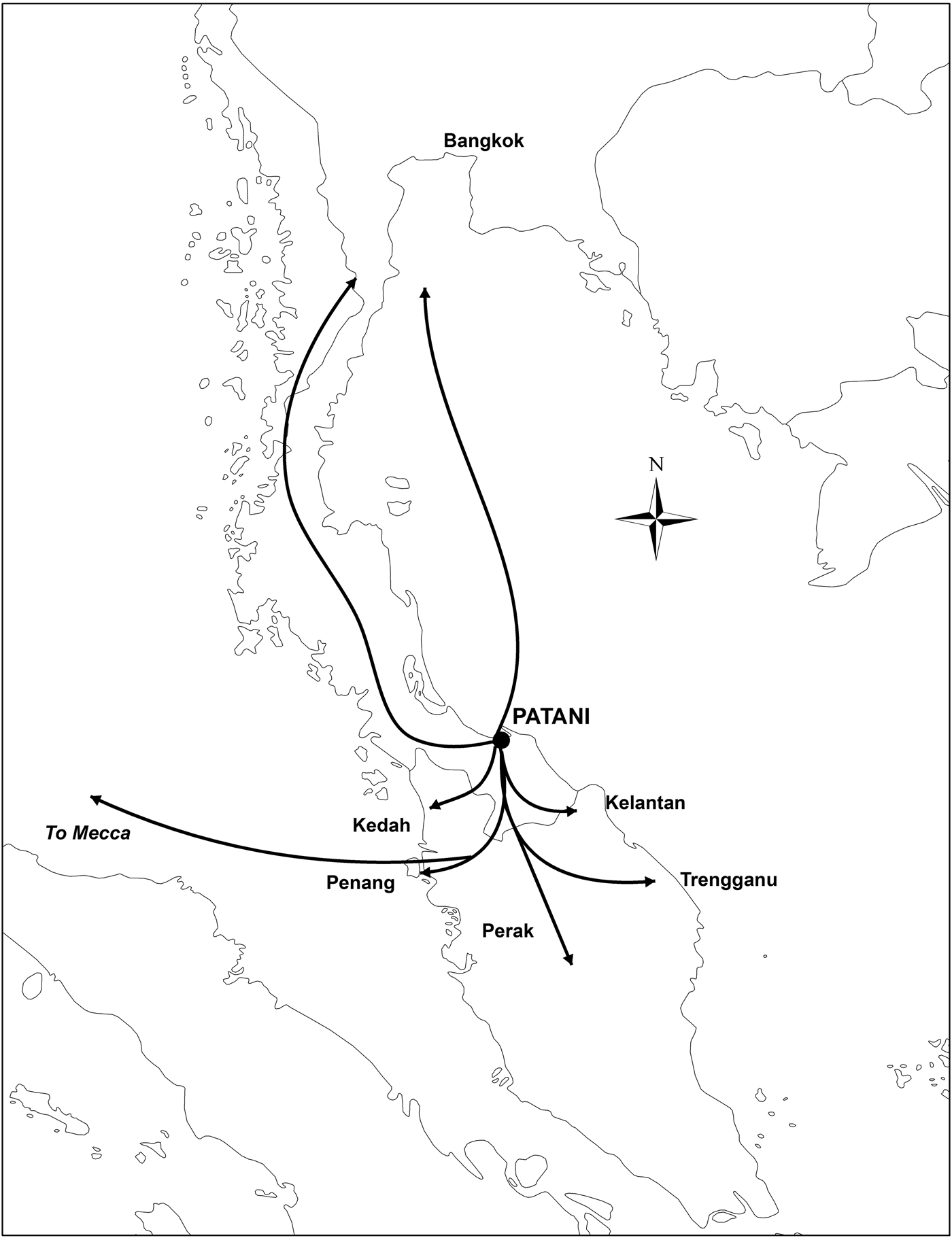
The main players in the exchange of knowledge between Arabia and Southeast Asia in the early nineteenth century were transient Malay-speaking Muslims. Particularly active were scholars from Patani, which was conquered by Siam in the period of 1199–1253/1785–1838. Massacres and expulsion in 1200/1786 and 1247/1832 led to thousands or even tens of thousands of refugees fleeing south into the neighboring peninsular regions of Kedah, Kelantan, Perak, and Terengganu, and a privileged few who made the journey to Mecca (Bradley Reference Bradley2010, 114–88). In Islam's holy city, these refugees-turned-scholars constructed newfound cultural unities, established pervasive discourses regarding Islamic practice, and transmitted these ideas to Southeast Asia via knowledge networks (see figure 1).
The northern trajectories indicate the possible routes for the slaves captured in 1200/1786 and 1247/1832. The southern trajectories represent the flight of Patani refugees. Map created by Dr. Jessica Athens.

Had the cultural destruction of Patani not been so devastating in 1200/1786, the sultans might have recovered their prestigious position, reestablished the court as the center of social life in the sultanate, and reconstructed a sociocultural power matrix with themselves at the apex. But the fall of Patani in 1200/1786 was a watershed moment for the sultanate and its people. Its reigning sultan, Muhammad, was slain in the battle, and the ruling dynasty came to an end. Patani's legendary cannons, once marks of political prestige and military puissance, were captured and taken to Bangkok along with thousands of slaves (Toua, n.d., 5). The sultan's nobat, sacred drums of sovereignty bequeathed as royal regalia by the last sultan of Melaka and passed down through the generations, disappeared, likely destroyed when the Siamese army burned the palace (istana) and the entire city to the ground (Bradley Reference Bradley2009, 288–89). The sultanate's principle mosque at Kresik, built in the early seventeenth century under royal patronage, was the only building left standing. As a Siamese chronicler, who escorted the victorious army in 1200/1786, wrote of the mosque, “The ceiling and floor are all broken, but the walls are still there which enclose all four sides” (Toua, n.d., 1). These people, places, and objects were of immense symbolic significance to the old system of value and prestige, and, without them, Patani's new leadership was to struggle for several decades before coalescing around a new moral order promulgated by Islamic leaders via an unprecedented textual tradition. Thus a sociomoral system that had been crumbling through the course of the eighteenth century came to its definitive end.Footnote 5 The leaders of the scattered community would take several decades before forging a new vision of themselves via writing.
The Patani community arrived in Mecca with at least a three-century tradition of Islamic belief and practice, but there is yet no evidence of a sustained scholarly tradition.Footnote 6 The sultanate's royal chronicle, the Hikayat Patani, features the conversion of the raja and the court as second in importance only to the foundation of the polity itself, but sheds little light on the role of Islamic leaders other than the building of an early mosque and the spread of basic teachings (LC 1839, 5–11, 14–15). It is very likely that Patani drew its knowledge of Islam considerably from the Sultanate of Aceh in the seventeenth century, despite its often adversarial relationship with the Sumatran power during the period. With the benefit of royal patronage, Aceh developed Southeast Asia's first sustained Islamic scholarly tradition for which ample evidence has survived. Nūr al-Dīn al-Ranīrī (d. 1068/1658) and ‘Abd al-Ra‘ūf al-Sinkīli (1023–1104/1615–93) were the most prominent of these scholars, building on or reforming the work of their predecessors. Via scholarly or trade networks, texts by these authors found their way to Patani, for which there is evidence by the early nineteenth century (MKI 144B, 13; PNM 547B, 12r; 781(1), 57r; 1690, 207r; 2270B, 30r; 2410, 150v).Footnote 7 Texts by the eighteenth-century Terengganu scholar ‘Abd al-Malik bin ‘Abd Allāh (better known as Tok Pulau Manis, c. 1060–1148/1650–1736) also appeared in Patani around the same time (PNM 2400A, 51r). Thus at the point when Patani scholars first began traveling to Mecca in significant numbers in the nineteenth century, they were already familiar with an Islamic scholarly tradition conducted in the Malay language stretching back more than two centuries.
In Mecca at the turn of the nineteenth century, language was the common ground upon which individuals from disparate Southeast Asian communities established bonds with one another (Snouck Hurgronje Reference Snouck Hurgronje and Monahan1931, 229). In their distant, newfound home, Jāwī from south Sumatra, southern Borneo, Patani, and other parts of Islamic Southeast Asia now formed a community in Mecca where they discussed the relevant issues of their day, debated scholarship, exchanged and shared texts, and competed for prestige within a small circle of religious scholars known as ‘ulamā’ (Azra Reference Azra2004, 112, 120; Snouck Hurgronje Reference Snouck Hurgronje and Monahan1931, 245).Footnote 8 It is not clear how large the community was at that time, but it likely numbered in the low hundreds, when including the families and entourages affiliated with the chief scholars. Despite the community's relatively small size, these writers began to harness the social forces of Islamic renewal and reform in an attempt to bring changes to their home communities that faced a diverse set of threats, from economic and political subjugation to perceived moral decay and social upheaval.
Mecca was changing rapidly at the turn of the nineteenth century. The Wahhābiyya movement spawned by Shaykh Muḥammad ibn ‘Abd al-Wahhāb (1115–1206/1703–92) sent profound sociomoral reverberations throughout the Islamic world as the most concerted and powerful effort to reform Islamic practice since Abū Ḥāmid Muḥammad al-Ghazālī (450–505/1058–1111). The Wahhābiyya began as followers of the Ḥanbalī school of law, generally considered the most “conservative” of the four Sunni schools of law, and were heavily influenced by the writings of Ibn Taymiyya (661–728/1263–1328). The central doctrine of the Wahhābiyya was monotheism (tawḥīd), and they rejected theological innovation, blind imitation (taqlīd), saint worship, vows, and pilgrimages to shrines (Laoust Reference Laoust1939, 514–24). And though they did not find fault with Muslims who appealed for intercession (tawassul) from the Prophet Muḥammad in approved ways, they criticized those who employed the practice involving recently or long-dead Sufi saints. The Wahhābiyya movement naturally came into conflict with many Sufi practices, which were synonymous with Islamic practice in many parts of the Muslim world. Many of these controversial debates continue to the present day.
Shaykh Dā’ūd bin ‘Abd Allāh al-Faṭānī (1183–1263/1769–1847; hereafter Shaykh Dā’ūd) was the most prominent of the Patani scholars in Mecca in the early nineteenth century, and the later knowledge networks built by his students mainly served to spread his writings. There was a distinct shift in the scholarship of Shaykh Dā'ūd during and after the Wahhābiyya occupation of Mecca. Before 1226/1812, he spent nearly all of his time translating Shāfi‘ī legal codes. These were relatively short treatises on themed topics, such as the laws of marriage, inheritance, or mercantile transactions.Footnote 9 Soon after the Wahhābiyya defeat, however, he turned to more practical texts concerning the hajj, Friday prayers, and the building of mosques. By 1232/1817, as the Wahhābiyya presence was surely receding, he first turned to the teachings of the great Sufi, al-Ghazālī, and spent much of the next seventeen years translating and extrapolating upon related teachings and writings. Only late in life did he return to an interest in legal texts, brought on by continued political problems for Patani back on the Malay-Thai peninsula.
Redefining the Family via Shāfi‘ī Law
Shaykh Dā’ūd's most popular and widely disseminated books were his legal tracts, largely due to the fact that they most directly addressed the social problems Patani faced. For a society that had been shaken to its very foundations by warfare and displacement, these focused and practical treatises, centered upon relevant thematic topics, had great appeal. Through the course of the nineteenth century, these books, read widely by the Patani community and broader Jāwī circles, served to orient them around the religious authority of Mecca, redefining the role of individuals, families, and communities within the broader Muslim world. I seek to build upon a number of influential studies that have made major steps forward in scholars' understanding of Southeast Asian family dynamics in recent years (Aihwa and Peletz Reference Ong and Peletz1995; Andaya Reference Andaya2000; Day Reference Day2002; Reid Reference Reid1988–93, vol. 1). Of particular influence on my thinking about families, anthropologist Engseng Ho (Reference Ho2006) broke new ground in his study of Ḥadhramī families in the Indian Ocean by examining how families continued to play a crucial role in community power relations after their state apparatuses had been destroyed.
I analyze the Patani case by asking how families became the single most influential social units for religious change and the transmission of knowledge. There are very few sources upon which to draw to illustrate family dynamics in pre-1785 Patani. The sultanate's royal chronicle displays how elite families operated with extended kin groups, sometimes in concert against rival families but no less often devolving into intrafamily feuds (Teeuw and Wyatt Reference Teeuw and Wyatt1970). Familial alliances often reached far beyond Patani, as local stakeholders sought to buoy their fortunes by increasing their local or regional political capital (Bassett Reference Bassett1969, 431). Networks of Patani orangkaya (elite families) extended as far as Makassar, Maluku, and Batavia in the sixteenth to eighteenth centuries (Cummings Reference Cummings1998, 114; Reid Reference Reid1983, 137). Like many parts of the region, familial kin groups also included a retinue of loyal followers, including warriors and servants, and often including scribes, entertainers, accountants, spies, and the like.
The fall of Patani in 1200/1786 thrust the family to the forefront of social relations within the Patani community. Indeed, the family came under considerable threat as refugees scattered. This movement of people tore apart families, separated parents and children, scattered siblings to disparate parts of the Malay-Thai peninsula and beyond, and sundered old relationships of oath, vow, and bondage. As ‘ulamā’ in the community sought to resurrect Patani, both spatially and disparately, the family became a fundamentally important social object by which to build their society anew. In Shaykh Dā'ūd's writings, he constructed legalistic prescriptions based upon the Shāfi‘ī scholarly tradition stretching back more than a millennium.
There are very few primary sources that we may employ to illustrate the place of the family in ritual observance before the fall of Patani to Siam in 1200/1786. Mosques open to public worship date to the reign of Sultan Muẓāffar Shāh (c. 936–71/1530–64), though these may have been preceded by smaller wooden structures built for the same purpose (LC 1839, 14–15). In 1602, one Dutch observer wrote of a later mosque:
The Mahometan Church is a stately Edifice of Brick-work, gilt very richly within, and adorned with Pillars. . . . In the midst close to the Wall is the Pulpit, carv'd and gilt all over, unto which the Priests are only permitted to ascend by four large Steps. (Nieuhoff Reference Nieuhoff1704, 218)
This almost certainly refers to the Kresik mosque, built under the royal patronage of Raja Ijau (r. 992–1025/1584–1616), who ruled Patani during the height of its economic and political strength. Kresik functioned as the sultanate's principle center for Muslims to worship. As Islamic practice became more prominent in the region, other smaller, less permanent structures also likely proliferated, which drew families to take part in ritual practice and knowledge acquisition.
Shaykh Dā’ūd's own genealogy reveals something about the role of an elite family in the process of acquiring knowledge and social prestige. His father, Shaykh ‘Abd Allāh, and his grandfather, Shaykh ‘Idrīs, both held respected positions at Kresik mosque. At Kresik, they naturally mediated between religious leaders and powerbrokers of the royal court, including the sultan. Shaykh Dā’ūd's line maintained their position by building relations between the court and the mosque and passed this down through the generations. Father taught son until the former's offspring had learned to deftly maneuver in court intrigue and was ready to stand on his own in religious debates and in leading rituals (LC 1839, 35–46, 75–78, 83–88).Footnote 10 Shaykh Dā'ūd himself was the eldest of at least six children, including five boys, at least one of whom joined him in Mecca. Shaykh Dā'ūd remained the senior scholar until his death, after which his brother and others of the inner circle took over leadership of the Jāwī in Mecca.
The transmission of knowledge and the building of a sociomoral order via family cannot readily be understood without also considering the role of the entourage. Elite families' prestige was often maintained by their ability to attract followers that included bodyguards, servants, slaves, warriors, scribes, religious advisors, musicians, and others (Reid Reference Reid1988–93, 2:35, 86, 108). The exodus from Patani in 1200/1786 undercut even the most economically powerful families from maintaining such large followings. But the tradition of acquiring protégés continued in religious communities. A respected teacher sometimes adopted a gifted student as his own son, and in many cases teachers solidified the bond by arranging a marriage between their daughter and the protégé.Footnote 11 In this way, families became not only the vessels of the passage of moral and religious authority, but also vibrant units for the transmission of knowledge and the reproduction of social changes often associated with Islamic revivalism.
Even close relatives had often become scattered after the exodus of Patani refugees in 1200/1786, but those with means to do so maintained contact with their siblings, cousins, and other relations in the decades that followed.Footnote 12 These lines of communication formed the foundation for the spread of Islamic knowledge between resettled branches of the scattered community. Mothers and fathers also reproduced a system of social values embedded in Islamic beliefs and practices by teaching their children, nephews and nieces, and grandchildren. Thus family upbringing, material circumstances, and one's familial or social relationship to scholars and teachers—the most powerful cultural producers—together gave birth to transformative social dynamics in the Patani community that allowed ‘ulamā’ to construct a new moral order centered upon Islamic learning. But these reforms were not confined to elite circles only, they were aimed at the entire community of believers, addressing “the religious problems to which the answers are needed by both educated and common believers” (Faṭānī, n.d.a, 2).
Shaykh Dā'ūd composed concise works related to family matters. His writings suggest a desire to bring the Patani community into line with prevailing ideas within the Shāfi‘ī school of law because he believed this would give them the inherent moral strength necessary to rebuild in the wake of defeat. He argued that the teachings contained in such books would “enliven the world and religion, and build communications” between the sources of Islamic authority and his Patani kindred (Faṭānī, n.d.b, 2). He turned primarily to one of the founders of Shāfi‘ī thought, Muḥyī al-Dīn Abū Zakariyyā Yaḥyā al-Nawāwī (631–76/1233–77). Shaykh Dā’ūd especially referenced al-Nawāwī's Minhāj al-Ṭālibīn (Direction for the inquirers) as the source for a number of his legal writings. Shaykh Dā'ūd also drew from a number of scholars who wrote commentaries on al-Nawāwī, especially ninth- through tenth-century scholars, among whom the most prominent was Abū Yaḥyā Zakariyyā al-Anṣārī (824–926/1420–1520), who wrote Fatḥ al-Wahhāb (The bounty of the giver).
In Īḍāḥ al-Bāb li-Murīd al-Nikāḥ bi-l-Ṣawāb (Explanation of the chapter for the one who desires a good marriage), which Shaykh Dā'ūd completed in 1224/1809, he provides a “commentary covering the law and rule of marriage. It also concerns divorce proceedings, as well as the other things necessary for those who need to know the right way of marriage” (Faṭānī, n.d.b, 2). This book is the first of a series of works he produced that addressed specific social concerns of the Patani community. With its sociomoral system torn asunder, the early nineteenth century was a period during which ‘ulamā’ began to reformulate the practice of a number of social objects—marriage, divorce, inheritance, trade, and worship being chief among them. Because the old order had collapsed, ‘ulamā’ seized the opportunity to redefine these actions—all of which possessed great sociomoral value—as a way of orienting the community around the spatial authority of Mecca and the moral authority of Islamic texts and teachings. This was a symbiotic process that involved gifted ‘ulamā’, students, and other members of the faithful who sought to explain their defeat and to rebuild their scattered community.
Shaykh Dā'ūd's treatise on marriage law was his single most popular work, evidenced by the movement of texts from Mecca to Southeast Asia and their circulation within the latter region, totaling eighty-four extant manuscript copies.Footnote 13 It was disseminated through the network with regularity from the time of its authorship well into the twentieth century. The work was one of the principle texts studied in Jāwī scholarly circles in Mecca (PNM 123, 42v; 470, 93; 530, 60r; 1256, 25r; 2541, 44r; 2566, 48r–49v; 2959, 23r). The text was met with widespread interest along the east coast of the Malay-Thai peninsula, appearing in Kelantan in the 1810s and Patani and Terengganu by the 1820s (MKI 75B, 105; PNM 161, 78v–78r; 2014, 110; 2545, 70v). Scholars also introduced the text wherever the network was expanding and had the greatest appeal of any of Shaykh Dā'ūd's works across the Malay-speaking world. Scholars brought it to Aceh by 1269/1853 and to Malay-speaking communities in Cape Town (today in the Republic of South Africa) around the same time. It appeared in publishing houses in Singapore from 1287/1870; Constantinople in 1304/1886; Mecca from 1306/1889; and in Egypt, Malaysia, Thailand, and Indonesia in the twentieth century (Proudfoot Reference Proudfoot1993, 135–36; Rahman Reference Rahman2002, 98).
Shaykh Dā'ūd followed his treatise on marriage law with Ghāyat al-Taqrīb fī al-Irth wa al-Ta‘ṣīb (The goal of approximation in inheritance and genealogy) in 1226/1811, which enjoyed a similar popularity. This second work detailed the Shāfi‘ī rules of inheritance, an issue that had become quite critical for the scattered people of Patani. Many in the community were now separated from their immediate families, often by vast distances, or had lost many close relatives. Others were living in new places with laws that varied from those of their native Patani. Defining inheritance and family relationships according to Shāfi‘ī law became critical to ensuring the community's survival and aligning it along a new system of value. The old authority of the sultan and, indirectly, that of the village headmen was no longer in a position to enforce traditional (adat) law, the legitimacy of which had been thoroughly humbled, and thus Islamic leaders implemented these new rules and regulations to fill the void. Shāfi‘ī law became an increasingly popular universal for a community divided, scattered, and politically marginalized.
Ghāyat al-Taqrīb was also one of the most commonly studied texts in the knowledge network, of which fifty-eight known copies exist. It remained one of the central texts for Jāwī scholars in Mecca (MKI 65, 22; 391, 42; PNM 231, 22r; 1147, 20r; 2338, 18r). There is also evidence of teachers spreading the work in Patani by the 1820s, where it retained its prominent position throughout the century (PNM 2419, 18v). Publishers in Singapore and Mecca began mass-producing the text from 1305/1887, as well as in Egypt, British Malaya, and Thailand in the twentieth century (Proudfoot Reference Proudfoot1993, 240; Rahman Reference Rahman2002, 98). The text did not travel further afield, however, perhaps encountering greater resistance from variant traditions of inheritance law practiced elsewhere in the Islamic parts of the archipelago.
The 1246–47/1831–32 Patani-Siam war, the fourth of the five conflicts between the two polities, was the most devastating for Patani since the events of 1200/1786 (Bradley Reference Bradley and Jory2012). A fresh wave of refugees appeared in Mecca shortly thereafter, to whom Shaykh Dā’ūd afforded nearly all of his energies as a teacher until his retirement in 1260/1844. Whether in response to the queries of his students or due to a personal interest in finding pragmatic solutions for the cause of Patani, he entered a new phase in his writing, turning again to Shāfi‘ī law.
The most popular work of Shaykh Dā’ūd's late legal period was Sullam al-Mubtadī fī Bayān Ṭarīqat al-Muhtadi (The beginner's ladder in the light of the guided), completed in 1252/1836. This treatise shed light upon the sources of a number of Islamic doctrines and was more broadly focused than his early legal writings. Rather than directing it at families, he addressed all segments of the community, advocating for purification of social practices, displays of public devotion, and how to respond to those who deviated from such laws and rituals. He claimed to outline all that was “required for devout worshippers” and directed his text at “families, friends, and soldiers” (Faṭānī, n.d.c, 2). Outward social practices, such as purification before prayer, fasting, pilgrimage (hajj), almsgiving (zakāt), and punishment for criminal offenses (jināya) garnered the greatest attention. As with all of his legal works, it is a moral text aimed at reforming Islamic practice and bringing existing traditions more in line with what he believed—based upon widely regarded Shāfi‘ī thought—to be the proper way for Muslims to live. This shift towards the community, just as another wave of refugees scattered across the northern Malay states, came at a time of great peril for the people of Patani. The ‘ulamā’ who spread the text sought to draw them together, offering a set of social and religious practices based upon Shāfi‘ī and broader Sunni tradition that might redefine transregional Patani as a religious community. Social practices, along with the moral attitudes and religious doctrines they outwardly expressed, became symbolic of this transition from a political community to a religious one.
Sullam al-Mubtadī was second in popularity only to his earlier writings on marriage law and found eager teachers and students throughout the knowledge network. The text maintained a regular readership throughout the century. It appeared on the east coast of the Malay-Thai peninsula in and around Patani by the 1850s, where it became one of the standard texts employed in the early learning centers (PNM 456, 48r). Publishers later began mass-producing the text in Singapore from 1313/1895, as well as in Egypt, British Malaya, Thailand, and Indonesia in the twentieth century (Proudfoot Reference Proudfoot1993, 483–84; Rahman Reference Rahman2002, 103).
Brief attention to Shaykh Dā’ūd's less popular writings further highlights the popularity of his legal treatises. He began and concluded his career as a scholar of jurisprudence, but he spent seventeen years—the most prolific period of his career—primarily focused upon Sufi writings and translations, most of which never gained the same level of readership. Of those, only his primer, al-Manhal al-Ṣāfī fī Bayān Ramz Ahl al-Ṣūfī (Pure spring in the explanation of Sufi symbolism), which he intended as an introduction for beginning students, became widely disseminated, but even of this text, only thirty-six extant copies remain. Sufi texts appear to have been relegated to circles of prestigious ‘ulamā’ and failed to gain as wide a following among students. One other notable category of Shaykh Dā'ūd's texts did gain a following: guides to prayer. Complementing legal texts, these guides to the conduct of communal prayers—a collective, social action of rising importance—were very popular alongside other books.Footnote 14
The Knowledge Network and the Emergence of Prestigious Lineages
The movement of Muslims and their teachings across the Indian Ocean began with Ḥadhramī merchants settling along India's Malabar Coast in the seventh century and reached Southeast Asia when another Ḥadhramī mass exodus occurred in the thirteenth century (Cherian Reference Cherian1969, 1, 3–12; Forbes Reference Forbes1981, 67, 82; Miller, Reference Miller1992, 41–42; Ho Reference Ho2006). A reciprocal movement by Southeast Asian Muslims to Mecca began in earnest by the sixteenth century, when scholars first came in substantial numbers to the Ḥaramayn (Attas Reference Attas1963, 22; Vakily Reference Vakily1997, 119). Thus, by the time of the arrival of Patani refugees around the turn of the nineteenth century, they came along well-charted routes most likely familiar to them in popular stories and tales.
The transmission of knowledge became the defining social characteristic of the Patani community in Mecca. One of the most significant ways they built relationships with their newfound neighbors in transplanted communities was through Islamic learning, wherever they settled. The Patani community built broad networks of scholars, teachers, and students in the nineteenth century that tied together Muslims from across the Indian Ocean on an unprecedented level.
The culture of knowledge transmission had numerous layers, only some of which will be analyzed in this article. At the apex, great scholars wrote or translated key works and thus defined the discourse on Islam as it was to develop over the course of the century. The authors of these works selected their writings from the massive stores available to them in Mecca and thus their choice to concentrate upon particular texts shows an explicit interest in introducing certain teachings, while ignoring others.
Teachers formed the second layer of people involved in knowledge transmission. They opened schools either in great centers of learning, such as Mecca, or back in their home societies, often moving between centers with regularity. It was customary, in fact, for most teachers to return to their hometown after studying, where they opened a school for students. These schools were known as pondok—taken from the Arabic word funduq, meaning circle—and generally revolved around one or more gifted teachers with a following of students or disciples. Pondok taught Malay-language literature, Arabic, and calligraphy, in addition to basics of the faith, such as prayer, oral recitation, and ritual purity. Once students had gained sufficient skill, teachers recited texts written by the great scholars, at which time students scribed their own written copies.
Students and disciples formed a third layer of people involved in knowledge transmission. The ability of some students to rise to become teachers or great scholars denotes a certain level of social mobility, or rather, that pathways existed for gifted ‘ulamā’ to gain considerable prestige via social practices, cultural acquisition, and the adoption of moral attitudes imbued with value by the broader community. The system was far from stagnant—even the corpus of Shaykh Dā'ūd's works alone provided a wide enough variety of thought to provide debates between students who focused on one text or another. Others inevitably rose through the ranks of the learned to compose works of their own, amplifying aspects of their predecessors' teachings or challenging prevailing perspectives on Islamic belief and practice. Nevertheless, Shaykh Dā'ūd's writings constituted the vast majority of texts studied in the network until around 1286/1870, after which the works of other scholars gradually appeared alongside them.
The most successful scholars established prestigious lineages through which knowledge and authority flowed and evolved. Sons, son-in-laws, and nephews of existing shaykhs benefited from valuable social and cultural capital by which to establish socially prestigious positions for themselves. They maintained their position by continuing to define Patani as a moral and religious community. The continued process of scholars teaching and spreading religious texts maintained the sociomoral order.
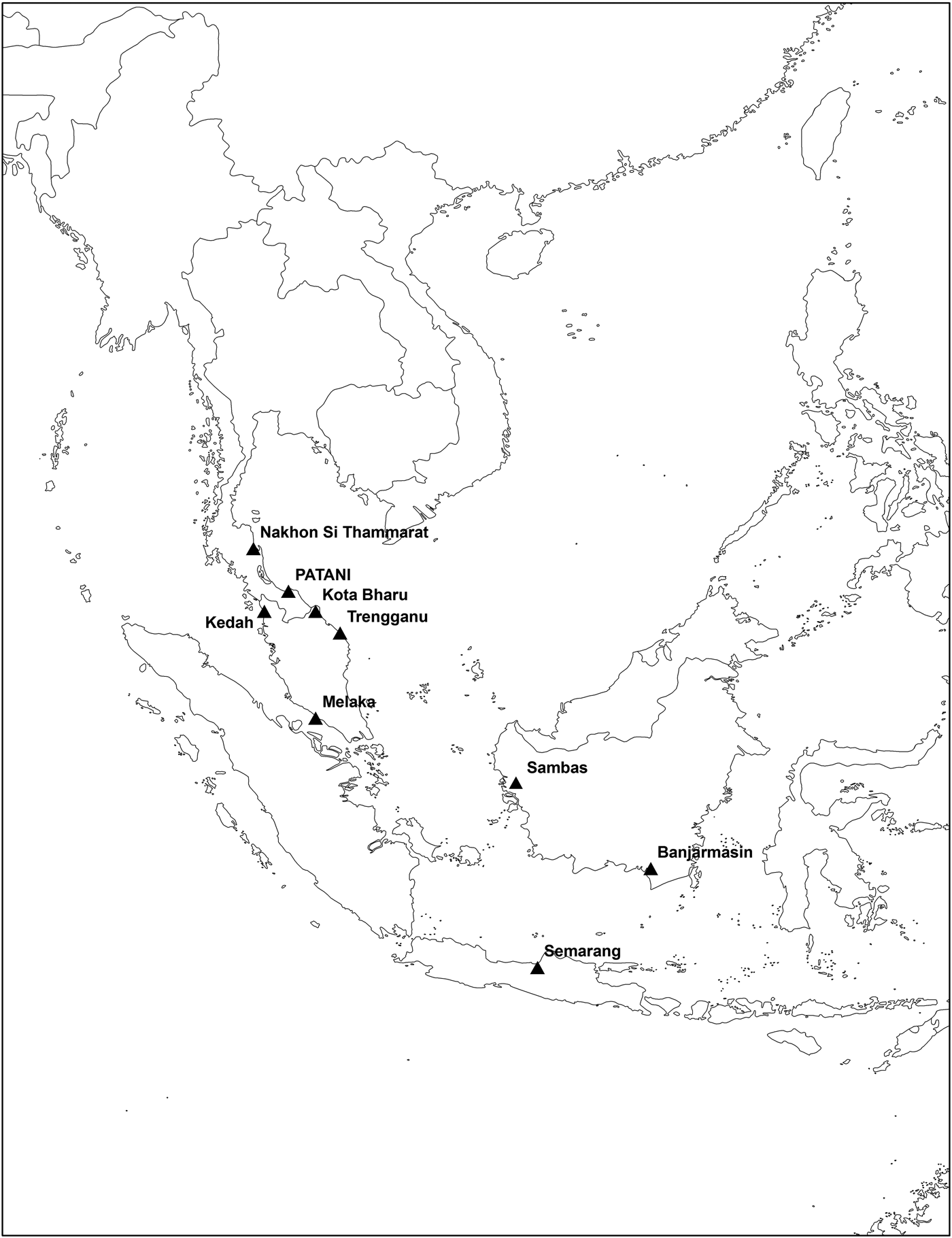
Shaykh Dā'ūd, for all of his interest in the family unit, never married and had no children of his own. This may have played a role in his desire to draw together dedicated students who could carry on his legacy and continue to spread his teachings. He had at least twenty-seven students who joined him in Mecca, but only those who left behind written copies of his works are known. He likely taught many more whom the sources did not record. Though fifteen were from Patani, others claimed origins from throughout the peninsula and wider Jāwī world, including Nakhon Si Thammarat, Kedah, Kelantan, Terengganu, Melaka, and Banjarmasin (see figure 2). The tradition of returning to one's birthplace to teach what one had learned in Mecca may have begun during Shaykh Dā'ūd's time, if it had not existed earlier. But this became the norm for students involved in the knowledge networks well into the twentieth century. In this manner, scholars transmitted knowledge from Mecca back into their home communities.
The origins of Shaykh Dā'ūd Faṭānī's students who came to study in Mecca. Most of these students afterward returned and spread his teachings in or near their homes. Map created by Dr. Jessica Athens.
After Shaykh Dā'ūd's death in 1263/1847, other teachers, including his younger brother, Shaykh ‘Idrīs, took over leadership of the scholarly circle in Mecca. Teachers continued returning to Southeast Asia's Malay-speaking areas carrying copies of Shaykh Dā’ūd's works. Later, Shaykh Dā'ūd's grandnephew, whom he had taken as his adopted son, Shaykh Muḥammad bin Ismā‘īl Dā’ūd al-Faṭānī (1260–1333/1844–1915), known as Shaykh Nik Mat Kecik Patani, emerged as one of the most esteemed teachers within the community in Mecca by the 1880s, when he spread existing texts and added more than ten of his own works to the intellectual milieu (Daud Reference Daud and Daud2001b, 193–201; Fatani Reference Fatani2002, 76). Another grandnephew, Shaykh ‘Abd al-Qādir bin ‘Abd al-Raḥmān al-Faṭānī (c. 1245–1315/1829–98), known popularly as Shaykh Nik Dir Patani, was active in the Shaṭṭāriyya Sufi order, affiliated himself with an anti-Wahhābiyya contingent in Mecca, and wrote over a dozen of his own works on diverse topics from Sufism to Qur’ānic recitation (tajwīd) (Daud Reference Daud and Daud2001a, 129). He also instructed a number of the most influential Shaṭṭāriyya brothers of the succeeding generation. Later generations of the family continued to play key roles in the community well into the twentieth century.
A second family that also became influential within the knowledge networks first came to prominence at Pondok Bendang Daya, near Patani, with relations who regularly connected with the community in Mecca. Shaykh ‘Abd al-Qādir bin Hajji Muṣṭafā al-Faṭānī (1234–1312/1818–95) studied directly with Shaykh Dā’ūd in Mecca in the 1830s, after which he returned to the peninsula, where he succeeded his father as chief teacher at Bendang Daya (MKI 158, 10; PNM 2764, 66v). He taught Shaykh Dā'ūd's texts on Sufism as well as other legal works and wrote his own books concerning Sufism and monotheism (MKI 17, 23; 729, 21; PNM 181, 32v; 1495A, 11r; 1495B, 14r; 1495C, 14r). Through his efforts, Bendang Daya became one of the most prestigious schools on the peninsula in the 1880s and 1890s—one of the final destinations for the most gifted students before they continued their studies in Mecca. His nephew, Shaykh Aḥmad bin Muḥammad Zayn al-Faṭānī (1272–1325/1856–1908), became one of the most prolific Jāwī writers in Mecca during the final two decades of the nineteenth century.Footnote 15 He also supervised the Malay wing of the Ottoman press in Mecca from 1301/1884 until his death, during which time he mass-produced copies of Shaykh Dā'ūd's works chief among its publications.Footnote 16 Two other members of the family carried on the legacy of teaching in Mecca until after World War II.Footnote 17 Other members of the family also figured as prominent teachers in Patani, Kedah, and Kelantan, as well as among the descendants of the slaves who still resided in Bangkok, and one went to India (PNM 1502; Awang Reference Awang and Daud2007; Fatani Reference Fatani2002, 149–66, 284–86, 289).
Many other examples of prestigious families arising from the scholarly milieu exist that will not be entertained here. Some of these lasted only for two or three generations, while others survive to the present day. The evidence provided shows that in this stateless power structure, families became the principle vessels for the passage of knowledge and authority. Social prestige within the community continued to evolve throughout the century, subject to the whims of scholarly debates that ‘ulamā’ waged in Mecca at the time. The chief powerbrokers managed these debates with an adept ability for fashioning the sociomoral order of the community, while justifying a social system based upon their prescribed moral authority.
Knowledge networks served to disjoin Patani from its regional context and propel its people to draw previously untapped cultural unities with a broader Jāwī community. Texts, journeys, and master-student relationships came to form a crux for the practice of their shared culture, centered upon Islam and the Malay language. While Patani's political concerns continued to draw attention even from those refugees who had settled in distant environs, the bonds they forged with other Jāwī endured long after the construction of the border that today separates Thailand from Malaysia.
Conclusion
This article has examined the role of social values in the formation of knowledge networks emanating from Mecca into Southeast Asia in the nineteenth century. The displacement of Malay-speaking populations from the Malay-Thai peninsula region of Southeast Asia gave birth to the transregional Patani community. This far-flung community stretched from Mecca back into Southeast Asia and used its scattered spatiality to its advantage in building networks of knowledge exchange and dissemination through the course of the nineteenth century. Underlying the motivations of Islamic scholars and teachers of the network was a desire to rebuild their community, which they accomplished by advocating for the moral and religious reform of the family as the most important unit after their dispersal in 1200/1786 and the result of later wars.
The period covered in this article represents only the earliest manifestations of the knowledge network as employed by the Patani scholars. Building on the work of their Southeast Asian predecessors, the Patani scholars continued to press for future reforms after the period covered here. Indeed, they encountered great success in institutionalizing their vision in the pondok that proliferated after 1286/1870. A large portion of the early teachers of pondok in what is now Malaysia in the late nineteenth and early twentieth centuries either came from Patani or were trained there. Many, in fact, traced their origins to Patani but had resettled in the northern Malay states of Kedah, Kelantan, Perak, and Terengganu. Other prominent teachers hailed from other displaced groups, such as the Minangs who had migrated north from Sumatra in the eighteenth century, the Mandailings who had been displaced as a result of a number of wars in Sumatra and later on the peninsula in the eighteenth and nineteenth centuries, and the Bugis who had similarly settled on the coasts of the peninsula in the 1700s and 1800s. The pondok were the fruit of their labor and formed a spiritual home for a number of dispossessed, exiled, and politically marginalized populations from across the archipelago.
North of the Malay-Thai border, however, the stalwart descendants of the Patani populations that chose to remain in the Siamese political periphery and often conflict-ravaged region struggled to find their place in a growing, Thai-speaking nation-state. Resistance to the central state has ranged from political organizing to educational reforms, a greater visibility for cultural practice, and sustained militant resistance. Through all of this, some of the most highly contested spaces have been the pondok, which have experienced a perceived marginalization by the central Thai state (e.g., Forbes Reference Forbes1983; Suhrke Reference Suhrke1977, 238–39). As the locus for local cultural reproduction, in many ways, these spaces still operate today as centers for social rebuilding and rebirth—an ongoing process that began nearly two centuries ago.
Acknowledgments
I conducted the initial research for this paper in Thailand with funding from the Social Science Research Council and subsequently from the Fulbright program in Malaysia. The Center for Southeast Asian Studies at the University of Wisconsin-Madison provided additional financial assistance for research in London. I owe a great deal to Thomas Wilson and the Asian Studies program at Hamilton College for providing me the time and additional funding to complete the writing of this article in 2010–11, when I worked there as a post-doctoral fellow. I also wish to thank Thongchai Winichakul, Michael Laffan, Eric Tagliacozzo, Abhishek Amar, Thom Rath, and the referees at the Journal of Asian Studies for their comments on various parts of the project. Appreciation is also due to Jessica Athens for her assistance in creating the maps.