Introduction
The application of an electric field to an atom induces polarization and an associated dipole moment. In an oscillating electric field, the electrons in a molecule also oscillate in response to the field. A plot of the induced dipole moment (polarization), μ induced, in a molecule as a function of the applied field will be linear if the molecule has a linear restoring force for the electrons around the nuclei. At the molecular level, an equation for this relationship is given by:
 $${\mu _{induced}}\, = \,\alpha \,{\rm E}$$,
where E is the electric field, and α is the linear polarizability. At the material level, one can write an analogous equation for the polarization density, which is related to the electric field by the constant referred to as the first-order susceptibility χ(1)—this is also related to the dielectric constant, and therefore, is the square of the refractive index of a material.Reference Meyers, Marder, Pierce and Brédas1
Not all materials respond linearly to an oscillating electric field. In some cases, there is a significant deviation from linearity in a plot of the induced dipole moment as a function of the electric field (especially at high field strengths), which can be described by expressing dipole moment as a Taylor series expansion as a function of the field (shown below to third order in the field):
 $${\mu _{{\rm{induced}}}}\, = \,\alpha \,{\rm E}\, + \,{\beta \mathord{\left/ {\vphantom {\beta 2}} \right. \kern-\nulldelimiterspace} 2}\,{E^2}\, + \,{\gamma \mathord{\left/ {\vphantom {\gamma 6}} \right. \kern-\nulldelimiterspace} 6}\,{E^3}\, + \,...\,.$$
Beyond the first term, α E, the terms scale with higher powers of the field, for example, quadratically (β) and cubically (γ) with the electric field; these terms are referred to as “nonlinear polarization” terms.
Both β and γ (χ(2)), second-order susceptibility, and χ(3), third-order susceptibility, for bulk materials, respectively) give rise to interesting effects that can be used, for example, for optical switching and for generation of new frequencies using lasers. In order to generate these effects and others efficiently, we are interested in understanding how to design molecules and materials that optimize molecular nonlinearity and bulk nonlinear susceptibility. In this article, we limit the discussion to effects that scale as the third-power of the electric field (E 3),Reference Meyers, Marder, Pierce and Brédas1–Reference Gorman and Marder16 referred to as third-order nonlinear optical effects. The term that relates E Reference Cumpston, Ananthavel, Barlow, Dyer, Ehrlich, Erskine, Heikal, Kuebler, Lee, McCord-Maughon, Qin, Röckel, Rumi, Wu, Marder and Perry3 to the induced polarization on the molecular level is the “second-hyperpolarizability” (or “third-order polarizability”) (γ), and on the bulk materials level is the “third-order susceptibility” (χ(3)).
There is both a realReference Meyers, Marder, Pierce and Brédas1,Reference Hales, Zheng, Barlow, Marder and Perry6,Reference Hales, Matichak, Barlow, Ohira, Yesudas, Brédas, Perry and Marder10–Reference Hales, Barlow, Kim, Mukhopadhyay, Brédas, Perry and Marder15 and an imaginary part of χ(3).Reference Albota, Beljonne, Brédas, Ehrlich, Fu, Heikal, Hess, Kogej, Levin, Marder, McCord-Maughon, Perry, Röckel, Rumi, Subramaniam, Webb, Wu and Xu2–Reference Rumi, Ehrlich, Heikal, Perry, Barlow, Hu, McCord-Maughon, Parker, Röckel, Thayumanavan, Marder, Beljonne and Brédas4,Reference Chung, Zheng, Odani, Beverina, Fu, Padilha, Biesso, Hales, Zhan, Schmidt, Ye, Zojer, Barlow, Hagan, Van Stryland, Yi, Shuai, Pagani, Brédas, Perry and Marder7–Reference Haske, Chen, Hales, Dong, Barlow, Marder and Perry9 The real part, Re(χ(3)) is the “nonlinear refractive index,” which describes how the refractive index of a material changes in the presence of an electric field, for example, an intense light source such as that from a pulsed laser. The ability to modulate the refractive index of a material by an intense light beam enables the material to be utilized for a variety of optical-switching applications.
The imaginary part, Im(χ(3)), is related to a process referred to as “two-photon absorption” (2PA), in which the molecules simultaneously absorb two photons of light to create an excited state whose energy lies at the sum of the energies of the two absorbed photons. Two-photon absorption gives rise to interesting phenomena. For materials exposed to an intense focused laser beam, excitation will be mainly confined in three dimensions at the focus of the laser beam. For certain applications, very strong 2PA arising from a large Im(χ(3)) is desirable, and for other applications, a very large nonlinear refraction arising from a very large Re(χ(3)) is desirable.
Additionally, in some cases where we want a very large Re(χ(3)), having any 2PA (i.e., Im(χ(3)) > 0) at the wavelength of interest is very detrimental. In some instances, we want to both maximize |Re(χ(3))| and minimize Im(χ(3)). Fortunately, quantum chemists can help us describe the essence of third-order nonlinear optical effects with equations, derived from perturbation theory, that relate third-order nonlinearity to the transition moments, transition energies, and changes in dipole moments associated with optical transitions. Working in concert with quantum chemists, one can ask: How can quantum-chemical equations be translated into molecular structure–property relationships that can guide the design of materials with desired properties?Reference Meyers, Marder, Pierce and Brédas1
Before delving into structure–property relationships, it is instructive to first briefly describe applications related to both the real and imaginary parts of χ(3). For Re(χ(3)), one can take advantage of the intensity-dependent refractive index of a material in such a way so as to enable all-optical switching applications (AOS), as described later in the text. Also, as mentioned previously, Im(χ(3)) is responsible for 2PA, which has many applications. However, only those that take advantage of the spatial confinement of excitation near the focus of a laser beam will be discussed. Since we can precisely control where excitation of molecules in three dimensions takes place, there can be, for example, excitation of fluorescence at a very small spot and, consequently, three-dimensional (3D) imaging of fluorescence in materials and in living tissues without having to filter out nonfocal point fluorescence, such as in confocal microscopy.
One can also make 3D optical memory or fabricate 3D micrometer-sized structures where chemical (and physical) changes in the materials can be realized precisely in three dimensions by 2PA-induced processes.Reference Cumpston, Ananthavel, Barlow, Dyer, Ehrlich, Erskine, Heikal, Kuebler, Lee, McCord-Maughon, Qin, Röckel, Rumi, Wu, Marder and Perry3,Reference Zhou, Kuebler, Braun, Yu, Cammack, Ober, Perry and Marder5,Reference Haske, Chen, Hales, Dong, Barlow, Marder and Perry9 Although 3D printing holds promise in additive manufacturing, 2PA allows for 3D microfabrication on a scale ca. 100× smaller than the lower size limits of conventional 3D printing. In the case of 2PA fabrication, truly nanoscopic structures (i.e., with feature sizes under 100 nm) can be created with 3D control using visible light as the excitation source by activating chemistry that changes the property of a material in a confined volume in three dimensions.
Two-photon absorbing materials and applications
My group’s 2PA-focused research program—in collaboration with my colleague Joseph Perry—started nearly 20 years ago when we observed a very simple organic molecule with a “stilbene” (C6H5–CH=CH–C6H5) core shown in the top left of Figure 1. Donors on each end had a 2PA cross section that was ∼20× that of stilbene itself (i.e., without donors on the end).Reference Albota, Beljonne, Brédas, Ehrlich, Fu, Heikal, Hess, Kogej, Levin, Marder, McCord-Maughon, Perry, Röckel, Rumi, Subramaniam, Webb, Wu and Xu2 It was conjectured that the 20× increase in cross section was due to the fact that, upon excitation, there was a symmetrical redistribution of electron density from the donors on the ends of the molecule toward the middle that caused a change in quadrupole moment. Our long-time collaborator, Jean-Luc Brédas, performed extensive calculations on these molecules and was able to reproduce the 20× difference in cross section and confirm that indeed there was a large change in the quadrupole moment of these molecules upon excitation.Reference Albota, Beljonne, Brédas, Ehrlich, Fu, Heikal, Hess, Kogej, Levin, Marder, McCord-Maughon, Perry, Röckel, Rumi, Subramaniam, Webb, Wu and Xu2
Examples of the effects of variation of chemical structure on two-photon absorption cross sections starting with stilbene (top left going clockwise) and showing the effects of adding donors to the end (D–π–D), acceptors to the middle (D–A–D), and the reverse (A–D–A). Note the enhancement of the cross section with increasing conjugation length (1 GM = 10–50 cm4s/photon). Reproduced with permission from Reference 2. © 1998 American Association for the Advancement of Science; and Reference 4. © 2000 American Chemical Society.

Our team hypothesized that molecules could be designed to have even larger cross sections than that observed for the bis(donor)-substituted stilbene (which was one of the largest cross sections that had been reported for any organic molecule at the time). This could be achieved by increasing the length over which charge was transferred during excitation to increase the change in quadrupole moment or to increase the amount of charge that was transferred, not only by having donors at the ends of the molecules, but also by having acceptors at the middle (or vice versa). Many examples of these types of molecules were synthesized in our labs. Perry’s group characterized their cross sections, and Brédas’ group performed extensive calculations to provide theoretical support. To summarize and simplify well over a decade of work, this simple design strategy is robust and has now been successfully applied to a large variety of organic structures by many groups around the world. Today, molecules have been identified that have cross sections on the order of 100–200× the cross section of the best molecules at that time (Figure 1).Reference Albota, Beljonne, Brédas, Ehrlich, Fu, Heikal, Hess, Kogej, Levin, Marder, McCord-Maughon, Perry, Röckel, Rumi, Subramaniam, Webb, Wu and Xu2,Reference Rumi, Ehrlich, Heikal, Perry, Barlow, Hu, McCord-Maughon, Parker, Röckel, Thayumanavan, Marder, Beljonne and Brédas4,Reference Chung, Zheng, Odani, Beverina, Fu, Padilha, Biesso, Hales, Zhan, Schmidt, Ye, Zojer, Barlow, Hagan, Van Stryland, Yi, Shuai, Pagani, Brédas, Perry and Marder7
Many of the molecules that have large 2PA cross sections are fairly easily oxidized in the ground state by virtue of being substituted with strong donors, and, largely for the same reason, they are very strong excited-state reducing agents. As a consequence, these molecules can be used to initiate chemical reactions induced by an electron transfer reaction triggered by 2PA. For instance, one can transfer an electron to an acrylate group (CH2=CH(CO2R), R = alkyl group) and create an acrylate radical anion, which can then find a proton to create an acrylate radical, which then initiates radical chain polymerization.Reference Cumpston, Ananthavel, Barlow, Dyer, Ehrlich, Erskine, Heikal, Kuebler, Lee, McCord-Maughon, Qin, Röckel, Rumi, Wu, Marder and Perry3,Reference Marder, Brédas and Perry8 If 2PA triggers the electron transfer event,Reference Albota, Beljonne, Brédas, Ehrlich, Fu, Heikal, Hess, Kogej, Levin, Marder, McCord-Maughon, Perry, Röckel, Rumi, Subramaniam, Webb, Wu and Xu2,Reference Zhou, Kuebler, Braun, Yu, Cammack, Ober, Perry and Marder5 then, under the correct conditions, polymerization can be confined to a very small volume element (voxel) at the focus of the laser beam. (For reasons that are beyond the scope of this article, the polymerization can actually be confined to a size smaller than the diffraction limit of the laser beam.) If this is done using a monomer that has at least two acrylate groups, then the polymerization will create a cross-linked acrylate that often has enough mechanical integrity to produce defined structures. Since the laser beam can be moved in three dimensions and turned on and off, the buildup of complex 3D structures is relatively easily compared to lithographic techniques.
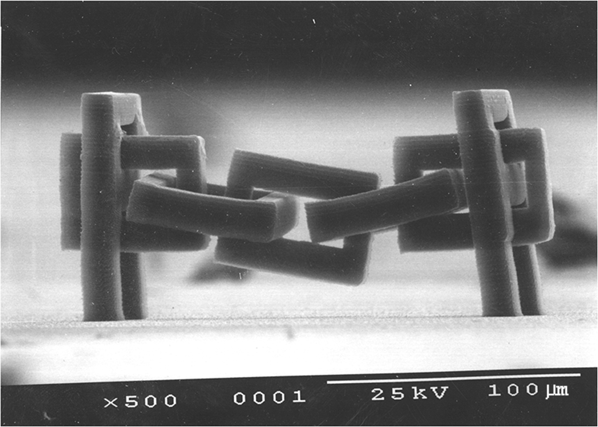
One of the initial structures fabricated in this manner in Perry’s group is shown as an example in Figure 2.Reference Marder, Brédas and Perry8 Many of these initial structures are on a scale comparable to the thickness of a human hair (50 μm), which is rather large relative to what has subsequently been shown to be achievable. Photonic crystals, microfluidic structures, and surfaces to use as templates for tissue engineering can be created.Reference Albota, Beljonne, Brédas, Ehrlich, Fu, Heikal, Hess, Kogej, Levin, Marder, McCord-Maughon, Perry, Röckel, Rumi, Subramaniam, Webb, Wu and Xu2 In addition to acrylate polymerization, it was also found that molecules that generate a proton upon 2PA can be designed; these are known as two-photon “photoacid generators” (PAGs).Reference Zhou, Kuebler, Braun, Yu, Cammack, Ober, Perry and Marder5 They can be used to polymerize acid-sensitive monomers such as epoxides, or they can change materials that are insoluble in a particular solvent mixture to becoming soluble by breaking off functional groups. The 2PA PAGs made in our group have two-photon sensitivities (i.e., the product of the quantum yield of acid generation and the 2PA cross section) that are ca. 5–30× more sensitive than conventional PAGs used in the lithography industry. Consequently, using 2PA with our PAGs, researchers can write faster or write with much lower intensity and higher fidelity. Subsequent to our early publications, the field has taken off, and researchers around the world are now performing 3D microfabrication using 2PA. Anyone can search Google images for “two-photon 3D fabrication” and view an amazing assortment of images of microscale structures, including renditions of the Eiffel Tower, the Brandenburg Gate in Berlin, the Statue of Liberty, Tower Bridge in London, and the Empire State Building; replicas of insects; and microscale versions of some classical sculptures. It is important to note that most of these complex 3D objects can fit within the width of a human hair, which is not easy to achieve by techniques other than “two-photon 3D microfabrication”; for example, they cannot be made by conventional 3D printing at these length scales. It is gratifying that our team played a significant role in laying out the molecular design guidelines that helped to spark this intense technological development around the globe.
Example of a microstructure fabricated by two-photon three-dimensional microstructures based upon a crosslinkable acrylate.Reference Marder, Brédas and Perry8 Courtesy of Joseph Perry.
Materials with large |Re(χ(3))| for AOS applications
One of the main uses of the real part of the third-order nonlinear optical susceptibility is AOS. The quantity of information transferred monthly keeps increasing dramatically and is likely to keep increasing as users seek faster and more data transfers with the explosion of cloud computing. For the purpose of this article, we assert that using third-order nonlinear processes to switch optical signals with light can avoid the need to convert light signals to electrical signals and back into light signals during routing, thus increasing data speeds.
In order to perform efficient optical switching using third-order nonlinear processes, the index of refraction of a material needs to be modulated. Utilizing the real part of χ(3), all-optical switching can be implemented in a variety of device architectures. For example, imagine splitting a light beam into two paths, or arms, and letting the light travel along each path before recombining the two beams; this is the basic structure of a device known as a Mach-Zehnder interferometer.Reference Mach17,Reference Zehnder18 If the paths are of equal length through materials of identical refractive index, the two beams interfere constructively, and the original input signal is recovered. If, on the other hand, the paths differ sufficiently in refractive index, the beams may interfere destructively. One of the beams will accumulate a phase shift relative to the other as it travels through an arm, and if the difference in the indices of refraction between the two arms is sufficiently large, the beam can accumulate a 180° phase shift before they recombine, resulting in complete destructive interference.
Using a Mach-Zehnder interferometer composed of χ(3) materials, a control pulse of intense light applied to one arm of the interferometer can change the refractive index in that arm controllably. Consequently, it is possible to control whether there is destructive or constructive interference, and light can be modulated at very high frequency (Tb/sec). The ability to change the refractive index of a material with light, using the Re(χ(3)) of the waveguide material, is a critical aspect of AOS. However, if there is large 2PA, two problems may arise: (1) for applications using high optical power, the carrier light may be absorbed in the waveguide, resulting in unacceptably high optical loss; and (2) the high-intensity control beam can be absorbed instead of changing the refractive index in the Mach-Zehnder arm, which can render optical modulation ineffective. An important figure of merit (FOM) for an AOS material is |Re(χ(3))/Im(χ(3))|, and this ratio needed to be greater than 12.Reference Hales, Matichak, Barlow, Ohira, Yesudas, Brédas, Perry and Marder10 For almost all organic materials that had been examined, it was difficult to identify examples with both (1) a reasonable |Re(χ(3))| and (2) a sufficiently low 2PA cross section to achieve a FOM of 12 or greater. This was such a sufficiently difficult and challenging problem that companies actually stopped working on organic materials for AOS.
It is possible to achieve large |Re(χ(3))| and, simultaneously, a 2PA cross section sufficiently low for a FOM greater than 12. Here, we examine a simple model to optimize |Re(χ(3))| based on a parameter referred to as bond-length alternation (BLA). In simple donor–acceptor polymethine or polyene molecules, the extent of charge transfer from the donor to acceptor in the ground state can be related to the BLA. BLA is defined as the average of the differences in the length between adjacent carbon–carbon bonds in a polymethine [(CH)n] chain. Unsubstituted polyenes have alternating double and single bonds (bond lengths roughly 1.34 Å and 1.45 Å, respectively) and thus show a high degree of BLA (+0.11 Å). Another related parameter is the π−bond order, an electronic measure of the double-bond character of a given carbon–carbon bond. Thus, the difference in the π−bond order between adjacent carbon–carbon bonds is the bond-order alternation, where the bond order of a double bond is 2 and the bond order of a single bond is 1.Reference Meyers, Marder, Pierce and Brédas1,Reference Gorman and Marder16
A simplistic explanation is as follows: In polyenes, the molecule can be thought of as a linear combination of “resonance forms” in which one is neutral and one is charge-separated. If either of the forms greatly dominates the ground-state structure, the molecule will have a very large degree of BLA. When donors and acceptors are added (typically to the ends of the polyene chains), the relative contribution of the neutral and charge-separated resonance forms, and, thus, the BLA can be tuned. If these molecules are synthesized such that the donor and acceptor are strong and nearly identical in structure, both resonance forms of the molecule are equivalent in energy, and BLA goes to zero; this is the so-called “cyanine” limit, as shown in Figure 3.Reference Meyers, Marder, Pierce and Brédas1,Reference Gieseking, Mukhopadhyay, Risko, Marder and Brédas11,Reference Hales, Barlow, Kim, Mukhopadhyay, Brédas, Perry and Marder15
(a) Contribution of neutral and charge-separated resonance forms to the ground-state structure of molecules and the impact on bond-length alternation (BLA) and bond-order alternation as explained in the text and (b) variation of polarization γ plotted versus BLA for a simple donor (D)–acceptor (A) polyene. At the polyene limit (region A in the figure), γ starts small and positive, and then increases, reaching a positive peak. With further polarization, γ then (region B) decreases, (region C) changes sign, and reaches a large negative peak at the cyanine limit (bond-length alternation = 0). As the polarization further increases, γ (region D) becomes more positive and (region E) reaches a second positive peak before decreasing in value. Note: δ+, partial positive charge; δ–, partial negative charge.
Working with Chris Gorman,Reference Gorman and Marder16 Jean-Luc Brédas,Reference Meyers, Marder, Pierce and Brédas1,Reference Gieseking, Mukhopadhyay, Risko, Marder and Brédas11,Reference Hales, Barlow, Kim, Mukhopadhyay, Brédas, Perry and Marder15 and others, we computationally and systematically varied the polarization of these molecules, which enabled us to tune the BLA from the polyene-like form through the cyanine limit and finally to a charge-separated-like form. As a function of BLA, third-order nonlinearity was observed to start out small, become increasingly positive, become very large and negative at the cyanine limit, and then become positive again beyond the cyanine limit. It is worth noting that materials with both positive and negative Re(χ(3)) are useful in AOS. Based on this, cyanine molecules appeared to be interesting candidates for maximizing third-order nonlinear optical properties.Reference Hales, Zheng, Barlow, Marder and Perry6,Reference Hales, Matichak, Barlow, Ohira, Yesudas, Brédas, Perry and Marder10
Cyanine dyes have large negative third-order nonlinearities, and these nonlinearities increase rapidly with length. They have sharp absorption bands, which mean that materials can potentially have little linear (one-photon) absorption at energies that are typically used in AOS devices. Unfortunately, cyanine dyes aggregate because they are among the most polarizable molecules known, which can be problematic.Reference Barlow, Brédas, Getmanenko, Gieseking, Hales, Kim, Marder, Perry, Risko and Zhang13
Our team examined a particular cyanine dye that had a very large negative Re(χ(3)), but at certain input wavelengths, it unexpectedly had almost no 2PA, which is exactly what was needed for a high AOS FOM. The reasons these molecules have that particular property has to do with the spacing of excited states and the widths of electronic transitions between states.Reference Hales, Matichak, Barlow, Ohira, Yesudas, Brédas, Perry and Marder10 Critically, cyanine molecules end up having a large spacing between one excited state and a higher excited state, such that two photons of a certain energy fall between the lower and upper excited states and are not absorbed by 2PA, leading effectively to an operational window for high FOM. With this realization, other molecules were carefully designed in which |Re(γ)/Im(γ)| ranged from ca. 95 to 190, which at the time was largely unprecedented for molecules with such large |γ|.Reference Hales, Matichak, Barlow, Ohira, Yesudas, Brédas, Perry and Marder10
For these molecules to be useful in AOS applications, they need to be used at very high concentrations because Re(χ(3)) is a function of the number of molecules with a given second hyperpolarizability per unit volume (sometimes in solution, but usually in films that are at least 50% by weight of cyanine). These cyanine molecules are highly polarizable and tend to aggregate. When aggregated, additional excited states are created, which quickly become problematic. These molecules were designed to have a large energetic separation between the first and second excited states. However, aggregation leads to additional excited states that cause the absorption spectrum to change drastically and introduce new 2PA bandsReference Gieseking, Mukhopadhyay, Risko, Marder and Brédas11 that severely reduce the FOM, which is the case for the molecule in Figure 4, top left. Thus, the π-electron systems of each molecule must be prevented from interacting with neighboring molecules, even at high concentrations in the solid state.
(Top left) An example of a positively charged cyanine dye that exhibits spectral features indicative of the formation aggregates at high concentration in solution and in neat films, and (top right) a positively charged cyanine dye with groups on the “Front,” “Back,” and “End,” which tend to diminish close approaches of neighboring molecules in the solid state, suppressing aggregate formation. (Bottom left) Space-filling model representation of a cyanine dye without blocking groups (coloring scheme for atoms: yellow = S, light gray = H, and dark gray = C), and (bottom right) a compound with close approaches by other molecules to the conjugated core “blocked” by the groups on the “Front,” “Back,” and “Ends” (illustrated by the large green arrows showing the extent to which the core of the dye is “blocked”). Reproduced with permission from Reference 13. © 2014 Royal Society of Chemistry.
To alleviate this, rigid groups are positioned on the molecules that would effectively prevent the molecules from aggregating (Figure 4, top right). If certain groups are placed in the middle to effectively surround the cyanine chain, the molecules can be kept from getting too close in the middle, but can interact with each other at the ends. If certain groups are positioned on the ends of the cyanine, then the cyanines can interact with each other in the middle. In order to prevent aggregation, spacer groups need to be added to both the middle and ends of the molecule. This enabled large |Re(χ(3))| and low 2PA to be achieved simultaneously in highly concentrated films for a two-photon FOM greater than 12, which is the case for molecules with the substitution pattern such as that shown in Figure 4, top right. In some cases, the linear loss (largely from scattering due to inhomogeneity in the film, or to vibrational overtone absorption of the polymer matrix) reduces sufficiently to the point that waveguide devices for AOS applications can be considered.Reference Barlow, Brédas, Getmanenko, Gieseking, Hales, Kim, Marder, Perry, Risko and Zhang13
My colleagues Norwood and Peyghambarian at The University of Arizona have used these materials in solution-core optical-fiber devices.Reference Shahin, Kieu, Hales, Kim, Getmanenko, Zhang, Perry, Marder, Norwood and Peyghambarian12 When light is sent through an optical fiber, there is a process called “self-phase modulation,” which takes a pulse that is very narrow in linewidth and broadens the pulse over many wavelengths as it travels through the fiber due to nonlinearities in the fiber-optic materials. Ideally, a fiber with no third-order nonlinearity would have no self-phase modulation, and thus, no broadening of the optical pulse.Reference Shahin, Kieu, Hales, Kim, Getmanenko, Zhang, Perry, Marder, Norwood and Peyghambarian12 The group took hollow-core optical fibers and filled them with a solvent that had a positive third-order nonlinearity, which had some of our molecules dissolved in it. These molecules have very large negative nonlinearity, to the point where their negative nonlinearity cancelled the positive nonlinearity of the solvent for the wavelength of the light traveling through the fiber. In this manner, they were able to cancel the self-phase modulations for a pulse traveling a reasonably long length (50 cm). The ability to do this is important for several optical-fiber-based applications that require high optical power.Reference Shahin, Kieu, Hales, Kim, Getmanenko, Zhang, Perry, Marder, Norwood and Peyghambarian12
Summary
In as much as one can summarize 25 years of research with many excellent colleagues—third-order nonlinear optical properties are certainly not simple—there are real parts and imaginary parts, and these can be positive or negative. Importantly, however, they can be systematically optimized if an understanding of how the molecules can be designed is developed using a combination of first-principle quantum mechanics, some chemical intuition, and challenging synthetic work. For 2PA, donor–acceptor–donor molecules have large two-photon cross sections. Today, there are commercial two-photon 3D microfabrication systems that use two-photon microfabrication and companies that use two-photon 3D microfabrication to make products. Cyanine molecules can be very good at possessing large |Re(χ(3))| while having a very low 2PA at a particular wavelength, and we speculate that, through combinations of novel device designs, coupled with cyanine molecules of the type discussed previously, third-order nonlinear applications based on all-optical switching will become feasible. We are working together with other groups to realize this goal.
Acknowledgments
The research described in this article was only possible through the collaborative efforts of colleagues and their research teams and most particularly, my colleagues Joseph Perry, Jean-Luc Brédas, Steve Barlow, and Bernard Kippelen. In addition, I have worked closely with Nasser Peyghambarian, Robert Norwood, Eric Van Stryland, Alex Jen, and Larry Dalton. Most of us have worked together as a team for over 20 years on theory, synthesis, and characterization to obtain an overall picture. Our team has had numerous talented students and postdocs, who have made invaluable contributions to our understanding of second- and third-order organic nonlinear optical materials. We have had sustained support from various funding agencies (most notably, NSF, AFOSR, ONR, and DARPA), and I think that I can speak for the entire team in saying that we are very grateful to have had the chance to work together and contribute to this exciting field. In addition, I am grateful to Tim Parker and Steve Barlow for comments and suggestions on this manuscript.
Seth R. Marder is currently the Georgia Power Chair of Energy Efficiency and Regents’ Professor of Chemistry and Materials Science and Engineering at the Georgia Institute of Technology. He is a Fellow of MRS, the American Association for the Advancement of Science, the Optical Society of America, SPIE, the Royal Society of Chemistry, and the American Physical Society. He is a recipient of the ACS Cope Scholar Award, the MRS Mid-Career Researcher Award, and an NSF Special Creativity Award. Marder can be reached by email at seth.marder@chemistry.gatech.edu.