Implications
In previous research, in birds fed diets containing metabolisable energy concentration of 11.51 MJ/kg, dietary CP levels more than 204 g/kg were recommended for good growth in weeks 1 to 4 for blue-breasted quails (BBQs) (Wei et al., Reference Wei, Hsieh, Chang, Chiu, Huang and Lin2011). Broilers are always expected to grow as fast as possible, but the growth rate of the experimental BBQs may need controlling. This can be achieved by restricting the provision of dietary CP. Because CP requirements must be apportioned for maintenance v. growth, this study estimated CP requirements by regressing weight gain and body nitrogen accretion on protein intake.
Introduction
Blue-breasted quail (BBQ; Excalfactoria chinensis), the smallest bird of the family Phasianidae, is considered a good laboratory avian model (Tsudzuki, Reference Tsudzuki1994) and is often utilised in research (Morita et al., Reference Morita, Maruyama, Hashizaki and Katsube1999; Ono et al., Reference Ono, Nakane, Wadayama, Tsudzuki, Arisawa, Ninomiya, Suzuki, Mizutani and Kagami2005; Lõhmus et al., Reference Lõhmus, Sundstrom and Silverin2006). Broilers are always expected to grow as fast as possible, but the growth rate of experimental BBQ may need to be controlled. This can be achieved by restricting the provision of dietary CP. Given a metabolisable energy concentration of 11.51 MJ/kg, a dietary CP level more than 204 g/kg is recommended for good growth (Wei et al., Reference Wei, Hsieh, Chang, Chiu, Huang and Lin2011). In many reported experiments, a linear model has been used to compute the requirements for maintenance and growth in chickens (Edwards and Baker, Reference Edwards and Baker1999; Sklan and Noy, Reference Sklan and Noy2005; Wei et al., Reference Wei, Kuo, Chiu and Chen2009), rats (Owens et al., Reference Owens, Shin, Pettigrew and Oltjen1994a, Reference Owens, Shin, Pettigrew and Oltjen1994b and Reference Owens, Shin, Oltjen and Pettigrew1994c) and pigs (Fuller et al., Reference Fuller, McWilliam, Wang and Giles1989) according to the first stage of a dose–response curve (Morris, Reference Morris1999). The purpose of this study was to estimate individual CP requirements for maintenance and growth by regressing weight gain and body nitrogen accretion on protein intake for growing BBQ from 7 to 21 days of age.
Material and methods
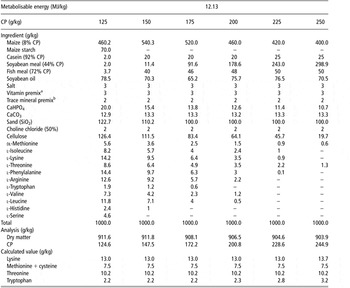
Seven-day-old quails originating from a flock in National Taiwan University and weighing 10.41 ± 0.51 g were raised in 36 individual cages (48 × 33 cm2), each holding five birds. There were 180 quails in all. Because it is very difficult to determine the sex of newly hatched quails, 1-day-old birds were assigned to cages at random. By the end of the experiment, it was possible to determine the sex by appearance and there were only 88 females and 84 males because eight birds died during the trial period. The temperature in each brooder was maintained at 40 ± 1°C for the first 2 weeks and was subsequently decreased by 2°C every 2 days to 30°C (Wei et al., Reference Wei, Hsieh, Chang, Chiu, Huang and Lin2011). The birds received for 2 weeks ad libitum water and a diet with a metabolisable energy concentration of 12.13 MJ/kg and a dietary CP concentration of 125, 150, 175, 200, 225 or 250 g/kg (Table 1). Because it was very difficult to compute formulae for diets with lower CP levels, 125 and 150 g/kg, on the basis of a lower ME of 11.51 MJ/kg recommended by Wei et al. (Reference Wei, Hsieh, Chang, Chiu, Huang and Lin2011), a higher concentration, 12.13 MJ/kg, was used instead. The moisture and nitrogen concentrations of the diets were measured by oven drying and by the Kjeldahl method, according to the Association of Official Analytical Chemists (2000, Methods 953.07 and 984.13). The measured CP contents of the diets were used to calculate CP intake and to estimate CP requirements. The daily BW per cage after a 4-h fast and the daily feed intake per cage were recorded. When a dead bird was observed, the average BW of that cage was calculated only from remaining birds on that day. The dead bird was dissected and its alimentary canal content was washed out, oven-dried and then multiplied by the moisture percentage of feed for correcting the feed consumption of that cage. The average weight gain per feed intake of that cage was calculated by the feed intake corrected and the weight gain of the remaining quails. Average metabolic BW was computed according to Edwards et al. (Reference Edwards, Fernandez and Baker1999). At the end of the experiment, all quails were killed using CO2 asphyxiation, and a midline incision was made from the anus to the pharynx to open the abdominal cavity for facilitating the following freeze-drying procedures. Bodies were stored in a freezer at −80°C overnight and freeze-dried at −50°C for 96 h to constant weight. After weighing, the dried bodies of five quails from one cage were put together and ground in a coffee grinder. The milled sample was spread onto a clean white paper and divided into nine squares. Then, separate samples from each square were combined to make a total of 6 g for the analysis of moisture and nitrogen according to methods described by the AOAC (2000, Methods 953.07 and 984.13). The Kjeldahl method was used for nitrogen analyses. Furthermore, additional 30 quails with BW around 10.31 ± 0.49 g were killed at the beginning of the experiment to obtain initial body nitrogen data for comparative slaughter.
Ingredient composition and calculated analysis of diets (g/kg as fed)

aVitamins per kilogram of diet: retinyl acetate, 4500 IU; cholecalciferol, 1000 ICU; dl-α-tocopheryl acetate, 30 IU; vitamin K3, 2 mg; vitamin B1, 3.36 mg; vitamin B2, 6 mg; vitamin B6, 4.86 mg; Ca-pantothenate, 54.59 mg; folic acid, 2.04 mg; biotin, 0.3 mg; niacin, 50 mg and vitamin B12, 0.01 mg.
bMineral supplement per kilogram of diet: Cu (CuSO4·5H2O, 25.45% Cu), 5.55 mg; Fe (FeSO4·7H2O, 20.09% Fe), 133.34 mg; Mn (MnSO4·H2O, 32.49% Mn), 67.32 mg; Zn (ZnSO4·7H2O, 22.74% Zn), 55.03 mg and Se (NaSeO3·5H2O, 30.03% Se) 0.15 mg.
Statistical analyses
The SAS GLM procedure (SAS Institute, 2002) was for orthogonal analysis to test the pattern of response belonging to linear or quadratic. A level of P < 0.05 was used as the criterion for statistical significance. The one-slope quadratic broken-line model used to determine the individual protein requirements for maintenance and growth (Morris, Reference Morris1999; Robbins et al., Reference Robbins, Saxton and Southern2006) was similar to those reported by Wei et al. (Reference Wei, Hsieh, Chang, Chiu, Huang and Lin2011).
Results
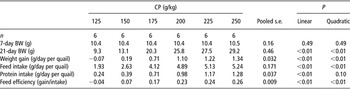
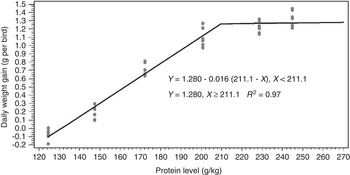
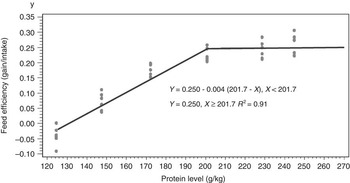
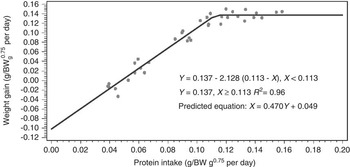
Because a total of eight birds died during the trial period, the final number of quails for the CP treatments of 125, 150, 175, 200, 225 and 250 g/kg was 27, 29, 29, 29, 29 and 29, respectively. The effects of dietary CP concentrations on BW, weight gain, feed intake, protein intake and feed efficiency are shown in Table 2. Quails fed 125 g/kg CP could not maintain their BW and had negative feed efficiency. There were linear and quadratic relationships between CP level and BW, weight gain, feed intake and feed efficiency (P < 0.05), whereas only the linear relationship was observed between CP level and protein intake (P < 0.05). Dietary CP requirements computed using the one-slope quadratic broken-line model according to weight gain and feed efficiency were 211 and 202 g/kg, respectively (Figures 1 and 2). The regression equations, on the basis of metabolic BW, of daily weight gain on daily protein intake according to the model (Figure 3) were

The effects of dietary protein levels on the growth responses of blue-breasted quailFootnote †, 7 to 21 days of age

† At the end of the experiment, the ratio of female to male for the CP treatment of 125, 150, 175, 200, 225 and 250 g/kg was 14:13, 16:13, 13:16, 16:13, 14:15 and 15:14 respectively, and the total number of observations was 172 quails.
Regression of daily weight gain on dietary protein levels according to a broken-line model for blue-breasted quail 7 to 21 days of age (n = 6).

Regression of feed efficiency on dietary protein levels according to a broken-line model for blue-breasted quail 7 to 21 days of age (n = 6).

Regression of weight gain on dietary protein intake according to a broken-line model for blue-breasted quail 7 to 21 days of age (n = 6).

The former equation could be converted to X = 0.470Y + 0.049 according to Kim et al. (Reference Kim, Cho, Shin, Yang and Han1997a), signifying that 0.049 g protein per gram of metabolic BW was required for maintenance and that an additional 0.47 g protein was required to gain 1 g weight after the maintenance requirement was satisfied.
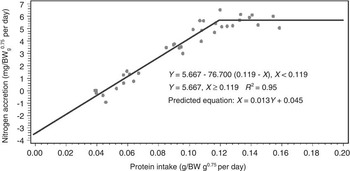
The regression equation of body nitrogen mass on BW for the birds killed at the beginning of the experiment was Y = 0.026X−0.010 (R 2 = 0.67, P < 0.05). This provided data on initial body nitrogen mass and body nitrogen accretion for the experimental quails. There were linear relationships between dietary CP concentration and both body nitrogen mass and body nitrogen accretion (P < 0.05). The regression equations, on the basis of metabolic BW, of daily body nitrogen accretion on daily protein intake according to the one-slope quadratic broken-line model (Figure 4) were

Regression of nitrogen accretion on dietary protein intake according to a broken-line model for blue-breasted quail 7 to 21 days of age (n = 6).

The former equation could be transformed to X = 0.013Y + 0.045, which was interpreted to mean that quails had to receive an amount of protein equal to 0.045 g per gram of metabolic BW to satisfy the requirement for maintenance and had to ingest an additional 13 g protein to accrete 1 g body nitrogen.
Discussion
Two different response criteria, weight gain and body nitrogen accretion, were utilised to measure protein requirements for maintenance and growth for BBQ. With regard to maintenance, both response criteria gave very similar estimates of protein requirements; this has also been observed in studies of the maintenance requirements of individual essential amino acids for broilers (Kim et al., Reference Kim, Cho, Shin, Yang and Han1997a, Reference Kim, Cho, Shin, Yang and Han1997b and Reference Kim, Cho, Shin, Yang and Han1997c). In addition, Klasing (Reference Klasing1998) compared differences in protein requirements for maintenance among tree sparrows, juncos, budgerigars, white-crowned sparrows, Japanese quails, chickens and turkeys. He constructed the equation Y = 3489X kg0.58, in which Y was the protein requirement for maintenance (mg) and X was BW (kg). According to Klasing's (Reference Klasing1998) equation, quails that were 27 g and 21 days old needed 430 mg protein for maintenance. It was estimated that the quails required 580 mg to maintain BW according to the equation, X = 0.470Y + 0.049, estimated in the current experiment. With regard to growth, the estimated 0.47 g required for a weight gain of 1 g could be converted to 15.7 g for a body nitrogen accretion of 1 g (based on 3% nitrogen in BW). This 2.7 g difference between the deduced and the measured estimate of 13 g is possibly due to variation in other body components, such as fat or water. Similar results have been reported in experiments with rats (Shin et al., Reference Shin, Owens, Pettigrew and Oltjen1994a, Reference Shin, Owens, Pettigrew and Oltjen1994b and Reference Shin, Owens, Pettigrew and Oltjen1994c) and broilers (Kim et al., Reference Kim, Cho, Shin, Yang and Han1997a, Reference Kim, Cho, Shin, Yang and Han1997b and Reference Kim, Cho, Shin, Yang and Han1997c).
When growing poultry, one can divide protein intake into two components, maintenance and growth, with the protein required for maintenance replacing the obligatory loss of body nitrogen (Klasing, Reference Klasing1998). After the requirement for maintenance is satisfied, any surplus is utilised for accretion in muscles, feathers and organs. Although the dietary CP requirement calculated according to weight gain using the one-slope quadratic broken-line model was 211 g/kg for BBQ 7 to 21 days of age, Fuller et al. (Reference Fuller, McWilliam, Wang and Giles1989) pointed out that this type of requirement regarding the entirety of maintenance plus growth can only be considered strictly applicable to one particular growth rate. That is, when forecasting the protein requirement for any accretion rate of whole body protein or for any growth rate, one must consider simultaneously the individual requirements for maintenance and growth for that given rate. For example, if the average daily weight gain is set at 0.97 g for a 1-week-old quail weighing 10.3 g, the average metabolic BW from 7 to 21 days of age would be calculated as 8.41. According to the equation X = 0.47Y + 0.049, the bird would need to ingest 412 mg protein per day for average daily maintenance and an extra 456 mg protein for average daily growth for the whole period. Furthermore, the dietary CP level would be calculated as 206 or 196 g/kg according to daily feed intake estimated by the two regression equations of feed intake on daily protein intake resulting from this study (Figure 5).
Regression of daily feed intake on daily protein intake for blue-breasted quail 7 to 21 days of age (n = 6).

In conclusion, because BBQ is considered a good laboratory avian model for research, it is necessary to apportion its protein requirements for maintenance and for growth if rates of growth or protein accretion are to be regulated by dietary CP for specific experimental purposes.