$$\raster="fx1"$$
In my final year of medical school, I had the great fortune of meeting Dr William Rashkind when I was completing an elective in Pediatric Cardiology
 $$\raster="fx2"$$
at The Children's Hospital of Philadelphia in 1981. It was one of those moments when I realised – “I want to do what he does”, and “I want to enjoy my work as much as he does”. Dr Rashkind was an innovator, teacher, humanitarian, humorist, and above all a superb clinician and role model. In most ways, he embodies the field of paediatric cardiology in the early years, a field that was led by a few forward-thinking leaders who taught the next generation of physicians. I was honoured that the Organizing Committee of Cardiology 2012 asked me to give the 11th Annual Lecture in Pediatric Cardiology in his honour.
Approximately 1 year before Cardiology 2012 in Orlando, another extremely accomplished individual in our field – Dr William Williams from the Hospital for Sick Children in Toronto – sent me a book written by Ronald WrightReference Wright 1 entitled “A Short History of Progress”. Writing about societal collapse, Wright presented a concise and moving view of thousands of years of human evolution (in 224 pages). As I was reading this wonderful evaluation of the state of the human species and how human evolution is inextricably tied to (a) the evolution of other species and (b) their combined effects on the planet, it reminded me of the evolution of the field of Pediatric Cardiology, and its symbiotic relationship with the sub-specialty of Congenital Heart Surgery. Perhaps more than any other discipline in medicine or paediatrics, our relationship with cardiac surgery is joined at the hip – certainly much more so than neurology–neurosurgery, gastroenterology–general surgery, or nephrology–urology. Thus, any discussion of progress in paediatric cardiology must, by necessity, also discuss the remarkable progress made in the surgical management of structural heart disease.
In structuring this talk, as WrightReference Wright 1 has done, I have borrowed from Paul Gauguin, the French post-impressionist artist. In one of his classic works (1897/1898), he wrote: (1) D'Où Venons Nous? (2) Que Sommes Nous? (3) Où Allons Nous? ([1] Where Do We Come From? [2] What Are We? and [3] Where Are We Going?). In this manuscript, I would like to discuss the short history of progress in the treatment of congenital heart disease, and as suggested by Gauguin this requires a look into the past, an assessment of the current “state-of-the-art”, and an educated guess regarding the future directions we will take.
How we got to where we are
“You have to know the past to understand the present” – Carl SaganReference Sagan 2
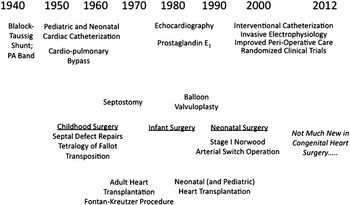
It is well beyond the scope of this article to review the history of cardiology and cardiac surgery. The reader is referred to a number of reviews on this topic,Reference Noonan 3 – Reference Castaneda 5 including Dr Rashkind's seminal review in 1979.Reference Rashkind 6 Figure 1 briefly reviews what I believe to be the major events in the past 60 years.
A short history of progress. Some of the seminal events in the history of paediatric cardiology and cardiac surgery. PA = pulmonary artery. The surgical procedures pioneered after the introduction of cardiopulmonary bypass were typically done in childhood; today, they are routinely done in early infancy.

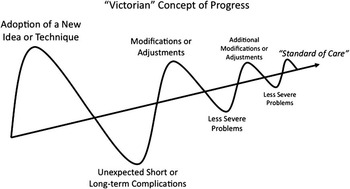
Reading these reviews, and as in Figure 1, one might assume that progress has always been a good thing in our field; however, this is not the case in the truest sense of the word. Sidney PollardReference Pollard 7 wrote of the “Victorian ideal” of progress in 1972. He stated that “… The assumption in Western cultural tradition that a pattern of change exists in the history of mankind… That consists of irreversible changes in one direction only, and that this direction is toward improvement”.Reference Pollard 7 Many of us have held a similar, simplified view of progress in the treatment of congenital heart disease. However, in reality, there are more typically “incremental” changes on original ideas, usually developed because of later complications of these new ideas, which result in subtle changes of the new idea, which is further modified, and so on. Figure 2 is a simplified representation of this modified “Victorian” concept of “progress”. A clinical example would be the changes seen in our field with the source of pulmonary blood flow provided during the Norwood procedure. On some occasions, within the same institution, surgeons have vacillated between a modified Blalock–Taussig shunt and the right ventricle to pulmonary artery conduit (“Sano modification”).Reference Tabbutt, Dominguez and Ravishankar 8 Sadly, this type of “progress” is usually due to recall bias – remembering outcomes from the last few cases; scientifically, it is more of a “random” event, rather than “randomised”. Also unfortunately, despite having results of randomised or other well-controlled clinical trials in paediatric cardiology and cardiac surgery – such as the single-ventricle reconstruction trial,Reference Ohye, Sleeper and Mahony 9 angiotensin-converting enzyme inhibition,Reference Hsu, Zak and Mahony 10 Fontan fenestration,Reference Lemler, Scott, Leonard, Stromberg and Ramaciotti 11 deep hypothermic circulatory arrest,Reference Newburger, Jonas and Wernovsky 12 etc. – many are reluctant to change practice, wishing to “believe” that what they had done for years remains “right” in the face of accumulating evidence against previously held beliefs. Leon Festinger has coined the term “Cognitive Dissonance” for this type of common human behaviour.Reference Festinger 13 – Reference Festinger 14
Graphic representation of a “Victorian” ideal of progress. Complications result in modifications of original ideas, with a presumably steady direction towards “improvement”. See text for details.

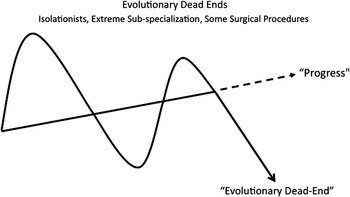
The somewhat simplified model in Figure 2 does not take into account (1) “evolutionary dead ends” and (2) “disruptive” events. “Evolutionary dead ends” are categorised by physical anthropologists when an adaptive change, which initially afforded a competitive advantage, results in the end of a species, and by social anthropologists when an adaptive change eventually results in the end of a belief system or society. More contemporary terms include “isolationists”, “niche specialists” and “niche specialisation”. For example, the sabre-toothed tigers were highly successful “specialists” for a period of time – until they ate themselves out of existence. An example of social isolationists would include “Neanderthal man” (Homo sapiens neanderthalensis). The Neanderthal were poor speakers, using telepathy as much as language; they had fire but few weapons, and they never suspected there was anyone else in the world except themselves. Their extinction was extremely rapid in the evolutionary time scale. I suspect that the reader can see some similarities in the way some centres currently deliver cardiac care.
Partly in jest, to paraphrase Konrad Lorenz the “specialist” has been defined as “someone who knows” more and more about less and less, until they know everything about nothing. 15 I believe that the extensive sub-specialisation common in our field – especially in large academic institutions – will be an “evolutionary dead end”. This is discussed in more detail below. It is important to recognise that there have been a number of surgical “evolutionary dead ends” as well, although these are rarely reported in the scientific literature. It is rare that someone wishes to report bad outcomes or bad ideas, but they surely exist. I am aware of at least two examples that have never reached the literature. In the mid-1980s, elective surgical resection was performed in children with non-obstructive sub-aortic membranes – with no aortic insufficiency – for the sole purpose of preventing progressive obstruction. In the early 1990s, banding the main pulmonary artery was performed in a series of newborns with transposition of the great arteries (<7 days of age) before an arterial switch operation just days later – with the goal of improving peri-operative left ventricular function by “training” the ventricle (Rychik J., personal communication). Patients have been submitted to these “evolutionary dead-ends” by well intended surgical and cardiology teams; however, these ideas and procedures rapidly became extinct. A graphic example is shown in Figure 3.
Representation of “evolutionary dead ends” on the road towards progress. See text for details.

However, there are many new ideas and concepts that do take hold, and result in rapid and significant changes in our field. Some have called these events “disruptive”.Reference Williams 16 “Disruptive thinking” may be thought of as “wild” leaps of insight or “revolutionary” changes. The five principles of disruptive thinking include: (1) Radically new relationships between resources; (2) A solution that transforms a constraint into a belief; (3) An idea that radically changes the scale of an innovation; (4) A concept that radically lowers cost owing to higher volume; and (5) An idea, technique or product that unearths a desire/market that no one thought was there – for example Facebook. As we look at the history of our field, it is clear that there were a number of sentinel or “disruptive” events that have radically transformed the way we care for children with congenital heart disease. The early closed surgical procedures such as the Blalock–Taussig–Thomas shunt, pulmonary artery banding, and coarcation repairs – now with 60+ years of experience – were revolutionary in their day. In the 1950s, disruptive events included cardiopulmonary bypass, and cardiac catheterisation for diagnosis and haemodynamic assessments. Rashkind's balloon atrial septostomy, first reported in 1966, was the first non-surgical, non-medical palliation for complex congenital heart disease. In the 1980s, the nearly simultaneous introduction of echocardiography and prostaglandin heralded the era of neonatal cardiac surgery. Shortly thereafter, the field of interventional catheterisation expanded and invasive electrophysiology took hold.
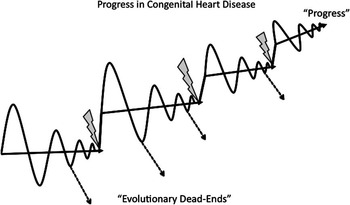
Progress in the field of congenital heart disease is indeed not linear, but a combination of incremental improvements, disruptive leaps and evolutionary dead ends (Fig 4). I believe that we are overdue for another series of “disruptive events”. In the past two decades, there has been little truly “disruptive” innovation, historically speaking. New procedures in congenital heart surgery and new interventions in the catheterisation laboratory are rare compared with two decades ago (Fig 1). A “hot topic” currently – transcatheter valve replacement – shows some promise; however, caution is warranted in this early phase, as it might also prove to be an evolutionary dead end. Decades of follow-up are necessary to determine what procedures, technologies, ideas, or medicines are truly “disruptive”.
Representation of the effect of “disruptive” events or technologies (“bolts”) and failed procedures/techniques (“dead ends”) on progress. See text for details.

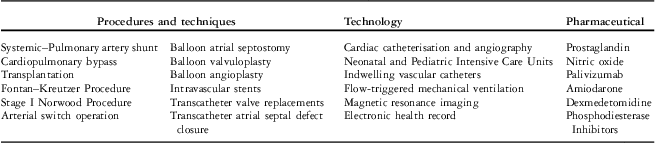
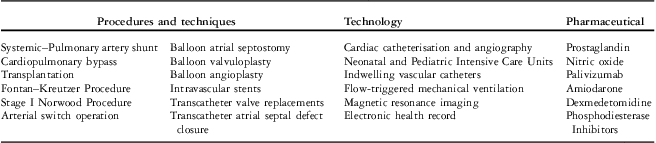
“Disruptive” events in congenital heart disease care.
Assessing the current status of our field
Therefore, how best to assess the current status or “state of the art” in the treatment of paediatric cardiovascular diseases? First and foremost, there is virtually no congenital heart disease without a treatment option in 2012 – a truly remarkable accomplishment over three to four generations of care. Much of this progress has been due to the simultaneous introduction of technology, medications, high-tech intensive care units, and the visionary thoughts of individual paediatric cardiologists and cardiac surgeons. Our patients are surviving at rates once thought impossible. Importantly, there have been additional efforts made to improve safety and quality, specifically to address neurodevelopmental outcomes,Reference Marino, Lipkin and Newburger 17 – Reference Andropoulos, Easley and Brady 21 “quality-of-life” assessments,Reference Luyckx, Missotten, Goossens and Moons 22 – Reference Mussatto 25 and a more thorough evaluation of the non-cardiac consequences of congenital heart disease.Reference Rychik, Veldtman and Rand 26 – Reference Surmeli-Onay, Cindik, Kinik, Ozkan, Bayraktar and Tokel 30
However, we must also recognise two “inconvenient truths”. First, the incidence of complex congenital heart disease is decreasing, and in some areas drastically. In part, this is due to a slowing of the overall birth rate in the United States and other developed countries. There are many theories as to why this is the case, but most believe that it is due to a slowing of the economy; this trend has been consistent since 2007 and continues to remain so at present. 31 However, in addition, the widespread application of foetal echocardiography has resulted in the pre-natal detection of complex congenital heart disease, resulting in elective terminations of pregnancy. The exact rates of pregnancy termination is difficult to ascertain in the literature; nonetheless, recent reports in the United States of America suggest termination rates as high as 40% for some complex lesions,Reference Hilton-Kamm, Chang and Sklansky 32 , Reference Swanson, Selamet Tierney, Tworetzky, Pigula and McElhinney 33 and in European and Asian countries the termination rates may be even higher.Reference Chenni, Lacroze and Pouet 34 , Reference Yu, Xi and Ding 35
The combined effects of a decreasing number of overall births and elective terminations of pregnancy are just beginning to become apparent, as there are decreasing numbers of neonates with complex cardiac disease being cared for at most large centres 36 – 39 – with an increasing number of centres “competing” to care for these children, at least in the United States. In the United States, this has resulted in a significant amount of time and money spent on “marketing” individual programmes, and sadly we continue to rely on the model of single-centre reports to determine “excellence”, while having many centres in the same geographic area each providing redundant services. When these services are expensive and/or rare, such as extracorporeal membrane oxygenation, transplantation, and complex neonatal cardiac surgery, continued expansion is an evolutionary dead end.
We must realise that many centres have developed “best practices” in one or more niches – for example, infection control, electronic health records, pain management, follow-up strategies, and complex surgery or catheter-based interventions – but may be “average” or “good” in other areas.Reference Karamlou, McCrindle and Blackstone 40 However, we continue to develop cardiovascular programmes and centres purporting to provide comprehensive services – all with superior results – in the face of evidence to the contrary and a shrinking market. We are only just beginning to collaborate across centres, and utilise and learn from others’ “best practices”, and sadly, some still do not wish to adopt this collaborative model.
From a fiscal and quality perspective, we can no longer continue to expand services and the numbers of centres providing these services in the United States. For the field to survive and advance, regionalisation of complex and expensive therapies must occur – reducing the number of centres performing complex interventions, particularly in the neonate, particularly given the decreasing incidence of complex congenital heart disease. In addition, there is a strong need to collaborate via the establishment of mandatory procedural and outcomes-based databases with an imperative for a commitment to changing practice based upon others’ improvements. Cognitive dissonance and paternalistic self-centred opinions must give way to evidence-based practices. We must be willing to change. However, first, we have to gather the evidence. In this regard, the work of the Paediatric Heart Network, as well as the work of Jeff Jacobs et al, involving the Multi-Societal Database projects, may represent the early steps of a new “disruptive event” in our field.Reference Jacobs, O'Brien and Pasquali 41 – Reference Jacobs, Edwards and Shahian 44
The second inconvenient truth is that we are ill-prepared for the wave of adults with complex congenital heart disease who have survived complex surgery over the past two to three decades, particularly in the United States. For the most part, paediatric cardiologists have done a poor job of preparing our patients and their families for transition into the world of adult medicine.Reference Webb 45 Many patients are lost to follow-up,Reference Webb 45 – Reference Meijboom and Mulder 48 emergency room visits – many preventable – are increasing,Reference Meijboom and Mulder 48 – Reference Moons, Meijboom and Baumgartner 51 and a series of unexpected complications are being seen as a result of the creative innovations of the past.Reference Stuart 52 – Reference Said, Dearani, Silversides, Martinez and Drajpuch 55 These two issues – a decreasing incidence of neonates with complex congenital heart disease, and an increasing prevalence of adults with complex congenital heart disease – are perhaps the single most important demographic change in our field since the sub-speciality began over 60 years ago.
In addition to this “demographic shift” that will shake our field, have we reached an “evolutionary dead end” in some areas? I believe in some respects we have. Reliance on our traditional ways of learning – textbooks, sit-down lectures, written and memorised recertification examinations, our traditional care models, separate “silos” of inpatient and outpatient care, extreme sub-specialisation, and in some cases our paternalistic approach to our patients and their families are evolutionary dead ends. We continue to train a younger generation to become increasingly sub-specialised, with “in-vogue” advanced fellowships responding to the short-term shifts in needs for these services. However, if we have learnt nothing else, it is most clear that everything will change: what seems “certain” in the current era – for example, the “need” for cardiac intensivists or exercise physiologists – is unlikely to be equally certain in 10–15 years. When echocardiography was introduced, what happened to the physician whose livelihood and professional identity was predominantly based on catheterisation for diagnosis? What will become of the congenital cardiac surgeon who focuses on neonates and children, given the shrinking numbers of neonates and increased numbers of less-invasive procedures in the catheterisation laboratory? What about all of the echocardiographers in current practice – what will they do when the next great technology replaces echo? As the incidence of complex congenital heart disease continues to decrease, what will become of all the cardiac units dedicated to the treatment of neonates – in an era of dramatically shrinking health-care dollars? We are becoming like sabre-toothed tigers – eating our way out of existence.
Where are we going?
“The future ain't what it used to be” – Yogi Berra
For the most part, many of us continue to provide care in an individualised, non-evidence-based model, usually based on the way we were taught by senior members of the field – sometimes referred to as “eminence-based medicine”. Sadly, there have been few, prospective, interdisciplinary, multi-centre longitudinal follow-up programmes or studies to assess how we are doing in improving our patients lives.
In addition, even if these studies were to be conceived, many have been fiscally impossible to undertake, and/or take so long to publish that the results have become irrelevant. In the past, many of us also learnt of new ideas and procedures from our mentors and teachers. Research was published in paper journals, but was always subject to “publication bias” – the fact that poor results or unsuccessful procedures were rarely published. Finally, annual societal meetings and sub-speciality meetings such as Cardiology 2012 have been one of the more popular ways of exchanging new ideas.
However the internet, electronic health records and distance learning will change these traditional methods of learning. The nearly universal availability of the Internet and the World Wide Web has drastically and forever changed the way we learn, have access to knowledge, and how we communicate. A recent study by the Pew Internet Project reported that 82% of adults in the United States use the Internet. 56 With regard to learning, new studies are available almost instantaneously on the Internet and disseminated throughout the world. Smartphones and tablets give us access to information on drugs, symptoms, images, and protocols instantaneously – which in the past needed to be memorised, available in the textbook at hand, or required a trip to the nearest medical library. Training programmes have materials available to all utilising cloud computing, and medical schools are teaching students remotely via teleconferences and online courses.
However, perhaps most important is the fact that our patients and their families are no longer “along for the ride”. They have become active participants in their care. In the past, our patients would learn about their congenital heart disease during office visits, possibly with an individualised sketch on a piece of paper – or paper towel – or some non-specific generic printed material. It is no wonder that many adults with complex disease have little understanding of their lesion, surgical management, and expected course. This has all changed. Nearly 60% of adults in the United States look online for health information, and 17% of mobile phone users – or 15% of adults – have used their phone to look up health or medical information, now coined mHealth. 56 Although there are no recent data on the percentage of patients and families affected by congenital heart disease who use the Internet, in 2002 there were about 60% Internet users.Reference Ikemba, Kozinetz and Feltes 57 In the intervening 10 years, I suspect that the usage approaches 90% or greater. Families frequently arrive for first office visits or second opinions with binders – or thumb drives – of information already in hand. Communication with physicians is shifting from phone messages on a pink slip of paper on a provider's desk to multiple e-mails, or even contacts via social media outlets such as Facebook.
I believe that the major disruptive event for the current generation of congenital heart disease has already occurred, but it has been seemingly insidious, and slow to be adopted by most cardiovascular practitioners: it is called Web 2.0. However, despite the slow adoption by cardiovascular practitioners, it has already been embraced by patients and families; in fact, it has become an expected form of instant communication.
Web 2.0
The term “Web 2.0” was coined by Tim O'Reilly, 58 and is commonly associated with web applications that facilitate interactive information sharing, inter-operability, user-centred design, and collaboration on the World Wide Web. In 1996, there were ∼250,000 websites, with ∼45,000,000 global users of the web. The majority of sites were “published content”; “user-generated content” represented a small minority of what was available on the internet. In just ten years, by 2006, over 80 million websites were registered, with over 1 billion global users. The introduction of “user-generated content” – sites such as YouTube, Facebook, Twitter, Vimeo, Blogs, and a seemingly endless number of other social media tools has fundamentally changed the way we need to interact with our colleagues, patients, and families.
“Web 1.0” typically was assessed via dial-up modem and was “E-commerce driven”. Remember Netscape? That was Internet access during Web 1.0. The majority of content were catalogues, and web pages consisted of hyperlinks and static content. “Web 2.0” was heralded by broadband, with new platforms for displaying content. There was the growth of seamlessly connecting applications, and access to the web began to move from desktops to mobile platforms such as tablet computers and smartphones. In contrast to the e-commerce driven World Wide Web, Web 2.0 has been described as “entertainment driven” and “user driven”. Google has replaced Netscape as the standard bearer of Web 2.0. 58
Many believe that we are already in the midst of the beginning stages of “Web 3.0”. The web has become less of the catalogue and more of a guide. High-grade analytics and artificial intelligence techniques are being mined to identify human behaviour, such as buying patterns and other available trends. Access is increasingly mobile – we have gone from 0 to 90,000,000 tablets in the United States in just over 3 years. With these new technologies, analytics, and computer advances, Web 3.0 is being described as “personalisation driven”. Unfortunately, for the most part, our field has failed to embrace this powerful technology. The vast amount of data we collect and create in our field, particularly in the inpatient care units and outpatient visits, goes uncollected and unanalysed. Almost begrudgingly, some practitioners began to utilise outdated listservs for patient care discussions and communications about jobs, etc. There are increasing numbers of mobile, professional-only applications with much better technology for sharing information, such as Doximity (https://www.doximity.com) and DocBookMD (www.docbookmd.com). In September, 2012, Doximity received $17 million in venture capital investment, and using collaborative, web 2.0-based technologies is beginning to tackle the significant problem of communication error in health-care delivery. 59
Although practitioners have been slow to adopt these newer technologies for patient care, communication, research, and quality improvement, this has not been the case for our patients and families. For example, on 24 February, 2012, an Internet search for the term “hypoplastic left heart” yielded 391,000 results (in 0.22 s). That same search on 20 September, 2012 yielded about 543,000 results (in 0.53 s). During the same time frame, YouTube searches for the term hypoplastic left heart increased from 452 to 696. Finally, by September 20, 2012, over 100 sites were linked by Facebook to the term hypoplastic left heart. This user-generated content is unmoderated – but frequently accurate – and in many cases is the first source of information for patients and families diagnosed with this complex condition. Finally, consumers are increasingly using “physician-rating” websites as they make choices of where to receive care, much to the chagrin of many physicians. 60 Compare this to the referral from the family physician, paediatrician, or even insurance company just one generation ago. All is changed.
Whether or not we like it, I believe that along with Web 2.0 we have entered “Congenital Heart Disease 2.0”. Some of us refuse to believe it – many of us are entering the digital age kicking and screaming – but the web and patient/family access to health-care information is here to stay. I believe that the most disruptive – and beneficial – aspect of this development is that the patient and the family are now at the centre of care, and are true partners in their care. I believe Web 2.0, and congenital heart disease 2.0, represents an inevitable direction in which we are going – in response to the changes in information technology, increasing patient and family expectations and other external and governmental pressures. Not only are interdisciplinary and multi-centre studies the best way to advance our field, they will now be greatly facilitated by high-grade analytics, mobile applications, and other tools of the new web. Personalised medicine will go along with a personalised World Wide Web. Families will expect near-instantaneous communication with their care team via e-mail and text. Video technology has already begun to replace some of our standard outpatient visits.Reference McCrossan, Grant, Morgan, Sands, Craig and Casey 61 , Reference Liddy, Dusseault, Dahrouge, Hogg, Lemelin and Humbert 62 Importantly, patients will have increasing input in the maintenance and accuracy of their personal health information.
Undoubtedly, there will be pushback to this approach from the “older generation” – it is as predictable as the response was to Rock and Roll music – however, I firmly believe that these e-based changes are here to stay. Indeed, younger physicians expect to be educated in this mode; they carry tablet computers and smartphones on inpatient rounds and while seeing outpatients. Rather than relying on memorisation, they have immediate access to global information. They have instant, coordinated patient data, which will soon be uniformly related to a larger population database rather than by remembering “my last difficult case”.
Embrace the Internet. It is here to stay. Patients and families are no longer passive participants in their care, nor should they be. In predicting “where we are going”, I believe that e-mail, social media, mobile-based applications (mHealth), and instantaneous results and communication via text are the most positive “disruptive event” to assist us in the care of our patients in the past few decades. It is time to get rid of call-back pink slips, paper charts, and single centres trying to answer important questions with a limited demographic and inappropriately slow time frame. Although there will undoubtedly be challenges, inaccurate use by patients and their families at times, and incomplete or incorrect data, on-balance, e-based technology is a huge step forward in the care of our patients and their families.
As a final statement, we will need to change what we as care givers consider to be the “primary outcome” of our efforts. Although we will continue to need to describe and improve survival and physiologically based outcomes, such as the 6-min walk, wedge pressure, ejection fraction, etc., these will need to be part of a composite outcome of quality, which will include patient-defined outcomes, such as educational achievement and quality of life, and public-defined outcomes, such as value, safety, and quality-adjusted life years.
To summarize “A Short History of Progress in Pediatric Cardiology”, at the beginning we were a field defined by visionaries, individual practitioners with creativity, perseverance, charisma, and incredible skill. Small adaptive changes made big differences in outcomes. It is a bit more difficult to describe “Where We Are”, as it is nearly impossible to see the forest when you are standing in the middle of the trees. Nonetheless, the original model of senior, individual practitioners dictating care has evolved into individual centres determining (or claiming) standard of care or “best practices”. In many ways, this has paralleled human evolution from small tribes led by a dominant leader to larger groups of individuals (cities) separated by distance but facilitated by new communications. Fortunately, communication between the large centres and a free, open exchange of ideas and “best practices” is beginning to take hold. Looking towards the future, “Where We Are Going” is challenging to predict. However, I believe the integration of the patients and family into the care model and the widespread use of information technology and the Internet will dramatically change our field. Do not resist it. It is here to stay. Get rid of your beeper.