Introduction
At the heart of the debate about global governance lies the question of its democratic legitimacy. As global governance systems have become more and more central in contemporary public policymaking, concerns about the democratic legitimacy of these political processes have also emerged, calling for a number of possible reforms to make global governance more democratically accountable.Footnote 1 While in the early phase of this debate some advanced the argument that making global governance democratically legitimate would require constructing global political institutions – a constitution, parliament, electoral authorisation and accountability, and citizenship on a global scaleFootnote 2 –, currently a consensus is emerging on the idea that the institutionalisation of processes for deliberative political participation beyond the limits of national boundaries would be a more realistic goal.Footnote 3 The normative assumption underlying these alternate positions, particularly the so-called stakeholder model of global democracy, is that the actors affected by particular political decisions should be given the opportunity to meaningfully participate and make their voices heard in the making of such decisions.Footnote 4
The results of the most recent and systematic research in this field, however, cast doubts on the effectiveness of the stakeholder model. Two observations are particularly relevant in weakening the normative case for the stakeholder strategy of democratisation of global governance. While empirical evidence shows that global governance has witnessed a systematic shift towards greater involvement of civil society actors over the last decades,Footnote 5 such strengthening opportunities for stakeholder involvement do not seem to have generated greater perceptions of democratic legitimacy by the stakeholder organisations operating within these international organisations (IOs).Footnote 6
This leads to a compelling question: why have greater opportunities for stakeholder participation in global governance not strengthened its perceived democratic legitimacy? Prima facie the above empirical observations would seem to run counter supporters of the viability of a stakeholder strategy. Yet, it is only by uncovering the causes of the absent effect of stakeholder involvement on perceived legitimacy that we can develop a proper assessment of whether such strategy is ready for abandonment or it retains potential. Indeed, different explanations of these empirical observations would yield hugely different normative implications. Whether the lack of perceived legitimacy is attributable to the effects of particular design features of global governance systems that are easily amenable to reform or to the structural incentives and constraints that globalisation brings about for political mobilisation of non-state actors (NSAs) makes a lot of difference, suggesting promoting the stakeholder strategy even more forcefully in the former case, and abandoning it in the latter one. While perceptions of (lacking) democratic legitimacy and actual (lacking) democratic legitimacy should not be conflated, the observation that greater stakeholder involvement does not translate in perceptions and experiences of greater democratic legitimacy by these actors calls for systematic investigations of the possible drivers of such an observed mismatch. In short, the position we take on whether the stakeholder model of global democracy should be abandoned, reconceptualised, or promoted further in practice ultimately depends on the answer we offer to the question why global governance still lacks perceived democratic legitimacy despite strengthened opportunities for stakeholder involvement.Footnote 7
In this article we confront this challenge. We argue that such an endeavour can be usefully undertaken by identifying the factors that lead to the effective representation of relevant global constituencies in global governance. Recent analyses have subjected to systematic empirical tests arguments about the conditions affecting IOs openness towards non-state actors, these actors’ influence within these international fora, and stakeholders’ perceived democratic legitimacy of such governance systems.Footnote 8 Quite surprisingly, the question of whether strengthened opportunities of stakeholder involvement have enabled the effective representation of global constituencies’ interest in global governance remains to be ascertained empirically. The success of a stakeholder strategy of democratisation of global governance is widely acknowledged to critically hinge on the effective involvement of ‘global’ stakeholders, that is by actors that voice concerns shaped independently from single national perspectives and interests and act with a global or international frame of reference.Footnote 9 It should therefore come as no surprise that empirical research on the perceived (lack of) democratic legitimacy of IOs explicitly calls for further research to systematically assess whether the reason why stakeholder involvement is perceived to be unproductive for democratic legitimacy lies in the fact the stakeholder organisations are unrepresentative of relevant global constituencies.Footnote 10 We therefore systematically investigate whether, and under what conditions, greater stakeholder involvement in IOs translates in greater participation by global, rather than domestic, stakeholders as a means to identify possible factors explaining why a stakeholder strategy of democratisation of IOs has so far been perceived unproductive in generating greater democratic legitimacy. Ultimately, one can hardly expect a stakeholder strategy of democratisation to generate perception of greater democratic legitimacy if such strategy leads to a systematic underrepresentation of the relevant global constituencies.
To do so, we rely on an original dataset collecting information on stakeholder involvement in two key international fora over the 1995–2012 period: the World Trade Organization Ministerial Conferences (WTO MC) and the UN Climate Summits. For all non-state actors active at these conferences (N=8,624) we coded via the websites of the organisations whether or not they represent national interest or, broader, transnational interests based on their websites. We then calculated for each conference during this period the proportion of national organisations compared to global organisations. This approach allows us a unique insight into the development of transnational non-state actor communities, and whether the non-state actor community active at these venues increasingly represents transnational interests, or whether it has become more focused towards the defence of domestic interests. Subsequently, given the extensive coding of these organisations, we can also explain the trend we observe through several multivariate analyses. More specifically, this allows us to systematically analyse four broad questions.
First, we ask how globalisation affects the mobilisation of non-state actors in global governance. A stakeholder strategy of democratisation of global governance based on the effective involvement of global constituencies largely depends on the presence (or absence) of underlying structural conditions that facilitate or obstruct the ability of such global stakeholders to mobilise politically. While some have presumed that the growing internationalisation of economic, social, cultural, and political activities would set the ground for increasing mobilisation of non-state actors on a transnational basis,Footnote 11 others have argued in the opposite direction, suggesting that global governance might end up being just another vehicle for domestic interests to make their voice heard.Footnote 12
Second, we analyse whether the politicisation of international institutions acts as a constraint against the effective representation of global interests within these venues. While global governance has without any doubt increasingly become politicised,Footnote 13 it remains an open empirical question of whether politicisation goes hand in hand with increasing representation of global interests. Again, while politicisation could intuitively be thought to foster the engagement of global stakeholders, some authors convincingly argue how it can also lead to the mobilisation of national stakeholders wishing to resist, or benefit from the opportunities stemming from the growing relevance of international centres of authority.Footnote 14
Third, we assess, as proclaimed by many proponents of the stakeholder model, whether particular design features of global governance systems make a difference in terms of how much can global stakeholders be effectively involved. Most prominently, we assess whether openness of political institutional structures fosters the representation of transnational interests by non-state actors. Finally, we investigate whether significant differences exist across types of constituencies. While collective action theory clearly suggest that business constituencies should be more able to mobilise politically and make their voice heard,Footnote 15 the literature has offered illustrative evidence of the importance of transnational NGOs in the management of political issues within global governance.Footnote 16
The article proceeds as follows. We start with an overview of the literature on the stakeholder model. More prominently we describe how this model has not led to more perceived legitimacy by stakeholders, despite early expectations. In the next section we provide a potential reason for this apparent paradox. Next we describe our data collection after which we test our hypotheses. We end with reflections on the findings and provide an avenue for future research.
The stakeholder model, democratic legitimacy, and the representation of global interests
Empirical research on the democratic legitimacy of global governance has recently turned to assessing democratic legitimacy as perceived by real political actors.Footnote 17 These research endeavours seek to subject to empirical scrutiny arguments developed by proponents of the so-called sociological variant stakeholder democracy of global governance.Footnote 18 Such a version of the stakeholder model of democracy was developed to respond to some of the criticisms advanced against earlier versions of the model, and it stresses the importance of recognising its empirically contingent sociological components in the form of the normative value of democracy as experienced by political actors themselves.Footnote 19 Starting from the recognition that stakeholder democracy may have a limited capacity to foster political equality, to distinguish between democratic and non-democratic representativeness, and to formulate a desirable and widely acceptable ideal of democratic legitimacy more generally, some have proposed to a sociological understanding of democratic legitimacy. According to this perspective, assessing whether global governance is democratically legitimate does not mean ascertaining whether specific criteria of an ideal democracy are fulfilled, but whether stakeholders do perceive and accept as democratic the political process within which they are involved.
The main advantage of such a sociological understanding of democratic legitimacy that underpins the focus of these analyses on perceived democratic legitimacy thus ultimately lies in its potential to circumvent the problem of defining a priori criteria of what democracy entails.Footnote 20 Such a strategy, however, can be effective only insofar as real political actors can indeed be found to experience or perceive democratic legitimacy. The observation that real political actors do not experience and perceive democratic legitimacy would necessarily bring us back square to the question what might be the factors that shape such (absent) perceptions by stakeholders.
Existing empirical research on the social legitimacy of global governance provides unequivocal support for the argument that stakeholder involvement per se does not generate greater perceived democratic legitimacy. For instance, Hans Agné, Lisa Maria Dellmuth, and Jonas Tallberg surveyed 300 randomly selected stakeholders organisations with varying levels of involvement in one global international organisation – the United Nations (UN) – and three regional ones – the African Union (AU), the Organization of American States (OAS) and the Council of Europe (COE) – and found that perceived democratic legitimacy was not strengthened by opportunities for involvement in these IOs, but rather by levels of democracy in the home countries of stakeholder organisations and by self-perceived influence of these organisations over policy outcomes.Footnote 21 Similarly, in an empirical study conducted on a dataset on public confidence in the UN based on World Values Survey (WVS) and the European Values Study (EVS) data for 26 countries from 1999 to 2004, Dellmuth and Tallberg find that perceived legitimacy of this particular international institution is strongly affected by both the organisation’s capacity to deliver and the citizens’ general confidence in political institutions rather than by this its procedures for channelling and representing popular interests. As the authors put it, ‘our multi-level analysis provides clear empirical support for two explanations: institutional performance and confidence extrapolation. By contrast, the evidence for a link between interest representation and UN legitimacy is weak.’Footnote 22
These empirical findings thus bring us back to the very questions that the sociological variant of stakeholder democracy was meant to overcome. If strengthened stakeholder involvement per se does not bring about greater perceived democratic legitimacy, further efforts are needed to shed light on the conditions under which stakeholder involvement may, or may not, produce greater perceived legitimacy. This ultimately means delving into the question of whether stakeholder involvement is conducive to the fulfillment of particular criteria of ideal democracy.
To explain the puzzling observation that increased participation of stakeholders at IOs does not translate into greater perceived legitimacy of these political institutions, one potential explanation, we argue, relates to nature of stakeholder participation at IOs. Different variants of stakeholder theory concur in suggesting that at least one criterion should be met for making stakeholder involvement effective in producing greater democratic legitimacy. Central to all such discussion is the idea that stakeholder democracy can be effective only as long as interests of relevant global constituencies can be effectively represented alongside the interests of national ones. For instance, Patrizia Nanz and Jens Steffeck argue that opening up global governance to greater participation by non-state actors can generate democratic legitimacy only if it leads to the emergence of institutionalised arenas for deliberative participation beyond the limits on national boundaries.Footnote 23 Jan Aarte Scholte similarly argues that making global governance democratically legitimate requires overcoming nationalist structures of community, according to which the people identified their demos in nationalist terms, and give meaningful representation to increasingly important cosmopolitan bonds and trans-border solidarities.Footnote 24 Manuel Castells also contends that meeting the challenges of democratic legitimacy in the current global order requires giving voice to a truly global civil society; that is to stakeholders with a global or international frame of reference in their action and goals.Footnote 25 Others equally contend that making global governance more democratically legitimate requires giving voice to opinions shaped independently of single national perspectives and interests.Footnote 26
This means that the relationship between increased participation of stakeholders can be expected to increase perceived legitimacy of global governance schemes only if it leads to an increase of globalised deliberation. Of course, democratic legitimacy and perceptions of democratic legitimacy should not be fully equated, as the former is a more complex concept that rests of a variety of political arrangements that cannot be grasped by relying solely on the latter concept. A particular political process could be perceived by stakeholders operating within it as democratically illegitimate even if all criteria of democratic legitimacy defined a priori were met. Yet, the observation that a particular political process is not perceived to be democratically legitimate underscores the importance of taking a step back and ascertaining first of all whether such political process does meet the criteria that are widely considered to be critical for ensuring democratic legitimacy. When it comes to analysis of the democratic legitimacy of international political processes such as those embedded in IOs, the fair representation of relevant global constituencies, as opposed to a system of interest representation heavily skewed in favour of domestic ones, clearly qualifies as one such defining criterion. To put it differently, it is just eminently plausible that a global sociopolitical order that remains defined by the realpolitik of nation-states, rather than by stakeholders that can enhance broader transnational debates, can hardly be expected to generate political processes that can be perceived as democratically legitimate.Footnote 27
In light of these sets of arguments, it should come as no surprise that scholars that have highlighted the absent positive relationship between greater stakeholder involvement and perceived democratic legitimacy suggest pushing this empirical agenda forward precisely by focusing on how much stakeholder involvement can be expected to lead to the effective representation of global interests.Footnote 28 Undertaking this empirical exercise is particularly important because of the different normative implications that different answers would yield for the viability of the stakeholder strategy of democratisation of global governance. We pick up this challenge by highlighting one potential explanation for the mismatch between increased participation of stakeholders at IOs and the perceived legitimacy of these political institutions.
The argument: the stakeholder model paradox
The main argument we advance in this article is that the lacking perceived democratic legitimacy of IOs can be traced back to the fact that increased participation of stakeholders does not necessarily lead to increased representation of global interests. The first reason we provide to substantiate this claim relates to the overall effect of globalisation on interest representation. The conventional wisdom posits a positive relationship between the representation of global interest and processes of globalisation more generally. Globalisation can be defined as a set of technological, economic, and political innovations that have drastically reduced barriers to economic, political, and cultural exchange.Footnote 29 In a context in which these patterns of exchange increasingly transcend national borders, it is just intuitive that processes of political mobilisation by societal actors that are no longer confined within the boundaries of the nation state should arise and become increasingly relevant. The functionalist logic of this argument posits a positive linear relationship between increasing global economic and political exchange and global political mobilisation on the basis of the argument that increasing externalities transcending national borders resulting from such processes of globalisation should engender the mobilisation of the transnational constituencies that bear the costs of such externalities.Footnote 30
However, these views have been criticised for going too directly from globalisation or some other such process to transnational social movements and thence to a global civil society.Footnote 31 The functionalist logic underlying of this argument overlooks how processes of globalisation and global regulation can be affected by the interests of powerful states and dynamics of domination that reflect national, rather than global, interests. As many authors have noted, the process of globalisation, and the connected processes of transnational regulation, are not neutral to the interests and power of dominant states, which often manage to forge the rules of such regulatory processes in line with their preferences.Footnote 32 Indeed, the dominant states in the international system have traditionally had a profound effect on transnational relations, not only by controlling non-state actors but often by subsidising them.Footnote 33 The logical extension of this line of reasoning is that globalisation cannot be necessarily expected to foster greater political activity by global constituencies but might in the end make national constituencies even more central in global politics. In fact, the idea that national interests should dominate international politics as globalisation increases is very much in line with a functionalist view that conceives of processes of cooperation and coordination at the international level as the result of states’ attempts to deal with various problems of strategic interdependence they face under conditions of increased globalisation.Footnote 34 Hence, our first hypothesis is:
H1: The globalisation of world politics has a negative effect on the proportion of global non-state actors active at IOs.
The second reason why we suspect a negative relation between increased participation of stakeholders and the representation of global interests relates to the politicisation of global decision-making. Politicisation is defined as the making of collectively binding decisions a matter or an object of public discussions.Footnote 35 At first glance, increased politicisation of international institutions would also seem to necessarily bring about more globalised interest representation. The logic of this line or argument is essentially the same as the one developed in the previous section: the more collectively binding decisions with a transnational scope become relevant in public discussions, the more a transnational public sphere will emerge. This perspective, albeit at first glance intuitively plausible, does not take into account that the politicisation of international institutions can in fact lead to the mobilisation of both transnational and national interests. As Michael Zürn puts it: ‘International institutions can thus hardly return to a purely functionalistic understanding of permissive consensus without suffering harm. Instead, the process and results of international negotiations are increasingly subject to monitoring by transnational and national publics, leading to the mobilization of national-level resistance to the ratification of international agreements’.Footnote 36 The politicisation of international institutions can therefore be expected to generate a contentious politics characterised by the confrontation between those defending transnational, deterritorialised standpoints, and those who direct their attention to international institutions to oppose, or at least use instrumentally, the migration of authority to the international level on national grounds.Footnote 37
Moreover, and more importantly for our argument, if IOs become more politicised, we especially expect domestically oriented non-state actors to be triggered to become active at a global level. These groups have the most to lose in case IOs gain decision-making power and political battles are increasingly transferred to the global level. There is also a clear precedent for this mechanism: the European Union. Ernst Haas already argued in the late 1950s that political actors in several distinct national settings would shift their loyalties, expectations and political activities toward a new centre if European integration would prosper and collectively binding decisions and the object of public discussions would become more and more European in member states.Footnote 38 Over fifty years later the prophetic words of Haas have become a reality. Several studies have shown that increased attention for EU policies and the transfer of competencies from member states to the European Union have led domestic non-state actors to increasingly shift their attention to the European Level.Footnote 39 In similar vein, we should therefore expect that high politicisation of global institutions should also bring about greater mobilisation of national interests, at least relative to a situation of low politicisation that can be expected to engender less resistance by national interests. As a result, we hypothesise:
H2: Politicisation of IOs has a negative effect on the proportion of global non-state actors active at IOs.
While overall, we expect a negative relation between the increased participation of stakeholders at IOs and the globalised nature of interest representation, the question is whether these are irreversible trends or whether there are ways to turn this around. In addition to the structural factors considered above, we therefore also look into how the opportunity structures of different international organisations and the admission of different types of constituency interests, which are mobilised at IOs, affect the globalised nature of interest representation at IOs.
We start with the former, the political opportunity structures of IOs. While changing economic, technological and political patterns of exchange at the global level, as well as the degree of politicisation of particular international institutions, can be expected to affect the extent to which interests organise and mobilise politically beyond national borders, the political opportunity structures of different global political arenas should also generate significant effects. Different works have looked into the how diverse interest groups populations are in international fora by looking at criteria such as organisational characteristics, countries of origin, economic sectors, and sectoral scope of the interests.Footnote 40 Other studies have investigated the determinants of domestic organised interests’ activity in international organisations.Footnote 41
While these factors are certainly important, it is crucial to systematically assess what the marginal effects of increased access opportunities on patterns of political mobilisation of national and global stakeholders are if we want to understand the potential of a stakeholder strategy of democratisation of global governance. Exploratory empirical research shows that while stakeholders representing constituencies transcending national borders remain a minority across different international institutions, the percentage of global stakeholder is higher in those cases in which access opportunities are greater.Footnote 42 Besides these preliminary empirical findings, and the general observation that the increasing number of international access opportunities should go hand in hand with growing patterns of transnational societal mobilisation,Footnote 43 the causal mechanisms that connect increased access opportunities to IOs and the relative balance of domestic and global stakeholders’ political activity within these venues remains largely underexplored.
In our view, it is plausible to expect that greater opportunities to access international organisations should lead to a relatively greater involvement of global stakeholders. This is so because international institutions provide political opportunities of various types – brokerage, legitimation, certification, and resources – that help to forge horizontal links among stakeholders with similar claims across boundaries.Footnote 44 In other words, because international institutions encourage the connections with others like themselves, increasing access opportunities should lead to a relatively greater increase of stakeholders with a non-national character. As Sidney Tarrow puts it, ‘this leads to the paradox that institutions, created by states and usually powerful ones, can be the arenas in which transnational contention is most likely to form against states’.Footnote 45 We therefore hypothesise:
H3: The proportion of global non-state actors increases when access opportunities of international institutions are greater.
Finally, we argue that the effective representation of global stakeholders varies depending on the types of constituency interests that are mobilised at these venues. The question of how greater stakeholder involvement in IOs affects the relative balance of business and non-business organisations has received much attention. Some argue that such processes can bring about more balanced representation among different types of interests, reducing the danger that these governance systems fall prey to overly specialised interests.Footnote 46 Other authors take a more pessimist stance in arguing that greater stakeholder involvement may actually turn out to further increase the likelihood of capture by influential special interests.Footnote 47 In line with this latter view, some studies have noted how differences in resources endowments go a long way in explaining why organisations representing business interests tend to be more influential than non-governmental organisations in regional or global governance.Footnote 48
Despite the richness of this debate, so far the more specific question of whether substantial differences exist between business and civil society stakeholders with respect to their geographical scope has received only scant attention. Preliminary descriptive empirical research on stakeholder involvement in WTO Ministerial Conferences shows that ‘business’ organisations tend to be more ‘national’ than the average, whereas ‘NGOs’ tend be relatively more ‘global’ than the average.Footnote 49 In our view, and in line with these preliminary findings, it is plausible to expect civil society organisations to be more likely to defend global interests, whereas business groups can be expected to be more likely to defend domestic interests. This is so because access to international venues may offer a viable alternative for the interests that do not manage to make their voice heard within national systems of interest representation traditionally captured by special interests.Footnote 50 Indeed, international institutions provide opportunities that plausibly have the larger marginal effect on weak, resource-poor, domestic actors that can therefore use exploit new opportunities to develop transnational ties that can then be ‘boomeranged’ on behalf of their own claims.Footnote 51 Given that resource-rich groups such as business organisations have long been noted to dominate domestic policymaking settings,Footnote 52 it is plausible that civil society organisations will be more prone to try to harvest these opportunities and thus mobilise on a global rather than national basis. Our final hypothesis therefore states:
H4: The attendance of civil society non-state actor activity at IOs has a positive effect on the proportion of global non-state actors active at IOs.
Research design
The data is drawn from a large-scale project that maps all interest group participation at two international venues: the World Trade Organization Ministerial Conferences (WTO MCs) (between 1995–2012) and the United Nations Climate Summits (1997–2011). Regarding the first, the interest population of the WTO MCs, we coded all interest organisations that were registered by the WTO-secretariat as eligible to attend and/or attended in one of the seven ministerial conferences organised by the WTO since 1996.Footnote 53 In total we identified 1,962 different organisations that were eligible and/or attended at least one of the seven Ministerial Conferences. The second data source is the mapping of the ‘UN Climate Summits’ interest group population.Footnote 54 To assess the development of the Conference of the Parties (COP) interest group community we mapped all interest organisations that attended COPs between 1997 and 2011. The dataset includes 6,655 organisations that all attended one or more of the COPs since 1995. Note that this number substantially differs from some earlier accounts of the COP interest group community.Footnote 55 The reason is that previous studies included only organisations that had official United Nations Framework Convention on Climate Change (UNFCCC) observers, while this coding includes all organisations that participated at the COPs, also as part of an observer organisation (see also later). That is, where former analysis identifies 1,322 organisational entities attending COPs, this dataset consists of 6,655 unique organisations.
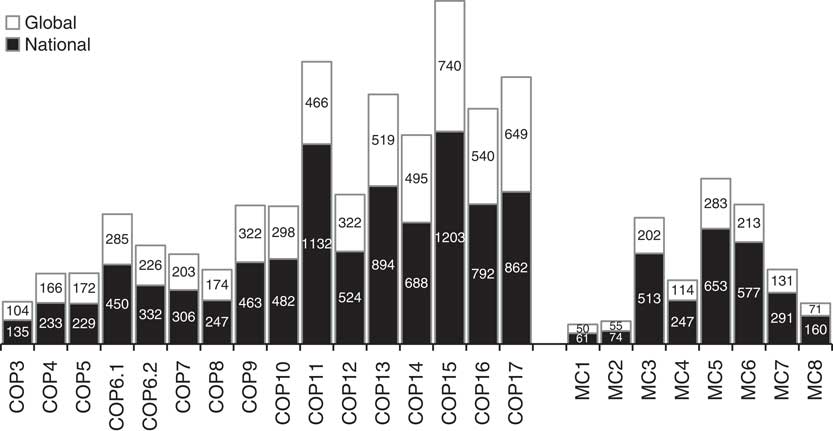
Number of actors per Conference of the Parties (COP) (left), and Ministerial Conference (MC) (right).

After the non-state actors were identified, we systematically coded all the websites for a set of variables. More specifically, for the WTO 1,409 organisations could be identified via a website that offers some to more elaborate data on the organisation; for 360 organiwations we were not able to find a website, but information stored on other websites (for instance, from other interest groups who refer to the organiwation in question) enables us to code at least some basic features of these organiwations. Only 24 organisations could not be traced. For the COPs we identified 6,655 organisations. For most organisations a website was identified, which provided more elaborate data on the organisation. For 972 organisations we were not able to find a website, but information stored on other websites enabled us to code some basic features of these organisations. Only for a small number of organisations no information at all was found (121). Combined, our dataset thus includes 8,624 non-state actors that have been coded by research assistants for a number of variables. This includes the types of organisations attending COP meetings, the region or countries from which they originate from, the issue areas in which they are active, their constituency base, how they are organised, etc. (Appendix 1).
We now turn to the operationalisation of the variables. For our dependent variable we rely on a specific variable we coded from the websites, namely the geographical area of the interests that the organisation is defending. More precisely, we coded whether or not non-state actors defend the interests of constituents or businesses located in one country (that is, national interests) or in more than one country (that is, multilateral interests). Initially, coders could pick one of four options: subnational representation (for example, Quebec); national representation (for example, Brazil); regional representation (for example, Asia); or global representation (more than two continents). The data was retrieved by looking at the about pages, policy documents listed on the websites, etc.Footnote 56 For our analysis we made a distinction between domestic interest representation, that is, the group of organisations representing subnational or national interest, and groups that defended multilateral interests at the conferences, that is, defending regional or global interest representation. To give an example, on the ‘About’ page of Greenpeace European Unit it is stated that ‘the organization is based in Brussels, where we monitor and analyse the work of the institutions of the European Union (EU), expose deficient EU policies and laws, and challenge decision-makers to implement progressive solutions’. Clearly the organisation sets out to defend the interest of multiple EU countries and therefore the organisation was coded as a transnational organisation. In contrast, the ‘About’ page of the Canadian Steel Producers Association (CSPA) states that the organisation ‘is the national voice of Canada’s $14B steel industry’. In this case the organisation is undoubtedly defending the interests of stakeholders in only one country and was therefore coded as a national organisation. This procedure was replicated for all 8,624 organisations allowing us to trace whether, over time, an increasing amount of transnationally or domestically oriented groups attended the conferences. Figure 1 offers an overview of the evolution over time of the absolute numbers of these two categories of NSAs attending COPs and WTO MCs.
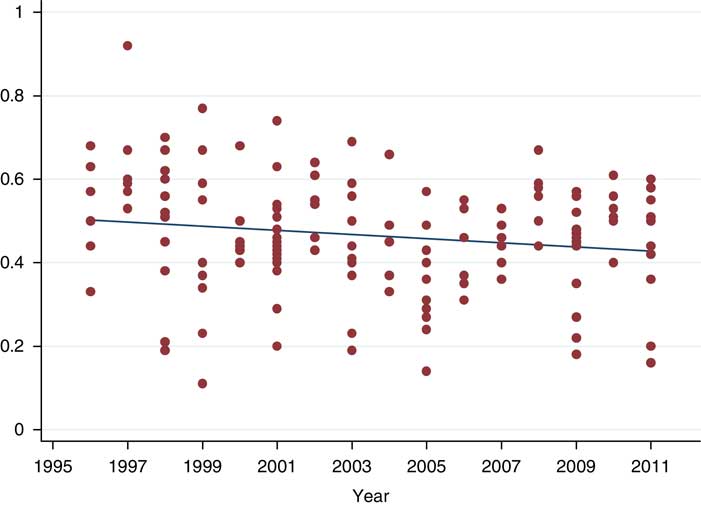
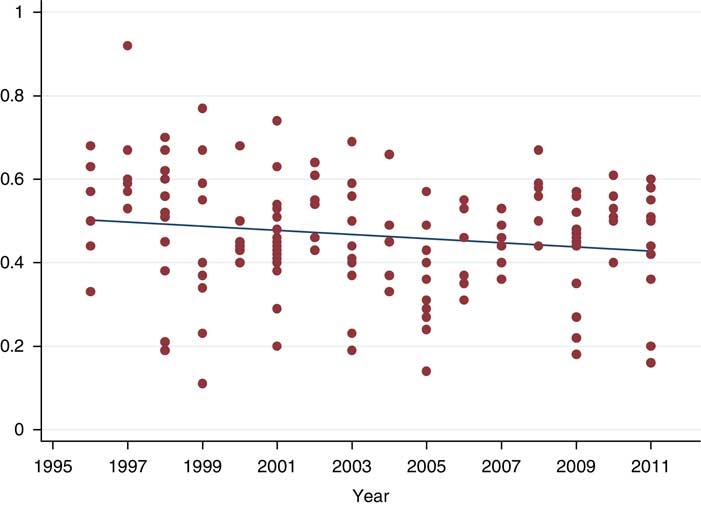
For the operationalisation of the dependent variable of the analyses we use the proportion of multilateral organised groups active at each of the conferences. Moreover, because we seek to explain the nature of interest representation at the level of sectors, we calculated for six major sectors (that is, environment, human rights, development, agriculture, manufacturing, and services) the percentage of multilateral organisations that were active in these communities at each venue. To illustrate, at the COP in Copenhagen (2009) 22 per cent of the attending manufacturing non-state actors defended a multilateral interest, while for environmental NGOs this percentage was 52 per cent. Likewise, at the MC in Hong Kong (2005) only 18 per cent of the agricultural organisations were defending multilateral interests, whereas 60 per cent of the development organisations defended cross-national interests. Overall, this exercise resulted in 144 observations: 6 sectors times 16 COPs, plus 6 sectors times 8 MCs. By focusing on the proportion of multilateral groups active at each venue, we directly tap into the question of whether or not greater participation by non-state actors has led to deliberative participation beyond the limits of national boundaries,Footnote 57 has overcome nationalist structures of community,Footnote 58 and gave voice to stakeholders with a global or international frame of reference in their action and goals.Footnote 59 Or, in in contrast, whether it has reinforced the opinions of single national perspectives and interests instead.Footnote 60 Overall, the proportion of domestic groups is substantially larger than the number of global organisations (65 per cent, or 5,432 NSAs, defends domestic interest whereas 35 per cent, or 3,521 NSAs, defends multilateral interests). Figure 2 plots the dependent variable over time, where a slight dropping trend is observed.
Proportion of multilateral organisations over time.
Furthermore, the analyses include four independent variables. For our first independent variable, globalisation, we rely on the Globalization Index (KOF Index) by the Zurich school of Politics.Footnote 61 The KOF Index of Globalization, available on a yearly basis for 207 countries over the period 1970–2013, measures the three main dimensions of globalisation: economic, social, and political. Political globalisation is measured by looking at four indicators: the embassies in foreign countries; the membership in international organisations; the participation in the UN Security Council missions department of peacekeeping operations; and the number of international treaties signed by a country. Economic globalisation is measured by looking at various trade indicators and foreign investment indicators. Social globalisation is based on several indicators related to personal contacts, information flows, and cultural proximity. To come to one measure, we rely on the average political globalisation of all countries over the period 1995–2012. We test whether variation in world globalisation over time is related to variation in the proportion of multilateral non-state actors active at the climate conferences and the WTO trade summits over the years.
Our second independent variable is the level of politicisation. Politicisation at IOs is defined as a process in which IOs generate increasing public awareness and non-state actor contestation.Footnote 62 The operationalisation of politicisation thus needs to be a combination of salience and non-state actor conflict surrounding international organisations and/or issues being discussed at these venues. To accommodate both aspects of politicisation, we combine the media attention for the negotiations per conference, with the attention by non-state actors for each of the conferences. For the MCs we calculated the level of media attention by coding the number of times global trade negotiations were mentioned in World Trade Online. World Trade Online is the most used online news service for people and organisations interested in global trade. Moreover, it is a common indicator in academic research to assess the attention for global trade issues. Unfortunately, for climate summits we couldn’t identify a specific news outlet dedicated to this venue. Instead we therefore opted to code the number of times climate change negotiations were mentioned in the Financial Times. To make both data sources comparable, instead of relying on absolute hits in the news outlets, we calculated the percentage of articles dedicated to each of the individual COP and MC conferences, compared to all articles dedicated to either the MCs or COPs. This way we have a relative measure of importance of each individual conference. For the attention of interest groups we rely on the number of groups active at each of the conferences (see Figure 1). Again to compare both venues, we take the relative share of non-state actor participation per conference as a percentage of the number of groups active at all of the MC or COP conferences. Last, to come to one measure for politicisation we calculate the average of salience and density. In Appendix 1 we provide an overview of the relative salience per conference, the relative density per conference, and the politicisation score per conference.
For our third independent variable, we rely on the relative openness of IOs. Hereby we compare the WTO Ministerial Conferences with the UN climate change negotiations. Our expectation is that the number of global organisations is higher at COPs as this venue is more open to the input of non-state actors. Our reasoning is as follows. One important accreditation requirement to become an observer at both a climate conference and Ministerial Conferences is that the organisation is a non-profit establishment, which excludes individual firms from registering. This, however, does not mean that firms do not attend these conferences. Quite the contrary, firms, and other ineligible organisations for that matter, often cope with these official requirements by registering as a member of an official observer delegation. Yet, in this is where the MC and COP vary considerably, the number of participants at COPs that can attend per observer organisation is much higher. At COPs, initially no cap was included, while at MCs a maximum of four organisations could participate at the conferences. This meant that at COPs a much broader set of organisations was allowed to participate than at MCs. Most prominently, many more firms were active. For instance, Shell and the Dow Chemical Company attend as members of the World Business Council for Sustainable Development, while Siemens and Google attend as part of the Alliance to Save Energy. But at COPs, more groups from developing countries participated as guests of Western NGOs, such as Greenpeace, Oxfam, or Friends of the Earth. At COPs these NGOs always pay for a certain amount of NGOs or activists that can’t afford a visit themselves, whereas this is not the case at MCs. The scarcity of attendants prohibits them to invite a large amount of guests. As a result, the number of non-state actors active at COPs is much higher than at MCs. Moreover, there is more variety in the type and origin of these groups. All in all, this leads us to conclude that the COPs, due to their more lenient accreditation procedures, are more open to non-state actors than the MCs.
Our fourth hypothesis relates to the type of interests that are defended. Here we make a distinction between three economic sectors (agriculture, manufacturing, and services) and three social sectors (environment, development, and human rights). The classification for business organiaations is based on the International Standard Industrial Classification of All Economic Activities (ISIC). For this specific analysis we first grouped each organisation at the 1-digit-ISIC-level, which corresponds with broad business sectors such as agriculture, construction, transport, communication, and so on. After this, we grouped these sectors into three main categories: agriculture, manufacturing, and services. For citizen groups we categorised interest groups according to three broad fields of attention: the environment, development and poverty reduction, and human rights (including human health). Our expectation is that the number of global groups is larger across the social sectors compared to the business sectors.
Analysis
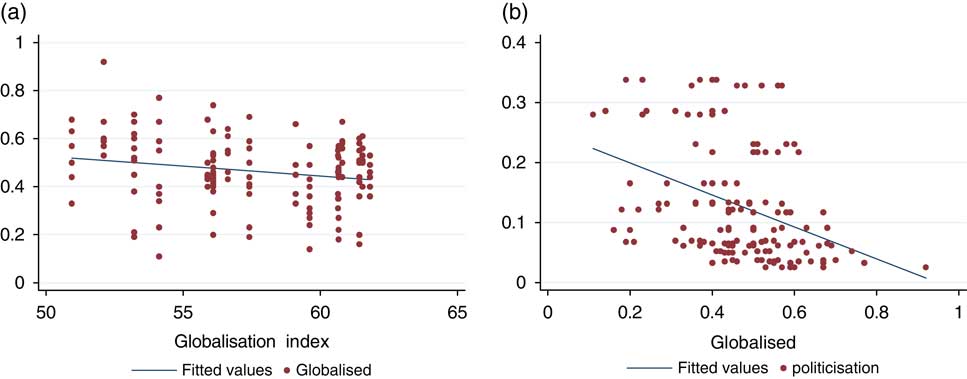
We start with an overview of some descriptive statistics. In Figure 3a, we plotted the development of global interest representation per level of political globalisation. The scatterplot shows quite some variation. To get some grip on the overall trend we plotted a trend line. As seen in Figure 3, the overall tendency is that the proportion of global groups becomes smaller as globalisation increases. While at the first conference in 1997 the percentage of global groups is 51 per cent, this drops to 42 per cent at the last conferences in 2011. Hence, we see, in line with our expectation, that increased globalisation has not led to an increase in the representation of global interests. Rather, we observe a decline in the political activity of these interests.
Percentage of multilateral organisations per globalisation of world politics (a), and per level of politicisation of conferences (b).
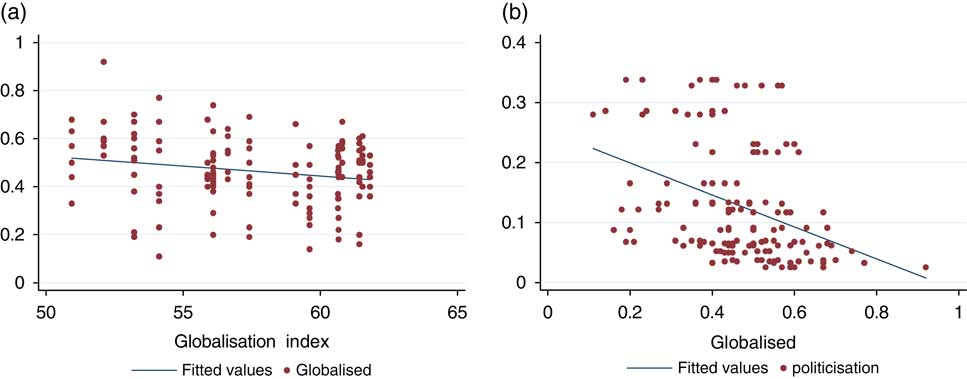
We see an even stronger correlation between the level of politicisation, that is, the attention of the media and the non-state actor community for a particular conference, and the participation of the organisations representing global interests at these conferences. In Figure 3b, we plotted the level of globalisation of the non-state community at each conference, and the level of politicisation at the conference in question. The results show a clear negative relation between politicisation and the representation of global interests at this particular conference. That is, the more politicised a conference is, the lower the proportion of global organisations. This again provides initial support for our expectation that increased attention for global political institutions raised the interest of non-state actors defending domestic issues.
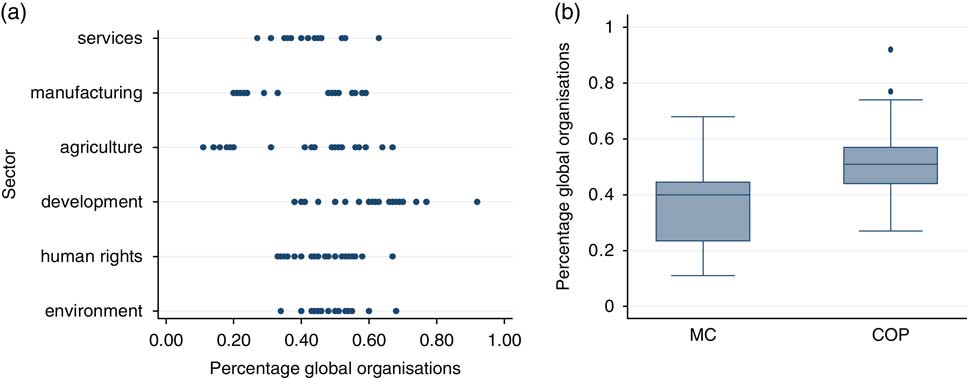
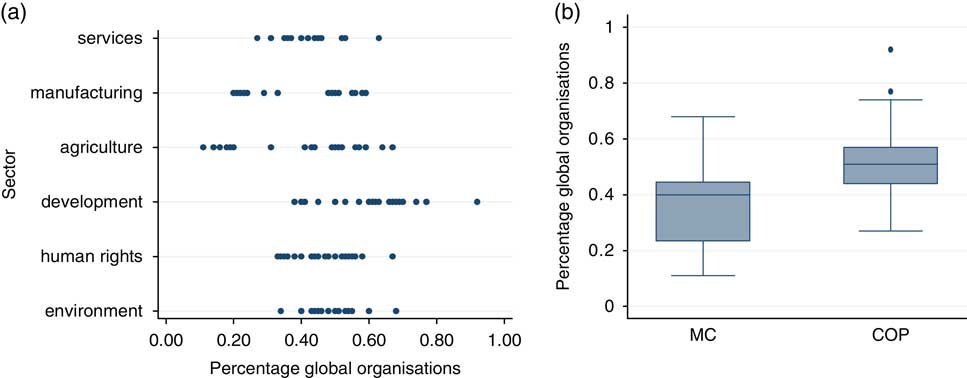
Going further, we also provided two conditional effects: the openness of the venue and the type of constituents that are defended. We plotted both across the proportion of global organisations in the population. Figure 4 shows both bivariate statistics. In the left figure (a), one can see the distribution across the sectors. The three sectors above are the economic sectors, whereas the three at the bottom are the social sectors. On the right (b), one can clearly see that the number of global organisations is higher at COPs than it is at the MCs. This is in line with our expectation. Again, the bivariate descriptive statistics confirm our initial expectation. The three social sectors show higher levels of global groups compared to the business communities. The development sector especially has a great number of global groups active at the conferences. In contrast, the agricultural and manufacturing contains the highest proportions of national groups.
Percentage of global organisations issue (a), and per conference (b).
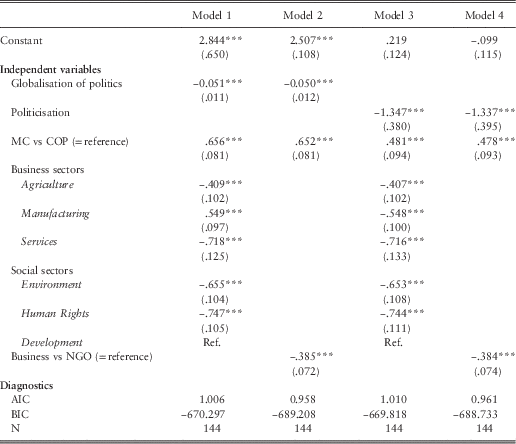
To further substantiate our claims, we run a multivariate analysis. Our dependent variable is the proportion of global organisations active at each venue (both at the COPs and at the MCs). To handle the bounded nature of this scale we use a fractional logit model with the proportion in the (0,1) interval as a dependent variable.Footnote 63 In order to avoid too optimistic estimates, we produce robust standard errors based on the observed raw residuals. Our independent variables are: the politicisation of each conference; political globalisation at the year the conference took place; the sector in which the group was active, business (services, manufacturing, agriculture) and social (environment, human rights, development); the international organisation in question (COP or MC). The results are summarised in Table 1. We run separate models for the globalisation of word politics (Models 1 and 2) and the politicisation of conferences (Models 3 and 4). Moreover, we provide separate models for the sectors (Models 1 and 3) and between business and social groups combined (Models 2 and 4).
Explaining the proportion of global non-state actors (NSAs) at conferences: fractional logit regression.

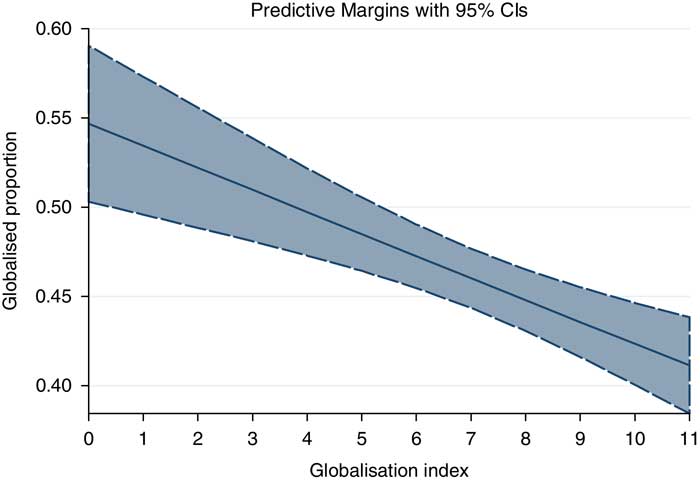
Models 1 to 4 present the results. What are the main findings? First of all, if we look at the effect of globalisation, we find a negative and statistically significant relation with the proportion of global NSAs active at the conferences (see also Model 2). To visualise this effect we plotted the predicted probabilities in Figure 5 where a clear decrease can be observed. This confirms our earlier observation that over time the proportion of global organisations decreases and thus corroborates the arguments of those who believe that globalisation, and the connected processes of transnational regulation, are not neutral to the interests and power of dominant states and relevant domestic actors within them.Footnote 64 Indeed, we show that these broader processes reverberate into the non-state actor community: as the globalisation of political processes increases, we observe greater political activity groups representing national constituencies. Hence, we find support for our first hypothesis. In addition to this statistical support, the following example nicely illustrates the logic of the argument. Some of the leading US companies, including Facebook, Walmart, Coca Cola, American Bank, and many others stopped lobbying the US government on climate change issue and started to become strongly involved in the Paris climate change negotiations when they realised that climate change is a global issue that warrants global solutions, most prominently embodied through a global agreement.Footnote 65 As our hypothesis suggests, these national companies diverted their attention from national to global institutional policymaking settings due to the increasingly global scale linked to the growing awareness of the global dimensions of the climate change problem.
Predicted probabilities proportion of global NSAs per level of globalisation.

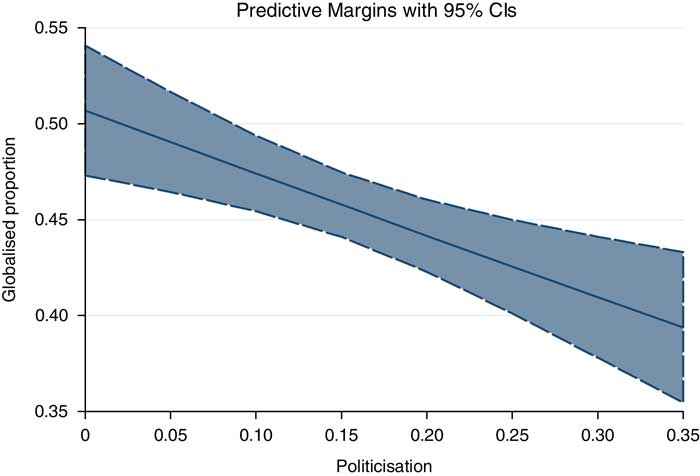
For politicisation we see a similar pattern, which confirms the bivariate statistics. First, in Table 1, we see a negative effect in both Models 3 and 4. To visualise this effect we plotted the predicted probabilities in Figure 6 where the trend is also clear. As conferences gain media attention and interest from the non-state actor community, the number of global organisations becomes much smaller. From a theoretical perspective this means that the expectation by Zürn seems accurate in that increased politicisation of world politics is not without risks.Footnote 66 As he argued, the process and results of international negotiations seem subject to monitoring by transnational and national publics. Even starker, the politicisation of international institutions seems to have generated a more contentious political arena characterised, at least, by the confrontation between those defending transnational, deterritorialised standpoints, and those who direct their attention to international institutions to oppose, or at least use instrumentally, the migration of authority to the international level on national grounds.Footnote 67 This could mean that the involvement of domestic interests engendered by politicisation undermines the ability of the concerned international organisation to pursue its objectives. Moreover, this is an important finding as it could serve as an explanation for why IOs are not perceived by non-state actors as more legitimate. Again, we can provide an illustrative example of these dynamics considering the last WTO Ministerial Conference in Nairobi (2015). One of the most salient issues at this conferences were special safeguard mechanisms for least developed countries (LDC) in the field of agriculture and trade distorting farm subsidies in the developed countries. As a result of the increased politicisation of these issues, many Indian and African domestic farmer organisations decided to attend the conference because realised they were among those to gain or lose the most from these negotiations. For instance, Nirmala Sitharaman, one of the Indian union leaders advocating for the farmers and attendant at the Nairobi MC said just days before the MC: ‘We don’t want to compromise with the interests of Indian farmers which comprise 52 per cent of 1.25 billion population and their livelihood, in the forthcoming WTO negotiations.’ President Balbir Singh Rajewal of the Bhartiya Kisan Union added the immanent importance of the conference: ‘If India does not stand firm at the Ministerial Conference [in Nairobi], Indian agriculture will face disastrous consequences.’Footnote 68 The fact that many Indian and African farmer organisations were present at this conference nicely illustrates how, as suggested by our hypothesis, the politicidation of agriculture was clearly among the most important factors that triggered a wave of domestic interest mobilisation at this conference.
Predicted probabilities proportion of global NSAs per level of politicisation.

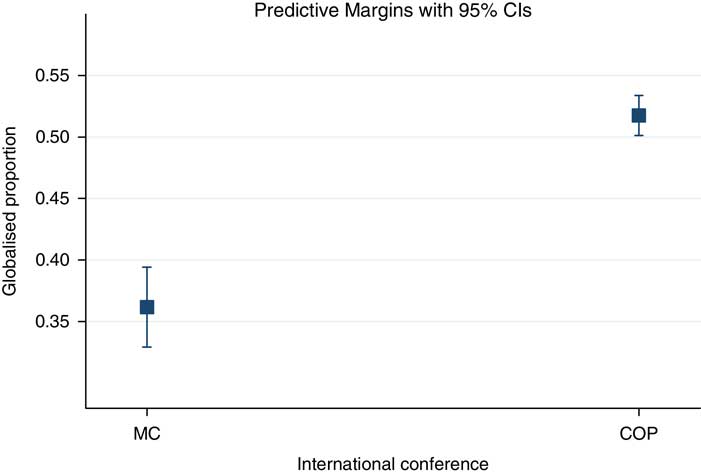
Next to these general effects we also set out to see whether there is variation across IOs and type of constituents that are represented. First of all, we argued that there is variation in the number of global organisations based on the type of IO. In Models 1–4 we see that the effect of the venue is significant. To grasp the magnitude of this effect we again plotted the predicted probabilities (Figure 7) of global organisations per conference. Here we see that there is a significant difference between both venues. At climate conferences the proportion of global organisations lies at just over 50 per cent, while at Ministerial Conferences this is 37 per cent. This confirms Hypothesis 3 indicating that the political opportunity structure of IOs matters. More precisely, it shows that while stakeholders representing constituencies transcending national borders remain a minority across different international institutions, such percentage is higher in cases in which access opportunities are greater.
Predicted probabilities proportion of global NSAs per venue.

Despite the confirmation of our hypothesis, we realise that we need to be careful with this assertion. While the results are in line with our expectations, making our argument more plausible, more research is needed to increase the generalisability of our claims. Nonetheless, the analysis provided here seems to indicate that IOs can influence whether or not the nature of non-state actor community active in international venues is of a more globalised or domestic nature. Moreover, anecdotal evidence further supports this view. Not only the WTO has been widely criticised by NGOs for its lack of openness and transparency over the course of the last two decades,Footnote 69 but this lack of openness seems to have had a particularly strong effect on global organisations’ decision whether or not to lobby within this venue. For instance, the lack of opportunities for groups such as Climate Action Network, Greenpeace, or Oxfam has been a critical factor for these organisations’ decision to focus more on other venues, and invest less in the WTO.Footnote 70
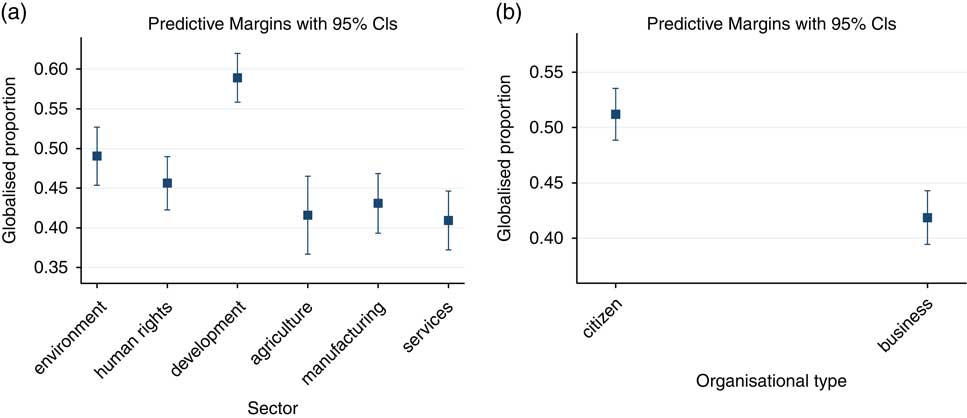
Finally, we look at the last hypothesis. This hypothesis states that the proportion of global organisation is higher among the civil-society NSA community compared to the business NSA community. First, as can be seen in Models 1 and 3, and visualised in Figure 8a (based on Model 1), we see that each of the citizen NSA communities includes relatively more global organisations. Moreover, these differences, with the exception of the human rights sector, are all highly significant. The development sector (see also descriptive analysis) has the highest proportion of global groups, followed by the environmental, and the human rights sector. All three businesses groups show rather equal shares of global groups. To test the effect of constituency type we also grouped together the sectors in business and citizen NSAs (see Figure 8b, based on Model 2). Here the effect is also clear. For citizen groups an almost equal share of domestic and global groups is active at the conferences, whereas for business groups 41 per cent is a global group. This confirms Hypothesis 4 and indicates that some sectors are more globalised than others based on the type of constituents they represent.
Predicted probabilities proportion of global NSAs per sector (a), and group type (b).

From a theoretical perspective this contradicts the more pessimist stance that greater stakeholder involvement may actually turn out to further increase the likelihood of capture by influential special interestsFootnote 71 and rather supports the view it can foster a more balanced representation among different types of interests, reducing the danger that these governance systems fall prey to overly specialised interests.Footnote 72 This also means that it is likely that IOs dealing with more economic issues are more attended by groups representing national interest, whereas IOs having more social issues on the agenda have a more globalised non-state actor community at their gates.
Conclusion
In this article we have tried to cast light on some of the factors that systematically influence the representation of global stakeholders in global governance. The starting point of our analysis is an empirical observation: increased opportunities for stakeholder involvement in global governance have not produced greater perceived democratic legitimacy. Democratic legitimacy and perceived democratic legitimacy should not be fully equated. A political system could be perceived as fully democratically legitimate while failing to meet a number of criteria that are critical for such a political system to be defined as democratically legitimate. At the same time, the stakeholders that operate within such political system may nonetheless perceive it as democratically illegitimate even when all a priori defined criteria of ideal democracy are met. While bearing in mind this important caveat, there are obvious important connections between the conventional and sociological understandings of stakeholder models of democracy. Empirically, the observation that IOs continue to be perceived as democratically illegitimate, despite considerable efforts to increase stakeholder participation within them, suggests the importance of taking a step back and assessing whether, and under what conditions, greater stakeholder involvement is conducive (or not) to meeting criteria of ideal democracy. Normatively, a judgement on the viability of a stakeholder strategy of democratisation of IOs ultimately depends on whether a plausible case can be made both about the feasibility of generating the political conditions that are presumed to create democratic legitimacy and the existence of causal links between the creation of such political conditions and perceptions of democratic legitimacy. Because the success of a stakeholder strategy of democratisation of global governance is widely perceived to critically hinge on its ability to foster involvement of ‘global stakeholders’, our analysis helps to shed some light on these important empirical and normative issues.
We subjected to systematic empirical scrutiny four hypotheses about the determinants of such ‘global’ stakeholders involvement in IOs: (1) growing and deepening processes of global economic, social, and cultural exchange; (2) the level of politicisation of international institutions; (3) political opportunities structures granting different degrees of access to stakeholders; and (4) the types of constituency interests represented. The first important finding of this article is that there are two crucial underlying structural conditions that constrain the effective representation of global stakeholders. On the one hand, and contrary to the conventional wisdom, we found that globalisation obstructs the involvement of global stakeholders in global governance. On the other hand, and again somewhat contrary to earlier expectations, we show that the politicisation of IOs increases the representation of national interests, rather than that of global ones. However, our study shows that granting greater access to stakeholders in international institutions can somehow mitigate these structural factors. Moreover, our findings suggest that granting greater access to IOs will not produce an equally effective representation of ‘global’ stakeholders across types of constituencies. If our analysis is correct, what is likely to emerge is an international institutional environment in which stakeholders representing civic interests increasingly have a ‘global’ character, while stakeholders representing business interests remain ‘domestic’.
What are the implications of our findings for the empirical and normative debates about viability of a stakeholder strategy of democratisation of IOs? The somewhat good news is that we have been able to identify a potentially good reason for why stakeholders continue to perceive IOs as democratically illegitimate, despite greater opportunities for their involvement in such political processes. If it is true that the effective involvement of ‘global’ stakeholders in global governance is a necessary condition for a stakeholder strategy of democratisation to produce greater perceived democratic legitimacy, then at least we know that such absent perceptions of democratic legitimacy do not grow out of some mysterious political logic, or is inherent to political processes at the international level. Our analysis shows empirically that greater stakeholder involvement may fail to produce greater perceptions of democratic legitimacy because it simply does not translate into an effective representation of global stakeholders.
When assessing whether assessment of whether such a stakeholder strategy of democratisation is ready for abandonment or it retains potential, the next obvious question is whether a plausible case can be made that these trends is reversible. Our findings point in different directions. For one, we should be aware that existing structural conditions such as globalisation and politicisation, two trends that are here to stay in the foreseeable future, are running counter to the ability of a stakeholder strategy of democratisation to ensure balanced representation of global and national interests. On a more positive note, our findings leave open the possibility whether existing institutional arrangements granting more and more access to stakeholders is perhaps sufficient to counter the effects engendered by these two underlying structural conditions. In case the answer is affirmative then perhaps there is still some hope for devising stakeholder strategies of democratisation of global governance that can produce greater perceived democratic legitimacy. Even in this more optimist scenario, however, the stark division between global civic interests and national business interests that we can expect to emerge may end up deepening existing perceptual differences across types of constituencies, and ultimately weakening overall perception of democratic legitimacy. This concern is reflected in more detailed studies of our cases.Footnote 73 For instance, at the WTO it seems that time and again, particular domestic business interests prevail at the expense interests defending of worldwide growth and development, especially at the expense of developing countries.Footnote 74 Also, during the climate change negotiations we have seen that state positions are strongly influences by NSA criticism.Footnote 75 If, domestic NSAs are able to increasingly dominate public discourse on global climate change negotiations (or other global issues), it will become increasingly problematic for states to set aside particularistic interests and act in favour of the global common good. A growing force of domestically oriented observers active at such negotiations will certainly not help in this respect.
In order to provide more conclusive answers to the questions we have touched upon in this article, further research could build on its findings and tackle some of its limitations. First, this article only investigates two international institutions. Given the time and costs demanding nature of collecting community type data (for this project already, over eight thousand websites have been coded) it is nearly impossible for one project to overcome this obstacle. Still, other scholars might have collected similar data with respect to other venues could assess whether our findings travel to other international organisations as well. This is particularly important from a normative viewpoint because our results suggest that any reason for optimism on the viability of a stakeholder strategy of democratisation of global governance ultimately lies in IOs capacity to foster greater stakeholder involvement.
Another way to expand on our work could be to develop more fine-grained, and less crude operationalisations of the distinction between domestic and global interests. It might very well be the case that actors representing domestic constituencies have developed a global attitude and ultimately act upon global issues, proposing global solutions. Perhaps these actors become more socialised over time leading them to become more open to the interests of other nations, or sensitive towards the need to devise global solutions to transnational problems.Footnote 76 This is not something we can capture with our data, but certainly warrants more attention in future studies because it has relevant normative implications as well. Should empirical research be able to show that domestic interests are able to genuinely defend global interests, the normative case for a stakeholder strategy of democratisation of global governance could be significantly strengthened.
More broadly, and returning to the initial premise of this article, further research could try to directly establish whether, and under what conditions, increasing the representation of global interests in global governance affects stakeholders’ perceptions of democratic legitimacy. Starting from the observation that increased access opportunities for stakeholder involvement in global governance have not generated greater perceived democratic legitimacy, we have identified in the lack of effective representation of global interests in these governance mechanisms a possible reason for it, and speculated about the prospects for more a balanced representation in the future. While many have identified in such effective representation a key criterion that needs to be met for global governance to be democratically legitimate, it remains to be established empirically whether meeting this standard of ideal democracy would lead to greater perceived democratic legitimacy, as well.
Despite these limitations, we hope this study can be instrumental in showing the usefulness of connecting more systematically empirical research based on the conventional and sociological understandings of stakeholder models of global democracy. Empirical observations based on the sociological variant of the stakeholder model have stimulated our interest in ascertaining empirically whether, and under what conditions, certain criteria of ideal democracy can be met. Our findings in turn, will hopefully stimulate efforts to empirically assess whether meeting such criteria can translate into democratic legitimacy as perceived by real political actors. Overall, we believe we can only come to understand how to make global governance more democratically legitimate by systematically connecting these two empirical research agendas.
Acknowledgements
The research reported in the article has been financially supported by research grants from the Research Council of the University of Antwerp, the Odysseus Programme, and a PhD fellowship of the Research Foundation – Flanders.
Appendix 1. Level of politicisation per conference