Introduction
On August 25, 2017, Hurricane Harvey made landfall as a Category 4 hurricane near Corpus Christi, Texas (USA).1–3 Over the next five days, 51 inches of rain – more than 27 trillion gallons – fell in Texas and Louisiana (USA) leading to a 500-year flooding event (ie, a flood with a 1-in-500 chance of occurring in a single year).1,3 Nearly 150,000 residents were forced out of flooded homes, while tens of thousands were stranded by major disruptions due to flooded roadways (which led to more than 30,000 water rescues), and damaged infrastructure that left 336,000 without power.1–3 Hurricane Harvey-associated inland flooding caused significant disruptions in medical care, including among residents with chronic kidney disease.4 Dialysis care requires clean water, access to specialized equipment, and electricity, all of which can be compromised during a natural disaster.Reference Lempert and Kopp5 In the City of Houston (Texas USA) alone, more than 150 hemodialysis centers and 6,700 hemodialysis patients were at risk of negative health outcomes as the result of the storm’s impacts.4
In a non-disaster setting, between five percent and nine percent of US hemodialysis patients miss at least one dialysis session per month. However, after a major hurricane, 44% of hemodialysis patients miss at least one dialysis session.Reference Saran, Bragg-Gresham and Rayner6–Reference Anderson, Cohen, Kutner, Kopp, Kimmel and Muntner9 Missed dialysis sessions have been associated with an increased incidence of mortality, hypertensive emergencies, fluid overload, respiratory failure, electrolyte imbalance, and hospital admissions.Reference Leggat, Orzol and Hulbert-Shearon7,Reference Kimmel, Peterson and Weihs10–Reference Kimmel, Varela and Peterson12 In a study of missed dialysis sessions and hospitalizations among 386 hemodialysis patients exposed to Hurricane Katrina (2005),Reference Anderson, Cohen, Kutner, Kopp, Kimmel and Muntner9 17% of hemodialysis patients missed at least three sessions and the percentage of hemodialysis sessions missed after the storm was five-to-seven-times pre-hurricane levels.
Systems related to dialysis treatment were improved in response to Hurricane Katrina, with many dialysis centers making advanced preparations, such as providing early treatment and adding generators to facilities. However, Hurricane Sandy (2012) exposed additional problems with the continuity of care for end stage renal disease (ESRD) patients. During Hurricane Sandy, many dialysis facilities closed in preparation for the storm and remained closed after the storm, which affected much of the Mid-Atlantic and Northeastern US. In some cases, patients received dialysis treatments a day early in anticipation of Hurricane Sandy’s landfall.Reference Lempert and Kopp5 However, dialysis facility closures during disaster preparedness and response phases can cause disruptions to care for dialysis patients that can have severe health consequences. After Hurricane Harvey, Le Maistre, et al reported that 90-day mortality increased by 5.84% among patients with ESRD who lived in Harvey-affected areas compared to an increase of 0.69% among residents of non-affected regions.Reference LeMaistre, Sterling, Miller and Molony13
One way to prevent the disruption of hemodialysis services during hurricanes is to regulate the placement of hemodialysis clinics in high-risk flood zones. The Federal Emergency Management Agency (FEMA; Washington, DC USA) manages the National Flood Insurance Program (NFIP), which was created to ensure that private and public structures located in the 100-year floodplain (ie, areas with an annual flood risk of one percent) have insurance coverage for flood damages. To assess the risk of flooding in an area, FEMA created Flood Insurance Rate Maps (FIRMs), which are used to determine eligibility for flood insurance coverage and to set rates, and are also used by mortgage lenders, who require home buyers to purchase insurance for properties in flood-designated areas.
However, natural disasters do not honor a boundary like a 100-year floodplain that does not physically exist.14 The magnitude of flooding may change based on a number of factors, including the proportion of land that is changed from pervious to impervious, subsidence, and sea-level rise.Reference Brody, Gunn, Peacock and Highfield15–Reference Cutter, Emrich, Gall and Reeves18 Over the past 50 years, the Houston Metropolitan Area has been affected by all of these, and flooding in both the 100- and 500-year floodplain has occurred more frequently than anticipated.19,20 Recent research in Houston suggests that the 100-year floodplain does not correctly predict risk and that areas outside of the floodplain may be more vulnerable to flooding than previously recognized.Reference Blessing, Sebastian and Brody21 For example, in an evaluation of Harris County parcels from 1978-2008, 47% of insurance claims related to flooding were from properties outside of the 100-year floodplain.Reference Highfield, Norman and Brody22 The continued reliance on the 100-year floodplain for risk characterization, particularly in rapidly developing urban areas like Houston and Harris County, Texas, is likely inadequate for planning and preparedness purposes, particularly for locating essential health care services. The objectives of this study are to estimate the proportion of hemodialysis clinics flooded after Hurricane Harvey, to calculate the percentage of such clinics located in or within 1km of a designated high-risk flood zone, and to assess the sensitivity of the FIRMs in the prediction of actual flood risk.
Methods
Study Area
Harris County is located in southeastern Texas near Galveston Bay and the Gulf of Mexico. With an estimated population of more than four million, Harris County is the largest county in the Houston-Galveston Metropolitan Statistical Area and the third-largest county in the US.23 Besides vulnerability to natural hazards associated with the county’s geographic location along the US Gulf Coast, 25% of the county lies within the 100-year floodplain, making it particularly prone to devastating flooding from storms like Hurricane Harvey, Tropical Storms Alison (2001) and Imelda (2019), as well as from inland precipitation events like the Memorial Day Floods of 2015 and the Tax Day Floods of April 2016.23
Data Sources/Extraction
Hemodialysis facilities in Harris County, Texas were identified using the search engine embedded in the webpage for Medicare.gov, the official US government site for Medicare.24 While Medicare is typically available for people aged 65 and older, all patients with ESRD requiring dialysis or transplant, regardless of age, are eligible for Medicare insurance coverage.25 The search returned 150 facilities in the Houston metropolitan area. Twenty-six facilities were excluded as they were located outside of Harris County. For each record, data were extracted including the name of facility, street address, and ZIP Code for geocoding using ArcGIS Online (Esri; Redlands, California USA).
Data on FEMA flood zones were extracted from a publicly available repository for Houston-Galveston Area Council.26 Data on Hurricane Harvey inundation were downloaded from Harris County Flood Control District (HCFCD).27
Flood Zones and Spatial Analysis
Topically, FEMA designates geographic areas (ie, parcels) based on their flood risk. Moderate- to low-risk areas are designated as “B” and “X;” high-risk areas as “A,” “AE,” “A1-30,” “AH,” “AO,” “AR,” and “A99;” and undetermined-risk areas as “D.” Additional information on flood zones is provided elsewhere.28 To identify the flood zone designation for each hemodialysis clinic, the flood zone feature class was overlaid onto the geocoded hemodialysis feature class and spatially joined the two features with the “intersect” option. A similar method was employed with the inundation map to identify dialysis clinics flooded after Harvey. Finally, flood zones within 1km of the hemodialysis clinics were identified using Generate Near Table and a search radius of 1km, planar method, and two maximum number of closest matches. Percentages of hemodialysis facilities located in the inundation area and in each flood zone designation were calculated. Confidence intervals were not included since the sample represented a complete census of hemodialysis facilities in the county.
All spatial analyses were conducted using ArcMap by Esri (10.4.2; Redlands, California USA). The study was reviewed and determined to be exempt by the Texas A&M Institutional Review Board (College Station, Texas USA; 2018-0730).
Results
A total of 124 hemodialysis clinics were included in the study, of which 17.7% (22 of 124) were located in a high-risk flood zone. Of the remaining 82.3% (102 of 124) situated outside of the high-risk zone, 37.3% (38 of 102) were within 1km of a high-risk flood zone (Table 1 and Figure 1).
Hemodialysis Clinics in FEMA Flood Zones, Houston, Texas

Abbreviation: FEMA, Federal Emergency Management Agency.
a 1% annual chance floodplain; Special Flood Hazard Areas subject to rising waters.
b 1% annual chance floodplain.
c Moderate to low-risk flood zone outside the 1% annual chance floodplain.
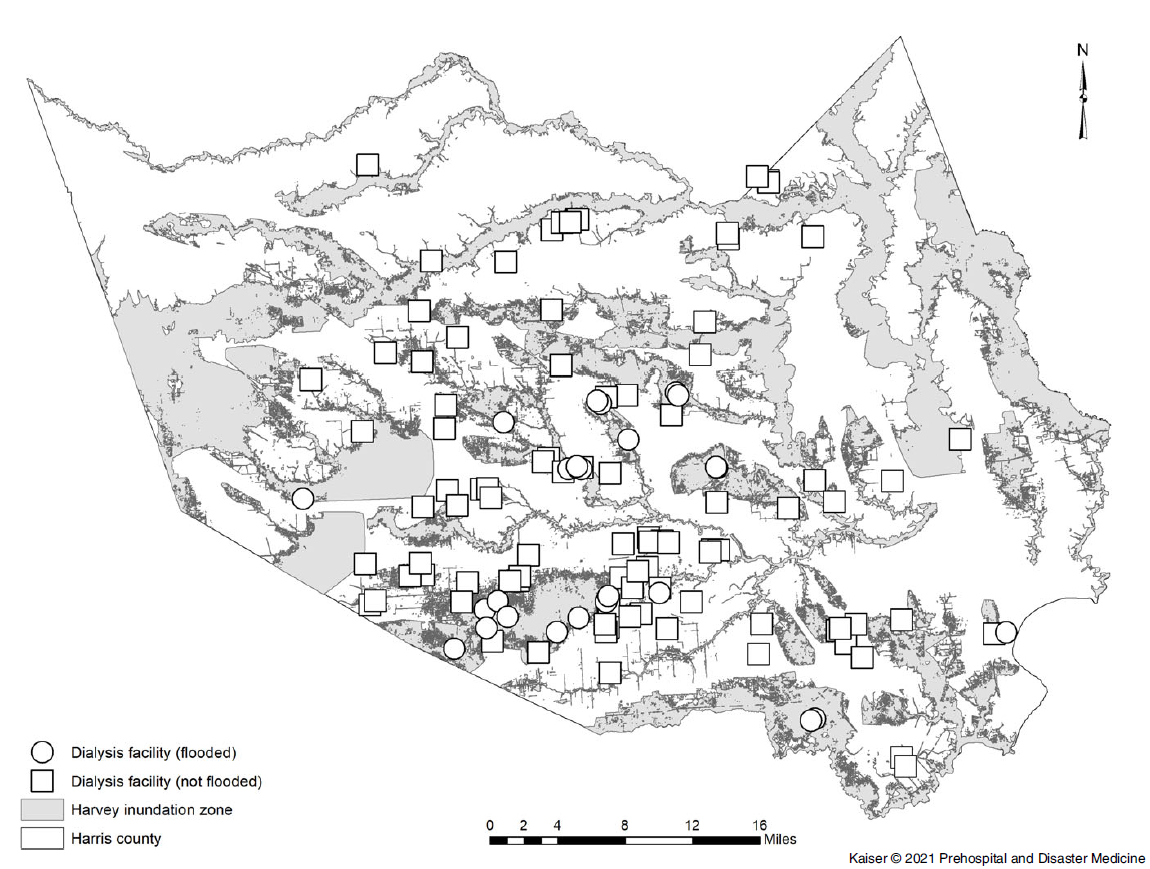
Hemodialysis Clinics in FEMA Flood Zones, Harris County, Texas.
Abbreviation: FEMA, Federal Emergency Management Agency.

Cross-Validation of the Flood Insurance Rate Map (FIRM)
Based on the HCFCD inundation map,27 21% (26 of 124) of hemodialysis clinics were flooded in the aftermath of the hurricane. The sensitivity of the FIRMs was assessed by using the HCFCD map to cross-validate the flood risk status of the hemodialysis clinics. The FIRMs had a sensitivity of 58%, identifying only 15 of the 26 dialysis clinics flooded. In other words, 42% (11 of 26) of the dialysis clinics flooded in Houston were wrongly designated as “low risk” for flooding by the FIRMs (Table 2 and Figure 2).
Cross-Validation of the FIRM using the HCFCD Inundation Data for Hurricane Harvey

Abbreviations: FIRM, Flood Insurance Rate Map; HCFCD, Harris County Flood Control District.
a 1% annual chance floodplain.
b Moderate to low-risk flood zone outside the 1% annual chance floodplain.
Hemodialysis Clinics Flooded from Hurricane Harvey.

Discussion
With 25% of Harris County parcels designated as being located in the 100-year floodplain – and 33% in the 500-year floodplain – storms like Harvey can cause significant disruption in hemodialysis care.23 Due to increases in impervious surfaces, subsidence, sea-level rise, and climate-changed induced wetter tropical storms,Reference Brody, Gunn, Peacock and Highfield15,Reference Cutter, Emrich, Gall and Reeves18,Reference Knutson, Camargo and Chan29–Reference Zhu, Quiring and Emanuel31 FIRMs can become outdated quickly, and even relatively small storms can lead to catastrophic flooding in Harris County and the City of Houston. For example, during Tropical Storm Allison in 2001, many hemodialysis centers in Harris County were flooded and inaccessible, necessitating unaffected facilities to compensate for the demand.Reference Sirbaugh, Bradley, Macias and Endom32 In response, Park Plaza Hospital (Houston, Texas USA) increased its staffing from two to three shifts per day for four months after the storm.Reference Sirbaugh, Bradley, Macias and Endom32 In the aftermath of Hurricane Katrina, 94 hemodialysis facilities along the US Gulf Coast closed for at least one week, leaving hundreds of chronic kidney disease patients deficient in renal care.Reference Kopp, Ball and Cohen33
Locating hemodialysis clinics in flood zones increases the likelihood that their operations will be impacted by flooding during tropical storms or hurricanes, disrupting medical care for those with ESRD. Missed hemodialysis sessions are associated with many adverse health outcomes, including biochemical and metabolic changes.Reference Leggat, Orzol and Hulbert-Shearon7,Reference Kimmel, Peterson and Weihs10–Reference Kimmel, Varela and Peterson12 In a study of 430 randomly selected patients from urban Brooklyn, New York (USA) and suburban New Jersey (USA), missing a single hemodialysis session was associated with a two percent reduction in hematocrit, the ratio of the volume of red blood cells to the total volume of blood.Reference Ifudu, Chan and Paul34 Other metabolic effects include weight gain, hypertension, and increased serum phosphate levels.Reference Leggat, Orzol and Hulbert-Shearon7,Reference Rahman, Fu, Sehgal and Smith35 In the Dialysis Outcomes and Practice Patterns Study, a large prospective study designed to identify aspects of hemodialysis associated with the best health outcomes, skipping at least one hemodialysis session was associated with a 13% increase in hospitalization risk.Reference Saran, Bragg-Gresham and Rayner6,Reference Pisoni, Gillespie, Dickinson, Chen, Kutner and Wolfe36 Other studies have reported between 14% and 30% increased mortality in patients who are non-compliant or miss dialysis sessions.Reference Leggat, Orzol and Hulbert-Shearon7,Reference Kimmel, Peterson and Weihs10–Reference Kimmel, Varela and Peterson12 After a disaster, a health system already stressed due to other types of direct and indirect disaster-associated morbidity (eg, aggravation of other chronic respiratory and cardiovascular conditions, injuries, or outbreaks of infectious diseases) may lack the capacity to efficiently address the consequences of missed dialysis sessions.Reference Curtis, Fair, Wistow, Val and Oven37,Reference Yuma, Powell, Scott and Vinton38
Given the projected increase in frequency and severity of hurricanes associated with anthropogenic and other changes to global climate, measures must be taken to prevent the disruption of hemodialysis services following disasters. Based on the study findings, as many as 21% of hemodialysis clinics in Harris County, Texas were flooded in the aftermath of Harvey. One approach to mitigate future occurrence would be to enact policies that regulate the construction of health care facilities in Special Flood Hazard Areas. In 2006, the State of Illinois39 (USA) enacted Executive Order #2006-05, mandating the development of critical facilities, including hemodialysis centers, outside of designated floodplains.39 Where adherence to regulation is not feasible, such facilities must be located in an area of at least a 1-in-500-year flood risk (ie, the 500-year floodplain). To the authors’ knowledge, no similar statute exists in Texas despite its coastal location, the designation of many properties in flood zones, the severity and frequency of storms, and poorer perceived health of the socially vulnerable US Gulf Coast population.Reference Karaye, Ross and Horney40–Reference Zhang, Villarini, Vecchi and Smith42
Limitations
This study has several important limitations. The placement of hemodialysis clinics in high-risk flood zones may not translate to the actual flooding of such facilities during hurricanes. In this case, the use of the inundation maps developed by HCFCD27 indicated that facilities were flooded after Hurricane Harvey; however, the severity of the flooding and the status of the facilities were not confirmed through direct observation and thus are not known. A primary survey of hemodialysis clinics found that as many as 10% of these facilities closed following Harvey. Future studies may consider larger primary surveys or the use of regulatory data to identify with higher precision the clinics that were actually closed following a disaster. Additionally, many concerns have been raised about the accuracy of the FIRMs for the estimation of flood risk.19,Reference Blessing, Sebastian and Brody21,Reference Pralle43–Reference Christian, Duenas-Osorio, Teague, Fang and Bedient45 As many as 50% of the flood events in Harris County occur outside of the FEMA 100-year floodplain.19 In this study, FIRMs correctly identified 58% of flooded hemodialysis facilities. Therefore, given the tendency of these data to under-estimate actual flood risk, a higher proportion of hemodialysis facilities in Harris County might be located in flood zones not yet designated as such, further underscoring the need for policy action. Officials in many nearby jurisdictions issued voluntary evacuation orders in anticipation of the impacts of Hurricane Harvey; however, no evacuation orders were issued in either Harris County or the City of Houston. Therefore, no inferences about the potential evacuation of those needing dialysis were included in this analysis.
Conclusions
Hurricanes are associated with severe disruptions of medical services, including hemodialysis, which can worsen the prognosis of chronic kidney disease among an already vulnerable population. Based on the findings from this study, 21% of hemodialysis clinics in Harris County, Texas were inundated in the aftermath of Hurricane Harvey. With one-quarter of Harris County parcels in the 100-year floodplain, projected increases in frequency and severity of disasters, and inadequate updates of flood designation maps, regulations that address the development of hemodialysis facilities and other health care facilities in high-risk flood areas should be considered.
Conflicts of interest
The authors declare no conflict of interest. The funders had no role in the design of the study; in the collection, analyses, or interpretation of data; in the writing of the manuscript; or in the decision to publish the results.