1. INTRODUCTION
In England and Wales state support for the poor has played an important role since Elizabethan times, with the introduction in 1601 of what is now known as the Old Poor Law, a parish-based system of poor relief funded by local taxation. This lasted for over 200 years until its replacement by the ‘New Poor Law’ following the Poor Law Amendment Act of 1834. Historians have identified that, under the impact of social and economic change, there was a steady growth in the number of paupers and the extent of pauperism, or people receiving rate-based relief, from about 1750 onwards, especially in rural parishes in south-eastern England. This article aims to re-examine this interpretation of events by looking at the extent of pauperism and its causes in five Oxfordshire communities during the latter years of the Old Poor Law.
Originally, the Old Poor Law focused on supporting the old, the very young and the sick, but by the second half of the eighteenth century spending on poor relief and the number of people receiving it had begun to increase.Footnote 1 Returns made to Parliament show that in nominal terms, national poor relief expenditure rose from £1,500,000 in 1776, or 4 shillings per head of population, to over £7,000,000, or 13 shillings per head, by 1818.Footnote 2 The level of pauperism, defined as the proportion of the total population who were receiving rates-based poor relief, was most pronounced in the south and east of England. Here, average per capita expenditure was higher than in northern areas; counties such as Oxfordshire, Berkshire and Wiltshire had around 20 per cent of their inhabitants receiving poor relief in 1802, when county-level comparisons first become available, in marked contrast to a county such as Lancashire, where the corresponding figure was just 7 per cent. At the same time, it has been argued, the south and east saw a shift in the composition of the ‘pauper host’ from ‘life-cycle’ recipients, such as widows and the elderly, to able-bodied and predominately male recipients. It has been estimated that in 1802 the able-bodied made up some 86 per cent of all paupers; the late eighteenth and early nineteenth centuries witnessed a profusion of initiatives to combat this problem such as the Speenhamland system, where poor relief payments were linked to the price of bread and family size, and the roundsman system and labour rate, where rural labourers had part of their wages subsidised by the parish.Footnote 3
The picture of rising pauperism and, by implication, growing poverty in the south and east has been a feature of the historiography since the pioneering work of the Hammonds in the early twentieth century.Footnote 4 One historian, for instance, has spoken of ‘endemic’ poverty existing among rural labourers in Oxfordshire by the early nineteenth century.Footnote 5 Research on the Poor Law in the north and west of England, by emphasising the low numbers receiving poor relief in these regions, has reinforced the impression of a more pauperised south.Footnote 6 Nevertheless, our picture of pauperism in the south and east during this period is still incomplete and more research is needed. First, the national data on pauper numbers mostly come from nineteenth-century material, the 1802 and 1813 Parliamentary reports and the 1834 Royal Commission on the Poor Laws.Footnote 7 Less information is available for the latter half of the eighteenth century, when relief expenditure first started to rise. Several local studies of pauperism in the south and east have been undertaken in this period, but geographical coverage is limited, and a need for further research remains.Footnote 8 Second, the characteristics of those making up the ‘pauper host’ in the late eighteenth and early nineteenth centuries require more attention. While some decades ago certain scholars queried the supposed predominance of able-bodied relief in southern counties, it is only more recently that historians have begun to research more extensively into this subject, emphasising the continued resilience of life-cycle pauperism in some areas.Footnote 9
Finally, and perhaps most significantly, the reasons behind the alleged rise in pauperism require further study. It is generally accepted that from the mid-eighteenth century onwards, Parliamentary enclosure, loss of common rights, and engrossment of farms all led to unemployment and static, or even falling, real wages amongst rural agricultural workers. The amount of work available to women and children similarly declined, and in some years there were harvest shortages and high food prices. The population growth witnessed in England after 1780 or thereabouts may also have contributed to this growth in poverty by increasing the supply of labour.Footnote 10 Exactly how these changes played out in particular areas, and their interaction with the Poor Law, is less clear. Even in the south and east, the 1802 Parliamentary report shows that there were wide variations in levels of pauperism between parishes, not only between town and country but within rural areas too. While extensive work has been conducted on so-called ‘open’ and ‘closed’ parishes, the former characterised by high poor rates and availability of land, the latter by restrictions on settlement and lower poor rates, few scholars have linked this to a wider analysis of the economic and structural changes affecting poverty.Footnote 11 There are exceptions where a more holistic approach has been taken, but again further work still needs to be done in this area.Footnote 12
Part of the reason for this relates to the methodological issues involved in studying the Poor Law at the local level. The sheer scale of material available in overseers' accounts can deter detailed analysis, with some accounts containing hundreds of entries for any particular year. Information on individual paupers is sparse, often confined to a person's name while their age and the number of their dependants is rarely specified. Historians have used the technique of family reconstitution to address these issues, linking the names contained in the overseers' accounts to the relevant parish registers in order to identify the age and marital status of relief recipients. This has produced useful results, and is particularly suitable for longitudinal analysis considering changes over time.Footnote 13 A family reconstitution, however, only identifies people experiencing a vital event such as a baptism or marriage, and is much less effective at capturing those who have recently arrived in a community or those who have not yet married. Common surnames also make it hard to distinguish between households, and the practice of out-parish relief, where parishes sent money to non-resident paupers, means that some people listed in a particular set of accounts may actually be living elsewhere.Footnote 14 Another approach, and the one adopted here, is to link the names contained in overseers' accounts with a local census of the same date, which records all residents of that particular community. It is thus possible to obtain a reasonable approximation of the proportion of people who are receiving poor relief and, providing the census is sufficiently detailed, to identify individual paupers. The use of censuses should be seen as a complement to the technique of family reconstitution, however, and not as a substitute. Censuses are not totally immune from linkage problems, and record only one point in time, preventing longitudinal analysis. Used with care, however, they can provide a detailed cross-sectional picture of pauperism in a particular locality, enabling comparisons with other areas to be made.
The first national censuses were taken in 1801, but individuals were not recorded separately until the 1841 census. Before 1841, however, a number of local censuses were compiled, generally at the parish level, and they have been used by historians to study demography, household formation and occupational structure.Footnote 15 Historians researching poverty have made less use of such censuses, though Thomas Sokoll has used census material to investigate the extent of pauperism in two Essex communities, Ardleigh in 1795 and Braintree in 1821.Footnote 16 This article uses five different censuses in Oxfordshire where corresponding overseers' accounts survive: Ewelme 1786, Bletchingdon 1795, Steeple Aston 1811, Salford 1814 and Summertown 1832.Footnote 17 The choice of parish is largely dictated by record survival, but, as we will see, the parishes cover a broad geographical area and provide a basis for a detailed cross-sectional analysis. The fact that each parish census was taken at a different date must be noted, however, when making any comparisons. Of the five parishes, only the Summertown census names all individuals in the community; the other four are household censuses. Yet these four each contain additional information to assist identification of people within each household. The Ewelme and Salford censuses give the marital status of each household head, list the numbers of children within a household and identify any lodgers by name. The Bletchingdon census records the numbers of children and identifies lodgers within a household. Family members are not differentiated in Steeple Aston but even here lodgers are named. Three main avenues of research relevant to Poor Law historiography will be discussed. First, having calculated the level of pauperism, relative to the population, in each of the five communities these figures will be compared with existing research. Second, the types of pauper resident in each village will be identified in order to assess the relative importance of able-bodied or life-cycle groups in these communities, and the value of the support that these groups received from the Poor Law will also be analysed. Finally, by employing other material, such as estate records, an attempt will made to explain any differences in relief levels seen in the five communities and to determine their long-term causes.
2. THE FIVE OXFORDSHIRE PARISHES
Oxfordshire in the late eighteenth and early nineteenth centuries was a typical rural county, similar in many respects to other parts of the south and east. Like its neighbours, it was primarily agricultural, with 54 per cent of families engaged in farming at the time of the 1811 census.Footnote 18 Apart from a few urban centres such as Oxford and Banbury, most of the population lived in small, mainly nucleated, villages. Rates of pauperism were high: in 1802 it has been calculated that 19 per cent of Oxfordshire inhabitants were in receipt of poor relief, a figure only slightly below that seen in nearby counties such as Berkshire or Wiltshire, and, as discussed above, much higher than in northern counties such as Lancashire.Footnote 19
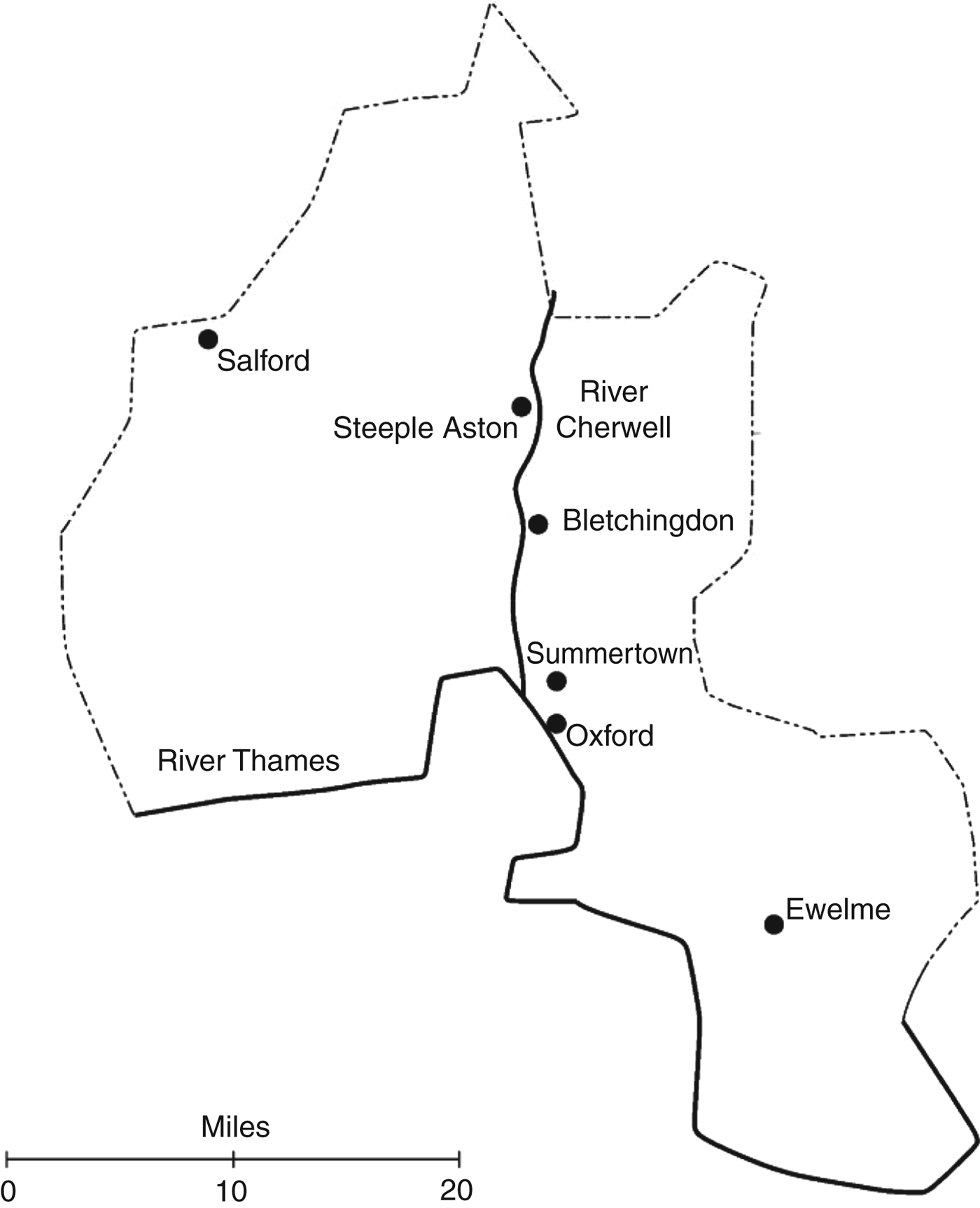
Of the five parishes studied, four were rural settlements (Figure 1), though with differences in their size and landholding structure.Footnote 20 Salford was the smallest, with a population of 281 in 1814, while Steeple Aston had an 1811 population of 336. Ewelme had 403 inhabitants at the time of its census in 1786, though servants were excluded from the total so that the true number would have been slightly higher. The largest rural parish was Bletchingdon, with a census population of 522 in 1795. Population trends prior to the 1801 national census are difficult to determine, but a 1751 listing for Bletchingdon gives 355 inhabitants, indicating a substantial rise before the 1795 census, while Ewelme had 490 residents in 1801, again suggesting some increase. All four parishes experienced significant population growth in the first three decades of the nineteenth century; the number of inhabitants in Bletchingdon, Ewelme and Steeple Aston increased by around a third, while the population of Salford rose by just over 50 per cent.Footnote 21 Differences were also apparent in the landholding structure of the parishes. Bletchingdon and Salford were dominated by one owner; in Bletchingdon the Annesley family paid 62 per cent of the land tax in 1795, while in Salford the Dawkins family paid 71 per cent of the land tax in 1814.Footnote 22 In the other two parishes landownership was more diffuse. In Steeple Aston, the rector, as the largest landowner, contributed 47 per cent of the land tax; the remainder was paid by 14 different landowners. The parish also differed from the other rural parishes by containing a higher proportion of artisans and tradesmen.Footnote 23 In Ewelme three people paid just over one-half of the land tax, but there were also several smaller landowners.Footnote 24
Location in the county of Oxford of places mentioned in the text.

Summertown was a rather different settlement, more akin to the suburban developments adjoining London and other cities than a purely rural community. Suburban settlements were growing in size and importance in the early nineteenth century, in the south-east and elsewhere, but they have rarely been studied by historians looking at the Poor Law. Lying a mile and a half to the north of Oxford, Summertown was built as a speculative venture in 1820 to meet the need for housing and expanded rapidly, so that by 1832, the date at which a local census was taken, there were 562 inhabitants. Summertown's proximity to Oxford meant that there was less dependence on agriculture amongst its inhabitants than was true of the other parishes and, although there were several farms, it was known locally as a ‘tradesman's village’. There was little ownership of land by the gentry; the village itself was comprised of small freeholds while the remainder of the parish was owned by St John's College and let out at long leases to local farmers or city residents.Footnote 25
These five parishes allow us to investigate the nature and extent of poor relief in different parts of the county during the last decades of the Old Poor Law, taking into account differences in population size, landowning structure and, in the case of Summertown, its semi-urban nature. All of the parishes practised outdoor relief, the usual practice in Oxfordshire, enabling comparisons to be made without any distorting effects from workhouses, which could absorb elderly and other life-cycle paupers. Summertown did have a small parish poorhouse, but it only provided housing for seven paupers who otherwise lived independently.Footnote 26 Considering the similarities that Oxfordshire as a whole shared with the rest of the south and east of England, observations on the situation of paupers in this county will allow some wider lessons concerning pauperism to be drawn.
3. THE EXTENT OF PAUPERISM
Before we investigate these issues further it is necessary to calculate the proportion of households in each parish in receipt of poor relief. The household was taken as the unit of measurement as all but one of the five censuses were based on this type of unit. A list was made of the household heads recorded in each of the five censuses. Lodgers were not counted separately but deemed to form part of the household to which they were assigned in the census, in line with the convention proposed by Sokoll.Footnote 27 Such a procedure has been criticised; an individual pauper lodging with a householder who was not on poor relief could, in theory, lead to the whole household being classified as paupers. Only three examples of this form of household were found, however, and in each case the pauper lodger was a relative of the householder concerned, indicating that they were part of the same domestic unit.Footnote 28 Using the overseers' accounts, a list of the names of those receiving poor relief was then collected for each parish for the same year as the census.Footnote 29 People were defined as receiving poor relief if they were in receipt of regular pension payments, payable monthly or weekly; or receiving casual relief: ad hoc cash sums, clothing, rent, fuel, doctor's and midwife's bills, funerals and apprenticeships. With the exception of Ewelme, the unit of granularity – the time period between observations – was taken to be one month. Ewelme only tabulated its expenditure every six months, making it impossible to work at a finer degree of granularity. While Bletchingdon recorded weekly disbursements, Steeple Aston, Salford and Oxford St Giles's (the parent parish of Summertown) recorded payments at monthly intervals. For each one-month period, those individuals in receipt of poor relief were then linked with the names recorded in the censuses. An additional check of marital status, and, where appropriate, the number of children, was made using the marriage and baptismal information recorded in the parish registers.Footnote 30 Households were classified as pauperised if one or more members, not just the household head, but also his wife, children, other relatives or lodgers, were in receipt of poor relief. Not all of the paupers recorded in the overseers' accounts could be identified in the relevant census returns; the proportions unlinked ranged from 24 per cent of paupers in Ewelme to 9 per cent in Steeple Aston.Footnote 31 Part of the discrepancy between parish linkage rates may be due to the granularity of the overseers' accounts. The six-month period between accounts in Ewelme could mean that some paupers recorded in the account prior to the census might have moved, or died, by the date the census was taken. Perhaps more significant, however, was the practice of non-resident relief, whereby paupers from the parish but living elsewhere had their payments sent to them, and therefore would not have been present to be enumerated when the census was taken. In an analysis of pauper lists that contained non-resident poor, Sokoll found that between one-fifth and one-quarter of people receiving relief in certain Essex localities did not live in their parish of settlement.Footnote 32
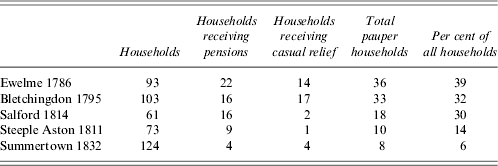
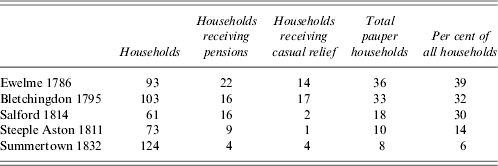
Table 1 shows the numbers and proportions of households receiving poor relief, divided into households receiving pensions, and those receiving only casual payments.Footnote 33 There is a wide variation in overall relief levels between parishes, from a high of 39 per cent of households in Ewelme to just 6 per cent of households in Summertown. The censuses were, however, taken at different points in time, and may reflect different social and economic conditions. As mentioned in the Introduction, poor relief expenditure in England and Wales as a whole rose five-fold in nominal terms between 1776 and 1818, though it fell back slightly by the 1830s.Footnote 34 There were several periods when national expenditure on poor relief increased sharply, and these often correlated with high wheat prices.Footnote 35 The years 1811 to 1814 (when the censuses of Steeple Aston and Salford were taken) fall into this category. Nationally, the price of wheat was also particularly high in 1795, when the Bletchingdon census was taken, and Oxfordshire, in conjunction with other counties, witnessed bread riots.Footnote 36 On the other hand, the census in Ewelme was compiled in 1786, when bread prices were low, there was no general economic distress in England, and national poor relief expenditure was only a third of its 1811–1814 level.Footnote 37
Numbers of households receiving poor relief in the five study parishes at selected dates
Sources: Oxfordshire History Centre (OHC), MSS. D.D. Par. Ewelme e.3, List of inhabitants 1786; PAR 227/10/MS/1, List of Salford inhabitants 1814; Eureka Partnership eds., The people of Bletchingdon (Aylesbury, 2002), 7–9; The people of Steeple Aston and Middle Aston (Aylesbury, 2005), 11–13; R. Fasnacht and C. Hicks eds., The making of a Regency village: Summertown in 1832 (Oxford, 1983). OHC, PAR 36/5/F1/1, Bletchingdon overseers' accounts 1787–99; MSS. D.D. Par. Ewelme b.10, Overseers' accounts 1772–91; PAR 227/5/F1/3, Salford overseers' accounts 1803–26; PAR 251/5/F1/2, Steeple Aston overseers' accounts 1810–32; MSS. D.D. Par. Oxford St Giles b.32, Overseers' accounts 1824–33.
We must therefore put the relief figures for each parish in the context of general economic events for England as a whole. Ewelme, and to some extent Summertown, reflect a reasonably benign economic climate; the censuses of Bletchingdon, Salford and Steeple Aston were taken in less favourable conditions. There is one other factor that must be noted: the season in which the various censuses were taken. Oxfordshire lay in an arable farming region and in such areas unemployment would tend to rise when there was a reduced demand for labour in the autumn and winter after the harvest period.Footnote 38 The censuses of Salford and Steeple Aston were taken in May, that of Summertown in late August or early September. Bletchingdon and Ewelme on the other hand, where pauperism appeared to be especially prevalent, had their censuses taken in December and January, respectively. Some of the poverty in these two parishes may thus be attributable to seasonal factors.Footnote 39 Indeed, when their level of pauperism in May, a spring month, was estimated using the same methodology as for the previous census calculations, it was found that the proportion of households receiving poor relief declined. Levels of pauperism fell to 24 per cent for Ewelme and to a much lower 15 per cent for Bletchingdon, well down on the 39 and 32 per cent shown for these parishes in Table 1.
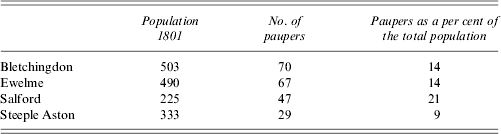
The poor relief data must thus be interpreted carefully. Nevertheless, some useful observations can be made. Salford, Bletchingdon and Ewelme all appear to have had high levels of pauperism of between 30 and 39 per cent of households, though the figures for Bletchingdon, in particular, may have been influenced to a marked degree by the seasonality of unemployment and further exacerbated by the high prices of 1795. Steeple Aston, on the other hand, had only 14 per cent of households in receipt of poor relief, while the percentage of households given relief in Summertown was the smallest, at just 6 per cent. These figures receive some corroboration from a comparison of poor relief recipients in the study parishes using figures from the 1802 Parliamentary report on the numbers of poor relieved and the 1801 census, as seen in Table 2. In this case the unit of analysis is the individual, not the household. The 1802 figures show a similar pattern to the rates of pauperism shown in Table 1, although the percentages of poor relief recipients from the 1802 report are lower than those derived from the censuses used in the current study.Footnote 40
Total numbers of poor relief recipients in four of the study parishes: as reported in 1802
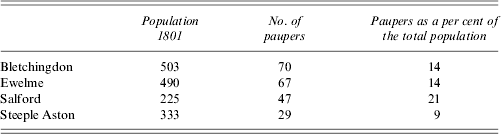
Sources: British Parliamentary Papers (BPP) 1803–4, VIII, 402–7; Census of England and Wales 1801, BPP 1802, VII, 283–7.
Comparable research using censuses and other material is limited, and is usually taken at different points in time and with different units of measurement, households or individuals. From analysis of the 1782 census for Cardington, Bedfordshire, David Baker estimated that 12 per cent of its inhabitants were on poor relief.Footnote 41 Sokoll calculated household pauperism rates of 42 per cent using the 1796 census for Ardleigh in Essex (although it should be noted that this was a year of particularly high food prices) and 25 per cent for Braintree in 1821.Footnote 42 Samantha Williams estimated from her reconstitution data that the percentage of individuals on poor relief in her two Bedfordshire parishes was between 12 and 15 per cent in 1811, though the figure was much higher in the ‘crisis’ year of 1801, when prices were especially high.Footnote 43 The pauperism rates for Bletchingdon, Ewelme and Salford thus appear to be on the high side compared with these south-eastern parishes, while Steeple Aston occupies a more middling position, similar to Williams' two Bedfordshire parishes. In all four cases the percentage of households receiving poor relief is higher than comparable data for the north of England. Even allowing for dependants, Steven King calculated that the maximum percentage of individuals receiving poor relief in Calverley, Yorkshire, only reached 10 per cent in 1801; similar figures for other northern counties are seen in the 1802 Parliamentary report.Footnote 44 Summertown, on the other hand, with its low pauperism rate, appears to have more in common with other urban centres, where the numbers receiving poor relief were generally small. The city of Oxford itself, for example, only had 11 per cent of its total population receiving poor relief in 1802, including paupers receiving non-resident relief from external parishes.Footnote 45
4. THE NATURE OF POOR RELIEF
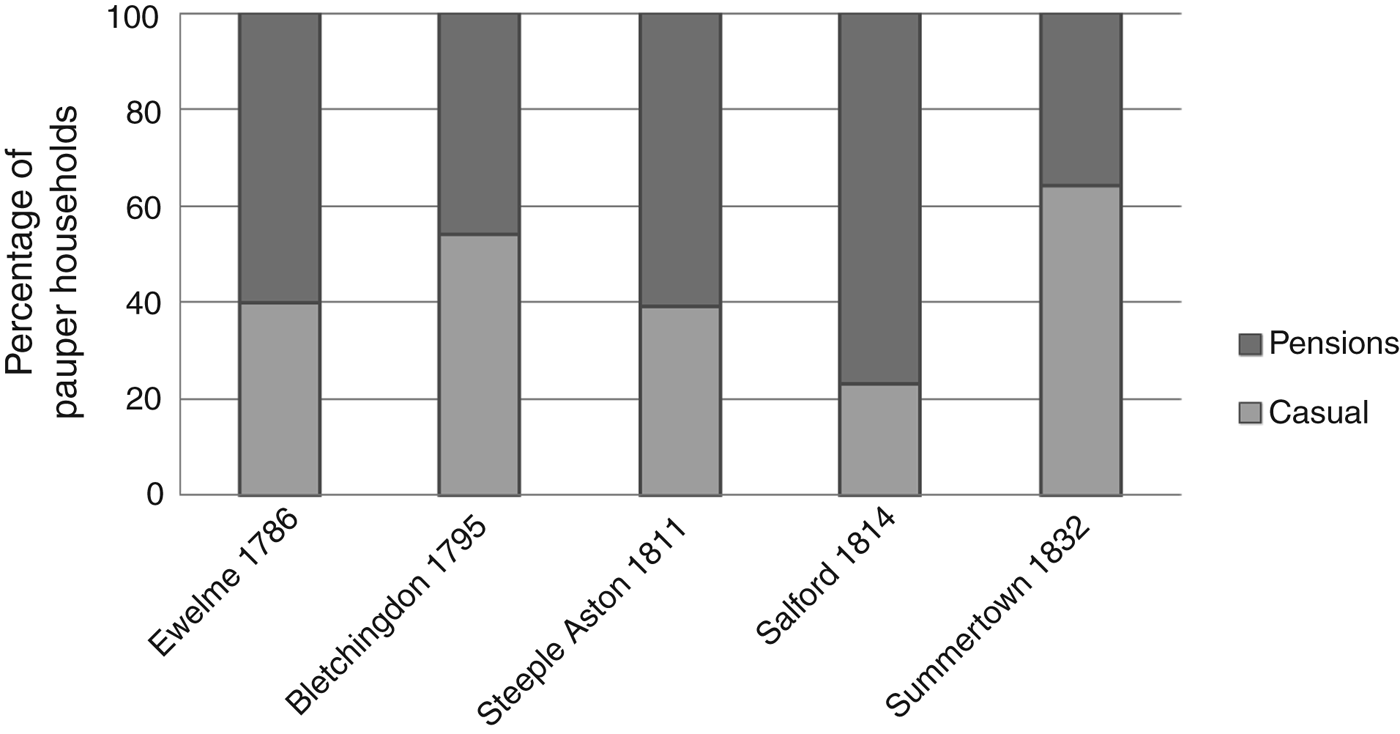
Alongside these differences in poor relief levels, can we see any trends relating to the types of people relieved and the generosity (or otherwise) of their relief? First, let us look at the assistance handed out in the five parishes. As Table 1 shows, not every pauper was in receipt of a regular pension, many only received casual relief, in particular during instances of hardship. It has been argued that from the middle of the eighteenth century there was a growing trend towards the granting of casual relief in the south and east of England. As increasing numbers of paupers outgrew welfare resources and there was a greater demand for occasional services such as medical care, more ad hoc systems of support such as the roundsman system developed alongside the traditional pension payment.Footnote 46 To investigate this matter further, and to produce a larger sample of paupers than that shown in Table 1, a count was made of the number of paupers (including lodgers) receiving either regular or casual relief for the complete accounting year, April to March, encompassing the date of each census. This resulted in 37 paupers under observation in Bletchingdon, 43 in Ewelme, 22 in Salford, 23 in Steeple Aston and 14 in Summertown, although it should be noted that immediate dependants, such as children and wives, receiving poor relief were not included. The results are shown graphically in Figure 2.
Percentage of pauper households receiving either regular pensions or casual relief in the five study parishes at selected dates. Sources: Oxfordshire History Centre (OHC), MSS. D.D. Par. Ewelme e.3, List of inhabitants 1786; PAR 227/10/MS/1, List of Salford inhabitants 1814; Eureka Partnership eds., The people of Bletchingdon (Aylesbury, 2002), 7–9; The people of Steeple Aston and Middle Aston (Aylesbury, 2005), 11–13; R. Fasnacht and C. Hicks eds., The making of a Regency village: Summertown in 1832 (Oxford, 1983). OHC, PAR 36/5/F1/1, Bletchingdon overseers' accounts 1787–99; MSS. D.D. Par. Ewelme b.10, Overseers' accounts 1772–91; PAR 227/5/F1/3, Salford overseers' accounts 1803–26; PAR 251/5/F1/2, Steeple Aston overseers' accounts 1810–32; MSS. D.D. Par. Oxford St Giles b.32, Overseers' accounts 1824–33.
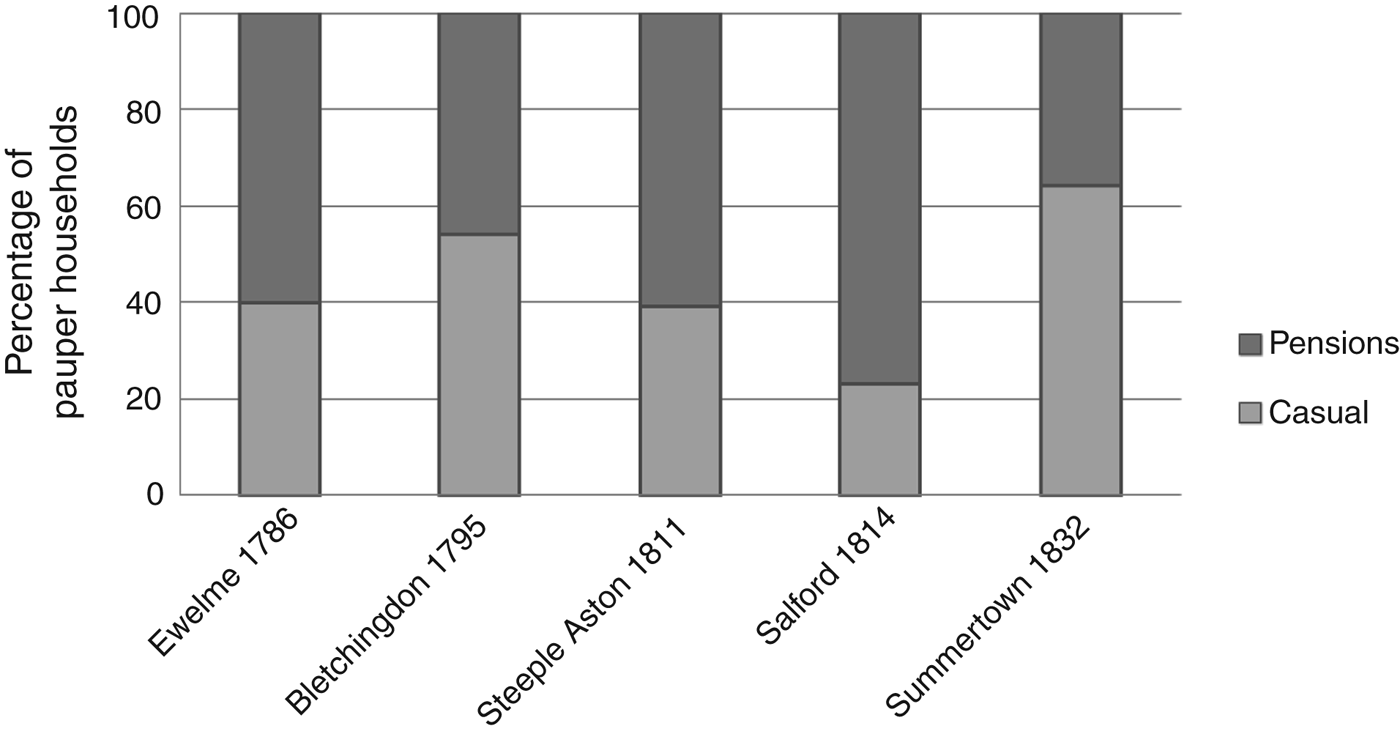
Figure 2 shows that the proportion of casual recipients in four of the parishes, Summertown, Steeple Aston, Bletchingdon and Ewelme, was broadly similar, at between 40 and 60 per cent of paupers. These percentages are similar to those seen by King and other scholars, though higher than the Bedfordshire data produced by Williams.Footnote 47 Salford, on the other hand, had only a fifth of its paupers on irregular relief and appears to have a greater propensity towards granting pensions. These differences will be explored in more detail later, but could reflect the outcome of the decision-making process by vestries and overseers, with applicants for pensions being turned down in some parishes and given casual relief in its place.
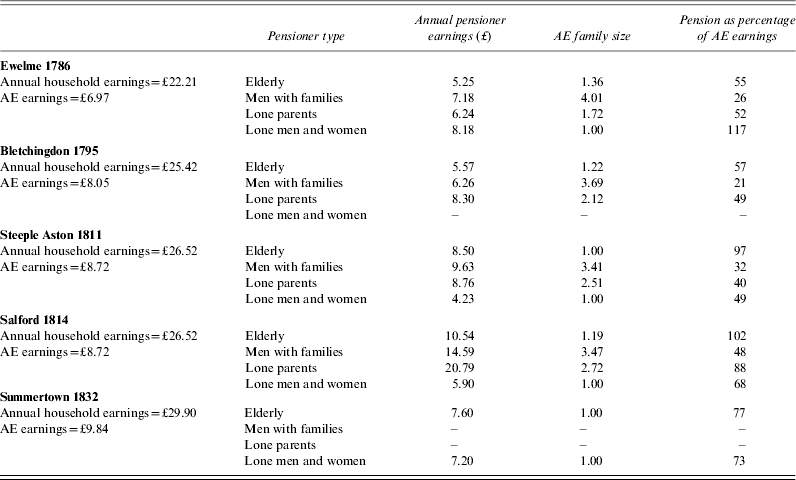
The level of support given by the respective parishes also varied. Estimating the value of pension payments in relation to incomes is a difficult process, as wages could vary over the year and it is hard to calculate the contribution made by women and children. Historians have, however, used the budgets collected by late eighteenth-century writers such as David Davies and Frederic Morton Eden and those published in government reports to estimate total household incomes; a similar approach will be adopted here.Footnote 48 Direct information is only available for Summertown, where the typical earnings of a labouring family were published in the 1834 Poor Law report.Footnote 49 For the other four parishes estimates have had to be made. For Ewelme, earnings were taken from Davies's 1790 figures for the nearby parish of Pangbourne; for Bletchingdon, Eden's 1795 data for nearby Banbury and Deddington.Footnote 50 No equivalent budgets survive for the period of the Salford and Steeple Aston censuses. We do have some wages information from Oxfordshire for 1813, however, and this has been used, with an allowance made for the contribution from wives and children.Footnote 51 Using the methodology adopted by Williams, so that comparisons can be made, pensioners were classified into four categories: the elderly – those aged over 60 years; married men with families; lone parents; and men and women living alone.Footnote 52 Two of these groups were subject to what historians have termed ‘life-cycle’ or ‘nuclear-hardship’ poverty: the elderly and lone parents, the latter including unmarried mothers, deserted wives, and both widows and widowers below the age of 60 years who have children living with them. The need for relief amongst individuals in these groups was primarily dictated by their age or familial circumstance; women lacking the support of a male breadwinner would have been particularly vulnerable.Footnote 53 For many of the lone individuals under the age of 60 years the reason why they were receiving poor relief is not known, but others in this group were recorded as infirm or disabled.Footnote 54 The final group was married men with families, who would have been regarded as ‘able-bodied’ by their contemporaries. Some of these individuals can be viewed as falling under the life-cycle categorisation if they had large numbers of children; others needed relief because of economic circumstances, such as unemployment or low wages. For all pensioners, their total earnings from the parish for the whole accounting year were taken. This means that income additional to their pension, such as rent payments and medical expenses, was also included. Both sets of earnings figures, the pension payments and estimates of total household income, were then converted into adult-equivalents, to allow for differing numbers of dependants.Footnote 55 The results can be seen in Table 3.
Value of relief payments by pensioner type when compared with adult equivalent (AE) earnings for a typical labouring household in each parisha
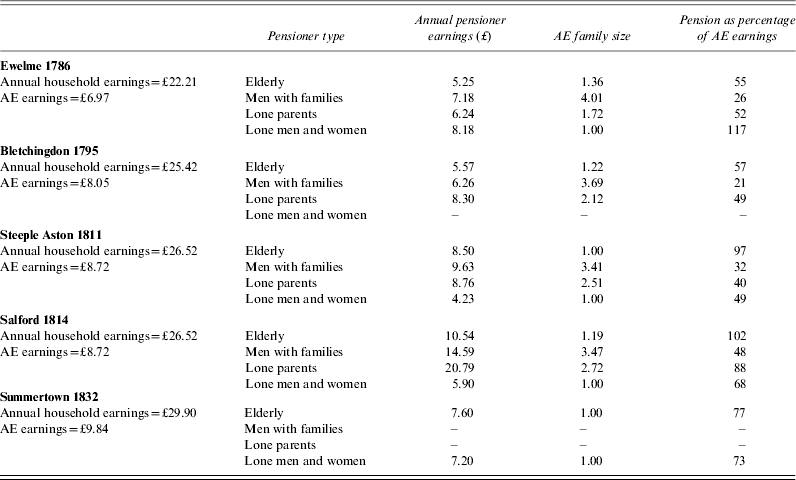
a AE earnings are the average earnings of an adult male labourer, calculated by dividing the total household earnings by family size using the following ratios: husband and wife 1.75; other adults 1.0; children 0.43. See S. Williams, ‘Poor relief, labourers’ households and living standards in rural England c.1770–1834: a Bedfordshire case study', Economic History Review 58 (2005), 508–10. All values in the Table are expressed in pounds and new pence.
Sources: Household earnings: Summertown: Report from her Majesty's Commission, 1834 Appendix B, 380; Ewelme: D. Davies, The case of labourers in husbandry stated and considered (London, 1795), 138; Bletchingdon: F. M. Eden, The state of the poor: or, a history of the labouring classes in England (London, 1797), ii, 589; Steeple Aston and Salford: A. Young, General view of the agriculture of Oxfordshire (London, 1813), 321. Pension payments: Oxfordshire History Centre (OHC), PAR 36/5/F1/1, Bletchingdon overseers' accounts 1787–99; MSS. D.D. Par. Ewelme b.10, Overseers' accounts 1772–91; PAR 227/5/F1/3, Salford overseers' accounts 1803–26; PAR 251/5/F1/2, Steeple Aston overseers' accounts 1810–32; MSS. D.D. Par. Oxford St Giles b.32, Overseers' accounts 1824–33.
The small numbers involved mean that any conclusions should only be regarded as tentative. In all, 96 paupers can be classified in this manner, of which 55 were men with families. The numbers of the elderly, lone men and women, and lone parents were much smaller, at 21, 14 and 6, respectively. It must also be stressed that the annual incomes given in the Table are average figures estimated for the poor of the whole parish, not just for pauper households. Nevertheless, Table 3 clearly shows that some groups of paupers were more generously treated than others. Elderly paupers and lone parents received between 50 and 100 per cent of the average adult wage estimated for their communities. Married men with families, however, were less generously treated, their adult-equivalent pension being only one quarter to one-half of the average wage. This focus on pension payments towards the elderly and what can be termed life-cycle paupers has been observed by scholars studying other communities. Williams, for instance, found that the elderly in the Bedfordshire parishes of Campton and Shefford received half or more of adult-equivalent earnings while male-headed families only received 20 to 30 per cent.Footnote 56 Yet within the five Oxfordshire parishes there were also some differences. The poor relief payments made by Ewelme and Bletchingdon were less generous, not only to their elderly pensioners but also to married men with families, than in the other three parishes. As we have seen, both Ewelme and Bletchingdon had a high proportion of households receiving poor relief and availability of resources could have been an issue here. Steeple Aston and Summertown, with fewer poor to relieve, may have been able to offer more generous treatment. On the other hand, both pensioners and male-headed families were generously treated in Salford, the latter group receiving almost 50 per cent of earnings, even though the parish had one of the highest rates of pauperism.
By its nature, casual relief was of less monetary value to the poor, as the sums involved were occasional, given only in times of need. Nevertheless, it could still act as a useful safety net in a crisis situation: when people fell sick, or during temporary periods of unemployment. John Pierce of Ewelme, for instance, received 5 shillings (5s) ‘when ill’, 2 shillings and 4 pence (2s 4d) ‘when [he had] no work’ and other occasional payments in the early part of 1785.Footnote 57 Casual relief was not just confined to cash payments or gifts in kind; in some parishes it could take the form of work. Ewelme and Steeple Aston did not provide any employment for their poor, but in Summertown male paupers were employed in repairing the roads while three paupers in Salford were paid for unspecified work.Footnote 58 The greatest use of work was made in Bletchingdon. The parish adopted the roundsman system, sending some paupers ‘on the rounds’, to work at local farms. Often these were teenage boys and girls from pauper families, such as the two daughters of Francis Morris, who in 1795 were sent on the rounds at various dates, each receiving one penny a day from the parish, supplementing any wages provided by the farmer. Labourers' wives in Bletchingdon were also paid to spin, receiving 9d for one pound of flax and 11d for one pound of hemp.Footnote 59 In some cases the income from work or spinning was the only contribution made by the Poor Law to the family budget. Mary North, for example, married with three children under 14 years, received a total of 8s 3d for spinning in 1795, the family's sole support from Bletchingdon parish in that year.
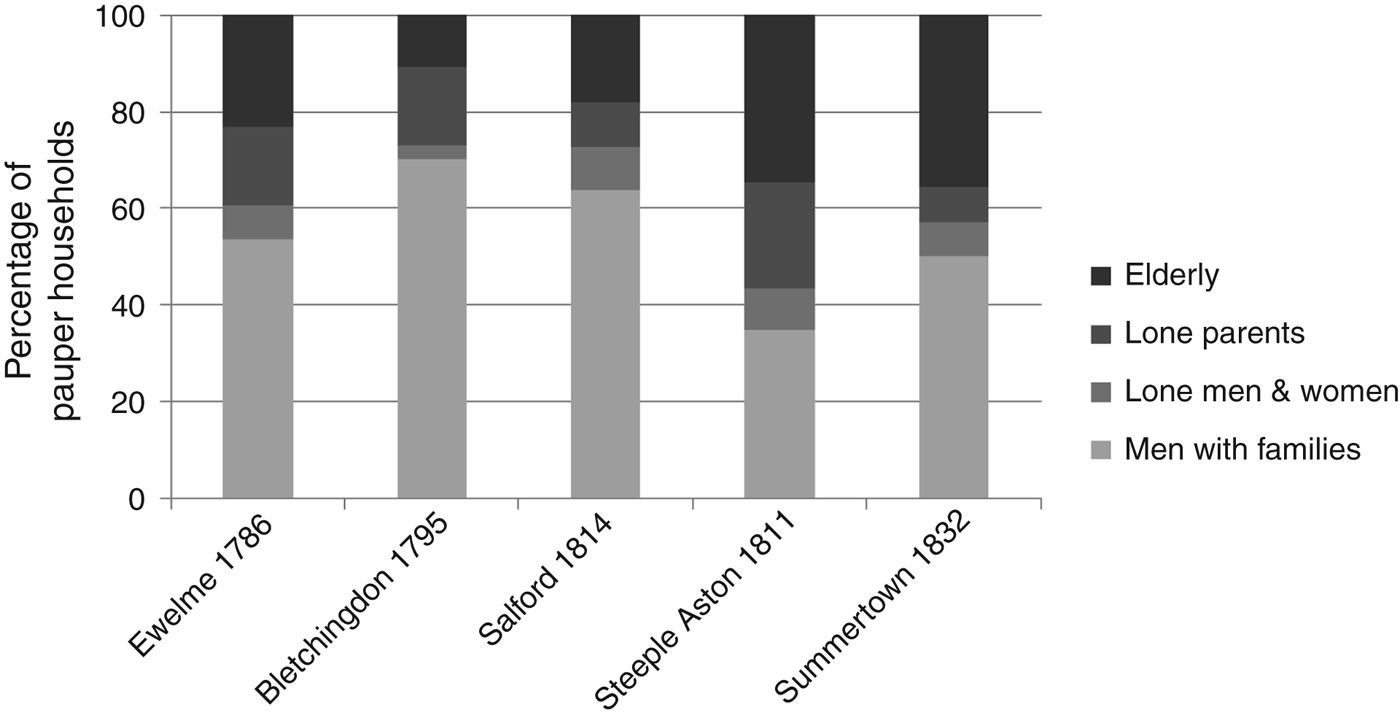
Turning now to the different types of people in receipt of poor relief, the four categories of welfare recipients identified by Williams were again used for comparison purposes. Figure 3 gives the relative proportions of these four categories for each parish.
Distribution of types of pauper household by parish, selected dates. For the definition of the categories of pauper household, please see the text. Sources: Oxfordshire History Centre (OHC), PAR 36/5/F1/1, Bletchingdon overseers' accounts 1787–99; MSS. D.D. Par. Ewelme b.10, Overseers' accounts 1772–91; PAR 227/5/F1/3, Salford overseers' accounts 1803–26; PAR 251/5/F1/2, Steeple Aston overseers' accounts 1810–32; MSS. D.D. Par. Oxford St Giles b.32, Overseers' accounts 1824–33.
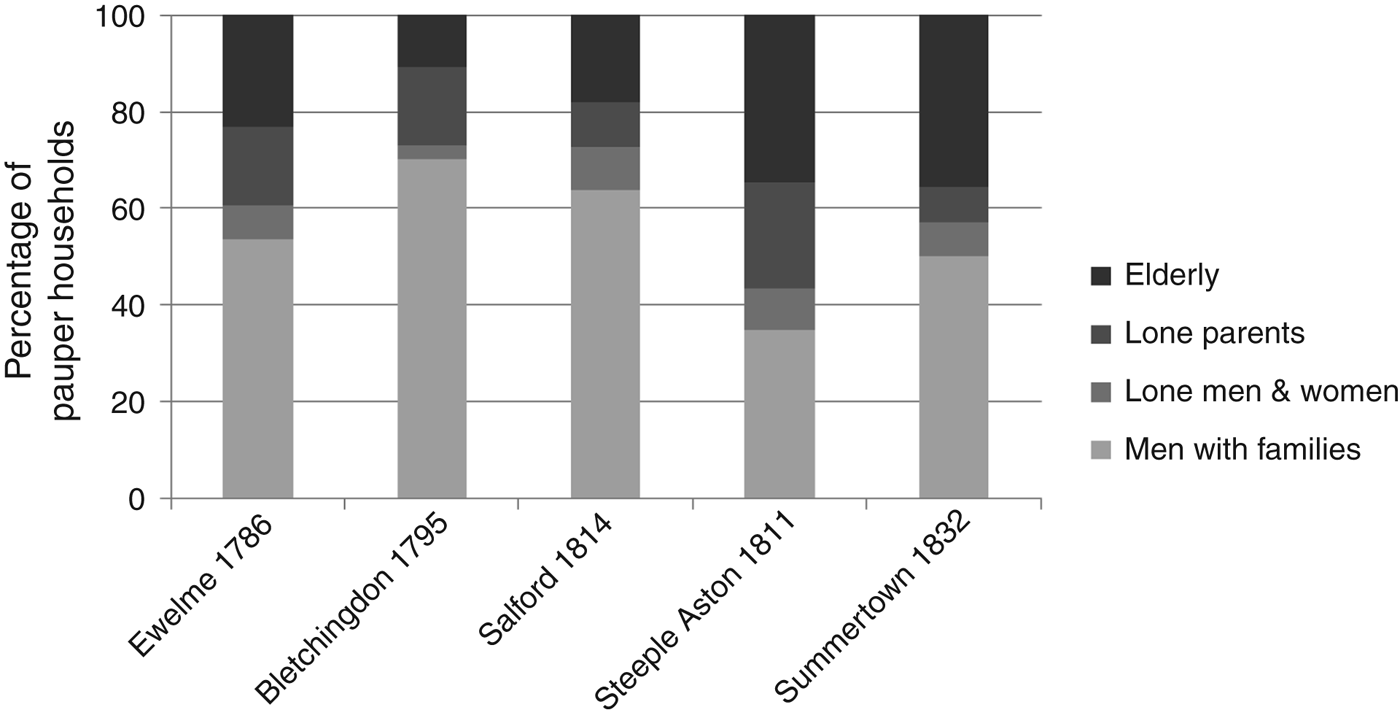
In the three parishes of Bletchingdon, Ewelme and Salford, between 50 and 70 per cent of pauper households were headed by men with families. This appears at first sight to support the notion of significant able-bodied poverty in rural areas. This may have been true in Salford, where 9 out of 14 pauper families were on regular pensions; in Bletchingdon and Ewelme, however, the majority of pauper families only received casual relief, and pension provision was still focused on the elderly and lone parents.Footnote 60 In Summertown and Steeple Aston, the proportion of pauper households comprising men with families was lower, at 35 to 40 per cent, and life-cycle groups of paupers were again predominant. King has argued that the proportion of male pension recipients was increasing by the early nineteenth century relative to more traditional groups of poor. The evidence from at least four of the parishes studied here, however, suggests a continued persistence of life-cycle pauperism; Williams found similar patterns in her two Bedfordshire parishes.Footnote 61
5. FACTORS AFFECTING LEVELS OF PAUPERISM
There were thus a number of differences in the nature and extent of pauperism between the five parishes. The percentage of households in receipt of poor relief varied, with a greater level of pauperisation in Bletchingdon, Ewelme and Salford than in Steeple Aston, and particularly Summertown. The type and value of the support offered under the Poor Law differed, with significant use of casual relief in some parishes and a greater reliance on pensions in others. Is it possible to account for these differences by examining more general social and economic factors? While regional variations in poor relief policy have come under some scrutiny, only a limited amount of comparative research has been conducted at the local level, such as George Boyer's work on the 1834 Poor Law report.Footnote 62 The data available allow us to examine three casual factors: the economic conditions existing in each parish; the availability of means of support other than the Poor Law; and the local relief policies practised by the vestry and overseers.
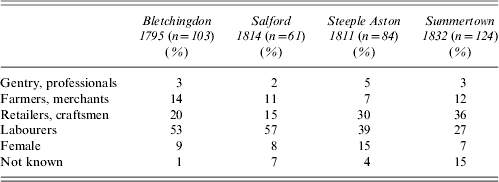
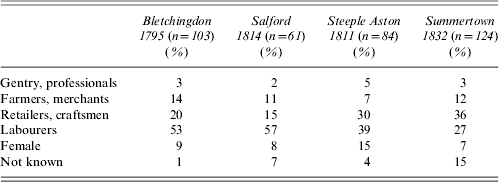
By determining the availability and type of employment offered, the economic conditions existing in each parish would have influenced overall levels of pauperism. Of the five censuses used in this study, all except that for Ewelme record the employment of the household head, enabling the occupational structure in the other four parishes to be determined. Table 4 summarises the results. Households marked ‘female’ are those headed by a woman whose occupation was not given.
Occupations by household head: Bletchingdon, Salford, Steeple Aston and Summertown
Sources: Oxfordshire History Centre (OHC), PAR 227/10/MS/1, List of Salford inhabitants 1814; Eureka Partnership eds., The people of Bletchingdon (Aylesbury, 2002), 7–9; The people of Steeple Aston and Middle Aston (Aylesbury, 2005), 11–13; R. Fasnacht and C. Hicks eds., The making of a Regency village: Summertown in 1832 (Oxford, 1983).
There were significant differences between the parishes. Bletchingdon and Salford had the highest proportion of labourers; more than 50 per cent of household heads in these communities were in this category. They would probably have been agricultural workers, given the rural nature of both parishes. Steeple Aston and Summertown, on the other hand, had fewer labourers, and a greater proportion of retailers and craftsmen: occupations such as shoemakers, innkeepers, butchers or grocers, to take a few examples. Although not mentioned in Table 4, the residents of 12 households in Summertown were described in its 1832 census as being retired and Steeple Aston was reputed to be populated by a number of professional families.Footnote 63 Although we have no direct evidence from its 1786 census, Ewelme would probably have had a similar proportion of rural labourers to Bletchingdon and Salford; three-quarters of its households were employed in agriculture in the 1811 national census, when occupations were first listed by family.Footnote 64
These occupational differences would have influenced the level of pauperism within each parish. There were proportionally more households in Steeple Aston and Summertown headed by retailers and craftsmen than in the other three parishes; occupations that were probably better-paid and with a more regular income than agricultural work. Whether the concentration of service occupations in Steeple Aston and Summertown created work opportunities for other residents we do not know; the evidence is silent on this aspect. Some households in Summertown did have servants, and not all of these households were necessarily wealthy. John Braine, a butcher, had a maid and two apprentices; William Dumbleton, a shoemaker, had a maid residing in his household.Footnote 65 In the more agricultural parishes the evidence suggests that servants may have been confined to farmers and wealthier groups. In Salford, where they are separately listed, of the nine households with servants, seven were headed by farmers, one by a clergyman and one by a blacksmith.Footnote 66
Economic conditions would have been less favourable for the labourers of both sexes working in agriculture, which, as we have seen, was experiencing significant structural change. Increased population, enclosure, a reduction in the number of small farmers and the consolidation of holdings all combined to increase unemployment among rural workers and depress wages in the late eighteenth and early nineteenth centuries. It was noted earlier that all of the parishes experienced population growth after 1800 – Summertown, of course, being a new settlement. With the exception of Ewelme, each of the parishes had been enclosed prior to its census date, though the enclosure of Summertown only took place in 1832, the same year as its census, and any effects may not yet have been felt.Footnote 67 The traditional perquisites of using unenclosed commons to gather fuel or keep animals would therefore not have been available in at least three parishes: Bletchingdon, Steeple Aston and Salford. It must be stressed, however, that even in open-field Ewelme such opportunities may have been limited. Of the two commons existing there, only one was available for residents; the other, the Cow Common, had been let out to local farmers for arable crop growing since at least the middle of the eighteenth century.Footnote 68
Large farms, which have been associated with a reduced demand for labour, were present in four of the five parishes under study.Footnote 69 In Bletchingdon, a survey of 1789 shows that three farms on the Annesley estates were over 300 acres in area; the land tax records suggest that there was another property of a similar size in the parish belonging to another landowner.Footnote 70 Salford had two farms of over 300 acres lying on the Dawkins estate in 1799; the largest farm at the date of enclosure in 1770 was 256 acres.Footnote 71 In Steeple Aston three farmers accounted for almost 60 per cent of its rateable value in 1816.Footnote 72 Around 80 per cent of tithes were paid by just five farms in Ewelme in 1786.Footnote 73 Summertown, however, appears to have had smaller farms; the largest holding recorded in 1832 was 113 acres occupied by a Thomas Cripps.Footnote 74
Small farms never completely disappeared, however. In Bletchingdon eight tenants in the 1789 survey occupied farms that were less than 60 acres in size.Footnote 75 In the 1786 Ewelme census we find Robert Tidmarsh, a small farmer and shopkeeper, who also kept pigs.Footnote 76 Small farmers were similarly found in Steeple Aston, again often combining occupations, such as Isaac Prentice, a soap boiler and shopkeeper who rented a meadow.Footnote 77 In Salford the 1814 census gives the example of Henry Stanley, a husbandman, who farmed 17 acres that he owned himself.Footnote 78 Overall, however, there were relatively few small farmers in these parishes and larger holdings predominated. The only exception was Summertown. We have already commented on the smaller size of farms there. The parish also had a number of smallholders, people with very small plots of land from which they made a living. Edward Deane, a middle-aged married man, kept a cow and sold milk and poultry. An elderly man by the name of Thornton sold the produce from his garden ‘which is his chief employ’. Thornton always had a pig ‘in the sty and bacon on the rack’.Footnote 79 Such people, forming perhaps a quasi-peasantry, may provide another explanation for the low rate of pauperism seen in Summertown.Footnote 80
By themselves, however, economic conditions may not fully explain differences in relief levels. Alternative means of support such as charity or kin might also have been available. People with access to such support would have had less need to turn to the Poor Law; the vestry and overseers, aware of such resources, might also be more discriminating, or less generous, in their granting of parish aid.Footnote 81 Examples of co-residing kin can be found in all of the parishes with the exception of Salford, where the labelling of lodgers simply as ‘inmates’ makes identification impossible. The Ewelme census, for instance, lists Robert Bell, a married labourer in his sixties, as living with his son, who was also married with four children.Footnote 82 Neither Bell nor his son was recorded as receiving poor relief, although other instances of co-residing kin needing help from the parish can be found in Ewelme. One such case was that of Widow King, a regular pensioner who lived with her unmarried daughter, the daughter's child, and a married son and his wife. With such contrasting examples, it is difficult to measure the impact of kin and harder still to make comparisons between parishes. Nevertheless, shared residence or other means of kin support may have ameliorated poverty in some instances.
The extent of charitable provision is perhaps easier to measure, and this was found in all except one of the parishes. Salford had no active endowed charities at the date of its census; there had been a loan charity in the eighteenth century but the stock of this had been lost.Footnote 83 Bletchingdon, Ewelme and Steeple Aston all had almshouses, funded by bequests of property. The Bletchingdon almshouse had accommodation for four women, who received a small pension worth 1s to 2s per week; six families resided in the Ewelme almshouse at the date of the census receiving 14d per week, with the same number non-resident; Steeple Aston's almshouse housed two widows who were given a pension of £4 per year.Footnote 84 The Bletchingdon census does not identify its alms people, but in the other two parishes there is evidence that the almshouses may have acted as an alternative to the Poor Law. Of the six families in the Ewelme almshouse – who were all established local residents – only one received poor relief; similarly one of the two almswomen in Steeple Aston was not a pensioner. Such numbers were, however, still small in contrast to those receiving poor relief.Footnote 85
It was in Summertown that the greatest engagement with charity was found. Residents there were eligible for support from the long-established endowed charities of its parent parish of St Giles's. The Eynsham charity, for instance, dispensed doles of 1s to 2s four times a year to several Summertown paupers such as Widow Austin and George Bridgewater, a widower.Footnote 86 Of greater influence, however, was a more recent charity, the St Giles's Benevolent Society, founded in 1823. This was funded by subscription, and aimed to relieve the ‘sick and distressed poor’ by giving out meat, bread, coal, and in some cases coffee and wine to those afflicted.Footnote 87 Of the 124 households recorded in the Summertown census in 1832, a total of 13 had received support from the Benevolent Society in previous years. Five households were in receipt of relief in the same year as the census, only one of which was supported by the Poor Law. A typical example is John Sturman. A married labourer with three children, he was first relieved by the Benevolent Society in April 1832 with four pounds of meat due to ‘Illness of wife & distress for want of work’. Sturman was also given relief in December of that year, again with meat, when his children became ill, assistance continuing at fortnightly intervals until February 1833.Footnote 88 At no time do the overseers' accounts record Sturman being given poor relief and such support may have helped to make people less reliant on parish welfare, further contributing to Summertown's low level of pauperism.
A final factor that can affect the level of pauperism and pension levels is the attitude of the overseers and vestry. As mentioned earlier, King has argued for a north–south divide in sentiment towards the poor; and in certain ‘closed’ parishes settlement and relief were strictly controlled.Footnote 89 The degree of generosity on the part of the parish authorities can be linked to the supply of welfare, expressed through the amount of poor rate collected.Footnote 90 To produce a comparison, the poor rate for each of the five parishes noted in the 1802 Parliamentary returns was divided by its 1801 population to give an average rate per inhabitant. It was found that Salford and Bletchingdon both had an average rate of 20s per head, Ewelme 26s. Steeple Aston, on the other hand, only had an average rate of 11s per head. Summertown, of course, was not built at this time but its parent parish of St Giles's had an even lower rate of 10s per head. If we look at 1831, when Summertown was in existence, overall relief expenditure had fallen slightly, but spending per head in St Giles's, at 8s per head, was still much lower than in Salford, where it stood at 17s.Footnote 91 Summertown and Steeple Aston, as we have seen, had the lowest rates of pauperism amongst the five parishes. Their need for relief spending would have been lower; they may also, however, have had a less generous attitude towards the granting of such relief.
The generosity of the authorities awarding relief payments is difficult to prove conclusively, as evidence such as vestry minutes that could give evidence of decision-making does not survive for any of the parishes. There is one indicator of sentiment that perhaps can be used: the removal order. Such orders were issued when paupers without a settlement in the parish from which they were seeking relief were sent back to their home parish and significant numbers of removals can be indicative of a harsher attitude to those seeking relief.Footnote 92 An analysis of removals for the accounting year of each parish's census shows that in four of them, Bletchingdon, Ewelme, Salford and Steeple Aston, none took place. In Summertown, however, four separate households were removed in the census year 1832 alone. Elizabeth Wixen, for instance, whose husband had been transported for stealing china-ware, was herself given 1 shilling and then removed to the nearby parish of Eynsham in September.Footnote 93 In each case, we are only looking at one year's worth of data, and the dates are well separated in time, but the overseers in Summertown's home parish, St Giles's, may have been actively deterring non-settled paupers, again setting it apart from the other four parishes.
6. CONCLUSION
The poor relief system practised in each of the five parishes studied was thus a complex affair, with different degrees of relief dependency, economic conditions and social structure interacting with each other. Some general observations can, however, still be made. First, with the exception of Summertown, the proportion of householders receiving poor relief was high. The January 1786 figure of 39 per cent of households receiving relief in Ewelme shows that widespread poverty existed there at that time. Even the 14 per cent of households receiving parish aid in Steeple Aston represents roughly one in seven of its inhabitants in 1811. These numbers thus confirm the findings of the 1802 report, and the conclusions of other scholars, that widespread pauperism existed in the south and east of England at the beginning of the nineteenth century.
Yet within these aggregate numbers the Poor Law in Oxfordshire was certainly not a uniform system. There were differences between the five parishes in the degree to which casual relief was granted, the value of pension payments and the proportions of life-cycle versus able-bodied relief recipients. There was no direct connection between levels of pauperism and the type of relief administered. Salford had high numbers on poor relief but many were on generous pensions; Bletchingdon had a similar proportion receiving poor relief but lower pensions while some paupers were sent out to work on the roundsman system. As we saw in the Introduction, there has been a tendency to categorise the Poor Law in the south and east during the late eighteenth and early nineteenth centuries as dominated by the able-bodied and focused on casual relief. The evidence here suggests that there was in fact significant local variation, with a continued emphasis in some parishes on supporting groups subject to life-cycle poverty.
The reasons for these differences are also complex. The economic structure of each parish was probably the main factor in influencing its level of pauperism. Bletchingdon, Ewelme and Salford, where occupations were primarily agricultural, had more households receiving poor relief than Steeple Aston and Summertown, parishes where a greater proportion of households were engaged in trades and crafts. Enclosure and a growth in farm size have traditionally been cited as key determinants here, but the presence (or absence) of small farmers and smallholders may also have been important. Yet economics was not the only factor affecting poor relief levels. In Summertown charity had some impact, with the St Giles's Benevolent Society acting as an alternative to the Poor Law for some short-term cases of need. Bletchingdon, Ewelme and Salford also had almshouses, though the numbers supported were small relative to their total populations. Finally, although the evidence is limited, the attitude of the parish authorities may have influenced how many people were relieved, and what assistance they were given. Each parish appears to have adopted its own relief system, tailoring it to fit local needs.
The variation in relief levels seen here thus reflects local social and economic trends rather than a simple narrative of increasing structural poverty. The Poor Law in Oxfordshire in the late eighteenth and early nineteenth centuries was very much a multifaceted affair, and there was no single ‘system’ in existence. If we take Oxfordshire to be a representative county for south-east England as a whole, as argued earlier, we may have to revise our assumptions about the Poor Law on a wider basis.