Introduction
Out-of-hospital cardiac arrest (OHCA) contributes to significant morbidity and mortality world-wide every year.Reference Benjamin, Spartano and Judd 1 , Reference Meng, Yue and Xuan 2 The average survival rate in OHCA treated by Emergency Medical Services is bleak, approximately eight percent to 11%.Reference Benjamin, Spartano and Judd 1 , Reference Link, Berkow and Kudenchuk 3 Sasson and colleagues had identified five key survival factors among OHCA survivors, namely return of spontaneous circulation, bystander cardiopulmonary resuscitation, initial shockable cardiac rhythm, cardiac arrest witnessed by bystander, and emergency medical personnel.Reference Sasson, Rogers and Dahl 4
Epinephrine, also known as adrenaline, is an endogenous catecholamine with high-affinity effects on alpha and beta adrenergic receptors.Reference Overgaard and Džavík 5 It is believed that the alpha-adrenergic effect of epinephrine increases the coronary perfusion pressure during cardiopulmonary resuscitation, which was associated with a higher chance of return of spontaneous circulation in human and animal studies.Reference Jacobs, Finn and Jelinek 6 – Reference Michael, Guerci and Koehler 10 Several observational studies, including the largest study of 417,188 patients, reported higher chance return of spontaneous circulation in patients who received prehospital epinephrine during OHCA.Reference Hagihara, Hasegawa and Abe 7 – Reference Yanagawa and Sakamoto 9 , Reference Herlitz, Ekström and Wennerblom 11 However, Hagihara and colleagues demonstrated that OHCA patients who received epinephrine were associated with increased mortality and poorer neurologic function after resuscitation.Reference Hagihara, Hasegawa and Abe 7 Despite the wide-spread use of epinephrine, as recommended in guidelines and protocols, the efficacy and safety of epinephrine in OHCA remain uncertain in the literature.Reference Link, Berkow and Kudenchuk 3 , Reference Soar, Nolan and Böttiger 12
The first under-powered, placebo-controlled trial (Prehospital Epinephrine for Cardiac Arrest; PACA trial) was conducted in 2011 to determine the effectiveness of epinephrine among OHCA patients.Reference Jacobs, Finn and Jelinek 6 Subsequently, the International Liaison Committee on Resuscitation had called for another randomized controlled trial ([RCT] Prehospital Assessment of the Role of Epinephrine: Measuring the Effectiveness of Drug Administration in Cardiac Arrest; PARAMEDIC2 trial) to establish the effect of epinephrine on the rate of survival at 30 days.Reference Soar, Nolan and Böttiger 12 , Reference Kleinman, Perkins and Bhanji 13 Thus, a systematic review and meta-analysis is timely warranted to synthesize evidence on the prehospital use of epinephrine in OHCA.
It was hypothesized that prehospital epinephrine increases the chance of return of spontaneous circulation and survival to hospital discharge during OHCA. The primary aim of this systematic review and meta-analysis was to determine whether epinephrine increases return of spontaneous circulation among OHCA patients. Secondary aims were to examine the clinical benefits of epinephrine on survival to hospital discharge, transport of patients to hospital, and favorable neurologic state at hospital discharge.
Methods
This review was conducted according to the PRISMA statement 2015.Reference Shamseer, Moher and Clarke 14 The review protocol was registered on PROSPERO (Center for Reviews and Dissemination; York, UK; CRD42018111763). The research questions were formulated using a Population, Intervention, Comparison, and Outcomes approach (eTable 1; available online only in the online supplement). Primary outcome was incidence of return of spontaneous circulation after epinephrine for OHCA. Secondary outcomes were transport of patients to hospital, survival to hospital discharge, and favorable neurologic function at hospital discharge after epinephrine for OHCA.
Ovid MEDLINE (US National Library of Medicine, National Institutes of Health; Bethesda, Maryland USA), EMBASE (Elsevier; Amsterdam, Netherlands), and CENTRAL (Cochrane Collaboration; London, United Kingdom) were systematically searched from their inception until October 4, 2018. Trial registers, namely ClinicalTrials.gov (US National Library of Medicine, National Institutes of Health; Bethesda, Maryland USA) and World Health Organization International Clinical Trials Registry Platform (World Health Organization; Geneva, Switzerland), were searched to identify any on-going or unpublished studies. Inclusion criteria were adults (≥18 years old), OHCA regardless of any cardiac causes, randomizing to prehospital epinephrine (intravenous or intraosseous) versus placebo, and RCTs only. All RCTs were sought for this review, regardless of the measured outcomes. Observational studies, case-controlled studies, case series, case reports, non-systematic reviews, and trials published as abstract were excluded. Non-randomized studies were excluded to minimize any bias and limitations of observational in nature. Trials comparing different doses of epinephrine (high-dose >0.1mg/kg versus standard dose of 1mg) or with other comparators (vasopressin or combination of epinephrine and vasopressin) were also excluded.
The search strategy is outlined in eTable 2 (available online only). Articles not written in English language were included if the journal provided an English-translated version. The bibliographies of all included papers and relevant systematic reviews were hand-searched for additional papers. Experts and authors of papers identified in the search strategy were contacted at least twice if any doubts with regard to the measured outcomes or missing data.
Titles/abstracts and full-texts of qualifying papers were independently screened against eligibility criteria by the two authors (KN and WT). Any discrepancies were discussed between them to reach a final decision. Selection of the final included articles was based on the final consensus between the two reviewers (KN and WT).
All the included RCTs were assessed independently for risk of bias using the Cochrane Collaboration Risk of Bias Assessment Tool (Cochrane Collaboration; London, United Kingdom) by the two authors (KN and WT).Reference Higgins and Green 15 Any disagreements were resolved via a group discussion until consensus was achieved. In addition to the measures of outcomes, the following fields, namely citation, country, population, setting, study designs, total number of patients, dosage of epinephrine, and duration of ambulance response, were extracted.
The GRADE assessments of the evidence and summary of findings were independently performed by the two authors (KN and WT) using the GRADEpro/GDT software (Cochrane Collaboration; London, United Kingdom). They downgraded a starting rating of “high-quality” evidence of RCT based on the five criteria (risk of bias, inconsistency, indirectness, imprecision, and publication bias) by one level for serious concern or by two levels for very serious concerns.Reference Ryan and Hill 16 Any disagreements were resolved via a discussion among the two authors (KN and WT).
RevMan Review Manager version 5.3 (Cochrane Collaboration; London, United Kingdom) was used for statistical analyses. A two-sided P value of <.05 was considered to denote the statistical significance of heterogeneity. Findings were reported as odds ratios (OR) or mean difference (MD) with 95% confidence interval (CI). The I2 test was used to assess the heterogeneity of studies. The values of less than 40%, 40%-60%, and more than 60% were categorized as low, moderate, and substantial heterogeneity, respectively.Reference Ryan and Hill 16 , Reference Choi and Lam 17 A fixed-effect model (Mantel-Haenszel method) was used to pool estimates. If evidence of substantial heterogeneity (I2>60%) was observed, a random-effects model (DerSimonian-Laird method) was used. To investigate the presence of small study effects on the measured outcomes with substantial heterogeneity (I2>60%), both fixed and random effect models were performed and compared. In addition, sensitivity analyses were performed by sequentially removing each study (from the most recent trials) and re-analyzing the remaining dataset of all the primary and secondary outcomes.
Results
The results of the literature search and study selection process are outlined in the PRISMA flow chart (eFigure 1; available online only). The titles and abstracts of 859 non-duplicate articles were screened, of which 10 articles were retrieved for full-text screening. After applying inclusion and exclusion criteria, two RCTs with a total of 8,548 participants were included in this meta-analysis. The study design and clinical characteristics of all included RCTs are illustrated in Table 1. Details of the excluded studies are outlined in eTable 3 (available online only). Searching the clinical trial registries identified no relevant, on-going studies.
Clinical Characteristics of Included Studies

Abbreviations: OHCA, out-of-hospital cardiac arrest; RCT, randomized controlled trial.
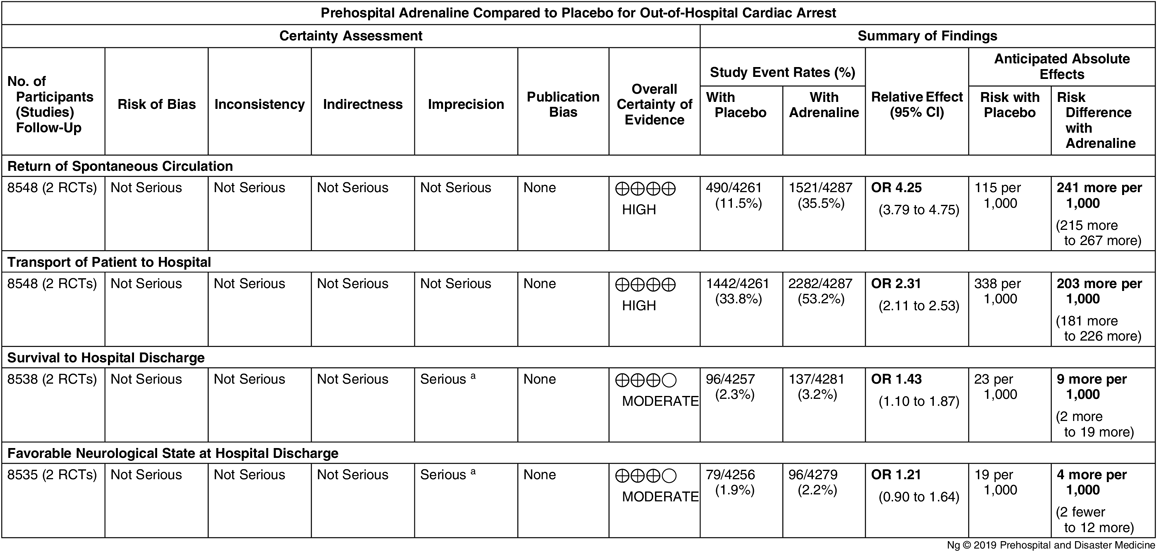
The PACA trial was a single-center RCT, which was conducted by Jacobs and colleagues in Western Australia in 2011 after the International Liaison Committee on Resuscitation urged for a RCT comparing epinephrine and placebo in OHCA patients.Reference Jacobs, Finn and Jelinek 6 Another study (PARAMEDIC2) was a multi-center RCT conducted in the United Kingdom, which was recently published to provide evidence on the survival rate at 30 days of prehospital epinephrine in OHCA.Reference Perkins, Ji and Deakin 18 Both trials randomized 1mg of epinephrine and 0.9% of normal saline to OHCA patients. In comparison to the PACA trial, the PARAMEDIC2 trial had a shorter mean of ambulance response interval: minutes (epinephrine 6.7 [SD = 0.9], placebo 6.6 [SD = 0.9]), and involved older population: age (epinephrine 69.7 [SD = 16.6], placebo 69.8 [SD = 16.4]).Reference Perkins, Ji and Deakin 18 All patients in the PACA trialReference Jacobs, Finn and Jelinek 6 were given intravenous epinephrine, whereas patients in the PARAMEDIC2 trialReference Perkins, Ji and Deakin 18 were either given intravenous or intraosseous epinephrine. In terms of overall risk of bias assessment, both RCTs were at low-risk.Reference Jacobs, Finn and Jelinek 6 , Reference Perkins, Ji and Deakin 18 Both authors (KN and WT) reached a consensus with regard to no potential conflict of interest (funding) in both trials (eTable 4; available online only). The summary of findings/GRADE assessment of quality of evidence and PRISMA checklist are shown in Table 2 and eTable 5 (available online only), respectively.
Summary of Findings Table with GRADE Assessment Quality of Evidence

Abbreviation: RCT, randomized controlled trial.
a Total number of events is less than 300.
The authors combined two RCTs (8,548 patients) in the analysis of the return of spontaneous circulation in OHCA. The incidence was 35.5% in the epinephrine group and 11.5% in the placebo group. Patients who received prehospital epinephrine had a significantly higher return of spontaneous circulation with an odds ratio (95% CI) of 4.25 (3.79-4.75), P <.001, I 2 = 0%; quality of evidence: high. The statistical heterogeneity was low in the pooled effect (Figure 1).
Forest Plot of Return of Spontaneous Circulation.

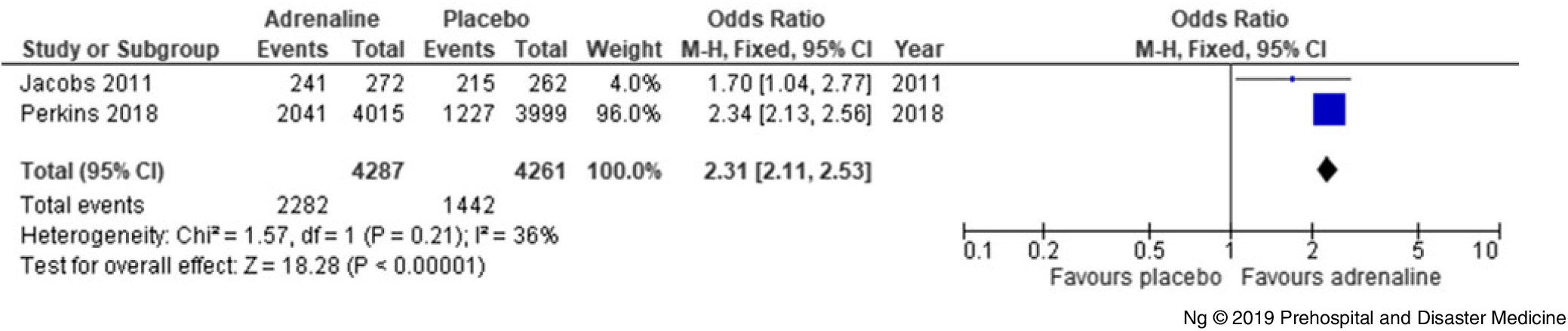
Epinephrine increased the chance of the patient being transported to the hospital based on the combined data of the included RCTs (a total of 8,548 patients, OR [95% CI] 2.31 [2.11-2.53], P <.001, I 2 =36%; quality of evidence: high; Figure 2).Reference Jacobs, Finn and Jelinek 6 , Reference Perkins, Ji and Deakin 18 The statistical heterogeneity was low across the studies.
Forest Plot of Transport of Patients to Hospital.

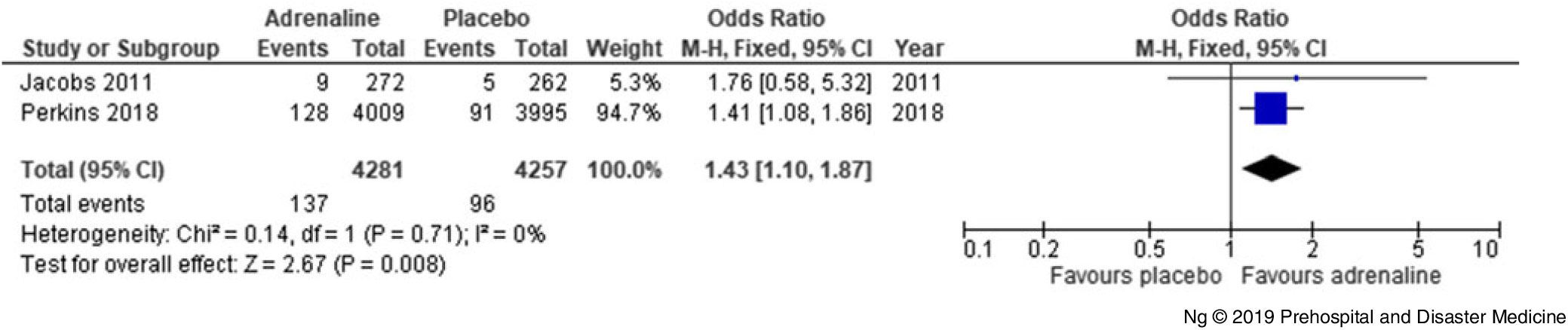
In comparison to placebo, patients who randomized to epinephrine had a significantly higher survival rate to hospital discharge, with an odds ratio (95% CI) of 1.43 (1.10-1.87), P = .008, I 2 = 0%; quality of evidence: moderate (Figure 3). The statistical heterogeneity across studies was low.
Forest Plot of Survival to Hospital Discharge.

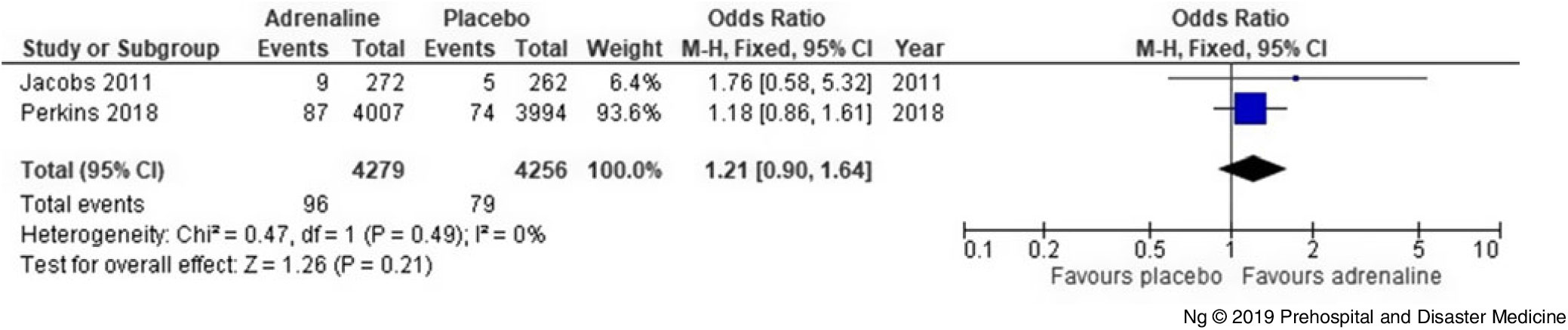
Based on data from the two RCTs, the authors found no significant effect on the favorable neurologic state at hospital discharge between the epinephrine and placebo groups, with the odds ratio (95% CI) of 1.21 (0.90-1.64), P = .21, I 2 = 0%; quality of evidence: moderate (Figure 4). By sequentially removing the most recent trial and re-analyzing the remaining dataset, it detected major changes in the magnitude of statistical findings for survival to hospital discharge, which indicated the potential evidence of between-study heterogeneity among all the included trials.
Forest Plot of Favorable Neurologic Function at Hospital Discharge.

Sensitivity analyses were performed on the primary and secondary outcomes and the estimated effects remained unchanged.
Discussion
This meta-analysis demonstrated that epinephrine increases the return of spontaneous circulation in OHCA. Although the epinephrine group has better survival rate at hospital discharge and higher chance of patients being transported to hospital, there is no evidence of significant group difference on the favorable neurologic function at hospital discharge. The general quality of evidence ranged from moderate to high, due to serious imprecision in some of the measured outcomes.
This review summarizes the latest evidence on the prehospital use of epinephrine in OHCA after the recent publication of the PARAMEDIC2 trial, based on the inclusion of RCTs only. An exhaustive literature search was conducted and all included RCTs were subjected to a rigorous assessment of methodological quality. Epinephrine has been the cornerstone of cardiac resuscitation and Advanced Life Support, which is recommended by the American Heart Association (AHA; Dallas, Texas USA) and the European Resuscitation Council (Niel, Belgium).Reference Link, Berkow and Kudenchuk 3 , Reference Soar, Nolan and Böttiger 12 This review showed that patients who received prehospital epinephrine had a significantly higher chance of restoring cardiac activity with pulse during cardiopulmonary resuscitation in OHCA. This finding was consistent with other previous systematic reviews and meta-analyses.Reference Atiksawedparit, Rattanasiri and McEvoy 19 – Reference Kempton, Vlok and Thang 23 Shao and his team concluded that the administration of epinephrine was associated with higher return of spontaneous circulation but no benefits on survival to hospital discharge or survival with favorable neurologic outcomes after OHCA.Reference Shao and Li 22 However, these findings need to be interpreted with caveat due to the nature of observational studies, unadjusted confounding factor, and lack of randomization.Reference Shao and Li 22 Although the weightage of the pooled effect for return of spontaneous circulation was mainly contributed by the PARAMEDIC2 trial (94.6%), the mean effect in the large trial was similar to the mean effect in the smaller trial.
The positive outcome of epinephrine on return of spontaneous circulation allows post-OHCA patients being transported to hospital for advanced resuscitation. In this review, the epinephrine group was associated with a significantly higher number of patients being transported to hospital alive for further management after OHCA. In the hospital, trained physicians could resuscitate post-OHCA patients in a controlled environment with oxygen, fluid, blood investigations, vital signs monitoring equipment, and consultant’s expertise. Targeted temperature management with mild hypothermia of 32°C-36°C (89.6°F-96.8°F) is recommended in the resuscitation guidelines.Reference Huang, Teo and Tan 24 – Reference Schenone, Cohen and Patarroyo 26 Early supplementation of levosimendan,Reference Kelm, Wagenführer and Engelhard 27 – Reference Wu, Peng and Zhao 29 a non-catecholamine calcium sensitizer, with intravenous epinephrine has been shown to improve the initial outcomes of cardiopulmonary resuscitation in animal studies.Reference Greco, Calabrò and Covello 30 – Reference Toller and Stranz 33 Future studies can investigate further on the post-OHCA resuscitation measures to improve the clinical outcomes of survivors.
In this meta-analysis, there was an evidence of statistically significant higher survival rate at hospital discharge in patients who randomized to intravenous/intraosseous epinephrine during OHCA. The PARAMEDIC2 trial even reported significant higher survival rate at 30-day in epinephrine group.Reference Perkins, Ji and Deakin 18 The PACA trial was initially planned as a multi-center RCT with an expected recruitment of 5,000 patients. Despite getting the approval from the Institutional Ethics Committees, Crown Law and Guardianship Boards, four out of the five ambulance services refused to participate due to strong objection from press with involvement of politicians. Thus, this trial became a single-center RCT and it was under-powered to detect significant effects on survival to hospital discharge. Olasveengen and team revealed a negative association between the survival at hospital discharge and epinephrine group.Reference Olasveengen, Wik and Sunde 34 A recent review based on five RCTs with 17,635 patients demonstrated that the use of epinephrine was not associated with significant difference in survival to hospital discharge and neurologic prognosis at discharge.Reference Kempton, Vlok and Thang 23 This review has to be interpreted with cautions as it included three studiesReference Nordseth, Skogvoll and Olasveengen 8 , Reference Olasveengen, Wik and Sunde 34 , Reference Woodhouse, Cox and Boyd 35 with high-risk of bias and potential confounding factors, which increased the degree of heterogeneity. In the Olasveengen’s study, the study design and methodology were fundamentally different as the intervention was based on the establishment of intravenous access by paramedics, and by default, administration of drugs (either intravenous epinephrine, atropine, or amiodarone) during resuscitation.Reference Olasveengen, Wik and Sunde 34 Nordseth and colleagues randomized their patients to either standard acute life support without intravenous access and drug administration (epinephrine), or modified acute life support without intravenous access or drug administration (epinephrine) after the decision of cardiopulmonary resuscitation was done. In addition, this study was rated as high-risk of bias due to significant heterogeneity in patient inclusion and violation of protocol.Reference Nordseth, Skogvoll and Olasveengen 8 Woodhouse and co-authors included both in-hospital and OHCA patients for randomization, in which the findings were not able to generalize to OHCA patients as the nature and setting of in-hospital cardiac arrest were different in term of aetiology of cardiac arrest, shorter time of administration epinephrine, and availability of cardiac arrest team.Reference Woodhouse, Cox and Boyd 35 The largest observational study of over 400,000 patients in Japan also documented a reduction in one-month survival to discharge for epinephrine group.Reference Hagihara, Hasegawa and Abe 7 Due to the nature of observational study with multiple uncontrollable confounding factors, the finding needs to be interpreted with caution.Reference Hagihara, Hasegawa and Abe 7 In another systematic review, Lin and colleagues reported that no positive benefits of epinephrine in survival to discharge or neurologic outcomes after OHCA.Reference Lin, Morrison and Callaway 20 That review included studies comparing the administering of epinephrine versus placebo in the setting of emergency department, instead of OHCA, which may introduce selection bias of participants to the findings.Reference Lin, Morrison and Callaway 20
The ambulance response interval in the PARAMEDIC2 trial was approximately four minutes shorter than the PACA trial.Reference Jacobs, Finn and Jelinek 6 , Reference Perkins, Ji and Deakin 18 Two RCTs reported that patients who received the prehospital epinephrine within 10 minutes of cardiac arrest had a better survival rate at hospital discharge.Reference Brown, Martin and Pepe 36 , Reference Stiell, Hebert and Weitzman 37 Early administration of epinephrine to OHCA patients is recommended in the AHA guidelines, especially in the non-shockable rhythm.Reference Goto, Maeda and Goto 38 Getting an intravenous access in OHCA patients often is a challenge to ambulance attendees. Mauch and colleagues reported that the intramuscular epinephrine provided similar survival rate compared with intravenous epinephrine during cardiopulmonary resuscitation in an animal study.Reference Mauch, Spielmann and Weiss 39 However, the plasma concentration of intramuscular and intravenous epinephrine remains unclear in the literature. Different route of epinephrine administration could be explored in future studies on OHCA patients when the intravenous or intraosseous access is not readily available.
This review showed that the epinephrine group was associated with favorable neurologic function at hospital discharge, but there was no evidence of statistical group difference. In contrast, several studies reported conflicting findings that epinephrine yielded to poor neurologic function at hospital discharge.Reference Jacobs, Finn and Jelinek 6 , Reference Olasveengen, Wik and Sunde 34 It is hypothesized that the diversion of blood flow from other organs to increase the coronary perfusion pressure compromised the cerebral microvascular blood flow to the brain. This was supported by animal studies where the epinephrine reduced capillary blood flow to swine brain.Reference Olasveengen, Wik and Sunde 34 , Reference Fries, Weil and Chang 40 , Reference Halvorsen, Sharma and Basu 41 Neurologic outcomes at hospital discharge are a subjective assessment based on cerebral performance category. In this review, the authors were unable to demonstrate any associations between poor neurologic prognosis with the duration of brain hypoxia, dosage, and timing of administration epinephrine. Beta-adrenergic effects are more pronounced at low-doses of epinephrine, while alpha-adrenergic effects are more pronounced at higher dose.Reference Davis, Loiacono and Summers 42 Two RCTs revealed that high-dose epinephrine was associated with poorer neurologic consequences among survivors of OHCA.Reference Brown, Martin and Pepe 36 , Reference Stiell, Hebert and Weitzman 37 Several studies documented that a high cumulative dose of epinephrine was associated with worsened post-resuscitation survival and unfavorable neurologic outcomes.Reference Arrich, Sterz and Herkner 43 – Reference Rivers, Wortsman and Rady 45 At present, a high-dose of epinephrine is not recommended for OHCA.Reference Link, Berkow and Kudenchuk 3
Limitations
The major limitation of this review was that it included only two RCTs and one was almost 10 times larger than the other. Also, other limitations were differences in population characteristics, uses of concomitant drugs, and varied primary outcomes of included RCTs. The use of beta-blockers may alleviate the harmful effects of epinephrine to reduce myocardial oxygen consumption, diminish arrhythmia recurrence, and prolong survival.Reference Atiksawedparit, Rattanasiri and McEvoy 19 – Reference Shao and Li 22 At this review level, the authors were not able to control the aforementioned confounding factor in all included RCTs. The exclusion of trials published as abstract or presented at conferences may potentially introduce publication bias to these findings.
Conclusion
In this meta-analysis, prehospital epinephrine increases return of spontaneous circulation in OHCA. The role of prehospital epinephrine in the initial management of OHCA is essential and it is associated with higher number of patients transported to hospital and survival rate at hospital discharge. However, no significant effects on favorable neurologic function at hospital discharge were demonstrated in this review.
Conflicts of interest/funding
All authors have declared that they do not have any funding in this review. No funding was received in support of this project.
Authors Contributions
KN: Protocol/project management, articles screening, data collection or management, data analysis, and manuscript writing/editing.
WT: Protocol/project management, articles screening, data collection or management, data analysis, and manuscript writing/editing.
Supplementary Material
To view supplementary material for this article, please visit https://doi.org/10.1017/S1049023X19004758