The value of testimony lies essentially in what it lacks; at its center it contains something that cannot be borne witness to and that discharges the survivors of authority. The ‘true’ witnesses, the ‘complete witnesses,’ are those who did not bear witness and could not bear witness.Footnote 1
With the pluralism of rules (and our times are the times of pluralism) the moral choices (and the moral conscience left in their wake) appear to us intrinsically and irreparably ambivalent. Ours are the times of strongly felt moral ambiguity. These times offer us freedom of choice never before enjoyed, but also cast us into a state of uncertainty never before so agonising.Footnote 2
What was theatre director Pol Heyvaert thinking when he decided to make a theatre production about the story of two parents who murdered their children in a hotel room in Belgium in 1999? What value might lie in the process of recounting such a grotesque story? The murders captured the nation's attention and for Heyvaert the story and the associated coverage was ‘just overwhelming’.Footnote 3 He points out that he is ‘critical of the way society deals with people on trial. And the people in the Aalst case in particular’, and as a result he wanted to ‘do something with it’. But he is careful to explain that the Victoria Theatre Company's intentions are ‘of the greatest integrity’.Footnote 4
Aalst is the result of this desire ‘to do something’. In effect, Aalst, as testimony, functions, in the way Agamben (following Primo Levi) explains, as a document that negotiates something that cannot be borne witness to.Footnote 5 The performance draws principally on trial transcripts, documentary footage and a small amount of created text to tell the story of the brutal murder of a three-month-old baby girl and a seven-year-old boy (Ellie and Matthew), by their parents.Footnote 6
The performance and witnessing
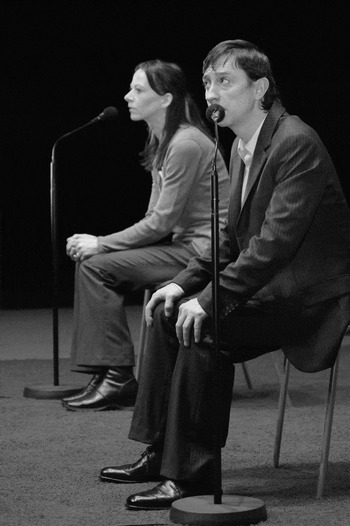
The set is simple and uncluttered. Each actor sits on a chair with a microphone, and faces the audience (Fig. 1). They are interviewed by a voice, prerecorded and offstage. The setting resembles a court or the office of a social worker or judge. The voice appears to be the voice of the judge who is addressing the parents at trial. He gradually leads, encourages and scolds them into recounting the events surrounding the murders and into revealing the story of lives of neglect, abuse and exploitation.Footnote 7 The play opens with the following lines:
- voice:
Cathy Delaney, I'm led to believe you used to like crosswords?
- cathy:
Yes
- voice:
Well, what we're going to try and do here is solve the crossword puzzle of your life.Footnote 8
Heyvaert states that his aim in writing Aalst was to stay ‘as close to the trial’ as possible; he wanted to ensure that he did not write ‘a second story’.Footnote 9 He goes on to say that the audience is integral to the performance and that not only is the subject matter difficult but the experience of being there is also difficult, given the intimacy of the performance space, with the actors sitting directly in front of the audience and speaking as if they were on trial. Heyvaert explains that in this context there is no chance for either performers or spectators to ‘hide or sit back’.Footnote 10
Kate Dickie and David McKay as Cathy and Michael Delaney on the sparse set of Aalst. Photography by Richard Campbell. Image courtesy of the National Theatre of Scotland.

The terms ‘witness’ and ‘witnessing’ are frequently used in discussions about theatre and performance spectatorship, but they are often used without detailed explanation of their relevance or necessity in particular contexts. While claims can be made for these terms as appropriate or productive in certain contexts (for example in response to verbatim theatre), there is still confusion and there are still conflicting ideas about what witnessing means, or might mean, and indeed how it differs from (or extends) spectatorship. As a consequence, I think it is crucial that these terms are defined carefully when used to describe acts of spectatorship or response to creative works. For the purposes of this article it is necessary to use these terms because the play is framed as a trial. What happens in Aalst, however, is that the performance complicates any attempts at distinguishing between primary and second-order witnesses. This occurs because although the spectator would normally be considered the ‘second-order’ witness (in this context), the work replays (or attempts to replay) the actual trial, and because it is a translation of a play (with actors playing characters based on characters who are based on ‘real’ people) the positioning of the witness (or the spectator as witness) becomes less clear-cut. This is something that is deliberately played with by the performers/writers as the performance unfolds. In the context of this discussion, then, I find Agamben's notion of witnessing, as outlined in this article's epigraph, most appropriate.
Intense intimacy
The performance is intense. This intensity emerges from the audience's fascination with the story as they attempt to understand these parents who refuse, or do not see the need, to participate in society and who seem to embrace the position of welfare-dependent social outcasts. As spectators we wonder at their world view and we work hard to try to understand how it was they found themselves in a position where the only option was to murder their children. The skill of the performers is such that when it is combined with the intimate nature of the set, where spectators are positioned as jurors or witnesses to the trial, a situation is created in which many people experience moments of slippage in their responses. At times they really do believe that they are witnesses to the trial of the ‘real’ parents. As John McCallum, in his review of the Sydney production, notes, ‘I keep writing “they” and “their” as if it were Cathy and Michael on stage, because that is the effect of this absorbing production’.Footnote 11 Given that ‘Cathy and Michael’ are the names given to the parents in the Scottish version of the play, this is in fact a triple slippage.Footnote 12
The performances, the intimacy of the context and the sense of formal questioning that directs the action combine to create a layered and sophisticated dramaturgy, in which spectators must constantly work to remember that they are not actually at the trial of Cathy/Maggy and Michael/Luc. There is a combination of simplicity and complexity in operation here. The story itself is almost mimetically performed and therefore, on the surface, straightforward and perhaps (if the content were different) potentially banal. Yet the setting and construction of the invisible voice of the narrator/inquisitor is so powerful (when combined with the gruesome details of the case) that many spectators experience these moments of slippage as they attempt to absorb the details of the brutal murders. The work implicates its audience in a play of fascination and estrangement as they search for a reason, an understanding or a mode of response to the events and their portrayal in the performance. James Waites, for example, explains that as he leaves the performance he feels ‘cast out . . . presumably as planned by the creators, to suffer’.Footnote 13 As witnesses or jurors, spectators attempt to decode, understand and position the story.Footnote 14 They try to gain some purchase on its implications, but this is a slippery endeavour as they are confronted by the calm, rational and affectless ways in which the performers describe the killings in minute detail. As Bryoni Trezise describes it, ‘as watchers our moral incredulity is often overtaken by a more aesthetic necessity to suspend disbelief, to trust that what we are receiving is from a dependable confessional source.’Footnote 15 This willingness to trust is thwarted at the end of the performance when Dickie and McKay reveal that the mood, tone and ‘confessional’ approach has been a ruse. After what seems to be a brutally honest disclosure by Michael about the fact that they killed the children to ‘finally get out of the misery’,Footnote 16 the lights dim, and once they are turned up again he says, ‘how was it?’ Cathy replies, ‘It was perfect. Very convincing. That's five years off your sentence, I'm sure’.Footnote 17 Spectators sit in silence, horrified perhaps at their gullibility, and realize that this was a performance after all. But this realization does not ease the anxieties liberated by the work; in fact, for some spectators at least, it deepens them.
For other spectators the content of the performance when combined with the skill of the performers as perpetrators/victims engendered an intricate emotional investment in the work (and the veracity of its story). And when the performance reveals this investment to be predicated on a hoax, some spectators are disappointed. A number of people who saw the play commented that the moment the ‘trial’ was revealed to be a sham (or a performance) they felt the work became overtly manipulative and that the question of the playwright's motivation emerged as an important one. There was a sense that they were being toyed with and that the work was perhaps using these horrific events primarily for entertainment, and that the slippages between stories ran the risk of rendering spectators or witnesses as voyeurs.Footnote 18 In a slightly different reading of this scene, Stuart Young argues that the revelation ‘underlines not only the question of how reliable is the Delaneys’ testimony, but how reliable is the play altogether when everything we have been told is in effect thrown into doubt’.Footnote 19
What is particularly poignant and significant about this production (apart from the story it recounts) is that it refuses to allow any straightforward moral judgments to be passed. Spectators or witnesses are not afforded the relief of knowing that the murderers feel remorse, sadness, guilt or pain. Nor are they provided with any justification for the gruesome actions of the couple. If the parents were labelled insane, unstable or unfit (intellectually incompetent) – or if the performance revealed them to be so – then understanding or responding to their actions might have been easier. But they are not and the performance makes clear that they are perfectly competent to stand trial. This competence, as well as the games played by performers Kate Dickie and David McKay in the performance (and perhaps by the ‘real’ parents during the trial given the near-‘verbatim’ nature of the script), means that spectators are left feeling profoundly unsettled by the production. As Mark Brown explains,
Dickie and McKay have insinuated their way into one's mind and emotions; creating a production that pans out from a suburban Belgian hotel room to raise penetrating questions about parenthood, criminality, the structures of society and ultimately, our very humanity.Footnote 20
Brown is not alone, Waites also reports that on leaving the performance he reflects over and over again on the material, and ‘it hurts’.Footnote 21 Ultimately he is unable to come up with any soothing answer or response to Aalst. The production does not facilitate judgment or even understanding in any singular sense; instead, it torments, or ‘hurts’ those who wish for closure.
Torturous stories
The parents (the Delaneys in the Scottish production) are represented as both victims and perpetrators. They live lives that, to them, are perfectly acceptable but to many of the spectators are confronting, sad and at times emotionally unbearable. They respond to questions at first haltingly, and with childlike obedience (peppered with brief moments of belligerence on Michael's part), but they seem curiously affectless. While the style of responses changes as the performance progresses, and indeed some of the responses to questions generate humour and laughter, there is a nervousness, or caution, that pervades the parents’ statements. They express a breathtaking sense of entitlement and an equally breathtaking inability (or refusal) to care or to accept responsibility. They live on credit and reject any sense that they should be grateful for the assistance offered by the government and/or by allied community or social organizations. When questioned about complaints from their neighbour about noise and disturbance, Cathy responds by saying,
she's jealous, of course, of us having two or three TVs, so that we can smash the odd one and let off steam. Why doesn't she just buy herself a few more tellies, then she can smash one herself from time to time!Footnote 22
Cathy Delaney states on a number of occasions that what they did to their children ‘was horrific’,Footnote 23 and Michael, with some indignation, states, ‘don't tell me we didn't want the best for them’.Footnote 24 Yet despite these protestations and an apparent understanding of the significance of the murders, neither displays any obvious emotion at any point in the production. When asked towards the end of the play about her apparent lack of ‘remorse’, Cathy responds as follows:
- cathy:
I do. My heart is wide open for my children.
- voice:
What do you mean by that?
- cathy:
I don't know.
- voice:
Don't you think you should apologise?
- cathy:
Who to?
- voice:
To the people you hurt.
- cathy:
I've been hurt too! It's strange, isn't it sir, we were never taught anything about ‘life’ at school. Never. All you got was: ‘What's the capital of Peru?’.Footnote 25
She is represented as a woman who seems to both adore and detest her partner. She alternates between declaring her love for him and proclaiming: ‘God I hate him! When that monster comes near me, I get the creeps. The things he committed on me are too filthy for words. I was abused, I was humiliated’.Footnote 26 It is clear that Michael Delaney abused her repeatedly, yet they both express their love for one another. They also explain that they were abused as children, with Cathy documenting repeated sexual abuse by her father and Michael recounting his time in care. Michael points out that they were useless parents, often ‘stoned’ and that he
used to beat his mother [Cathy] and fuck her up the arse while he [Matthew] sat and played in the corner with some old clothes. We never got him any proper toys. We told him: ‘Santa Claus doesn't come to bad kids’.Footnote 27
He then provides a partial explanation for the killings by saying that they felt their lives would not continue without intervention for much longer. He feared the intervention of ‘Child Welfare’ and the removal of the children to a ‘home’. And he goes on to say that ‘there aren't many things I know for sure, but one thing I do know is: no one will ever put any of my kids in a home. Over my dead body’.Footnote 28
So rather than feeling trapped, desperate or incapable of changing their lives, to avoid intervention the parents made the decision to kill their children. The description of his treatment of his partner (in front of the child) and the obvious lack of care or emotional connection with Matthew does not sit comfortably with the decision to kill the children rather than allow them to be cared for by others, because we do not get the impression that the action is carried out as a result of any sense of care, protection or love. It is, instead, explained as if it were a very sensible or natural choice, one that is perhaps about the loss of power or control to the despised authorities rather than about any connection with the children as human beings.
Ambivalence
Drawing on the work of Zygmunt Bauman I have argued elsewhere that ambivalence, which Bauman sees as a central component of the postmodern condition, needs to be interpreted not necessarily as a negative experience or one in which individuals, or spectators in this case, are left floundering and directionless, but as something that has the potential to stimulate ongoing reflection, engagement and participation with the ideas raised by a work. If considered in this way, the experience of ambivalence generates the possibility of detailed consideration and response. In effect, I have argued that ambivalence can be a productive state in which multiple and, sometimes, conflicting responses can be worked through in a way that might allow the richness of a performance to emerge. During the process of working through, spectators often experience moments of connection with and alienation from a work's themes, ideas or form, and these moments can be redolent with meaning and affect.Footnote 29
The experience of spectatorship at Aalst, however, seriously challenges this idea and, in fact, on first consideration could reveal it to be naive and utopian. What Aalst uncovers is that despite the desire for complexity, multiplicity and fraught and exciting engagements with politically inflected performance, there are some issues that we just do not want to feel ambivalent about. Killing children is one of them.Footnote 30 Coming to this realization, however, leads to further questions about what function judgment, or categorization, might serve. If, as spectators, we witnessed this performance and found material within it that allowed some kind of positioning or judging of the parents, would the work have had the impact it did, or would it have allowed us to respond and then move on? It is, I believe, precisely the fact that we do not want to feel ambivalent about infanticide that makes the ambivalence generated (for some spectators) in, and in response to, Aalst so provocative and, indeed, important. Aalst pushes its spectators to reflect on what it means to be human, and to consider what their own personal limits are in terms of judgment, empathy and responsibility.
Is ‘thoughtlessness’ the answer?
Reviewers have suggested that the parents’ actions as represented in Aalst reflect Hannah Arendt's concept of ‘the banality of evil’.Footnote 31 While this concept has been overused and much abused, on initial consideration Arendt seems to offer guidance when attempting to work through, respond to or make judgments about what it is that Aalst does and why this might in fact be significant. In Eichmann in Jerusalem she states, ‘It was of great political interest to know how long it takes an average person to overcome his innate repugnance toward crime, and what exactly happens to him once he has reached this point.’Footnote 32 Arendt is discussing how it was that Adolf Eichmann justified (to himself) his role in the deaths of so many innocent people. For Arendt the ‘thoughtlessness’ of Eichmann is troubling. She wonders how it is that he became so. How he managed not to reflect on, or consider, the real implications of his actions. Arendt defines thoughtlessness as ‘the heedless recklessness or hopeless confusion or complacent repetition of “truths” which have become trivial and empty’.Footnote 33 However, if we explore this idea further it becomes clear that Arendt's ‘thoughtlessness’ does not apply to the parents in Aalst. While they do repeat empty and disturbing ‘truths’ there is no sense that they are either confused or reckless; rather they seem strategic and, at times, manipulative. It is also much easier to talk about ‘thoughtlessness’ in terms of Eichmann's actions than it is in terms of the actions of these particular parents because moving to a point of justification for an act that occurs at some distance is one thing, but physically stabbing or strangling a child is a visceral, embodied act that results in a different order of experience.Footnote 34 It requires presence, participation and thought (even if this is only a mechanical process in order to subdue or restrain the child); resistance must be overcome, struggle engaged in and a body dealt with. The physical involvement of the parents in the murder challenges the connection between their actions and those of Eichmann. As Leora Y. Bilsky explains, ‘Eichmann failed to practice reflective judgment since he blocked himself deliberately from the reality of his victims, as well as from the judgment of future spectators’.Footnote 35 This blocking must surely be much more difficult to achieve when one has to step over the bodies, for several days, in order to walk around the bedroom.
In a much later work Arendt returns to the concept of thoughtlessness and asks,
Might the problem of good and evil, our faculty for telling right from wrong, be connected with our faculty for thought? . . . Could the activity of thinking as such . . . be among the conditions that make men abstain from evil-doing or even actually ‘condition’ them against it?Footnote 36
Again this understanding is challenged by Aalst because although the kinds of thoughts the parents have are not easy to absorb or accept, they do think and they present what to them seems to be a clear and rational (although abhorrent) argument for killing their children. In fact, they seem to have thought quite deeply about the killings in terms of planning, recording and justifying the acts. Cathy Delaney, recounting her attempt to suffocate her son, describes the process in detail:
I looked at him for a minute, then I thought, ‘this is it.’ I put the blanket over his head, to suffocate him. But he woke up and started to fight me off. If I'd been stronger at that moment, harder, it would have been over there and then. But he struggled free. He cried, ‘Mummy, Mummy, don't hurt me, I don't want to die’. His eyes were like a cow's. He looked at me like a cow going past in a truck.Footnote 37
This frank description seems very self-conscious, rehearsed even, rather than as something that was felt, experienced or lived through. And the image of the cow is startling.
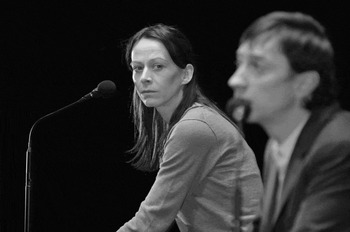
Arne Johan Vetlesen, in Perception, Empathy, and Judgment, challenges Arendt's reading of Eichmann's failure as one of ‘thoughtlessness’ and suggests perhaps that the ‘capacity in which Eichmann was lacking was emotional, as opposed to purely cognitive’.Footnote 38 If we accept this reading it is easier to align the actions of the parents to those of Eichmann, as it seems that the affectless or emotionless recounting of the events – as if they happened in the abstract, or to someone else – can be more easily understood as a failure of emotion. As the performance continues the parents give a detailed account of the process of killing Matthew, hence the thoughtful investment in the act (Fig. 2). After an aborted plan to electrocute him, they describe reaching for a pair of scissors placed beside the bed:
- voice:
So was that the plan, Mrs Delaney? You take hold of his legs and then we kill him?
- cathy:
Yes.
- voice:
Mr Delaney?
- michael:
That's right.
- voice:
What did you do then?
- michael:
I stabbed those scissors into his back.
- voice:
You stabbed those scissors into his back. And what did you do, Mrs Delaney, while this was going on?
- cathy:
I held my hand over his mouth to stop him screaming.Footnote 39
Ultimately, then, what Aalst presents us with, as this excerpt makes clear, is a story that does not seem to contain a point at which Arendt's moment of ‘repugnance’ is ever arrived at. Instead it shares, via the voices of the murderers and their unseen inquisitor, acts of evil that are not just banal but presented as perfectly ‘normal’.
Cathy Delaney looks anxiously at Michael as he responds to a question from ‘the voice’. Kate Dickie and David McKay as Cathy and Michael Delaney. Photography by Richard Campbell. Image courtesy of the National Theatre of Scotland.

If not ‘thoughtlessness’ then perhaps ‘vulnerability’
There is a desire to understand, judge or make sense of the work (or of the perpetrators) and to avoid the painful ambivalence with which many audience members leave the performance space. It is, however, a desire that is very difficult, if not impossible, to separate from the emotional burden the work places on spectators. The detailed descriptions of the acts of killing impact on a visceral level as we wonder how anyone could carry out such brutal actions, and then recount them so vividly and evenly. We spend much of the performance, as I have suggested earlier, searching for a way through, a mode of response that might allow us to understand, or to deal with, the fact of the acts described.
In this attempt to understand the experience of ambivalence, or to tame it (perhaps to find a way of labelling it aberrant and therefore less threatening, or as something outside the realm of possibility for ‘normal’, ‘sane’ people like me?), I turn to Emmanuel Levinas's philosophy. Levinas proposes that each individual subject is responsible for the other and that this responsibility occurs in a relation of proximity between the self and other. This is not necessarily a geographical proximity but a proximity of self and other. As Bauman explains, for Levinas
‘proximity’ stands for the unique quality of the ethical situation – which ‘forgets reciprocity, as in love that does not expect to be shared’. Proximity is not a very short distance, it is not even the overcoming or neglecting or denying distance – it is, purely (though not at all simply), ‘a suppression of distance’.Footnote 40
In this context Levinas argues that the subject is compelled to respond to the ‘call of the other’, and it is this responsibility that Levinas calls ethics; he does not, however, prescribe what kind of response this might be. He talks at great length about the subject's sensibility to the other's call and the impossibility of refusing to respond. For Vetlesen this sensibility, or ‘vulnerability’ as he terms it, ‘accounts for our capacity to be affected by the affectedness of the other’ which he defines as ‘empathy’,Footnote 41 and he sees this as a crucial component of any act of judgment. In fact Vetlesen states that ‘empathy entails an intuitive and tentative judgment about the other's situation and facilitates the ensuing development of a deeper and more comprehensive judgment’.Footnote 42 This is quite a radical idea, because when we think about it in relation to the parents, we must wonder if it means that their actions could be interpreted, at some level, as empathic.
When I then turn to thinking about the responses of spectators, how do Levinas or Vetlesen help? It is clear from the responses the work received that Aalst rendered many of its spectators vulnerable and that it emotionally engaged them. It is also important to make clear that this vulnerability occurred not in simplistic ways that imply a desire to absorb their pain. The work and our relationships with the performers/parents do not facilitate this kind of unquestioning acceptance. Instead we move from abhorrence to intrigue as the stories unfold. However, while I would like to use Levinas to assist in reading or accounting for my own uncomfortable ambivalence, the fact is that there are also problems with this framework.
To begin with, Levinas detests representation, and most particularly mimetic representation, which he feels obscures the ‘face’ of the other. This causes difficulty when attempting to respond to Aalst because it is a work that, as I have argued, generates illusion and slippage between the performers and their characters. So the question that arises for individual spectators is: whose call am I responding to, or whose ‘affectedness’ demands my response? For Levinas, art gets in the way of the ‘real’ call of the other and I cannot deny that because of the verbatim style of the work and the seamless performances, there is a difficulty in knowing how to find the other (in Levinasian terms) in this work (and again here we return also to Agamben's notion of the ‘true’ witness). But could the counterargument also be made? Is it perhaps in the slippage that the face is revealed?Footnote 43 After all, we are dealing with transcripts and reports, and, as Heyvaert states, he tried to stay as close as possible to the real material. Does the fact that the work slips between character and the ‘real’ mean that we gain access to the other, or to at least a fragment of the other?
There is also the problem of the affect that Vetlesen alludes to. I have focused here on the fact that the performers are particularly powerful because they do not seem to demonstrate affect. So how might their lack of affect contribute to our sense of vulnerability? There certainly is vulnerability and a desire to get to a point where empathy may be possible, but the lack of affect in Aalst stifles any actual sense of empathy with the parents, although empathy and pain for the suffering of the ‘true’ or ‘complete witnesses’ that Agamben refers to is experienced in abundance.
So what does this failed application of Arendt and Levinas do for both the reading of Aalst and indeed for the issue of responding to evil – and the particular representation of evil that allows no peace, resolution or escape? What I think it does is illuminate that, despite the fact that Aalst refuses to fit particular models of ethics or judgment, it is a work that is profound and profoundly disturbing. It is precisely the fact that I, or many of the other spectators and critics (or false witnesses) who have written about it, cannot resolve this awful ambivalence that makes it such a powerful treatise on both the complexity and the limits of judgment and ethics in the twenty-first century.