




No CrossRef data available.
CONTROLLED SUFFERING: MORTALITY AND LIVING CONDITIONS IN 19TH-CENTURY EGYPTIAN PRISONS
Published online by Cambridge University Press: 01 August 2004
Abstract
Whereas it is required by equity and justice that, in accordance with the principles of hygiene, the gaols in the governorate and the district capitals be clean and have access to so much fresh air that a person's health is not impaired, and whereas it has been noticed that some of these prisons do not satisfy these conditions, therefore the governors are instructed to conduct personally an examination and inspection of the prisons in their governorate, together with the chief engineer and the regional health officer.
—Order of the Majlis al-Aḥkām, issued in 1849Majlis al-Aḥkām, Mahfaza 1, doc. 1/89, 16 Sha ban 1265/13 June 1849, no. 451.
Information
- Type
- ARTICLES
- Information
- Copyright
- 2004 Cambridge University Press
Between 1829 and the 1870s, the administration of criminal justice in Egypt was rationalized and bureaucratized. The most prominent features of this reform were the emergence of a hierarchical judiciary consisting of judicial councils and shari
a courts with clearly circumscribed jurisdictions; the introduction and enforcement of penal codes with well-defined offenses and penalties; and, finally, the development of a system of punishment in which imprisonment had become the main penalty, corporal punishment had been abolished, and the death penalty had become rare.
2For the development of criminal law in 19th-century Egypt, see Rudolph Peters, “Islamic and Secular Criminal Law in 19th Century Egypt: The Role and Function of the Qadi,” Islamic Law and Society 4 (1997): 70–90; idem, “Administrators and Magistrates: The Development of a Secular Judiciary in Egypt, 1842–1871,” Die Welt des Islams 39 (1999): 378–97; idem, “‘For His Correction and as a Deterrent Example for Others’: Mehmed
Alī's First Criminal Legislation (1829–1830),” Islamic Law and Society 6 (1999): 164–93.
il but of a number of more general processes that had begun by the 1830s.
The first factor was the emergence of a public health service3
On the 19th-century public-health service, see Khaled Fahmy, “Medicine and Power: Towards a Social History of Medicine in Nineteenth-Century Egypt,” Cairo Papers in Social Science 23 (2000); Laverne Kuhnke, Lives at Risk: Public Health in Nineteenth Century Egypt (Cairo: American University in Cairo Press, 1992).
Khaled Fahmy, “Medical Conditions in Egyptian Prisons in the Nineteenth Century” in Marginal Voices in Literature and Society, ed. R. Ostle (Strasbourg: European Science Foundation/Maison Mediterraneenne des Sciences de l'Homme d'Aix-en-Provence, 2000), 135–55.
My main sources for reconstructing prison conditions are official documents, which give information on the institutional aspects but rarely on the experience of those who suffered punishment. By necessity, this study cannot offer more than a view from the outside. In addition to the printed texts of penal codes that I used (for a list of the relevant codes, see Appendix 1), these documents are located in the Egyptian National Archive (Dār al-Wathā

iq al-Qawmiyya), in Cairo. They consist of unpublished decrees and khedival orders,
5Although the title “khedive” (khidīw) did not become official until 1867, when the Ottoman sultan conferred it to Isma
il Pasha, it was used by his predecessors. During Mehmed
Ali's reign, the department of the interior was called (in Turkish) Dīvān-i Hidīvī.
All this is supplemented by the scarce information that can be culled from the publications of contemporary Western observers. These sources, however, must be used with extreme caution. Most of these travelers did not know the local language and therefore had difficulty in interpreting what they saw. Moreover, they had preconceived notions of Oriental justice as being arbitrary and cruel, which demonstrably tainted their observations. To substantiate these notions, they had a tendency to present as eyewitness reports the cock-and-bull stories that they had heard or read.
THE PRISON SYSTEM
During the 19th century, imprisonment emerged as the main form of judicial punishment in Egypt.6
For a detailed description of the development of the prison system, see Rudolph Peters, “Egypt and the Age of the Triumphant Prison: Legal Punishment in Nineteenth Century Egypt,” Annales Islamologiques 36 (2002): 253–285.
Michel Foucault, Surveiller et punir. La naissance de la prison (Paris, 1975).
Elsewhere I have discussed in detail the extent to which Foucault's theories are relevant for explaining the Egyptian developments.8
Peters, “Egypt and the Age of the Triumphant Prison.”
On the Egyptian police, see Khaled Fahmy, “The Police and the People in Nineteenth Century Egypt,” Die Welt des Islams 39 (1999): 340–77.
See idem, “The Anatomy of Justice: Forensic Medicine and Criminal Law in Nineteenth-Century Egypt,” Islamic Law and Society 6 (1999): 224–71.
The Egyptian prison system, as far as its punitive functions are concerned, was based on retribution, deterrence, and rehabilitation.11
Egyptian prisons served not only as penitentiaries. Many prisons, especially the local ones, also held suspects in custody during police investigation, debtors, and political prisoners.
Egyptian prisons were part of a four-tier hierarchy consisting of (1) labor camps in Sudan for those sentenced to hard labor with transportation, (2) national labor prisons in Egypt, (3) local labor prisons and factories at the provincial level, and (4) gaols for simple detention. Transportation to Sudan was introduced as a punishment in the early 1840s. We do not have any details of prison life there, but the distance from home and the working conditions must have made life very hard for the inmates. The introduction of transportation was motivated by two factors. First, it enabled the total exclusion of serious criminals from society, which could serve as a substitute for capital punishment. And second, there were economic considerations. Prisoners had to work in those areas where free labor was not available or not sufficiently available—in the gold mines and quarries in eastern Sudan and, later, in the reclamation projects in central Sudan. Because of the lack of information on the Sudanese labor prisons, I will not discuss them in this essay.
At the national level there were, at various times, three prisons for men. In addition, there was the spinning factory (iplikkhāne, maghzal) in Bulaq, established in 1856 as a national prison for women. The national prison that remained operative during the entire period under study was the one connected with the Alexandria arsenal, where convicts were originally employed in digging and moving earth in connection with the construction of a new harbor and later also in the arsenal's workshops. The prison accommodated 200–650 inmates. This prison fell under the jurisdiction of the Department of the Navy (Dīwān al-Donanma or Dīwān al-Baḥriyya). The second national prison, located near the fortifications at al-Qanatir al-Khayriyya (called al-Qal
a al-Sa
īdiyya or al-Istiḥkāmāt al-Sa
īdiyya), was operative from about 1853 until at least 1865.
12See khedival order sending people to the Qanatir, 7 Safar 1282/22 July 1865, Amin Sami, Taqwim al-Nil, 3 vols. (Cairo: Matba
at al-Kutub al-Mısriyya, 1928–36), iii/2:615.
Amaliyyāt, also called Dīwān al-Fābrīqāt wa-l-
Amaliyyāt).
13Khedival order of 16 Dhu al-Hijja 1273/7 August 1857, Ma
iyya Saniyya Turki, Mahfaza 14, leaf 132, doc. 398, Egyptian National Archive card index, s.v. “sujūn.”
Khedival order to Mudīr of Taka, 29 Jumada I 1273/24 February 1857, Majlis al-Ahkam, Daftar majmu
umur jina
iyya, 133.
The provincial prisons and various industrial establishments held less serious offenders sentenced to hard labor. Hard labor in factories and on construction sites goes back to the late 1820s, when convicts were sent to the iron foundry (demürhāne in Turkish) in Bulaq or to building sites in Alexandria (Iskenderiye ebniyesi in Turkish). Prisoners were put at the disposal of the Department of Industry. Hard labor in provincial gaols existed also at that time. It is defined in the Law of Agriculture (Qānūn al-Filāḥa),
15For a short survey of the 19th-century Egyptian criminal codes, see app. 1.
mūriyya) in the district (ma
mūriyya) where he comes from” (Article 17). The Penal Code of 1845 (Qānūn al-Muntakhab) mentions expressly that these building sites are located both in Cairo and in the provincial centers (Article 192). Since this type of hard labor was served not too far from home, it was considered to be lighter than terms served in the national prisons. The Imperial Penal Code (Qānūnnāme Sulṭānī, introduced in Egypt around 1853) referred to it using the term “lowly jobs” (khidamāt danī
a or ashghāl sufliyya). Convicts serving time in the provincial prisons were employed in sweeping, cleaning, and light construction labor.
Places for simple detention (ḥabs) without hard labor were the police prisons in the big cities, the prison in the Cairo Citadel, and prisons in the various provincial capitals. These prisons fell under the authority of the local police departments (ḍabṭiyya) or the provincial administrations (mudīriyyāt, muḥāfaẓāt). These provincial prisons also held inmates sentenced to hard labor. The police and provincial gaols were relatively small. In August 1859, about 100 prisoners were detained in the Cairo police gaol, among them those held for debt.
16Ma
iyya Saniyya to Dabtiyyat Misr, 4 Muharram 1276/3 August 1859, Majlis al-Ahkam, Daftar majmu
umur idara wa-ijra
at, Sin 7/33/1, 233.
Khedival order to Mudīr Bani Suwayf and Fayum, 9 Dhu al-Qa
da 1270/3 August 1854, Ma
iyya Saniyya 1879 (old), awāmir, doc. 4, 4 (from Egyptian National Archive card index, s.v. “sujūn”).
a court and the judicial councils.
For higher officials and military officers there was detention in the fortress of Abu Qir on the Mediterranean shore not far from Alexandria.18
Article 62 of the Penal Code of 1849 lays down that this is where officials with the rank of qā
immaqām (lieutenant-colonel in the army and a government official at the village level in the civil ranks) or higher were held.
Khedival order to the Muhafazat Misr, 23 Safar 1272/4 November 1855, to send a certain village shaykh to the Abu Qir prison: Sin 1/1/5, 74. The Qānūnnāme Sultānī (hereafter QS) does not mention Abu Qir anymore.
Decree of the Majlis al-Ahkam, 8 Rajab 1265/30 May 1849, Majlis al-Ahkam, Daftar majmu
umur jina
iyya, 133.
Prisons fell under various departments: the Ministry of War, the Ministry of Navy, and the Ministry of Construction; the various police departments; and city and provincial administrations. The organization of the prison system was therefore diverse. A small measure of uniformity was introduced by the appointment of a special inspector of prisons in February 1865, with the task of checking the conditions of the prisons and the punctual release of the prisoners.21
Appointment of Salim Pasha al-Jaza
irli, 9 Ramadan 1281/5 February 1865, Amin, Taqwim, iii/2:597.
MORTALITY
Among the catalogued holdings of the Egyptian National Archives are five unique registers listing the entries of prisoners in Egypt's principal national prison of the 19th century, the one housed in the Alexandria Arsenal (tarsānat Iskandariyya) and usually called līmān (or lūmān) Iskandariyya.22
For a detailed description of these registers, see app. 2.
With the help of these registers I have calculated the mortality of the inmates in the Alexandria prison. For the late 1840s, I have followed eighty-six convicts with sentences of five years or more who entered the prison between 18 March 1847 and 27 September 1847. For the early 1860s I followed 108 prisoners who entered the Alexandria arsenal between 26 August 1863 and 6 September 1866; were sentenced to three years or more; and were not released during the first year. An exact comparison with the 1847 numbers was not possible: in the 1860s, the Alexandria arsenal was no longer used as a prison for convicts with long sentences, and most of them during that period were deported to Sudan. Prisoners who spent more than one year in the Alexandria prison were rare in this period.
As Table 1 shows, the average mortality rate during the first period was higher than 15 percent per year. Calculating the mortality of this group without taking into account the twenty-six inmates who were released before their term results in an even more dramatic mortality rate of 20 percent—that is, after five years, only one-third of the inmates were still alive (Table 2). The exceptionally high mortality rate of 25 percent in the second year of their imprisonment (see Table 1) must reflect the toll taken by the cholera epidemic that raged in Egypt during the summer of 1848.23
Kuhnke, Lives at Risk, 57.
André Zysberg, “Politiques du bagne 1820–1850,” in L'impossible prison: recherches sur le système pénitentiaire au XIXe siècle, ed. Michelle Perrot (Paris: Eds du Seuil, 1980), 191.
Herman Franke, The Emancipation of Prisoners: A Socio-historical Analysis of the Dutch Prison Experience (Edinburgh: Edinburgh University Press, 1995), 39–40.


Sixteen years later, the conditions in the Alexandria Arsenal must have improved a great deal, for the mortality rate had decreased to an average of 4.5 percent in the years 1863–1866 (Table 3), becoming roughly the same as the mortality rate in French and Dutch prisons (which varied from 2 to 9 percent for the French and from 3.5 to 6 percent for the Dutch prisons).26
Ibid., 39, 94; Zysberg, “Politiques du bagne,” 191.
Daniel Panzac, “Endémies, épidémies et population en Egypte au XIXe siècle,” in L'Egypte au XIXe siècle. Aix-en-Provence, 4–7 juin 1979 (Paris: Éditions du CNRS, 1982), 88.
This could only be established for the 1860s, since the register covering the late 1840s does not record the age of the inmates: see app. 2.

Since no data exist for the other prisons, it cannot be excluded that this drop in mortality was restricted to Alexandria. The Alexandria prison might have received special attention from the government to create a model prison to impress European visitors, for most of whom Alexandria was the port of entry. However, this is not very likely, and there are several factors that make it plausible that these figures reflect a general trend. First, the Alexandra prison was not a separate institution but part of the arsenal, where, as I will show, the prisoners represented only a small part of the entire workforce. That its prison function was not very conspicuous is demonstrated by the fact that two very detailed recent studies of 19th-century Alexandria do not mention it.
29See R. Ilbert, Alexandrie, 1830–1930, 2 vols. (Cairo: IFAO, 1996); and Michael J. Reimer, Colonial Bridgehead: Government and Society in Alexandria, 1807–1882 (Cairo: American University in Cairo Press, 1997).
il (r. 1863–79). Because the reduction in mortality had already set by 1863, the change of policy of which it was a result must have taken place before that year and thus cannot be ascribed to measures taken by Isma
il. Finally, as I will show, there were general changes in the administration and government of Egypt that can explain the improvement of prison conditions and would apply to all prisons, not just the one in Alexandria.
PRISON CONDITIONS
In this section I will try to give an impression of what Egyptian prisons were like in the 19th century. Unfortunately, the source material is scarce and fragmentary, and many questions must remain unanswered. I will especially highlight those changes in prison conditions that may have had an effect on prison mortality.
Accommodation
By the end of 1850, officials of the State Health Inspection (Taftīsh al-Ṣiḥḥa) had examined the state of the Cairo prisons. Their findings were devastating. They observed that gaols were in an abominable state and so detrimental to the inmates' health that their lives were in jeopardy. The prisons were in need of drastic reconstruction, or even demolition and rebuilding, to satisfy health standards. However, since they realized that the budgets were limited, the health officials proposed only the most urgent alterations: one prison lacked latrines, which should be built, and in all others the accumulated excrement and urine needed to be removed. Some prisons lacked light holes, which should be remedied immediately. Certain wards were so small that the prisoners were piled on top of one another. Finally, the officials discovered that in some gaols the inmates slept on damp floors because their were no stone or wooden platforms (maṣṭaba) to sleep on. Therefore, they recommended that the wooden benches stored in the Hospital of the Sultan Qalawun Mosque should be transferred to these prisons.30
Taftish Sihhat Misr to Diwan Khediwi, 19 Muharram 1267/24 November 1850 and 4 Jumada I 1267/7 March 1851, Mım 5/1 (old 163), Taftish Sihhat Misr, Sadir Taftish, doc. 47, 21; doc. 128, 62.
This report gives some impression of the state of prisons in the first half of the 19th century. It is not difficult to imagine the stifling atmosphere, the stench of unwashed bodies, the vermin and dirt in a ward without sanitary facilities and with a limited supply of water—all of which had to be brought in by water carriers—where many men were confined and one had to call for a guard to be taken to the latrines. There was little concern about prison buildings. Prisons were not specially constructed as prisons but established in ordinary houses that were bought or rented for the purpose;31
Khedival order to Mudīr al-Rawda, 2 Jumada II 1272/9 February 1856: Mudīr must find a solid building that can serve as a prison instead of the houses now used for the purpose (Ma
iyya Saniyya, Sadir al-ma
iyya, 1616 [old], doc. 3, 446); khedival order to Muhafazat Iskandariyya, 7 Dhu al-Hijja 1272/9 February 1856: order to pay a rent of 37 piasters per month for a house used as a women's prison in Alexandria (Ma
iyya Saniyya, awāmir, 1884 [old], doc. 144, 46); khedival order to the Muhafazat Misr, 23 Shawwal 1277/4 May 1861: to rent a house for 50–75 piasters to serve as a women's prison and appoint a guard with a monthly wages of 150 piasters, because the existing women's prison in the Police Department (Ḍabṭiyya) is too close to the men's prison (Ma
iyya Saniyya, awāmir, 1894 [old], doc. 65, 125 [from Egyptian National Archive card index, s.v. “sujūn”]).
On the disused stable, see Fahmy, “Medical Conditions,” 142.
For a precise description of the location of the provincial prison of Dumyat, see Majlis al-Ahkam, al-madabit al-sadira, Sin 7/10/15, 10 Rabi
I 1280/25 August 1863, no. 784, 51–55.
See, for example, Majlis al-Aḥkām to Mudiriyyat Bani Suwayf and Fayum, 11 Jumada II 1267/13 April 1851, Majlis al-Aḥkām, Mahfaza 4, doc. 3.
Khedival order, 4 Jumada II 1272, Ma
iyya Saniyya, Sadir al-Ma
iyya, Daftar 1616 (old) (from Egyptian National Archive card index, s.v. “sujūn”).
The prison inmates were locked up together in wards, not in separate cells. They slept on the floor or on wooden or stone platforms. Bedding seems not to have been provided.36
Coles Pasha mentions that during his time as an inspector of the Egyptian prison administration (1897–1913) this was not the case: C. E. Coles Pasha, Recollections and Reflections (London: Saint Catherine Press, 1919), 100.
Layihat tabdil al-darb bi-l-habs (11 Sha
ban 1278/11 February 1862), art. 11. This was an implementing order of the 1861 decree banning corporal punishment: text in Muhafazat Misr, Lām 1/20/8, doc. 3, 71.
For rich prisoners the harshness of prison life could be mitigated. In 1845, a traveler observed, there were glaring differences between the conditions of rich and poor inmates. In Alexandria, the rich prisoners had their own furnished rooms and even servants or slaves and did not have to work, unless Mehmed
Ali had expressly ordered so. In the Cairo prison they had their own café and could have food brought in from outside, whereas the poor were detained in a dark ward without daylight and given only two round loaves of bread per day. At night they were chained to one another.
38Victor Schoelcher, L'Egypte en 1845 (Paris: Pagnerre, 1846), 27–29.
The 1849 order of the Majlis al-Aḥkām directing the regional authorities to examine the prisons together with health officers
39Majlis al-Aḥkām, Mahfaza 1, doc. 1/88, 16-8-65 (7 July 1849).
il gave this policy a new boost. A khedival order of 1863 instructed the prison authorities that all circumstances that were injurious to the inmates' health were to be eliminated; that all prisons had to be cleaned and repaired; and that inmates needed to have access to fresh air.
40Khedival order to Majlis al-Aḥkām, 28 Rabi
I 1280/12 September 1863, Ma
iyya Saniyya, Qayd al-awamir al-karıma al-Sadira min qalam majalis bi-l-mu
awana, Sin 1/19/2, doc. 1, 1.
Fahmy, “Medical Conditions,” 145.
il's new policy was that, in 1864, the Cairo Police Department received permission to renovate the police gaol because the stench and the filth were unsupportable.
42Khedival order to Muhafazat Misr, 23 Ramadan 1280/2 March 1864, Ma
iyya Saniyya, Sadir al-awamir al-
aliyya ila al-majalis wa-l-dawawin-wal-aqalim wa-l-muhafazat, Sin 1/1/24, doc. 23, 106.
Food
In principle, the inmates or their relatives had to provide their food.43
See, for example, Dabtiyyat Misr, Sadir, Lām 2/6/2, 1–3, no. 99, 24 Ramadan 1264/24 August 1848: case of a women from Suez who was robbed of money and jewelry while sitting in front of the Cairo police gaol waiting to hand over bread and the valuables to her relatives in prison.
In 1834, the Pasha ordered to distribute meat twice monthly to the inmates of the Alexandria Arsenal and Abu Qir and to provide them with cloaks (
abā
āt) and hats (ṭawāqī): khedival order of 5 Shawwal 1249/15 February 1834, Ma
iyya Saniyya, Sın 1/56/1 (1248–50), doc. 715. In 1836, the pasha approved the distribution of food rations to indigent prisoners: khedival order to the wakil al-Majlis al-Mulki, 9 Ramadan 1252/18 December 1836; text also in Sın 7/33/1, Majlis al-Ahkam, Daftar Majmu
umur idara wa-ijra
at, 233. For the period after 1855, see QS chap. 3, arts. 15, 17.
In the 1247/1831–32, issues of al-Waqa
i
al-Misriyya, one often finds the formula “He was sent to the Diwan al-Abniya to work there for wages but under detention (maḥbūs) to punish him.” Bowring, writing about the late 1830s, reports that the “galley slaves employed in the different works” of the Alexandria Arsenal were paid four piasters a day, including provisions and clothing, which is only one piaster less than the other workers received: John Bowring, Report on Egypt and Candia Addressed to the Right Hon. Lord Viscount Palmerstone (London: Command Paper, 1840), 59.
In the 19th century French bagnes, the forçats were also paid: see Jacques Valette, “Le bagne de Rochefort 1815–1852,” in L'impossible prison, 206–35.
This was a standard ration during most of the 19th century. It is mentioned in the Qānūn al- Filāḥa (1830), art. 48, laying down that local authorities must provide this ration to prioners who are left with them by the army. See, further, Resolution of the Majlis Mulki of 1252/1836–37, Sin 7/33/1, Majlis al-Aḥkām, Daftar majmu
umur idara wa-ijra
at, 233. The ration is described as charity (ṣadaqa) from the khedive: decree of the Majlis al-Ahkam, 19 Ramadan 1266/29 July 1850, ibid., 234. The latter decree also mentions that the governors must inspect the gaols under their authority every two weeks and check whether the prisoners are getting their rations.
Valette, “Bagne de Rochefort,” 209; Zysberg, “Politiques du bagne,” 189. Spanish convicts received about 700 grams of hardtack in the late 18th century: Ruth Pike, Penal Servitude in Early Modern Spain (Madison: Universitity of Wisconsin Press, 1983), 81. In the French bagnes, this amount of hardtack was regarded as equivalent to 900 grams of bread: Zysberg, “Politiques du bagne,” 189.
Khedive to Burhan Bey, 5 Shawwal 1249/15 February 1834, ordering the distribution of meat twice a month to the inmates of the Tarsāna, the Līmān, and Abu Qir: Sin 1/56/1, doc. 715.
Ma
iyya Saniyya to Muhafazat Misr, 27 Jumada II 1272/5 March 1856, Ma
iyya Saniyya, Daftar 1616 (old) (from Egyptian National Archive card index, s.v. “sujūn”).
In the early 1860s a marked improvement can be observed in the quality of food distributed to the prisoners. A khedival order of April 1863 states that the following monthly rations were already standard in the national labor prisons and lays down that these were henceforth to be distributed to all inmates of local and police prisons who could not support themselves:
- 28 kilograms of coarse bread (which amounts to the ration of about 900 grams per diem mentioned earlier)
- 3.7 kilograms of lentils
- 1.8 kilograms of rice
- 0.37 kilograms of clarified butter
- 0.88 kilograms of beef50
Khedival order, 11 Dhu al-Hijja 1279/30 May 1863, Ma

iyya Saniyya, Sadir al-awamir al-
aliyya ila al-majalis wa-l-dawawın-wa-l-aqalım wa-l-muhafazat, Sın 1/1/23, 47, doc. 27.
This was a somewhat one-sided diet but adequate as far as caloric value is concerned. It is not very different from the rations provided to students in the state boarding schools during the same period.51
Monthly rations consisting of 23.2 kilograms of bread, 3.7 kilograms of lentils, 1.9 kilograms of ful, 0.9 kilograms of clarified butter, 1 kilogram of rice, and 2.2 kilograms of meat: Sami, Taqwim, iii/2:554, 1 Muharram 1281/6 February 1864.
27.5 kilograms of bread (or 21 kilograms of hardtack) and 3.6 kilograms of dry beans: Zysberg, “Politiques du bagne,” 189. In late-18th-century Spain, prisoners received 20 kilograms of hardtack, 9 kilograms of dry beans, and 2.5 kilograms of rice: Pike, Penal Servitude, 81.
From the early 1860s, all prisoners were entitled to adequate standard rations. For those held in simple detention, who did not have to work, rationing could then be used to increase the measure of suffering. This was indeed introduced by the 1862 ordinance abolishing corporal punishment, which stipulated that detention could be aggravated for some categories of offenders by putting them on “bread and water” (ḥabs al-riyāḍa). Until that time, this form of punishment was applied only to military and state officials. The idea behind it was that simple detention would not be a sufficient deterrent. The ordinance specified that such offenders would get about 450 grams of bread daily—that is, half the normal bread ration—and a jug with 1.2 liters of water. With regard to the latter, the instructions mention that, especially during summer, prisoners would get more water if they asked for it.53
Layihat tabdil al-darb bi-l-habs, art. 11.
Work
Sometime in the early 1860s, Fadil Pasha, the governor of al-Minufiyya province, noticed that not all inmates in the provincial prison who were sentenced to “lowly jobs in the mudīriyya” were working. They should be employed in manufacturing mud bricks for the repair of the buildings of the provincial administration. When he pointed this out to the prison warden (ma
mūr al-sijn), the latter replied that he was short of staff. Apart from the common guards, there was only one sergeant-major (bāshjawīsh), who could not guard all prisoners that had to work outside the prison. Fadil Pasha then suggested that the warden himself could also take a batch of prisoners to their work, while the prisoners who did not have to work could be left in the prison with a few soldiers. There was no reason, he said, why the warden would sit idly in his office. The warden angrily rejected the suggestion, saying that he was a warden and not a common guard (qawwās). The warden must have been a stubborn man, because the case was finally brought before the Majlis al-Aḥkām, who decided that the warden should be reprimanded and instructed him to do as the governor had told him.
54Majlis al-Ahkam, al-Madabit al-Sadira, Sin 7/10/17, no. 11, 3, 2 Rabi
II 1280/16 September 1863.
Apart from showing the arrogance of some petty officials, this story makes clear that the separation between those prisoners who had to work and those who did not was strictly maintained and that this work was carried out outside the prison. The work assigned to them, manufacturing mud bricks (ḍarb al-ṭūb) by filling molds and letting them dry in the sun, cannot have been very strenuous. Moreover, being outside the prison probably gave the inmates a chance to converse with friends and acquaintances and receive food. “Lowly jobs” in the provincial gaols was obviously much lighter than hard labor in Alexandria.
In Alexandria, prisoners were detained in the Navy arsenal, which was located on the western shore of the peninsula. They made up only a small fraction of all people employed there. In the late 1830s, there were about 200 prisoners in a total workforce of several thousand.55
Bowring mentions 200 prisoners and more than 5,000 employees: Bowring, Report, 59. For other estimates of the number of employees in the Alexandria Arsenal (4,000–8,000), see Ilbert, Alexandrie, i:18; Reimer, Colonial Bridgehead, 56.
Majlis al-Ahkam, al-Madabit al-Sadira, Sin 7/10/23, doc. 893, 132, 28 Dhu al-Qa
da 1280/5 May 1864.
The inmates were originally employed in spadework and carrying earth, activities connected with the construction of the new harbor and the docks. Later they were also employed in the various workshops of the arsenal, such as those for rope making, saddle making, sail making, painting, carpeting, and smithing, and in other activities such as loading and unloading ships and carts.57
In the sentences pronounced during the first half of the 19th century, the following words are used: naql al-turāb (transporting earth), ḥaml al-turāb (carrying earth), toprak hizmeti (spade work). Later, they also worked in the workshops: see, for example, Bowring, Report; H. von Pückler-Muskau, Aus Mehemed Alis Reich: Ägypten und der Sudan um 1840, repr. ed. (Zurich: Manesse Verlag, 1985), 69. For a map of the Alexandria Arsenal as it existed in 1829, see Ilbert, Alexandrie, ii:766.
Unless otherwise indicated, the data on the organization of the Alexandria Arsenal are culled from the following trials of guards for negligence in guarding prisoners: sentence of al-Jam
iyya al-haqqaniyya, Sin 6/9/6, 8 Shawwal 1263, no. 2, 3; Sentence of Dıwan al-Tarsane, Dıwan al-Tarsane 1037 (old), 22 (30 Rabi
I 1275); sentences of Majlis al-Ahkam, Sın 7/10/15, 10 Rabi
I 1280, no. 784, 51–55; Sın 7/10/21, 10 Dhu al-Qa
da 1280, no. 750, 157; Sin 7/10/18, 13 Jumada II 1280, no. 336, 35; Sin 7/10/23, 28 Dhu al-Qa
da 1280, 133–36; Sın 7/4/33, 43.
I have not been able to establish whether there was any change in the working conditions of the prisoners in the 1850s and early 1860s.
Medical Care
In the 1850s, the public-health administration became involved in the sanitary conditions of prisons. Khaled Fahmy attributes this to two factors: the growing prison population as a result of the decrease of capital sentences and sentences of flogging and as a result of the growing crime rate; and the close connection between law and medicine that had already been firmly established.59
Fahmy, “Medical Conditions.”
Khedival order, 28 Rabi
I 1280/12 September 1863, Ma
iyya Saniyya, Sadir al-awamir al-
aliya ila al-majalis wa-l-dawawın wa-l-aqalım wa-l-muhafazat, Sin 1/1/24, doc. 2, 8.
Layihat tabdil al-darb bi-l-habs, art. 9.
Prisoners held in simple detention (maḥbūsūn) were entitled to a suspension of their punishment if they fell seriously ill. They were allowed to go home for medication on the condition that they could produce a guarantor (ḍamāna qawiyya). They would be visited every other week by an official of the civil administration (ma
mūr al-umūr al-mulkiyya) to ascertain that they were still sick.
62QS, chap. 3, art. 16.
Muhafazat Misr to Diwan Jihadiyya, 28 Dhu al-Hijja 1281/24 May 1865, Muhafazat Misr, Sadir, Lām 1/4/3, doc. 48, 102.
Guards and Security
The buildings where the prisons were housed did not offer much security. Preventing the inmates from escaping was achieved by the presence of gaolers (sajjān) or soldiers and by chaining the inmates. The police prisons in the cities and the provincial capitals were under the command of a gaoler or prison warden (ma
mūr al-sijn), who typically had at his disposal a number of ordinary soldiers for guard duty. Female prisons also had a male gaoler.
64See n. 31.
Ma
iyya Saniyya, Sadir al-awamir al-
aliya ila al-majalis wa-l-dawawın wa-l-aqalim wa-l-muhafazat, Sin 1/1/30, doc. 14, 125, 3-8-82, correspondence regarding reinforcement of the detachment of soldiers in the arsenal for guard duties.
Nevertheless, escapes were frequent. Inmates and their relatives used various means to get out of prison, including bribery, as in the following case:
A certain
Abd Allah Jad al-Nabi, whose brother Ahmad was held in custody in the Khartum gaol, feared that the latter would die in gaol. He, therefore, had bribed a certain Musa Ibrahim, a clerk in the provincial administration and given a sum of over 4,000 piasters so that the clerk would arrange the prisoner's release. When the prisoner was indeed set free, it turned out that this was because there was not sufficient proof against him and that the clerk had nothing to do with it. The brother protested with the clerk and demanded that he return the money that he had paid him. The clerk offered a deal: he would give him a Sudanese slave girl, worth 2,500 piasters, and would repay the rest later. This he accepted. However, soon it became clear that trade in Sudanese slaves was not permitted anymore and that the sale, therefore, was null and void.
Abd Allah sued the clerk before the shari
a court and won his case: he returned the girl and received the amount he had paid the clerk. When the case was examined by the Majlis al-Aḥkām and reviewed by the khedive, the clerk was sentenced to two years hard labor on the White Nile and fired from his office, and the money that was returned to
Abd Allah was confiscated for the benefit of the Bayt al-Māl.
66Ma
iyya Saniyya to hukumdar Sudan, 2 Jumada I 1282/23 September 1865, Ma
iyya Saniyya, Sin 1/1/31, 37, no. 8.
When prisoners fled, guards were often implicated.67
See, for example, Ma
iyya Saniyya to Mudıriyyat Asyut, 3 Dhu al-Qa
da 1281, Sadir al-awamir al-
aliya ila al-majalis wa-l-dawawin wa-l-aqalim wa-l-muhafazat, Sin 1/1/28, doc. 5, 18.
See, for example, khedival order, 3 Rabi
II 1272/13 December 1855, issued to the governor of the Qal
a Sa
īdiyya to execute a soldier by shooting him. Ma
iyya Saniyya, Sadir al-awamir al-
aliya, Sin 1/1/5, doc. 15, 144.
Majlis al-Ahkam, Sın 7/10/15, al-Madabit al-sadira, 10 Rabi
I 1280, no. 784, 51–55.
The guards were ordinary conscript soldiers without special training. Sometimes they do not seem to have been up to their duties, as in the following case:
On 15 Rabi
I 1275 [23 October 1858], Ahmad Hasan and
Amr Hasan and two inmates of the Alexandria Prison were working outside the prison near the Abu Shahba Fort, close to the sea. They were loading stones onto a cart. When Muhammad Salim, the soldier who guarded them, told them that he wanted to relieve himself in the sea and that they should come with him, they replied that they could be trusted and would wait for him. When he returned, Ahmad and
Amr had escaped. Muhammad Salim had failed to ask the soldier working close by to keep an eye an the prisoners. The latter had left the spot and gone to the fort's storehouse (jabkhāna) because his prisoners had finished loading the cart and wanted a drink. Since the escaped prisoners were serving life sentences, the guard was sentenced to the same penalty, with the provision that, if the fugitives were found, his punishment would be reconsidered.
70Dıwan al-Tarsane, sijill 1037, Qayd al-qararat, 22, no. 12, 30 Rabi I 1275/7 November 1858.
This story gives some insight into the relationship between the guards and the prisoners that were entrusted to them. They were often of the same class background, and their daily contact seems to have been characterized by a certain geniality. The soldier who let these inmates escape was probably extremely naive, but the example of the other, who at the request of his men went to the fort so they could have a drink, shows that gaolers and inmates were usually on good terms. The situation was no doubt different with regard to the officers commanding the guard units.
I have not found any documents concerning cases of violence committed by prison officials against the prisoners. The absence of evidence might point to the absence of excessive violence—that is, the absence of a level of violence higher than what was usual outside prison in the relations between officials and subjects. However, it might be the consequence of the prisoners' lack of rights and the impossibility for them to submit complaints. The latter assumption can easily be shown to be false, though, because the holdings of the Egyptian National Archive include petitions and complaints submitted by prisoners. Therefore, however tricky and deceptive an argument e silentio may be, I am inclined to accept the first explanation.
In addition to the presence of guards, security was achieved by shackling and chaining the prisoners. This was standard practice during transportation, when the prisoners were chained to one another by foot irons (ḥadīd, qayd) or by iron neckbands (ṭawq or al-ḥadīd bi-l-a
nāq). Both the foot irons and the neckbands could be attached to long chains (zinjīr). Sometimes the prisoners' hands were attached to a wooden plank (khashab).
71See, for example, Dabtiyyat Misr, Sadir, Lām 2/5/6 (old 23), doc. 13, 21, 27-1262/18 October 1846, Majlis al-Ahkam, Sadir al-aqalım al-Qibliyya, Sin/7/4/33, doc. 1, 43, 7 Jumada I 1281/8 October 1864, to hukumdariyya al-Sudan.
Schoelcher, L'Egypte, 27–29.
Khedival order to Mudıriyyat Minufiyya, 4 Jumada II 1281/4 November 1864, Ma
iyya Saniyya, Sadir al-awamir al-
aliyya ila al-majalis wa-l-dawawin wa-l-aqalim wa-l-muhafazat, doc. 7, 49.
Chaining could also be used as a means to increase punishment. The order of 1862 implementing the decree that replaced beating by detention laid down in Article 7 that the hands and feet of those held in simple detention could be shackled to make the punishment more severe.74
Layihat tabdil al-darb bi-l-habs, art. 11.
Diwan al-Jihadiyya, Sadir mashwarat al-tibb, 444 (old), doc. 43, 8, 8 Rajab 1273/4 March 1857; ibid., doc. 125, 24, 15 Dhu al-Qa
da 1273/7 July 1857. See also Fahmy, “Medical Conditions.”
Jam
iyya Haqqaniyya, Daftar Qayd al-Khulāsāt, Sin 6/9/6, 3, no. 2, 8 Shawwal 1263/19 September 1847.
A final security measure was the tattooing of the letter lām (for līmān) on the right shoulder of convicts serving life sentences. This was borrowed from the French Code Pénal, which actually prescribed branding.77
124 QM, art. 124, corresponding with French Code Pénal, art 20.
The tattooing of prisoners was indeed practiced: see, for examples, Diwan al-Tarsane, 953, 7.
I have seen only one reference to the distribution of clothes, ordered in 1834. It is not clear whether these were conspicuous prison clothes: see n. 49.
CONCLUSION
How can we explain this improvement of prison conditions between roughly 1850 and 1865? In my view, three factors played a role: the growing involvement of the public-health service with prisons; the increased capabilities of the Egyptian administration; and, finally, a change in thinking about crime and punishment. The improvement was not the result of a specific policy of the khedives, except that Isma
il actively supported the process during the first years of his reign. It was, rather, the achievement of a new class of Egyptian administrators who staffed the emerging rational bureaucracy. There is an interesting parallel here with the first wave of prison reforms in England in the 18th century. As Roy Porter has shown, these were not the result of a conscious policy from above; rather, they were the result of the efforts of those directly involved in prison administration:
Not from philosophies, prison reform arose from practicalities, and it was generated from below, in the localities…. It arose out of local crisis, it proceeded piecemeal. Traditionally, as everyone knows, criminals were hanged, transported, whipped, fined or accorded mercy. Few had ended up long gaol sentences. Most of those in gaol had been debtors or those awaiting trial. Therefore gaols had been small and ramshackle and their makeshift nature had not mattered much. In the second half of the [18th] century, things changed. Population rose, crime rose; the prison population grew, especially when transportation of felons was drastically interrupted by American Independence…. And the upshot of overcrowding was typhus.80
Roy Porter, “Howard's Beginning: Prisons, Disease, Hygiene,” in The Health of Prisoners: Historical Essays, ed. Richard Creese, W. F. Bynum, and J. Bearn (Amsterdam: Rodopi, 1995), 15–16.
In general, these conclusions apply also to Egypt. When Isma
il became interested in prison conditions and issued orders to raise the living standards, the process of prison reform had already been under its way for more than a decade due to the efforts of lower-rank officials and administrators.
Of these, the health officials were the most important. In the late 1820s, a health service was established that worked not only in the field of curative medicine but also in public health and was intimately linked with the organs of law enforcement. From the 1850s on, health officials increasingly became involved in the conditions of prisons and were the motor behind the improvement of the conditions of the prisoners during the 1850s and early 1860s. They were prompted by official concern about the public-health risks of prisons.81
See Fahmy, “Medical Conditions.”
See Peters, “Egypt and the Age of the Triumphant Prison.”
That they could realize these improvements was a consequence of the increased capabilities of the state. Until 1840, Egypt was organized as a command economy. Production, marketing, and the allocation of labor to the industrial establishments were carried out by order of the Pasha. However, the administrative apparatus was small and in general lacked the skills of running such large-scale operations. Often, things went wrong, as becomes clear from the Pasha's frequent orders addressing with violent abuse officials who had committed mistakes or been negligent. This may well have affected the provisioning of the prisons, which was not a high political priority for Mehmed
Ali in any case. The situation of prisons in the late 1820s is illustrated by the following incident:
When, somewhere during 1829, Khalil Bey, one of Mehmed
Ali's aides (mu
āwin), was returning from an official assignment, he came upon a prison ward (ḥāṣil) with twenty starved, suffocating, and moribund prisoners and the bodies of three unfortunate prisoners who had already died. They had not been fed for some time, and the atmosphere in the shed was stifling. It seems that they had been forgotten by the official in charge. Khalil Bey reported the incident to Mehmed
Ali, who then did not punish or reprimand the responsible official but just instructed him to show more compassion for the fate of these poor people.
83Ma
iyya Saniyya to Ma
mur qism al-Ja
fariyya, 20 Dhu al-Hijja 1244/23 July 1829, Sin 1/47/13, Ma
iyya Saniyya, Sadir ifadat wa-awamir wa-mukatabat ila jihat mutafarriqa (1243–45), doc. 390.
Mehmed
Ali's lukewarm reaction—so different from his usual rebuking of negligent officials, which was riddled with invectives—shows that the matter did not unduly worry him. With the growth of the administration and the appointment of officials not only on the basis of trust and loyalty, but also on the basis of training and skills,
84See F. R. Hunter, Egypt under the Khedives, 1805–1879: From Household Government to Modern Bureaucracy (Pittsburgh: University of Pittsburgh Press, 1984), 80–85.
See E. J. R. Owen, Cotton and the Egyptian Economy, 1820–1914: A Study in Trade and Development (Oxford: Oxford University Press, 1969), chap. 4.
Reforms to improve the living conditions in prisons were supported by the administration as a result of the spread of new ideas about crime and punishment that informed the penal system that emerged in Egypt after 1829. One of its characteristics was the notion of quantification of penalties to avoid arbitrariness in criminal justice.86
See Peters, “For His Correction.”
APPENDIX 1: THE 19TH-CENTURY EGYPTIAN CRIMINAL LAWS
Penal Code of 1829 (PC 1829)
Turkish text and translation in R. Peters, “‘For His Correction and as a Deterrent Example for Others’: Mehmed
Alī's First Criminal Legislation (1829–1830),” Islamic Law and Society 6 (1999): 164–93.
Qanun al-Filaha (Code of Agriculture) of 1830 (QF)
Text published as an appendix to Layihat zira
at al-fallah wa-tadbir ahkam al-falah (Bulaq, 1840–41). In 1845, it was included in the QM (Article 1–55).
Al-Qanun al-Muntakhab (Code with Selected Penal Provisions) of 1845 (QM)
Text in Ahmad Zaghlul, al-Muhamah (Cairo: Matba
at al-Ma
ārif, 1900), app. 100–55; also in Fılıb Jallad, Qamus al-idara wa-l-qada
(Alexandria, 1890–92), iii, 351–78.
Penal Code of 1849 (PC 1849)
Printed in a bilingual (Arabic and Turkish) edition by Dar al-tiba
a al-
Amira al-Mıriyya in Bulaq on 8 Rajab 1265/30 May 1849.
Al-Qanunname al-Sultani (QS)
Text in Zaghlul, al-Muhamah, app., 156–78; Jallad, Qamus, ii, 90–102. Jallad also gives the administrative regulations (ḥarakāt) issued together with the code (pp. 102–11).
Supplement of five articles to the QS drafted by the Majlis al-Aḥkām in 1858
Text in Amin Sami, Taqwim al-Nil (Cairo: Matba
at al-Kutub al-Misriyya, 1928–36), iii/1:294–97.
APPENDIX 2: A DESCRIPTION OF THE FIVE SIJILLS REGARDING THE ALEXANDRIA PRISON
Dīwān al-tarsāna, 953–57 (old), Qayd asmā
al-madhnūbīn bi-līmān tarsānat Iskandariyya. This is the title as given on the first leaf of the sijill. On the cover, as in the index, this series is erroneously referred to as Qayd asmā
al-madyūniyya bayān tarsānat Iskandariyya.
Sijills:
953: 29 Safar 1263/16 February 1847 to 4 Dhu al-Hijja 1268/19 September 1852
954: 13 Rajab 1277/25 January 1861 to 5 Dhu al-Qa
da 1281/1 April 1865
955: 5 Dhu al-Qa
da 1281/1 April 1865 to 24 Rabi
I 1283/8 August 1866
956: 24 Muharram 1278/1 August 1861 to 26 Rabi
I 1285/17 July 1868
957: 26 Rabi
I 1285/17 July 1868 to 10 Safar 1286/22 May 1869
There is a gap between the first sijill (ending on 4 Dhu al-Hijja 1268/19 September 1852) and the second sijill (beginning 13 Rajab 1277/25 January 1861). The second through fifth sijills are consecutive. The fourth sijill seems to be an exception, as the third sijill ends on 24 Rabi
I 1283/8 August 1866, and the first entries of the fourth one are dated 24 Muharram 1278/1 August 1861. The reason is that the first twenty pages of the fourth sijill are a recapitulation of the previous sijills, listing by their date of entry, all prisoners present on 1 Jumada I 1283/11 September 1866, that is, all prisoners convicted for homicide who had not benefited from the amnesty of 5 Rabi
I 1283/18 July 1866.
The sijills give the following information:
Name
Beginning of detention spent before arrival
Personal characteristics and estimated age (this is lacking in the first sijill)
Short description of offense
Length of sentence
Date of arrival
Number and date of covering letter
Date of the end of the sentence
Date of release or decease, with date and number of pertinent correspondence
Author's note: I thank the staff of the Egyptian National Archives for their assistance in making available the relevant documents for this study. All of the archival materials used for this study are in that archive. I owe a great debt of gratitude to Khaled Fahmy, who generously shared his extensive knowledge of these archives and helped me in many other ways during my research. Finally, I thank the anonymous IJMES readers for their comments.
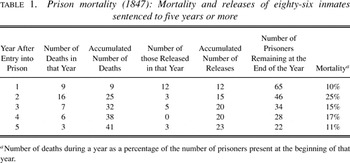
Prison mortality (1847): Mortality and releases of eighty-six inmates sentenced to five years or more
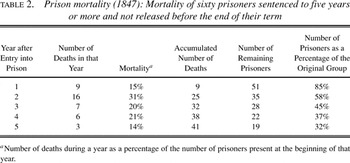
Prison mortality (1847): Mortality of sixty prisoners sentenced to five years or more and not released before the end of their term
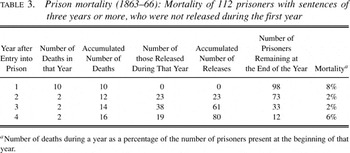
Prison mortality (1863–66): Mortality of 112 prisoners with sentences of three years or more, who were not released during the first year
 You have Access