Introduction
Cognitive deficits are a core feature of schizophrenia (Elvevag & Goldberg, Reference Elvevag and Goldberg2000; MacCabe, Reference MacCabe2008; Kahn & Keefe, Reference Kahn and Keefe2013). Lower intelligence is already present before illness manifestation (Woodberry et al. Reference Woodberry, Giuliano and Seidman2008; Dickson et al. Reference Dickson, Laurens, Cullen and Hodgins2012) and poor scholastic achievement is associated with an increased risk for developing schizophrenia (van Oel et al. Reference van Oel, Sitskoorn, Cremer and Kahn2002; MacCabe et al. Reference MacCabe, Lambe, Cnattingius, Torrang, Bjork, Sham, David, Murray and Hultman2008). Several studies report that clinically unaffected first-degree relatives of schizophrenia patients also show lower intelligence quotient (IQ) and worse educational performance than healthy controls (Kremen et al. Reference Kremen, Faraone, Seidman, Pepple and Tsuang1998; Cannon et al. Reference Cannon, Huttunen, Lonnqvist, Tuulio-Henriksson, Pirkola, Glahn, Finkelstein, Hietanen, Kaprio and Koskenvuo2000; Hughes et al. Reference Hughes, Kumari, Das, Zachariah, Ettinger, Sumich and Sharma2005; McIntosh et al. Reference McIntosh, Harrison, Forrester, Lawrie and Johnstone2005), implying that an increased familial vulnerability to schizophrenia is associated with intellectual deficits.
Whether intellectual deficits also occur in euthymic bipolar disorder (BD) patients is unclear. Although deficits in specific cognitive domains, e.g. executive function, attention and verbal memory, are frequently reported (Martinez-Aran et al. Reference Martinez-Aran, Vieta, Reinares, Colom, Torrent, Sanchez-Moreno, Benabarre, Goikolea, Comes and Salamero2004; Robinson et al. Reference Robinson, Thompson, Gallagher, Goswami, Young, Ferrier and Moore2006; Torres et al. Reference Torres, Boudreau and Yatham2007), results from individual studies on global intelligence in BD patients are equivocal. Whereas some studies show a lower IQ in BD patients compared to controls (Toulopoulou et al. Reference Toulopoulou, Quraishi, McDonald and Murray2006; McIntosh et al. Reference McIntosh, Harrison, Forrester, Lawrie and Johnstone2005; Frantom et al. Reference Frantom, Allen and Cross2008; Eric et al. Reference Eric, Halari, Cheng, Leung and Young2013), others demonstrate similar IQ scores (Coffman et al. Reference Coffman, Bornstein, Olson, Schwarzkopf and Nasrallah1990; Frangou et al. Reference Frangou, Haldane, Roddy and Kumari2005; Pirkola et al. Reference Pirkola, Tuulio-Henriksson, Glahn, Kieseppa, Haukka, Kaprio, Lonnqvist and Cannon2005). Furthermore, some studies show comparable IQ scores in BD patients and schizophrenia patients, but failed to include a control group in their study (McClellan et al. Reference McClellan, Prezbindowski, Breiger and McCurry2004; Reichenberg et al. Reference Reichenberg, Harvey, Bowie, Mojtabai, Rabinowitz, Heaton and Bromet2009). These inconsistent findings on IQ in BD patients are possibly the result of methodological deficiencies: although there have been large register-based studies on the association between premorbid IQ and BD, studies that focused on IQ in BD patients have been small (n < 90) (McIntosh et al. Reference McIntosh, Harrison, Forrester, Lawrie and Johnstone2005; Toulopoulou et al. Reference Toulopoulou, Quraishi, McDonald and Murray2006), and in some cases lacked a control group (McClellan et al. Reference McClellan, Prezbindowski, Breiger and McCurry2004; Reichenberg et al. Reference Reichenberg, Harvey, Bowie, Mojtabai, Rabinowitz, Heaton and Bromet2009). Four meta-analyses compared IQ of first-episode BD patients with that of controls, using combined samples (of sizes between 237 and 298 BD patients and 218 to 615 controls) and found lower IQ in the BD patients (with an average effect size of 0.16–0.45; Robinson et al. Reference Robinson, Thompson, Gallagher, Goswami, Young, Ferrier and Moore2006; Arts et al. Reference Arts, Jabben, Krabbendam and van Os2008; Bora et al. Reference Bora, Yucel and Pantelis2009; Bora & Pantelis, Reference Bora and Pantelis2015).
What is known is that, in contrast to findings in schizophrenia, intellectual deficits do not appear to be present before onset of BD (Reichenberg et al. Reference Reichenberg, Weiser, Rabinowitz, Caspi, Schmeidler, Mark, Kaplan and Davidson2002; Zammit et al. Reference Zammit, Allebeck, David, Dalman, Hemmingsson, Lundberg and Lewis2004); and intelligence in first-degree relatives of BD patients appears to be preserved (Balanza-Martinez et al. Reference Balanza-Martinez, Rubio, Selva-Vera, Martinez-Aran, Sanchez-Moreno, Salazar-Fraile, Vieta and Tabares-Seisdedos2008). In fact, recent studies suggest that high premorbid intelligence (Gale et al. Reference Gale, Batty, McIntosh, Porteous, Deary and Rasmussen2013) and excellent scholastic performances (MacCabe et al. Reference MacCabe, Lambe, Cnattingius, Sham, David, Reichenberg, Murray and Hultman2010) are associated with an increased risk of developing BD. However, since intelligence after disease onset has not been examined in these studies, the question remains whether BD patients also had a higher IQ.
Since research in schizophrenia patients demonstrates clear evidence for general IQ deficits (Kahn & Keefe, Reference Kahn and Keefe2013) and robust associations have been found for IQ and other disease-related measures such as brain morphology (Deary et al. Reference Deary, Penke and Johnson2010) and genetic background (Davies et al. Reference Davies, Tenesa, Payton, Yang, Harris, Liewald, Ke, Le Hellard, Christoforou, Luciano, McGhee, Lopez, Gow, Corley, Redmond, Fox, Haggarty, Whalley, McNeill, Goddard, Espeseth, Lundervold, Reinvang, Pickles, Steen, Ollier, Porteous, Horan, Starr, Pendleton, Visscher and Deary2011; McIntosh et al. Reference McIntosh, Gow, Luciano, Davies, Liewald, Harris, Corley, Hall, Starr, Porteous, Tenesa, Visscher and Deary2013), this study focuses on general IQ in both BD and schizophrenia patients.
Furthermore, given the strong genetic influence in schizophrenia [Schizophrenia Psychiatric Genome-Wide Association Study (GWAS) Consortium, 2011] and BD (Psychiatric GWAS Consortium Bipolar Disorder Working Group, 2011) and some degree of genetic overlap between them (Purcell et al. Reference Purcell, Wray, Stone, Visscher, O'Donovan, Sullivan and Sklar2009), it is also interesting to investigate the contribution of a familial vulnerability to differences in intelligence and educational performance. Additionally, delineating intelligence and educational performance is important, since other factors besides intelligence are predictive of educational performance (Chamorro-Premuzic & Furnham, Reference Chamorro-Premuzic and Furnham2003; Deary et al. Reference Deary, Strand, Smith and Fernandes2007).
We investigate IQ after onset of disease and educational performance in schizophrenia and BD patients and healthy controls. We include parents and siblings of these patient groups and siblings of controls to investigate IQ and educational performance and the association of a familial vulnerability with the disorders.
Method
Study design
Data were collected by three Dutch studies: Bipolar Genetics (BiG), Dutch Genetic Risk and Outcome in Psychosis (GROUP) and CannabisQuest. All studies were approved by the relevant medical ethical committee and all participants gave written informed consent.
BiG is an ongoing case-control study that started in June 2011 and is part of a collaboration between the University of California Los Angeles and the Dutch healthcare institutes University Medical Center Utrecht (UMC Utrecht), GGZ Altrecht, GGz InGeest, University Medical Center Groningen, Delta Center for Mental Health Care, Dimence, Parnassia (PsyQ) and Reinier van Arkel Group. BiG investigates genetic and phenotypic information of patients with bipolar disorder type I (BD-I), first-degree relatives and controls. Patients were recruited via clinicians, the Dutch patients’ association, pharmacies and advertisements. First-degree relatives were invited through the patients who participated. Controls were recruited via advertisements and among individuals who previously participated in scientific studies and agreed to be contacted for new research. Inclusion criteria for all participants were: (1) age ⩾18 years, (2) at least three Dutch-born grandparents, and (3) a good understanding of the Dutch language. Patients with a somatic illness that could have influenced the diagnosis of BD were excluded. Participants were considered euthymic when they did not meet DSM-IV criteria for a mood episode in the last month according to the Structured Clinical Interview for DSM-IV (SCID-I). Participants that were not euthymic were excluded from the analyses.
The GROUP study is an ongoing longitudinal study that investigates gene–environment interaction and resilience in schizophrenia spectrum disorder (SCZ) patients, first-degree relatives, controls and siblings of controls (Korver et al. Reference Korver, Quee, Boos, Simons and de Haan2012). Supplementary Table S1 demonstrates the diagnoses of the SCZ patients. The GROUP study is conducted by four Dutch university departments of psychiatry (Amsterdam, Groningen, Maastricht, Utrecht). Patients were included when they were aged between 16 and 50 years, had a diagnosis of a non-affective psychotic disorder according to DSM-IV criteria and a good command of the Dutch language. First-degree relatives were invited through the patients. The CannabisQuest study is a cross-sectional study that included adolescents and young adults from the general population (Schubart et al. Reference Schubart, van Gastel, Breetvelt, Beetz, Ophoff, Sommer, Kahn and Boks2011; Vinkers et al. Reference Vinkers, van Gastel, Schubart, Van Eijk, Luykx, Van Winkel, Joels, Ophoff, Boks, Bruggeman, Cahn, De Haan, Kahn, Meijer, Myin-Germeys, van Os and Wiersma2013). Participants completed an online questionnaire and were subsequently assessed by a psychiatric interview and neuropsychological tests at the UMC Utrecht.
Participants
For the current study, we included BD-I patients and first-degree relatives of BD-I patients (participants of BiG), SCZ patients and first-degree relatives of SCZ patients (participants of GROUP) and unrelated community controls. Controls were included from all three studies (BiG, GROUP, CannabisQuest), siblings of controls were included by the GROUP study only. Participants were aged >15 years. The three studies used identical neuropsychological tests and educational assessment. All psychiatric and neuropsychological assessments occurred at the UMC Utrecht or one of their academic collaborative institutes. To avoid inclusion of an unrepresentative population, we did not exclude controls with a psychiatric diagnosis other than a psychotic disorder or BD. Controls and their siblings with a diagnosis of BD or a psychotic disorder or with a first-degree relative with BD or a psychotic disorder were excluded. After excluding participants who did not meet the inclusion criteria, data were available for 494 BD-I patients, 952 SCZ patients, 135 parents of BD-I patients (BD-I parents), 896 parents of SCZ patients (SCZ parents), 161 siblings of BD-I patients (BD-I siblings), 1039 siblings of SCZ patients (SCZ siblings), 1104 controls and 100 siblings of controls (control siblings). Table 1 shows the characteristics of the participants included in the analyses. For an overview of the excluded participants, see Supplementary Fig. S1.
Demographics: participants included in IQ analyses

BD-I, Bipolar disorder type I; SCZ, schizophrenia spectrum disorder.
a Lifetime psychiatric diagnosis. Controls with BD or a psychotic disorder or with first-degree relatives with BD or a psychotic disorder are not included.
* Significant difference between groups at p < 0.01.
Diagnosis
BD-I patients were diagnosed using the Structured Clinical Interview for DSM-IV (SCID-I; First et al. Reference First, Spitzer, Gibbon and Williams1997). In addition, we also used the SCID-I to establish lifetime history of psychotic symptoms in BD-I patients. Relatives of BD-I patients and controls included by the BiG study were diagnosed by the Mini-International Neuropsychiatric Interview (Sheehan et al. Reference Sheehan, Lecrubier, Sheehan, Amorim, Janavs, Weiller, Hergueta, Baker and Dunbar1998). Participants included by the GROUP study were assessed through the Schedules for Clinical Assessment in Neuropsychiatry 2.1 (Wing et al. Reference Wing, Babor, Brugha, Burke, Cooper, Giel, Jablenski, Regier and Sartorius1990) or the Comprehensive Assessment of Symptoms and History (CASH; Andreasen et al. Reference Andreasen, Flaum and Arndt1992). Controls that participated in the CannabisQuest study were diagnosed by the SCID-I. Disease history was considered positive when lifetime criteria for any psychiatric disorder were met. We obtained family history of psychiatric diseases through the Family Interview Genetic Studies (Maxwell, Reference Maxwell1992). For SCZ patients, age at onset was assessed by the Life Chart Schedule (Sartorius et al. Reference Sartorius, Gulbinat, Harrison, Laska and Siegel1996) as previously reported (Apeldoorn et al. Reference Apeldoorn, Sterk, van den Heuvel, Schoevers, Islam, Bruggeman, Cahn, de Haan, Kahn, Meijer, Myin-Germeys, van Os and Wiersma2014). For BD-I patients, age at onset was defined as age of first medication as reported in the Questionnaire for Bipolar Illness (QBP-NL; Dutch translation by Akkershuis, Groenesteyn, Nolen, 1997; an adaptation of the Enrolment Questionnaire as previously used in the Stanley Foundation Bipolar Network (Leverich et al. Reference Leverich, Nolen, Rush, McElroy, Keck, Denicoff, Suppes, Altshuler, Kupka, Kramlinger and Post2001; Suppes et al. Reference Suppes, Leverich, Keck, Nolen, Denicoff, Altshuler, McElroy, Rush, Kupka, Frye, Bickel and Post2001)), given the insidious onset of BD-I and the high probability of recall bias in the retrospective assessment of first reported symptoms. When age at first reported symptoms was used in the models instead of age at first medication, the reported results did not change.
IQ
To estimate IQ we used four subtests of the Dutch version of the Wechsler Adult Intelligence Scale – III (WAIS-III; Wechsler, Reference Wechsler1997) consisting of the subtests ‘Information’, ‘Block Design’, ‘Digit Symbol Coding’ and ‘Arithmetic’. Each subtest belongs to one of the four indices (‘Information’ to the Verbal Comprehension Index; ‘Block Design’ to the Perceptual Organization Index; ‘Digit Symbol Coding’ to the Processing Speed Index; ‘Arithmetic’ to the Working Memory Index). The combination of these subtests has been shown to most fully account for full-scale IQ in both schizophrenia patients (R 2 = 0.90) and controls (R 2 = 0.86) (Blyler et al. Reference Blyler, Gold, Iannone and Buchanan2000).
Educational performance
In The Netherlands, most schools are state schools which are ordinally organized into primary, secondary and tertiary education tiers. From 4 until 12 years of age, all children receive primary education. After 12 years, children are streamed into four levels of secondary education (low, intermediate, high preparatory vocational, and pre-university), each level requiring greater intellectual and scholastic abilities (Vonk et al. Reference Vonk, van der Schot, van Baal, van Oel, Nolen and Kahn2012). After passing the examinations in secondary education, there are three levels of tertiary education possible (intermediate professional education, higher professional education and university). After achieving a master's degree at university, it is possible to enrol in a doctoral program. The Dutch school system, with different educational levels and similar quality of education across schools, allows a detailed insight into intellectual and scholastic ability.
We asked participants to record their highest completed level of education. To have approximately equally distributed groups, we delineated six categories: Level 1: Low (no education, primary education and low secondary education); Level 2: Intermediate secondary education; Level 3: Intermediate professional education; Level 4: High preparatory vocational and pre-university; Level 5: Bachelor degree (higher professional education) and Level 6: University (Master's degree or PhD degree).
Statistical analyses
We studied the association of group status [five comparisons: (1) BD-I patients v. controls and SCZ patients v. controls; (2) BD-I patients v. SCZ patients; (3) BD-I siblings v. control siblings and SCZ siblings v. control siblings; (4) BD-I siblings v. SCZ siblings; (5) BD-I parents v. SCZ parents] with two outcome variables: IQ and educational performance. Since we did not include parents of controls, we compared BD-I parents with SCZ parents. The statistical analyses were carried out using the R package for statistical computing (R Core Team, 2014) and SPSS v. 20.0 (SPSS Inc., USA). Assumptions were checked before analysing data. Subjects with missing data were excluded listwise from the analyses. We used ANOVA and t tests to compare the patient, control and parent groups for age and age at onset and χ2 tests to compare these groups for gender and disease history. Furthermore, we compared BD-I patients with and without a lifetime history of psychotic symptoms on IQ and educational performance using a t test and χ2 test. To estimate whether BD-I patients with a lifetime history of psychotic symptoms had a greater cognitive decline than BD-I patients without a history of psychotic features, we calculated standardized residuals of IQ scores by adjusting for educational performance. We compared these standardized residuals using a t test.
We used mixed-effects models with ‘family’ (indicating the family a person belonged to, used to account for relatedness within the sibling samples) as random factor to compare the three sibling groups on age, gender and disease history. We checked whether selective drop-out had occurred for missing values by comparing the participants included in the IQ analyses with the participants included in the analyses on educational performance. We conducted χ2 tests for gender, disease history and frequency of subjects within the analyses and performed t tests for age, age at onset and IQ.
First, we studied the association of the disorders with IQ. To investigate whether patients differed from controls, we used a linear mixed-effects model with two dummy variables (BD-I v. controls and SCZ v. controls) as main determinants and IQ as outcome. We included a random factor ‘study’ (indicating the study a participant belonged to) to control for bias that may occur when samples from different studies are compared. To investigate whether siblings of patients differed from control siblings on IQ we used a linear mixed-effects model with two dummy variables (BD-I siblings v. control siblings and SCZ siblings v. control siblings) as main determinants, IQ as outcome and ‘study’ and ‘family’ as random factors.
Since the indicator ‘study’ was identical for the patient, parent and sibling groups, we were unable to use this indicator as random factor for comparisons between BD-I and SCZ patients and BD-I and SCZ relatives. Therefore, we conducted two separate linear models with IQ as outcome and patient (BD-I patients v. SCZ patients) and parent (BD-I parents v. SCZ parents) groups as main determinants. To compare BD-I siblings with SCZ siblings, we conducted a linear mixed-effects model with sibling group as main determinant and ‘family’ as random factor.
Subsequently, we studied the association of the disorders with educational performance. We applied five different thresholds for the six categories for level of education and compared participants that completed an educational level and above with the remaining group (threshold 1: completing ‘Intermediate secondary education’ or higher v. completing ‘Low’; threshold 2: completing ‘Intermediate professional education’ or higher v. below; threshold 3: completing ‘High preparatory vocational and pre-university’ or higher v. below; threshold 4: completing ‘Bachelor’ or higher v. below; threshold 5: completing ‘University’ v. below). We used logistic regression analyses with dummy coding for patients and controls to investigate the differences in educational performance between patients and controls. Furthermore, we conducted logistic regression analyses to investigate educational performance between patient groups and parent groups. In addition, to estimate differences between parents and controls in absence of a group of parents of controls, we ran 10 000 permutation tests in which we compared the parent groups with a random sample of 600 controls. We used this resampling method to reduce the chance of selecting a biased subsample of the control group. We analysed educational performance of siblings with a generalized mixed model with ‘family’ as random factor. Since we used five thresholds as outcome variables, we corrected for multiple testing by applying a Bonferroni correction and considered p values < 0.01 as statistically significant.
Additionally, to account for illness effects in siblings, we excluded 14 BD-I and 50 SCZ siblings with a psychotic disorder or BD and repeated the analyses of IQ and educational performance. We also repeated the IQ and educational performance analyses in BD-I patients, SCZ patients and controls aged >34 years to rule out that age differences between these groups influence the results.
To investigate whether BD-I patients with high educational performance but a low IQ constitute a subgroup of patients with rapid cognitive decline, we compared the characteristics of those patients with other BD-I patients with high educational performance. We compared patients with an IQ <95 (1/3 standard deviation below the average of 100) who had completed University with normal IQ BD-I patients who had completed University.
Age and gender were covariates in all models and age at onset was a covariate in the comparison of BD-I patients and SCZ patients. To ensure that our results were not biased by the different measurements of age at onset in BD and SCZ patients, we repeated the analyses excluding age at onset as covariate. We calculated Cook's distances to investigate potential outliers. For two thresholds in the sibling comparisons (‘Intermediate secondary education’ and ‘University’) we could not calculate Cook's distance due to non-convergence of the mixed-effects model, so we calculated Cook's distance without a random factor in a linear model.
Results
We included 4881 participants. Data on educational performance were missing for 24 BD-I patients, 8 SCZ patients, 5 BD-I parents, 54 SCZ parents, 6 BD-I siblings, 17 SCZ siblings and 56 controls. Listwise exclusion of these participants resulted in a sample of 4714 participants included in the analyses of educational performance. There was no evidence of selective drop-out for missing values; the frequency of subjects within each group did not change (patients and controls: χ2 = 0.54, p = 0.76; patients: χ2 = 0.27, p = 0.60; parents: χ2 = 0.03, p = 0.85; siblings and control siblings: χ2 = 0.05, p = 0.98; siblings: χ2 = 0.03, p = 0.86) and there were no differences in demographic characteristics between the participants included in the IQ analyses and the participants included in the analyses of educational performance (gender: χ2 = 0.004, p = 0.95; age: t = 0.38, p = 0.70; IQ: t = −0.60, p = 0.55; age at onset: t = 0.25, p = 0.80; disease history: χ2 = 0.08, p = 0.78).
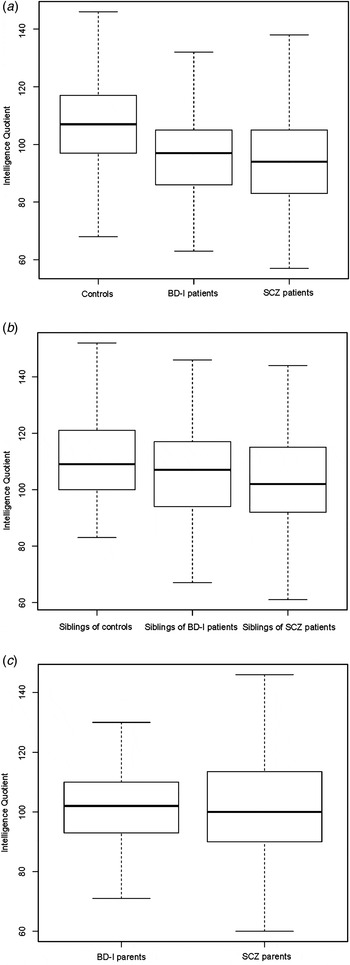
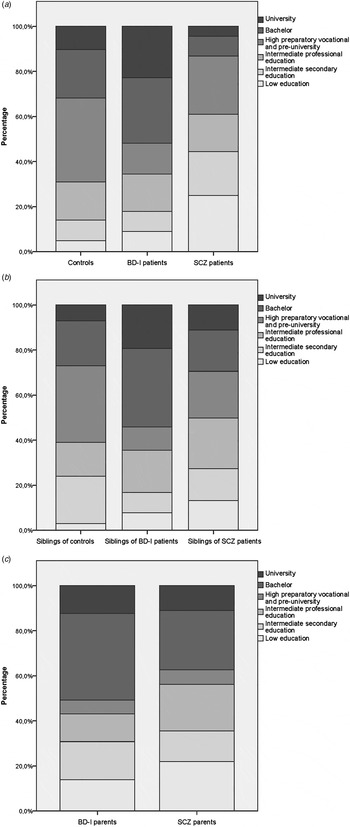
The groups differed on several demographic factors (see Table 1). Figs 1 and 2 show the distribution of IQ and educational performance by group.
Boxplots of IQ scores. (a) Controls, bipolar disorder type I (BD-I) and schizophrenia spectrum disorder (SCZ) patients. (b) Control siblings, BD-I siblings and SCZ siblings. (c) BD-I parents and SCZ parents.

Educational performance by group. (a) Controls, bipolar disorder type I (BD-I) and schizophrenia spectrum disorder (SCZ) patients. (b) Control siblings, BD-I siblings and SCZ siblings. (c) BD-I parents and SCZ parents.

BD-I and SCZ patients v. controls
Both BD-I and SCZ patients had a significantly lower IQ than controls (BD-I: β = −9.09, s.e. = 1.27, p < 0.001; SCZ: β = −15.31, s.e. = 0.86, p < 0.001). BD-I patients had a significantly higher IQ than SCZ patients (β = 4.57, s.e. = 1.34, p = 0.001).
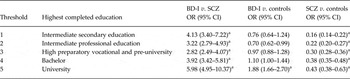
SCZ patients had completed lower educational levels than BD-I patients and controls. In contrast, BD-I patients were more likely to have completed the highest educational level than controls. Table 2 shows the results of the analyses of educational performance in patients and controls. In addition, excluding age at onset as covariate did not change the results in the patient analyses (data not shown).
The association of disorder with educational performance

BD-I, Bipolar disorder type I; SCZ, schizophrenia spectrum disorder; OR, odds ratio; CI, confidence interval.
a Does not include unity.
BD-I patients with a history of psychotic symptoms did not differ from BD-I patients without such a history on IQ (t = −0.49, p = 0.63) and educational performance (χ2 = 4.97, p = 0.42), nor did they show a more rapid cognitive decline (t = 0.46, p = 0.65).
We also compared patients with a large IQ decline who had completed University (n = 15) with normal IQ BD-I patients who had completed University (n = 92). We found no differences between the groups for age (mean = 52.73, s.d. = 11.14 v. mean = 47.25, s.d. = 11.37; t = 1.74, p = 0.09), age at onset (mean 34.00, s.d. = 9.26 v. mean = 31.98, s.d. = 9.73; t = 0.75, p = 0.46) and gender [6 males (40%) v. 56 males (60.9%); χ2 = 2.31, p = 0.13].
To account for the effect of age difference between the patients and controls, we repeated the IQ and educational performance analyses in patients and controls aged >34 years. We found very similar results as in the main analyses; BD-I patients and SCZ patients had a lower IQ than controls (BD-I: β = −8.08, s.e. = 1.45, p < 0.001; SCZ: β = −15.81, s.e. = 1.66, p < 0.001) and BD-I patients had a higher IQ than SCZ patients (β = 5.77, s.e. = 1.73, p = 0.001). Furthermore, SCZ patients had lower educational performance than BD-I patients and controls, whereas BD-I patients were more likely to have completed University (see Supplementary Table S2).
BD-I and SCZ siblings v. control siblings
BD-I and SCZ siblings had a similar IQ (β = 3.53, s.e. = 2.00, p = 0.08), which was significantly lower than that of control siblings (BD-I: β = −5.73, s.e. = 2.41, p = 0.02; SCZ: β = −8.33, s.e. = 1.68, p < 0.01). Moreover, although Fig. 2 suggests that BD-I siblings are more highly educated than SCZ siblings and control siblings, the three sibling groups did not significantly differ in educational performance after adjusting for age and gender.
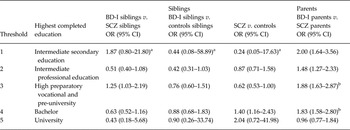
Analysis of (healthy) siblings without BD-I or a psychotic disorder revealed lower intelligence for SCZ siblings (β = −8.19, s.e. = 1.67, p < 0.001) but not for BD-I siblings (β = −4.69, s.e. = 2.44, p = 0.05) compared to control siblings. Instead, BD-I siblings had a higher IQ than SCZ siblings (β = 4.53, s.e. = 2.06, p = 0.03). The results for educational performance did not change: the three sibling groups did not significantly differ on educational performance (see Supplementary Table S3). Table 3 shows the results of the analyses of educational performance in relatives of patients and controls.
The association of familial vulnerability with educational performance

BD-I, Bipolar disorder type I; SCZ, schizophrenia spectrum disorder; OR, odds ratio; CI, confidence interval.
a Age was left out due to problems converging the models.
b Does not include unity.
BD-I parents v. SCZ parents
BD-I parents had a similar IQ as SCZ parents (β = −1.21, s.e. = 1.70, p = 0.48), but were more often higher educated (see Table 3). The results of 10 000 permutation tests revealed that BD-I parents had similar educational performance as random (unrelated) controls. SCZ parents had lower educational performance than unrelated controls (see Supplementary Table S4).
Analysis of outliers and ethnicity
None of the participants fulfilled the criteria for outliers by Cook's distance. Since not all SCZ patients, SCZ relatives and controls were Dutch, we analysed the data from the Caucasian participants only (SCZ patients: n = 754; SCZ parents: n = 797; SCZ siblings: n = 865; controls: n = 1067; control siblings: n = 92). The results of these analyses did not differ from the results we found for the entire group of participants (data not shown).
Discussion
In the largest cross-sectional study on IQ and educational performance in BD-I and SCZ patients and relatives to date, patients with established BD-I had a lower IQ, but superior educational performance relative to healthy controls. By contrast, SCZ patients had lower IQ as well as inferior educational performance compared to controls, suggesting that IQ in schizophrenia is affected in an earlier stage of the illness. The fact that educational performance of BD-I siblings and BD-I parents was comparable to that of controls while in patients it was higher, raises the question as to whether high educational performance is associated with bipolar disorder itself rather than with a familial vulnerability to develop the illness.
Cognitive deficits in BD-I patients have been reported previously (McIntosh et al. Reference McIntosh, Harrison, Forrester, Lawrie and Johnstone2005; Toulopoulou et al. Reference Toulopoulou, Quraishi, McDonald and Murray2006) and our findings are, to some extent, in line with a recent meta-analysis that also showed broad cognitive deficits in 1026 euthymic BD patients (Mann-Wrobel et al. Reference Mann-Wrobel, Carreno and Dickinson2011). This meta-analysis included two out of the four subtests we used for IQ estimation, and found lower performance on one of them (Digit Symbol). In addition, cognitive function of BD patients was not compared to that of SCZ patients.
Lower IQ in BD-I patients appears to be associated with the illness itself, as healthy BD-I siblings do not show a significantly reduced IQ compared with control siblings. In contrast, healthy SCZ siblings had a lower IQ than control siblings, indicating that lower IQ may be associated with a familial vulnerability for SCZ. The current study emphasizes that IQ may not fully account for educational performance, as we show different results for both domains in BD-I patients. Moreover, our results confirm findings by previous register-based studies that low educational performance is associated with schizophrenia and high educational performance is associated with BD (MacCabe et al. Reference MacCabe, Lambe, Cnattingius, Torrang, Bjork, Sham, David, Murray and Hultman2008, Reference MacCabe, Lambe, Cnattingius, Sham, David, Reichenberg, Murray and Hultman2010).
One of the explanations for the contradictory finding regarding high educational performance and lower intelligence in BD-I patients is that intelligence may have been higher before onset of BD, but decreased after illness onset (Trotta et al. Reference Trotta, Murray and MacCabe2015) possibly as a result of number of hospitalizations (Robinson & Ferrier, Reference Robinson and Ferrier2006), traumatic experiences (Aas et al. Reference Aas, Dazzan, Fisher, Morgan, Morgan, Reichenberg, Zanelli, Fearon, Jones, Murray and Pariante2011) or long-term medication use (Pachet & Wisniewski, Reference Pachet and Wisniewski2003; Senturk et al. Reference Senturk, Goker, Bilgic, Olmez, Tugcu, Oncu and Atbasoglu2007; Wingo et al. Reference Wingo, Wingo, Harvey and Baldessarini2009; Vreeker et al. Reference Vreeker, Van Bergen and Kahn2015). Additionally, prodromal symptoms like elevated energy (Egeland et al. Reference Egeland, Hostetter, Pauls and Sussex2000) may have contributed to high educational performance.
Interestingly, BD-I siblings and BD-I parents did not have higher educational performance than controls, which suggests that high educational performance is associated with the illness itself, rather than with a familial vulnerability to BD. This is partly in line with earlier findings showing fewer completed years of education for non-bipolar co-twins, but not for bipolar co-twins, compared to controls (Vonk et al. Reference Vonk, van der Schot, van Baal, van Oel, Nolen and Kahn2012). From an evolutionary perspective our results raise the question whether high (educational) achievement could be a result of an adaptive advantage of the disorder, associated with benefits in leadership (Akiskal & Akiskal, Reference Akiskal and Akiskal2005).
Limitations
The current study has several limitations. First, it should be noted that the cross-sectional design of our study does not allow us to conclude that there has been a decline in IQ in BD-I patients. Moreover, BD-I patients were significantly older than SCZ patients and controls which may have resulted in a greater opportunity for BD-I patients to attend higher education. However, analyses of patients and controls aged >34 years, yielded very similar results. Furthermore, younger people tend to be higher educated than older people in general (Barro & Lee, Reference Barro and Lee2013) and the fact that BD-I patients were higher educated despite their greater age could also underscore their superior educational performance.
Despite careful analysis that incorporate multilevel analysis, sensitivity analysis and exploration of a range of possible confounders, residual confounding may remain as we are unable to adjust for all possible factors (e.g. medication use, comorbid disorders) that could have influenced IQ scores. Particularly, information on parental socioeconomic status is absent and we cannot rule out the possibility that differences in parental socioeconomic status may have influenced our results. However, since tuition fees are low and income differences are substantially reduced by social security and taxes in The Netherlands we do not expect that differences in socioeconomic status may have accounted for our results on educational performance.
Furthermore, although we accounted for the effect of clustering by including ‘family’ as random factor, the absence of genetic data precluded the use of genetic proximity as a more precise measure of dependencies within families.
A final limitation is that, despite our large sample, we cannot be sure that our populations are representative; inherent to clinical cohorts is Berkson's bias (bias toward those willing to participate and those under treatment) (Regeer et al. Reference Regeer, Krabbendam, De Graaf, Have, Nolen and van Os2009).
Conclusions
We show that despite BD-I patients having a lower IQ relative to controls, they are more likely to have completed the highest level of education. This contrasts with our findings in SCZ patients, who demonstrate both lower IQ and lower educational performance. The fact that BD-I patients, but not BD-I parents or BD-I siblings, had more often completed the highest level of education compared with controls suggests that high educational performance may be a distinctive feature of the illness itself.
Appendix. GROUP Investigators
R. Bruggeman1, W. Cahn2, L. de Haan3, R. S. Kahn2, C. J. Meijer3, I. Myin-Germeys4, J. van Os4,5 and D. Wiersma1
1 Department of Psychiatry, University Medical Center Groningen, University of Groningen, The Netherlands
2 Department of Psychiatry, Brain Center Rudolf Magnus, University Medical Center Utrecht, Utrecht, The Netherlands
3 Department of Psychiatry, Academic Medical Centre, University of Amsterdam, Amsterdam, The Netherlands
4 Maastricht University Medical Center, South Limburg Mental Health Research and Teaching Network Euron, Maastricht, The Netherlands
5 Department of Psychosis Studies, King's College London, King's Health Partners, Institute of Psychiatry, London, UK
Supplementary material
For supplementary material accompanying this paper visit http://dx.doi.org/10.1017/S0033291715002299.
Acknowledgements
This work was supported by several grants. The infrastructure for the GROUP study is funded through the Geestkracht program of the Dutch Health Research Council (ZON-MW, grant number 10-000-1001), and matching funds from participating pharmaceutical companies (Lundbeck, AstraZeneca, Eli Lilly, Janssen Cilag) and universities and mental healthcare organizations (Amsterdam: Academic Psychiatric Centre of the Academic Medical Center and the mental health institutions: GGZ Ingeest, Arkin, Dijk en Duin, GGZ Rivierduinen, Erasmus Medical Centre, GGZ Noord Holland Noord. Maastricht: Maastricht University Medical Centre and the mental health institutions: GGZ Eindhoven en de kempen, GGZ Breburg, GGZ Oost-Brabant, Vincent van Gogh voor Geestelijke Gezondheid, Mondriaan Zorggroep, Prins Clauscentrum Sittard, RIAGG Roermond, Universitair Centrum Sint-Jozef Kortenberg, CAPRI University of Antwerp, PC Ziekeren Sint-Truiden, PZ Sancta Maria Sint-Truiden, GGZ Overpelt, OPZ Rekem. Groningen: University Medical Center Groningen and the mental health institutions: Lentis, GGZ Friesland, GGZ Drenthe, Dimence, Mediant, GGNet Warnsveld, Yulius Dordrecht and Parnassia psycho-medical center (The Hague). Utrecht: University Medical Center Utrecht and the mental health institutions Altrecht, GGZ Centraal, Riagg Amersfoort and Delta). The BiG study is funded by the National Institute of Mental Health, grant number: R01 MH090553 (to Prof. Dr. R. A. Ophoff). The CannabisQuest was financially supported by a grant of the NWO (Netherlands Organization for Scientific Research), grant number: 91207039. We are grateful for the generosity of time and effort by the patients and their families, healthy subjects, and all the researchers who make the BiG, CannabisQuest and GROUP project possible. We thank the patients’ association ‘Vereniging voor Manisch Depressieven en Betrokkenen’ and the pharmacy network ‘UPPER’ for their assistance in recruiting participants and Willemijn van Gastel, Christian Schubart, Diandra Bouter, Ellen Bleijenberg, Diane Ramakers, Tim Zandbelt and Yoon Jung for their efforts in collecting and managing the data.
Declaration of Interest
None.