1
This paper offers a new interpretation of the heuristic role of Wright's (Reference Wright1932) adaptive landscape diagram. Wright's diagram is the most influential visual heuristic in evolutionary biology. That said, it is interesting that Wright's biographer, Provine, would argue that the heuristic is poor. According to Provine (Reference Provine1986), the landscape is mathematically uninterpretable, from which he thinks it follows that the heuristic is no good. Ruse (Reference Ruse and Baigrie1996) has defended Wright against Provine. Ruse claims Provine has not shown Wright's use of the landscape is flawed, and that, even if it were, it is heuristically valuable. Both Provine and Ruse claim that the diagram plays its heuristic role as an illustration of Wright's “shifting balance” process of evolution. Ruse adds that other biologists have used the diagram to great effect for similar illustrative purposes. My view of the diagram is that it is a theory evaluation heuristic for evaluating the dynamical behavior of population genetics models, but that Wright's use of it as such is of dubious value. Nevertheless, other biologists have established the diagram's heuristic value for evaluating dynamical behavior.
2
East invited the architects of theoretical population genetics, Fisher, Haldane, and Wright, to present their work at the 1932 Sixth International Congress of Genetics. They were to present compact and accessible forms of their seminal but mathematically intimidating work on evolutionary theory. Wright's principal evolutionary paper was his Reference Wright1931 “Evolution in Mendelian Populations.” The paper Wright delivered at the congress in Reference Wright1932 was, basically, a distillation of the Reference Wright1931 paper, and was published in the proceedings as “The Roles of Mutation, Inbreeding, Crossbreeding and Selection in Evolution.” The adaptive landscape was first publicly presented in the Reference Wright1932 paper.
Wright's aim in the Reference Wright1931–Reference Wright1932 papers was to determine the ideal conditions for evolution to occur, given specific assumptions about the relationship between Mendelian heredity and the adaptive value of gene complexes (Wright Reference Wright[1931] 1986, 158; Reference Wright[1932] 1986, 163). Wright's view was that his “shifting balance” process of evolution described those conditions. Evolution on the shifting balance process occurs in three phases:
Phase I. Random genetic drift causes subpopulations semi-isolated within the global population to lose fitness.
Phase II. Selection on complex genetic interaction systems raises the fitness of those subpopulations.
Phase III. Interdemic selection then raises the fitness of the large or global population.
In Wright's Reference Wright1932 paper, he used the adaptive landscape diagram to demonstrate why he thought such an apparently complicated process was required for the ideal conditions for evolution to be satisfied.
According to Wright (Reference Wright[1932] 1986, 161–163), accurately representing the population genetics of the evolutionary process requires thousands of dimensions. This is because the field of possible gene combinations in the field of gene frequencies of a population is vast (approximately 101000). Indeed, Wright begins the Reference Wright1932 paper by asking about the nature of this field of possible gene combinations. Figure 1a is Wright's first illustration, in which he depicts the combinations of two to five allelomorphs. Here, Wright illustrates how quickly the dimensionality of the field expands as the number of combinations expands: for the case of 32 combinations, five dimensions are required, plus a sixth to represent adaptive value. In the case of a species, with 101000 combinations, the required dimensions number at 9,000.
Wright's Reference Wright([1932] 1986, 161–163) key figures. Fig. 1a is Wright's representation of two to five allelomorphs in combination. Fig. 1b is Wright's adaptive landscape diagram. Fig. 1c depicts Wright's results from Reference Wright1931 on the statistical distribution of genes under varying assumptions. Fig. 1d depicts evolution occurring on the adaptive landscape under alternative assumptions.

Wright used the two-dimensional graphical depiction of an adaptive landscape (in Figure 1b) as a way of intuitively conveying what can only be realistically represented in thousands of dimensions. The surface of the landscape is typically understood as representing the joint gene frequencies of all genes in a population graded for adaptive value. Wright is confusing here, as we will see. The surface of the landscape is very “hilly,” says Wright, because of epistatic relations between genes, the consequences of which (for Wright) are that genes adaptive in one combination are likely to be maladaptive in another. Given Wright's view of epistasis and the vastness of the field of gene combinations in a field of gene frequencies, Wright estimates the number of adaptive ‘peaks’ separated by adaptive ‘valleys’ at 10800. Peaks are represented by ‘+’; valleys are represented by ‘−’.
The adaptive landscape diagram sets up Wright's signature problem, viz., the problem of peak shifts. That is, given that the adaptive landscape is hilly, the ideal conditions for evolution to occur must allow a population to shift from peak to peak to find the highest peak. In Wright's Reference Wright1931 paper, he demonstrated mathematically the statistical distributions of genes under alternative assumptions of population size, mutation rate, migration rate, selection intensity, etc. In the 1932 paper, the graphs displaying the results appear, and he uses them in combination with the landscape diagram to argue for his three-phase shifting-balance model of the evolutionary process (window F in Figure 1d) as the solution to his problem of peak shifts, via assessments of alternative models of the process (windows A–E in Figure 1d). We will return to this heuristic role of the diagram below.
3
Provine harshly criticized Wright's understanding of the adaptive landscape. Provine's criticism rests on problems he identifies with the way Wright interprets the diagram. Provine argues that Wright interpreted the diagram in two main ways. First, Wright interpreted the diagram as the multidimensional field of all possible gene combinations graded for their adaptive value (Wright Reference Wright[1932] 1986; Reference Wright1977, 452). Call this the genotype interpretation. Second, Wright interpreted Figure 1b as the multidimensional field of joint frequencies of all genes in a population graded for their adaptive value (correspondence to Fisher February 3, 1931, in Provine Reference Provine1986, 271–273; Wright Reference Wright[1939] 1986, 320; Reference Wright[1978] 1986, 7). Call this the population interpretation.
Provine (Reference Provine1986, 308–316) has argued that Wright's genotype interpretation of the diagram is mathematically incoherent and that the two interpretations are incommensurable. Provine claims that on the genotype interpretation each axis of the graphic is a gene combination. But, Provine argues, there are no gradations along the axes, no indications of what the units along the axes are, and no point along them to indicate where a gene combination is to be placed. Given this, Provine concludes that there is no way of generating the continuous surface represented in Figure 1a. Differently put, Wright's genotype interpretation of the diagram is mathematically incoherent.
Provine thinks that the population interpretation of the diagram is an improvement. On this interpretation, Provine argues, each point on the surface represents a population, and the entire surface is of mean population fitness rather than genotype fitness. Each axis is now graded between 0 and 1 for gene frequency; the result is a continuous surface. However, Provine claims, there is no way to translate between the population interpretation and the genotype interpretation of the diagram. That is, there is no way to plot genotype fitness values on the surface of gene frequencies; one is attempting to plot individual haplotypes onto a surface of which the points are populations. The result, Provine claims, is a surface that collapses into a single point because the axes are incompatible. Provine concludes that Wright's adaptive landscape diagram does not successfully illustrate his view of the evolutionary process. Indeed, because of this Provine thinks that the general heuristic value of the diagram is dubious.
Ruse (Reference Ruse and Baigrie1996) thinks that Provine's criticisms are defective.Footnote 1 Ruse claims that Provine has misread the graphic on its genotype interpretation. Ruse says, contra Provine, that gene combinations are not axes; they are points. For Ruse, the adaptive landscape is like a printed photograph: there are many discrete points producing, effectively, a continuous surface. Ruse (Reference Ruse and Baigrie1996, 322–328) counters Provine's criticism that the gene-combinations and gene-frequencies interpretations of the landscape are not equivalent, with the same point that biologists had countered Provine with previously: to show that the two interpretations are equivalent, one need merely integrate over the fitnesses of the gene combinations to get the mean fitness of the population. However, Ruse nowhere demonstrates that a continuous surface can be produced on the genotype interpretation of the diagram. He also does not demonstrate, by doing the mathematics, that Wright's two interpretations of the diagram can be shown to be equivalent. Without these demonstrations, Ruse's critique is inconclusive.
Whatever is to be made of the Provine-Ruse technical disagreement over interpreting the diagram, I do not think it matters much to understanding the adaptive landscape. Indeed, contemporary presentations of Wright's understanding of the adaptive landscape usually assume its population interpretation and dismiss its genotype interpretation because the latter fails to yield a continuous surface (e.g., Coyne et al. Reference Coyne, Barton and Turelli1997; Futuyma Reference Futuyma1986; Ridley Reference Ridley1996). Ultimately, the Provine-Ruse disagreement over the interpretation of the diagram misses the diagram's critical problem: Wright is mistaken in his core assumption that the graphical depiction of the adaptive values of populations in two dimensions represents them in what would be many thousands of dimensions. Indeed, biologists have articulated this point since the origination of the diagram. I consider three prominent critiques below.
4
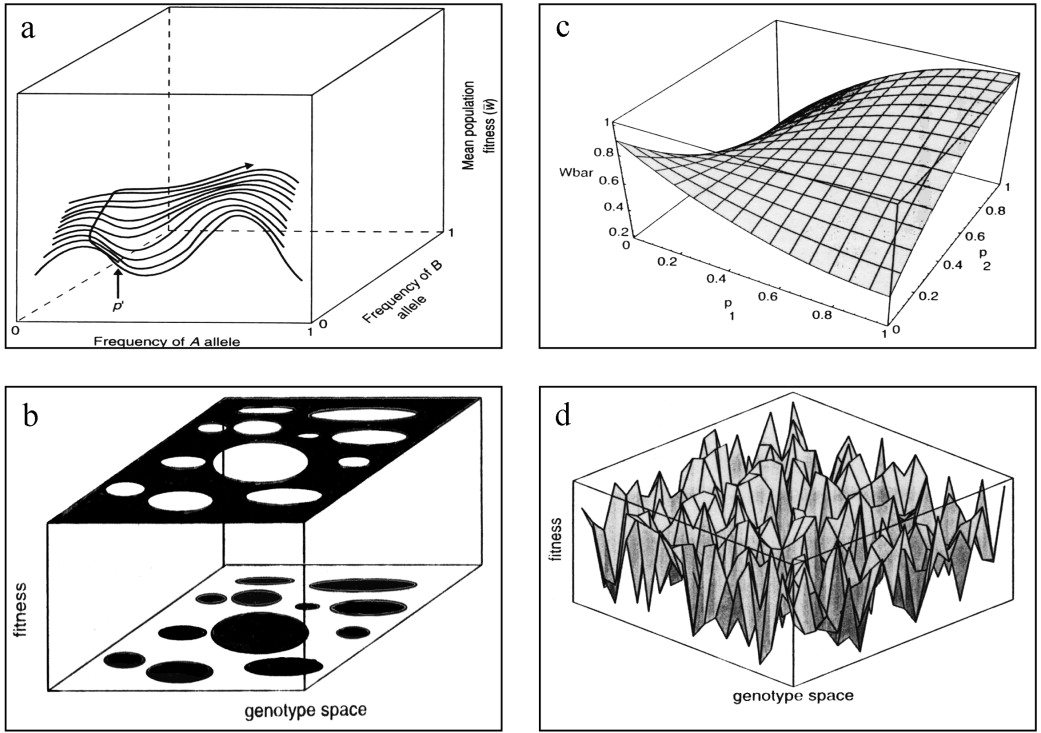
Fisher was the first to notice the key problem with Wright's interpretation of the diagram. Fisher and Wright had discussed Wright's interpretation of a version of the diagram in correspondence prior to Wright's Reference Wright1932 presentation. According to Fisher, Wright's understanding of the adaptive landscape in multiple dimensions is flawed because as the dimensionality of the field of gene combinations in the field of gene frequencies increases the number of stable peaks on the surface of the landscape decreases. Thus, claims Fisher, representation of the mean fitness of populations in multiple dimensions will not result in a hilly landscape, but one that is a single peak with ridges along it. As a consequence, evolution on the landscape does not require the complex of evolutionary factors of Wright's shifting balance process, but only selection and mutation (Fisher correspondence to Wright May 31, 1931, in Provine Reference Provine1986, 274; Fisher Reference Fisher1941). Fisher's informal critique of Wright was taken up by Edwards (Reference Edwards1994), and more formally by Moran (Reference Moran1964). Ridley (Reference Ridley1996) has developed an adaptive landscape diagram based on the Fisher-Edwards-Moran critique, reproduced in Figure 2a.
Four adaptive landscape diagrams, resulting from critiques of Wright's Reference Wright1932 diagram. Fig. 2a is Ridley's (Reference Ridley1996, 219) depiction of a Fisherian landscape. Fig. 2b is Gavrilets’ (Reference Gavrilets1997, 309) depiction of the holey landscape. Fig. 2c is Coyne et al.'s (Reference Coyne, Barton and Turelli1997, 647) simplified Wrightian landscape. Fig. 2d is the Kauffman and Levin (Reference Kauffman and Levin1987, 33) rugged adaptive landscape.

Gavrilets (Reference Gavrilets1997) has criticized both Wright's and Fisher's interpretations of the landscape. On Gavrilets’ view, the adaptive landscape in multiple dimensions will have neither multiple peaks nor a single peak. Instead, the landscape will be the holey one in Figure 2b. That is, the higher the number of possible gene combinations in a field of gene frequencies, the higher the number of incompatible combinations in that field. The incompatible gene combinations cause reproductive isolation within populations, which cause genetically driven speciation events. The holes represent locations of incompatible combinations of genes and replace the peaks. Gavrilets’ argument, as he recognizes, is based on a set of specific assumptions that must be relaxed in fundamental ways if his theoretical intuitions are to be tested empirically. Gavrilets assumes that (1) fitnesses of gene complexes are generated randomly, (2) fitnesses are generated independently, and (3) fitness values are either 0 or 1 (Gavrilets Reference Gavrilets1997, Reference Gavrilets1999; Gavrilets and Gravner Reference Gavrilets and Gravner1997). Nevertheless, Gavrilets (Reference Gavrilets1999) has discussed the evolutionary dynamics of speciation on holey landscapes as driven by random genetic drift, mutation, recombination, and migration. Gavrilets’ surface requires neither Wright's nor Fisher's sets of mechanisms.
A series of papers by collaborators working on the genotype-phenotype map problem have raised an issue against Wright's interpretation of the landscape diagram that is related to Gavrilets’ above (e.g., Fontana and Schuster Reference Fontana and Schuster1998; B. Stadler et al. Reference Stadler, Stadler, Wagner and Fontana2001; P. Stadler Reference Stadler, Lässig and Valleriani2002). The basic claim here is that a discontinuous landscape surface is more likely than a continuous one. The argument, however, is different. Roughly, the argument is that taking seriously the developmental processes involved in going from genotype to phenotype in evolution, one will discover that there are many phenotypes inaccessible from genotypes, resulting in discontinuities on the surface of the landscape. The argument is driven by computational work on the biophysical genotype-phenotype model defined by the folding of RNA sequences into secondary structures. The RNA sequences are considered genotypes, and the role of the phenotype is played by the structure of the molecule. Based on this model, a general, mathematical theory of landscapes has resulted, reaching far beyond the informal use of commonsense topographical mapmaking Wright used in Reference Wright1932. Despite the implications for Wright's interpretation of the landscape, apparently a landscape on which to depict evolutionary trajectories in population genetics based on the general landscape theory is not immediately forthcoming due to constraints on computational power.
Although there are serious problems for Wright's view that he can transform a hilly landscape in two dimensions into a hilly landscape in thousands of dimensions, the notion that there are simple cases of hilly landscapes persists (e.g., Coyne et al. Reference Coyne, Barton and Turelli1997, 647). Indeed, in simple and rather restrictive cases, i.e., two loci cases assuming complete dominance at each locus, Wright's landscape has been given some plausibility (e.g., Coyne et al. Reference Coyne, Barton and Turelli1997; Lande Reference Lande1976, Reference Lande1979) (Figure 2c). Further, Kauffman and Levin (Reference Kauffman and Levin1987) responded to problems for Wright's view of the landscape by developing “rugged adaptive landscapes” as a way of understanding the fitness of gene combinations given simple Wrightian epistatic gene interaction (Figure 2d). In Kauffman and Levin's NK model, the fitness contribution of each of N loci depends in a random way on K other loci. The parameter K describes the degree of epistasis. If
 $K=0$, then an adaptive landscape with one peak results. But as K increases, the number of peaks on the landscape increases and the mean fitness of the nearest peak decreases toward that of an entirely random genotype. Typically, the result is a rugged adaptive landscape. Kauffman and Levin's work has been applied in biochemistry (e.g., Fontana et al. Reference Fontana, Schnabl and Schuster1989, Reference Fontana, Greismacher, Schnabl, Stadler and Schuster1991, Reference Fontana, Stadler, Tarazona, Weinberger and Schuster1993), and interestingly that work is a principal ancestor of the genotype-phenotype mapping work discussed above. Kauffman (Reference Kauffman1993) extends the use of rugged adaptive landscapes in his work on complexity and on artificial-life modeling.
I have argued here that Ruse's defense of the coherence and equivalence of Wright's interpretations of the landscape against Provine's critique is inconclusive. I have further argued that the Provine-Ruse technical disagreement on this issue is unimportant in light of the critical problem for Wright's view of the diagram: the hilly landscape in two dimensions is not one in thousands of dimensions.
5
The Provine-Ruse technical disagreement over Wright's interpretations of the diagram ends in a disagreement between Provine and Ruse on the diagram's heuristic value. Provine doubts its value because Wright's understanding of the diagram is incoherent. Ruse disagrees: even if Wright's interpretation of the diagram is incoherent, it is still a valuable heuristic. Ruse thinks that Provine's assessment of the heuristic value of Wright's diagram is too conservative: heuristics are devices that are used to generate paths of inquiry, whether those paths are fruitful or not. The fact that Wright's interpretation of the diagram might be incoherent is beside the point. Rather, because uses of the diagram have generated fruitful paths of inquiry, it is a valuable heuristic. Ruse cites biologists Dobzhansky (Reference Dobzhansky1951), Simpson (Reference Simpson1953), Stebbins (Reference Stebbins1969), and Waddington (Reference Waddington1956) as having used the adaptive landscape to produce apparently positive results. Ruse is correct on this point. Moreover, the biological work I review above includes instances of the heuristic used to produce positive results, as we will see (briefly). Provine's doubts about the heuristic value of the adaptive landscape diagram are misplaced.
Notwithstanding Ruse's defense of the landscape diagram's value as a heuristic, I think his philosophical analysis of it is lacking. Ruse (Reference Ruse and Baigrie1996, 331–336) argues that the landscape heuristic has aided in the production of fruitful paths of biological inquiry. Yet, he does not account for how it has done that. Instead, Ruse situates the landscape diagram within a general philosophical framework, viewing the diagram as part and parcel of our conceptual framework and of the ways in which we attempt to illuminate reality. But all Ruse has said here is that the adaptive landscape diagram has been used to mediate scientific knowledge (diagrams are, after all, used to mediate knowledge). Ruse has said nothing about how the landscape diagram has mediated that knowledge. But that is what is crucial to understanding it in such a capacity.
Ruse limits his discussion of the landscape as a heuristic to uses of it as an illustration. Indeed, this characterization of the diagram permeates his discussion: Wright and Dobzhansky used the landscape to illustrate the shifting-balance process, Simpson used the landscape to illustrate species and speciation, Waddington used the diagram for his own illustrative purposes in population genetics. Ruse is right that the landscape is useful as an illustration, but wrong if it is merely as such. In my view, the landscape heuristic has played a central role in theory evaluation. Ruse's consideration of the diagram as purely an illustration belies this central heuristic role for it. As such, his account of the diagram is defective.
Wright's main use of the landscape was as a theory evaluation heuristic. Indeed, Wright used the adaptive landscape diagram as a visual heuristic to evaluate the dynamical behavior of population genetics models of evolutionary processes constructed with alternative assumptions to demonstrate his own. The dynamical behavior of a mathematical model refers to the way(s) in which some system being described by the model change(s) according to changes in the model's state(s).Footnote 2 The dynamical behavior of a system described by such a model in population genetics includes, e.g., the changes in the mean fitness of a population against the parameters that hold the measured intensity of specific evolutionary factors such as population size, migration rate, selection, mutation, etc. and describe the ways that the states of the model change. The adaptive landscape diagram, as a visualization of common, core assumptions of all the models, is where the evaluation of the behaviors of the models takes place; the diagram is the heuristic with which the evaluation is being made. A model is positively evaluated in case a system described by it can traverse the landscape, shifting from one adaptive peak to the highest adaptive peak.
Wright assesses the dynamical behavior of evolutionary systems described by six alternative models, i.e., windows A–F in Figure 1d. Each window is a piece of the larger adaptive landscape in Figure 1b. What Wright does is to simulate the dynamical behavior of a system on the landscape. Consider window A in Figure 1b. Here, Wright sets up a model with the following assumptions: populations are very large and panmictic, mutation rate is high, selection intensity and mutation rate are low. On Wright's landscape, a system modeled in such a way will not be able to get to the highest adaptive peak on the landscape, because it will not be able to traverse the hilly surface—it will not be able to move from its initial position to a higher peak. Wright repeats this process in windows B–F, demonstrating how the dynamical behavior of the various models changes as the assumptions change. Only the model sketched in window F succeeds; that is the model Wright interprets as describing the shifting balance process.
Ultimately, Wright's evaluative strategy, using the landscape diagram, led him to his view that evolution is a process that includes a constellation of factors. That is, out of his evaluation of alternative evolutionary hypotheses, driven by the landscape diagram, Wright was led to his shifting balance process: the evolutionary factors delineated in the shifting balance process are necessary for traversing the adaptive landscape. Now, Wright's own heuristic use of the diagram is problematic because of a flaw in his interpretation of it. However, critics who have pointed out Wright's flaw have then gone on to create landscape diagrams of their own for the sort of illustrative purposes Ruse discusses. And they further use the landscape to assess the dynamical behavior of alternative population genetics models. Indeed, Ridley, using his version of the Fisherian landscape, shows that Wright's shifting balance process is unnecessary for traversing the landscape: the models that describe the shifting balance process overdetermine the process that is required given the surface of the landscape. Gavrilets shows, using his holey landscape, that neither Wright's nor Fisher's mechanisms are necessary to traverse the landscape. In Gavrilet's case, mass selection is unnecessary for speciation because there are no peaks. And Coyne et al. show that, in simple cases, Wright's three-phase evolutionary process is one possible mechanism for traversing a hilly landscape. The adaptive landscape diagram is valuable, in spades, and not merely as an illustration, but in the role Wright devised it for, i.e., as a heuristic for evaluating the dynamical behavior of evolutionary models.
6
In this paper I have attempted to provide a new interpretation of the heuristic role of Wright's Reference Wright1932 adaptive landscape diagram. That role is as a visual theory evaluation heuristic for assessing the dynamical behavior of models of the evolutionary process. I have also argued that Provine and Ruse have provided flawed analyses of the heuristic role and value of the adaptive landscape diagram. And I have shown that although Ruse is correct that Provine's doubts about the heuristic value of the landscape diagram are misplaced, Ruse's further philosophical analysis of the diagram belies its primary heuristic role. The adaptive landscape heuristic is best understood in the context of theory evaluation. I suggest that this understanding best captures precisely how the diagram has been used to generate paths of scientific inquiry.