Non-technical Summary
The James Ross Basin, located in the Antarctic Peninsula’s northwestern region, is home to an extensive sedimentary record from the Cretaceous, offering valuable insights into ancient ecosystems. Notably, it boasts well-preserved fossil assemblages, showcasing a diverse range of organisms, a rarity in high southern latitudes. Within this basin, the Santa Marta Formation from the Santonian–Campanian stands out for its rich crustacean fauna, such as lobsters, crayfishes, and crabs. This study focuses on James Ross Island, specifically within the Marambio Group. Material gathered during the 41st Brazilian Antarctic Operation, under the PALEOANTAR project, reveals a unique collection recovered from a site formed by volcanic sandstones, siltstones, and tuffs, indicating a deltaic setting. Sabellidromites santamarta, described here as a new species, belongs to Dynomenidae based on distinct characteristics observed on its dorsal carapace, pleonal segments, and legs. This discovery not only adds to our understanding of Antarctic paleofauna but also suggests biogeographic connections between the Northern and Southern hemispheres during the Mesozoic.
Introduction
The recent Dynomenidae comprises a clade of basal relict brachyuran crabs often found in association with corals, distributed globally at depths to ~500 m (McLay, Reference McLay1999). The family, which is thought to have originated from Tethyan crabs (McLay, Reference McLay1999), comprises 22 extant and 42 fossil species (DecaNet eds., 2024) and dates back to the Late Jurassic (Glaessner, Reference Glaessner1960, Reference Glaessner1969; Guinot, Reference Guinot2008; Van Bakel et al., Reference Van Bakel, Guinot, Corral and Artal2012). Most of these species have been documented from the Northern Hemisphere. Among the fossil dynomenids, only one species, Dynomene acutispinis (Rathbun, Reference Rathbun1945), from the Pleistocene of Fiji, has been recorded from the former Gondwana.
McLay (Reference McLay1999) conducted a significant review of Dynomenidae; Guinot (Reference Guinot2008) made substantial additions and proposed a new familial arrangement, initially comprising four subfamilies. Subsequently, Van Bakel et al. (Reference Van Bakel, Guinot, Corral and Artal2012) expanded Dynomenidae, to include a new subfamily. Currently, the family is divided into five subfamilies: Acanthodromiinae Guinot, Reference Guinot2008, Dynomeninae Ortmann, Reference Ortmann1892, Graptocarcininae Van Bakel et al., Reference Van Bakel, Guinot, Corral and Artal2012, Metadynomeninae Guinot, Reference Guinot2008, and Paradynomeninae Guinot, Reference Guinot2008.
Regarding paleobiogeographic dispersion, the Dynomenidae have an incomplete and scarce fossil record, although there are currently almost twice as many fossil species as extant species. The oldest confirmed occurrence of the group is Cyclothyreus Remeš, Reference Remeš1895 of Tithonian (Upper Jurassic) age, from central and eastern Europe (Schweitzer and Feldmann, Reference Schweitzer and Feldmann2009; Van Bakel et al., Reference Van Bakel, Guinot, Corral and Artal2012). Later occurrences are recorded from: Barremian, Graptocarcinus moosleitneri Hyžný and Kroh, Reference Hyžný and Kroh2015 of France; Albian, Graptocarcinus texanus Roemer, Reference Roemer1887 in Spain (Klompmaker, Reference Klompmaker2013) and Graptocarcinus muiri Stenzel, Reference Stenzel1944 in Mexico (Stenzel, Reference Stenzel1944); Cenomanian, Graptocarcinus bellonii Collins and Dieni, Reference Collins and Dieni1995 in Italy (Collins and Dieni, Reference Collins and Dieni1995) and Graptocarcinus texanus in the USA (Rathbun, Reference Rathbun1935), Spain (Fraaye, Reference Fraaye1996), England (Wright and Collins, Reference Wright and Collins1972), France (Breton and Collins, Reference Breton and Collins2011), and the Czech Republic (Kočová Veselská et al., Reference Kočová Veselská, Kočí and Kubajko2014); and Turonian, Graptocarcinus texanus in the Czech Republic (Kočová Veselská et al., Reference Kočová Veselská, Kočí and Kubajko2014). During the Santonian and Maastrichtian, the family achieved an almost cosmopolitan distribution pattern, from The Netherlands to Antarctica.
According Karasawa et al. (Reference Karasawa, Schweitzer and Feldmann2011), the low diversity of living Dynomenidae could be explained by a specialized way of life, considering that dynomenids occupy a specific ecological niche. According Van Bakel et al. (Reference Van Bakel, Guinot, Corral and Artal2012), a wide geographic distribution and a low diversity of living genera and species could be an indication that these organisms were remnants of once-rich and diverse group. Some dynomenid genera (e.g., Acanthodromia A. Milne-Edwards, Reference Milne-Edwards1880) would have originated from ancestral crabs in the Tethys Sea, possibly during the Late Jurassic (McLay, Reference McLay1999).
Since 2006, the PALEOANTAR project (conducted by the Museu Nacional of the Federal University of Rio de Janeiro, Brazil [MN/UFRJ]) has searched for fossil material on the islands off of the coast of the Antarctic Peninsula, originally focusing on fossil vertebrates, plants, and microfossils (see Kellner et al., Reference Kellner, Simões, Riff, Grillo and Romano2011, Reference Kellner, Rodrigues, Costa, Weinschütz and Figueiredo2019; Lima et al., Reference Lima, Sayão, Ponciano, Weinschütz and Figueiredo2021; Piovesan et al., Reference Piovesan, Correia Filho, Melo, Lacerda, Dos Santos, Pinheiro, Costa, Sayão and Kellner2021; Brum et al., Reference Brum, Simões, Souza, Pinheiro, Figueiredo, Caldwell, Sayão and Kellner2022, Reference Brum, Elutério, Simões, Whitney, Souza, Sayão and Kellner2023; Santos Filho et al., Reference Santos Filho, Brum, Souza, Figueiredo and Usma2023; Souza et al., Reference Souza, Bulak, Soares, Sayão, Weinschütz, Batezelli and Kellner2023). More recently, the activity of this project expanded, including ichnofossils (e.g., Sedorko et al., Reference Sedorko, Gutiérrez, Pazos, Nebelsick, Weinschütz, Garcia, Cardoso, Sayão and Kellner2024) and fossil invertebrates (Pinheiro et al., Reference Pinheiro, Saraiva, Santana, Sayão, Figueiredo, Rodrigues, Weinschütz, Ponciano and Kellner2020; Videira-Santos et al., Reference Videira-Santos, Scheffer, Ponciano, Weinschütz, Figueiredo, Rodrigues, Sayão, Riff and Kellner2020; Weinschütz et al., Reference Weinschütz, Ghilardi, Kellner and Sayão2024). During the 41st Brazilian Antarctic Operation, researchers from the PALEOANTAR project recovered a well-preserved cephalothorax of a brachyuran crab from the Santa Marta Formation (Antarctic Peninsula), revealing both dorsal and ventral characteristics. Although the specimen exhibits a set of characters consistent with Dynomenidae, these characters do not correspond to any of the currently known subfamilies. This material is described here as a new species of Sabellidromites Schweitzer and Feldmann, Reference Schweitzer and Feldmann2008. The position of Sabellidromites, currently considered in Goniodromitidae, is called into question and the genus is here transferred to Dynomenidae. Insights into the paleobiogeographical pattern of Dynomenidae are discussed as well, highlighting the importance of the South Atlantic in this process.
Geological setting
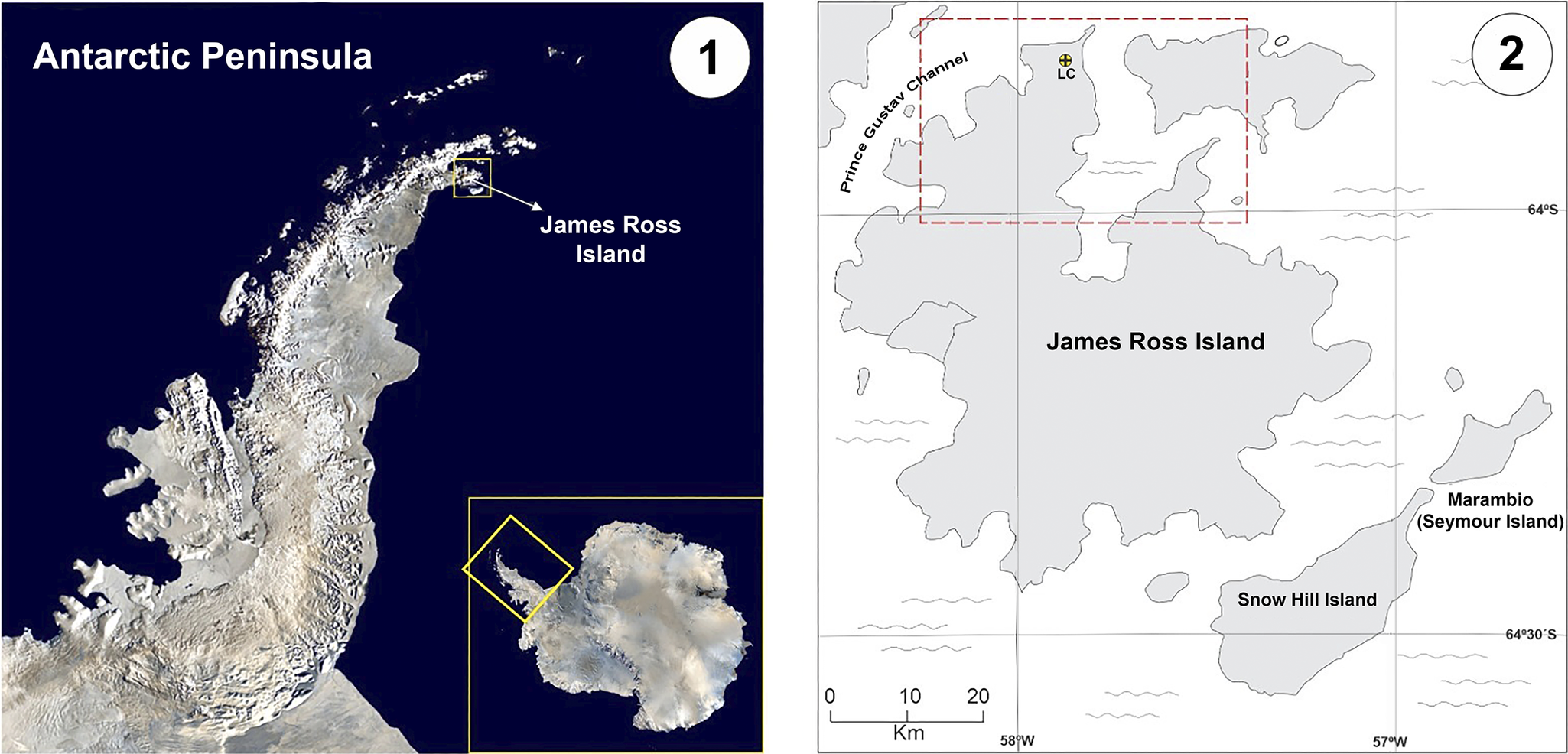
The specimen was collected in a site located northwest of James Ross Island, James Ross Archipelago, Antarctic Peninsula, ‒63.76° to ‒64.58°S, 56.44° to 58.50°W (Del Valle and Scasso, Reference Del Valle and Scasso2004) (Fig. 1). The James Ross Island Group preserves an uninterrupted series of sedimentary layers, filled with abundant fossils from the Barremian Stage to the Eocene Series (Zinsmeister, Reference Zinsmeister1988; Crame et al., Reference Crame, Pirrie, Riding and Thomson1991, Reference Crame, Lomas, Pirrie and Luther1996; Olivero, Reference Olivero2012b). The geological evolution of the James Ross Basin (JRB) is complex, with sediments deposited in a back-arc environment, resulting from a raised magmatic arc that aligns with the current Antarctic Peninsula (Hathway, Reference Hathway2000; Del Valle and Scasso, Reference Del Valle and Scasso2004). From the Barremian to the Eocene, the basin underwent infill by marine-derived siliciclastic and volcanoclastic sediments (Del Valle et al., Reference Del Valle, Fourcade, Medina and Craddock1982; Scasso et al., Reference Scasso, Olivero and Buatois1991; Riding and Crame, Reference Riding and Crame2002; Francis et al., Reference Francis, Crame and Pirrie2006; Whitham et al., Reference Whitham, Ineson and Pirrie2006; Olivero, Reference Olivero2012b; Burton-Johnson and Riley, Reference Burton-Johnson and Riley2015; Piovesan et al., Reference Piovesan, Correia Filho, Melo, Lacerda, Dos Santos, Pinheiro, Costa, Sayão and Kellner2021; Brum et al., Reference Brum, Simões, Souza, Pinheiro, Figueiredo, Caldwell, Sayão and Kellner2022). These marine deposits are organized into three main lithostratigraphic units: Gustav (Aptian–Coniacian; Ineson et al., Reference Ineson, Crame and Thomson1986; Riding et al., Reference Riding, Crame, Dettmann and Cantrill1998), Marambio (Santonian–Paleocene; Olivero and Medina, Reference Olivero and Medina2000; Olivero, Reference Olivero2012b; Amenabar et al., Reference Amenabar, Carames, Adamonis, Doldan, Maceiras and Concheyro2019), and Seymour (Paleocene–Eocene; Montes et al., Reference Montes, Beamud, Nozal and Santillana2019).
(1) Location map of James Ross Island, northeastern Antarctic Peninsula (after Pinheiro et al., Reference Pinheiro, Saraiva, Santana, Sayão, Figueiredo, Rodrigues, Weinschütz, Ponciano and Kellner2020). (2) Position of the Lachmann Crags (LC) location on the James Ross Island, where the specimen was collected.

Within the stratigraphic units of JRB, the Marambio Group is the most fossiliferous, encompassing a large number of vertebrate and invertebrate fossils found in the region. This unit is found in several locations across James Ross Island (study area) as well as on Vega, Humps, Snow Hill, Seymour, and Cockburn islands (Weinschütz et al., Reference Weinschütz, Ghilardi, Kellner and Sayão2024). It comprises a prograding sequence characterized by diverse lithologies, including sandstones, siltstones, and mudstones, interbedded with coquina levels, interpreted as having formed under storm-influenced conditions in both inner and outer shelves (Crame et al., Reference Crame, Pirrie, Riding and Thomson1991, Reference Crame, Francis, Cantrill and Pirrie2004; Olivero et al., Reference Olivero, Ponce and Martinioni2008; Olivero, Reference Olivero2012a). The group is divided into five formations: Santa Marta, Rabot, Snow Hill Island (see Piovesan et al., Reference Piovesan, Correia Filho, Melo, Lacerda, Dos Santos, Pinheiro, Costa, Sayão and Kellner2021 for age and environmental interpretations), Lopez de Bertodano (Olivero and Medina, Reference Olivero and Medina2000; Olivero, Reference Olivero2012a, Reference Oliverob), and Haslum Crag Sandstone (Olivero et al., Reference Olivero, Ponce and Martinioni2008).
The Santa Marta Formation (Santonian–Maastrichian) is the basal unit, ~350 m thick, of Marambio Group. The formation consists of alternating layers of sandstones, siltstones, and mudstones interspersed with volcanic tuffs and occasional coquinas (Olivero, Reference Olivero2012b). These deposits are interpreted as subaerial volcaniclastic sequences formed within a deltaic environment (Scasso et al., Reference Scasso, Olivero and Buatois1991; Olivero, Reference Olivero2012b). On northeastern James Ross Island, the Santa Marta Formation is subdivided into two members: Lachman Crags and Herbert Sound (Crame et al., Reference Crame, Pirrie, Riding and Thomson1991). The fossil described here was collected in sediments of the Lachman Crags Member (-63º49’38”S, 057º53’21”W).
Materials and methods
Descriptions, drawings, and photographs were made using a Nikon SMZ745T stereomicroscope equipped with a camera lucida and a Leica EZ4 W, each with a digital camera attached. Photographs of the whole specimen dry and uncoated or coated with ammonium chloride (Gašparič, Reference Gašparič2015) were made using a Canon G10 camera. The morphological descriptions are based on the holotype of Sabellidromites santamarta new species and the terminology used in the descriptions mostly followed McLay (Reference McLay1999), Guinot (Reference Guinot2008), and Van Bakel et al. (Reference Van Bakel, Guinot, Corral and Artal2012).
The classification of Brachyura by Guinot et al. (Reference Guinot, Tavares and Castro2013) was used in suprafamilial rankings. Infrafamilial rankings mostly follow Guinot (Reference Guinot2008). Genera were compared based on their respective type species, as noted in the Remarks. The following abbreviations have been used: cl, carapace length; cw, carapace width (taken at the widest point, just anterior to midlength, excluding anterolateral teeth); coll., collector or collected by; L/W, length/width ratio; P1–P5, first to fifth pereopods; †, taxon with Recent and fossil representatives; ††, taxon exclusively known from fossil record.
Repository and institutional abbreviation
The type and sole specimen examined during this study is deposited in the Paleoinvertebrate Collection of the Department of Geology and Paleontology of Museu Nacional (MN/UFRJ), Rio de Janeiro, Brazil.
Systematic paleontology
Infraorder Brachyura Latreille, Reference Latreille1802
Subsection Dynomeniformia Guinot, Tavares, and Castro, Reference Guinot, Tavares and Castro2013
Superfamily Dromioidea De Haan, 1833 in Reference De Haan1833–Reference De Haan1850
Family Dynomenidae Ortmann, Reference Ortmann1892
Included subfamilies
Acanthodromiinae Guinot, Reference Guinot2008; Dynomeninae Ortmann, Reference Ortmann1892; Graptocarcininae Van Bakel et al., Reference Van Bakel, Guinot, Corral and Artal2012; Metadynomeninae Guinot, Reference Guinot2008; Paradynomeninae Guinot, Reference Guinot2008.
Included fossil genera
Acanthodromia A. Milne-Edwards, Reference Milne-Edwards1880 †; Cracchidynomene Beschin et al., Reference Beschin, Busulini, Tessier and Zorzin2016 ††; Cyamocarcinus Bittner, Reference Bittner1883 ††; Cyclothyreus Remeš, Reference Remeš1895; Dynomene Desmarest, Reference Desmarest1823 †; Eotrachynotocarcinus Beschin et al., Reference Beschin, Busulini, De Angeli and Tessier2007 ††; Gemmellarocarcinus Checchia-Rispoli, Reference Checchia-Rispoli1905 ††; Graptocarcinus Roemer, Reference Roemer1887 ††; Kierionopsis Davidson, Reference Davidson1966 ††; Kromtitis Müller, Reference Müller1984 ††; Metadynomene McLay, Reference McLay1999 †; Ovamene Müller and Collins, Reference Müller and Collins1991 ††; Paradynomene Sakai, Reference Sakai1963 †; Sabellidromites Schweitzer and Feldmann, Reference Schweitzer and Feldmann2008 ††; Sierradromia Artal et al., Reference Artal, Ferratges, Van Bakel and Zamora2022 ††.
Remarks
The new species described hereafter is assigned to the Dynomenidae on the basis of the following features: (i) well-developed uropods showing as calcified dorsal plates; (ii) coxal prominences or spines on the second and third pereopods to hold the pleon against the body ventral surface (locking mechanism); (iii) reduced, obliquely subdorsal P5. Within the Dynomeniformia (i.e., Homolodromioidea Alcock, Reference Alcock1900 and Dromioidea De Haan, 1833 in Reference De Haan1833–Reference De Haan1850), all taxa typically feature both reduced P4 and P5, sometimes similar in size and shape, oriented dorsally, often exhibiting a subcheliform structure associated with carrying behavior. However, Dynomenidae stands apart by having only P5 reduced, and with a small subchelate (an arrangement involving a distal extension of the propodus opposed to the dactylus), sexually dimorphic structure, not used for carrying behavior (see McLay, Reference McLay1999, p. 449–454, fig. 8d; Guinot, Reference Guinot2008, p. 6; Guinot et al., Reference Guinot, Tavares and Castro2013, p. 242).
Dynomenidae is currently subdivided into five subfamilies. Guinot (Reference Guinot2008) initially proposed an arrangement into four subfamilies: Acanthodromiinae, Dynomeninae, Metadynomeninae, and Paradynomeninae. Subsequently, Van Bakel et al. (Reference Van Bakel, Guinot, Corral and Artal2012) expanded this family to accommodate Graptocarcininae.
The new species described here possesses a set of characters (see Diagnosis) that do not align with those of the currently recognized subfamilies within Dynomenidae. It exhibits the diagnostic podotreme characters including a reduced, obliquely subdorsal P5 (obliquely subdorsal assumed based on the position of the preserved P5 coxa), dorsally exposed uropods in pleonite 6, and pleonal holding by the pereopod coxae of P2 and P3. The exclusive presence of reduced P5 excludes the new species from Homolodromiidae and Dromiidae, because these families feature both reduced P4 and P5.
The new species shares significant similarities with Metadynomeninae, particularly in the presence of large uropods, filling the entire length of the sixth pleonal somite; pleonal holding by coxal structures; carapace moderately convex and subcircular; well-defined carapace lateral margins, marked by indentations or armed with distinct teeth; well-developed branchial groove; and orbits deep, oblique, long, and dorsally exposed. The new species is nevertheless distinguished from Metadynomeninae by carapace longer than wide, ornamented with sparsely distributed small granules; and carapace regions and grooves poorly defined (vs. carapace as wide as long, ovoid, smooth, with an uneven surface, and undulating appearance with transverse distinct cervical and branchial grooves in Metadynomeninae).
The new species shares with Graptocarcininae a carapace surface ornamented with granules; indistinct carapace regions; front weakly projecting, downturned, and triangular; telson long and broadly triangular; uropod relatively large; and pleonal holding mechanism involving pereopod coxae. The new species can be separated from Graptocarcininae by the presence of teeth on the carapace anterolateral and posterolateral margins; carapace longer than wide; and well-marked branchial groove (vs. anterolateral and posterolateral margins granular; carapace distinctly wider than long; and branchial groove obsolete in Graptocarcininae).
The pleonal holding mechanism in the new species is most similar to those of Graptocarcininae, Acanthodromiinae, and Paradynomeninae—the most basal of Dynomenidae—by having distinct coxal prominences. The new species has a single spine on the posterior base on P2 coxa, and P3 coxa with an inconspicuous granular prominence, adjacent to the sixth pleonite lateral margins (vs. P1 coxa with granules and P2–P4 coxae with granular prominence in Graptocarcininae; mxp3 with spinules and P1–P3 coxae with spinules or granules in Acanthodromiinae—the most extensive system among dynomenids; and P2 and P3 coxae with granules in Paradynomeninae). In Metadynomeninae, the pleonal holding mechanism involves weak coxal prominences, which are not efficient and only restrict the lateral movement of the pleon. In Dynomeninae, the pleonal holding mechanism is also inefficient and restricts only lateral movements of the pleon, however, unlike Metadynomeninae, it involves a sternal mechanism (Guinot and Bouchard, Reference Guinot and Bouchard1998; Guinot, Reference Guinot2008; Van Bakel et al., Reference Van Bakel, Guinot, Corral and Artal2012).
A new subfamily to accommodate Sabellidromites should be considered, because it does not fit within any of the existing subfamilies highlighted above. However, a detailed study encompassing all species attributed to the genus is needed, which is beyond the scope of this study.
Genus Sabellidromites Schweitzer and Feldmann, Reference Schweitzer and Feldmann2008
Type species
Goniodromites scarabaeus Wright and Wright, Reference Wright and Wright1950, by original designation.
Other species
Sabellidromites inflata (Collins and Karasawa, Reference Collins and Karasawa1993); Sabellidromites lanae Nyborg, Garassino, and Ross, Reference Nyborg, Garassino and Ross2020; Sabellidromites oscari (Nyborg et al., Reference Nyborg, Garassino, Vega and Kovalchuk2019); Sabellidromites santamarta n. sp.
Emended diagnosis (changes within brackets)
Carapace slightly longer than wide, widest just posterior of intersection of cervical groove with lateral margin, approximately half distance posteriorly on carapace, weakly vaulted or flattened transversely, moderately vaulted longitudinally. Rostrum triangular, downturned, axially sulcate, rimmed. Orbits oblique, ovate, fronto-orbital width two-thirds to three-quarters maximum carapace width; outer-orbital angle a blunt tooth. Lateral margins with small spines, anteriorly keeled, incised where intersected by grooves; cervical groove well marked, extending in two relatively straight segments to intersect at axis; branchial groove deepest laterally, weakened at edge of cardiac region. Epigastric regions small, weakly inflated; mesogastric region poorly marked, with ovate scabrous patches posteriorly; cardiac region small, triangular, with [granules] at each corner; remainder of carapace regions poorly differentiated, ornamented with scattered [small to large granules]. Cervical and branchial grooves extending onto lateral sides, directed anteriorly, and merging just posterior to subhepatic region. [P2–P4 coxae of similar width, in same plane; P5 reduced, obliquely subdorsal (assumed, based on position of preserved P5 coxa). Pleonites 3–6 free; dorsal uropods filling entire length of sixth pleonite; pleonal holding mechanism involving coxae of P2 and P3] (adapted from LaBonte et al., Reference LaBonte, Schweitzer and Feldmann2024).
Occurrence and age
Albian to Campanian: France, Albian; UK, Albian; Oregon, USA, Albian; Antarctica, Santonian–Campanian; Japan, lower Campanian; British Columbia, Canada, late Campanian.
Remarks
With the assignment of this new species to Sabellidromites, the generic diagnosis (sensu LaBonte et al., Reference LaBonte, Schweitzer and Feldmann2024) has to be slightly emended to include characteristics of the carapace, pereopods, and pleon: (i) carapace epigastric region with scattered, small to large granules; (ii) P2–P4 coxae in the same plane, of similar width; (iii) P5 reduced, obliquely subdorsal (based on the position of the preserved P5 coxa); (iv) pleonites 3–6 free; dorsal uropods filling the entire length of sixth pleonite; pleonal holding mechanism involving coxae of P2 and P3.
Sabellidromites santamarta new species
Holotype
Male (accession number MN 12193-I), cw 20.0 mm, cl 21.0 mm, three-dimensional carcass of incomplete crustacean, exhibiting fragmented carapace and considerably preserved pleon. Collected during austral summer of 2022–2023 by PALEOANTAR project team (from 8 December 2022 to 13 January 2023) during the 41st Brazilian Antarctic Operation.
Diagnosis
Carapace slightly subcircular, longer than wide; ornamented with sparsely distributed small granules; dorsal regions indistinct; front slightly projecting beyond orbits, turned downward. Antero- and posterolateral margins with two teeth each; lateral margins rounded. Pleonites 3–6 free; dorsal uropods filling entire length of sixth pleonite; pleonal holding mechanism involving coxae of P2 and P3.
Occurrence and age
Lachmann Crags, James Ross Basin, Antarctic Peninsula, Santa Marta Formation (Santonian–Campanian), Marambio Group, Late Cretaceous.
Description
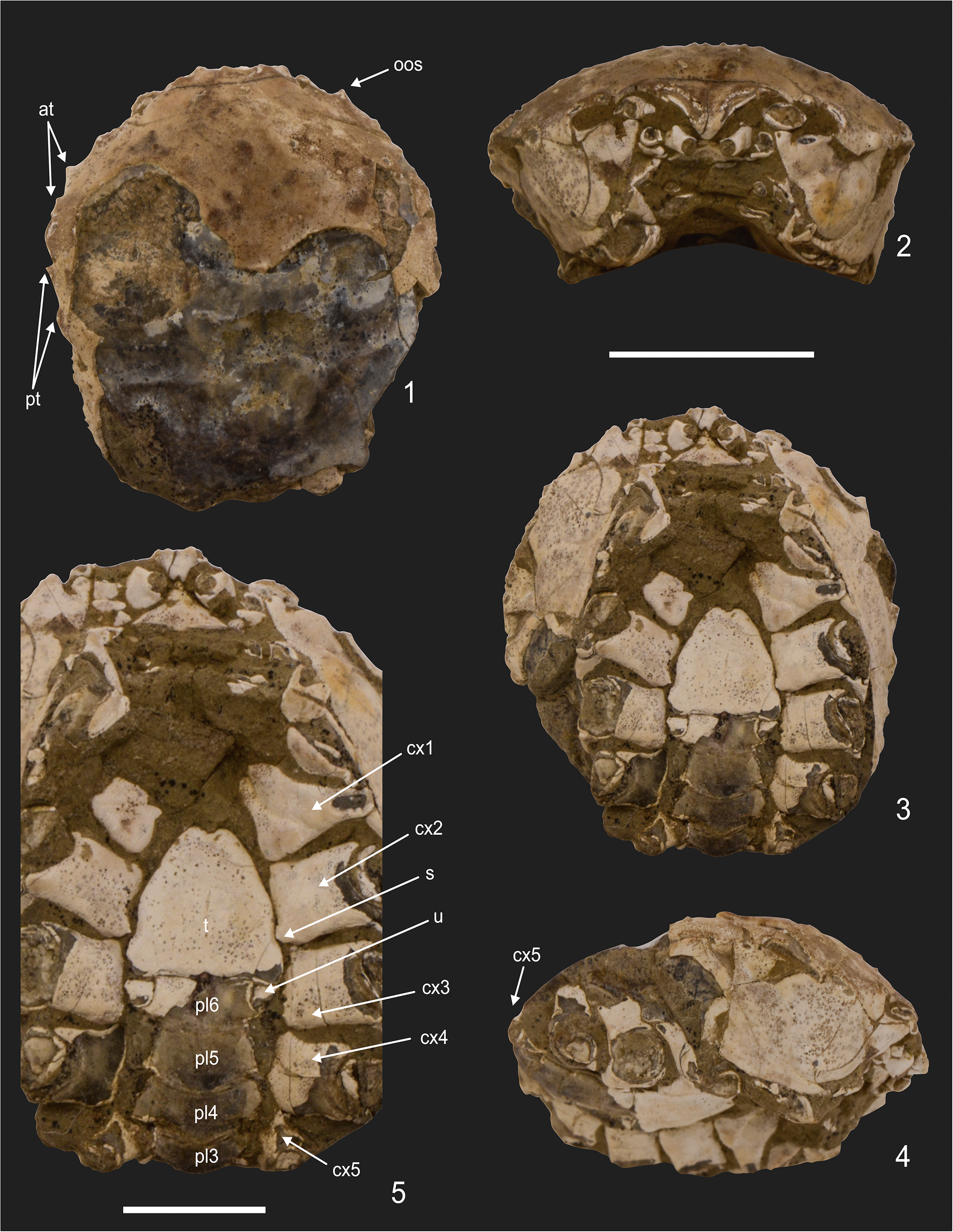
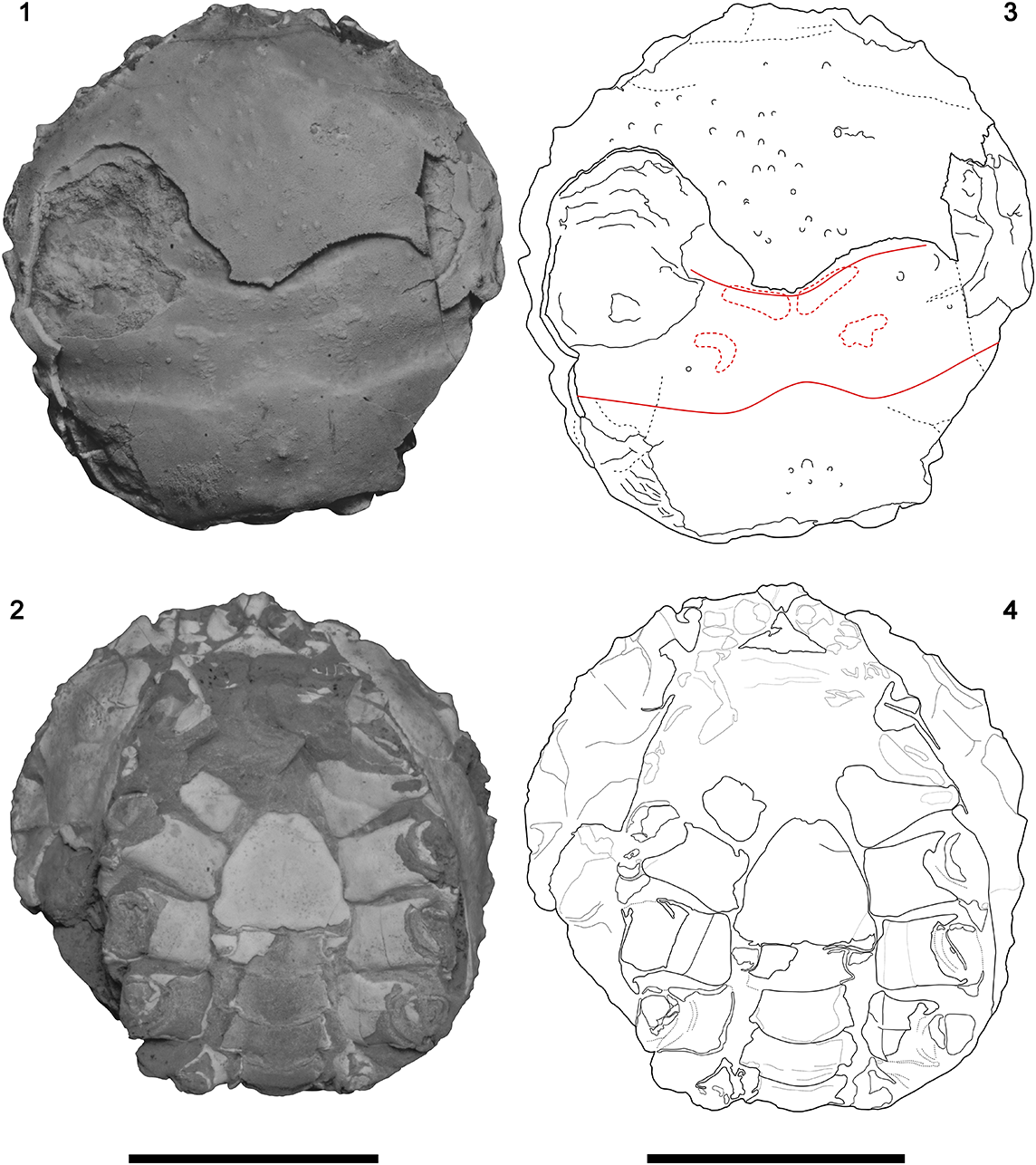
Anterior carapace cuticle partially preserved, ornamented with sparsely distributed small granules (Figs. 2.1, 3.1, 3.3); posterior carapace preserved as internal mold, with posterior gastric, attractor epimeralis, and branchial muscle scars partially preserved (Fig. 3.1, 3.3); carapace slightly subcircular, longer than wide; almost all regions indistinct, anterior cardiac region delimitated by branchiocardiac groove; cervical groove not well preserved, but apparently reaching lateral carapace margin; branchial groove well marked, extending onto lateral sides, parallel to cervical groove (Fig. 3.1, 3.3). Front broadly triangular, narrow, slightly projecting beyond orbits, turned downward; orbits oblique, elongated, well-defined, deep (Fig. 2.1, 2.2); supraorbital margin entirely visible in dorsal view, notched; outer orbital spine acute (Fig. 2.1). Anterolateral margin short, well-defined, rounded, with two small anteriorly directed teeth; posterolateral margins long, weakly defined, with two sharp, lateral teeth; lateral margin rounded. Ventral region (Figs. 2.3, 2.5, 3.2, 3.4) with narrow pleon with somites 3–6 free; pleonites 1 and 2 not preserved; pleonite 3 narrower than pleonites 4 and 5; pleonites 4 and 5 of similar width and length; sixth pleonite narrow, with dorsal uropods filling entire length of sixth pleonite. Telson well developed (Figs. 2.3, 2.5, 3.2, 3.4), long, broad, triangular; anterior margin with median weak indentation, rounded corners; basal lateral margin with indentation associated with pleonal holding mechanism at coxal spines of P2. Pleonal holding mechanism involving coxae of P2 and P3. P2 coxa with single spine at posterior base, adjacent to telson lateral margins; P3 coxa with inconspicuous granular prominence, adjacent to sixth pleonite lateral margins. P2–P4 coxae of similar width, in same plane; P5 reduced, obliquely subdorsal (assumed, based on position of preserved P5 coxa) (Fig. 2.4).
Sabellidromites santamarta n. sp., holotype (MN 12193-I): (1) dorsal, (2) frontal, (3) ventral, and (4) lateral views; (5) detail of ventral region. at, anterior teeth; cx1–cx5, pereopod 1–5 coxae; oos, outer orbital spine; pl3–pl6, pleonal somites; pt, posterior teeth; s, second pereopod coxa spine; t, telson; u, uropod. Scale bars = 10 mm (1–4); 5 mm (5).

Sabellidromites santamarta n. sp., holotype (MN 12193-I): (1, 2) specimen whitened with ammonium chloride prior to photography, dorsal (1) and ventral (2) views; (3, 4) line drawings of the dorsal (3) and ventral (4) regions. Scale bars = 10 mm.

Etymology
The species epithet is a compound noun used as a name in apposition in allusion to the type formation, Santa Marta, and therefore does not need to agree in gender with the generic name (ICZN, 1999, p. 38, Art. 31.2.1).
Remarks
The new species is assigned to Sabellidromites based on the following characteristics: carapace slightly longer than wide, widest just above the cervical groove; weakly vaulted transversely and moderately vaulted longitudinally; rostrum triangular, downturned; orbits oblique; cervical and branchial grooves well-marked, extending onto lateral margins; and carapace regions poorly differentiated, ornamented with scattered granules.
Sabellidromites santamarta n. sp. exhibits distinguishing characters from other dynomenids as discussed above. Sabellidromites santamarta n. sp. can be easily separated from brachyurans of the Antarctic Peninsula by its unique features, notably with only P5 reduced and uropods as dorsal plates on the sixth pleonite. However, preservation of the ventral parts and pereopods is exceedingly rare (similar pleonal preservation is only known for the dynomenid Graptocarcinus urbasaensis Van Bakel et al., Reference Van Bakel, Guinot, Corral and Artal2012), so that comparison with other brachyurans previously reported from the Santa Marta Formation must rely heavily on aspects of the dorsal carapace.
In addition to Sabellidromites santamarta n. sp., the dynomeniformian taxa from Santa Marta Formation include the homolodromiids Notiodromia australis (Feldmann, Tshudy, and Thomson, Reference Feldmann, Tshudy and Thomson1993) (Homolodromiidae) and Plagiophthalmus collinsi Feldmann, Tshudy, and Thomson, Reference Feldmann, Tshudy and Thomson1993 (Prosopidae). The new species can be distinguished from these species by its subcircular carapace (vs. quadrate carapace in N. australis and ovoid to pentagonal in Plagiophthalmus collinsi). Plagiophthalmus collinsi is also found in the Lachman Crags Member of Santa Marta Formation, from which Sabellidromites santamarta n. sp. can be additionally distinguished by the carapace anterolateral margin being twice as long as the orbital length and the absence of a broad node between the orbit and the anterolateral margin (vs. orbits approximately equal in length to anterolateral margin and separated from the anterolateral margin by a broad, low node in Plagiophthalmus collinsi). Furthermore, the general outline of the carapace serves as a distinctive feature separating Sabellidromites santamarta n. sp. from the raninid Cristafrons praescientis Feldmann, Tshudy, and Thomson, Reference Feldmann, Tshudy and Thomson1993 (carapace distinctly longer than wide, a typical trait of raninids).
The other brachyuran reported exclusively from Antarctica is the necrocarcinid Hadrocarcinus Schweitzer, Feldmann, and Lamanna, Reference Schweitzer, Feldmann and Lamanna2012, with three species: H. wrighti (Feldmann, Tshudy, and Thomson, Reference Feldmann, Tshudy and Thomson1993) and H. carinatus (Feldmann, Tshudy, and Thomson, Reference Feldmann, Tshudy and Thomson1993), known only by dorsal carapaces from the Santa Marta Formation, and H. tectilacus Schweitzer, Feldmann, and Lamanna, Reference Schweitzer, Feldmann and Lamanna2012 from the Coniacian Hidden Lake Formation. Although Sabellidromites santamarta n. sp. bears superficial resemblance to H. carinatus and H. wrighti in carapace general outline, the new species differs in having the dorsal carapace regions indistinct. In contrast, Hadrocarcinus is characterized by very well-defined carapace regions, and lateral margins bearing several spines (Schweitzer et al., Reference Schweitzer, Feldmann and Lamanna2012).
Discussion
The familial position of Sabellidromites
The familial position of Sabellidromites among Dynomeniformia (Homolodromiidae, Dromiidae, Dynomenidae) has been controversial. Schweitzer and Feldmann (Reference Schweitzer and Feldmann2008) established Sabellidromites and assigned the new genus to Goniodromitidae (Homolodromioidea) based mainly on dorsal characteristics; ventral surface and appendages were unknown. More recently, Nyborg et al. (Reference Nyborg, Garassino, Vega and Kovalchuk2019) described Dromiopsis oscari Nyborg et al., Reference Nyborg, Garassino, Vega and Kovalchuk2019 and attributed the new species to Dynomeninae (Dynomenidae, Dromioidea) based mainly on the presence of a fully developed P4 and a reduced P5. However, LaBonte et al. (Reference LaBonte, Schweitzer and Feldmann2024) transferred Dromiopsis oscari to Sabellidromites based on dorsal characteristics. The placement of Dromiopsis oscari in Sabellidromites is problematic because Sabellidromites is currently attributed to Homolodromioidea, which is characterized by having both P4 and P5 reduced (Karasawa et al., Reference Karasawa, Schweitzer and Feldmann2011; Guinot et al., Reference Guinot, Tavares and Castro2013), whereas only P5 is reduced in Dromiopsis oscari, just as in Sabellidromites santamarta n. sp. Unexpectedly, Nyborg et al. (Reference Nyborg, Garassino and Ross2020), following Guinot’s (Reference Guinot2019) classification, described Sabellidromites lanae and attributed the new species to Dromiidae (Dromioidea) based on dorsal carapace and P1 characteristics; the ventral surface and P2–P5 were unknown.
Sabellidromites superficially resembles Goniodromitinae in the carapace dorsal characteristics, however, only P5 is reduced in Sabellidromites oscari and Sabellidromites santamarta n. sp., and the presence of uropods as calcified dorsal plates in Sabellidromites santamarta n. sp. strongly suggests that Sabellidromites actually belongs in the Dynomenidae, to which family the genus is here accordingly transferred.
Among dynomenids (subfamilies incertae sedis), Sabellidromites stands apart from Cyamocarcinus (type species Cyamocarcinus angustifrons Bittner, Reference Bittner1883), Gemmellarocarcinus (type species Gemmellarocarcinus loerentheyi Checchia-Rispoli, Reference Checchia-Rispoli1905), Graptocarcinus (type species Graptocarcinus texanus), and Ovamene (type species O. franciae Müller and Collins, Reference Müller and Collins1991) due to the anterolateral, lateral, and posterolateral margins of carapace being toothed (Fig. 2.1) (vs. carapace anterolateral and posterolateral margins smooth in Cyamocarcinus, Gemmellarocarcinus, Graptocarcinus, and Ovamene). Sabellidromites additionally differs from Cyamocarcinus and Gemmellarocarcinus by its carapace being slightly longer than wide (vs. distinctly wider than long in Cyamocarcinus and Gemmellarocarcinus).
Sabellidromites differs from Cracchidynomene (type species Cracchidynomene areolata Beschin et al., Reference Beschin, Busulini, Tessier and Zorzin2016) in having the carapace with rounded lateral margins and front slightly projecting beyond the orbits and turned downward (Fig. 2.1, 2.2) (vs. carapace with lateral margins straight, nearly parallel and the front well projected beyond the orbits in Cracchidynomene). Both genera further differ in carapace outline: subcircular in Sabellidromites, and subquadrate in Cracchidynomene.
Sabellidromites can be distinguished from Sierradromia (type species Sierradromia gladiator Artal et al., Reference Artal, Ferratges, Van Bakel and Zamora2022) by its carapace, which has indistinct dorsal regions and rounded lateral margins bearing four short spines (vs. carapace with well-defined dorsal regions with projected protuberances, shallow grooves, and entire broadly rounded lateral margins bearing seven long, robust spines in Sierradromia).
In comparison to Eotrachynotocarcinus (type species Eotrachynotocarcinus airaghii Beschin et al., Reference Beschin, Busulini, De Angeli and Tessier2007), Sabellidromites possesses a front slightly projecting beyond the orbits and turned downward, a subcircular carapace with indistinct dorsal surface, and the maximum width of the carapace on the anterior third (vs. front consisting of two lobes divided by a median sinus, carapace subheptagonal, well-defined dorsal regions with numerous swellings, and the maximum width of the carapace on the posterior third in Eotrachynotocarcinus).
Sabellidromites superficially resembles the paradynomenines Paradynomene (type species Paradynomene tuberculata Sakai, Reference Sakai1963), Kromtitis (type species Dromilites koberi Bachmayer and Tollmann, Reference Bachmayer and Tollmann1953), and Kierionopsis (type species Kierionopsis nodosa Davidson, Reference Davidson1966) in having a carapace longer than wide and spines or protuberances along the carapace anterolateral and posterolateral margins. However, the subcircular carapace with dorsal regions indistinct and weakly ornamented and rounded lateral margins clearly distinguish Sabellidromites from the above-mentioned paradynomenine genera with subquadrangular or suboval carapaces with uniform tubercles, granules, or spines, dorsal surfaces distinctly areolate, regions distinct, and lateral margins subparallel.
Moreover, Sabellidromites differs from the monotypic acanthodromiine Acanthodromia (type species Acanthodromia erinacea A. Milne-Edwards, Reference Milne-Edwards1880) in the carapace with well-delimited anterolateral margin, slightly projecting and downward-turned frontal margin, and free pleonal somites 3–6 (Fig. 2.3, 2.4) (vs. carapace anterolateral margins poorly defined and obscured by numerous spines, narrow projection of the frontal margin, and fused pleonal somites 3–6 in Acanthodromia).
Sabellidromites shares several characteristics with the monogeneric metadynomenine Metadynomene (type species Dynomene devaneyi Takeda, Reference Takeda1977), e.g., a moderately convex, subcircular carapace; well-defined lateral carapace margins marked by distinct teeth; and large uropods filling the entire length of sixth pleonal somite. However, Sabellidromites differs in having a subcircular carapace longer than wide, ornamented with sparsely distributed small granules, and poorly defined carapace regions and grooves (vs. smooth, subcircular carapace as wide as long or slightly wider [ovoid], with an irregular surface and an undulating appearance characterized by transverse distinct grooves in Metadynomene).
Sabellidromites can be separated from the dynomenine Dynomene (type species Dynomene hispida Latreille, Reference Latreille1812) in having a carapace longer than wide, uropods filling the entire length of somite 6, and pleonal holding mechanism involving coxae of thoracopods (vs. carapace distinctly wider than long, uropods not filling the entire length of somite 6, and pleonal holding mechanism involving a sternal tubercle on episternite 5 in Dynomene).
Paleobiogeographical dispersion of Dynomenidae
During the Cretaceous, the Tethys Sea currents played a significant role in the dispersal of species throughout the South Atlantic. The occurrence of Hymenosomatidae (e.g., Eureotropis Mendes, Santana, and de Souza Carvalho, Reference Mendes, Santana and de Souza Carvalho2022) and Protohymenosoma Mendes, Santana, and de Souza Carvalho, Reference Mendes, Santana and de Souza Carvalho2022, from the Morro do Chaves Formation (Sergipe-Alagoas Basin, Brazil) suggests a possible Tethyan marine incursion into the proto-South Atlantic in the late Barremian (Mendes et al., Reference Mendes, Santana and de Souza Carvalho2022). However, no other brachyurans are known from the same period in this region.
During the Aptian and Albian, the surface current systems of the South Atlantic were strongly influenced by the Tethys Ocean (Koutsoukos, Reference Koutsoukos1992), with several records of this incursion along the Brazilian continental margin basins (Arai, Reference Arai2014). Orithopsidae from the Aptian–Albian were described from the Araripe Basin (Romualdo Formation), e.g., Exucarcinus gonzagai Prado and Luque in Prado et al., Reference Prado, Luque, Barreto and Palmer2018 and Chronocancer camilosantanai Santana et al., Reference Santana, Tavares, Muniz Martins, Pereira Melo and Pinheiro2022, and of the ?Necrocarcinidae, e.g., Araripecarcinus ferreirai Martins-Neto, Reference Martins Neto1987 for the Araripe Basin (Romualdo Formation) (Luque, Reference Luque2015; Prado et al., Reference Prado, Luque, Barreto and Palmer2018; Santana et al., Reference Santana, Tavares, Muniz Martins, Pereira Melo and Pinheiro2022). According to Prado et al. (Reference Prado, Luque, Barreto and Palmer2018), the similarity of taxa from Araripe Basin and those found in North America reflects the wide distribution of Raninoida across the Tethys Ocean. The tropical regions of South America might have acted as an important distribution area for crustaceans, bringing together several basal lineages of Brachyura during the Cretaceous, e.g., Raninoida (Prado et al., Reference Prado, Luque, Barreto and Palmer2018).
During the Cenomanian and Turonian, connections were also formed between the Tethys Ocean and the South Atlantic through a trans-Saharan maritime canal capable of establishing a flow of marine specimens between the Mediterranean and West Africa (Gallo et al., Reference Gallo, Cavalcanti and Andrade da Silva2007). Some Raninoida, e.g., Cenomanocarcinus Van Straelen, Reference Van Straelen1936 (Cenomanocarcinidae) and Pseudonecrocarcinus Förster, Reference Förster1968 (Paranecrocarcinidae), occupied this channel throughout the Late Cretaceous (Schweitzer et al., Reference Schweitzer, Feldmann, Rader and Franţescu2016). Even though there are no records of the Dynomenidae from the western coast of the African continent during the Cretaceous, Recent records of Dynomene filholi Bouvier, Reference Bouvier1894 in the Gulf of Guinea could indicate the opposite (Forest and Guinot, Reference Forest and Guinot1966). According to McLay (Reference McLay1999), the ancestor of Dynomene filholi, a crab from the Tethys Sea, would have migrated to the Southern Hemisphere from the opening of the South Atlantic in the Late Cretaceous, however, a dispersal through the trans-Saharan channel would also be possible.
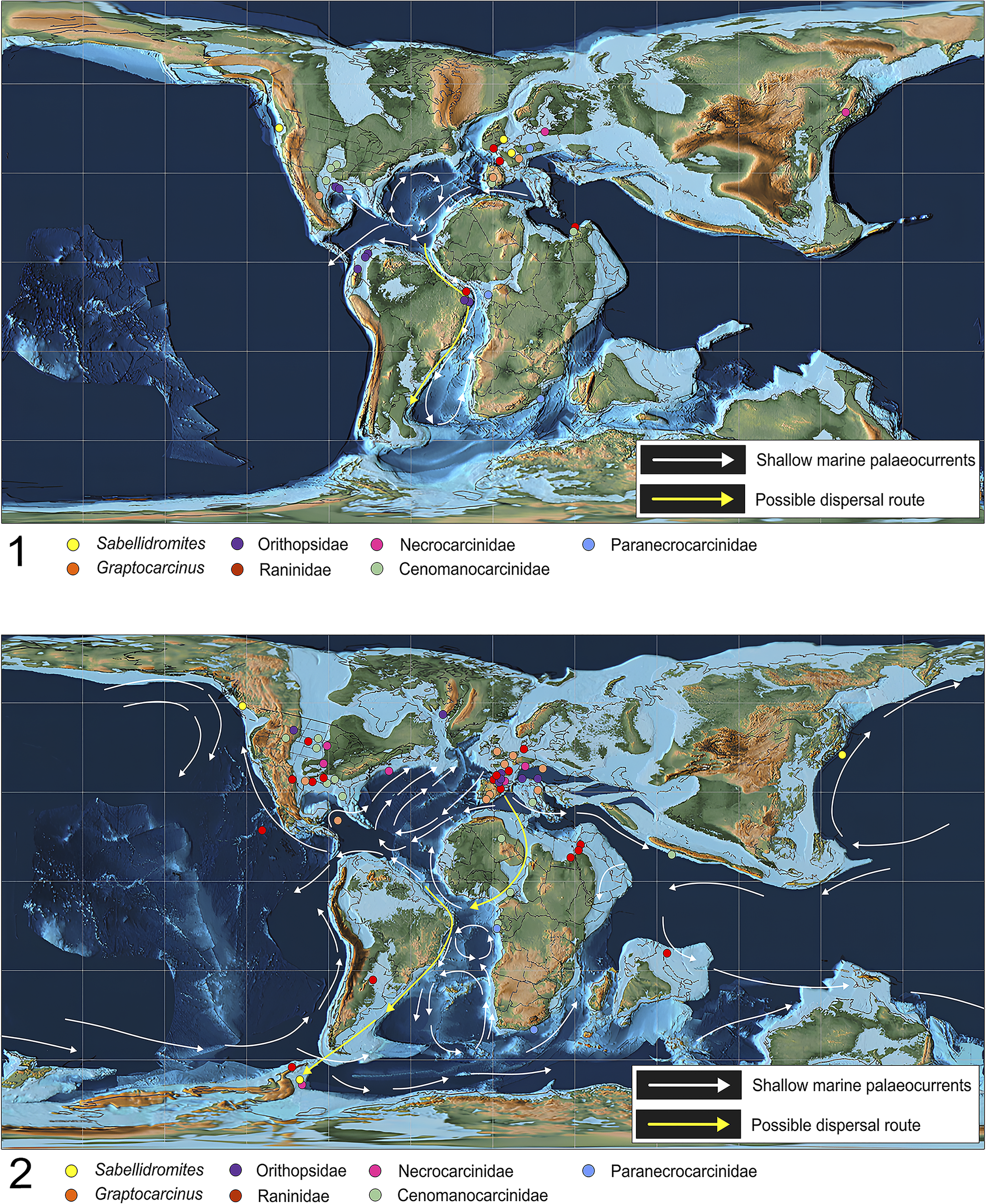
The dispersal of dynomenids across the South Atlantic to the Antarctic Peninsula might have occurred through different stages (Fig. 4). Initially, the narrow South Atlantic Basin could have acted as a dispersal route for the crab larvae toward the subtropical and temperate regions of South America and Africa (Schweitzer et al., Reference Schweitzer, Feldmann, Gonzáles-Barba and Vega2002; Feldmann and Schweitzer, Reference Feldmann and Schweitzer2006). The proximity between the ocean basins and the presence of epicontinental seas probably helped in the dispersal of these decapod crabs along the continental shelves (Schweitzer et al., Reference Schweitzer, Feldmann, Gonzáles-Barba and Vega2002; Feldmann and Schweitzer, Reference Feldmann and Schweitzer2006; Luque et al., Reference Luque, Feldmann, Schweitzer, Jaramillo and Cameron2012). With the rise of sea level in the early Cenomanian and Turonian (Košťák et al., Reference Košťák, Kohout, Mazuch and Čech2020), some dynomenids might have found favorable conditions for their dispersal between adjacent basins, thus reaching the Antarctic Peninsula. Indeed, evidence suggests that the Antarctic climate during the Late Cretaceous was warm and humid, with mean annual temperatures ranging from 15–23°C in the Santa Marta Formation (Huber et al., Reference Huber, Norris and Macleod2002; Hayes et al., Reference Hayes, Francis, Cantrill and Crame2006), where the studied specimen was found. This warm climate likely supported lush forests and high seasonal precipitation (Huber et al., Reference Huber, Norris and Macleod2002), creating ecological conditions favorable for the establishment of diverse marine (Cione and Medina, Reference Cione and Medina1987; Richter and Ward, Reference Richter and Ward1990; Olivero et al., Reference Olivero, Gasparini, Rinaldi and Scasso1991; de la Fuente et al., Reference de la Fuente, Novas, Isasi, Lirio and Nuñez2010) and terrestrial fauna (Salgado and Gasparini, Reference Salgado and Gasparini2006; Cerda et al., Reference Cerda, Carabajal, Salgado, Coria, Reguero, Tambussi and Moly2012; Kellner et al., Reference Kellner, Rodrigues, Costa, Weinschütz and Figueiredo2019), including dynomenid crabs. The occurrence of Sabellidromites santamarta n. sp. in the Late Cretaceous of Antarctica (Fig. 5) is evidence of dynomenid exchanges between the Northern and Southern hemispheres during the Cretaceous (Feldmann and Schweitzer, Reference Feldmann and Schweitzer2006).
Paleomaps of (1) Early Cretaceous (Aptian–Albian) and (2) Late Cretaceous (Coniacian–Santonian). Colored circles indicate occurrences of some brachyuran basal families. White arrows indicate shallow marine paleocurrents. Yellow arrow indicates possible dispersal route of dynomenid during (1) Early and (2) Late Cretaceous. Paleomaps modified from Gplate (Müller et al., Reference Müller, Cannon, Qin, Watson and Gurnis2018).

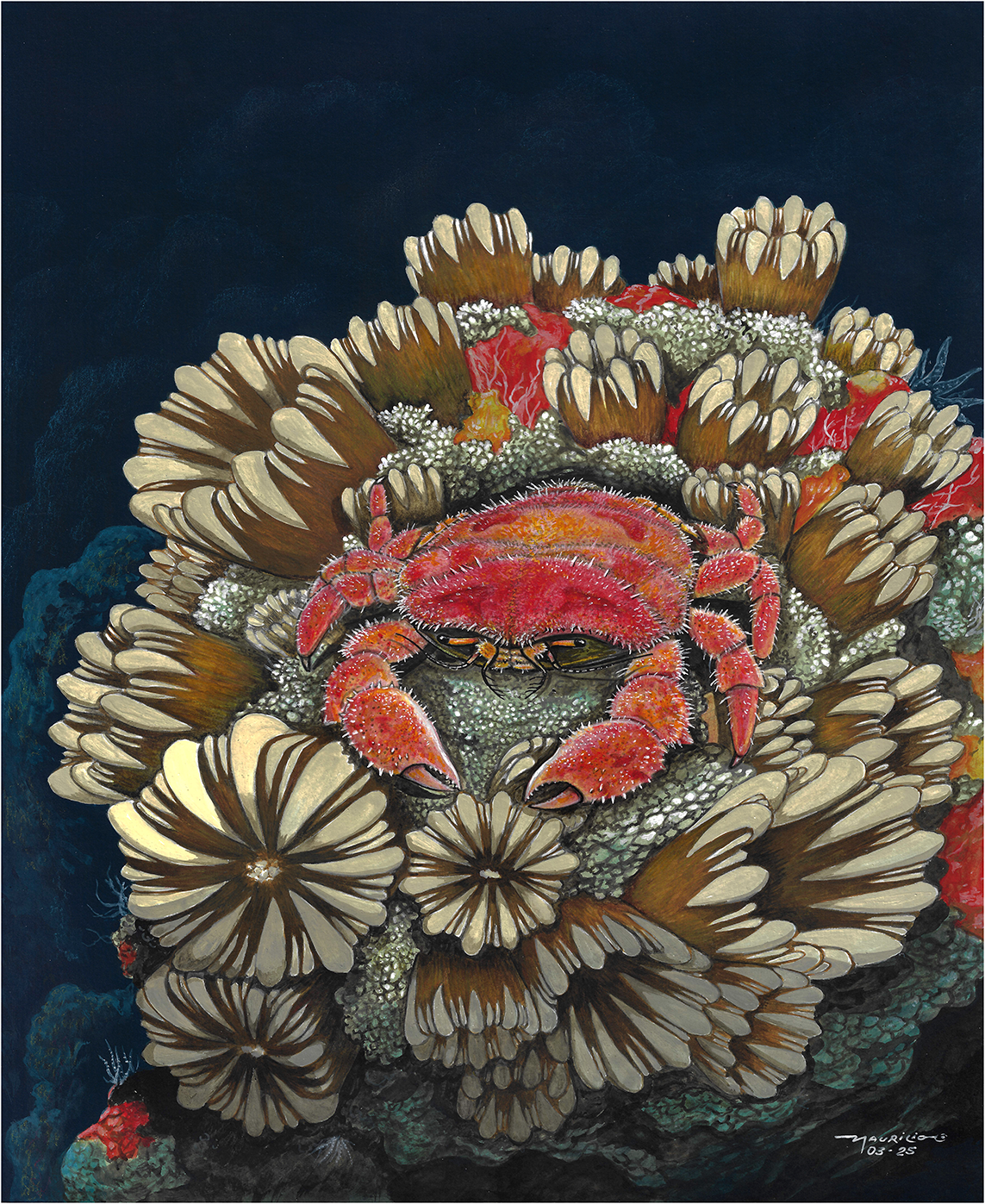
Reconstruction of Sabellidromites santamarta n. sp. in its paleoenvironment. Illustration by Maurilio Oliveira (paleoartist, MN/UFRJ).

Acknowledgments
This project was supported by Programa Antártico Brasileiro (PROANTAR) through Conselho Nacional de Desenvolvimento Científico e Tecnológico (CNPq# 313461/2018-0 and #440902/2023-1 to AWAK). CNPq additionally funded this study through the grants #314222/2020-0 and #153078/2024-3 to JMS, #309488/2020-6 to MT, and #308707/2023-0, #406779/2021-0, #406902/2022-4 to AWAK. Fundação Carlos Chagas Filho de Amparo à Pesquisa do Estado do Rio de Janeiro (FAPERJ) funded this study through the grants #E-26/201.095/2022 to AWAK and E-26/210.066/2023 to JMS). The authors would like to express sincere gratitude to the reviewers D. Guinot, M. Veselská Kočová, and B. Van Bakel and to the guest editor A. Klompmaker for their constructive comments on the early version of this article. DL thanks FUNCAP grants #PV1-0187-00019.01.00/21 and #BP5-0197-00056.01.00/22. The team of the PALEOANTAR Project thanks the NApOc Ary Rongel military group and the pilots of the HU-1 helicopter squadron for their logistic support during fieldwork on the Antarctic Peninsula. Alpinist M. Campos is thanked for the support and safety of the camp and walking around James Ross Island. We also thank paleoartist M. Oliveira for the life reconstruction of Sabellidromites santamarta n. sp., which greatly contributed to the visual communication of this study.
Competing interests
The authors declare none.