INTRODUCTION
Neobythites, Goode & Bean (Reference Goode and Bean1885) is far the most speciose genus within the oviparous family Ophidiidae. It is known from all oceans, however, in the Atlantic only from the western part except for one specimen caught west of Cape Town. In the Indo-Pacific Ocean it is recorded from 67 to 950 m of depth and is invariably well represented in many collections (Nielsen, Reference Nielsen and Wolff2002).
Cohen & Nielsen (Reference Cohen and Nielsen1978) recognized 14 species while Nielsen et al. (Reference Nielsen, Cohen, Markle and Robins1999) listed 35 species. Eight species occur in the western Atlantic Ocean, all endemic to that area (Nielsen et al., Reference Nielsen, Cohen, Markle and Robins1999). Fifteen more species were added recently by Nielsen (Reference Nielsen and Wolff2002), so the genus now stands with a numerical strength of 50 species.
Indo-Pacific species of Neobythites occur below tropical and subtropical parts of the ocean. Indo-Australian waters with 16 species seem to be the most species rich, while the poorest areas the East Pacific with only one species. The potentially richest area is the West Pacific (Nielsen, Reference Nielsen and Wolff2002). Only one species is so far reported from the Indian EEZ viz., Neobythites steatiticus Alcock, 1893, locality being the east coast (Nielsen, Reference Nielsen and Wolff2002). Recent deep sea fish hauls made by the Research Ship, FORV ‘Sagar Sampada’ were examined for their systematics in detail wherein a few specimens were identified as Neobythites multistriatus Nielsen & Quéro, Reference Nielsen and Quéro1991, which is hitherto unknown from the Indian exclusive economic zone (EEZ). Hence an attempt to report and redescribe this deep sea fish comparing its morphomeristics with the holotype was done in this context.
MATERIALS AND METHODS
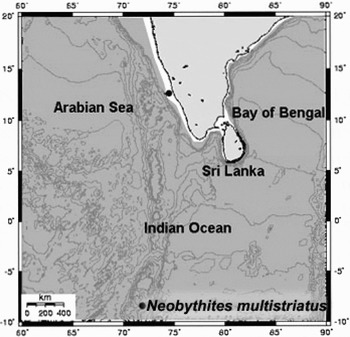
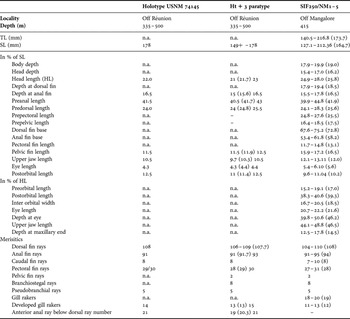
The present study was carried out as part of the Ministry of Earth Sciences (MoES), Government of India funded research project on ‘Resource assessment and biology of deep sea fish along the continental slope of the Indian EEZ’. The fish were caught during cruise No. 250 of FORV ‘Sagar Sampada’, from Station 11 (12°282′N and 74°095′E) at a depth of 415 m on 8 November 2006 (Figure 1) using a high speed demersal trawl (HSDT) fish-version net and identified following Nielsen (Reference Nielsen and Wolff2002). The condition of the material examined was generally satisfactory, as Neobythites specimens are very robust. Furthermore, they were not caught at such great depths as many other ophidiids which means that net-damage is less pronounced. The pigmentation, however, bleaches after being preserved for a certain period, especially bars on the body while ocelli on the dorsal and anal fins seem to resist bleaching much better. Specimens (SIF 250/NM1-5) are deposited in the Fish Museum of the School of Industrial Fisheries, Cochin University of Science and Technology, India. Morphometric measurements were taken to the nearest mm using a dialled vernier caliper following Smith & Heemstra (Reference Smith, Heemstra, Smith and Heemstra1986). Body proportions were expressed in terms of standard length (SL, length from snout tip to base of caudal fin) and head length (HL, length of snout tip to the posterior margin of opercle). Meristic counts and proportional measurements of N. multistriatus with its holotype and paratypes are shown in Table 1. Measurements of the type specimens were archived from Nielsen & Quéro (Reference Nielsen and Quéro1991).
Locality map of Neobythites multistriatus from the exclusive economic zone of India.

Comparison of the meristic and morphometric measurements of Neobythites multistriatus with the holotype and paratypes of the species.

Source, Nielsen & Quero, 1991; n.a., not available.
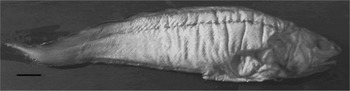
Photograph of lateral view of Neobythites multistriatus (SL 190.28 mm).

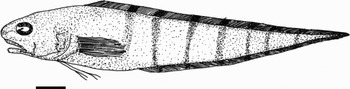
Lateral view of Neobythites multistriatus. Scale indicates 1 cm.

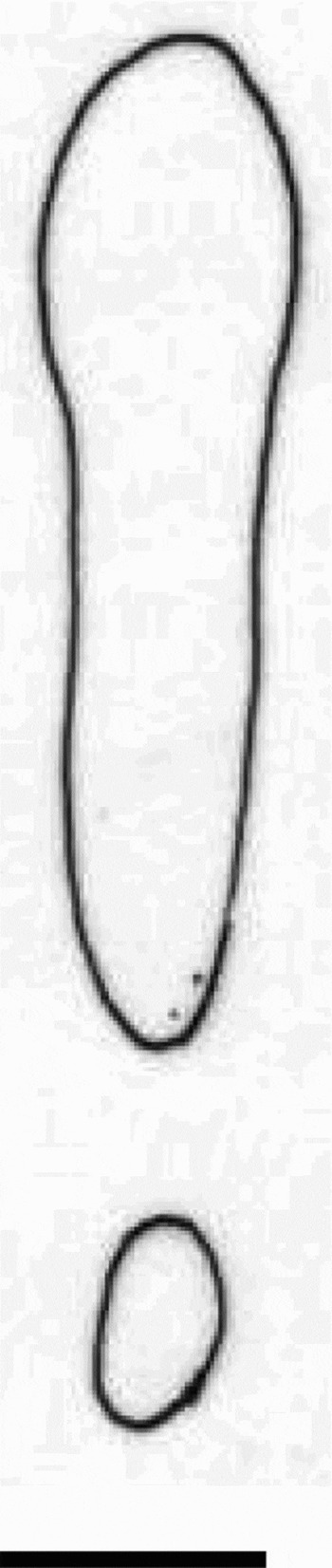
Basibranchial tooth patch of Neobythites multistriatus. Scale indicates 2 mm.

TYPE MATERIAL
Neobythites multistriatus Nielsen & Quéro, Reference Nielsen and Quéro1991: 194, figure 1 (type locality: off Réunion, 20°57.9′S 55°14.5′E).
Neobythites fasciatus (non Smith & Radcliffe): Scherbachev et al., Reference Scherbachev, Pakhnorukov and Piotrovsky1986: 203.
Neobythites multistriatus: Schwarzhans, Reference Schwarzhans1994: 74, figures 23–24; Nielsen, Reference Nielsen1995: 8, figure 7.
Holotype: MNHN 1988–1945 (SL 178 mm), off Réunion.
Paratypes: MNHN 1988–1946 (2, SL 152–165 mm) and ZMUC P77809 (1, SL 149+ mm), off Réunion.
Non-types: ZM MGU P-18914 (1, SL 76 mm), off Rodrigués.
See Nielsen & Quéro (Reference Nielsen and Quéro1991: 194) for station data for types and Nielsen (Reference Nielsen1995: 8) for non-type.
MATERIAL EXAMINED
SIF250/NM1, SIF250/NM2, SIF250/NM3, SIF250/NM4, SIF250/NM5; 190.28 mm, 212.36 mm, 155.36 mm, 137.92 mm, and 127.1 mm respectively: off Mangalore, south-west coast of India, 12°28.2′N and 74°09.5′E; HSDT net; 415 m; 8 November 2006.
DIAGNOSIS
Hind margin of preopercle with two spines; dorsal fin with 7–9 and anal fin with 3–4 more or less distinct ocelli or dark blotches and corresponding vertical, dark bars on body, dorsal fin rays 104–110; anal fin rays 91–95; pectoral fin rays 27–31; long rakers on anterior gill arch 11–13; pseudobranchial filaments 5.
DESCRIPTION
Meristics and morphometrics of Neobythites multistriatus are given in Table 1. Elongate fish with indistinct lateral line; snout blunt or rounded, slightly longer than eye, maxilla ends well behind eye; teeth granular; vomer tooth patch varies in shape apparently due to age, anterior basibranchial tooth patch broad in front (Figure 4), anterior nostril with flap or low tube and larger posterior nostril a mere hole; hind margin of preopercle with two spines; ventral fin reaches half way from its base to anal fin; anterior gill arch with 2–3 short and three long rakers on upper branch, one long raker in angle and lower branch with 8–10 long and 4–6 short rakers; 3–5 pseudobranchial filaments.
COLORATION
Generally light brown with somewhat darker indication of lateral line; dorsal fin with 7–9 and anal fin with 3–5 ocelli or dark blotches with corresponding vertical, dark brown bars; peritoneum black.
SIMILARITY
Neobythites multistriatus is closely related to N. fasciatus due to the presence of two opercular spines and several vertical bars on body ending as ocelli or dark blotches on dorsal and anal fin. However, they differ from each other by having 11–13 long rakers in the former versus 8–10 in the latter and anterior ocellus in front of line versus posterior to line in the former species.
DISTRIBUTION
Type locality of Neobythites multistriatus is off Réunion, east of Madagascar, Indian Ocean (20°57.9′S 55°14.5′E) at a depth of 335–500 m (Nielsen & Quéro, Reference Nielsen and Quéro1991). Scherbachev et al. (Reference Scherbachev, Pakhnorukov and Piotrovsky1986), Schwarzhans (Reference Schwarzhans1994) and Nielsen (Reference Nielsen1995) have all reported this species off Rodrigués. The record of N. multistriatus from the Indian EEZ assumes significance to strengthen the view that a rich and diversified deep sea ichthyofaunal biodiversity encompasses the EEZ of India.
REMARKS
Generic diagnosis of Neobythites based on Nielsen & Quéro (Reference Nielsen and Quéro1991) followed the diagnostic characters such as: strong opercular spine, hind margin of preopercle with two spines, posterior part of maxilla sheathed, ventral fin rays two, median basibranchial tooth patches two, anterior gill arch with 6–34 developed rakers, pectoral fin entire with 22–34 rays and vertical or horizontal dark bands on body and fins. The meristic counts of anal, caudal, pectoral and pelvic fin rays, pseuodobranchial rays and anterior anal fin rays below dorsal fin rays of SIF 250/NM1-5 concur with the holotype (Table 1). Depth at dorsal fin, pre-anal length and predorsal length in percentage of SL was found in agreement with its holotype. Upper jaw length and eye length in %SL were in the range of the type specimens. Many morphometric measurements were missing with respect to holotype and paratypes. Therefore, the redescription of this species would be useful for easy identification and confirmation of N. multistriatus. Although Nielsen & Quéro (Reference Nielsen and Quéro1991) have suggested that morphometrics and meristic characters could vary with specimen size and geographical localities, specimens examined in the present study were almost agreeing with that of the holotype and paratypes, but for a few measurements such as post-orbital length and pelvic fin length in %SL (10.2 versus 12.5 and 16.5 versus 11.5–12.5). In the Indian Ocean the species has been reported only from the western side at depths less than 500 m (Scherbachev et al., Reference Scherbachev, Pakhnorukov and Piotrovsky1986; Nielsen & Quéro, Reference Nielsen and Quéro1991; Schwarzhans, Reference Schwarzhans1994; Nielsen, Reference Nielsen1995). Nevertheless, occurrence of N. multistriatus in the Indian EEZ assumes significance in its extended geographical distribution from Africa to the Indian EEZ which is a major salient feature of the study is shown by the global distribution of the species.
ACKNOWLEDGEMENTS
The Captain, Technical Officers and Fishing Hands of the FORV ‘Sagar Sampada’ and the Chief Scientist of the cruise No. 250 are duly thanked. The financial assistance from the Ministry of Earth Sciences (MoES), Government of India is acknowledged.