




No CrossRef data available.
Article contents
A COMPARISON OF READING DEVELOPMENT BY LEARNERS OF JAPANESE IN INTENSIVE DOMESTIC IMMERSION AND STUDY ABROAD CONTEXTS
Published online by Cambridge University Press: 23 April 2004
Abstract
To investigate the role of context in reading development, a comparison of reading comprehension and processes was conducted between learners of Japanese as a second language in study abroad (SA; n = 15) and intensive domestic (in the United States) immersion (IM; n = 15) contexts. A significant difference was found between contexts in pretest to posttest gains on only one measure of reading comprehension, a self-assessment. Differences on the two other measures of comprehension—free-recall and vocabulary knowledge—were not significant. The self-assessment measure indicated that SA students felt more confident reading the second language than their IM counterparts. In terms of reading processes, think-aloud protocols showed significant differences in changes over time in the amount of monitoring understanding (less for IM than SA) and responding and reacting to text content affectively or emotionally (more for IM than SA). In the IM context, office-hour interaction with teachers influenced students to monitor comprehension less and more efficiently and to respond affectively to text more often. Variability in terms of gains on reading measures and contact with language and culture outside of class was greater for SA than for IM. The controlled IM setting and the open SA context contributed to differences in variability. The need for a variety of new measures designed to capture gains specific to any given context is discussed and specific suggestions for new measures are given.I wish to thank the following individuals for their help: Joe Collentine and Barbara F. Freed for extensive feedback on the manuscript; Barbara F. Freed, G. Richard Tucker, and Isabel Beck for advising on the dissertation that led to this manuscript; the Office of Michael Katz, Dean of the Language Schools at Middlebury College, for facilitating much of the data collection for this study through the Baker Research Fellowship; my former colleagues at Carnegie Mellon University for ongoing input throughout this study; and the two anonymous SSLA reviewers of this paper for their input and suggestions.
Information
- Type
- Research Article
- Information
- Copyright
- © 2004 Cambridge University Press
There has been much discussion in the field of SLA on the need to consider what happens to second language (L2) learners outside of the classroom and to be more aware of the entire language learning setting. Those calling for consideration of context (e.g., Firth & Wagner, 1997, 1998; Freed, 1995a; Tarone, 2000), when investigating the acquisition and use of L2s, have observed a heavy emphasis in SLA research on learning in a formal academic-year classroom. They submit that it is time to consider other settings that may involve frequent contact with the L2 outside of the classroom such as study abroad (SA) and intensive domestic immersion (IM). The former involves living and studying the L2 in a country where that language is spoken. (Although some SA programs emphasize the experience of living abroad and provide little or no formal classroom instruction, the program discussed in this paper included extensive classroom language learning.) IM refers to settings where students study “at home,” in programs that require many more hours per day of classroom instruction than are typical with normal academic-year formal classroom settings, and where the goal of instruction is to teach the target language.1
The term immersion has also been used to refer both to being immersed in the language during SA and to situations where content is taught via the L2, usually to younger students (see Swain & Johnson, 1997, for discussion). The purpose of the latter is usually to “promote among … children additive bilingualism—the learning of an L2 while developing and maintaining [the] L1” (Swain & Johnson, p. 4).
The focus of this article is to compare gains in reading by learners of Japanese in these two settings—SA and IM. Reading is a skill area that has been neglected in the research that looks at the effects of context on language learning.
PREVIOUS STUDIES
Recently, L2 reading researchers (e.g., Hill & Parry, 1994; Kern, 1995; Leki, 2000; Swaffar, Arens, & Byrnes, 1991; Urquhart & Weir, 1999) have called for the investigation of contexts where learners develop L2 reading abilities. Most reading studies have occurred in controlled settings (e.g., formal academic-year classrooms) rather than in more complex social contexts, such as SA. These researchers call for studies of the interaction between factors external to the classroom and reading development in various settings. The few studies concerning reading acquisition in contexts other than the formal classroom indicate that these contexts may have unique advantages over at-home academic-year classroom learning, but because studies are small in number and have specific limitations, much has yet to be learned about reading development here.
Several studies involving predicting success in language learning have included reading and time abroad as variables of importance. In two studies of L2 learning by undergraduates in the United States, Carroll (1967) and Gomes da Costa, Smith, and Whitely (1975) found that time spent abroad was a significant predictor of L2 reading comprehension, as measured by the Modern Language Association reading tests.
Two large-scale multidimensional studies of SA (Brecht, Davidson, & Ginsberg, 1995; Lapkin, Hart, & Swain, 1995) reported that (a) students made significant gains in reading during SA, and (b) preprogram reading scores predicted reading gains abroad. Learner self-assessments indicate that students feel more confident reading after SA (Lapkin et al., 1995; Meara, 1994; Opper, Teichler, & Carlson, 1990). Meara noted that, in his study, although learners reported gains in reading, these reported gains were not as great as those for oral and aural skills.
In a small-scale study of beginning learners of Japanese, Huebner (1995) reported that SA learners demonstrated greater gains in reading abilities than IM learners with comparable instruction, although both groups experienced similar gains in character recognition. Differences in attitudes toward learning to read were also present. Members of the SA group were anxious to learn to read and felt greatly inhibited by their inability to read. On the other hand, members of the IM group expressed frustration with the burden of having to learn two syllabaries—namely, hiragana and katakana.
Taking a very different (ethnographic) research approach, Kline (1998) produced an extensive description of learners' reading habits while in a French SA context. She observed behavior indicating that gender, group affiliations, and host-family preferences can influence reading habits (in particular, text selection). No connection was made between reading habits and the development of reading comprehension.
IM, as defined here, has not drawn nearly as much attention as SA but has been the focus of several recent studies (e.g., Breiner-Sanders, Richter, & Chi, 1999; Dewey, 2002; Freed, Segalowitz, & Dewey, this issue; McKee, 1983). Findings suggest that the IM context can have advantages over the formal academic-year and SA contexts. Studies of IM language learning have focused largely on speaking skills (e.g., Breiner-Sanders et al.; Freed, Segalowitz, et al.). One small-scale study (McKee) compared postinstruction reading, writing, and listening test scores for students of French in a 6-week intensive summer immersion program with scores for students enrolled in a traditional 15-week semester program. McKee found significant differences only for writing and suggested that it may be possible for students to make gains in reading during 6 weeks of IM comparable to 15 weeks of formal academic-year classroom learning. However, McKee did not conduct a pretest, so solid conclusions concerning differences in developmental gains cannot be made based on this study.
L2 reading researchers (e.g., Bernhardt, 1991; Urquhart & Weir, 1999) have expressed the need, in studies of reading acquisition, to go beyond simply testing comprehension and to explore in greater detail processes involved in reading in an L2 to gain a deeper understanding of L2 reading development. The present study addresses both comprehension and processes.
Language contact outside of class has been shown to explain gains in speaking during SA and IM (Freed, 1995b; Freed, Segalowitz, et al., this issue), but the tie between language contact and reading comprehension and processes has yet to be explored in detail. Interactive models of reading (see Carrell, Devine, & Eskey, 1988, for discussion) suggest that as lower level processes become more automatic, cognitive resources are freed up for other higher level processes. The common belief is that SA provides more opportunities for contact with the L2 both in printed and spoken forms. Such contact could result in improved lower level reading processes (i.e., breadth and depth of knowledge of vocabulary, characters, and grammar and increased speed of processing).2
Contrary to this assumption, there is reason to question whether grammar and vocabulary do develop to the degree expected during SA (see Collentine, this issue; Segalowitz & Freed, this issue).
This literature review shows the need for research that compares language learning in contexts other than the formal academic-year classroom and that looks at the effects of different contexts on the acquisition of various aspects of reading. To help fill this gap, the current study compares reading development in the SA and IM contexts by focusing on both comprehension and processes and by investigating potential connections between contact with language and culture outside of class and reading development. The questions to be addressed are:
- Are there differences in the development of reading comprehension and processes between learners in the SA and IM contexts?
- If there are differences between groups, can these differences be explained by contact with language and culture outside of class?
THE PRESENT STUDY
The goal of this study is to expand the limited body of reading-related SA and IM research by reporting on the development of reading for learners of Japanese as a second language (JSL) in these two contexts. Given that the SA and IM settings included in this study were largely similar in terms of amount and nature of formal language instruction, a comparison between the two serves to highlight differences that might be attributable to factors other than instruction (i.e., what goes on outside of the classroom in either context). A major focus is behaviors unique to or in common across the two contexts that influence reading development.
Subjects
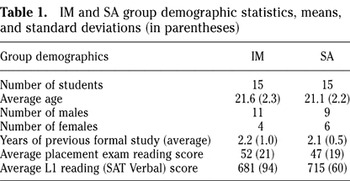
Participants in this study were native speakers (NSs) of English from colleges and universities in the United States studying JSL in SA or IM settings. Heritage speakers of Japanese and readers of Chinese and Korean were not included in the study. The SA participants (n = 15) were enrolled in a renowned study center in Kyoto, Japan, and the IM participants (n = 15) were enrolled in a summer intensive Japanese program at Middlebury College, in Middlebury, Vermont. All participants had studied Japanese for 2–4 years prior to the beginning of their SA or IM experiences. Demographic information for both groups is shown in Table 1. Because first language (L1) reading ability predicts L2 reading ability (Alderson, 1984) and L2 reading proficiency predicts gains in L2 reading during SA (Brecht & Davidson, 1992; Brecht et al., 1995), measures of L1 and L2 reading comprehension (SAT Verbal scores3
SAT Verbal scores were first self-reported by students and later verified by paying students who showed the researcher official reports from Educational Testing Services ($10.00 plus $8.00 for costs related to score requests). Although students had to request scores for themselves, the tester facilitated this process by providing detailed instructions and preaddressed envelopes. Twenty-one of the 30 participants showed official score reports. For students who did not submit formal verification, self-reports were used, as self-reports correlated highly (0.86) with actual scores for the 21 students who showed verification.
This Diagnostic and Placement Exam was originally developed in the mid 1980s at Brigham Young University (BYU) to measure the proficiency of students with approximately 2 or more years of Japanese study experience. The test has an internal reliability of 0.86. Further information can be obtained from BYU's Department of Asian and Near Eastern Languages.
IM and SA group demographic statistics, means, and standard deviations (in parentheses)

Both the SA and the IM groups were diverse in terms of their previous language learning and general academic backgrounds.5
The type of variation found in the SA and IM groups is typical of the two contexts. As Warnick (1996) noted, working with learners with such diverse backgrounds can be to one's advantage, given that patterns in data cannot be attributed to specific instructional approaches and textbooks.
Contexts
The SA and IM programs were roughly comparable in terms of desired learning outcomes, teaching approaches, and overall program objectives. Although both emphasized development of advanced speaking, listening, reading, and writing skills, classroom instruction in the two settings was largely centered on reading materials. Both programs included 2–4 hours of Japanese language instruction per day (approximately 165 total hours over 11 weeks for SA and 180 hours over 9 weeks for IM). SA also provided additional classes in English (with some components in Japanese) focusing on Japanese culture, arts, history, politics, and other similar topics. Readings in each context consisted of authentic materials such as magazine and newspaper articles or short stories. (See Dewey, 2002, for more details concerning classroom instruction.)
Two key differences between the SA and IM contexts in this study affected students' behavior outside of class. The first difference was the presence of a language pledge in the IM setting. SA students signed no pledge and were free to speak English at any time. Second, IM students lived in a tiny rural Vermont town. They stayed in dormitories with Japanese teachers and learners of Japanese, ate meals with these same people, and seldom left campus. SA students lived in a large city with over 1.5 million Japanese—a city dotted with countless sites of historical and cultural significance. They stayed in homes with Japanese families (nine students) or in dormitories or apartments by themselves (six students) and were scattered throughout the city.
Both IM and SA students faced heavy study demands for courses (SA students reported average of 6.3 hours of daily preparation for class, and IM students reported 6.7 hours). A portion of IM students' course grades was based on participation in (and planning and preparation for) extensive extracurricular activities (e.g., special lectures, cultural performances, sports teams, and parties). SA students participated on a voluntary basis in a variety of field trips to local historic and cultural sites. Overall, IM students' experiences were more controlled and limited, whereas those of SA students were varied and open.
Procedures
Measures of reading were administered before and after 11 weeks of instruction in the SA setting (plus a 3-week break in the middle) and 9 weeks in the IM setting. Reading comprehension was assessed using free-recall protocols, vocabulary knowledge tests, and self-assessments. Three very different measures were used to maximize the chances of capturing gains over time. Reading processes were assessed using think-aloud protocols. Contact with language and culture was measured using the Reading Language Contact Profile (RLCP), a self-report of language use focusing largely on reading activities (Dewey, 2002). The RLCP was based on the Language Contact Profile (LCP) used by Freed (1995b) and assessed the amount of time spent outside of class (a) reading in Japanese (reading time), (b) interacting with others in Japanese (Japanese interaction), and (c) learning about Japanese culture (contact with culture). Freed found that self-reported LCP responses can provide invaluable information concerning the kinds of activities students choose to engage in during SA. The current study also used diaries, interviews, and observations to support RLCP findings and to increase the possibility of uncovering actual behavior rather than reported behavior alone.6
Dörnyei (2003) discussed the possible disconnect between self-reported questionnaire data and actual behavior and also recommended the use of other data sources such as interviews and observations in conjunction with questionnaires.
Testing occurred in two phases: one-on-one testing and Internet-based testing. In the one-on-one phase, students expressed aloud any thoughts that they had while reading silently. Following this think-aloud reading, passages were removed from sight and students were asked to write out all that they could recall from the passage. They then completed a computerized test of knowledge of vocabulary for that passage. This same process was completed for three passages. For the vocabulary test, a computer randomly selected 30 words per passage and generated a web form with these words and blank definition fields to be filled in by the student. During and after completion of the first passage, students were encouraged to ask questions to clarify the tasks. Think-aloud comments were digitally recorded for later transcription.
Two sets of three reading passages of approximately 350–500 characters were selected largely based on experiences with Japanese think-aloud protocols and free recalls reported by Mori (1995) and Warnick (1996). Readings were chosen in pairs, such that each pair was comparable in terms of number and types of characters and pilot difficulty and interest ratings. Students read a different passage from each pair during pretesting and posttesting. Each passage was read by an equal number of readers at the beginning and end of the study.
Think-aloud procedures have varied in other studies. Beck (personal communication, February 22, 2000) suggested that if instructions are too specific, there is the danger that students' comments will be too closely guided by those instructions and will not reflect the full range of readers' thoughts. Instructions were therefore loosely worded to encourage students to share all thoughts freely and were kept free from specific examples of what students might be expected to say. Following Warnick (1996), in each of the passages, red dots were placed at the end of paragraphs or after every third sentence in paragraphs longer than three sentences. These dots were to remind students to express their thoughts aloud if they had not done so recently. Once students completed the first passage, if they had not commented much during that passage, they were asked if they could recall what they were thinking at the end of each paragraph. They were then encouraged to express these kinds of thoughts during the reading process for future passages.
Internet-based testing included a self-assessment of reading abilities and the RLCP, submitted via web browser forms. The self-assessment included Clark's (1981) items, as well as 35 items focusing specifically on ability to read a variety of genres and to perform more advanced reading skills. Clark's items listed specific language tasks ranging broadly in complexity (e.g., read simple signs, personal letters or notes written to NSs, and popular novels with the use of a dictionary) and asked students to rate their ability to do each task based on the following scale: 1 = can do quite easily, 2 = can do with some difficulty, and 3 = can do with great difficulty or not at all. Clark's self-assessment scores strongly and significantly correlated with standardized tests administered to several thousand American university students in a number of different languages.
Data Analyses
Free-recall results were scored based on the percentage of clauses within a passage that a student was able to recall. Clauses were identified by two raters using guidelines given initially by Kroll (1977, as cited in Johns & Mayes, 1990) and modified for Japanese by Mori (1995). Interrater reliability for clause division ranged between 0.85 and 0.94, depending on the passage. Students were given one point for recalling clause content completely and accurately and half a point for recalling with minor errors (e.g., mistranslating one word). The two raters who identified clauses scored all passages. These two ratings were averaged to produce a student's final recall score.
A new scheme for categorizing think-aloud comments was created to allow insights that might not have been seen using previous coding methods—methods often used for L1 or ESL research. Mori (1995) and Warnick (1996) pointed out that JSL research merits a different approach, given the linguistic distance between English and Japanese and the multiple obstacles encountered when reading Japanese.
Think-aloud protocol coding was conducted using NUD*IST (QSR International, 1999), qualitative data analysis software. Short descriptions were attached to one-third of the think-aloud comments. These descriptions were then used to identify similarities in behavior and create 16 major categories. Once an initial list of categories was created, two raters (one NS of Japanese and one nonnative), both experienced in JSL reading research, read and categorized 20% of the student comments. Interrater reliability level was increased from 0.88 to 0.95 by allowing comments to be placed into multiple categories. Given this high level of agreement, one rater categorized all the remaining comments. Following complete categorization, a comprehensive list of think-aloud statements fitting into each category was generated and used to confirm category fit for each item. Although frequency of occurrence of each category for each individual was of interest, the ratio of the tokens per category over the total tokens generated by each student proved to be more meaningful (differences between individuals in terms of overall rate of production of comments skewed token results). If fewer than one-third of the students made comments in a particular category, this category was not included in the analyses. This resulted in 10 final categories for statistical analysis (as shown in Table 2 with examples).
List of think-aloud categories

To establish whether differences between the SA and IM contexts exist in terms of the development of reading during the study experience, a series of ANCOVAs were conducted. For reasons previously mentioned, L1 and L2 reading abilities (as measured by SAT Verbal scores and initial recall score, respectively) were used as covariates. The dependent variables for each ANCOVA were change over time in each measure of comprehension and in the ratio of comments in each individual think-aloud protocol category. Group was the single independent variable.
To determine whether contact with language and culture explained reading patterns in the development of the SA and IM contexts, a series of correlations and regressions was conducted using the contact variables (reading time, Japanese interaction, and contact with culture) and the reading variables for which significant differences between the SA and IM contexts were found.
RESULTS
The variety of data collected in this study lends itself to the discussion of both quantitative and qualitative results. The first part of this section presents results of the main quantitative analyses, focusing on measures of reading comprehension and processes and on numeric data related to contact with language and culture. The second part includes other results, mostly qualitative, for the purpose of substantiating and elucidating quantitative results presented in the first part. Although a few statistics are presented under the qualitative discussion, these statistics are not the focus of the study but help to elucidate results seen in the quantitative section.
Quantitative Results
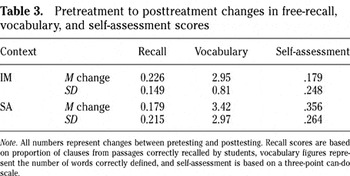
Changes over time on measures of reading comprehension—recall, vocabulary, and self-assessment—are shown in Table 3. ANCOVA results indicated no significant differences between IM and SA on free-recall and vocabulary measures. Significant differences were found between contexts on the reading self-assessment, F(3, 26) = 6.53, p < .05. SA participants felt more confident in their abilities to read over time than IM students.
Pretreatment to posttreatment changes in free-recall, vocabulary, and self-assessment scores

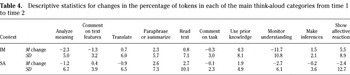
Reading process development, expressed in terms of changes in the percentage of the total number of think-aloud comments in each category, is depicted in Table 4. ANCOVA results showed significant differences between the SA and IM groups for only two categories: monitor understanding, F(3, 26) = 12.15, p < .01, and show affective reaction, F(3, 26) = 6.75, p < .05. The monitor-understanding category included thoughts indicating some assessment by the speaker of his or her understanding of overall text, individual phrases, words, characters, and so forth. Show-affective-reaction comments indicated some emotional reaction to the text and included expressing feelings or laughing about some aspect of text content. Affective comments indicating frustration over the difficulty of the text and not focusing on content were not included. See Table 2 for sample comments for individual think-aloud categories. Students in the IM group made fewer monitor-understanding comments over time than SA students and expressed more show-affective-reaction comments than their counterparts abroad.
Descriptive statistics for changes in the percentage of tokens in each of the main think-aloud categories from time 1 to time 2

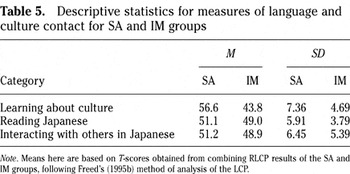
The RLCP data (see group statistics in Table 5) indicate that SA students spent more time reading and interacting with others in Japanese and learning about the culture than IM students. IM students spent more time interacting with their teachers outside of class than their SA counterparts. Interaction with teachers (one specific type of interaction with others in Japanese out of class) is an important contextual variable that will be discussed in connection with reading development later.
Descriptive statistics for measures of language and culture contact for SA and IM groups

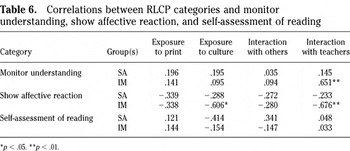
Regression and correlation data indicate no links between contact with language and culture (time spent reading in Japanese, interacting with others in Japanese, or learning about culture) and self-assessment scores (the only significantly different reading measure) for either the SA or the IM contexts (see Table 6 for correlations).
Correlations between RLCP categories and monitor understanding, show affective reaction, and self-assessment of reading

As far as reading processes are concerned, analyses of the SA data alone showed no significant relationships between the three key contact variables (time reading, time interacting with others, and time learning about culture) and changes in proportion of comments indicating monitoring of text understanding and showing affective reaction (the two reading processes where significant differences between contexts were seen). For IM data alone, several significant models were produced using setwise (best subset) regression.7
Although the sample size in this study was small, Stevens (1999) suggested that it is ample for best subset regression—in particular, for models including only one or two predictors. The power of any given model is decreased by increasing the number of predictors, especially when the sample size is small.
The lack of significant correlations between contact with language and culture and reading processes in the SA context can be largely explained by variability in these data. Greater variation is seen in all of the language and culture contact variables for the SA group than for IM. Levene's Test for Equality of Variance showed that these differences in variation were significantly greater for time learning about culture, F(1, 28) = 4.967, p < .05, and time reading in Japanese, F(1, 28) = 4.34, p < .05. Similarly, variability in both comprehension and process results was greater for the SA data in all cases (though significant only for vocabulary, F(1, 28) = 18.869, p < .001).
IM data showed much less variation than SA and allowed for more predictability, even in areas where significant differences were not found between SA and IM. For example, for the IM group, reading time predicted 39.2% of the gain in recall scores, F(1, 14) = 9.017, p < .01. No significant predictors were found for any measure for SA.
Qualitative Results
Qualitative data (e.g., observations, interviews, and diary entries) also point to large amounts of variability in SA and little in IM. SA students had nearly unlimited opportunities to explore and to engage in a broad range of activities out of class. Diary entries are filled with descriptions of travels, involvement with club and community activities, and interactions with both native and nonnative speakers of Japanese. On the other hand, IM diary entries included both positive and negative feelings about “being in a very controlled place,” “having such well-defined schedules,” and “not having much time or reason to get out and do anything.”
Qualitative analyses highlighted the importance of student-teacher office-hour interaction in terms of reading development for IM students. Analyses of researcher notes and tape recordings and transcriptions of classroom talk and office hours showed a contrast between what typically occurred during student-teacher office-hour interactions and what occurred during class. Certain types of questions were asked by teachers concerning reading materials during class: grammar oriented (e.g., “What are the subject and predicate of this sentence?”), fact oriented (e.g., “Who is the author talking about here?”), and background knowledge (e.g., “Have you ever eaten somen before? What did it taste like?”). Although some of these same questions also occurred during office hours, other types were noticeably less present in the classroom but very prominent in office-hour sessions: comprehension checks (e.g., “Do you understand that sentence?”), comprehension clarification (e.g., “What part of the sentence don't you understand?”), and requests for thoughts, reactions, and opinions (e.g., “What do you think of that?”). In short, questions during office hours focused more on checking and improving comprehension and eliciting affective reaction than classroom instruction. Overall, students were encouraged during office hours to go beyond the level of simple sentence comprehension (i.e., stop worrying about understanding every word, phrase, and sentence) and to think deeper about text meaning and about how to apply a text to oneself. One student comment illustrates this tendency:
I pushed myself to office hours again today. I finally got, after many visits, that [Teacher Name] was trying to get me to think over the story. She got me to thinking so that I had to produce my ideas—my thoughts and what are my opinions of the whole story. I only just realized that that's her major push. She wants me to think it over carefully and bring up my opinions and ideas when I'm reading with her.
Differences in contact time with teachers outside of class (in particular, office hours) between the two contexts can be explained by the general nature of each program. In the SA program, teachers interacted with students during class and occasionally during out-of-class excursions or activities. They also made themselves available daily for office hours (comparable to IM), but students seldom made use of those hours. In the IM context, teachers were told when they accepted employment that they would be expected to sacrifice personal time outside of class to interact with students on a regular basis. They were asked to eat and reside in dormitories with students and to attend and participate in daily educational events and weekly cultural activities. In response to questions sent following the completion of testing for this research, an IM student commented on his teachers as follows:
We eat with them, play with them, study with them, and some might even say we sleep with them. They're an ever-present part of our lives, so we can't help but get used to talking with them about anything. This all transfers over to our office hours. We take very [sic] chance we're able to get in with them and ask questions.
In contrast with the IM setting, students in the SA context failed to take advantage of teacher availability. Three students' comments illustrate this contrast between availability and students' use of teachers. One student noted:
I feel that the teachers are very accessible here (sometimes to the point where it seems like they really don't have much to do!)…. The teachers seem to be always available, in their office, but I'm not sure [h]ow many people actually go very often.
A second commented, “I usually didn't have any reason to go [to see the teachers].” A third student stated
There's so much to do here in Kyoto and so many other people we could know and get help from that it doesn't make sense to spend all our time with our teachers. We're with them four hours a day as it is.
Students knew their instructors were very available but did not seem to value this office-hour time as much as IM students.
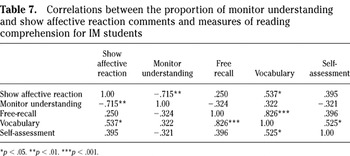
Given the apparent effects of interaction with teachers on reading processes in IM, it is important to answer the question of whether these changes in processes affected reading comprehension. If we are able to influence processes through such concentrated instruction, then we want to be certain to advocate only processes that lead to better comprehension. Significant correlations were found between proportion of show-affective-reaction comments and vocabulary and self-assessment scores for IM data (see Table 7). For these measures, better readers tended to make more comments indicating affective reaction. Contrary to this finding, Block (1986) found that less proficient readers tended to express affective thoughts related to a text more frequently than more proficient readers. Given this contradiction, a detailed qualitative analysis of IM readers' comments was conducted to investigate possible reasons for the contradiction. Students in the present study who expressed more affective reactions tended to be “integraters,” drawing on information from a variety of sources and using both top-down and bottom-up processes. In Block's study, less advanced students who made many affective comments were characterized as “nonintegraters.” Block's readers, who achieved minimal comprehension and were able to do little more than try to make some affective connection with the text, were led by these affective reactions on tangents down a “one-way bridge” away from flow of the text. In this study, better IM readers' affective comments were largely imagery oriented (e.g., “Now I'm reading this about the guy at the gas station and trying to imagine his voice in my head and it just sounds kind of funny [laughs].”). These readers did not get distracted from the text by their affective reactions but instead integrated them back into the reading and continued on.
Correlations between the proportion of monitor understanding and show affective reaction comments and measures of reading comprehension for IM students

Monitoring of understanding is a process seen in effective L1 and L2 readers (Block, 1986; Palincsar & Brown, 1984). Readers can be trained to monitor well, and this can have a positive impact on reading comprehension. One might therefore expect to find evidence of more comprehension monitoring by more advanced learners. In contrast with this, in the current study, more advanced readers (i.e., those with higher scores on comprehension measures) showed less comprehension monitoring. Given this apparent conflict, an analysis of monitor-understanding comments was conducted to determine the nature of the connection between monitoring and reading comprehension for the IM students. Statistical analyses showed no significant relationships between monitor understanding and any of the three reading-comprehension measures. However, an informal analysis of monitor-understanding data indicated that, over time, the proportion of IM comments focusing on vocabulary and characters (e.g., “I don't know this word and these characters”) decreased and the proportion and frequency of comments addressing understanding at the sentence level or above (e.g., “I'm not sure what this phrase/sentence means”) increased. Furthermore, the top seven readers all showed increases in comprehension monitoring at the sentence level or above. The complete lack of comments at or above the sentence level for many students prevented statistically significant findings in this area, but the qualitative data show a clear story: Better readers monitored less, but this decrease in monitoring was mostly attributable to fewer comments addressing character- and word-level comprehension.
DISCUSSION
The two main purposes of this research were: (a) to determine whether differences existed between two contexts (SA and IM) in terms of the development of reading comprehension and processes, and (b) to account for the effects that these two contexts might have on the development of reading skills.
Researchers comparing language learning during SA with domestic learning that occurs at one's home institution during the normal academic year—that is, the “at home” (AH) learning—have often found no significant differences in terms of gains on language measures between these contexts. This pattern has frequently been blamed on the use of inadequate tools to measure language gains. To increase the chances of capturing differences in gains between SA and IM students in this study, three distinctly different measures of reading comprehension were chosen. Significant differences between SA and IM contexts were found for only one of the three measures—self-assessment. The SA group felt more confident reading than IM learners. Other studies (e.g., Lapkin et al., 1995, Opper et al., 1990) have also found an advantage for SA over domestic (AH) learning on self-assessments. Although there may be flaws in the recall and vocabulary measures (see Swaffar et al., 1991, for a discussion of concerns related to the use of free recalls), it is clear from the lack of differences on these measures that studying in a 9-week IM program can produce gains in objective reading measures comparable to 11–12 weeks of SA. Huebner (1995) found greater gains on an objective measure of reading for SA learners than IM learners. However, his learners were at the beginning level. Huebner also noted that SA students were more motivated to learn to read than IM students. The current study found no indications of differences in terms of motivation to learn to read in any of the qualitative data between the SA and IM contexts. Student level (beginner vs. intermediate) likely contributed to the apparent conflict between the present study and Huebner's. This highlights the need to assess the specific advantages of departing for SA at varying times of one's language learning experience. It might be that the optimal experience would include both an early and then a later experience in the target culture.
Questions on the self-assessment involved many situations typically encountered while living in Japan but not in the United States (e.g., reading questions about health problems at a doctor's office or signs on store fronts). IM students, having less experience with these situations, felt less confident in their ability to deal with them. Growth in SA students' confidence reading could be associated with experience reading but might also be associated with an overall increase in self-assurance in terms of general linguistic competence. As learners struggled to function in the SA setting, they became accustomed to coping with less familiar situations, developed a variety of skills for managing these situations, and were therefore more confident tackling even the unfamiliar.
Common assumptions about SA might lead to the following conclusions concerning reading development in the SA context: (a) improved lower level processes would be brought about by large quantities of contact with the L2, and (b) increased background knowledge (much from exposure to culture) related to Japan would result in better top-down processes. These changes in processes would lead to better comprehension. Contrary to these expectations, contact with language and culture do not appear to have played this sort of role in terms of producing differences between SA and IM on measures of reading. However, it is noteworthy that time spent reading Japanese, interacting with others in Japanese, and learning about Japanese culture was greater for the SA group than IM. Furthermore, a variety of data related to contact with language outside of class served to explain two differences in processes between contexts, in spite of the failure of this data to prove an indirect connection between language and culture contact and reading comprehension development (via processes).
The greater degree of interaction in Japanese in the SA than the IM context is opposite the trend seen in another study that compares the SA, IM, and AH learning contexts and uses similar questions to elicit amount of contact with language outside of class (Freed, Segalowitz, et al., this issue). The difference in patterns of language contact between these studies highlights the need to be cautious over making any broad claims concerning language use during SA or IM based on this or any other single study. It is possible that the linguistic and cultural divides between the two languages involved in this study and that by Freed, Segalowitz, et al. (Japanese and French, respectively) could explain differences in interaction to some degree. One ought to take into account linguistic and cultural differences in addition to programmatic issues when designing and interpreting studies on context and language learning.
Significant differences were found between the IM and SA groups in the proportion of comments indicating comprehension monitoring and affective or emotional reaction to text content. No significant relationships were found between contact with language and culture and measures of reading comprehension or processes for the SA think-aloud data (i.e., quantitative data offered no explanation for variability in reading development for SA). For IM, three significant relationships were found: exposure to culture with changes in affective reaction to text content and interaction with teachers outside of class with patterns in affective reaction to text and comprehension monitoring.
IM students who reported greater exposure to culture tended to make fewer show-affective-reaction comments over time than those who reported less. To explore possible causes for a tie between time spent learning about culture and affective reaction to text, four main sources were used: (a) changes in other think-aloud categories, (b) wording of specific RLCP items, (c) individual show-affective-reaction comments, and (d) qualitative data from diaries, interviews, and observation notes. These data sources shed little light, and ultimately the only feasible explanation is that, as IM students became more familiar with Japanese culture, the contents of the Japanese readings were less striking than prior to the IM experience. For this reason, students were less inclined to laugh at or react to text content. Time spent in Japan prior to IM also correlated negatively with show affective reaction. Time in Japan could have also contributed to decreased content novelty and therefore fewer affective comments.
Interaction with teachers proved to be the most useful measure of language contact for explaining patterns in the development of reading processes seen in IM. IM students visited with teachers outside of class more than did SA students, and this contact correlated highly with changes in proportion of comments indicating comprehension monitoring and affective reaction to a text for these students. During office-hour interactions, IM teachers influenced students' processes by focusing questions on comprehension monitoring and affective reactions. Through extensive experience at monitoring with teachers, students became more efficient at monitoring: They made fewer monitor-understanding comments overall and monitored at the sentence level or above proportionally more. They also came to express affective thoughts more often. The potential for teacher impact on reading processes suggests the need for teachers to be well informed concerning processes that will lead to better comprehension and to tutor students in ways that will promote these effective processes and optimize students' language learning. Fortunately for the IM students in this study, the data indicates that increased affective reaction and efficient comprehension monitoring were both associated with better comprehension.
Another important finding—greater variation in SA data than IM—was most evident when comparing results from the RLCP, a measure of contact with language and culture outside of class. SA students showed significantly more variability on every aspect of contact than IM students. They were enticed by a wide range of activities outside of class and therefore were less likely to visit teachers during office hours. Their comments indicated that they had a variety of goals other than language learning, such as learning about culture, sightseeing, and getting far away from parents. This ability to achieve a variety of goals by participating in a wide range of activities, depending on one's expectations, needs, and personality, may be the key strength of SA.
Relatively little variation was seen in the IM data (in terms of both contact and reading measures). These students were in a very isolated environment and had few choices in terms of out-of-class activities. They had only their teachers as NS conversation partners. It should be emphasized that the IM experience described here is a unique one, where students are isolated not only by their geographical location but also by their living arrangements (e.g., dorms and cafeterias). Furthermore, the tradition of the language pledge in this particular IM context is a longstanding one, which students take very seriously. Aware of the rigor and demands of this specific program, IM students in this study were in general highly motivated. This motivation may have played an important role in terms of linguistic development.
To better understand the connections between study context (in particular, SA) and linguistic gains, better instruments will be necessary. The RLCP and self-assessment of reading used in this study were lengthy measures and occasionally took several sessions to complete.8
Although most students completed the entire RLCP at one time, a few students completed one part via the Internet and then returned at a later time or date to complete more. One or two students submitted parts of the RLCP at three different times.
This study measured reading development over the course of one semester abroad and 9 weeks of summer intensive instruction. It may be that developmental differences between contexts in reading would be more evident over longer periods of time. Davidson (2002) compared gains on measures of reading, speaking, and listening made by students abroad for 1 year with those abroad for one semester and for a summer. He found that the number of year-abroad students making gains of two threshold levels (the highest gain seen on his scale) in reading was nearly three times that of students abroad for one semester and over five times that of summer students. Speaking and listening showed similar patterns, providing strong support for the full year abroad. It is possible that if students in this study had been abroad for a year, the benefits of opportunities for out-of-class contact with language and culture in terms of reading development in SA would have been more evident. In short, additional research on the effects of length of study is necessary.
One other issue not addressed here is the contribution of general linguistic abilities (in particular, spoken L2 skills) to the development of reading comprehension. The close relationship between various linguistic skills (in particular, speaking and reading) during SA has been documented by Brecht and Davidson (1992), Brecht et al. (1995), and Lapkin et al. (1995). An interconnection between self-confidence in skill areas has also been shown, although confidence in reading has not typically grown as much as confidence in speaking and listening (Lapkin et al.; Meara, 1994). It is possible that reading was affected by developments in speaking in this study. Future work might include both reading and speaking and explore connections between these and other skills. Freed, Segalowitz, et al. (this issue) found a tie between time spent writing in the L2 and oral fluency development, hinting at the interactive nature of L2 skill development in SA and IM. Freed, Segalowitz, et al. also suggested the need for determining the potential impact of practicing specific linguistic skills on the development of other skill areas (e.g., practicing writing on speaking skills).
The strength of IM in terms of creating a controlled setting involving extensive use of the L2 and large amounts of contact with an instructor is evident from this study. The ability of a teacher to influence students' linguistic development in such a setting is especially apparent. It is important to further consider the role of the teacher both in and out of the classroom in both the SA and IM settings. Potential variables to measure or manipulate could be classroom instruction hours, amount of interaction with teachers outside of class (formally and informally), the nature of student-teacher interaction both in and out of class, and amount and nature of interaction with individuals other than instructors outside of class. The value of formal and informal instruction might depend both on study setting and student goals.
The comparison of SA and IM teacher interaction indicates that it was not availability alone that promoted interaction with students outside of class; rather, it was an environment that created multiple opportunities for students to interact with teachers and become comfortable visiting with them outside of class. Although it may be difficult for instructors wishing to promote student-teacher interaction outside of class (in particular, during office hours) to obtain a level comparable to that seen in this particular IM setting, these instructors may be able to emulate to some degree the proactive nature of the IM instructors in this study. These IM instructors purposely came in contact and spoke with their students during meals, in dormitory hallways, and during social events. Although careful to maintain appropriate professional distance from students, they developed a rapport with individuals and took every opportunity to answer questions about language and culture and to invite students to meet with them during more formal occasions such as office hours. Instructors in any setting might follow this example—in particular, by finding occasions to discuss language and culture outside of class and inviting students to continue discussions during office hours.
Those preparing students for SA might keep in mind the presence of extreme variability in terms of linguistic development and contact with language and culture seen in this and other studies. Given this variability, it appears that each individual is likely to participate in a unique experience and gain a rather particular set of skills through this experience. For this reason, it may be advisable to encourage students to establish goals in advance, select an SA program based on these goals, and then maintain habits while abroad that will facilitate the achievement of these goals. Students can largely determine their own out-of-class curricula based on their individual objectives. Hokanson (2000) found that accommodating students' individual learning styles and allowing them to achieve their own goals in a variety of ways led to similar gains on measures of speaking and writing proficiency, regardless of students' choices of learning activities. Although Hokanson's study was small in scale and largely qualitative, it highlights the potential positive impact of allowing individuals to mold their own unique learning experiences.
CONCLUSION
This study demonstrates the value of collecting a variety of data types and conducting both quantitative and qualitative analyses to gain a clearer understanding of how language develops and of what factors influence that development in various contexts. Multiple objective measures, self reports, interviews, and researcher observations complemented each other to produce clearer pictures of the SA and IM experiences and of reading development in these two contexts. In particular, these multiple sources clarified the degree of variability in the SA experience and the relative homogeneity of IM. They also provided an understanding of the impact of student-teacher office-hour interactions on reading. Studies with more data types and greater sample sizes will produce even clearer understandings of SA, IM, and other contexts.
As multiple instruments are used to measure connections between study contexts and linguistic gains, these instruments will need to be more carefully designed and refined. This study hints at the existence of differences between learning at home and abroad (in particular, functional literacy and the ability to apply newly acquired cultural knowledge when reading) that are not captured using measures typically used in reading research. If we are to capture gains in these or other areas, we need to develop new instruments to do so. As the research on context and learning continues to develop, the need for other measures focusing on specific areas where linguistic development is likely to occur in any given setting will no doubt continue to be evident.
References
REFERENCES
Alderson, J. C.
(1984).
Reading in a foreign language: A reading problem or a language
problem? In
J. C. Alderson &
A. H. Urquhart (Eds.),
Reading in a foreign language (pp.
1–27).
London:
Longman.
Bernhardt, E. B.
(1991).
Reading development in a second language: Theoretical, empirical,
and classroom perspectives.
Norwood, NJ:
Ablex.
Block, E.
(1986).
The comprehension strategies of second language readers.
TESOL Quarterly,
20,
463–494.CrossRefGoogle Scholar
Brecht, R., &
Davidson, D.
(1992).
Language acquisition gains in study abroad: Assessment and
feedback. In
E. Shohamy &
A. R. Walton (Eds.),
Language assessment for feedback: Testing and other strategies (pp.
87–101).
Dubuque, IA:
Kendall/Hunt.
Brecht, R.,
Davidson, D., &
Ginsberg, R.
(1995).
Predicting and measuring language gains in study abroad settings.
In
B. F. Freed (Ed.),
Second language acquisition in a study abroad context (pp.
37–66).
Amsterdam:
Benjamins.
Breiner-Sanders, K.,
Richter, J.,
Chi, T. R.
(1999, November).
Total language immersion programs: Outcomes and
assessments—the Middlebury experience.
Paper presented at the annual meeting of the American Council on
the Teaching of Foreign Languages (ACTFL), Dallas, TX.
Carrell, P. L.,
Devine, J., &
Eskey, D. E. (Eds.).
(1988).
Interactive approaches to second language reading.
New York:
Cambridge University Press.CrossRef
Carroll, J. B.
(1967).
Foreign language proficiency levels attained by language majors
near graduation from college.
Foreign Language Annals,
1,
131–151.CrossRefGoogle Scholar
Clark, J. D.
(1981).
Language. In
T. D. Barrows (Ed.),
College students' knowledge and beliefs: A survey of global
understanding (pp.
25–35).
Princeton, NJ:
Educational Testing Service.
Davidson, D.
(2002, October).
When just being there is not enough.
Paper presented at the Symposium on Language Gain and Study
Abroad, Forum on Global Languages and Cultures, University of
Wisconsin, Madison.
Dewey, D.
(2002).
The effects of study context and environment on the acquisition of
reading by students of Japanese as a second language during
study-abroad and intensive domestic immersion.
Unpublished doctoral dissertation,
Carnegie Mellon University,
Pittsburgh, PA.
Dewey, D.
(2003).
Japanese L2 vocabulary development and study context.
Unpublished manuscript,
University of Pittsburgh,
PA.
Dörnyei, Z.
(2003).
Questionnaires in second language research: Construction,
administration, and processing.
Mahwah, NJ:
Erlbaum.
Firth, A., &
Wagner, J.
(1997).
On discourse, communication, and (some) fundamental concepts in SLA
research.
Modern Language Journal,
81,
285–300.CrossRefGoogle Scholar
Firth, A., &
Wagner, J.
(1998).
SLA property: No trespassing.
Modern Language Journal,
82,
91–94.CrossRefGoogle Scholar
Freed, B. F.
(1995a).
Language learning and study abroad. In
B. F. Freed (Ed.),
Second language acquisition in a study abroad context (pp.
3–33).
Amsterdam:
Benjamins.
Freed, B. F.
(1995b).
What makes us think that students who study abroad become fluent?
In
B. F. Freed (Ed.),
Second language acquisition in a study abroad context (pp.
123–148).
Amsterdam:
Benjamins.
Gomes da Costa, B.,
Smith, T. M. F., &
Whitely, D.
(1975).
German language attainment: A sample survey of universities and
colleges in the UK.
Heidelberg, Germany:
Julius Gross Verlag.
Hill, C., &
Parry, K.
(1994).
Models of literacy: The nature of reading tests. In
C. Hill &
K. Parry (Eds.),
From testing to assessment: English as an international language (pp.
7–34).
London:
Longman.
Hokanson, S.
(2000).
Foreign language immersion homestays: Maximizing the accommodation
of cognitive styles.
Applied Language Learning,
11,
239–264.Google Scholar
Huebner, T.
(1995).
The effects of overseas language programs: Report on a case study
of an intensive Japanese course. In
B. F. Freed (Ed.),
Second language acquisition in a study abroad context (pp.
171–193).
Amsterdam:
Benjamins.
Johns, A., &
Mayes, P.
(1990).
An analysis of summary protocols of university ESL students.
Applied Linguistics,
11,
253–271.CrossRefGoogle Scholar
Kern, R.
(1995).
Redefining the boundaries of foreign language literacy. In
C. Kramsch (Ed.),
Redefining the boundaries of language study (pp.
61–98).
Boston:
Heinle & Heinle.
Kline, R.
(1998).
The acquisition of second language literacy in a study abroad
context.
Frontiers,
4,
139–166.Google Scholar
Lapkin, S.,
Hart, D., &
Swain, M.
(1995).
A Canadian interprovincial exchange: Evaluating the linguistic
impact of a three-month stay in Quebec. In
B. F. Freed (Ed.),
Second language acquisition in a study abroad context (pp.
67–94).
Amsterdam:
Benjamins.
Leki, I.
(2000).
Writing, literacy, and applied linguistics.
Annual Review of Applied Linguistics,
20,
99–115.CrossRefGoogle Scholar
McKee, E.
(1983).
The effects of intensive language instruction on student
performance in beginning college French.
(Report no. FL013910).
Washington, DC:
Center for Applied Linguistics
(ERIC Document Reproduction Service no. ED233601).
Meara, P.
(1994).
The year abroad and its effects.
Language Learning,
10,
32–38.CrossRefGoogle Scholar
Mori, M.
(1995).
Reading bilingually: Crosslinguistic study of reading comprehension
in English and Japanese by intermediate and advanced level Japanese
speakers of English as a second language (ESL) and English speakers of
Japanese as a foreign language (JFL).
Unpublished doctoral dissertation,
University of Minnesota,
Minneapolis.
Opper, S.,
Teichler, U., &
Carlson, J. (Eds.).
(1990).
Impact of study abroad programmes on students and graduates.
London:
Jessica Kingsley.
Palincsar, A. S., &
Brown, A. L.
(1984).
Reciprocal teaching of comprehension-fostering and
comprehension-monitoring activities.
Cognition and Instruction,
7,
117–175.Google Scholar
QSR International
(1999).
NUD*IST (Version 4.0 for Macintosh) [software].
Victoria, Australia:
QSR International.
Stevens, J. P.
(1999).
Intermediate statistics.
Mahwah, NJ:
Erlbaum.
Swaffar, J. K.,
Arens, K. M., &
Byrnes, H.
(1991).
Reading for meaning: An integrated approach to learning language.
Englewood Cliffs, NJ:
Prentice-Hall.
Swain, M., &
Johnson, R. K.
(1997).
Immersion education: A category within bilingual education. In
R. K. Johnson &
M. Swain (Eds.),
Immersion education: International perspectives (pp.
1–16).
New York:
Cambridge University Press.
Tarone, E.
(2000).
Still wrestling with “context” in interlanguage theory.
Annual Review of Applied Linguistics,
20,
165–171.CrossRefGoogle Scholar
Urquhart, S., &
Weir, C.
(1999).
Reading in second language: Process, product, and practice.
London:
Longman.
Warnick, J. P.
(1996).
A phenomenology of reading performances: Reading Japanese as a
foreign language.
Unpublished doctoral dissertation,
The Ohio State University,
Columbus.
IM and SA group demographic statistics, means, and standard deviations (in parentheses)

List of think-aloud categories
Pretreatment to posttreatment changes in free-recall, vocabulary, and self-assessment scores
Descriptive statistics for changes in the percentage of tokens in each of the main think-aloud categories from time 1 to time 2
Descriptive statistics for measures of language and culture contact for SA and IM groups
Correlations between RLCP categories and monitor understanding, show affective reaction, and self-assessment of reading
Correlations between the proportion of monitor understanding and show affective reaction comments and measures of reading comprehension for IM students
 You have
Access
- 106
- Cited by