





Introduction
On December 14, 2011, a quiet street in Seoul’s Chongno District became the stage for a powerful act of remembrance. Before the Japanese Embassy, a bronze statue of a Korean girl in hanbok took its seat accompanied by an empty chair—the P’yŏnghwaŭi Sonyŏsang [Statue of a Girl for Peace], widely known as the “Comfort Women” Statue. This unassuming yet evocative figure came to embody the silenced voices of the “comfort women.”Footnote 1
The statue’s unveiling marked a historic milestone—the 1,000th Wednesday Demonstration, part of a decades-long movement led by the Korean Council for the Women Drafted for Military Sexual Slavery by Japan (hereafter the Korean Council). Since 1992, these weekly protests have served as an enduring symbol of postcolonial resistance and resilience in the face of historical denial and gendered violence. The public acknowledgment of this state- and military-driven sexual violence emerged only in the 1990s, when some victim-survivorsFootnote 2 broke decades of silence with their courageous testimonies, supported by persistent advocacy from nongovernmental organizations (NGOs) in South Korea, Japan, and the wider Asia-Pacific region (Ahn Reference Ahn2015; Min Reference Min2003). In South Korea, the first public testimony by victim-survivor Kim Hak-sun (1924–1997) on August 14, 1991, marked a crucial turning point in confronting the long-silenced history of military sexual slavery.Footnote 3
Nonetheless, the “comfort women” issue remains a persistent subject of political and historical dispute. The central point of contention concerns the coercive nature of the “comfort system,” particularly with regard to questions of legal and political accountability for the Japanese state and military involvement (Yoshimi Reference Yoshimi, Richter and Höpken2003). In recent years, the Japanese government has officially denied the state’s and military’s involvement in the forcible mobilization of victims (Ministry of Foreign Affairs of Japan n.d.), thereby overturning the position articulated in the 1993 Kono Statement.Footnote 4 This regression in historical consciousness is closely tied to Japan’s broader rightward political shift, with former Prime Minister Shinzo Abe (2006–2007, 2012–2020) of the conservative Liberal Democratic Party playing a central role in consolidating political power (Kim Reference Kim2017).
Since the installation of the first Statue of a Girl for Peace in Seoul, numerous replicas have been disseminated, installed, and exhibited in cities around the world, including Berlin, New York, Shanghai, Sydney, and Toronto. The impetus for this transnational proliferation can be traced to the controversial 2015 Comfort Women Agreement between the governments of South Korea and Japan, which sought to resolve the “comfort women” issue “finally and irreversibly” (Ministry of Foreign Affairs, Republic of Korea 2015). The bilateral agreement included the removal of the statue in front of the Japanese Embassy in Seoul and the establishment of the Foundation for Reconciliation and Healing to offer financial support to the surviving victims. However, the exclusion of victim-survivors from the negotiation process provoked widespread public criticism and discontent among advocacy groups. This dissatisfaction, in turn, catalyzed the proliferation of “comfort women” memorials both within South Korea and across the globe (Kwon Reference Kwon2019). The transnational proliferation of the “comfort women” memorial has frequently provoked diplomatic tensions with the Japanese government, leading in several cases to their removal or relocation.
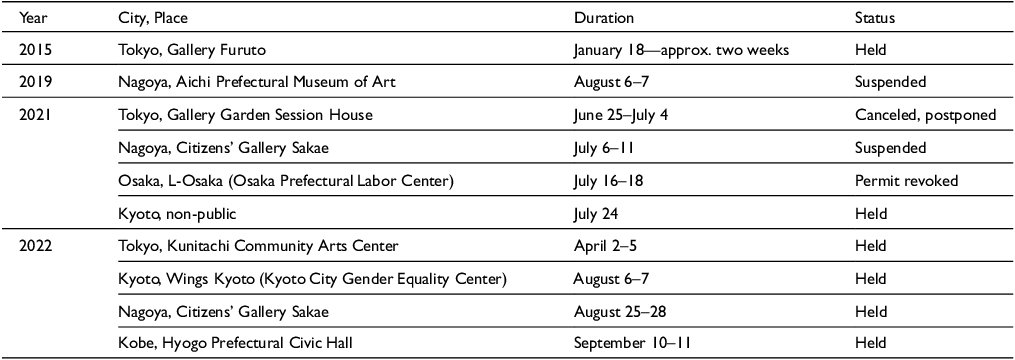
In Japan, the Statue of a Girl for Peace has operated as a mobile and temporary exhibit. The shift from a permanent public monument to a transient, exhibition-based installation reflects a strategic adaptation to Japan’s sociopolitical context, where permanent memorialization remains impossible. Since 2015, it has circulated as a traveling memorial within the frame of the Hyōgen no fujiyūten [Non-Freedom of Expression Exhibition]—a series of exhibitions in major Japanese cities including Tokyo, Nagoya, Osaka, and Kyoto that foreground the suppression of politically sensitive artworks (Table 1). Despite its impermanence, the memorial has not escaped controversy. It has been subjected to sustained attacks by far-right groups and to censorship pressures from local authorities, resulting in repeated cancellations and postponements.
List of exhibitions in Japan

Table 1. Long description
The table lists exhibitions in Japan, detailing the year, city, place, duration, and status of each event. It has six columns: Year, City, Place, Duration, and Status. The table includes the following rows: 2015, Tokyo, Gallery Furuto, January 18—approx. two weeks, Held; 2019, Nagoya, Aichi Prefectural Museum of Art, August 6–7, Suspended; 2021, Tokyo, Gallery Garden Session House, June 25–July 4, Canceled, postponed; 2021, Nagoya, Citizens’ Gallery Sakae, July 6–11, Suspended; 2021, Osaka, L-Osaka (Osaka Prefectural Labor Center), July 16–18, Permit revoked; 2021, Kyoto, non-public, July 24, Held; 2022, Tokyo, Kunitachi Community Arts Center, April 2–5, Held; 2022, Kyoto, Wings Kyoto (Kyoto City Gender Equality Center), August 6–7, Held; 2022, Nagoya, Citizens’ Gallery Sakae, August 25–28, Held; 2022, Kobe, Hyogo Prefectural Civic Hall, September 10–11, Held.
This article focuses on the Kyoto exhibition, held from August 6 to 7, 2022, to trace the transnational trajectory of the Statue of a Girl for Peace and analyze the spatial and political contestations surrounding its display. The study demonstrates how the memorial has been transculturally recontextualized across distinct cultural and sociopolitical settings. The analysis draws primarily on fieldnotes and interviews conducted during two months of fieldwork in Japan.
Held in a highly charged political climate, the Kyoto exhibition was organized under strict secrecy at Wingusu Kyōto [Wings Kyoto], the Kyoto City Gender Equality Center. Tickets were released online a month in advance; however, the venue information was disclosed only four days prior to the event via postal mail, underscoring the organizer’s efforts to preempt interference. In addition, visits were restricted to a fixed time and duration of 50 minutes due to COVID-19 regulations in place during the summer of 2022. It was fortunate for me to have met the initiator, Okamoto Yuka, prior to the exhibition, as this personal connection allowed me to receive detailed information directly from her—access that would have otherwise been difficult given the confidentiality surrounding the event. This precautionary approach not only reveals the volatile conditions under which the statue is displayed in Japan but also illuminates the broader entanglement of memory politics, censorship, and right-wing resistance that continues to shape contestations over the history of the “comfort women.”
Traveling “comfort women” memorial
Globalization has significantly influenced how collective memories are formed, transmitted, and reinterpreted, enabling them to move beyond national and cultural boundaries. Scholars of memory studies describe this development as part of the “third phase” of memory, marked by the global circulation of memories through media, migration, and transnational encounters. Astrid Erll introduced the concept of “travelling memory,” which emphasizes not only the movement of memory across borders but also its transformation within new sociopolitical and cultural settings (Erll Reference Erll2011). This framework, situated within the broader discourse of transcultural memory, foregrounds the fluidity, adaptability, and situatedness of memory as it traverses diverse locales (Erll Reference Erll2014; Erll and Nünning Reference Erll and Nünning2014).
Within this context, the “comfort women” memorial offers a compelling example of how memory symbols circulate globally and acquire new meanings in varied settings. While existing scholarship has extensively analyzed the Japanese government’s opposition to the global proliferation of these statues (e.g., Ushiyama Reference Ushiyama2021; Yoon Reference Yoon2018; McCarthy and Hasunuma Reference McCarthy and Hasunuma2018), comparatively little attention has been paid to the memorial’s exhibition within Japan itself (Shin Reference Shin2020; McNeill Reference McNeill2019). This article addresses this gap by presenting the first detailed analysis of the “comfort women” memorial as presented in the 2022 Non-Freedom of Expression Exhibition in Kyoto.
Theoretically, this study contributes to the existing literature by shifting the analytical lens from a transnational to a transcultural perspective (e.g., Hasunuma and McCarthy Reference Hasunuma and McCarthy2019; Yoon Reference Yoon2019; Yoon Reference Yoon2018; McCarthy and Hasunuma Reference McCarthy and Hasunuma2018; Son Reference Son2018; Schumacher Reference Schumacher2021). Earlier studies have largely focused on how Korean diaspora communities transmitted the memorial across borders, transforming mnemonic narratives into global norms. However, these studies have not sufficiently examined how memories are reinterpreted within new cultural and sociopolitical environments by local memory agents.
Building on recent developments in memory studies, this article explores the dynamic interplay between mobility and locality in the production of transcultural memory. As Dorr et al. (Reference Dorr, Erll, Högerle, Vickers and Wegner2019: 2) observe, “[m]emory, we argue, exists in a dynamic tension between travel and locatedness.” Drawing upon Erll’s theoretical framework of traveling memory, this study examines how the “comfort women” memorial operates as an object of transcultural memory within Japan, focusing particularly on its exhibition in Kyoto.
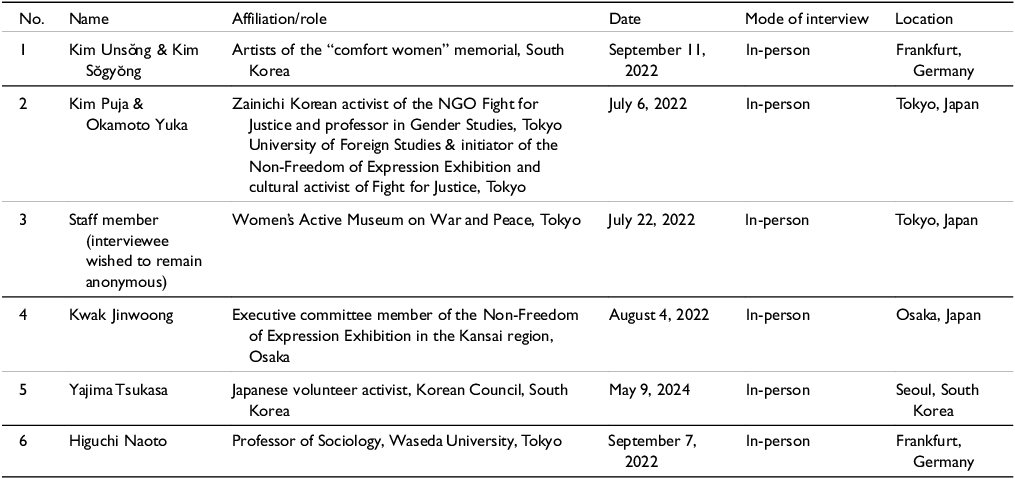
Methods
This study employed a qualitative research design, incorporating six semi-structured interviews with participant observation, primarily conducted during fieldwork in Japan between June and August 2022 (Table 2). Interviews were carried out in Japan, Germany, and South Korea with individuals who played key roles in the production of the statue, the organization of exhibitions in Japan, and the broader “comfort women” redress movement, as well as a scholar specializing in Japan’s far-right organizations. Two of the interviews were conducted in a group setting, each involving two interviewees. With the exception of one case, all interviews were audio-recorded with participants’ consent and subsequently transcribed to ensure accuracy and provide a textual basis for analysis. Owing to situational constraints, one interview could not be recorded; detailed notes were taken instead.
List of interviewees

Table 2. Long description
The table lists interviewees with their affiliations, roles, interview dates, modes, and locations. It has six rows and five columns. The columns are labeled No., Name, Affiliation/role, Date, Mode of interview, and Location. Row 1: No. 1, Name Kim Unsng & Kim Sgyng, Affiliation/role Artists of the comfort women memorial, South Korea, Date September 11, 2022, Mode of interview In-person, Location Frankfurt, Germany. Row 2: No. 2, Name Kim Puja & Okamoto Yuka, Affiliation/role Zainichi Korean activist of the NGO Fight for Justice and professor in Gender Studies, Tokyo University of Foreign Studies initiator of the Non-Freedom of Expression Exhibition and cultural activist of Fight for Justice, Tokyo, Date July 6, 2022, Mode of interview In-person, Location Tokyo, Japan. Row 3: No. 3, Name Staff member (interviewee wished to remain anonymous), Affiliation/role Womens Active Museum on War and Peace, Tokyo, Date July 22, 2022, Mode of interview In-person, Location Tokyo, Japan. Row 4: No. 4, Name Kwak Jinwoong, Affiliation/role Executive committee member of the Non-Freedom of Expression Exhibition in the Kansai region, Osaka, Date August 4, 2022, Mode of interview In-person, Location Osaka, Japan. Row 5: No. 5, Name Yajima Tsukasa, Affiliation/role Japanese volunteer activist, Korean Council, South Korea, Date May 9, 2024, Mode of interview In-person, Location Seoul, South Korea. Row 6: No. 6, Name Higuchi Naoto, Affiliation/role Professor of Sociology, Waseda University, Tokyo, Date September 7, 2022, Mode of interview In-person, Location Frankfurt, Germany.
Interviews conducted in Korean were transcribed using the Clova and cross-checked by the author, while the English-language interviews were transcribed directly by the author. For the translation of the interview content and quotations used in this paper, ChatGPT was employed, with care taken to exclude interviewees’ names and other identifying information.
The data from the semi-structured interviews underwent the focused analysis of qualitative interviews with the assistance of MAXQDA software (Rädiker and Kuckartz Reference Rädiker and Kuckartz2020). The data was coded according to the categories developed from prior literature, as well as the study’s theoretical framework.
Transnational memory activism confronting state’s historical denialism
The cross-border movement of the “comfort women” memorial was facilitated through transnational collaboration between the Korean artists of the statue Kim Sŏgyŏng and Kim Unsŏng based in South Korea and the initiator of the exhibition, Okamoto Yuka, a Japanese cultural activist affiliated with the NGO Fight for Justice in Tokyo dedicated to research and education on the “comfort women” issue. Okamoto has long worked on the “comfort women” issue alongside Kim Puja, a Zainichi KoreanFootnote 5 activist and Professor of Gender Studies at the Tokyo University of Foreign Studies. Since 2012, they have jointly operated a website within Fight for Justice, collaborating with prominent historians on the “comfort women” issue such as Yoshimi Yoshiaki and Hayashi Hirofumi.Footnote 6 The initiative aims to accurately inform the public about the issue and has engaged in various publications and educational activities. For Okamoto, who identifies herself as a cultural activist, organizing an artistic exhibition on the “comfort women” issue has been an essential means of engaging younger generations in Japan.
Constrained by limited financial resources, the artists transported the memorial to Japan themselves for its first exhibition in Tokyo, Japan, opting to construct it from fiber-reinforced plastic instead of bronze, the material used in the original Seoul statue.Footnote 7 This material choice was strategic, allowing the statue to be disassembled into three parts for easier transport and reassembly—an adaptation that reflects both logistical ingenuity and sensitivity to geopolitical constraints. According to the artists, by 2015, the growing international visibility of the “comfort women” memorial risked complicating its border-crossing into Japan, where right-wing resistance to the memorial had already been persistent.Footnote 8 After the exhibition, the artists left the “comfort women” memorial in Japan, entrusting its full care and responsibility to Okamoto Yuka.Footnote 9
The idea of exhibiting the “comfort women” memorial in Japan is closely linked to an earlier incident of censorship in 2012, when a miniature of the statue was removed from the JAALA International Exchange Exhibition at the Tokyo Metropolitan Art Museum after just four days. In an interview with the statue’s artists, they remembered that this removal occurred without prior notice, and museum officials justified the decision by claiming that the statue might make viewers “uncomfortable.”Footnote 10 This act of suppression served as a catalyst for curator Okamoto Yuka, who proposed the creation of an alternative exhibition platform that would challenge institutional censorship. Her vision materialized in the form of the artistic exhibition Non-Freedom of Expression, which sought to display the “comfort women” memorial alongside other artworks similarly censored and suppressed by Japanese authorities. In a declaration published on her Facebook page, Okamoto Yuka explicitly stated that the exhibition sought to “restore the rights and dignity of the ‘erased things’ by collecting works of art that have been deprived of the opportunity to express themselves in public facilities and spaces” (Okamoto Reference Okamoto2021).
Yamaguchi argues that the censorship of the “comfort women” memorial is closely tied to the Japanese right-wing’s belief that eliminating the memorials constitutes a central battleground in their so-called rekishisen [history wars] (Yamaguchi Reference Yamaguchi2020a). This term was first introduced in a 2014 series published by Japan’s conservative national newspaper Sankei Shimbun, which framed Japan’s disputes with its neighboring countries—particularly South Korea and China—as struggles over the interpretation of Japan’s colonial past. The invocation of “war” in this term reflects the logic of revisionist narratives that portray the “comfort women” as a fabrication designed to inflame diplomatic conflicts and to promote a biased, negative portrayal of Japan within the international community—an effort allegedly driven by China, South Korea, the Japanese left, and the liberal media.
Historical revisionism gained momentum in the 1990s, with the “comfort women” issue emerging as one of its central points of contention (Yamaguchi Reference Yamaguchi2020a; Ahn Reference Ahn, Saaler and Schwentker2008). As public awareness of the “comfort women” issue grew, movements of historical revisionism developed in parallel, seeking to downplay Japan’s wartime responsibilities. At the core of revisionist discourse lies the denial of state and military involvement in the establishment of the “comfort system,” the forced recruitment of the girls and women, and the accepted estimates of victim numbers (Ahn Reference Ahn, Saaler and Schwentker2008; Yamaguchi Reference Yamaguchi2020a). This revisionist logic corresponds with the Japanese government’s contemporary stance. In recent years, the Ministry of Foreign Affairs of Japan has officially refuted: (1) claims of direct state and military involvement in the forced mobilization of women; (2) the use of the term “sex slaves,” as defined by the United Nations; and (3) widely accepted estimates of the number of victims (Ministry of Foreign Affairs of Japan n.d.). In doing so, it has effectively overturned the position articulated in the 1993 Kono Statement. The institutionalization of this revisionist orientation was reinforced under the administration of former Prime Minister Shinzo Abe of the conservative Liberal Democratic Party, who actively sought to recast Japan’s wartime history within a broader framework of history revisionism and national restoration (Kim Reference Kim2017; Yamaguchi Reference Yamaguchi, Min, Chung and Yim2020b).
Against this backdrop, the exhibition of the “comfort women” memorial in Japan functions as an act of memory activism, challenging the official and hegemonic memory regime (Gutman and Wüstenberg Reference Gutman and Wüstenberg2023). Through its spatial and symbolic interventions, the memorial seeks to recover suppressed histories and to confront dominant narratives. This symbolic act of resistance is deeply rooted in long-standing grassroots initiatives that seek to counter what Aleida Assmann terms the politics of “active forgetting”—the deliberate attempt to erase specific historical memories (Erll and Nünning Reference Erll and Nünning2008: 104–5). In this context, the memorial confronts both official state denial and far-right campaigns aimed at erasing this historical episode and evading subsequent historical accountability.
A leading institutional example of such memory activism is the Women’s Active Museum on War and Peace in Tokyo (hereafter WAM), founded in 2005 by feminist journalist and activist Matsui Yayori (1934–2002). As the only museum in Japan dedicated to documenting the Japanese military’s system of sexual slavery, WAM plays a vital role in preserving and disseminating marginalized narratives. Importantly, WAM’s status as a private, nonprofit organization has largely shielded it from direct intervention by government authorities and far-right groups.Footnote 11 By contrast, public institutions that engage with the “comfort women” issue—particularly when advocating for compensation or staging public exhibitions—often provoke severe backlash for allegedly misusing taxpayer resources to promote a “politicized” narrative. In this contentious context, WAM’s independent institutional framework thus provides a relative degree of protection, enabling it to maintain its critical stance and continue its memory activism within a hostile mnemonic landscape.
However, the “comfort women” memorial has neither been installed nor publicly exhibited at WAM; instead, it remains in storage at an undisclosed location.Footnote 12 This absence can be attributed, in part, to the statue’s propensity to provoke strong opposition from governmental actors and attacks from far-right groups. Simultaneously, debates within WAM also reflect differing perspectives on the statue’s representational scope. According to a WAM staff member, the memorial embodies a commemorative culture closely associated with a particular ethnic and national group—namely that of South Korea.Footnote 13 This view reflects a long-standing tension between Korean and Japanese scholars and activists regarding how the experiences of the “comfort women” should be approached and understood (Min Reference Min2003; Yamashita Reference Yamashita2009). Korean activists and scholars have generally emphasized the suffering of Korean victims from the perspective of colonial subjugation, highlighting the structural violence experienced by Korean victims under Japanese colonial rule. In contrast, Japanese activists and scholars have often argued that, because victims came from multiple countries, the issue should be approached primarily through a gender-based framework that foregrounds shared experiences of wartime sexual violence. Viewed in this light, the “comfort women” memorial can be seen as revealing an inherent limitation of collective memory: while it powerfully represents and commemorates Korean victims, it does not necessarily encompass the diverse experiences of victims from other regions. Consequently, the memorial raises broader questions about the challenges of representing the history of the “comfort women” as transnational memory through a single commemorative form.Footnote 14
Contesting the public sphere: translocal collaborations
As previously discussed, exhibiting the “comfort women” memorial emerged from transnational collaboration between Japanese activist Okamoto Yuka and Korean artists, both acting as agents of memory production and transmission. However, what proved to be more crucial in the exhibition’s realization was the translocal collaboration among activists across Japan—particularly Tokyo, Osaka, and Kyoto—who navigated the spatial politics of an increasingly contested public sphere.
A key figure in this local coalition was Kwak Jinwoong—a third-generation Zainichi Korean born in Osaka and a prominent human rights activist. Kwak played a central role in the exhibition’s executive committee in the Kansai region, which includes Kyoto and Osaka. He is also a founding member of Korea NGO, an Osaka-based human rights organization established in 2004 by second- and third-generation Zainichi Koreans. The organization operates as a critical platform for addressing structural discrimination and advocating for the rights of ethnic Koreans in Japan. Together with a junior high school teacher in Osaka dedicated to teaching the history of the “comfort women”—despite its exclusion from the official school curriculumFootnote 15 —and a member of an Anglican religious group, Kwak co-organized the exhibitions in the Kansai region.Footnote 16 Their collaboration exemplifies how diverse local actors cooperate to assert marginalized narratives within public discourse.
According to Kwak, officials of the Osaka government justified their restrictions by citing security concerns over potential disturbances from far-right groups when a “politically charged event” is held in a public hall.Footnote 17 This rationale mirrored earlier cases, such as the suspension of the Nagoya exhibition in July 2021, when municipal authorities halted the event after it provoked disruptions by far-right groups, including the receipt of a package resembling fireworks that detonated (Kurahashi Reference Kurahashi2025). These incidents reveal a broader pattern of institutional resistance, in which local governments preemptively restrict access to public spaces in response to anticipated political controversy. Rather than safeguarding civic dialogue, these measures effectively serve to regulate the mnemonic landscape by suppressing the visibility of counter-narratives.
As noted by the exhibition’s initiator, Okamoto Yuka, earlier exhibitions encountered sustained attack and harassment from far-right groups.Footnote 18 Members of the Tokyo Exhibition Executive Committee—including Okamoto herself—received a series of threatening emails over the two months preceding the planned 2021 exhibition at a private gallery in Tokyo. Many of these messages contained misogynistic and discriminatory language and ultimately led to the exhibition’s postponement. A formal report was filed, and a suspect was arrested on suspicion of making criminal threats. For Okamoto, making the existence of these threats publicly visible was essential to exposing the broader climate of hostility surrounding critical engagement with historical memory in Japan.
The postponed Tokyo exhibition was ultimately held at the Kunitachi Community Arts Center, a public cultural facility, from April 2 to 5, 2022, and was visited by approximately 600 visitors.Footnote 19 The exhibition drew protests from approximately 40 far-right groups, comprising over 100 individuals. Among the protesters was Sakurai Makoto, leader of the Japan First Party and a prominent figure in Zainichi Tokken o yurusanai Shimin no Kai [Association of Citizens against the Special Privileges of the Zainichi]. Founded in 2007, this nativist-oriented group has actively campaigned against what they perceive as the “privileged” status of ethnic Koreans in Japan and has targeted Korean communities through hate speech, demonstrations, and physical violence (Higuchi Reference Higuchi, Chiavacci, Grano and Obinger2020). At the Tokyo exhibition, far-right groups demanded the termination of the exhibition, claiming it displayed a statue that allegedly fabricated the history of the “comfort women” and insulted the emperor.Footnote 20 Their rhetoric also included xenophobic calls for Zainichi Koreans to leave Japan. In anticipation of potential threats, approximately 300 staff members, including lawyers, and around 300 police officers were mobilized to protect the exhibition and its organizers.
Similar to the Tokyo exhibition, the subsequent Kyoto exhibition in August 2022 was held in a public facility, generating tensions with the local government over the politics of the public sphere, in addition to opposition from far-right groups. Paradoxically, however, exhibiting in public facilities also created strategic opportunities for the organizers. Although such exhibitions have repeatedly attracted interference and resistance from local authorities, this opposition, in turn, opened avenues for legal recourse.
In response to the decision by Osaka authorities to block the exhibition scheduled for July 2021 at L-Osaka, the Osaka Prefectural Labor Center, the organizers—supported by local lawyers—filed a lawsuit arguing that the decision constituted a violation of civil rights.Footnote 21 As Kwak Jinwoong highlights, this legal struggle played a crucial role in asserting the right to use public facilities for future exhibitions, beginning with the postponed Tokyo exhibition held at the Kunitachi Community Arts Center and later extending to the exhibition held in Kyoto. Significantly, the lawsuit was funded through crowdfunding, symbolizing both the fragility of institutional support and the resilience of civil society. The Supreme Court’s ruling in favor of the organizers represented a critical milestone, fundamentally redefining the parameters of public facility usage and strengthening the possibilities for civic engagement in highly contested arenas of historical memory.
Thus, the Kyoto exhibition exemplified the vital role of translocal networks as both practical and symbolic resources within Japan’s contested memory politics. The collaboration among activists and individuals across Tokyo, Osaka, and Kyoto demonstrated the strategic importance of shared knowledge, regional coordination, and legal mobilization. These alliances were not only instrumental in addressing logistical and legal challenges but also symbolically significant, as they embodied a collective form of resistance that transcended municipal boundaries. By pooling resources and expertise, the organizers ensured the exhibition’s successful execution despite sustained opposition, highlighting how translocal cooperation has become indispensable in confronting state-imposed constraints in the ongoing struggles over historical memory in Japan.
Transcultural recontextualization
Beyond its material transformation—from a bronze statue to one made of fiber-reinforced plastic—the movement and relocation of the Statue of a Girl for Peace, through transnational and translocal efforts, have transformed the “comfort women” memorial into what Astrid Erll conceptualizes as transcultural memory. According to Erll, as memories circulate across national borders, they are not simply transmitted but are dynamically reshaped through processes of local reinterpretation, mediation, and appropriation (Erll Reference Erll2011). Within this framework, the display of the Kyoto memorial as part of the Non-Freedom of Expression Exhibition illustrates such a reconfiguration. Positioned alongside 13 other politically censored artworks, the statue’s meaning was reframed within a broader curatorial narrative addressing contested historical memory and state suppression.
The exhibition featured works by Korean, Japanese, and Zainichi Korean artists that engaged with a range of politically sensitive subjects. While several pieces directly addressed the “comfort women” issue, others engaged with themes such as the Shōwa Emperor’s reign (1926–1989) during Japan’s imperial expansion; the forced mobilization of Korean laborers during Japan’s wartime; and the 2011 Fukushima nuclear disaster. Collectively, these topics problematized the Japanese state’s responses to imperial legacies and more contemporary crises—contexts in which questions of accountability and responsibility remain both enduring and intensely contested.
Significantly, the “comfort women” memorial was displayed alongside Chinkonka [Requiem], an installation by Japanese artist Mori Taeko, as noted by Okamoto Yuka (Figure 1).Footnote 22 Okamoto highlighted that Mori’s work emerged as a direct artistic response to her encounter with the “comfort women” memorial, underscoring the emotional and conceptual impact the statue had on Japanese viewers. Upon learning about the statue, Mori expressed a deep sense of empathy, which served as the impetus for her piece—featuring butterflies arranged within a mesh net, a symbolic motif associated with the victims of the “comfort system.” This pairing of works not only reinforces the transnational resonance of the “comfort women” narrative but also reveals a process of cultural translation and reinterpretation within a Japanese context.
P’yŏnghwaŭi Sonyŏsang by Kim Sŏgyŏng and Kim Unsŏng and Chinkonka by Mori Taeko. Photo taken by the author.

In parallel, and reinforcing this dialogic relationship between the two works, Chinkonka, like the “comfort women” memorial—which encourages viewers not merely to observe but also to interact, such as by sitting beside the seated figure—was designed to invite audience participation. The installation included instructions prompting visitors to add butterflies onto a net, thereby transforming spectators into active participants in the production of meaning. Such participatory practices can be understood as affective and embodied mechanisms that cultivate empathy and prompt critical reflection on the suppressed history of the “comfort women” in Japan.
Moreover, Okamoto Yuka also highlighted a painting titled Tsugunawanakereba naranai koto [What Requires Reparations] (Figure 2), created by Cho Yŏnsu, a Zainichi Korean student, in explicit opposition to the 2015 Comfort Women Agreement between the Japanese and the South Korean governments. In the foreground of the artwork, the victims of the “comfort system” are portrayed with faces that are heavily distorted, marked by tear-filled eyes. While four figures have mouths from which pain-filled voices seem to burst forth from the depth of the soul, one figure is portrayed without a mouth, thereby symbolizing the enforced silence they endured for nearly half a century. In the background, the artist represents Japanese soldiers using only helmets and eyes, a visual strategy that both evokes the dehumanizing conditions of war and suggests that even perpetrators were subsumed under a system that eroded individual agency and human rights.
Tsugunawanakereba naranai koto by Cho Yŏnsu. Photo taken by the author.

This critical artwork became a focal point of contention with local authorities. First exhibited in 2016 at the 45th Student Art Exhibition in Chiba—an event held since 1972 by the Chiba Korean Elementary-Middle School (an ethnic Korean school in Chiba prefecture, Japan), in collaboration with local Japanese schools—the painting, alongside another work addressing the “comfort women” issue, provoked a swift political response. In reaction to these works, Chiba Mayor Kumagai Toshihito (2009–2021) withdrew the municipal funding previously allocated to the school for the exhibition, arguing that the event was intended to foster local exchange rather than serve as a platform for political critique of the government.
This act of political intervention underscores the persistent institutionalized censorship surrounding the “comfort women” issue in Japan. Echoing broader controversies over memorialization, such as the disputes surrounding the “comfort women” memorials, this incident reveals how local authorities continue to delimit the boundaries of public memory, actively excluding and marginalizing contested histories from Japan’s public sphere.
Crucially, this critical artwork not only engages with the “comfort women” issue but also points to the broader historical experiences of Zainichi Koreans residing in Japan. The Chiba Korean Elementary-Middle School itself was founded in 1946, shortly after Japan’s surrender, by Korean forced laborers who had been brought to Chiba and surrounding cities during Japan’s colonial rule over Korea (1910–1945) (Sohn Reference Sohn2018). The mobilization of Korean laborers unfolded in three distinct phases: beginning with the recruitment in 1939, followed by official mediation in 1942, and culminating in compulsory national conscription in 1944 (Kim Reference Kim2020). In particular, Koreans were assigned to exploitative labor conditions, such as coal mining and heavy industry, as Japan faced growing labor shortages following the outbreak of the Second Sino-Japanese War in 1937.
Building on this history, the emergence of ethnic Korean schools in Japan, as the one in Chiba, can be understood as part of the Zainichi community’s broader efforts to preserve their language, culture, and ethnic identity in the aftermath of colonial rule. Following the outbreak of the Korean War (1950–1953) and the subsequent division of the Korean peninsula, two major Zainichi Korean organizations—Ch’ongnyŏn and Mindan—were established in Japan, representing pro–North and pro–South orientations respectively. As Japan’s relationship with North Korea deteriorated, particularly amid the revelations of state-sponsored abductions of Japanese citizens during the 1970s and 1980s, ethnic Korean schools affiliated with Ch’ongnyŏn increasingly became targets of political suspicion, were excluded from governmental subsidies, and faced escalating social discrimination (Ha Reference Ha2020). This historical context forms an essential backdrop of the student’s artwork, linking contemporary acts of resistance to longer genealogies of colonial structures, forced displacement, and systemic marginalization.
Another salient example of contested memory related to Japan’s colonial rule over Korea and the issue of forced labor is the installation titled Gunma-ken Chōsenjin Kyōsei Renkō Tsuitō-hi [Memorial for Korean Victims of Forced Mobilization in Gunma Prefecture] by Shirakawa Yoshio (Figure 3). This artwork is a reproduction of the original memorial, which was erected in 2004 in a public park in Gunma Prefecture to commemorate Korean laborers who were forcibly recruited or conscripted during Japan’s wartime mobilization and who died in the prefecture. The artwork reproduces the memorial at its original scale, but with its surface covered in fabric, thereby foregrounding absence and obstruction as visual strategies that serve to highlight the artist’s intention to draw attention to efforts by Japanese historical revisionists to remove the monument and suppress public memories related to colonialism.
Gunma-ken Chōsenjin Kyōsei Renkō Tsuitō-hi by Shirakawa Yoshio. Photo taken by the author.

Although the installation was intended to be exhibited at the Gunma Museum of Modern Art in 2017, the work was ultimately withdrawn from the exhibition due to its connection to an ongoing legal dispute. The dispute originated in 2014, when the prefectural government decided to remove the memorial, prompting the “Association to Protect the Memorial” to file a lawsuit in November of the same year, arguing that the removal constituted a violation of freedom of expression. In February 2018, the Maebashi District Court ruled that the prefecture’s decision was unlawful; however, in August 2021, the Tokyo High Court overturned this ruling and rejected the citizens’ group’s claim.
The memorial embodies the ongoing power struggle between the state-sanctioned narratives that seek to deny Japan’s war perpetration and grassroots efforts to sustain counter-memories of colonial violence. According to Yajima Tsukasa—a volunteer Japanese activist affiliated with the Korean Council in South Korea—the memorial has long been a target of Japanese far-right groups and historical revisionists.Footnote 23 These attacks reflect a recurring pattern of denial and suppression, mirroring the controversies surrounding the “comfort women” memorials. Under pressure from these groups, Governor Yamamoto Ichita (2019–), a member of the conservative Liberal Democratic Party, ordered the dismantling of the monument. Much like the controversy surrounding the “comfort women” issue, the conflict over the Gunma memorial centered on the contested historical narrative of forced labor mobilization. The Gunma Prefectural government justified this decision by citing a contractual violation, claiming that the civil society group organizing the annual commemorative ceremony had engaged in “political activity” by employing the term “forced mobilization.” On these grounds, the prefectural authorities refused to renew the land lease agreement, ultimately leading to the memorial’s dismantling in January 2024.
Within this constellation of censored artworks, the “comfort women” memorial in Kyoto functioned as an act of counter-memory, directly opposing state-sponsored narratives and the intertwined processes of state’s active forgetting and historical denialism. The memorial simultaneously engaged Japan’s local struggles over memory, censorship, and political repression. Through its juxtaposition with other censored artworks, the statue’s resonance expanded beyond the representation of Korean “comfort women,” as embodied in the original bronze statue in Seoul, transforming it into a transcultural symbol of resistance and wider critique against Japan’s sociopolitical order. In this regard, Kim Puja emphasized the significance of the transcultural recontextualization of the “comfort women” memorial through its transnational movement:
In my opinion, the P’yŏnghwaŭi Sonyŏsang is a record of the movement in which the grandmothersFootnote 24 participated in the Wednesday Demonstrations in the 1990s, and also a record of why the “comfort women” suffered, as well as a record of the demand directed at the Japanese and South Korean governments to resolve the issue. I think it carries various meanings. I believe that the original statue in front of the Japanese Embassy in Seoul is important, but what I find even more significant is the process by which citizens and students, moved by the statue’s message, have created new variations from their own perspectives and sentiments. This reflects not only the memory work of Korean society but also the will of global citizens to carry this memory into the future. For me, the P’yŏnghwaŭi Sonyŏsang symbolizes that collective intention. I believe that, moving forward, it is crucial to carry on memory through mediums such as art, film, television drama, and literature.Footnote 25
However, while the Kyoto exhibition illustrates the possibility of the “comfort women” memorial as a transcultural memory object within a new sociopolitical setting, the political censorship and far-right opposition surrounding both the statue and the broader “comfort women” issue—alongside the contested public memorialization of Japan’s colonial violence during the Second World War—underscore the ongoing struggle between hegemonic state narratives and marginalized counter-memories within Japan’s memory landscape.
Rather than exemplifying what Michael Rothberg terms multidirectional memory—productive interplay through which different collective memories intersect and mutually reinforce one another (Rothberg Reference Rothberg2009)—the Kyoto “comfort women” memorial exhibition more clearly reveals the dynamics of what Berthold Molden conceptualizes as mnemonic hegemony: a condition in which dominant social and political forces selectively privilege certain memories while marginalizing or silencing others (Molden Reference Molden2016). The intense opposition to the “comfort women” memorial and other contested memories, coupled with institutional censorship, thus underscores the limits of such pluralism within contemporary Japan, where state-sanctioned frameworks continue to constrain the articulation of colonial and wartime responsibility.
In particular, state-sanctioned narratives—especially those emphasizing Japan’s victimhood in Hiroshima and Nagasaki—have achieved hegemonic status. During my fieldwork at the Hiroshima Peace Memorial Museum and the Nagasaki Atomic Bomb Museum, I observed that these institutionalized public peace museums serve as the lieux de mémoire [sites of memory] (Nora Reference Nora1989)—symbolic and material anchors that selectively inscribe Japan’s victimhood. These sites prominently foreground the Japanese suffering caused by the atomic bombings while largely effacing Japan’s role as a wartime aggressor and colonial power. By prioritizing Japan’s suffering as a nuclear victim, these narratives obscure broader recognition and memorialization of the country’s wartime atrocities. In this context, Uesugi’s notion of “chosen trauma” is especially pertinent (Uesugi Reference Uesugi2024). He argues that the memory of the atomic bombing functions as a foundational site of collective identity, enabling the reconstruction of a national self-image rooted in exceptional suffering—as the only nation to have experienced nuclear attack. In contrast, privately operated institutions such as the Nagasaki Museum for Human Rights and Peace in NagasakiFootnote 26 and the aforementioned Women’s Active Museum on War and Peace in Tokyo offer counter-narratives that critically engage with Japan’s wartime atrocities. Nonetheless, within the broader public sphere, hegemonic discourses of victimhood—reinforced by state institutions—continue to dominate these dissenting perspectives, shaping a collective memory that prioritizes Japanese suffering while marginalizing its perpetration.
Against this hegemonic mnemonic backdrop, the Kyoto exhibition of the “comfort women” memorial has provoked intense resistance from Japanese far-right organizations, reflecting a broader pattern of backlash faced by previous exhibitions in Japan. During the Kyoto exhibition, the venue was encircled by vehicles bearing the Rising Sun—a contested symbol of Japan’s imperialism—and the national flags, both serving as powerful visual markers of far-right mobilization and nationalist performativity (Figure 4).
The Kyoto Exhibition surrounded by far-right groups. Photo taken by the author.

Figure 4: Long description
A landscape photo of a group of people and a vehicle with flags and signs in an urban setting. The vehicle has multiple Japanese flags and signs with Japanese text. Several individuals are wearing masks and standing near the vehicle. There are police officers in uniform standing nearby. A sign for BooBoo Park is visible in the background.
For these far-right groups, the “comfort women” memorial, along with other politically charged artworks, represents a direct challenge to their ideological agenda, which seeks to downplay or deny Japan’s colonial violence and wartime responsibility. In an interview, Higuchi Naoto—Professor of Sociology at Waseda University and a leading expert in Japan’s right-wing movements—attributed this hostility to the convergence of multiple ideological strands within the far right.Footnote 27 On one hand, the so-called “old right,” historically rooted in fascist ideologies, is organized around loyalty to the emperor, state authority, and military power. In contrast, the “new right” embodies neo-nationalism, anti-communism, and anti-US sentiment. Crucially, Higuchi Naoto highlighted, although these groups differ in their ideological orientation, the “comfort women” memorial draws attention from both factions, as well as from Diet members, because it intersects with state power and raises questions concerning the emperor and the military, while also functioning as Koreaphobia for the new right and a focal site of historical revisionism.
The intensity of the backlash—ranging from organized protests to threats of violence—underscores the extent to which Japan’s colonial past and wartime responsibilities remain deeply contested in the present. Yet, despite strong resistance from far-right groups and censorship by local governments, the exhibition of the “comfort women” memorial operated as a powerful act of counter-memory from below. By foregrounding silenced narratives of colonial violence, it mobilized a form of decolonial praxis, understood as a reflective and process-oriented practice that confronts coloniality through the reclamation and rearticulation of historically subjugated pasts, while seeking to transform the colonial structures that regulate whose histories and subjectivities become publicly legible and legitimate (Castillo Reference Castillo2022; Noh Reference Noh2024).
In this sense, the Kyoto Exhibition not only disrupted the colonial structures that have governed the visibility and legitimacy of “comfort women” memory, as well as other suppressed histories, but also reconfigured the spatial and institutional boundaries of public remembrance by producing fissures in Japan’s hegemonic memory regime and repositioning marginalized memories within public facilities. To achieve this, material and spatial forms of inscription remained crucial, even amid the growing proliferation of digital memory practices. The exhibition’s emphasis on physical materiality operated as a strategic intervention into the politics of the public sphere, challenging state-regulated frameworks of visibility and reclaiming the right to remembrance within institutional spaces. At the same time, it facilitated broader public engagement, ranging from crowdfunding initiatives supporting the legal dispute against the Osaka government’s decision to enabling viewers to engage affectively with and critically reflect on the “comfort women” issue and other marginalized histories in Japan.
This material and spatial intervention was made possible through transnational and translocal collaborations that transcended both national borders and official memory frameworks. By situating the “comfort women” memorial alongside other censored artworks, the exhibition created a counter-hegemonic space of remembrance—one that actively contested Japan’s heavily censored mnemonic landscape. In doing so, it demonstrated how transcultural memory objects can be reinterpreted and recontextualized within specific national and local settings, revealing the political and mnemonic potential of memorial art to challenge dominant memory regimes.
Conclusion
This study has examined the travel, relocation, and recontextualization of the “comfort women” memorial in Kyoto, Japan, through the lens of transcultural memory. By tracing the statue’s trajectory from its original Korean context to the Japanese public sphere, the analysis has illuminated how memory travels, transforms, and acquires new meanings when negotiated within distinct historical and political conditions.
The transnational and translocal collaborations that enabled the exhibition of the “comfort women” memorial in Japan—despite resistance from local authorities and far-right groups—demonstrate both the possibility and significance of such a display within Japan’s contested memory landscape. The Kyoto exhibition underscores that, even amid censorship and ideological opposition, spaces for critical remembrance can be carved out through civic and cross-border solidarity.
Empirically, this study contributes to scholarship on the memory politics surrounding “comfort women” memorials in Japan by offering the first detailed analysis of the “comfort women” memorial feature within the Non-Freedom of Expression series (Shin Reference Shin2020; McNeill Reference McNeill2019). It situates the Kyoto example within the broader struggles over public commemoration, censorship, far-right opposition, and historical denialism, revealing how local actors mobilize transnational memory symbols to challenge state-sanctioned narratives. Within this contentious mnemonic terrain, the “comfort women” memorial has been reinterpreted not merely as a symbol of colonial violence, but as a catalyst for dialogue, confrontation, and reflection on the limits of historical responsibility. Its recontextualization within the Non-Freedom of Expression Exhibition demonstrates that memory is neither static nor bound to national frameworks; rather, it is a dynamic and relational process, continuously reshaped through transnational encounters and the agency of civic actors.
Theoretically, this study extends Astrid Erll’s framework of traveling and transcultural memory by demonstrating how mnemonic objects such as the “comfort women” memorial not only move across borders but also acquire new political and ethical functions when embedded in restrictive national contexts (Erll Reference Erll2011, Reference Erll2014). The analysis further dialogues with Berthold Molden’s concept of mnemonic hegemony, showing how transcultural memory practices intervene in hierarchies of remembrance dominated by state power (Molden Reference Molden2016).
Ultimately, the Kyoto example reveals how transcultural memory can operate as both a site of contestation and a potential space for ethical encounter, exposing the entanglement of remembrance, resistance, and reconciliation across borders. The very fact that the “comfort women” memorial could be exhibited in Japan, however temporarily, signals the enduring potential for transcultural engagement to challenge hegemonic narratives and to sustain dialogue on Japan’s unresolved historical responsibilities.
Acknowledgements
I am grateful to Professor Higuchi Naoto for his guidance and supervision during my stay in Japan. I also extend my sincere gratitude to the eight interviewees for generously sharing their experiences and insights.
Financial support
This research was generously funded by the Japan Society for the Promotion of Science.
Competing interests
The author declares no competing interests.
Author Biography
Ah-Hyun Angela Lee recently defended her doctoral dissertation in Korean Studies at the Faculty of Linguistics, Cultures, and Arts, Goethe University Frankfurt, Germany. Her research explored the transcultural dynamics of “comfort women” memorials in Seoul, Berlin, and Kyoto through multi-sited ethnography. As part of her fieldwork, she was a visiting research fellow at Waseda University in Japan and Sungkonghoe University in South Korea.


 Open access

