Feminist theories based on Chinese traditions are now growing internationally. Scholars are trying to develop feminist thinking out of Confucianism, neo-Confucianism, Buddhism, Daoism, and so on. These are valuable efforts that go back to ancient wisdom. However, a salient feature of them is not to be ignored: despite their claims of being “practical” and “contextual” instead of abstract, and their call for care and love, they are detached from the feminist movement in China. The problem lies, I would argue, in that a close examination of power that reveals how exactly patriarchy functions has not yet been brought into view by Chinese feminism, precisely due to its reluctance to face the domination of patriarchy. Away from the soil of reality, it lacks the power or the intention to change the status quo and remains only an idea or a conception. The danger is that, I would argue, it might be perpetuating patriarchy in the form of a feminist theory.
The development of Chinese feminism requires us, in the first place, to take a close look at how different forms of patriarchy function in contemporary China, which will provide us the soil for the reflection of our feminist efforts and determine what feminist seeds need to be planted and what to expect of their fruit. The first part of this article examines how modern patriarchy unfolds through the land-enclosure movement that has caused serious pollution in China. I will show that the patriarchal development is a double exploitation of both nature and humans. I will then turn to the patriarchy in traditional Chinese philosophies and explore some possible dangers in Confucian feminism. The last part of the article will try to raise as a solution Daoist ecofeminism as a new democracy, wherein the feminist ontology and the freedom of all beings will be explored.
I. Modern Forms of Patriarchy: Land-enclosure in China
[T]hese newly freed men became sellers of themselves only after they had been robbed of all their means of production . . . And this history, the history of their expropriation, is written in the annals of mankind in letters of blood and fire.
—Marx, Capital, vol. I. (Marx Reference Marx1990, 875)China can serve as a good case for observation of many problems caused by the modern way of living because modernization has been anything but peaceful there. After the wars of colonialism at the end of the Qing Dynasty and the Civil War between the Nationalist Party and the Chinese Communist Party (CCP), China was thrown into the swirls of the Cultural Revolution under communism. Now that it has become a capitalist regime as a result of its “economic reform” (gaige kaifang 改革開放), however, new forms of ruthless oppression and exploitation take place under the drive of both international and domestic capital. Nevertheless, with all its modern (communist and capitalist) “accomplishments,” China still does not recognize basic human rights, which is now choking its modern development scheme. In this part I will elucidate the modernization and development of China as double exploitation of both nature and humans through a brief examination of China's land-enclosure movement.
Since the 1980s, the land-enclosure movement, under the name of urbanization, has been a persisting process and has constituted the main part of China's modernization. The transition from traditional agriculture to capitalist production “naturally” starts from the expropriation of land, the primary means of production for capitalism. The factories, the headquarters and branches of its offices, and the shopping malls all require, first and foremost, land. Compared with Marx's analysis of England, China's land-enclosure enforced by the state seems more, instead of less, violent and happens on a larger scale. In twenty-three years, from 1991–2013, the arable land occupied and expropriated reached as least ten million hectares. The number of peasants who became landless during this period may be as high as 130 million people. About 1.4 million to 1.5 million villages were destroyed and disappeared, which is 33.3–35.7% of China's villages (Zhang, Reference Zhang2014). Therefore,
In less than a quarter of a century, 3.4 times as much land has been enclosed in China than throughout the 400 years of enclosures in Britain . . . 3.4 times as many peasants have been dispossessed as those in Britain at the end of its enclosure (1875, 37.5 million). More importantly, Britain's enclosures reached their peak in about 300 years. Meanwhile China's contemporary enclosures peaked right at the beginning. (Zhang Reference Zhang2014)
China has been an agricultural country throughout its history. In 1978 about 80% of China's population were farmers. This number dropped to 42.6% by 2016, still with 600 million farmers out of a total population of 1.37 billion, and 220 million so-called “migrant workers” (nongmingong 农民工) who have been thrown off their land to urban China by the power of capital (see Li Reference Li2018). This massive transmutation from land farmers to free workers was achieved via massive violence.
Violence in the enclosure movement is highly organized. The whole power system including gongjianfasi 公检法司 (public security, procuracy, courts, and judiciary collectively) would be mobilized. Hundreds would be mobilized to target a specific “refractory holdout” (dingzihu 钉子户, literally “person who refuses to move”), whereas in a larger operation involving a village and a number of peasants, thousands would be mobilized. Many operations took place at night or before dawn, and the brutal behavior was reminiscent of the scene in World War II when the “Japanese imperialist devils entered the villages” (guizijincun 鬼子进村). When fierce resistance was met, “shoot-outs” were justified as a necessity. Gangsters have a wide and profound involvement in the enclosure process . . . where a local gangster would act alone, or they would join arms with the government by taking up a role in the tactical team. Such a union between gangsters and the government in land acquisitions is no longer a taboo for the local government officials; in fact, local officials are longing for the help and influence of gangsters. (Zhang Reference Zhang2014)Footnote 1
Expropriation of the arable land was accompanied by the clearing of houses. A human rights lawyer pointed out, “In front of the eviction machines of the local government, the profits of the developers, the violence of the gangsters and the handcuffs of the police, individuals are powerless. . . . Numberless are detained; numberless are thrown to forced labor (laojiao 劳教)Footnote 2; numberless are beaten; numberless houses are evicted” (Southern Metropolis China 2012). People who resisted the expropriation were ruthlessly cracked down upon. Qian Yunhui died on December 25, 2010 after being crushed by a truck loaded with rocks. Xue Jinbo died on December 11, 2011 in police custody, which caused the Wukan protests. Many were thrown into black jails.Footnote 3
When organized protests lost their efficacy, people began to burn themselves. In 2010 alone, ten “accidents” of self-immolation were reported. On September 10, 2010, three members of the Zhong family burned themselves in their house in the process of a housing demolition. One died and two were severely injured. A peasant who tried to burn himself in Zhuzhou during 2011 cried out:
There is no way we can live anymore. We have filed so many lawsuits but they are all useless. The court and law don't work for us anymore. We went to Beijing to shangfang (上访, that is, to appeal using the petition system in China) in the morning, but were arrested in the afternoon. We called the police but they wouldn't help us. We were brought to the police stations and beaten. There is no personal safety for us. (Southern Metropolis China 2012)
On July 16, 2014, after having had their land seized and been subsequently tortured in a black jail because of their petition against the seizure, seven from the county of Sihong, Jiangsu gathered outside the offices of the China Youth Daily, a state-run paper, in Beijing and swallowed pesticide (BBC News 2014a).
Compensation is of course always a word out there. In the village of Ge Sanli in Shandong, after their land was taken away, the peasants managed to negotiate for themselves 600 RMB ($94.70 US) per person per year.
Tramping in between the different forms of patriarchies of tradition and capitalism, women's situation in the process of land-enclosure is significant. According to Sally Sargeson, “Although many women disproportionately rely on agricultural income, nation-wide more than 80 percent of land-use contracts are signed by men, ostensibly as representatives of unitary households” (Sargeson Reference Sargeson2008, 641). When women come out onto the job market, however, it is not an optimistic picture. Here they have to face severe gender discrimination. Not only is the rate of female employment is much lower than that for male employment, but also females are confined mostly to the extension of housework. In the face of the expectation that they become housewives, Chinese women are now employed as kindergarten teachers, waitresses, and cheap low-paid factory workers, with wages far below that of male workers. When asked why he would hire only female workers, a factory manager in the toy manufacture industry told the reporter, “They are easy to control” (Ekelund and Bjurling, Reference Ekelund and Kristina Bjurling2004). Gender equity in education has been often cited in the process of China's modernization. However, much of the job market for higher positions is still not open to females. According to a report in 2006, at a college-graduate job fair in Pudong, Shanghai, more than 30,000 positions were offered by about 300 companies, 80% of which were only for males, despite two-thirds of the applicants being women. Discrimination is ubiquitous and severe (Fu Reference Fu2009).
It is noteworthy that the process of land-enclosure in China coincided with the spread of pollution all over the country. The enclosed land is usually used to construct “development zones,” housing estates, retail parks, and infrastructure. Where forests and crops used to grow, mines, factories, and tall buildings are built. Land disappears under cement, and it is now where industrial waste is dumped. China then becomes the factory of the world, and “made in China” has a global reach. Meanwhile, 80% of the country's underground water is polluted and one-fifth of its arable land is contaminated, with 4,000 deaths every day caused by air pollution (BBC News 2014b; BBC China 2015; Buckley Reference Buckley2016; The New York Times 2016).
As we can see, development is a double oppression of both nature and humans. Oppression of humans is accomplished through the exploitation and pollution of nature. Development in this sense is violence against nature as well as dispossession of people's right to life. Meanwhile, even though the direct cause of pollution is modernization—be it via capitalism or communism—traditional patriarchy plays an essential role in the manipulation of capital for the construction of oppression.
It is not a secret that development has caused poverty that permeates the whole world while plundering tremendous wealth from the labor of the poor and putting it in the pockets of a small group of people.
The inexorable processes of agriculture-industrialisation and internationalization are probably responsible for more hungry people than either cruel or unusual whims of nature. . . . Scarce land, credit, water and technology are pre-empted for the export market. . . . The profits flow to corporations that have no interest in feeding hungry people without money. (Barnet Reference Barnet1981, 171)
In the game of globalization, as “the world's factory” China has been playing the role of the provider of raw material, that is, the clean resources that diminish daily and cheap labor, and as the collector and processor of industrial waste for developed countries. Herein capitalism and “socialism” (alleged by the Chinese Communist Party) have cast away the false appearance of antagonism. In its massive violence toward both humanity and nature, the one-party system has become the very strong power to secure capitalist (both domestic and international) exploitation and oppression.
Therefore, as we can see, in the process of China's opening up to the international capitalist market, a double totalitarianism has developed, that is, capitalism under one-party rule. The capitalist thirst for money and the CCP's thirst for power are now combined and are equally devastating to humanity and nature. Capitalist consumerism fragments and homogenizes life, causing poverty despite its apparent fake abundance. Meanwhile, an ominous nationalism under severe surveillance and massive persecution is emerging, with a development scheme that threatens everyone's existence. Basic living resources such as clean water, soil, and air are becoming more and more rare under the rule of capital combined with power. Chinese now live in a state of both spiritual and physical homelessness.
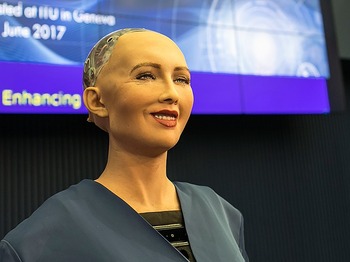
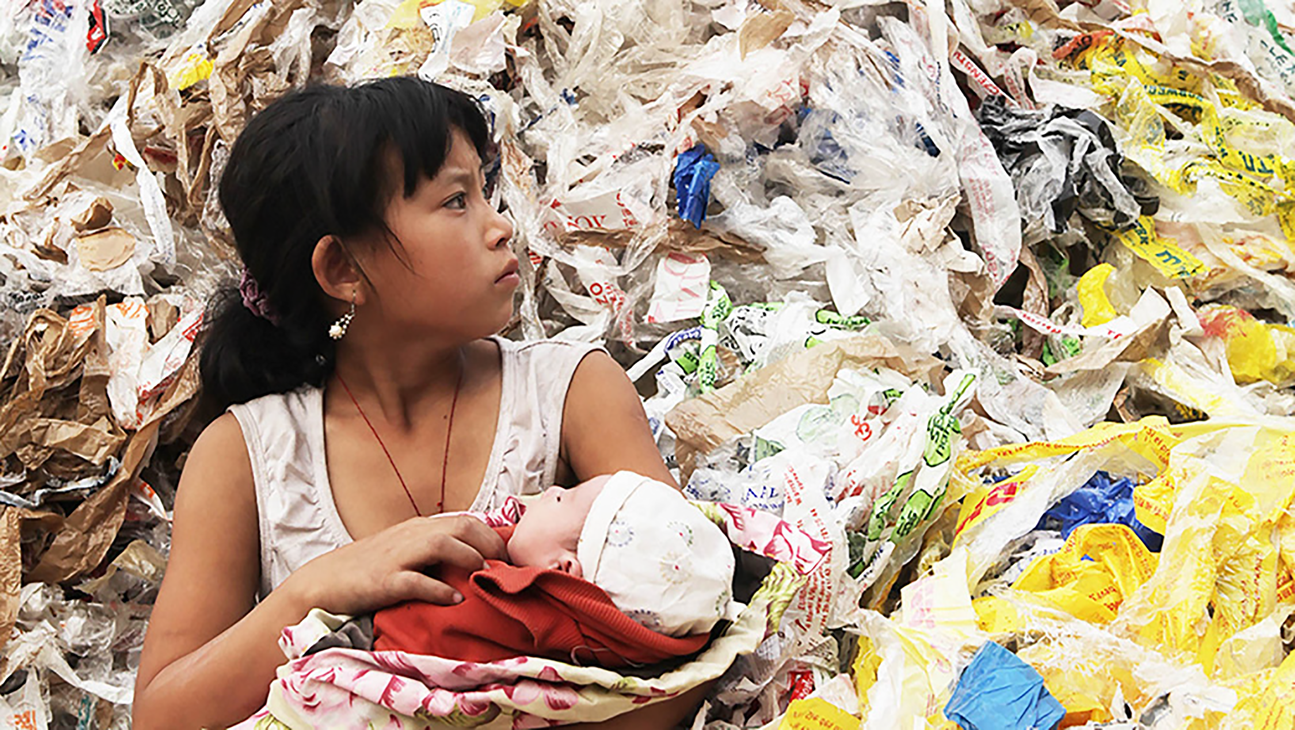
The two pictures below illustrate my points. Some philosophers have noticed that in our highly technological time, it is difficult to find the purely “natural” person. However, this point, I would argue, is still grounded in the belief that nature is something out there, something different from cultural beings. In any case, philosophers have proposed that cyborgs, a combination of both organic and biomechatronic body parts, instead of natural human beings, should be considered an indication of a posthuman subjectivity that “provides the grounding for new ethical claims” (Braidotti Reference Braidotti2013, 90). At this point, it is difficult to ask how much we have become machines or how human machines are in our time wherein things are done and thoughts and ideologies are formed and transformed through media and screens: TVs, computers, laptops, and tablets. Though the apparently complicated phenomena should not obfuscate the following fact: It is the force of capital that drives technology forward. And more important, under the dazzling and rumbling technological mechanism, it is social relations that produce the former and at the same time are produced by it.
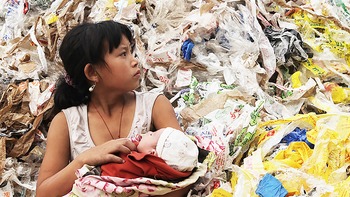
Therefore, Picture 1, the “female robot” Sophia, who received “her” Saudi Arabian citizenship in 2017, is a good symbol for high-tech cyborgs. Picture 2, however, is another face of the posthuman. This is a picture from Wang Jiuliang's documentary Plastic China.Footnote 4 The girl and her family came from Sichuan province in Southern China. She has no sense that it is capital, both international and domestic, that has driven her family to the plastic workshop in Northern China that processes plastic waste from Europe, the United States, and who knows what other parts of the world. As a poor proletarian, her father claims he cannot afford to educate her and prefers that she take care of her younger brothers, one still in her arms. Her father tried to take two of the children back home where they could be sent to school, only to find, however, right at the railway station, that the tickets back were too expensive for them.
Sophia, the first robot to receive citizenship. https://en.wikipedia.org/wiki/Sophia_(robot)

Eleven-year-old Yi-Jie with her brother on a pile of imported plastic waste. https://www.plasticchina.org/single-post/2017/05/09/Plastics-News
II. Patriarchy in Traditional Chinese Philosophies
Patriarchal hierarchies have taken on different forms in the West and in China. Feminist philosophers have closely examined the depreciation and degradation of both nature and the female in Western metaphysics. Nature is degraded while it is associated with the female. The other world of spirituality is glorified because this world is despised. In modern metaphysics, the enslavement of nature is conceptualized through the language of the enslavement of women. As Francis Bacon exclaimed, through the medium of science men should become “masters and processors of nature” (Farrington Reference Farrington1970, 28). In fact, men should “put nature on the rack and torture her” (92; see also Merchant Reference Merchant1989, 168, 172),Footnote 5 so that nature will be revealed and exploited according to men's needs.
In traditional Chinese philosophy, however, there is no such enmity against nature. Chinese philosophy usually underscores humans’ belonging to nature. In fact in some Chinese philosophies oppression of women and the constitution of hierarchies are naturalized. The enslavement of women and therefore the oppression of humans is carried out under the name of natural order. As the Xici Commentary famously put it:
Heaven is lofty and honorable; earth is low. Thus Qian and Kun are settled (in accordance with this). Things low and high appear displayed in a similar relation. The noble and mean have their places assigned accordingly. (Li Reference Li1994, 541, my translation)
天尊地卑, 乾坤定矣. 卑高以陳, 貴賤位矣.
Contrary to the common interpretation of Chinese philosophy as always seeking harmony with nature, here we see at least a distortion of nature, if not the denial and oppression of it as in some Western philosophies. That is, what is natural and spontaneous is now given hierarchical value. The meaning of “the unity of the heavenly and the human” (tianrenheyi 天人合一) lies in this, if not only this: The heavenly is taken as father and the earthly the mother, but the former is noble whereas the latter is low; the heavenly therefore governs the earthly. The cosmological order of “the unity of the heavenly and the human” is used to set the ground for gender and hierarchical oppressions. Not only is man superior to woman, but also hierarchical orders from rulers to commoners are set up among males.
In recent years Confucian feminism has become a growing trend in the field of Chinese feminism. Some feminists, Li-Hsiang Lisa Rosenlee, for example, try to combine Confucianism with care ethics and feminism. A contextualized notion of personhood, relationality, care, love, and family should be promoted in order to anticipate a Confucian feminist society (see Rosenlee Reference Rosenlee and Pang-White2016, 157). I am sympathetic to Rosenlee's worry about cultural racism and hegemony, particularly in an international environment. No doubt Confucianism can help our society in many ways, such as to help build communities and strengthen correlations. However, feminism should not turn away from its task of criticizing the dominant patriarchy in respective cultures and traditions. And, as the dominant patriarchal ideology throughout Chinese history, Confucianism keeps its patriarchal influence in contemporary China. Hence the neo-Confucian Jiang Qing told women to return home and taught “Only Confucianism Can Settle Modern Women” (Jiang Reference Qing2015). According to Jiang Qing, in traditional Chinese culture, concubines enjoyed protection and stability. “In Islamic societies due to the practice of polygamy, there is less family breakdown,” claimed Jiang, “Relationships between husband and wife are better than in the west.” Now Jiang Qing's might be a radical form of Confucianism, but it is a typical traditional Confucian view of women. Furthermore, in seeing a man announce his prejudice against women with such confidence in public, we can get a glimpse of how Confucianism still holds patriarchal power's sway in contemporary China. Jiang's ridiculous views reflect the old patriarchy taking on its modern form, that is, cultural nationalism. It is therefore dangerous for us to rush through and embrace Confucianism as a feminism.
In doing feminism, Catherine MacKinnon's dominance approach is a good one (MacKinnon Reference MacKinnon1987, 32–46). That is, the gender issue is not about sameness or difference, for both can be used to oppress women. Rather, it is only under patriarchal dominance that we begin to seek sameness or difference. Feminism requires us to gaze at power, never lose sight of it, understand how it functions, and thereby deconstruct it.
Next I'll briefly examine Confucian patriarchy under the dominance approach. Despite contemporary scholars’ efforts to promote relationality and contextuality as an antidote to Western individualism, Confucianism establishes patriarchal hierarchy precisely through these two essential factors. Mencius says, “between father and son there is affection (qin 親); between ruler and minister, appropriateness (yi 義); between husband and wife, separate functions (bie 別); between old and young, order (xu 序); between friends, faithfulness (xin 信)” (Bloom Reference Bloom2009, 3A4). A Confucian society is built upon these core relations. Among these five core relations, except for the one between friends, all are hierarchical. Obedience and submission are the emphasis. Hence filial piety and loyalty play a central role in Confucian ethics. Not only does Confucianism lack resources to limit power, it cultivates the submission to and worship of power through deification of it. Perhaps it is true that, as philosophers have pointed out, Confucianism does not need a God beyond this world, but this is precisely because patriarchal hierarchy is deified and demands to be put into practice in ordinary life. The political order between ruler and minister, officials and their superiors is cultivated domestically, through father and son, husband and wife. In a sense, we can say that family is the foundation of Confucian patriarchy. One obedience and submission leads to another. These core relations constructed in the logic of domination are the content of Confucian virtues of ren 仁 (benevolence) and yi 義 (appropriateness). If a woman does not follow her husband and breaks this hierarchy, she is then considered not-ren and not-yi, so can expect the punishment of Rituality (li 禮). On this point we just need to be aware of the pig-cage drowning punishment used throughout Chinese history. If a woman were found to be having an extramarital affair, she would be locked into a pig-cage and drowned in the river (see Huang Reference Huang, Li and Huang1980).
The relational hierarchy is infused with the cultivation of oppressive emotions: respect, responsibility, and obedience—all about power. In Confucian patriarchy, the internalized “love” (renai 仁愛) is demanded with its root in subordination. The feminist love that we want to promote should not mean “I love to obey.”
So is it possible for Confucianism to be feminist? This is a question similar to “Is it possible for Platonism to be feminist?” I will keep the question open. I think it is still possible, but not without a deep critique. At this point I hope we can understand that it is not so simple, as if individualism and autonomy are bad, therefore relationality and contextuality are good. They can be good and should be emphasized as antidotes to capitalist individualism. But at the same time, any domination is always a relation. I would say it is very important to understand where we are in doing philosophy: while Western feminism has done a thorough critique of traditional Western patriarchy and is thus moving forward, the job in contemporary China has met with many obstacles and is still to be done. Because of its complicated situation under different forms of patriarchy, which have caused enormous suffering, Chinese feminism has not been able to criticize traditional (or modern) patriarchy thoroughly; instead it now turns back to embrace it. Now when facing critique, many Confucian scholars might mention the devastating Cultural Revolution when traditions were violently destroyed, implying that Confucianism was not only criticized but persecuted, that it is now the time to protect it. One simply cannot call the persecution during the Cultural Revolution a rational critique. Interestingly, China is now using traditional studies (guoxue 國學) to promote nationalism. In a sense, self-critique has never happened within Chinese traditional studies. Not surprisingly, Confucian feminism has deliberately separated itself from the feminist movement that is under crackdown by the Chinese government. Without a deep critique of patriarchal traditions, Chinese feminism combined with these traditions might be perpetuating patriarchal domination.
III. Daoist Ecofeminism as a New Democracy
Above we have pointed out the double totalitarianism of capitalism and the one-party system that dominates China. One can argue whether China can be said to be a communist country since it has become so capitalist; however, the Chinese government still officially claims it is a communist country. While communism certainly doesn't have to become authoritarian, it is important that we are alert to the Chinese combination of capitalism and the one-party system. What we see here is that different modern regimes have been cooperating with one another efficiently while making enemies of one another due to totalitarianism's need to generate antagonism. Going beyond modernity is our common task. One simple fact is that freedom is beyond modern political regimes. It is simply beyond modernity and its power struggles. Freedom should be THE power, not to be submitted to any ideology whatsoever. We have also pointed out that oppression of humans is done through oppression of nature in Chinese modernization. This is also true under capitalism. The liberation of nature is therefore naturally tied up with the struggle for true democracy, East and West.
The task of going beyond modernity, I would argue, is an ecofeminist one because it requires the elimination of all patriarchal domination, over both humans and nature. Next I will propose Daoist ecofeminism as a new democracy and as a solution to the problems listed above.
The following question arises right away when this solution is posited: Why Daoism, which is itself part of Chinese tradition? First, Daoism fulfills our requirement of the critique of patriarchal domination, both traditional and modern, over humans and nature. It advocates the deconstruction of power through a feminist philosophy that seeks freedom in intimacy with nature. Second, it would be an exaggeration to say that Laozi established Daoism as a feminist philosophy, which would require gender equity as the center of his focus. Gender equity was not the center of the philosophical discourses of that time, and we just have to accept this mere fact. However, this does not mean, as some philosophers maintain, that Daoism is not a feminist philosophy. I would argue that it is, with its strong feminist features. Finally, we are not, at the end of the day, simply going back to a tradition, even a feminist one. We are trying to learn something from the deep wisdom that it can offer to help us to go beyond both tradition and modernity. And for the sake of this task, the ecofeminist features of Daoism are underscored.
With the task of going beyond both tradition and modernity in view, we anticipate a new way of living. This, I believe, can only be done through communication between East and West so that growth and prosperity for both can happen. The old hatred between capitalism and communism is not working. The terrible human rights situation connected with severe pollution in China demands a functional democracy, and learning from the West will greatly help. Meanwhile, the massive suffering in the West in our time of a global pandemic shows us that capitalist democracy and its hostility to socialism have long been dysfunctional. It might be that it is precisely this hostility that has caused the dysfunction. The West needs to overcome its racism, sexism, and other types of discrimination and learn from the East. Today, with 26 million refugees worldwide, 1% of the world's population being displaced (UNHCR USA 2020), a global pandemic, institutionalized (capitalist or communist) greed, hatred and deep ignorance, together with climate change that is daily getting out of control, the world needs to learn a new way of life guided by love and compassion and caring for one another, so that prosperity for all can be achieved. And freedom and equality gain new meanings. This is the new democracy I am talking about.
I use “democracy” here in a Deweyan sense as a way of living. It includes but is not confined to various basic human rights within a political regime such as freedom of speech, freedom of assembly, and freedom of association. It does not mean the capitalist and exploitative democracy that is now causing massive deaths and severe poverty across the planet. That is, freedom does not mean to freely incite or to express one's racist hostility, with words or guns. Nor does it mean free exploitation of others’ labor and lives. Equality also does not mean being equally impoverished by the “all for profit” system and then being left alone without care from society. Daoist democracy refers to a way of life of equality and freedom for all beings, which is expressed through ziran自然. These terms gain new meanings through ziran in Daoism. Therefore, what I am doing here is not putting Daoist ecofeminism under the Western conceptual framework, but rather seeking ways out of capitalist democracy by interpreting it within the Daoist context. That is, Daoist ecofeminist democracy aims to enrich and transform our understanding of democracy. Next I'll elucidate this new way of life through the analysis of ziran.
Ziran 自然 are the two characters used to translate the English word “nature.” Zi 自 literally means “self.” Ran 然 originally comes from the burning of fire. In its original use, ran 然 vividly depicts a dynamic, generative, and spontaneous blazing. It can be translated as “to be (in a certain way)” (shi 是), “as such” (ru 如), or “like this” (rushi 如是). Ziran is usually translated as “nature,” “self-soing,” “self-going,” “being free,” “spontaneous,” “natural,” and so on.Footnote 6 It refers to a free state that is manifested in all the myriad things, including humans. Daoist freedom therefore belongs not only to humans but also to the myriad things. As a matter of fact, in humans’ enslavement of nature, violence is committed simultaneously to humans themselves. The historical event of the capitalist land-enclosure movement has fully demonstrated this; the serious pollution calls us to be aware of it. Human freedom can only be achieved in her belonging to nature.
Meanwhile, Daoist philosophy not only advocates the removal of all oppressions among humans, it also proclaims that all things are equal. As is stated in the Zhuangzi, “All the myriad things are equal” (“Autumn Water”), which resonates with the Buddhist idea that all sentient beings are pure and equal. Even though I have no space in this essay to give a full argument for this seemingly radical proposition, it might be helpful to point out that it is not to be understood within an individualistic perspective wherein egos are presumed as the starting point of reality. In both Buddhist and Daoist philosophy, everything depends on everything else; everything is a continuation of everything else. With this radical egalitarianism, Daoist philosophy makes the following request of us: Return life to the earth, the myriad things, and the people. It shows us the wonders and marvels of nature in complete emptiness (wu 無), wherein all oppression and exploitation are unnecessary. Like empty flowers, humans take root in the earth together with the myriad things in order to let flourishing grow. Ziran or nature is freedom. Moreover, this is not any abstract philosophical proposition. Rather, what it says is a simple way of life that is yearned for by every modern person. This is what I call “democracy” wherein the fertile earth, the pure sky, the freely flowing rivers, and the vast ocean are the home and freedom of the myriad things and humans.
Next I will briefly explore the feminist characteristic of Daoist philosophy. As a critique of the hierarchical rule of the patriarchal Zhou Dynasty with the de (virtue or virtuosity, creativity) of sages and authorities, Laozi raised the female dao and de in order to dissolve the alienation of nature and the oppression of humans. Dao is the mother of all things and de follows dao. Such is what is called the dark de (xuande 玄德).Footnote 7 The feminist feature in Daoist philosophy therefore has ontological primacy. As a contrast to the honorable heaven and the lowly earth in some Chinese philosophy and the male spirit in some Western ones, the dao that is developed later on as the center of any Chinese thought is female. This is a salient feature of Daoism compared with other patriarchal philosophies, which has been deliberately forgotten in the history of Chinese philosophy. The female here is not the power that is opposite to the male, rather she is the source of all and thus defines all life power. Female power is the realization of ziran 自然 (self-soing, self-going, or nature).
The first chapter of the Dao De Jing (DDJ) reveals the female feature of the dao:
It is not that the dao cannot be spoken of, yet all that can be spoken of is not the constant dao. It is not that the name cannot be named, yet all that can be named is not the constant one. Therefore to name the dao with be-ing and non-be-ing is to designate it as the beginning (shi 始) and the mother (mu 母) of all. The beginning verses point out the unspeakability of the constant, then it illuminates the manifestation of the constant be-ing and non-be-ing. Be-ing and non-be-ing are not two but one as the mysterious disclosing of the dao. The xuan 玄 (mysterious) and the men 門 (gateway) here demonstrate the feminist feature of the dao from its disclosing.
Chapter 6 says:
The gateway here refers to both dao and things. In terms of the dao, the gateway of the dark female is where all the myriad things are from; in terms of things, the ziran or spontaneity of all is the gateway of the dao. The gateway in the first chapter also covers the dimension of humans, that is, the self who embodies the dao opens the gate for the mysterious be-ing and non-be-ing. Only she who is at one with the mysterious mother can open the gate for all the wonders in the world. The spirit of the valley and the gateway are, again, female metaphors for the flow of the cosmic power. Obviously, Laozi uses the reproduction of the female to explain the ziran of the myriad things. The generation of the myriad things is the reproductive process of the dao as the mother. The disclosing of ziran wherein dao, things, and humans are one is grounded on and manifested through the reproductive process of the female. This is similar to female nature in Western thought. However, the difference is distinctive, that is, Daoist philosophy does not seek any human essence that is beyond nature and opposes nature, rather it rests in nature to seek the freedom and prosperity of the earth and humans.
Therefore sheng 生 (life, to grow, to give birth, to live, to produce, to arise) is an important concept in Daoist texts. It contains both meanings of the disclosing of the dao and the nature or ziran of things. It is for this reason that the nature (xing 性) of things is understood originally as sheng 生, which belongs to dao. Xing 性 was originally written as sheng 生. Chapter 51 of the Dao De Jing says,
- Dao gives life
道生之
- De nurtures
德畜之
- Events shape
物形之
- And circumstances consummate
而器Footnote 8成之
- Therefore all things revere dao and honor de
是以萬物尊道而貴德
- As for the reverence directed at dao
道之尊也
- And the honor directed at de
德之貴也
- It is out of the constant self-soing (heng ziran) Without anyone having ennobled them
夫莫之爵而恒自然
- Dao gives them life and nurtures them
道生之畜之
- Rears and develops them
長之遂之
- It brings them to fruition and maturation
亭之毒之
- Nourishes and extinguishes them
養之覆之
- Dao gives them life Yet does not manage them
生而弗有也
- It assists them Yet makes no claim upon them
為而弗恃也
- It rears them Yet does not dominate them
長而弗宰
- This is called the dark de (virtuosity)Footnote 9
是謂玄德 (Liu Reference Liu2006, 501, my edited translation from Ames Reference Ames and David Hall2003)
In this chapter, dao, de (virtue, virtuosity, creativity), things, heng 恒 (constancy), and ziran (self-soing, nature) all appear together. Contrary to a common understanding, I don't think it is the case that the “dao gives life” comes prior to the “de nurtures,” which again is subsequently followed by the growth, nourishing, and extinguishing of things, no matter how we understand this “priority,” whether it is cosmological, logical, or existential in terms of humans’ experience in practice (gongfu 功夫). The “dao gives life” is at once the “de nurtures,” which is constancy or heng, spontaneity or ziran, and which is the growth, nourishing, and extinguishing of things. That is to say, that dao gives life is at once the growth, nourishing, and extinguishing of the myriad things. The life and death of all things are the self-realization of the dao as the female power.
Most important, the female dao is a deconstruction of patriarchal domination. The power of dao is that of giving and nurturing without domination. In terms of how power should function in human society with relation to the sentient beings, Laozi gives us an ecofeminist answer: the dao, the mother of all living things, is the only power. Dao gives life and nurtures, all without manipulation or oppression. Such is ziran. All human contrivances of hierarchical domination depart from the dao and therefore seek their own extermination, whereby belonging to the dao is exactly fulfilled. Nowadays, for some scholars even the relation between parents and child can be viewed as a hierarchy, which is then used for the justification of hierarchy. These philosophers do not see how they are driven by their own intention to mislead their audience in understanding a completely natural phenomenon. At the end of the day, why does the love of a parent for the child have to be hierarchical? And why did it become hierarchical in Confucianism? Surely Laozi's view of the dao's mothering her children, the myriad things including us humans, does not work for their view of parenting. Interestingly enough, when Confucianism talks about parenting, it focuses on the father–son relationship. The mother is absent, and appears only in the husband–wife relationship as a submissive figure. Is that why parenting is viewed as a hierarchy in Confucianism? Here again, we see that Confucianism, compared with Daoism, born out of patriarchy, seeks to strengthen hierarchy through the construction of social relations.
Laozi's feminist philosophy emerged in a highly patriarchal time. It was developed to cure the disease of patriarchal domination via the deconstruction of the dominating power. Above, we analyzed ziran, which designates how dao moves. The point is also manifested by the wu forms. In Daoism the dao is wu 無, or non-being. It has no form (無形), no mind (無心), no name (無名). Its use is no-use (無用), its function not-self (無我) and impermanent (無常); its action is non-action (無為). Power in human society should follow the dao, and be dissolved to nothing (or non-being), or wu. Through this thorough deconstruction of dominance, the life of things and humans spontaneously unfolds; all sentient beings thus gain their true freedom and equality in complete emptiness, the mother that nourishes all.
The female in Daoism is therefore not passive dead matter, a common way of understanding the idea in some forms of metaphysics, which, at the end of the day, is nothing but a human construct that serves the needs of patriarchy. She is, on the contrary, the ceaseless creativity itself. It is helpful here to distinguish “sheng 生,” which is an important concept in both Daoism and the Yijing. The Yijing adopted some Daoist thoughts and developed the concept of sheng. However, sheng (generativity, creativity) in the Yijing is associated with yinyang, wherein yang is exalted while yin is degraded, upon which the hierarchy of the honorable and the lowly is built. Undoubtedly, yinyang in the Yijing does not have to be associated with this kind of value. It can and should construct a yinyang that could bring about a more free and equal way of life. This is essentially different from the female creativity in Daoism. The latter is not opposite to male power, rather it is beyond the polarity of the female and the male and preserves the two in itself. She is, in fact, the only power in the world.
One point worth clarifying is that Laozi is not perpetuating women's role through promoting feminine virtues. Laozi is famous for advocating “honoring the soft” and “keeping to the female.” This should not be misunderstood as the so-called “morality” that preaches the subordination and subservience of women, which is still popular to many. Softness and the female are, like water, the self-manifestation of the female creativity and the freely flowing nature (ziran). The female creativity inherently opposes and dissolves any hierarchical oppression. It does not allow the dominance of the female over the male, or construct any ruling order between genders. Neither does it understand the human through her dominance over nature. It requires us to break away from the anthropocentric delusion and cast off any egoistic “self” so as to return to nature, wherein ultimate equality and freedom are achieved.
I will highlight some possible contributions of Daoist ecofeminism to feminist theory. Two major approaches emerge in feminist theory, that is, sameness and difference. The sameness approach grounds gender equality on the sameness of women and men. That is, we are, at the end of the day, humans just like you. The problem of this approach is that it buys into patriarchal standards and values. The difference approach recognizes the difference between sexes, and claims special benefit for women. However, according to Mackinnon, this theory does not recognize that difference is already a result of patriarchal domination. The problem of this approach is that by embracing the role defined by patriarchal society, it might be perpetuating the oppression of women (MacKinnon Reference MacKinnon1987). We get a glimpse of this problem in Confucian feminism. I will show that Daoist ecofeminism challenges patriarchy from a different dimension and shows us ways out of the dilemma.
First, the Daoist view of gender is not fixed or exclusive. Daoism approaches gender via the lens of yin and yang, the play of which constitutes the movement of the cosmos qi (see Wang Reference Wang, Garry, Khader and Stone2017, 35–48). Yin and yang are interdependent. There is no yin without yang, just like there is no yang without yin. Furthermore, the qi of yinyang is not fixed but changes all the time. To start with, there are males and females, and this is a yinyang. But if we look at a particular person, her spirituality can be called yang while her body can be called yin. If we look at her body, the five viscera are yang and the six bowels are yin. Even within the five viscera, for example, the qi of the kidneys has yin and yang too, and so on and so forth. This process can go on infinitely. Therefore there is yin in men and yang in women. The playful Daoist yinyang perspective deconstructs the exclusive view of gender, and thus can help to construct a healthy gender view according to the female principle. In the Dao De Jing the cultivation of feminine characteristics was prescribed for male rulers. According to this strategy, instead of essentializing women's subordinate role, we should focus on transforming our society into the feminine value.
Second, Daoist ecofeminism offers us a feminine politics. Feminism has criticized masculine epistemology wherein knowledge is defined under patriarchal rules. It has recognized that epistemology is not only an abstract theory. Rather, it is politics. In her article “Dao Becomes Female: A Gendered Reality, Knowledge, and Strategy for Living” Robin Wang presents Daoist femininity as “a cosmic force, a way of knowing, and a strategy for leading a flourishing life” (Wang Reference Wang, Garry, Khader and Stone2017). In my view what Daoism presents is a feminine politics wherein the feminine value permeates all realms of society. Daoism anchors feminine politics and the deconstruction of patriarchal power on a feminist ontology. The female Dao is not simply the counterpart of the exclusive patriarchal domination. It is the deconstruction of whatever domination there is at all. Let us be clear: Our task, just like Laozi's, is to deconstruct patriarchy. As much as the East and the West should learn from each other, we should not blindly buy into another patriarchy when one form fails. Different forms of patriarchy have come onto the stage of history. And now our time demands we go beyond. In practice, this task requires us to identify domination and deconstruct it in particular situations and across different fields, such as law, environmental issues, academics, politics, and so on.
The deconstruction of domination and the generation of feminine politics go hand in hand. Whereas patriarchy takes domination as power, Daoism maintains that any dominance should be deconstructed to nothing (wu). Feminine politics embraces love and compassion and caring for all beings, just like Dao nourishes all beings. Chapter 49 of the Dao De Jing shows us an ideal government for Daoism:
- As for the sages’ being in the world:
聖人之在天下也
- They have mind muddled for the world.
熙熙然為天下渾其心
- The common people all have their eyes and ears occupied,
百姓皆註其耳目
- And the sages treat them as so many children. (49)
聖人皆孩之 [Liu Reference Liu2006, 486]
The feminine power should function like a mother loving and caring for her children. Chapter 67 claims three treasures of Dao: compassion (ci 慈), simplicity (jian 儉), and humility (不敢為天下先). Compassion in Daoism is toward all the myriad things. Simplicity is demanded as a new way of living to solve the environmental crisis. Humility is an antidote for the pernicious racism, sexism, discrimination, and anthropocentrism in our society. The three treasures are the practice of feminine values, dissolving any egoistic domination.
The serious problems involved in China's industrialization that permeate all social realms—spiritual, material, environmental, and existential—are rooted in various forms of patriarchy. The question is not, then, whether it is possible to construct democracy within patriarchy, but how to develop a true democracy beyond patriarchy, using resources from both East and West. And we have shown that this is not only a task for China, but also for the world. Daoist ecofeminism offers us a feminine democracy that is different from the capitalist one wherein freedom is defined through the exploitation of nature and the affirmation of contentious rights among rational beings. It anchors human existence on the ground of nature to anticipate the future of humans in harmony with nature.
In our global time of pandemics, wars, totalitarianism of various political regimes, poverty, famine, the increasing number of refugees, the worsening problem of pollution, increasingly scarce resources, and so on, human survival faces severe challenges. The world urgently calls for an enlightenment out of the dominance and exploitation of traditional and modern patriarchy over nature and humans, toward a feminine democracy of peace, freedom, and prosperity of all humans and all sentient beings. This is an enlightenment toward nature, and with nature, in nature, wherein love and compassion and caring for one another are generated. The enlightenment is a collective one: for the survival of all beings, humans included, we need to learn to get over antagonism and act together. Our hope lies in our awareness and action right here and now.
Jing Liu is Associate Professor in the Department of Philosophy and Social Development at Shandong University. Her research areas include Daoism, Buddhism, continental philosophy, feminism, and ecofeminism. Jing6@Hawaii.edu