Introduction
Recreational gambling has become a popular behaviour among older adults. Point prevalence rates around 75 per cent have been recorded in seniors participating in gambling activities (Welte et al., Reference Welte, Barnes, Tidwell and Hoffman2011). Many older subjects enjoy gambling for pleasure and entertainment and do not suffer any negative consequences, but others are particularly susceptible to develop problem gambling habits or even disordered gambling.
Gambling disorder (GD) is a behavioural addiction characterised by repeated, uncontrollable and problematic gambling behaviours that cause significant impairment and distress (American Psychiatric Association, 2013). Studies on GD in older age are scarce compared with the large number of studies within other age groups. In fact, no consensus exists regarding what is considered old age in this research area, and while some studies fix old age as 60–65 (the age required to become eligible for senior social programmes), other studies consider the onset of old age as 50+ years (at this age metabolism is down between 10 and 15 per cent, and a variety of physical changes can cause health to decline with higher likelihood of physical and mental conditions). Aside from the definition of old age, early observational studies published lower rates of GD among older adults than among their younger peers, and though some recent prevalence studies have also reported lower estimates (Abbott et al., Reference Abbott, Romild and Volberg2018), most current epidemiological research has found that the incidence of individuals meeting criteria for disordered gambling among older adults is at least as high as at other developmental stages: between 0.7 and 1.7 per cent in the study by Welte et al. (Reference Welte, Barnes, Tidwell and Hoffman2011), and between 0.1 and 11 per cent in studies of lifetime problem gambling (Tse et al., Reference Tse, Hong, Wang and Cunningham-Williams2012; Subramaniam et al., Reference Subramaniam, Wang, Soh, Vaingankar, Chong, Browning and Thomas2015b). Differences in the estimated proportion of problem and disordered gambling in older age have been related to methodological issues (such as sampling origin, clinical versus population-based), use of different measurement instruments and definition of different age thresholds (the lower bound for classifying older adults varies substantially across studies, from 50+ to 70+ years or older). Cultural variations (mostly values and beliefs regarding gambling), historical context and the regulatory/legalisation structures for gambling activity are also powerful reasons to increase variability between the prevalence estimates among older adults, since these variables directly impact on gambling behaviours and help-seeking attitudes (Subramaniam et al., Reference Subramaniam, Abdin, Shahwan, Vaingankar, Picco, Browning, Thomas and Chong2015a). In any case, epidemiological data show that the frequency of gambling-related problems in older adults is similar to those frequencies obtained in younger ages, and even that older adults constitute a sector of the population with special vulnerability. This evidence requires new research to address what factors are related to the onset and progression of GD. This study contributes with analyses of the relationship pattern between the presence and frequency of life events (strong risk factors identified in adolescence and young adulthood populations) on the gambling profile among older adults.
The prevalence of GD at older ages is of particular concern because these individuals are less likely (often unaware or even in denial) of their problem gambling compared to younger counterparts, and only realise the extent of the problem when its most severe consequences have already occurred (such as financial loss, accumulating debt, involvement with the legal system due the illegal behaviours related to the gambling activity (forgery, fraud, theft or embezzlement to finance gambling)) (Bischof et al., Reference Bischof, Meyer, Bischof, Guertler, Kastirke, John and Rumpf2014). Because of this situation, the real incidence of the problem in the general population may be underestimated. Significant increases in the incidence rates are also expected in the coming years, largely as a consequence of the growth in the segment of older age in the demographic pyramid and the more than likely increase in their participation in the digital revolution, which will make gambling increasingly accessible, primarily through internet platforms (Tse et al., Reference Tse, Hong, Wang and Cunningham-Williams2012; Alberghetti and Collins, Reference Alberghetti and Collins2015; Ioannidis et al., Reference Ioannidis, Treder, Chamberlain, Kiraly, Redden, Stein, Lochner and Grant2018). Although the impact of these new environmental conditions on the reward and cognitive control systems in older age is unknown, recent findings in neurocognitive research exploring the neural responses to stimuli that simulate betting on sports suggest that high exposure to gambling may be correlated with higher fronto-striatal activation and higher insular cortex activity and functional connectivity, and that receiving stimuli that increase users’ confidence in their ability to win is associated with activation of the brain regions involved in affective decision-making, cognitive inhibitory control and reward processing (Brevers et al., Reference Brevers, Herremans, He, Vanderhasselt, Petieau, Verdonck, Poppa, de Witte, Kornreich, Bechara and Baeken2018).
This scenario is further aggravated by the high comorbidity between GD with other psychopathological disorders (Parke et al., Reference Parke, Griffiths, Pattinson and Keatley2018), particularly in older age, such as substance use (Pilver et al., Reference Pilver, Libby, Hoff and Potenza2013; Rash et al., Reference Rash, Weinstock and Van Patten2016) and mood and anxiety disorders (Assanangkornchai et al., Reference Assanangkornchai, McNeil, Tantirangsee and Kittirattanapaiboon2016; Parke et al., Reference Parke, Griffiths, Pattinson and Keatley2018; Nicholson et al., Reference Nicholson, Mackenzie, Afifi, Keough and Sareen2019). Poor physical health has also been strongly related to the presence of GD (Ariyabuddhiphongs, Reference Ariyabuddhiphongs2012) among older adults, particularly chronic medical conditions, heart disease and obesity-related problems (Desai et al., Reference Desai, Desai and Potenza2007) (many of these multifactorial connections have been related to the sedentary nature of the gambling activity). Further, the comorbidity between GD with other health problems among older adults, persistent and uncontrollable gambling activity has been also correlated with clinical significant difficulties. In global terms, GD influences on a lower quality of life, mainly defined as a pervasive sense of loneliness, social isolation, a pessimistic view of the future state of health, levels of guilt and shame, deceptive practices, heightened impulsivity, financial problems and even illegal acts to finance gambling (Tira et al., Reference Tira, Jackson and Tomnay2014; Subramaniam et al., Reference Subramaniam, Wang, Soh, Vaingankar, Chong, Browning and Thomas2015b; Botterill et al., Reference Botterill, Gill, McLaren and Gomez2016; Black et al., Reference Black, Coryell, McCormick, Shaw and Allen2017). The inability to decide to stop gambling has also been associated with an increase in age-related cognitive impairments, such as unsuccessful perception of risk, increase in the severity of cognitive distortions and impaired decision-making (Pilver et al., Reference Pilver, Libby, Hoff and Potenza2013; Bruneau et al., Reference Bruneau, Grall-Bronnec, Vénisse, Romo, Valleur, Magalon, Fetsáes, Chéreau-Boudet, Luquiens, Challet-Bouju and Hardouin2016; Levésque et al., Reference Levésque, Sevigny, Giroux and Jacques2018), especially in activities related to cognitive functioning which involves the frontal cortex. Moreover, the practice of gambling is in itself a stress factor, with the consequence of potential neuro-chemical and neuro-physiological affectation (such as elevated levels of dopamine, neropinephrine and cortisol) (Moccia et al., Reference Moccia, Pettorruso, De Crescenzo, De Risio, di Nuzzo, Martinotti, Bifone, Janiri and Di Nicola2017), which can in turn increase the risk of previous chronic pathologies.
GD has been defined as a complex condition with multiple interacting biological, psychological and social factors. A recent systematic review of its aetiology showed that certain variables seem to be almost universal risk factors which can contribute to the onset and progression of GD within all age groups (from adolescents to older adults) (Dowling et al., Reference Dowling, Merkouris, Greenwood, Oldenhof, Toumbourou and Youssef2017): (a) among socio-economic features, male sex, younger age, economic disadvantage (low income, limited financial resources and unemployed status), unmarried, membership of an ethnic minority and low education levels; (b) certain personality traits, specifically high levels of impulsivity, sensation seeking and under-controlled temperament; and (c) poor health. Cognitive and behavioural constructs of the gambling profile have also been associated with emotion dysregulation or deficits in coping (Di Trani et al., Reference Di Trani, Renzi, Vari, Zavattini and Solano2017; Rogier and Velotti, Reference Rogier and Velotti2018), as well as with neural correlates in the brain's reward system typical of substance use-related disorders (Potenza, Reference Potenza2014; Rash et al., Reference Rash, Weinstock and Van Patten2016). Cognition research studies have also found that problem gamblers (at younger and older ages) show high gambling-related cognitive biases, the most notable being the gambler's fallacy (i.e. that one is certain to win after a number of losses), selective memory (remembering wins rather than losses), illusions of associations related with gambling outcomes and over-rating one's own skill for controlling these outcomes (Chrétien et al., Reference Chrétien, Giroux, Goulet, Jacques and Bouchard2017; Lévesque et al., Reference Levésque, Sevigny, Giroux and Jacques2018). Finally, twin studies have also obtained an aggregate influence of genetic factors in the risk of GD among both men and women (Davis et al., Reference Davis, Slutske, Martin, Agrawal and Lynskey2019). But a major challenge ahead will be to identify the genetic variants that confer this risk, since molecular-genetic research on GD is lagging (to our knowledge only two studies with large samples have been published: Lind et al., Reference Lind, Zhu, Montgomery, Madden, Heath, Martin and Slutske2013; Lang et al., Reference Lang, Leménager, Streit, Fauth-Bühler, Frank, Juraeva, Witt, Degenhardt, Hofmann, Heilmann-Heimbach, Kiefer, Brors, Grabe, John, Bischof, Bischof, Völker, Homuth, Beutel, Lind, Medland, Slutske, Martin, Völzke, Nöthen, Meyer, Rumpf, Wurst, Rietschel and Mann2016) and no genome-wide significant single-nucleotide polymorphisms or genes have been detected.
The studies published suggest that all these risk factors, identified mostly at younger ages, may also modulate the gambling profile at older age (Guillou Landreat et al., Reference Guillou Landreat, Cholet, Grall Bronnec, Lalande and Le Reste2019). But age-specific risk factors may also make older age a particularly vulnerable developmental stage for the onset and evolution of GD. As a whole, three clusters of risk factors have been identified as characteristic of the older adult problem gambler (Welte et al., Reference Welte, Barnes, Tidwell and Hoffman2011; Lorenz et al., Reference Lorenz, Gleich, Beck, Pöhland, Raufelder, Sommer, Rapp, Kühn and Gallinat2014; Tira et al., Reference Tira, Jackson and Tomnay2014; Subramaniam et al., Reference Subramaniam, Chong, Satghare, Browning and Thomas2017): (a) individual variables motivating and preceding the behaviour (escaping from boredom, life stress and negative emotional states); (b) social and environmental problems (e.g. social isolation or loneliness); and (c) neurological vulnerabilities in the mechanisms related to behavioural regulation and diminished executive functioning (e.g. due to older age, substance-related impairments, general physical impairment or the effects of medication for illnesses such as Parkinson's). Aetiological research has found that GD may be associated with unique clinical phenotypes among older adults and specific consequences. Monetary gain (a frequent motivation for gambling at younger ages) has not been identified as a main motivation for the onset or progression of gambling activity in older individuals, who reported the most likely incentives as relaxation, boredom, passing time, getting away for the day, and to achieve excitement or stimulation as a way of overcoming social isolation (e.g. due to the limited relationships with family and friends or the loss of a partner/spouse), to relieve boredom (e.g. generated by retirement) or to cope with physical or mental diseases (Clarke, Reference Clarke2008; Martin et al., Reference Martin, Lichtenberg and Templin2011). But once problematic gambling appears, the motivations of older adults may change, and they may prioritise responses to stress or emotional difficulties (Pattinson and Parke, Reference Pattinson and Parke2017). Other studies have found that specific motivations significantly related to different gambling profiles among older gamblers (Stansbury et al., Reference Stansbury, Beecher, Schumacher, Martin and Clute2015; van der Maas et al., Reference van der Maas, Mann, McCready, Matheson, Turner, Hamilton, Schrans and Ialomiteanu2017): gambling activities as a way of socialisation, entertainment and excitement are related to a lower likelihood of gambling problems, while avoidance and monetary motives may be predictors of a higher risk of problematic or disordered gambling.
On the other hand, aetiological research has also found that gambling can be a way for some individuals to reduce the effects of stress on their lives, particularly in later life. Routine daily situations characterised by acute stress seem linked to the urge to gamble among problem gamblers (Elman et al., Reference Elman, Tschibelu and Borsook2010), and stressful life events (SLE) have been identified as powerful motivators and contributors to the onset of gambling behaviour, gambling severity and changes in gambling habits over time (Hing et al., Reference Hing, Russell, Tolchard and Nower2016; Luce et al., Reference Luce, Kairouz, Nadeau and Monson2016; Bilevicius et al., Reference Bilevicius, Single, Bristow, Foot, Ellery, Keough and Johnson2018; Godinho et al., Reference Godinho, Kushnir, Hodgins, Hendershot and Cunningham2018). The consequences of SLE in either precipitating and/or perpetuating GD may appear in either the short or the long term, and some studies have found that even SLE during childhood, adolescence and early adulthood may be connected with the frequency and severity of later gambling behaviour (Scherrer et al., Reference Scherrer, Xian, Kapp, Waterman, Shah, Volberg and Eisen2007; Storr et al., Reference Storr, Lee, Derevensky, Ialongo and Martins2012). Various theoretical assumptions have been postulated to explain the underlying links between stress management and gambling, most of them suggesting that emotional vulnerability to SLE may trigger gambling as a way of evading negative emotional issues and increasing their wellbeing (Wood and Griffiths, Reference Wood and Griffiths2007). It seems that even after controlling for the individual differences (e.g. in impulsivity and coping ability), environmental SLE may affect the likelihood of engaging in excessive gambling behaviour (Welte et al., Reference Welte, Wieczorek, Barnes, Tidwell and Hoffman2004). Neuropsychological research has also suggested that alterations in cognitive, executive and emotional feedback processing may be the result of stress-induced changes (Ungless et al., Reference Ungless, Argilli and Bonci2010; Lighthall et al., Reference Lighthall, Gorlick, Schoeke, Frank and Mather2013; Schiebener and Brand, Reference Schiebener and Brand2015; Canale et al., Reference Canale, Rubaltelli, Vieno, Pittarello and Billieux2017): individuals who experience high levels of stress focus mainly on more immediate gratification and report difficulties in delaying rewards, mainly because the effects of dopamine increases in situations of stress correlate with a reduced interest in avoiding potential losses. Indeed, a recent meta-analysis reported three potential mechanisms that might explain the relationships between experiencing stress and deficits in decision-making in situations of risk and ambiguity (Starcke and Brand, Reference Starcke and Brand2016): (a) experiencing acute stress increases the reliance on immediate high reward seeking at the cost of considering delayed losses, thus negatively affecting cognitive performance in the decision-making area; (b) high stress levels correlate with excessive release of dopamine, noradrenaline and cortisol, which impairs executive control and leads to rushed and unsystematic decision-making; and (c) certain personality variables (above all impulsivity) and the social context may moderate the negative influence of stress on decision-making performance (FeldmanHall et al., Reference FeldmanHall, Raio, Kubota, Seiler and Phelps2015; Wise et al., Reference Wise, Phung, Labuschagne and Stout2015).
Later life can be a time of particularly persistent stress, in particular for people who are frail and isolated. Older individuals may experience financial difficulties or insecurity, loss of physical ability (in particular, mobility), and may lose relationships with relatives and friends. These challenges may be aggravated by the occurrence of SLE and/or under the chronic stress experienced as a result of the SLE accumulated across the lifespan, which may make it more difficult for older people with low ability in stress management techniques to adapt. Gambling may be attractive to these individuals as a means to cope and to escape their own situations but others are particularly susceptible to developing problem gambling habits or even disordered gambling. Uncontrollable gambling is a stressor itself which may cause (or aggravate) very serious harm at any age (medical conditions, financial, social and familial loss), but with a potentially great impact in vulnerable populations such as older adults. Unfortunately, studies focused on this section of the population remain rare subjects in the literature, and new empirical studies are needed to broaden our understanding of the links between SLE and GD, in order to characterise GD specificities in older adults.
Aims
In summary, there exist a large number of studies identifying the risk factors of GD, and how these variables contribute to the onset and progression of the disorder. Most of the works have been carried out with samples of young adults, and a few studies have included samples composed of only older adults. However, current studies warn of the risk of gambling-related problems within this sector of the population. Therefore, further empirical research is necessary in older adults to obtain a comprehensive profile of GD at this age, including its aetiology and its motivations, which will help to improve screening/diagnosis and treatment for senior gamblers. On the other hand, SLE have demonstrated a powerful capacity for triggering gambling activity and for increasing GD severity in young adulthood, but it remains unknown whether discrete and/or single SLE are related to the presence of GD in older adults.
The objective of this study was to explore the contribution of a large set of SLE to the presence of GD at older age. Based on earlier empirical studies obtained in adolescence and young adulthood, we hypothesised that the greater the impact of the SLE, the higher the probability of presenting GD and the greater the GD severity in older adults.
Material and methods
Participants
The data analysed here are from a research project carried out at the Pathological Gambling Outpatient Unit at the University Hospital of Bellvitge which assessed gambling habits in older age. This unit oversees the outpatient treatment of cases with behavioural addiction-related problems, mainly GD, and it is certified as a tertiary care centre for the treatment of these psychiatric conditions (tertiary care is a level of health care obtained from specialists in large hospitals (after referral from the providers of primary and/or secondary care), characterised by highly specialised equipment and expertise). The catchment area of the Hospital of Bellvitge includes over two million people in the metropolitan area of Barcelona.
The total number of participants was N = 408, in two independent samples: patients recruited from the clinical setting (the ‘clinical sample’; N = 47) and participants recruited from the general population (the ‘community sample’; N = 361). The only inclusion criterion was age 50 years or over. Exclusion criteria were the presence of an organic mental disorder, intellectual disability, neurodegenerative disorder (such as Parkinson's disease) or active psychotic disorder which reduced cognitive capacity and therefore the ability to complete the study's self-report questionnaires. Age 50 was selected as the lower bound for considering someone an older adult, based on substantial variations in the literature (usually from age 50+ to 70+ years). In fact, while the most developed countries usually characterise old age as starting at 60 years and above (roughly equivalent to retirement ages), this is not a universal cut-off. The definition of old age in clinical research differs depending on multiple factors, such as the medical condition, the culture, the context or even the sex. The cut-off of 50 coincides with the World Health Organization proposal, which sets 50 as the beginning of old age.
To ensure that the two samples had the same geographical origin, the participants in the community sample were contacted at the University of Barcelona podiatry and dental clinics, located on the same campus as the Bellvitge University Hospital between November 2016 and February 2018. In this sample, most participants were retired (N = 354; 98.1%), were married (N = 233; 61.8%) or widowed (N = 110; 30.5%), and had a primary level of education or lower (N = 309; 85.6%). As regards gender, 135 participants were men (37.4%) and the mean chronological age was 73.8 years (standard deviation (SD) = 8.4).
The clinical sample was recruited during the same period as the clinical group, and included 37 (78.7%) men, with a mean age of 70.0 years (SD = 5.6). All the patients in this sample met DSM-5 (American Psychiatric Association, 2013) criteria for GD. Most were married (N = 29; 61.7%) or widowed (N = 11; 23.4%), had a primary level of education or lower (N = 41; 87.2%) and were retired (N = 44; 93.6%).
Materials
Diagnostic Questionnaire for Pathological Gambling
The Diagnostic Questionnaire for Pathological Gambling (According to DSM Criteria) (Stinchfield, Reference Stinchfield2003) measures the presence of diagnostic criteria for GD through 19 items recoded on a binary scale (yes/no) based on the DSM-IV-TR (American Psychiatric Association, 2010). It provides a binary classification of GD (present/absent) and a dimensional measure of gambling severity (total number of DSM criteria for GD, obtained by summing the single criteria). Given the similarities for the GD criteria between DSM-IV-TR and DSM-5 (American Psychiatric Association, 2013), this scale can also be used to measure the presence and severity of GD. The Spanish adaptation of the questionnaire was used (Cronbach's α = 0.81 for the general population and α = 0.77 for the clinical sample) (Jiménez-Murcia et al., Reference Jiménez-Murcia, Stinchfield, Álvarez-Moya, Jaurrieta, Bueno, Granero, Aymamí, Gómez-Peňa, Martínez-Giménez, Fernández-Aranda and Vallejo2009). Internal consistency for this scale in the study sample was excellent (α = 0.92).
Life events
The identification of the personal stressors was based on the assessment of SLE across the lifespan through a questionnaire designed ad hoc for the research project, based on a previous scale also used for GD populations (Granero et al., Reference Granero, Jimenez-Murcia, Del Pino-Gutierrez, Mena-Moreno, Mestre-Bach, Gomez-Pena, Morages, Aymami, Giroux, Grall-Bronnec, Sauvaget, Codina, Vintro-Alcaraz, Lozano-Madrid, Camozzi, Aguera, Martin-Ramera, Sanchez-Gonzalez, Casale, Sanchez, Lopez-Gonzalez, Munguia, Valenciano-Mendoza, Mora, Baenas-Soto, Menchon and Fernandez-Aranda2020; Jimenez-Murcia et al., Reference Jimenez-Murcia, Granero, Gimenez, Del Pino-Gutierrez, Mestre-Bach, Mena-Moreno, Morages, Baňo, Sánchez-González, de Gracia, Baenas-Soto, Contaldo, Valenciano-Mendoza, Mora-Maltes, López-González, Menchón and Fernandez-Aranda2020). Considering as stressor any situation that potentially produces stress, the questionnaire covers a large set of experiences that may disrupt individuals’ lives and cause substantial change and readjustment (such as moving to a new city or to a new country, loss of relatives, severe illness, violent behaviours, involvements with law, financial problems, sexual problems, divorces, accidents, severe problems with family or friends, unwanted pregnancy, abortion, birth of a child, problems in parenting, job changes/promotions/losses or extramarital sex. The total number of different life events covered by the questionnaire was 31 (see Table 1). For each SLE, the initial scoring is binary (1 if the life event has happened and 0 if it has not), and if a positive answer was obtained for the presence of the life event complementary questions are required: the number of times it occurred, their age at first time of the event and the degree of its influence (measured with a scale ranged zero, moderate, some, considerable). The questionnaire does not have a cut-off point: it is scored on the basis that the more life events the older adult has been through, the greater the likelihood of some form of longer impact on the adult. The internal consistency in the study sample was good (α = 0.75).
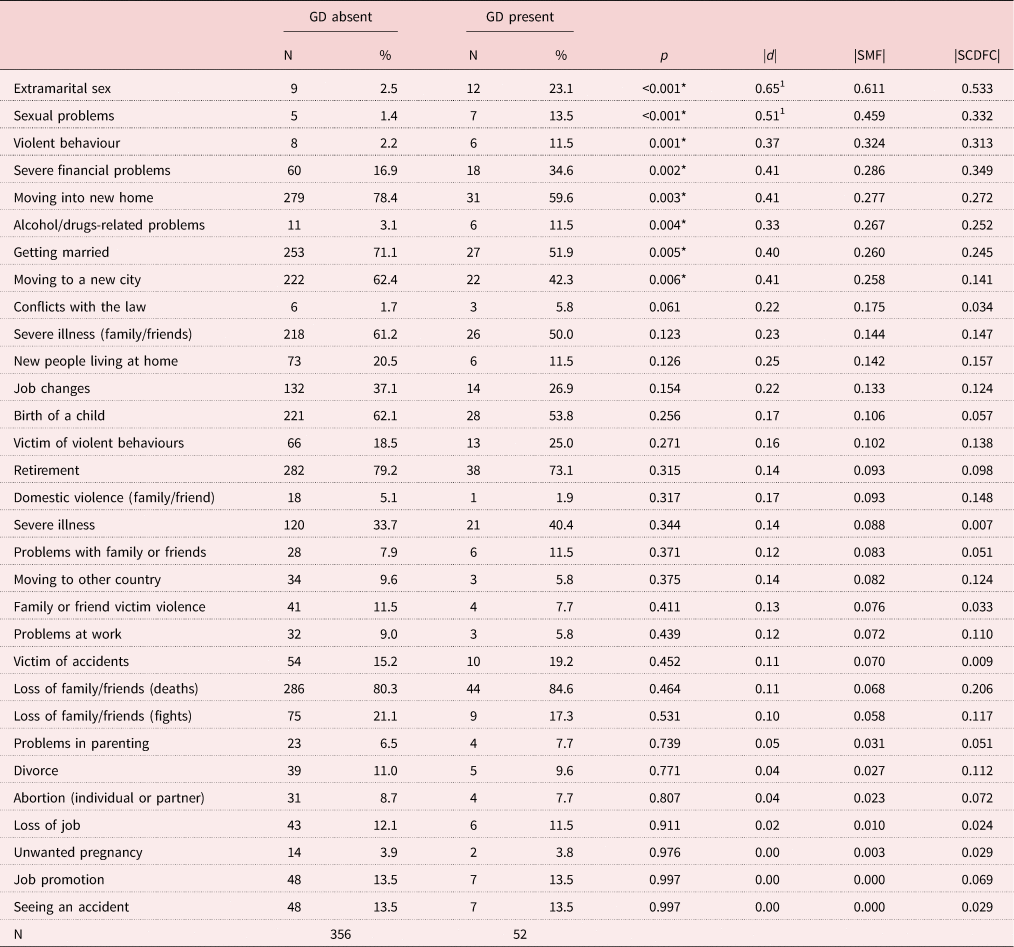
Discriminative capacity of the presence of stressful life events for identifying gambling disorder (GD)

Notes: SMF: structure matrix function. SCDFC: standardised canonical discriminant function coefficients. 1. Moderate–mild (|d| > 0.50) to large–high (|d| > 0.80) effect size.
Significance level: * Significant comparison.
Other variables
The additional data analysed were recorded through a semi-structured interview, which measured socio-demographics (sex, education, marital status, employment status and income, and socio-economic position according to the Hollingshead scale (based on the participants’ education and profession; Hollingshead, Reference Hollingshead2011)) and other gambling problem-related variables (e.g. bets per gambling/episode or debts accumulated due to gambling).
Procedure
All procedures were carried out in accordance with the Declaration of Helsinki. Ethical approval was obtained from the Ethics Committee of Bellvitge University Hospital. The semi-structured interview was conducted by psychologists and psychiatrists highly experienced in the assessment and treatment of GD. The clinicians also helped participants to complete the self-report questionnaires so as to guarantee the absence of missing data.
Statistical analysis
Statistical analysis was carried out with Stata 16 for Windows (StataCorp, 2019). To explore which SLE achieved statistically significant discriminative capacity for identifying the presence of GD, two groups were considered in the study: GD-present (N = 52, merging all the participants from the clinical sample plus the five individuals from the community sample who met clinical criteria for GD), versus GD-absent (N = 356, the subset of the community sample who did not meet criteria for GD). Next, discriminant function analysis (DFA), chi-square tests (χ2) and the t-test were used to detect any differences between the two groups in terms of the SLE occurrence and impact.
In this study, DFA was used to order the contribution of the SLE measures for differentiating between participants who did and did not meet clinical criteria for GD. In this procedure, standardised discriminant function coefficients are interpreted in an analogous way to standardised regression coefficients in linear regression (partial correlations), indicating the relative relevance of the indicators for predicting the criterion (the higher the absolute value of the coefficient, the greater the discriminative capacity of the indicator). The structure matrix function (also known as canonical loading) represents the correlations between the observed variables and the unobserved discriminant functions (dimensions), considering the values with absolute loadings equal or higher than 0.24 to be relevant (Huberty and Olejnik, Reference Huberty and Olejnik2006).
In addition, the effect size for the mean and proportion differences was estimated with Cohen's d coefficient (low–poor effect size was considered for |d| > 0.20, moderate–medium for |d| > 0.5 and large–high for |d| > 0.8; Kelley and Preacher, Reference Kelley and Preacher2012), and the Finner method (a family-wise error rate stepwise procedure) was used to control the increase in type-I error due to multiple statistical tests (Finner, Reference Finner1993).
Results
Distribution of the SLE in the study
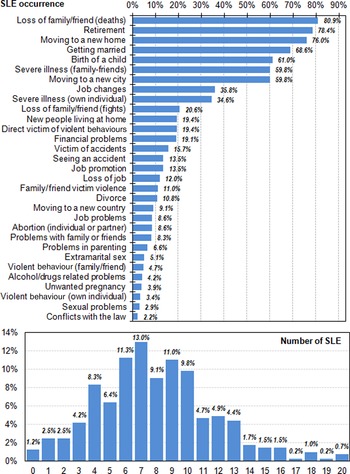
The most frequent SLE in the sample were loss of family members or close friends due to death (80.9%), retirement (78.4%), moving to a new home (76.0%), getting married (68.6%), birth of children (61.0%), severe illness of family or friends (59.8%) and moving to a new city (59.8%) (Figure 1, upper panel). The least frequent SLE were unwanted pregnancy (3.9%), domestic violence (3.4%), sexual problems (2.9%) and conflicts with the law (2.2%). The number of different SLE across the lifespan ranged between 0 and 20 in the sample (Figure 1, lower panel). Most study participants reported experiencing one or more of the SLE analysed in this study at some point in their lives (N = 403, 98.8%), and 54.2 per cent reported experiencing between six and ten. No differences by sex were found for the mean number of different stressors (for men, mean = 7.98, SD = 3.69; for women, mean = 7.87, SD = 3.80; p = 0.762). Comparison between men and women for the presence of each life event only reported statistical differences for extramarital sex (higher prevalence for men compared to women: 10.5% versus 1.3%, p < 0.001).
Distribution of stressful life events (SLE) occurrence in the study.
Note: N = 408.

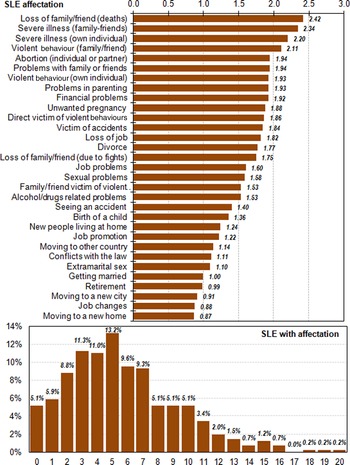
The upper panel in Figure 2 displays the ordered bar chart with the mean impact of the SLE (the mean for each stressful event was calculated for participants who reported its occurrence). The highest impact was for loss of family members or close friends due to death (2.34 on a scale 0–3), followed by severe illness of family members or friends (2.34), severe illness of the participant (2.20) and exposure to domestic violence by family members or friends (2.11). The lower panel in Figure 2 shows the frequency of SLE experienced with any level of impact. In all, 63.2 per cent of the sample experienced between two and seven SLE with an impact on their lives. No differences by sex were found for the mean impact of the SLE (for men, mean = 5.29, SD = 3.54; for women, mean = 5.90, SD = 3.80; p = 0.009). Comparison between men and women for the mean impact related to the presence of each life event did not achieved statistical differences (p > 0.05) for all stressors.
Distribution of the impact of stressful life events (SLE) in the study.
Note: N = 408.

SLE with discriminative capacity for identifying GD
Table 1 presents the discriminative capacity of the presence of SLE for identifying GD in seniors. The SLE are listed in order according to their relevance and capacity to differentiate between the groups. These results indicate that the presence of GD was related to a higher prevalence of extramarital sex, sexual problems, domestic violence, financial problems, and alcohol or other drug-related problems, and to a lower prevalence of moving to a new home, getting married and moving to a new city.
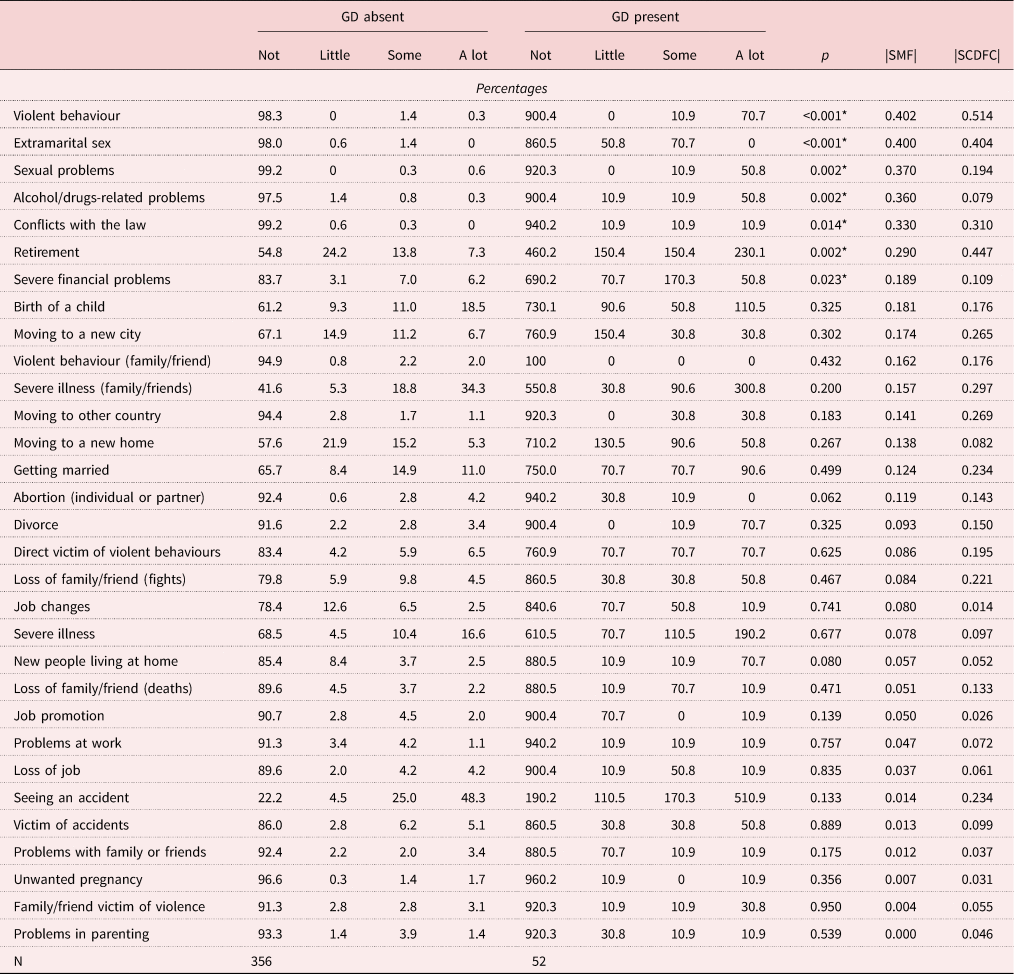
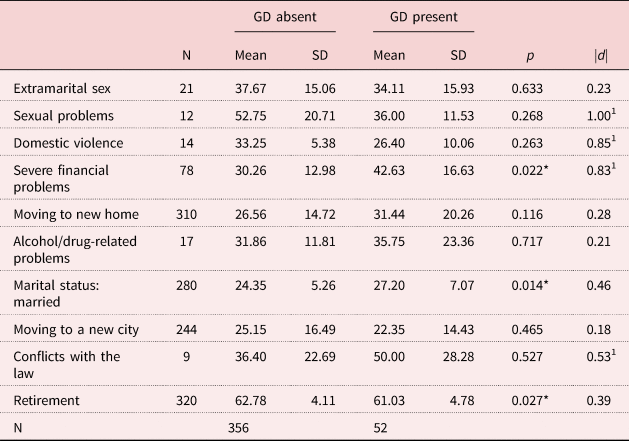
Table 2 displays the discriminative capacity of the impact related to SLE for identifying GD in seniors, ordered according to their relevance for differentiating between the groups. The presence of GD was significantly associated with higher impact of domestic violence, extramarital sex, sexual problems, alcohol or other drug-related problems, conflicts with the law, retirement and financial problems.
Discriminative capacity of the impact of stressful life events for identifying gambling disorder (GD)

Notes: SMF: structure matrix function. SCDFC: standardised canonical discriminant function coefficients.
Significance level: * Significant comparison.
Contribution of the age of SLE to the presence of GD
Table 3 displays the results for comparing the age of the first occurrence of SLE between patients who met and did not meet clinical criteria for GD. The comparison was obtained for the SLE that obtained discriminative capacity (occurrence or impact) to identify the disordered gambling. Age at the first occurrence of the SLE achieved statistical significance or effect size in the moderate to large range for sexual violence (older age in the GD-absent group), domestic violence (older age in the GD-absent group), financial problems (older age in the GD-present group), getting married (older age in the GD-present group) and retirement (older age in the GD-present group). Due to the small sample size of some of the groups, the results in Table 3 must be interpreted with caution.
Discriminative capacity of the age at the time the stressful life events occurred for identifying the presence of gambling disorder (GD)

Notes: SD: standard deviation. 1. Moderate–mild (|d| > 0.50) to large–high (|d| > 0.80) effect size.
Significance level: * Significant comparison.
Contribution of the accumulated SLE measures to the presence of GD
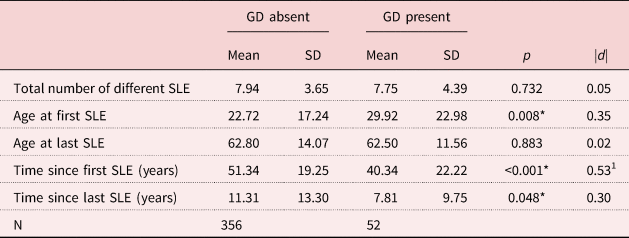
Table 4 shows the results of comparing the study groups’ accumulated SLE measures (total number of SLE across the lifespan, age at first and last SLE occurrence, and time since the first and last SLE). The results indicate that the presence of GD was related to higher age at the time of the first SLE occurrence and lower mean time since the first and last SLE occurrence.
Comparison between groups for the measures of accumulated stressful life events (SLE)

Notes: GD: gambling disorder. SD: standard deviation. 1. Moderate–mild (|d| > 0.50) to large–high (|d| > 0.80) effect size.
Significance level: * Significant comparison.
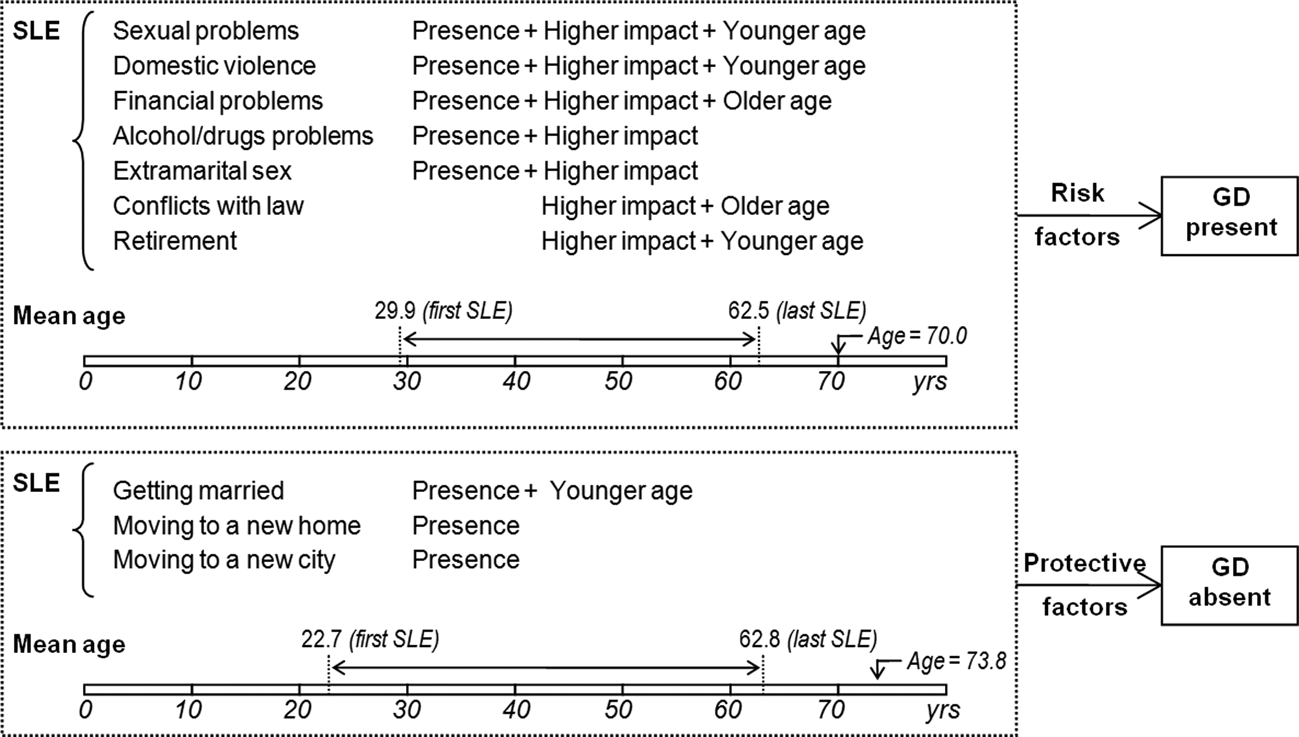
Figure 3 displays a summary of the main results of the study, showing the SLE with capacity for identifying the presence of GD, the potential contribution of the impact and age of occurrence.
Summary of results: stressful life events (SLE) with discriminative capacity as risk factors or protective factors for identifying the presence of gambling disorder (GD).

Discussion
The present study aimed to identify the SLE across the lifespan and their impacts that are most strongly associated with an increased risk of GD in later life. The results showed that the likelihood of GD was increased for individuals who reported sexual problems, were exposed to domestic violence, had severe financial problems, presented alcohol or drug-related problems and reported extramarital sex. For these sets of SLE, the higher the impact was also related to greater risk of GD. In addition, retirement and conflicts with law were risk factors for GD, independent of their impact. Moving to a new home or to a new city and getting married were protective factors which decreased the likelihood of GD.
Despite the increasing participation in recreational gambling among older adults, few studies have focused on the nature and course of problem and disordered gambling in this population. Most of the empirical evidence available for GD has been obtained from younger populations (mainly from adolescents and young adults) and few studies have been conducted specifically in samples of large numbers of older people (Tse et al., Reference Tse, Hong, Wang and Cunningham-Williams2012, 2013; Subramaniam et al., Reference Subramaniam, Wang, Soh, Vaingankar, Chong, Browning and Thomas2015b; Guillou Landreat et al., Reference Guillou Landreat, Cholet, Grall Bronnec, Lalande and Le Reste2019). This study contributes to this research area, and provides empirical evidence regarding the stressors related to disordered gambling activities in older adults.
Considering the SLE that protect against GD (moving to a new home, moving to a new city and getting married), getting married is particularly relevant. Older adults are more likely to lose their spouse, and to be a widower has been considered to be a particular stressor for the onset/progression of gambling-related problems (Guillou Landreat et al., Reference Guillou Landreat, Cholet, Grall Bronnec, Lalande and Le Reste2019). Since younger age of marriage was also related to the absence of disordered gambling in this study, we were able to assess the specific contribution of marriage to the development of GD after adjusting for domestic violence and sexual problems, resulting in odds ratio (OR) = 0.37 (inverse OR = 2.70, p = 0.002). This evidence reinforces the contribution of having a partner to attenuating the risk of gambling, and is consistent with previous research which concluded that unpartnered older adults are more likely to gamble and present more problem gambling probably as a result of social isolation and loneliness (Elton-Marshall et al., Reference Elton-Marshall, Wijesingha, Sendzik, Mock, van der Maas, McCready, Maan and Turner2018; Godinho et al., Reference Godinho, Kushnir, Hodgins, Hendershot and Cunningham2018). These results also corroborate those of previous research which has emphasised the important role of close family members in the initiation and maintenance of gambling activities (Subramaniam et al., Reference Subramaniam, Chong, Satghare, Browning and Thomas2017).
Some stressors which obtained discriminative capacity for the presence of GD in our study were relatively infrequent (specifically, involvement with the legal system, sexual problems, domestic violence, alcohol and other drug-related problems, and extramarital sex). These results are consistent with those of some previous reports, and highlight the relevance of these stressors and their severe long-term consequences, even though they affect only a small segment of the population. The results for domestic violence are particularly important. Some studies have found that early negative experiences related with violence, such as abuse or trauma, are linked to GD in later life and to higher gambling severity (Felsher et al., Reference Felsher, Derevensky and Gupta2010); intimate partner violence at different stages of adulthood has also been related to increased likelihood of problem gambling and GD (Roberts et al., Reference Roberts, Sharman, Coid, Murphy, Bowden-Jones, Cowlishaw and Landon2017). However, while evidence of a relationship between family violence and problem gambling is growing, the underlying mechanisms are not clear. In a sample of treatment-seeking problem gamblers, Suomi et al. (Reference Suomi, Dowling, Thomas, Abbott, Bellringer, Battersby, Koziol-McLain, Lavis and Jackson2019) found a high prevalence of some form of violence among the patients (recorded in around 61%), no gender differences in perpetration and victimisation, a higher incidence of bidirectional violence (44%) compared to perpetration only (11.3%) or victimisation only (6%), and a direct relationship between being a victim of intimate partner violence and the onset of GD or increased gambling severity. In any case, these results are particularly relevant, since current reports indicate that domestic violence is under-identified: a high proportion of individuals exposed to violence by a partner or spouse do not recall being asked about it, independent of the multiple impacts of this severe stressor on daily functioning (Dowling et al., Reference Dowling, Ewin, Youssef, Merkouris, Suomi, Thomas and Jackson2018).
Our study also shows that older retired adults and those who have experienced financial difficulties are particularly susceptible to developing problem gambling. Previous research has associated these specific SLE with the onset of gambling problems or with the evolution of risky gambling habits over time (Luce et al., Reference Luce, Kairouz, Nadeau and Monson2016). Considered simultaneously, it has been postulated that retirement may be the most powerful SLE for gambling activity in older age. In fact, although monetary gain seems to be a frequent motivation for the onset of gambling at younger ages, in older subjects it appears less significant than other incentives such as seeking excitement or relieving the boredom generated by retirement (Clarke, Reference Clarke2008; Martin et al., Reference Martin, Lichtenberg and Templin2011). Of course, if gambling becomes problematic, the motivations of older individuals may become monetary due to their fear of financial difficulties (Stansbury et al., Reference Stansbury, Beecher, Schumacher, Martin and Clute2015; van der Maas et al., Reference van der Maas, Mann, McCready, Matheson, Turner, Hamilton, Schrans and Ialomiteanu2017, Reference van der Maas, Shi, Elton-Marshall, Hodgins, Sanchez, Lobo, Hagopian and Turner2019); this may explain the older age of occurrence of the financial problems stressor in the group who met criteria for GD. Furthermore, we stress that in our study it was not retirement per se that was associated with the presence of GD, but the higher impact and the relatively younger age of its occurrence.
In our study, the number of different SLE accumulated across the lifespan was not a significant predictor of the presence of GD. This unexpected result is at odds with the findings of previous research, e.g. a recent cross-lagged analysis suggested that the higher the number of SLE, the greater the increase in the severity of problem gambling 12 months later (Luce et al., Reference Luce, Kairouz, Nadeau and Monson2016). Moreover, many of the specific SLE analysed in our study were not related to the presence of disordered gambling. There are a number of possible explanations for our results. First, the potential attenuation effect of specific variables on the links between specific and cumulative SLE over the lifespan with gambling severity should be borne in mind. Roberts et al. (Reference Roberts, Sharman, Coid, Murphy, Bowden-Jones, Cowlishaw and Landon2017) found that the contribution of specific powerful stressors to pathological gambling was largely attenuated when adjusted for probable alcohol and drug dependence (especially the latter) effects, suggesting that the concurrence of various SLE with different impacts on GD may result in spurious relationships when analysed separately, simply due to a statistical bias. The study by Roberts et al. (Reference Roberts, Sharman, Coid, Murphy, Bowden-Jones, Cowlishaw and Landon2017) also argues against considering a summative effect of various SLE on gambling activity, and favours an assessment of the specific conditions and the repercussions of each stressor. The study by Storr et al. (Reference Storr, Lee, Derevensky, Ialongo and Martins2012) also concluded that the mere acknowledgement of experiencing SLE was not associated with increased odds of presenting gambling behaviour, but that gambling severity was significantly increased when modelling the circumstances of each SLE (specifically, SLE directly experienced as threatening or SLE involving deviant/violent behaviours). Secondly, it has been suggested that regardless of the initial motivation for starting to gamble, once the behaviour becomes problematic the motivations of older individuals may shift to coping with the stress or emotional difficulties directly related to the urge to gamble (Martin et al., Reference Martin, Lichtenberg and Templin2011; Pattinson and Parke, Reference Pattinson and Parke2017); this may also attenuate the capacity of SLE occurring at younger ages to identify GD at older age.
Limitations
The most important limitation of the study is the retrospective character of the design: (a) the measurement of SLE relied on individual recall, which may be inaccurate and subject to bias; and (b) the difficulty of assessing temporal relationships restricts the possibility of inferring causes. Another limitation is the low frequency of some SLE in the study and in the clinical sample of patients who met diagnostic criteria for GD which prevented us from obtaining a fuller picture of the links between SLE across the lifespan and disordered gambling in older age. Related with the above, although a large set of stressors was analysed in this work, the questionnaire used could not cover all the potential factors that happened to individuals and were related with the onset and/or the progression of GD (future research should assess what other specific events could influence gambling activity among older adults).
On the other hand, this study analysed groups with a different origin: a population-based sample and a clinical GD sample. All the participants were recruited for a research project with older adults, and the relatively short duration made a difference in the sample sizes for the groups (361 control participants versus 47 GD patients). However, it should be noted that although the sample sizes for the groups were unequal, this aspect should not be considered a limitation since the sizes of the groups are large enough to guarantee the statistical power. In fact, based on methodological considerations, we decided to use the maximum number of subjects from each sub-sample to contribute to the improvement of the external validity of the research (selecting subjects in order to have equivalent samples in size could include an unnecessary selection bias in this research) (Maas and Hox, Reference Maas and Hox2005; Hocking, Reference Hocking2013).
Conclusions
Compared to younger individuals, older adults are highly vulnerable to gambling-related problems due to specific age-related risk factors, among them the occurrence of SLE and the impact of these events on their lives. Older adults constitute a heterogeneous group with life experiences, values and attitudes shared across generations (Alberghetti and Collins, Reference Alberghetti and Collins2015), which makes this group of special relevance for the study of gambling profiles. Our findings can broaden our understanding of the aetiological mechanisms underlying gambling severity in seniors by identifying specific SLE over the lifespan with discriminative capacity for detecting the presence of disordered gambling. The results indicate the need to reduce the impact of stressful events most strongly related to the onset and evolution of gambling severity as a target of preventive and clinical interventions.
However, this study is a pioneer, and the sample size for the GD group is relatively low. Future research is needed to obtain a more complete picture of the specific links between SLE over the lifespan, psychological and physical co-morbidities, and other individual and social factors related to the gambling phenotype in older ages. Path-analyses defining and estimating the mediational mechanisms underlying gambling severity in this segment of the population may lead to significant improvements in the areas of prevention and early intervention and treatment. As we had hypothesised, based on the literature for adolescence and young adulthood, SLE impact on the gambling profile among older adults. But our study adds new valuable information: specific stressors experienced at different ages could have different effects on GD, some of them even decreasing the likelihood of presenting this behavioural addiction. The design of assessment tools, preventive programmes and intervention therapies specific for older adults should consider these concrete events, since as more information is available on the gambling behaviour of these individuals, more efficient programmes could be used, tailored to their specific needs.
Finally, the signs of problematic and disordered gambling may be subtle among older adults, and in some cases other family members or close friends do not realise the scope of the problem until they help them pay bills or balance a chequebook. Primary care physicians and geriatricians, the professionals closest to older people and responsible for monitoring their health and medication, should have reliable and effective tools to explore the presence of gambling-related problems during their routine visits, since early identification of these impairments could contribute to reduce greater damage. On the other hand, some older adults live alone, have few relationships with other family members, have limited income and are more likely not to access treatment compared to other age groups. This sub-group may feel particularly embarrassed about potential consequences of problematic gambling (such as cumulate debts or financial losses) contributing to higher reluctance to seek help. Educational programmes and preventive services addressed to increase public awareness of the potential problematic behaviours related to gambling activities could contribute to responsible gambling to reduce harm within older age. Evidence-based programmes including the specificities of older adults are also required to treat GD effectively.
Acknowledgements
We thank the CERCA Programme/Generalitat de Catalunya for institutional support.
Financial support
This work was supported by the Ministerio de Economía y Competitividad (PSI2015-68701-R), funded by the Delegación del Gobierno para el Plan Nacional sobre drogas (grant numbers 2017I067, 2019I47), Instituto de Salud Carlos III (ISCIII) (FIS PI14/00290 and PI17/01167) and co-funded by FEDER funds/European Regional Development Fund (ERDF, A Way to Build Europe) (CIBERObn and CIBERSAM are both initiatives of ISCIII); a predoctoral AGAUR grant (GMB, grant number 2018 FI_B2 00174), co-funded by the European Social Fund (‘ESF’, Investing in Your Future), with the support of the Secretariat for Universities and Research of the Ministry of Business and Knowledge of the Government of Catalonia; and the Ministerio de Educación, Cultura y Deporte (TMM, CVA and MLM, predoctoral grant numbers FPU16/02087, FPU16/01453, FPU15/02911). The funders had no role in the study design, data collection and analysis, decision to publish or the preparation of the manuscript.
Author contributions
Conceptualisation and design: RG, SJM; data analysis and interpretation of data: RG, SJM; formal analysis: RG; funding acquisition: SJM, FFA; investigation: TMM, GMB, MGP, LM, NA, EC, CVA, MLM, CM, ZA, JSG, IS, HLG, IB, GCS; methodology: RG, SJM; project administration: SJM, FFA, JMM; resources: AdPG; supervision: SJM; validation: AdPG; visualisation: SJM, IG, MGB, AS; writing – original draft preparation: RG, SJM; writing – review and editing: SJM, RG.
Conflict of interest
The authors declare no conflicts of interest.
Ethical standards
All procedures were carried in accordance with the Declaration of Helsinki. Ethical approval was obtained from the Ethics Committee of Bellvitge University Hospital (reference PR286/14).