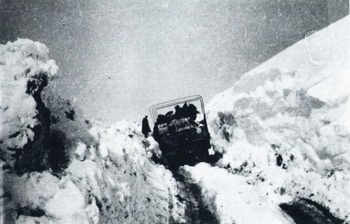
IN the north-east, north-west, and south-west of China, snow-drifts often occur in winter and spring, causing damage to communications and transportation (Fig. 1), factories and mines, as well as to agriculture and livestock breeding. Since 1967, we have conducted researches on the prevention of snow-drifts in T’ien-shan. On the basis of field observations, modelling experiments in the wind-tunnel, and some experimental prevention and control constructions, we have developed design methods for choosing preferable courses for roads to be built and for avoiding snow accumulation on road beds. In addition, we have proposed as preventive (Figure. 1) measures snow “leading” (e.g. among others, bottom-deflecting (blower) and laterally- deflecting fences of various dimensions and types), topographic improvements (e.g. among other means, elevating roadbeds, mending side slopes, digging snow storage pits, and augmenting the radius of road bends), snow collection (e.g. among other means, plantations and snow fences of different heights and wind permeabilities), and snow clearing (e.g. among other means, removing snow with machines). One of these, the utilization of leading fences has already been mentioned in the literature (Reference Strom, Strom, Kelly, Keitz and WeissStrom and others, 1962; Reference ShiotaniShiotani, 1967). Here we should like to discuss what we have learned about blower fences.
A snow-drift in a leeward one-sided cut.

1. The mechanism of the protective function of the blower fence
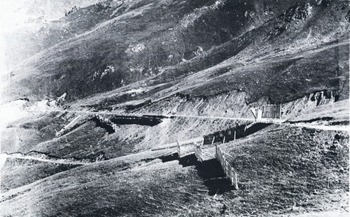
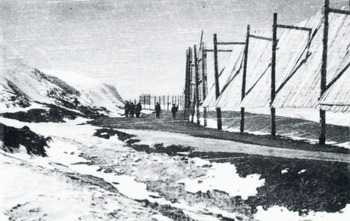
Accumulation of snow-drift always occurs in places where there is a sudden change in the curvature of the terrain. In the case of a road, accumulation occurs in separation areas such as the roadbeds where the eddy resistance increases rapidly. Blower fences may be used to prevent fall-out from the air flow caused by the changes in curvature of the local terrain. If this is successful, a great amount of snow can be transported across the road surface and free traffic can be guaranteed (Figs 2, 3, and 4).
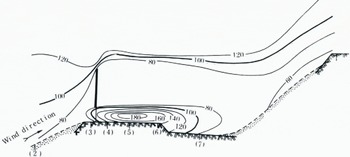
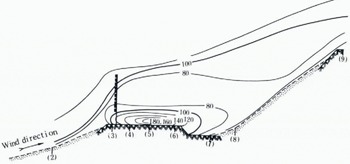
Figures 5 and 6 show that at a certain distance in front of a blower fence, owing to the obstruction by the fence, the density of drifting snow increases and its velocity decreases causing some of the snow particles to accumulate and to form a snow-drift or snow-bank. As the blowing snow approaches the blower fence, it is forced to change its course and is divided into two streams, with increased velocities, A smaller part of the snow particles is transported over the fence by the upward flow. The increase in the velocity of the lower flow is evident; this prevents the snow-drift or snow-bank from expanding forward and helps to carry the greater amount of snow through the bottom opening of the fence. The flow field behind the fence is as follows: behind the top of the fence there is an area of weakly increased velocity, while beyond the bottom opening there is an area of strongly increased velocity; between these two areas there is a velocity discontinuity where a small eddy can form.
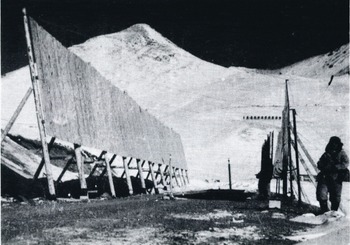
Double row of leading fences of 4 m height at a leeward one-sided cut.

Forward-inclined fences 4 m high at a windward one-sided cut.

Upright fences 2 to 4 m high at a windward one-sided cut.

Comparing the field of surface air flow on a stretch of road provided with blower fences to that on an adjoining stretch of road without such fences, we can see that the blower fence creates a radical change in the flow field. The air flow acquires turbulence similar to that caused by a plate perpendicular to the flow, with five systematic velocity areas appearing before and behind the fence. The blower fence clears the road of snow due to the fact that, as the air flow rushes through the bottom opening of the fence, the pressure energy of the air flow in front of the fence is converted behind the fence into kinetic energy. This destroys the vortex area of reduced velocity which otherwise would have existed on the road surface, and produces a zone of distinctly increased wind velocity beyond the bottom opening for a certain distance (Table 1). In this way, not only is much of the snow carried by the wind itself, but also snow particles deposited in the area of the circulation with reduced velocity in the middle part of the space behind the fence are carried away across the road surface. Thus the road surface is kept clear of snow.
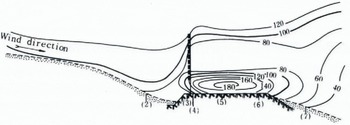
Isolines of percentage of undisturbed wind velocity near a blower fence in a leeward one-sided cut

Isolines of percentage of undisturbed wind velocity near a blower fence in a windward one-sided cut.


II Factors affecting the drift-free width created by a blower fence and its calculation
The drift-free width W is considered to be a comprehensive indicator of the preventive effect of the fence. It is important to know the factors affecting the drift-free width created by the leading fence so as to enable us to choose a solution suitable for the local conditions and to design the fence with good economy and results.
The factors affecting the drift-free width characteristic of a blower fence are: the height of the deflecting board H, the height of the bottom opening beneath it h, the inclination of the board α, the slope of the mountain side β, the intersection angle between the direction of the wind and the direction of the fence γ, the wind velocity, the quantity of the snow being transported, and so on.
1. The influence of the height of the deflecting board on the drift-free width
Generally speaking, the higher the deflecting board, the better will be the snow-preventing effect of the blower fence. If the height of the board is increased while the height of the bottom opening is kept unaltered, the drift-free width increases linearly with the logarithm of the height of the board. The following regression formulae hold between these variables: For leeward one-sided cuts

For windward one-sided cuts

When a scale coefficient of the blower fence, defined by  is kept unaltered, the augmentation in the drift-free width with the height of the deflecting board appears to be linear, i.e.
For leeward one-sided cuts

For windward one-sided cuts

Thus it can be seen that when a blower fence is used to prevent snow accumulation, a suitable ratio K must be kept between the height of the bottom opening and the height of the deflecting board.
2. The influence of the inclination of the deflecting board on the drift-free width
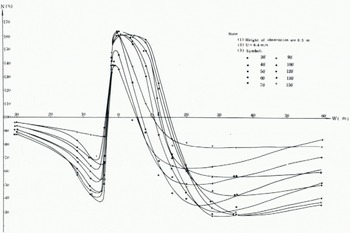
The drift-free width increases as the inclination of the leading-board increases, reaches a maximum when the inclination is 100°, and after that decreases gradually as the inclination of the deflecting board becomes greater and greater (Fig. 7).
It is desirable to use a forward leaning fence (inclination smaller than 90°) for a leeward one-sided cut. For a windward one-sided cut, a backward-leaning fence with an inclination greater than 90° can be used to produce the maximum drift width. Generally speaking, however, a vertical blower fence, requires less material and is effective enough to ensure free traffic.
3. The influence of the height of the bottom opening on the drift-free width
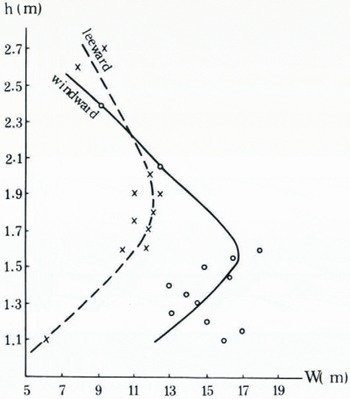
With the height of the deflecting board fixed, a preferable height of the bottom opening can always be found to maximize the drift width (Fig. 8). The preferable height of the bottom opening varies with fence location, for example the preferable height of the bottom opening for a fence set at a leeward one-sided cut is greater than that for a fence set at a windward one-sided cut.
Variation of percentage of undisturbed wind velocity with inclination α of a blower fence (H = 4 m, h = 2m, γ = 90°; wind-tunnel data).

Variation of drift-free width W with height h of the bottom opening (H = 4 m, α = 90°, γ = 90° ).

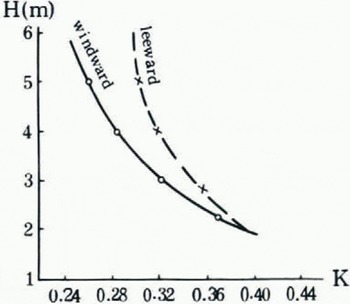
The preferable height of the bottom opening varies not only with the height but also with the inclination of the deflecting board. Taking account of the correlation between the board height and the scale coefficient of the fence (Fig. 9), Table II has been calculated for the use of fence designers; it shows the preferable height of the bottom opening corresponding to different board heights and inclinations.

The correlation between the height H of the leading board and scale coefficient K of the fence.

4. The influence of the terrain slope on the drift-free width
Mainly the slope up-wind of a leeward one-sided cut and the slope down-wind of the windward one-sided cut are taken into consideration here.
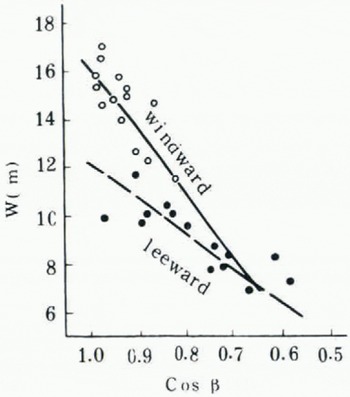
It can be seen in Figure 10 that with a continuous increase in terrain slope, the drift-free width tends to decrease faster and faster in proportion to cos β. The regression relations are: For leeward one-sided cuts

For windward one-sided cuts

In the case of a leeward one-sided cut, a cliff or a hillock on the up-wind slope close enough to the road, and higher than the blower fence, makes it absolutely necessary to smooth the slope, otherwise the blower fence loses its effectiveness. In the case of the windward one-sided cut, when there was a steep extended section on the down-stream slope it required adjustments to preserve the protecting effect of the fence.
Influence of the mountain slope on the drift-free width behind a blower fence (H = 4 m, α = 90°).

5. The influence of wind direction, wind velocity, and quantity of snow being transported on the drift-free width
The drift-free width is largest when the wind direction is perpendicular to the leading fence and it diminishes in proportion to sin γ where γ is the intersection angle between the wind direction and the direction of the blower fence.
For leeward one-sided cuts

For windward one-sided cuts

Generally speaking the blower fence can produce good results only with γ larger than 40° in the case of a fence set near a leeward one-sided cut or larger than 30° in the case of a fence set near a windward one-sided cut.
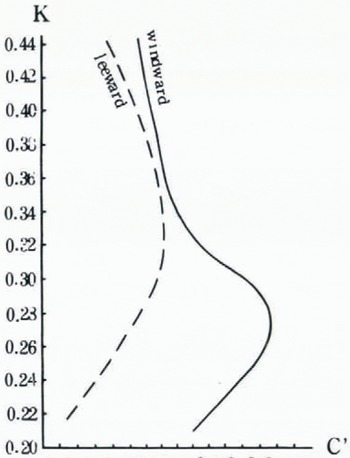
The influence of the wind velocity on the drift-free width depends on the quantity of snow being transported. When snow resources are plentiful, the air flow is nearly saturated with (Figure.11) snow particles and, owing to the large quantity of snow being transported, the drift-free width decreases with increasing wind velocity; when snow resources are scanty and the quantity of the snow being transported is small, the drift-free width increases with increasing wind velocity.
The variation in the average coefficient C' with the scale coefficient K of a blower fence.

We have developed, through a comprehensive analysis of the inherent inter-relations between all the influencing factors, the following empirical formula to calculate the drift width for a leading fence:

where W is the drift-free width, C is a coefficient related to the quantity of snow being transported, the wind velocity, and the scale coefficient of the leading fence; the average coefficient C’ can be found from Figure 11 from the scale coefficient of the blower fence K, H is the board height of the blower fence, α the inclination of the deflecting board, δ the diffusion angle of the air flow (the value of 11° was obtained for this parameter by measurements), γ the intersection angle between the wind direction and the direction of the blower fence, and β the angle between the ground and the line joining the road shoulder (in the case of a leeward one-sided cut), or from the road edge (in the case of a windward one-sided cut), to the top of the nearby slope.
In order to demonstrate the reliability and the error range of Equation (9), calculations were made for 104 data sets obtained for leeward one-sided cuts and 82 data sets for windward one-sided cuts. The relative deviation between W, the drift-free width obtained through calculations, and W’, the drift-free width obtained through actual measurement, is measured by P = (W’—W)/W’ and is shown in Table III.

It can be seen in Table III that relative deviations in the range of ± 25% constitute 70% of the total, and relative deviations of ± 30% constitute 80% of the total.
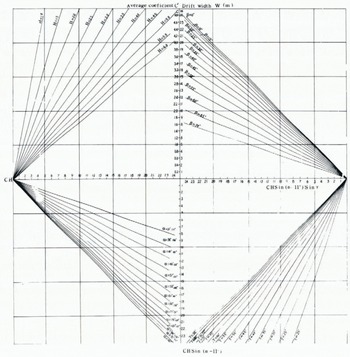
As a substitute for Equation (9) a nomogram (Fig. 12) has been worked out. This gives the estimated drift-free width of the blower fence or, if the drift-free width and the inclination angle of the deflecting board are given, enables an optimum height for the board and an optimum height for the bottom opening to be derived from the slope and the intersection angle between the wind direction and the direction of the Fence.
III. Types of blower fences and their main applications
Blower fences can be grouped according to the inclination of the deflecting board into the following three types: forward-leaning type (generally with an inclination of about 80°), the upright type, and the backward-leaning type (generally with an inclination of about 100°). Solid leading fences of these three types are very effective as preventive constructions, but they consume large amounts of material. A problem worth further study is how to improve the construction in order to minimize its cost of construction.
1. The permeable blower fence
The energy-transforming function of the blower fence is effected by the resistance of the deflecting board itself. The resistance of the leading-board has two elements: the frontal resistance to the air flow and the negative air pressure arising from the vortex turbulence created by the deflecting board. There is a possibility that for a fixed height of the deflecting (Figure.12) board, the energy losses caused by turbulence can be diminished by suitably increasing the permeability of the deflecting board. Hence we have carried out experiments on permeable leading fences. The result shows that leading fences with a permeability of 25-35% retain their snow-deflecting ability fairly well. The results we obtained through the experiments in mountainous regions agree with those of Reference DyuninDyunin (1963). Figures 13 and 14 show the velocity fields characteristic of leading fences with a permeability of 35% set at leeward one-sided cuts or windward one-sided cuts, respectively.
Fig. 12. Nomogram for calculating the drift-free widths behind blower fences.

Isolines of percentage of undisturbed wind velocity of a blower fence with a permeability of 35% ; leeward one-sided cut.

lslines of percentage of undisturbed wind velocity of blower fence with a pemeability of 35%; windward one-sided cut.

It must be pointed out that the height of the accumulated snow in front of a blower fence at a leeward one-sided cut has an influence on the down-wind protective effect of the fence. The drift-free width diminishes with increasing height of the up-wind drift. A permeable leading fence has the merit that the up-wind drift is lower. In this sense, the permeability strengthens the protective effect of the blower fence.
2. The intermittent blower fence
When a solid blower fence is set up at a windward one-sided cut or at an embankment where snow has been accumulating, there always appears in front of the deflecting board a horizontal air flow toward both ends of the blower fence. An area of distinctly increased wind velocity is formed near the edges of the fence on the road surface clear of the leading fence; owing to this, snow particles are efficiently transported across the road surface there. According to our observation, the width of the area of increasing velocity measures around 12 m when the horizontal length of the solid leading fence is 48 m.
Hence, at windward one-sided cuts or snow-accumulated embankments, intermittent leading fences can be used to prevent the formation of drifts.
The wind permeability of the fence and the space between two neighbouring fences may be selected according to the existing conditions; the intermittent leading fences themselves can be designed according to the above-mentioned method.
To sum up, the blower fence is an effective means of preventing severe snow-drift obstruction on roads. Provided the intersection angle between the road and the wind direction is larger than 40° at leeward one-sided cuts, or larger than 30° at windward one-sided cuts, level sections, or low embankments, free traffic can be guaranteed with well-designed leading fences. Roads can also be protected against snow-drift obstruction by combining the use of blower fences and laterally-deflecting fences. Moreover, at road sections vulnerable to winds coming alternately from opposite directions, double-row blower fences often are less expensive and more effective than the construction of road beds designed to prevent snow accumulation on both sides.