Syndromic multiplex polymerase chain reaction (mPCR) panels allow rapid detection of multiple pathogens from a single clinical specimen, and they can be performed on a variety of specimen types. mPCR tests are more sensitive and specific than antigen detection assays; they have rapid turnaround times; and they detect coinfections. Reference Caliendo1–Reference Xu, Qin and Astion5 However, such panels are costly and of unclear clinical benefit in many patient populations. The clinical utility and cost-effectiveness of mPCR panels must be evaluated to justify their routine clinical use.
Most research on rapid mPCR testing has been conducted in older children and adults and has focused almost exclusively on respiratory pathogen detection. Reference Wabe, Li and Lindeman4–Reference Rappo, Schuetz and Jenkins6 Although some adult studies demonstrate associations between mPCR testing of respiratory specimens and decreased length of stay (LOS), lower admission rates, and less antibiotic and ancillary test use, other studies show no such benefits. Reference Wabe, Li and Lindeman4,Reference Rappo, Schuetz and Jenkins6–Reference McCulloh, Andrea, Reinert and Chapin9 Some studies report that the use of respiratory mPCR tests is cost-effective compared to conventional or no testing. Reference Nelson, Stockmann and Hersh10,Reference Subramony, Zachariah, Krones, Whittier and Saiman11 However, these studies have limitations. Most are retrospective, have varied turnaround times of mPCR testing, include limited evaluation of nonrespiratory specimen types, and do not adjust for temporal trends.
Few studies have investigated the role of rapid mPCR testing in the evaluation of febrile young infants, a population commonly seen in pediatric emergency departments (EDs). Reference Huppler, Eickhoff and Wald31–Reference Aronson, Shabanova and Shapiro33 Evaluation of these infants, in whom it can be especially difficult to differentiate between viral and bacterial infections, Reference Caviness, Demmler, Almendarez and Selwyn12–Reference Sharp, Harrison and Puckett15 has great interhospital and patient-level variation, and current guidelines do not recommend routine viral testing. Reference Aronson, Thurm and Alpern16,Reference Woll, Neuman and Aronson17 However, several studies have shown that the risk of serious bacterial infection is very low among febrile young infants who have viral pathogens detected. Reference Byington, Enriquez and Hoff2,Reference Blaschke, Korgenski and Wilkes18–Reference Titus and Wright20 Outcomes studies evaluating mPCR use in febrile infants have been small, retrospective, and observational. Reference Eichinger, Hagen, Meyer-Buhn and Huebner21–Reference Burstein, Dubrovsky, Greene and Quach23 More rigorous and larger studies are needed to determine whether mPCR testing should be incorporated into routine evaluation of febrile or hypothermic infants.
To evaluate the impact of using a clinical practice guideline alone and in conjunction with mPCR testing on outcomes of febrile or hypothermic infants ≤90 days old presenting to the ED, we conducted a before-and-after intervention study.
Methods
Study design
We conducted a quasi-experimental, single-center, observational, study from January 1, 2011, through June 15, 2019, in a 271-bed, free-standing, tertiary-care academic children’s hospital. We included all infants ≤90 days old presenting to the pediatric ED with a chief complaint of fever (body temperature ≥38.0°C) or hypothermia (body temperature <35.8°C). We collected data over 3 periods. During period 1 (January 1, 2011, through December 31, 2014), no standardized clinical guideline was in effect and no rapid respiratory pathogen testing was available. Batched mPCR testing (performed once or twice daily) using a Genmark eSensor XT-8 respiratory viral panel (RVP) was available during this period but was rarely used by clinicians due to slow turnaround time. During period 2 (January 1, 2015, through April 1, 2018), a standardized institutional treatment guideline was implemented that did not include recommendations for viral testing other than HSV PCR of the cerebrospinal fluid. Batched RVP testing was also available during this period but was rarely used. During period 3 (May 1, 2018, through June 15, 2019), BioFire FilmArray respiratory panel 2 (RP 2) was available on demand and was performed daily across all shifts as specimens arrived in the laboratory. Meningitis encephalitis panel (MEP) testing was available in addition to the guideline. The guideline did not change between periods 2 and 3 (Supplementary Fig. 1 online). All testing was performed in a central clinical microbiology laboratory by licensed technologists.
For 1–2 months prior to the start of period 3, ED providers were educated about the RP and MEP tests. Monoplex tests for single virus detection (eg, herpes simplex virus [HSV], enterovirus, influenza) were available, although they were discouraged during period 3. During all periods the decision to follow the guideline or order the mPCR tests was taken at the discretion of the treating provider. A nasopharyngeal swab was collected by the bedside nurse in the ED for the RP, and cerebrospinal fluid (CSF) specimens were collected when clinically indicated and were used for the MEP.
All rapid mPCR testing during all periods was performed in the main clinical microbiology laboratory. CSF specimens were manually transported from the ED to the microbiology lab. Providers could order additional testing including some or all of the following: complete blood count (CBC); electrolyte levels; blood, urine, and CSF cultures; urinalysis; CSF cell count and chemistries, and rapid point-of-care influenza and respiratory syncytial virus (RSV) antigen tests in the ED. RVP and rapid mPCR results were reported in the electronic medical record.
Data collection
Data from all 3 periods were extracted retrospectively from the electronic medical record between September 2018 and July 2019. We collected age at presentation, date of birth, sex, date and time of admission and discharge, chief complaint(s), laboratory and radiology results, readmissions and deaths within 30 days, and antimicrobial durations. Inpatients were defined as patients discharged from an inpatient unit rather than the ED. Antimicrobial duration was calculated among those who received >2 doses, as time between first and last administered dose. If a patient received multiple antimicrobials, total duration of therapy was the sum of individual antimicrobial durations. We also recorded single doses of antimicrobials. Ancillary tests included CBC; basic metabolic panel; urinalysis; CSF cell count and chemistries; enterovirus PCR; RSV and influenza antigens, HSV PCR; aspartate aminotransferase (AST); alanine aminotransferase (ALT); total and direct bilirubin; and bacterial blood, urine, and CSF cultures.
Outcomes included inpatient LOS, percentage of patients admitted to the hospital, days of antibiotic and antiviral therapy, presence of a bacterial or viral infection, time from specimen collection to identification of a bacterial or viral infection, ancillary test utilization, percentage of patients receiving chest radiographs or lumbar punctures, 30-day mortality, and 30-day readmissions.
Analysis
We compared outcomes across all 3 periods, and we performed pairwise comparisons between periods, when indicated. We also compared outcomes among period 3 patients who had positive versus negative mPCR test results to determine whether detection of a potential pathogen was associated with less treatment and diagnostic testing. We estimated that a sample size of ~1,200 patients during period 1, 1,200 patients during period 2, and 750 patients during period 3 would provide 80% power to detect a difference of ≥0.5 days in LOS between periods 2 and 3. We also performed subgroup analyses of age groups: 0–28 days, 29–60 days, and 61–90 days.
Data were analyzed using R version 3.5.2 software (R Foundation for Statistical Computing, Vienna, Austria). Continuous variables were calculated using median and interquartile range (IQR) and categorical variables were calculated using frequency and percentage. The Wilcoxon rank-sum test and χ2 tests were used, as appropriate. The autoregressive integrated moving average (ARIMA) model was used to fit the time series data adjusted for seasonality. The best ARIMA models were picked according to Akaike information criterion (AIC) values. This study was approved by the Vanderbilt University Medical Center Institutional Review Board with a waiver of consent.
Results
Demographic and clinical characteristics
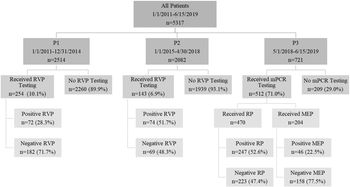
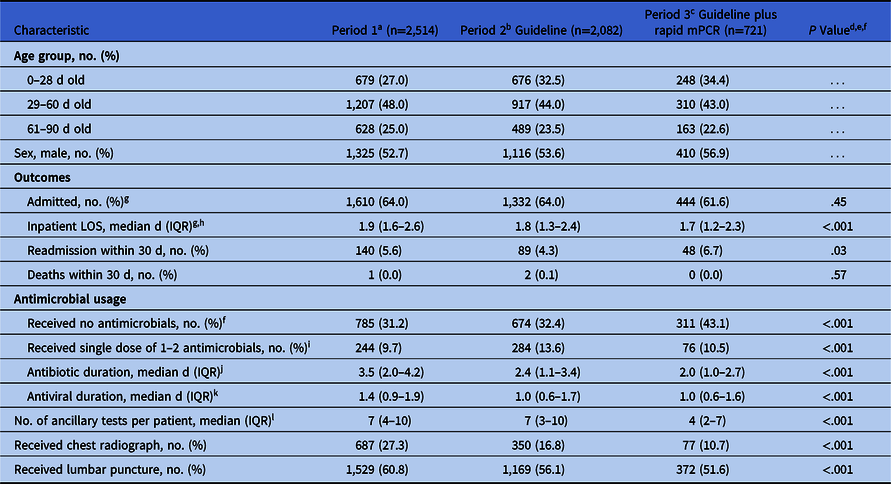
During the 8-year study period, 5,317 total patients met the inclusion criteria: 2,514 in period 1, 2,082 in period 2, and 721 in period 3 (Fig. 1). Patients in each of the 3 periods were similar in sex and age distributions (Table 1). The most common antimicrobials used during all periods were ampicillin, gentamicin, and third-generation cephalosporins (ceftriaxone or cefotaxime). In all periods, the number of infants discharged from the ED without antibiotics in whom bacterial pathogens were ultimately cultured from urine, blood, or CSF, was small: period 1, n = 19 (0.8%); period 2, n = 13 (0.6%); period 3, n = 3 (0.4%). We detected no statistically significant difference in the number of deaths in each period, and there was a small but statistically significant decrease in LOS between periods 1 and 2 but not between periods 2 and 3 (Table 1).
Patient enrollment and testing in each study period. Note. RVP, Genmark eSensor XT-8 respiratory viral panel; mPCR, multiplex polymerase chain reaction testing; RP, BioFire FilmArray respiratory panel 2; MEP, BioFire FilmArray meningitis encephalitis panel.

Characteristics and Outcomes Among Infants ≤90 days (n = 5,317)

Note. LOS, length of stay; IQR, interquartile range; mPCR, rapid multiplex chain reaction; PCR, polymerase chain reaction.
a 1/1/2011–12/31/2014; no clinical practice guideline or rapid multiplex polymerase chain reaction (mPCR) testing.
b 1/1/2015–4/30/2018; clinical practice guideline available, no rapid mPCR testing.
c 5/1/2018–6/15/2019; clinical practice guideline and rapid mPCR testing available.
d P value shown comparing all 3 periods.
e Variables with statistically significant differences between period 1 and period 2, with P value <.05 include LOS, readmission, single dose of antimicrobials, antibiotic duration, antiviral duration, number of ancillary tests, and receipt of chest radiograph and lumbar puncture.
f Variables with statistically significant differences between periods 2 and 3, with P value <.05 include readmission, single dose of antimicrobials antibiotic duration, number of ancillary tests, and receipt of chest radiographs and lumbar puncture.
g Considered inpatient if discharged from an inpatient unit.
h Excludes 93 patients in period 1 and 56 patients in period 2 with incomplete inpatient admission times
i Antimicrobials include acyclovir, ampicillin, cefepime, cefotaxime, ceftriaxone, gentamicin, oseltamivir, penicillin, and vancomycin.
j Among patients receiving more than a single dose of 1–2 antibiotics.
k Among patients receiving more than a single dose of 1–2 antivirals.
l Includes complete blood count, basic metabolic panel, urinalysis, cerebrospinal fluid cell count and chemistries, enterovirus PCR, respiratory syncytial virus antigen, influenza antigen, herpes simplex virus PCR, aspartate aminotransferase, alanine aminotransferase, total and direct bilirubin, and bacterial cultures during the hospital encounter.
We detected no difference in the distribution of pathogens across the study periods. The most commonly identified respiratory organisms were rhinovirus and enterovirus in all 3 periods (Supplementary Fig. 2 online). The groups differed significantly in how commonly mPCR testing was used and its turn-around time. RVP batch testing in both periods 1 and 2 was used in 10% or less of patients and had a median turnaround time of 29 hours (interquartile range [IQR], 20–47) in period 1 and 26 hours (IQR, 20–37) in period 2. In contrast, in period 3, when on-demand mPCR testing was available, 71.0% of patients received the RP, MEP, or both. The youngest patients were most likely to receive the MEP, with or without the RP (Supplementary Table 2 online). The median turnaround time for the RP was 1.6 hours (IQR, 1.2–2.4) and for the MEP it was 3.2 hours (IQR, 2.4–6.3). More than half of patients receiving the RP, MEP, or both tests had a pathogen identified. Multiple respiratory pathogens were detected in 34 patients: 32 patients had 2 respiratory pathogens identified and 2 patients had 3 respiratory pathogens identified. Both enterovirus and human herpes virus 6 were detected in the MEP of 2 patients (Fig. 1 and Supplementary Fig. 2 online).
Impact of clinical guideline introduction
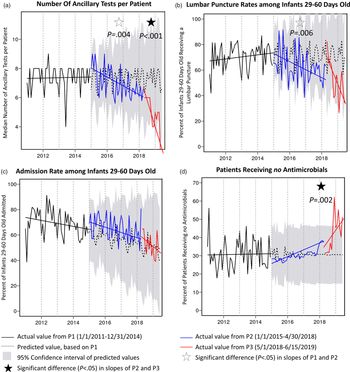
We evaluated the impact of the clinical guideline by performing pairwise comparisons of outcomes among patients in periods 1 and 2. Following introduction of the clinical guideline, we observed small but statistically significant decreases in the duration of antimicrobial therapy and the use of chest radiographs, lumbar punctures, and ancillary tests. Among infants receiving >2 doses of antibiotics, median (IQR) duration of therapy was 0.9 days shorter in period 2 than in period 1 (95% CI, 0.8–1.0; P < .001). There were no significant differences in other outcomes following introduction of the guideline (Table 1). When we adjusted for temporal trends using interrupted time series analysis, we detected a statistically significant decrease in the number of ancillary tests used between periods 1 and 2 (Fig. 2A).
Interrupted time series analysis displaying temporal trends across three time periods. A clinical guideline was introduced at the start of period 2 and was unchanged through period 3. Rapid mPCR testing was introduced at the start of period 3. Vertical grey lines mark each January. (A) Mean number of ancillary tests per patient each month among all infants <90 days old. Ancillary tests include complete blood count, basic metabolic profile, CSF cell count and chemistries, enterovirus PCR, RSV antigen, influenza antigen, HSV PCR< AST, ALT, total and direct bilirubin, and bacterial cultures. (B) Percent of patients 29–60 days old receiving a lumbar puncture each month. (C) Percent of patients 29–60 days old admitted to the hospital each month. (D) Percent of patients 29–60 days old who did not receive antimicrobials each month. Antimicrobials include acyclovir, ampicillin, cefepime, cefotaxime, ceftriaxone, gentamicin, oseltamivir, penicillin, and vancomycin.

Impact of mPCR testing
We evaluated the impact of mPCR testing used in conjunction with the treatment guideline by performing pairwise comparisons of outcomes among patients in period 2 and period 3. Following introduction of mPCR testing, the percentage of patients who did not receive antimicrobials increased from 32.4% to 43.1% (difference, 10.8%; 95% CI, 6.5%–15%); median (IQR) antibiotic duration decreased by 0.47 days (95% CI, 0.16–0.51); ancillary tests per patient decreased by 3 (95% CI, 2–3); and the proportion of patients receiving chest radiographs decreased from 16.8% to 10.7% (difference 6.1%; 95% CI, 3.3%–9.0%) (Table 1 ). However, after adjusting for temporal trends using interrupted time series analysis, only the reduction in ancillary tests remained statistically significant between periods 2 and 3 (Fig. 2A). The reduction in ancillary testing was due, in part, to fewer tests for enterovirus PCR, influenza antigen, and RSV antigen in period 3; however, also fewer patients received basic metabolic panels (42.2% in period 2 vs 22.9% in period 3), liver function tests (ALT and AST; 35.2% in period 2 vs 24.0% in period 3), and bacterial cultures. Blood cultures were obtained in 72.2% in period 2 versus 61.0% in period 3; CSF cultures were obtained in 54.1% in period 2 versus 39.9% in period 3; and cultures were obtained in 72.9% in period 2 versus 62.2% in period 3.
Outcomes among infants 29–60 days old
When we evaluated the impact of the interventions by age group (0–28 days, 29–60 days, and 61–90 days) and adjusted for temporal trends using interrupted time series analysis, we found notable outcome differences among infants 29–60 days old that were not absent in other age categories (Supplementary Table 1a–c online). Specifically, among infants 29–60 days old, there was a significant decrease between period 1 and period 2 in the percentage who underwent lumbar punctures (Fig. 2B) and the percentage admitted (Fig. 2C), although the latter difference did not reach statistical significance when we adjusted for temporal trends. Also in this age group, we detected a significant increase between periods 2 and 3 in the percentage of patients who did not receive antimicrobials (20.2% increase; 95% CI, 13.7%–26.6%; P < .001), which remained statistically significant when we adjusted for temporal trends (Fig. 2D). In contrast, among infants 0–28 days old and 61–90 days old, we detected modest reductions in LOS and in antibiotic use and chest x-ray that were not significantly different after adjustment for temporal trends (Supplementary Tables 1a and 1c online).
Outcomes among those with positive versus negative mPCR tests
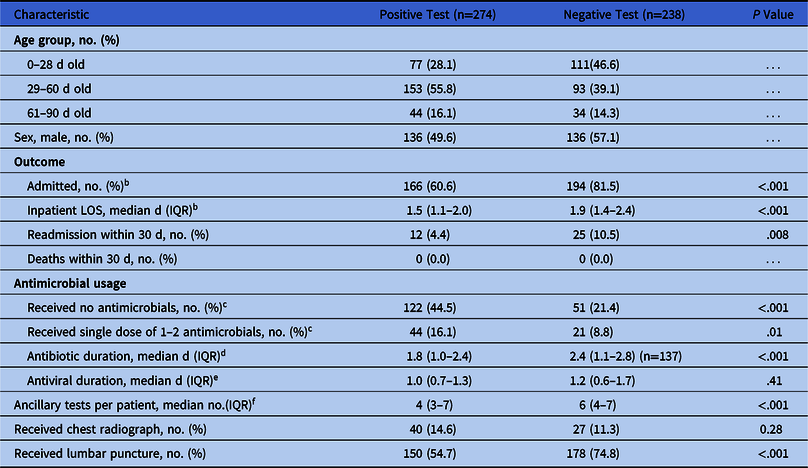
Among all period 3 patients who received mPCR testing, those with positive test results had lower rates of admission and 30-day readmission than those with negative test results. Patients with positive mPCR test results also underwent fewer lumbar punctures and ancillary tests, and a larger percentage received no antimicrobials compared to patients with negative tests. Among patients who received >2 doses of antibiotics, antibiotic duration was 0.4 days shorter (95% CI, 0.13–0.66; P < .001) in those with positive test results than those with negative test results (Table 2). Among patients admitted to the hospital, inpatient LOS was 0.3 days shorter (95% CI, 0.5–0.2; P < .001) among those with positive mPCR test results than among those with negative mPCR results (Table 2).
Characteristics and Outcomes Among Period 3 a Patients Receiving Respiratory Panel and/or Meningitis Encephalitis Panel (n = 512)
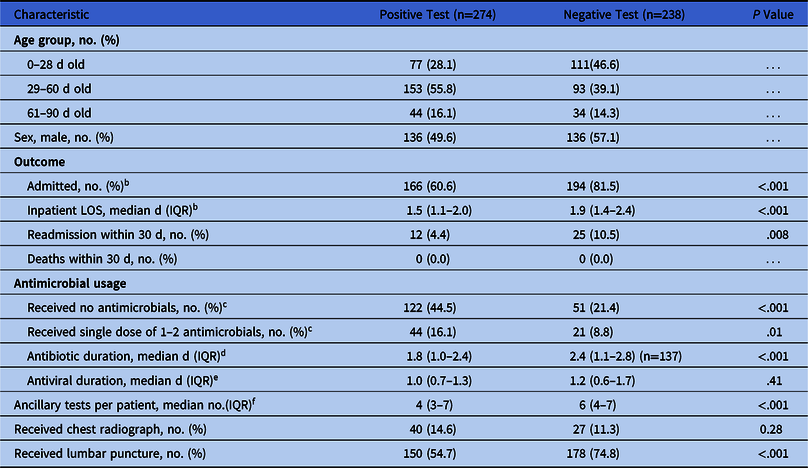
Note. LOS, length of stay; IQR, interquartile range; mPCR, rapid multiplex chain reaction; PCR, polymerase chain reaction.
a 5/1/2018–6/15/2019; clinical practice guideline and mPCR testing available.
b Considered inpatient if discharged from inpatient unit.
c Antimicrobials include acyclovir, ampicillin, cefepime, cefotaxime, ceftriaxone, gentamicin, oseltamivir, penicillin, and vancomycin.
d Among patients receiving more than a single dose of 1–2 antibiotics.
e Among patients receiving more than a single dose of 1–2 antivirals.
f Includes complete blood count, basic metabolic panel, urinalysis, cerebrospinal fluid cell count and chemistries, enterovirus PCR, respiratory syncytial virus antigen, influenza antigen, herpes simplex virus PCR, aspartate aminotransferase, alanine aminotransferase, total and direct bilirubin, and bacterial cultures during the hospital encounter.
Discussion
In this large before-and-after intervention study, we analyzed temporal trends in the management of febrile or hypothermic infants presenting to the ED, and we determined the clinical impact of a clinical practice guideline with and without mPCR testing. After adjusting for temporal trends during the 8-year study period, the introduction of the guideline was associated with reductions in ancillary tests and LPs. The addition of rapid, on-demand mPCR testing to the young infant evaluation clinical guideline led to dramatically shorter turnaround time for test results as well as pathogen identification in more than half of the study cohort. This, in turn, was associated with additional reductions in ancillary testing for all patients and a higher proportion of infants 29–60 days old being managed without antibiotics. Importantly, lower resource and antimicrobial utilization was not associated with harm; the proportion of infants found to have serious bacterial infection who were discharged from the ED without antibiotic treatment remained very low (<1%) following implementation of either the guideline or mPCR testing. Our findings suggest that the use of mPCR testing in conjunction with a clinical guideline may have benefit, particularly for infants 29–60 days old.
The clinical benefits we observed have downstream impact that we could not quantify, including less antibiotic exposure, which may lead to less selection for drug-resistant organisms and less disruption of the infant microbiome, potentially resulting in fewer adverse health outcomes. Reference Aghaali and Hashemi-Nazari24,Reference Ahmadizar, Vijverberg and Arets25 Fewer parenteral antimicrobial doses may lead to less adverse events from drug exposure or use of intravenous catheters; reductions in chest radiographs would expose fewer infants to potentially harmful radiation; and fewer LPs would shorten time in the ED, would reduce parent and provider anxiety, and would lower cost.
It is not surprising that the mPCR test had the most significant clinical impact among infants 29–60 days old, an age category for which practice varies and recommendations differ regarding the optimal evaluation of fever. Reference Woll, Neuman and Aronson17,Reference Baker, Bell and Avner26–Reference Jaskiewicz, McCarthy and Richardson32 Notably, routine viral testing with mPCR methods is not included in either of the recently published clinical prediction rules to identify serious bacterial infections in young infants. Reference Aronson, Shabanova and Shapiro33,Reference Kuppermann, Dayan and Levine34 Traditionally, providers perform full sepsis evaluations on infants <28 days and less comprehensive evaluations in infants >60 days old, but practice often varies in the management of infants 29–60 days old. We found that the percentages of infants 29–60 days of age who were treated with antibiotics, who were admitted to the hospital, or who underwent a lumbar puncture were all lower following mPCR introduction. This percentage was also lower among patients who had positive mPCR tests versus those with negative mPCR tests. These results suggest that providers in our study were more comfortable doing fewer evaluations when mPCR detected a pathogen that could explain fever or hypothermia in an otherwise well-appearing infant. These findings are consistent with prior studies. Reference Ramers, Billman, Hartin, Ho and Sawyer14,Reference Eichinger, Hagen, Meyer-Buhn and Huebner21–Reference Burstein, Dubrovsky, Greene and Quach23 Readmission rates were higher among patients with negative mPCR test compared to those with positive mPCR tests. Reasons for this finding are unclear, but we speculate that it may be due to higher acuity of illness or greater provider discomfort when infants did not have confirmed microbiologic diagnoses. Our findings suggest that the use of mPCR testing, although expensive, may ultimately be cost-effective, particularly for infants 29–60 days old. Further studies are needed to assess the cost-effectiveness of mPCR testing in this population.
Our study has several limitations. The quasi-experimental design meant that we could not prove causation. The temporal trends we observed may have been due to practice changes other than introduction of the guideline or mPCR testing. We collected data retrospectively for 2 study periods. We did not capture deaths or readmissions that did not occur within our institution, nor did we assess compliance with the clinical guideline. This was a single-center study, and our findings cannot be generalized to institutions that do not perform on-demand mPCR testing 24 hours per day, 7 days per week. We did not randomize or match patients, so baseline characteristics may have differed between periods. However, because we had a large sample size and each period had similar distributions of age, pathogens, and antimicrobials used, we suspect that the patients in each period were similar. Lastly, our study did not compare the impact of multiplex testing versus testing for a more limited number of organisms. Rapid detection of influenza or RSV only may have provided similar results as multiplex testing.
Study strengths are the large sample size, the multiyear study period, and the ability to separately evaluate the impact of a guideline versus mPCR testing, adjusted for temporal trends. Additionally, we used an implementation strategy to facilitate uptake of the mPCR tests. We incorporated testing recommendations into a frequently used clinical practice guideline that was familiar to ED providers. In addition, we worked with the central microbiology laboratory to provide nearly 24-hour, on-demand testing of the RP and MEP, allowing the test results to be available to providers before patients were discharged from the ED. We feel that the faster turnaround time of the RP and MEP led to the increased uptake of mPCR testing during period 3 compared to earlier periods.
In conclusion, we performed a multiyear evaluation of >5,000 infants presenting to the ED and found that use of a standardized guideline safely reduced unnecessary ancillary testing and LPs, and use of mPCR tests together with the guideline further reduced unnecessary testing and decreased antibiotic exposure for infants 29–60 days old. The cost-effectiveness of including mPCR syndromic panels as part of routine evaluation of well-appearing infants who present to the ED with fever or hypothermia warrants further study.
Supplementary material
To view supplementary material for this article, please visit https://doi.org/10.1017/ice.2020.317
Acknowledgments
Financial support
BioFire provided instruments and reagents but had no role in design or conduct of the study, data analysis, and interpretation of the data, or manuscript preparation.
Conflicts of interest
R. B. has received research funding from Accelerate Diagnostics and Roche. All other authors declare no conflicts of interest.