Non-technical Summary
A fascinating discovery from the shores of an ancient Chinese sea improves our understanding of life after Earth’s most devastating mass extinction. On the floors of these long-vanished waters, over 240 million years old, are enormous and intricate trails and trackways. At first glance, such large traces were attributed to marine reptiles or other vertebrates. However, a detailed analysis reveals a culprit: a giant, ancient relative of the horseshoe crab. These remarkable trace fossils, found in the Early Triassic rocks of the Chaohu region, consist of wide, sweeping trails and trackways up to 5 m long and 30 cm wide. Analysis of their shape and pattern points not to a vertebrate animal but to a massive aquatic arthropod. While the trails do not match any previously named trace fossil exactly, they most closely resemble the swimming traces of horseshoe crabs. The sheer size of the trails and trackways suggests the animal that made them was a true giant, potentially over 70 cm long, making it one of the largest horseshoe crabs ever identified. This discovery adds a new dimension to the famous Chaohu Fauna, revealing the presence of a large, bottom-dwelling arthropod that was likely an important part of the food web. It provides a stunning glimpse into the rapid recovery and evolution of life after a global catastrophe, showing that giants were already patrolling the oceans earlier than previously thought. This finding highlights how trace fossils can unlock secrets of behavior and gigantism in ancient marine creatures.
Introduction
Limulids are aquatic arthropods belonging to the Xiphosurida. Their earliest appearance dates to the Ordovician (Rudkin et al., Reference Rudkin, Young and Nowlan2008), and their morphology is barely different from that of modern limulids (Kin and Błazejowski, Reference Kin and Błażejowski2014), with only an increase in body size (Diedrich, Reference Diedrich2011). Most extant limulids live in marine environments, but the fossil record shows a more diverse range of habitats, including fluvial, lacustrine, floodplain, and marine settings (Gaillard, Reference Gaillard2011; Xing et al., Reference Xing, Wang, Klein and Gao2024). Body fossils and ichnofossils of limulids are widely distributed in geological strata, spanning the Paleozoic (Willard, Reference Willard1935; Caster, Reference Caster1938; Hardy, Reference Hardy1970; Fischer, Reference Fischer1978; Miller, Reference Miller1982), Mesozoic (Caster, Reference Caster1939; Kolb, Reference Kolb1963; Shibata and Varricchio, Reference Shibata and Varricchio2020; Xing et al., Reference Xing, Wang, Klein and Gao2024), and Cenozoic (Russell, Reference Russell1940; Xing et al., Reference Xing, Lockley, He, Matsukawa, Persons IV, Xiao and and Zhang2012). The trace fossils produced by different behaviors of limulids correspond to distinct ichnogenera, such as Kouphichnium Nopsca, Reference Nopsca and Soergel1923 (repichnia—locomotion trackways; King et al., Reference King, Stimson and Lucas2019), Limulicubichnus Miller, Reference Miller1982 (cubichnia—resting traces), Selenichnites Romano and Whyte, Reference Romano and Whyte1990 (domichnia—burrowing activity; Romano and Whyte, Reference Romano and Whyte1987, Reference Romano and Whyte1990), and Crescentichnus Romano and Whyte, Reference Romano and Whyte2015 (fodichnia/cubichnia—foraging and resting behavior).
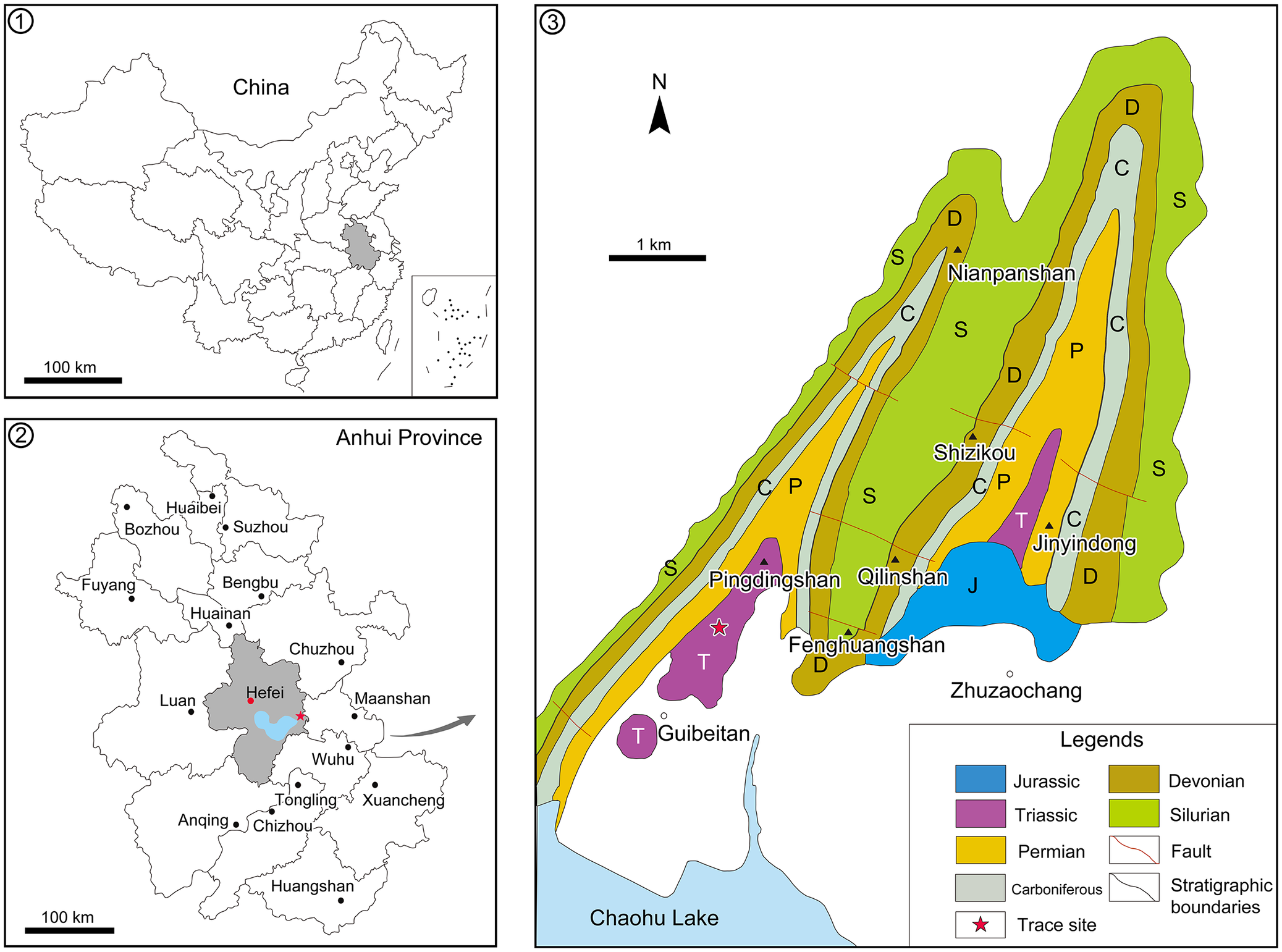
The study area is located at the Majiashan site in Chaohu City, Anhui Province (Fig. 1), which is famous for the discovery of the oldest ichthyosaur, Chaohusaurus (Young and Dong, Reference Young, Dong, Young and Dong1972a). The Majiashan site is situated on the northwestern margin of the Lower Yangtze Platform within the South China Block and is dominated by carbonate sediments (Fig. 2; Anhui Bureau of Geology and Mineral Resources, 1987). It exposes complete marine strata of the Permian and the Lower Triassic (Xiong and Ji, Reference Xiong and Ji2023). The stratigraphic sequence of the Majiashan Section has been described in detail on multiple occasions (Fig. 2; Chen, Reference Chen1985; Tong and Yin, Reference Tong and Yin2002; Tong et al., Reference Tong, Zuo, Zhao, Duan, Zhang, Zakharov and Hansen2004). Notably, the Majiashan Section is the primary research area for the Chaohu Fauna. The fossil-bearing layers of the Chaohu Fauna are buried mainly in the middle to upper Spathian of the upper Olenekian (Lower Triassic; Jiang et al., Reference Jiang, Zhou, Motani, Tintori and Fraser2023) in relatively deep waters on the northern slope of the carbonate platform (Zhang et al., Reference Zhang, Jiang, Fu, Ji and Sun2014; Fu et al., Reference Fu, Jiang, Montañez, Meyers, Motani and Tintori2016). This locality possesses a rich diversity of marine reptile fossils, with the oldest basal ichthyopterygian Chaohusaurus (Young and Dong, Reference Young, Dong, Young and Dong1972a) as the main component of the Chaohu Fauna (Motani et al., Reference Motani, Jiang, Chen, Tintori, Rieppel, Ji and Huang2015; Huang et al., Reference Huang, Motani, Jiang, Tintori, Rieppel, Zhou, Ren and Zhang2019; Jiang et al., Reference Jiang, Zhou, Motani, Tintori and Fraser2023). Other fossil assemblages include fishes, bivalves, cephalopods, conodonts, arthropods, and others (Tong et al., Reference Tong and Zakharov2004, Reference Tong, Zhou, Erwin, Zuo and Zhao2006; Tong and Zakharov, Reference Tong, Zuo, Zhao, Duan, Zhang, Zakharov and Hansen2004; Sun et al., Reference Sun, Tintori, Jiang and Motani2013; Ji et al., Reference Ji, Zhang, Jiang, Bucher, Motani and Tintori2015, Reference Ji, Tintori, Jiang and Motani2017), representing an important record of Early Triassic marine faunas (Tong and Yin, Reference Tong and Yin2009). However, before this study, no body fossils or trace fossils of limulids (aquatic arthropod) had been discovered or reported at the Majiashan site.
Map showing (1, 2) the location of concretions and (3) concretion-bearing sequences in the Chaohu area, Anhui Province, Eastern China (modified from He et al., Reference He, An, Sun and Lai2019).

Figure 1. Long description
Panel 1 at the top-left shows a map of China with provincial borders. Anhui Province is highlighted in grey in Eastern China. A 100 k m scale bar is at the bottom-left.
Panel 2 at the bottom-left shows a detailed map of Anhui Province. Major cities including Huaibei, Bozhou, Suzhou, Fuyang, Bengbu, Huainan, Chuzhou, Luan, Maanshan, Wuhu, Xuancheng, Anqing, Chizhou, and Huangshan are marked with black dots. The central Hefei region is shaded grey, containing a blue lake and a red star. A 100 k m scale bar is at the bottom-left.
Panel 3 on the right is a large-scale geological map of the Chaohu area. A North arrow and 1 k m scale bar are at the top-left. The map shows folded stratigraphic bands labeled with letters. From the outer edges toward the center of the folds, the colors and labels represent:
- S (light green): Silurian
- D (brown): Devonian
- C (light grey): Carboniferous
- P (yellow): Permian
- T (purple): Triassic, including sites Guibeitan and Pingdingshan marked with a red star trace site.
- J (blue): Jurassic, located near the center-right.
Specific locations marked with black triangles include Nianpanshan in the North, Shizikou and Qilinshan in the center, and Fenghuangshan and Jinyindong in the South. Red lines indicate faults, and thin black lines indicate stratigraphic boundaries. Chaohu Lake is visible at the bottom-left, and Zhuzaochang is labeled in the Southeast.
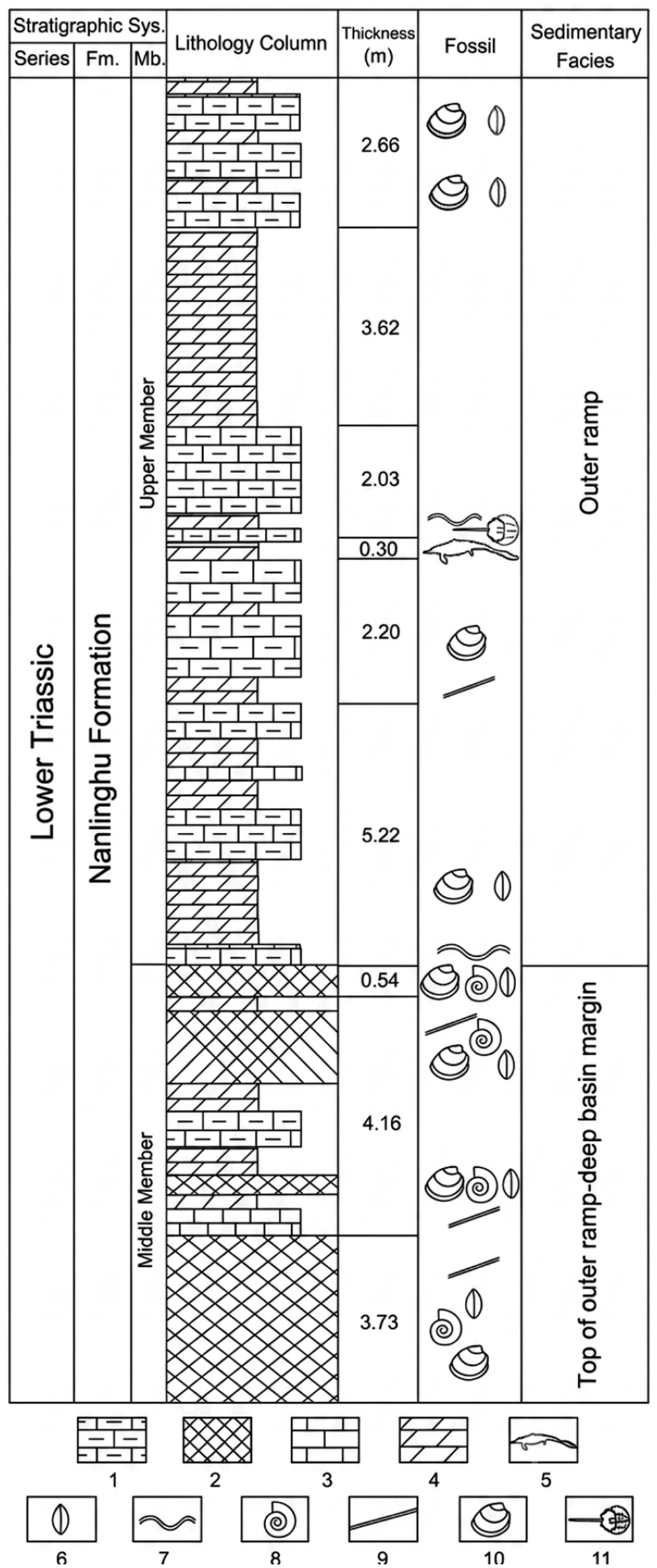
Integrated stratigraphic column of the middle–upper members of the Nanling Formation in the Majiashan section of Chaohu area, Anhui Province (modified from Zhang et al., Reference Zhang, Jiang, Fu, Ji and Sun2014). 1 = mud-bearing micrite; 2 = nodular micrite; 3 = limestone; 4 = argillaceous micrite; 5 = chaohusaur; 6 = ostracod; 7 = trace fossil; 8 = ammonite; 9 = sponge spicule; 10 = bivalve; 11 = limulid traces.

Figure 2. Long description
The diagram is organized into seven vertical columns. From left to right, they are Series, Formation, Member, Lithology Column, Thickness in meters, Fossil, and Sedimentary Facies.
* Stratigraphy: The entire section belongs to the Lower Triassic Nanlinghu Formation. It is divided into a Middle Member at the base and an Upper Member above.
* Middle Member: This section is 8.43 meters thick. It begins at the base with 3.73 meters of nodular micrite, followed by 4.16 meters of alternating limestone and nodular micrite, and ends with 0.54 meters of argillaceous micrite. Fossils present include bivalves, ammonites, sponge spicules, and ostracods. The sedimentary facies is labeled as Top of outer ramp-deep basin margin.
* Upper Member: This section is 14.03 meters thick. It consists of alternating layers of mud-bearing micrite, argillaceous micrite, and limestone. Specific thickness intervals from bottom to top are 5.22 meters, 2.20 meters, 0.30 meters, 2.03 meters, 3.62 meters, and 2.66 meters. Fossil distribution includes trace fossils, chaohusaurs, limulid traces, bivalves, and ostracods. The sedimentary facies for the entire Upper Member is Outer ramp.
* Legend: 1 mud-bearing micrite. 2 nodular micrite. 3 limestone. 4 argillaceous micrite. 5 chaohusaur. 6 ostracod. 7 trace fossil. 8 ammonite. 9 sponge spicule. 10 bivalve. 11 limulid traces.
The newly discovered large trace fossils in the Majiashan area are complex curved traces associated with punctate impressions, which were likely left by the scratch of the whorled pushing apparatuses of arthropods in a semi-swimming state. A detailed description of the characteristics of the traces will be provided, along with a discussion of their similarities and differences relative to other arthropod trace fossils documented in the literature. This comparative analysis also informs tracemaker identification and ethological interpretations.
Geological setting
The Majiashan Section is situated at Chaohu City, on the northeastern margin of Chaohu Lake, approximately 100 km from Wuhu and 50 km from Hefei (Fig. 1). In the Chaohu region, the Lower Triassic is continuously exposed (Fig. 1.3), encompassing the Induan and Olenekian (Li, Reference Li2005). These strata form a conformable contact with the underlying Dalong Formation and overlying Dongmaanshan Formation and comprise the Yinkeng Formation, Helongshan Formation, and Nanlinghu Formation in ascending order (Zhang et al., Reference Zhang, Jiang, He, Gao, Liu and Nie2016). The Majiashan Section is characterized by the complete sequence of the Nanlinghu Formation among Majiashan stratigraphic units. Specifically, the Nanlinghu Formation is stratigraphically assigned to the Spathian of the Olenekian (Tong, Reference Tong1997; Wang et al., Reference Wang, Jiang, Motani, Yao, Zhou, Sun, Huang and Ma2025), with an approximate total thickness of 207 m, and is subdivided into Upper, Middle, and Lower members (Fig. 2; Zhang et al., Reference Zhang, Jiang, He, Gao, Liu and Nie2016).
The Upper Member and the upper part of the Middle Member of the Nanlinghu Formation are exposed primarily in the Old Quarry at Majiashan (Fig. 2). The Upper Member can be further subdivided into two distinct subintervals. The lower subinterval consists mainly of thin- to medium-bedded, blue gray to grayish red argillaceous limestone intercalated with subordinate thin-bedded gray to black shale. This interval exhibits well-developed horizontal lamination, abundant pyrite concretions, and bitumen impregnations (Tong et al., Reference Tong, Zuo, Zhao, Duan, Zhang, Zakharov and Hansen2004; Zhang, Reference Zhang, Jiang, He, Gao, Liu and Nie2016). The upper subinterval is dominated by alternating medium- to thin-bedded dark gray to gray argillaceous limestone and marl (Zhang et al., Reference Zhang, Jiang, He, Gao, Liu and Nie2016). The Middle Member, exposed mostly in the New Quarry Section of Majiashan, comprises variegated (yellow, blue, to grayish green) nodular limestone interbedded with black mudstone. Some layers contain abundant pyrite grains and biogenic borings, which are oriented vertically or obliquely to bedding planes. The Lower Member is characterized by massive gray micritic limestone interbedded with medium- to thick-bedded grayish-green nodular limestone. These lithologies form a rhythmic stacking pattern, wherein the bed thickness of nodular limestone gradually decreases upward, while that of the micritic limestone correspondingly increases (Tong et al., Reference Tong, Zuo, Zhao, Duan, Zhang, Zakharov and Hansen2004).
The argillaceous limestone of the Upper Member of Nanlinghu Formation hosts a diverse assemblage of fossils, including conodonts (Zhao et al., Reference Zhao, Orchard, Tong, Sun, Zuo, Zhang and Yun2007; Sun et al., Reference Sun, Liu, Ji, Jiang and Zhou2020), ammonoids (Ji et al., Reference Ji, Zhang, Jiang, Bucher, Motani and Tintori2015), bivalves (Tong et al., Reference Tong, Zuo, Zhao, Duan, Zhang, Zakharov and Hansen2004, Reference Tong, Zhou, Erwin, Zuo and Zhao2006), thylacocephala (Ji et al., Reference Ji, Tintori, Jiang and Motani2017), fish (Sun et al., Reference Sun, Tintori, Jiang and Motani2013; Tintori et al., Reference Tintori, Huang, Jiang, Sun, Motani and Chen2014), and marine reptiles (Young and Dong, Reference Young and Dong1972b; Motani et al., Reference Motani, Jiang, Chen, Tintori, Rieppel, Ji and Huang2015; Jiang et al., Reference Jiang, Motani, Huang, Tintori and Hu2016, Reference Jiang, Zhou, Motani, Tintori and Fraser2023; Huang et al., Reference Huang, Motani, Jiang, Tintori, Rieppel, Zhou, Ren and Zhang2019). The trace fossil documented herein is located on the bedding plane of marl in the Upper Member of the Nanlinghu Formation. Partial jawbones of Chaohusaurus have been discovered in adjacent stratigraphic horizons.
The paleoenvironment was interpreted as a typical outer-ramp depositional setting. The bioclastic content in the strata is low, consisting primarily of fragmented bivalves and ostracods, some of which are weakly oriented. The mud content generally decreases upward in the sequence, indicating a shallowing of seawater depth upward through the strata (Zhang et al., Reference Zhang, Jiang, Fu, Ji and Sun2014).
Materials and methods
Materials
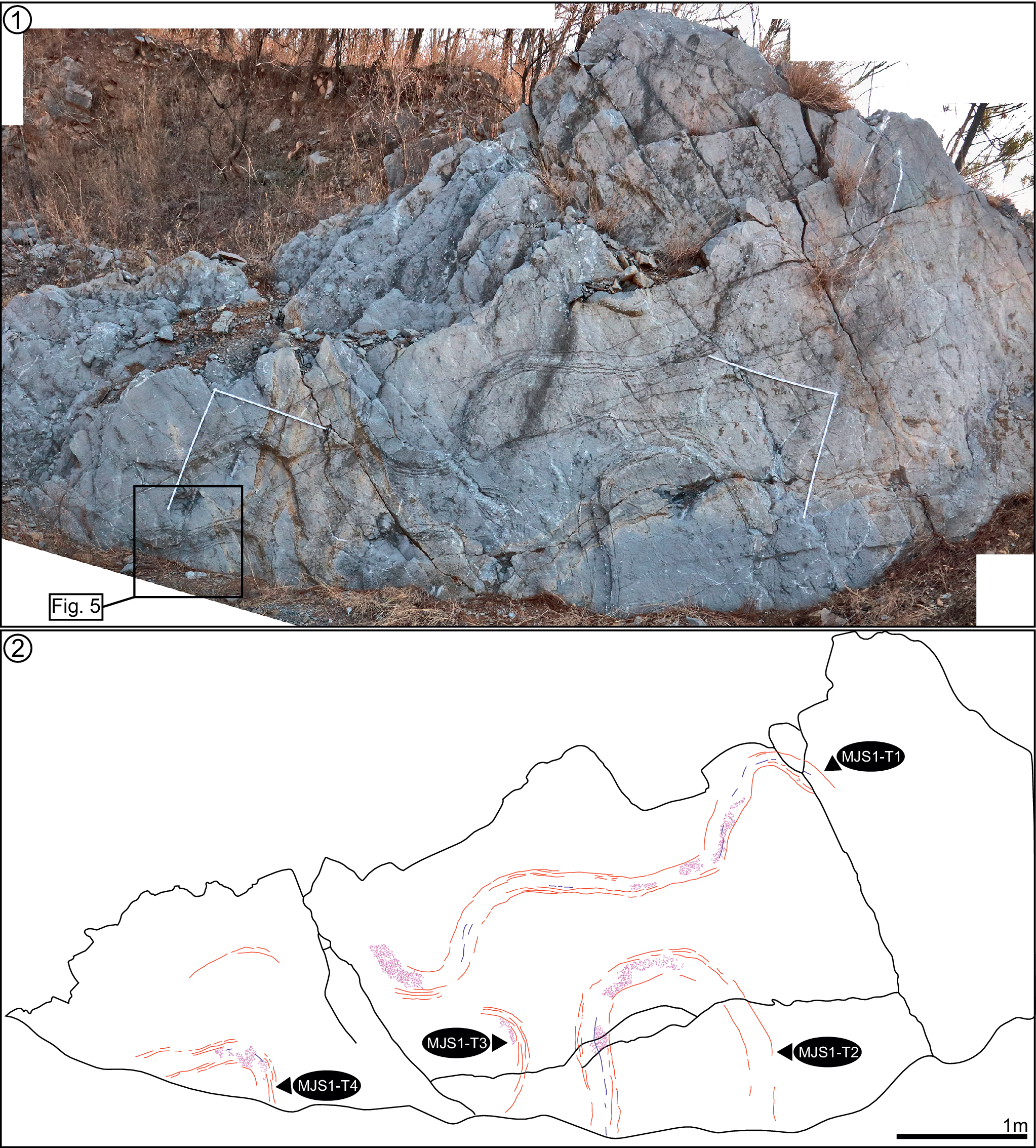
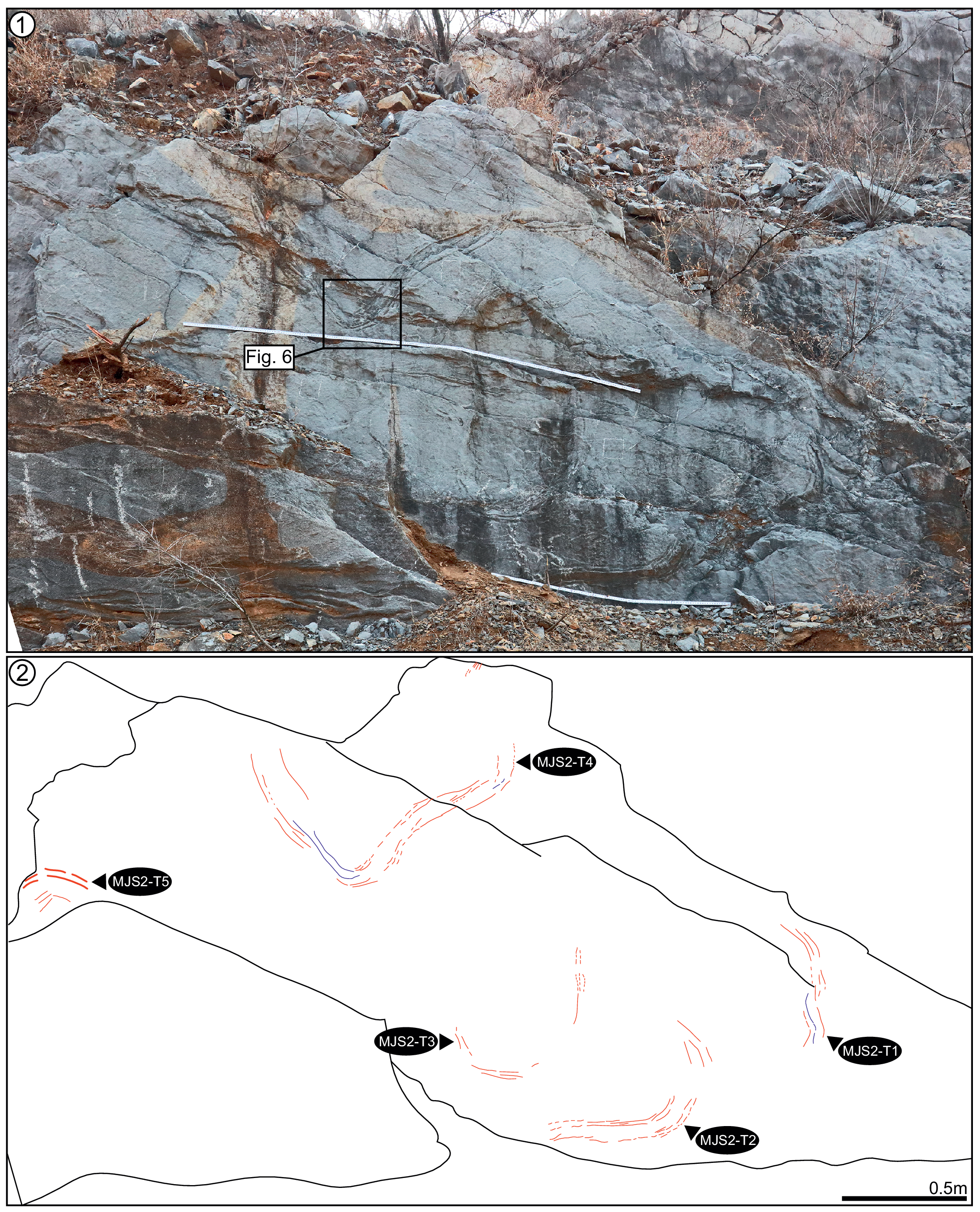
Nine trails/trackways were analyzed from two trace-bearing slabs (Figs. 3, 4). The MJS1 (Fig. 3) trace-bearing surface is overall sub-triangular and composed of marlstone. It has a length of 8.03 m, a height of 3.67 m, and an area of 19.43 m2. A total of four trackways/trails are preserved on the surface, numbered MJS1-T1–T4 (Fig. 3). The MJS2 (Fig. 4) surface covers an area of 6.42 m2, with a length of 3.95 m and a height of 2.20 m. A total of five trails and trackways are preserved on the surface, numbered MJS2-T1–T5 (Fig. 4).
Slabs from horizon MJS1. (1) Photograph of the slab with the location of the sample removed for photogrammetry (Fig. 6). (2) Traced drawings of the trails and trackways with each trace denoted as MJS1-T1 to T4. Red = external scratches; blue = internal scratches; purple = granular sediments.

Figure 3. Long description
Panel 1 is a photograph of a large, grey, fractured rock outcrop. A black square in the lower left is labeled Fig. 5. White angled lines indicate the area sampled for photogrammetry.
Panel 2 is a line drawing tracing the features of the rock slab. It includes four distinct trackways.
* M J S 1-T 1 is located at the top right, showing a long, winding path moving toward the center.
* M J S 1-T 2 is at the bottom right, showing a curved path.
* M J S 1-T 3 is in the lower center, showing a tight U-shaped curve.
* M J S 1-T 4 is at the bottom left, showing a shorter segment.
The traces are color-coded. Red lines represent external scratches. Blue lines represent internal scratches. Purple stippled areas represent granular sediments. A 1 meter scale bar is located in the bottom right corner.
Slabs from horizon MJS2. (1) Photograph of the slab with the location of the sample removed for photogrammetry (Fig. 6). (2) Traced drawings of the trails and trackways with each trace denoted as MJS2-T1 to T5. Red = external scratches; blue = internal scratches.

Figure 4. Long description
Panel 1 is a photograph of a large, light-gray rock face with horizontal sedimentary layers. A white scale bar lies across the center. A black square box labeled Fig. 6 indicates a specific sample area on the left-center of the slab.
Panel 2 is a line drawing of the same rock slab, outlining the boundaries of the stone blocks. Five distinct sets of fossil trails are marked with black oval labels and arrows. Red lines represent external scratches and blue lines represent internal scratches.
* M J S 2-T 1 is located on the far right, showing a vertical cluster of red and blue scratches.
* M J S 2-T 2 is at the bottom right, consisting of several long, parallel red horizontal scratches.
* M J S 2-T 3 is in the bottom center, showing a curved set of red scratches.
* M J S 2-T 4 is in the upper center, featuring a long, wavy path of red scratches with a small blue section.
* M J S 2-T 5 is on the far left, showing a dense horizontal band of red scratches.
A 0.5 meter scale bar is located at the bottom right corner.
Methods
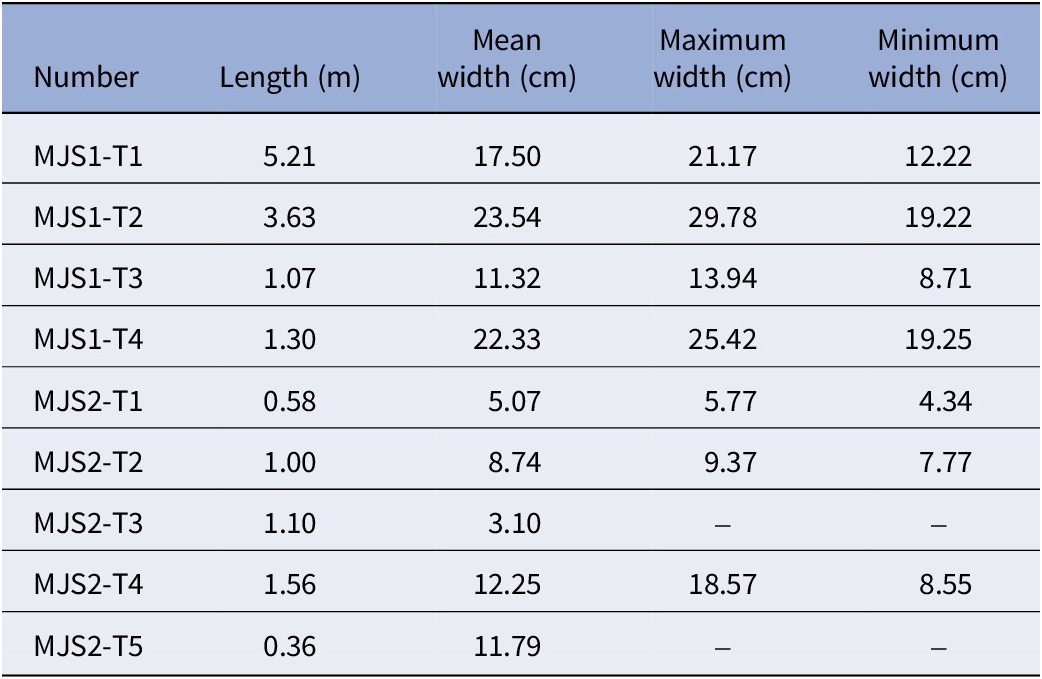
Morphological characterization of arthropod trails and trackways was carried out in accordance with ichnological guidelines of Trewin (Reference Trewin1994) and Minter et al. (Reference Minter, Braddy and Davis2007). The terms “trackways” and “trails” are used independently in the trace-fossil description due to the morphological variability presented on the material. Trackways are defined as a repeated pattern of tracks, with discrete difference between the tracks (Trewin, Reference Trewin1994; Minter et al., Reference Minter, Braddy and Davis2007). Trails are continuous traces with no discrete tracks (Frey, Reference Frey1973; Ekdale et al., Reference Ekdale, Bromley and Pemberton1984). Ichnospecimens were photographed using Canon EOS 5DS and measured using Adobe Acrobat Pro DC. All measurements can be found in Table 1.
Trackway measurements of MJS1 and MJS2 track-bearing surfaces

Table 1. Long description
The table consists of five columns: Number, Length in meters, Mean width in centimeters, Maximum width in centimeters, and Minimum width in centimeters.
* M J S 1 dash T 1: Length 5.21, Mean width 17.50, Maximum 21.17, Minimum 12.22.
* M J S 1 dash T 2: Length 3.63, Mean width 23.54, Maximum 29.78, Minimum 19.22.
* M J S 1 dash T 3: Length 1.07, Mean width 11.32, Maximum 13.94, Minimum 8.71.
* M J S 1 dash T 4: Length 1.30, Mean width 22.33, Maximum 25.42, Minimum 19.25.
* M J S 2 dash T 1: Length 0.58, Mean width 5.07, Maximum 5.77, Minimum 4.34.
* M J S 2 dash T 2: Length 1.00, Mean width 8.74, Maximum 9.37, Minimum 7.77.
* M J S 2 dash T 3: Length 1.10, Mean width 3.10, Maximum and Minimum values are not provided.
* M J S 2 dash T 4: Length 1.56, Mean width 12.25, Maximum 18.57, Minimum 8.55.
* M J S 2 dash T 5: Length 0.36, Mean width 11.79, Maximum and Minimum values are not provided.
Images of the in situ track-bearing surface were acquired for photogrammetric modeling following established protocols outlined by Mallison and Wings (Reference Mallison and Wings2014), Romilio (Reference Romilio2020), and Lallensack et al. (Reference Lallensack, Buchwitz and Romilio2022). A total of 32 photographs were captured as a single dataset using a Canon EOS 5DS under natural lighting conditions. To provide scale, a 2 m foldable ruler of known length was positioned and partially wrapped around the track surface. Photogrammetric reconstruction was performed using Agisoft Metashape Professional Edition (v2.1.2). The resulting three-dimensional (3D) model was subsequently imported into MeshLab (v2023.12; Cignoni et al., Reference Cignoni, Callieri, Corsini, Dellepiane, Ganovelli, Ranzuglia, Scarano, De Chiara and Erra2008), where it was centered and aligned to the world origin of the spherical coordinate system. Final visualizations of surface topography were produced in ParaView (v5.10.1; Ahrens et al., Reference Ahrens, Geveci, Law, Hansen, Johnson, Hansen and Johnson2005), employing orthographic projections with false-color elevation and contour overlays rendered from a nadir viewpoint.
Repositories and institutional abbreviations
The limulids trace specimens were observed from Majiashan site (GPS: 31°37’14.90"N, 117°49’10.71"E) in Chaohu City, Anhui Province. As a core site for ichthyosaurs, the Chaohu City government has designated the Majiashan area as a protected zone, prohibiting mining activities, and installed a CCTV monitoring system. Currently, this area is applying for designation as a National Geopark. Since the original specimens are not allowed to be collected, we selected local portions of the two best-preserved traces (MJS1-T4 and MJS2-T4) and created digital models using photogrammetric modeling. These two models were printed using a 3D printer (Kings FGF-800Pro industrial-grade 3D printer) and are stored at the Dinosaur Odyssey Science Museum (DONHM) in Nanning, Guangxi, China, with catalog numbers DONHM-I24570 and DONHM-I24571. The “I” prefix indicates invertebrate fossils. After publication, the specimens DONHM-I24570 and I24571 will be displayed to the public together with a specimen of a modern horseshoe crab. A second set of models is stored at the China University of Geosciences, Beijing (CUGB), China, with specimen numbers CUGB-M261 and M262. The “M” prefix indicates resin models.
Results
Trace-fossil description
Sample MJS1
MJS1-T1 (Fig. 3.2) is the longest among all the trails, with a total length of 5.21 m. It can be divided into six straight segments measuring 64.16 cm, 114.42 cm, 114.42 cm, 68.29 cm, 95.66 cm, and 65.21 cm, respectively. The trail has an average width of 17.50 cm, with a marked variation in width along its course: a maximum width of 21.17 cm, occurring where granular sediment is most developed, and a minimum width of 12.22 cm. Within the trail, seven discontinuous but interconnected scratches are observed. Granular deposits are most prominent along the central axis of the trail but tend to shift outward.
MJS1-T2 (Fig. 3.2) is a curved trail with a total length of 3.63 m. The arch is divided into three segments measuring 127.08 cm, 73.86 cm, and 161.74 cm, respectively. The average width is 23.54 cm, with a maximum of 29.78 cm at the area containing granular sediment and a minimum width of 19.22 cm. Up to six scratches can be observed, with the outermost ones being well preserved, whereas the internal scratches are highly discontinuous or even absent. Near the left end of MJS1-T2, a medial impression is preserved, extending for a considerable length, flanked by granular deposits along both sides of the trail. Like T1, granular sediment accumulates at curves, where it forms a pattern resembling the letter “S”.
MJS1-T3 (Fig. 3.2) preserves only four discontinuous scratches, unilaterally arranged. A small amount of accumulation of granular sediment is present near the internal curve, arranged parallel to the scratches. The scratches are 1.07 m in total length (entirely curved), with an average width of 11.32 cm, a maximum of 13.94 cm, and a minimum of 8.71 cm.
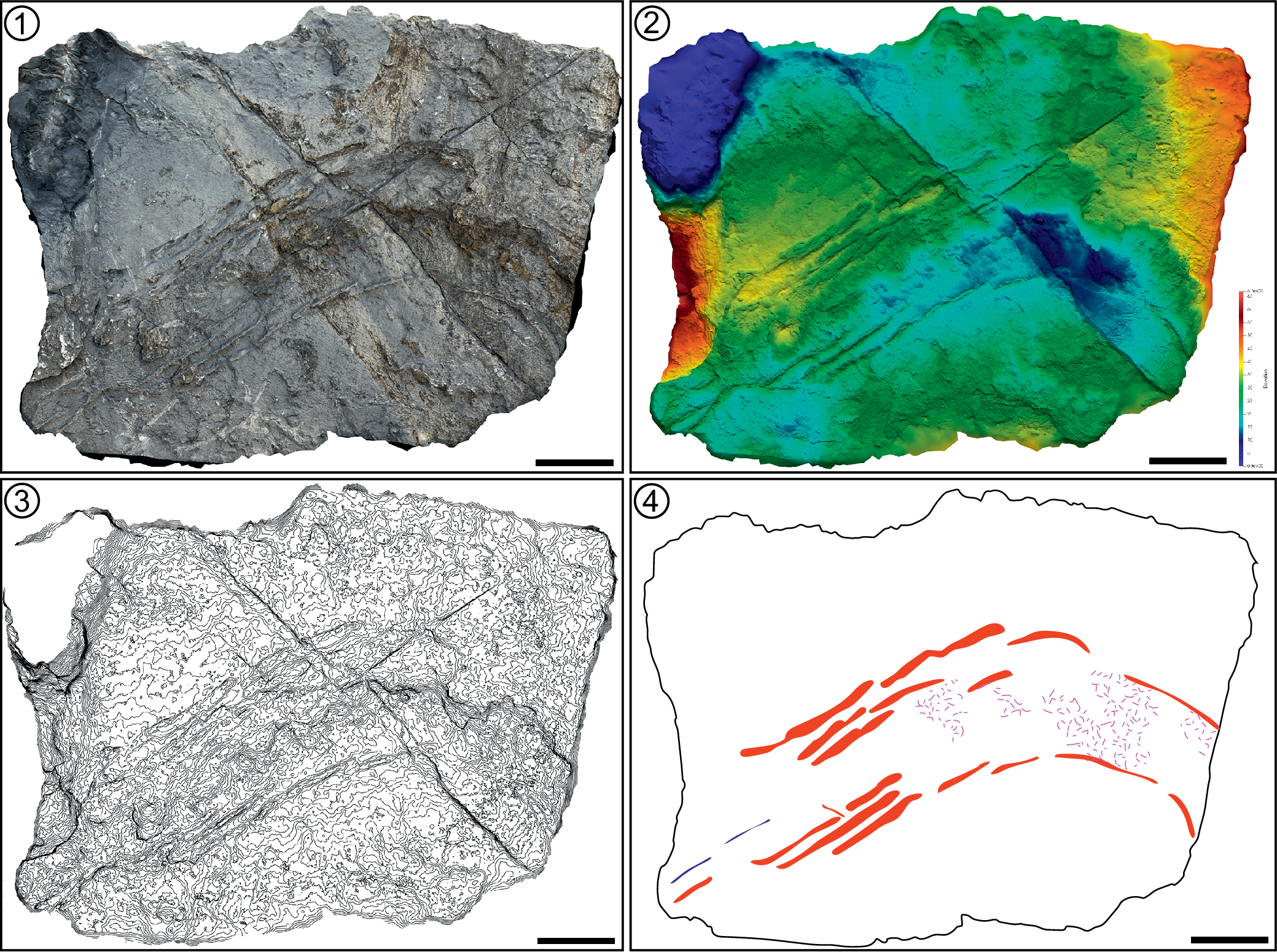
On MJS1-T4 both external scratches are preserved (Figs. 3.2, 5). Although the two sides are not perfectly parallel or symmetrically aligned, the trackway is composed of eight discontinuous scratches. Granular sediment occurs along the midline in the curved section, extending laterally. The external areas show lanceolate-shaped granular sediment patches, and the granular sediment as a whole forms a cross-shaped pattern. The total length of T4 is 1.30 m (curved), with an average width of 22.33 cm, maximum 25.42 cm, and minimum 19.25 cm.
Sample recovered from horizon MJS1, part of trace MJS1-T4; see location denoted in Fig. 3. (1) Color orthographic image. (2) Rainbow elevation image. (3) Solid color contour image. (4) Interpretative traced drawing. Scale bars = 10 cm. Red = external scratches; blue = internal scratches; purple = granular sediments.

Figure 5. Long description
The four panels are arranged in a two-by-two grid. Each panel includes a 10 cm scale bar in the bottom-right corner.
* Panel 1 (Top-Left): A color orthographic photo of a grey, textured rock surface. It features prominent diagonal linear grooves crossing each other, creating an X-like pattern across the center.
* Panel 2 (Top-Right): A rainbow elevation map of the same surface. A color scale on the right indicates depth, with dark blue representing the lowest elevations (deepest grooves) and red/orange representing the highest peaks. The deep grooves are concentrated in the center and top-left.
* Panel 3 (Bottom-Left): A solid color contour map showing the topography of the rock through dense, black topographic lines on a white background, highlighting the complex micro-relief of the surface.
* Panel 4 (Bottom-Right): An interpretative traced drawing within the rock’s outline. Thick red lines represent external scratches, primarily oriented diagonally from the bottom-left toward the center and top-right. Two small blue lines in the bottom-left represent internal scratches. Clusters of small purple dots and dashes represent granular sediments, located mainly in the center-right and upper-right regions of the trace.
Sample MJS2
MJS2-T1 (Fig. 4.2) preserves only a set of scratches, consisting of four to five arranged in a wavy pattern. No granular sediment is observed. The trackway is 0.58 m long, with an average width of 5.07 cm, a maximum width of 5.77 cm, and a minimum width of 4.34 cm.
Overall, trail MJS2-T2 is sickle-shaped, with scratches symmetrically arranged on both sides of the midline (Fig. 4.2). The number of scratches per side ranges from three to four; however, at the curve, one side of the scratches is missing, and granular sediment accumulates on the opposite side. The granular deposit is sub-elliptical, covering an area of approximately 0.01π m2. Additional granular sediments are evenly distributed along the midline and exhibit a reddish-brown coloration. The trackway is 1.00 m long (composed of two straight parts measuring 71.53 cm and 28.88 cm), with an average width of 8.74 cm, a maximum width of 9.37 cm, and a minimum width of 7.77 cm.
Trace MJS2-T3 is 1.10 m long and has an average width of 3.10 cm (Fig. 4.2). It preserves only two to three scratches.
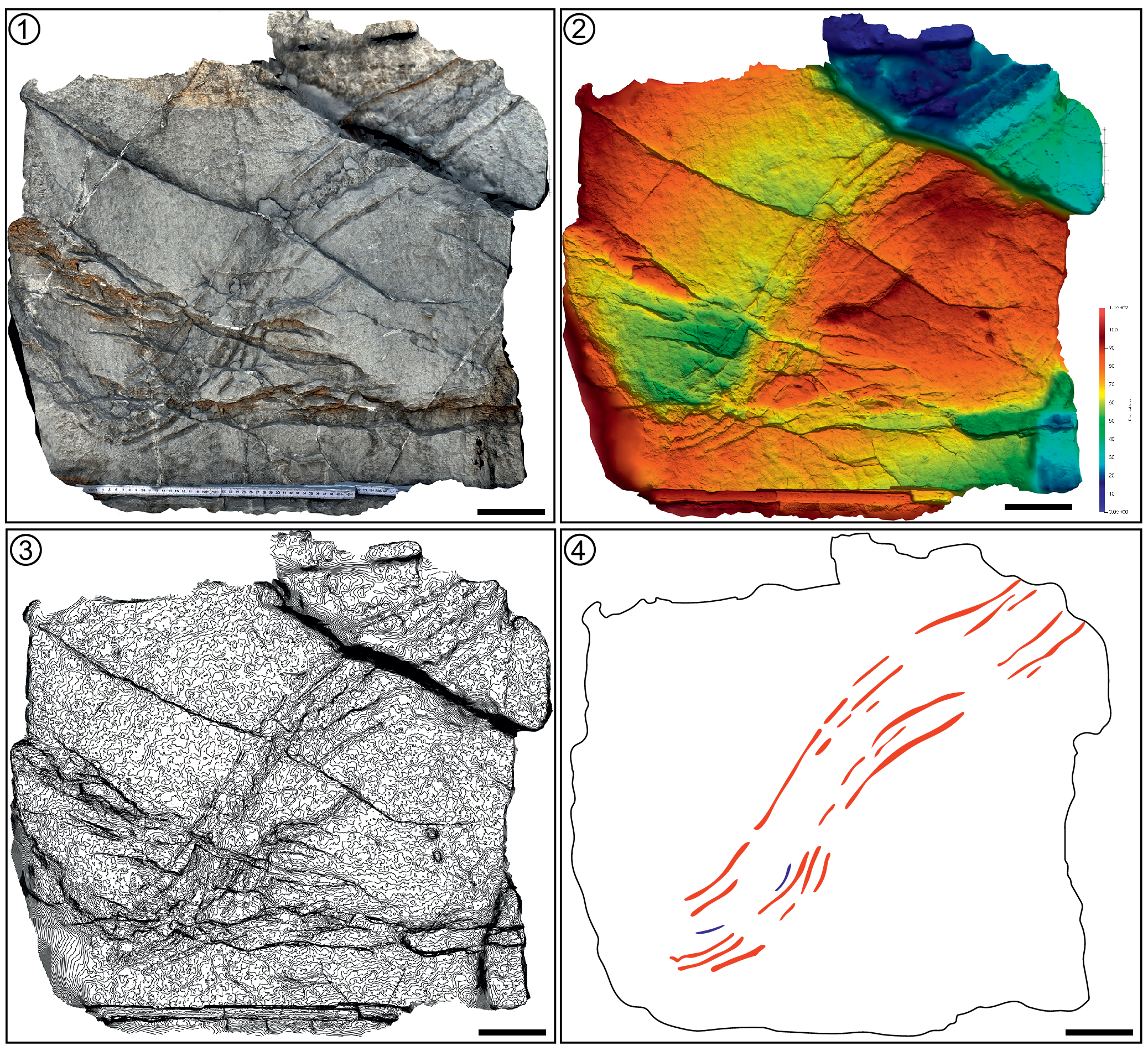
MJS2-T4 (Figs. 4.2, 6) exhibits the greatest change in direction and is the longest trackway among those on the MJS2 surface. Granular sediment is concentrated slightly on both sides of the internal space of the trackway, appearing grayish white in color. It preserves discontinuous lateral ridges and sets of up to four scratches. The total length is 1.56 m, with an average width of 12.25 cm, a maximum width of 18.57 cm, and a minimum width of 8.55 cm.
Sample recovered from horizon MJS2, part of trace MJS2-T4; see location denoted in Fig. 4. (1) Color orthographic image. (2) Rainbow elevation image. (3) Solid color contour image. (4) Interpretative traced drawing. Scale bars = 10 cm. Red = external scratches; blue = internal scratches.

Figure 6. Long description
A multi-panel figure containing four views of a rock sample. Each panel includes a 10 cm scale bar in the bottom right.
Panel 1, top-left: A color orthographic photo of a grey, rectangular rock slab with a rough, fractured surface. A measuring tape is visible at the bottom edge. Darker brown and grey linear features crisscross the surface.
Panel 2, top-right: A rainbow elevation map where colors represent depth. A vertical color scale on the right indicates elevation from blue (lowest) to red (highest). The top-right corner is deep blue, while the central and left portions are primarily orange and yellow, indicating higher relief.
Panel 3, bottom-left: A solid color contour map showing the topography of the rock surface through dense, black topographic lines on a white background, highlighting the intricate ridges and depressions.
Panel 4, bottom-right: An interpretative traced drawing showing the outline of the rock. Inside, a series of red lines represent external scratches, mostly concentrated in a diagonal band from the bottom-left to the top-right. Two small blue lines representing internal scratches are located near the bottom-center.
Trackway MJS2-T5 (Fig. 4.2) preserves only scratches in a curved manner, measuring 0.36 m long and having an average width of 11.79 cm. Both scratches and spot-like granular deposits are present. Five scratches are observed, showing a pattern of thicker outer and thinner inner ridges. Granular sediments accumulate mainly near the midline; in lower external scratches, deposits cluster near the thinner scratches, while at the upper scratches, deposits are concentrated adjacent to the thicker scratches.
Discussion
Trace-fossil comparisons
A few ichnotaxa are comparable to the presented trails. Taphrhelminthoides Weber and Braddy, Reference Weber and Braddy2004 is a rare trail represented by slightly flattened smooth lobes showing transverse striations and separated by a medial ridge with a “figure-of-eight” pattern in the internal space. It is interpreted as produced by large Paleozoic mollusks due to the presented striations and internal details of the trail (Weber and Braddy, Reference Weber and Braddy2004). The occurrence of Taphrhelminthoides is very limited—recorded only on the type horizon of Shackleton Range, Early Ordovician of Antarctica—and its similarities with the presented traces are limited: the presence of a bilobed trail separated by a medial ridge. However, it differs in all other characteristics: presenting an internal “figure-of-eight” pattern, not showing internal scratches, and the trails being entirely continuous (Weber and Braddy, Reference Weber and Braddy2004), differing from the intermittent/discontinuous trails presented in the analyzed material (Figs. 3–6).
Diplopodichnus Brady, Reference Brady1947 is also a bilobed trail, with straight to gently winding pattern, in some cases, ornamented by punctate tracks in transition to trackways (Keighley and Pickerill, Reference Keighley and Pickerill1996). Diplopodichnus is recorded from the Cambrian to Holocene deposits (Buatois and Mángano, Reference Buatois and Mángano2018) and is commonly attributed to arthropods in general, but specifically to isopods, myriapods, and trilobites (Keighley and Pickerill, Reference Keighley and Pickerill1996; Davis et al., Reference Davis, Minter and Braddy2007; Lucas and Lerner, Reference Lucas, Lerner, Lucas, Schneider and Spielmann2010; Schatz et al., Reference Schatz, Mángano, Buatois and Limarino2011; Uchman et al., Reference Uchman, Hu, Wang and Song2011; Netto et al., Reference Netto, Corrêa, Lima, Sedorko and Villegas-Martín2021). It differs from the presented traces by having smooth internal ridges (without the scratches and granular sediments) and continuous external trails (not intermittent/discontinuous scratches).
Undichna Anderson, Reference Anderson1976, the most commonly reported fish swimming trace, is composed of sinusoidal trails often parallel to each other (depending on the ichnospecies), ranging from one (Undichna unisulca de Gibert et al., Reference de Gibert, Buatois, Fregenal-Martínez, Mángano, Ortega, Poyato-Ariza and Wenz1999) or two (U. bina Anderson, Reference Anderson1976, U. britannica Higgs, Reference Higgs1988, and U. consulca Higgs, Reference Higgs1988), to multiple waves (four to nine; U. simplicitas Anderson, Reference Anderson1976, U. insolentia Anderson, Reference Anderson1976, U. quina Trewin, Reference Trewin2000, U. septemsulcata Wisshak et al., Reference Wisshak, Volohonsky and Blomeier2004, and U. quadrisulcata Knaust, Reference Knaust2019). Undichna is recorded in continental (alluvial, lacustrine) and marine (marginal, shallow, and deep) settings, from the Silurian to the Holocene (Minter, Reference Minter, Lucas, Hunt and Klein2025). Producers include myriad fish clades, with trace morphology not only related to the behavior and level of interaction with the sediment, but also by producer morphology (number, location, morphology of the fins) (Anderson, Reference Anderson and Haughton1970; Minter and Braddy, Reference Minter and Braddy2006, Reference Minter and Braddy2009; Minter, Reference Minter, Lucas, Hunt and Klein2025). All Undichna ichnospecies differ on some level from the presented traces. In general, the trails are continuous with a sinusoidal wave pattern rather than the discontinuous and meandering morphology observed in the studied material. They also lack the internal, non-sinusoidal scratch patterns characteristic of the traces presented here (Figs. 3–6).
Regarding the transitional to definitive trackways, a few ichnotaxa can be compared with the material. Mitchellichnus Walker, Reference Walker1985 is a trackway consisting of two different elements: (1) a multiserial external track series, circular to ellipsoidal in shape, oblique to the midline, and (2) a medial impression, flanked by a pair of less-marked continuous impressions, presented internally to the track series (Walker, Reference Walker1985). It is presented only in the type locality/strata of Old Red Sandstone (Early Devonian of Scotland; Walker, Reference Walker1985) and in the Rhode Island Formation (Pennsylvanian, USA; Getty et al., Reference Getty, Sproule, Wagner and Bush2013, Reference Getty, Sproule, Stimson and Lyons2017). Walker (Reference Walker1985) indicated the difficulty of assigning a tracemaker to this ichnotaxon, but due to its size, it could indicate a eurypterid producer. Getty et al. (Reference Getty, Sproule, Wagner and Bush2013) suggested an archaeognathan producer, indicated by neoichnological experiments. The similarities between Mitchellichnus and the presented material described here lie in the presence of medial impressions that produce a trail-like structure. However, Mitchellichnus differs in overall morphology and size, as well as in the presence of circular to ellipsoidal tracks.
YPM 237004 is a trackway consisting of a single set of scratches with a medial impression, identified as Stiallia pilosa Smith, Reference Smith1909 by Getty et al. (Reference Getty, Sproule, Wagner and Bush2013, p. 247, fig. 3J). The presented trace is like YPM 237004 in possessing a series of continuous and discontinuous scratches in the form of a trackway, but it clearly differs by having a greater number of discontinuous lateral scratches, with opposite series of tracks.
Kouphichnium Nopsca, Reference Nopsca and Soergel1923 is the most common trackway ichnogenus attributed to limulids and has become something of a wastebasket ichnogenus (Buatois et al., Reference Buatois, Mángano, Maples and Lanier1998; Minter and Braddy, Reference Minter and Braddy2009; King et al., Reference King, Stimson and Lucas2019), comprising at least 13 ichnospecies: Kouphichnium lithographicum (Oppel, Reference Oppel1862), K. scotti (Abel, Reference Abel1926), K. aspodon (Aldrich and Jones, Reference Aldrich, Jones and Jones1930), K. didactylus (Willard, Reference Willard1935), K. arizonae Caster, Reference Caster1944, K. gracilis (Linck, Reference Linck1949), K. variabilis (Linck, Reference Linck1949), K. walchi Malz, Reference Malz1964, K. minisculum Aceñolaza, Reference Aceñolaza1978, K. fernandezi Romano and Meléndez, Reference Romano and Meléndez1985, K. pentapodus Erickson, Reference Erickson2005, K. minkinensis King et al., Reference King, Stimson and Lucas2019, and K. atkinsoni King et al., Reference King, Stimson and Lucas2019. They occur from Middle Ordovician to Holocene deposits (Buatois and Mángano, Reference Buatois and Mángano2018). The overall morphology of the trackways is defined by oppositely symmetrical series of up to five heteropodous tracks—highly variable; bifid, trifid, quadrifid, circular, and ellipsoidal—with occasional medial impressions (produced by the telson), with a lot of variability in the interseries arrangement depending on the ichnospecies (King et al., Reference King, Stimson and Lucas2019). From all this morphological variability, the only ichnospecies with similarities to the presented traces is K. variabilis (Linck, Reference Linck1949), reported in Carboniferous, Triassic, and Jurassic strata (Linck, Reference Linck1949; Chisholm, Reference Chisholm1983; Eagar et al., Reference Eagar, Baines, Collinson, Hardy, Okolo, Pollard and Curran1985). K. variabilis differs from other Kouphichnium ichnospecies by having a telson impression laterally dislocated (in most ichnospecies, they are medially located) and change in direction according to the movement (Linck, Reference Linck1949; Chisholm, Reference Chisholm1983; Eagar et al., Reference Eagar, Baines, Collinson, Hardy, Okolo, Pollard and Curran1985; Pollard and Hardy, Reference Pollard and Hardy1991; Romano and Whyte, Reference Romano and Whyte2003), similar to the internal scratches in the observed material. However, it differs in having discrete tracks external to the telson impression. One “trackway” presented by Chisholm (Reference Chisholm1983, p. 41, fig. 1F) presents a similar pattern observed in this material: up to six parallel scratches, continuous and discontinuous. Chisholm (Reference Chisholm1983) interpreted these as undertrack scratches produced by the inner appendages of limulids, probably swimming—although this mode of locomotion is highly controversial (see ethological interpretations in Tracemaker identity and ethological interpretation). Some traces identified as Kouphichnium isp. by Diedrich (Reference Diedrich2011, p. 88, fig. 8B, p. 89, fig. 9) are similar to the trail-like structures described in this study: they consist of continuous to discontinuous parallel scratch marks interpreted as pusher scratches produced during a swimming motion.
Monomorphichnus Crimes, Reference Crimes1970 consists of a series of straight to sinusoidal, parallel to subparallel scratches repeated laterally, continuous to discontinuous (Hammersburg et al., Reference Hammersburg, Hasiotis and Robison2018). They are interpreted as swimming traces of different arthropods (e.g., trilobites, eurypterids, limulids, isopods; Crimes, Reference Crimes1970; Romano and Melendéz, Reference Romano and Meléndez1985; Mikuláš, Reference Mikuláš1995; King et al., Reference King, Miller and Stimson2017; Hammersburg et al., Reference Hammersburg, Hasiotis and Robison2018; Sharma et al., Reference Sharma, Pandey, Ahmad, Kumar and Ansari2018; de Barros et al., Reference de Barros, Becker-Kerber, Sedorko, Lima and Pacheco2021). They are recorded from the Cambrian to the Holocene (Buatois and Mángano, Reference Buatois and Mángano2018; Gougeon, Reference Gougeon2023). Monomorphichnus is ichnotaxonomically contentious, with at least 18 ichnospecies erected (Gougeon, Reference Gougeon2023) and in the need of a strong revision; however, seven ichnospecies are the most commonly accepted as valid: Monomorphichnus bilinearis Crimes, Reference Crimes1970, M. multilineatus Alpert, Reference Alpert1976, M. lineatus Crimes et al., Reference Crimes, Legg, Marcos, Arboleya, Crimes and Harper1977, M. pectenensis Legg, Reference Legg and Curran1985, M. intersectus Fillion and Pickerill, Reference Fillion and Pickerill1990, M. biserialis Mikuláš, Reference Mikuláš1995, and M. needleiunm Wang, Reference Wang2007. The ichnospecies most like the presented material is M. biserialis (Mikuláš, Reference Mikuláš1995), characterized by two long series of four to six scratches parallel to each other, with some intersection of scratches along the trackway (Mikuláš, Reference Mikuláš1995). The presence of paired scratches, almost “trail-like,” is similar to the presented material. Some differences can be noted: the external scratches in this material commonly have one to four scratches (Figs. 3–6), differing from the four to six scratches of M. biserialis; the presence of internal scratches/medial imprints is also different from M. biserialis. However, M. biserialis can be used as an ethological analog to the presented material.
Although several ichnotaxa share partial similarities with the presented traces, none provides a complete morphological match. Taphrhelminthoides and Diplopodichnus resemble the studied material in their bilobed organization but differ in their fully continuous structure and lack of internal scratches or granular texture (Keighley and Pickerill, Reference Keighley and Pickerill1996; Weber and Braddy, Reference Weber and Braddy2004). Undichna display continuous sinusoidal morphologies that contrast with the discontinuous and irregular patterns observed here (Minter, Reference Minter, Lucas, Hunt and Klein2025). Among trackway-type ichnotaxa, Mitchellichnus and Stiallia share some superficial resemblances, particularly the presence of medial impressions, but differ significantly in track morphology and arrangement (Walker, Reference Walker1985; Getty et al., Reference Getty, Sproule, Wagner and Bush2013). The closest morphological parallels are found within Kouphichnium variabilis, which exhibits laterally displaced telson impressions and parallel scratches (Linck, Reference Linck1949; Chisholm, Reference Chisholm1983; Eagar et al., Reference Eagar, Baines, Collinson, Hardy, Okolo, Pollard and Curran1985) although the studied traces lack discrete external tracks, and Monomorphichnus biserialis, by the presence of paired scratches (Mikuláš, Reference Mikuláš1995)—suggesting analogous swimming or near-bottom locomotion behavior but with no direct ichnotaxonomic equivalence. Overall, the analyzed material likely represents a distinct behavioral mode within limulid producers, possibly related to near-bottom subaqueous locomotion. Another possibility is the preservation of undertracks of limulid trackways (discussed later).
Tracemaker identity and ethological interpretation
The relative lack of telson impressions indicates that the trace was produced underwater by an animal in a walking/swimming state (Moreau et al., Reference Moreau, Fara, Gand, Lafaurie and Baret2014; Shibata and Varricchio, Reference Shibata and Varricchio2020; Xing et al., Reference Xing, Wang, Klein and Gao2024; see Devine and Minter, Reference Devine and Minter2022 for subaerial trackways), either dragging locomotory appendages or dragging some other part of its carapace, producing two continuous to discontinuous scratches (Figs. 3–6). The elongate, straight to slightly curved morphology of the trackways and trails suggests light contact with the substrate rather than full body support (Figs. 3–6).
They can reasonably be attributed to a large benthic or nektobenthic arthropod due to its morphology and trace-fossil comparisons listed before. Almost no arthropod body fossils are recorded from the Nanlinghu Formation, with most of its biota being marine vertebrates of the Chaohusaurus fauna (e.g., marine reptiles, fish) and other invertebrates (e.g., cephalopods, bivalves) (Benton et al., Reference Benton, Zhang, Hu, Chen and Wen2013; Ji et al., Reference Ji, Zhang, Jiang, Bucher, Motani and Tintori2015; Du et al., Reference Du, Song, Dal Corso, Wang, Zhu, Song, Tian, Chu, Huang and Tong2023). Among plausible producers, thylacocephalans Ankitokazocaris and Diplanthocaris are known from the Middle and Upper Member of the Nanlinghu Formation (Ji et al., Reference Ji, Tintori, Jiang and Motani2017, Reference Ji, Tintori, Jiang, Motani and Confortini2021; Laville et al., Reference Laville, Smith, Forel, Brayard and Charbonnier2021). These arthropods possessed laterally flattened bodies and robust raptorial appendages and are interpreted as nektonic organisms, living in the lowermost levels of the water column in shelf marine settings (Vannier et al., Reference Vannier, Chen, Huang, Charbonnier and Wang2006). They tend to be very small (1–12 cm long), with Triassic species being 1–8 cm in maximum length. Rare examples of “giant” thylacocephalans species—exceeding 16–25 cm—are recorded only from the Jurassic (Vannier et al., Reference Vannier, Chen, Huang, Charbonnier and Wang2006). The thylacocephalan species from the Nanlinghu Formation tend to be 1–3 cm in length (Ji et al., Reference Ji, Tintori, Jiang and Motani2017, Reference Ji, Tintori, Jiang, Motani and Confortini2021), have very laterally flattened bodies, and are ecologically nektonic. So they can be discarded as possible producers of the trace fossils.
Another possibility is the production by large swimming long-bodied crustaceans, especially malacostracans (e.g., isopods, lobsters, mantis shrimps; Brusca et al., Reference Brusca, Moore and Shuster2003). Mantis shrimps (Stomatopoda) have a similar body to common shrimps but are more benthonic animals, with elongated segmented bodies, a pair of specialized raptorial appendages, legs (pereopods) for benthic locomotion, and pleopods for swimming (Brusca et al., Reference Brusca, Moore and Shuster2003). Lobsters (Decapoda) have a hard, segmented body with a large cephalothorax, muscular abdomen. They use their legs for benthonic locomotion and their telson and uropods for swimming (Brusca et al., Reference Brusca, Moore and Shuster2003). Isopods (Isopoda) have a dorsoventrally flattened, segmented body, with pereopods used for locomotion and pleopods for breathing and swimming (Brusca et al., Reference Brusca, Moore and Shuster2003). All three clades have giant extant species recorded—Odontodactylus scyllarus (Linnaeus, Reference Linnaeus1758) (Stomatopoda), Jasus edwardsii (Hutton, Reference Hutton1875) (Decapoda), and Bathynomus giganteus Milne-Edwards, Reference Milne-Edwards1879 (Isopoda)—reaching up to 50–60 cm long (Rudkin et al., Reference Rudkin, Young, Elias and Dobrzanski2003; Butler et al., Reference Butler, Steneck, Herrnkind and Phillips2006; McClain et al., Reference McClain, Balk, Benfield, Branch and Chen2015; Vermeij, Reference Vermeij2016). The Stomatopoda stem group originates in the Carboniferous (Van Der Wal et al., Reference Van Der Wal, Ahyong, Ho and Lo2017), with a very low diversity and small size, until a rise in diversification in the Late Jurassic (Smith et al., Reference Smith, Aubier, Charbonnier, Laville, Olivier, Escarguel, Jenks, Bylund, Fara and Brayard2023), making it extremely unlikely that they were the producers of the material. Lobsters are an extremely recent group, probably originating in the Cretaceous (Tshudy, Reference Tshudy2003; Tshudy et al., Reference Tshudy, Donaldson, Collom, Feldmann and Schweitzer2005). Even in the most inclusive groups of “lobster-like” decapods—Achelata, Polychelida, and Astacidea (infraorder Pleocyemata)—which originated between the Permian and Triassic, their bauplans exhibit (1) a broader, more benthic adaptation that would have produced distinct trackways, and/or (2) a swimming mechanism inconsistent with the trace fossils in question, typically involving rapid backward propulsion using the telson and uropods (Brooks et al., Reference Brooks, Carpenter, Glaessner, Hahn, Hessler, Moore and Teichert1969a; Schweitzer et al., Reference Schweitzer, Charbonnier, Feldmann and Schweigert2025a, Reference Schweitzer, Feldmann, Audo, Charbonnier, Karasawa and Schweigert2025b).
Within crustaceans, the most probable producer is Isopoda, a very ancient lineage with origins in the Ordovician and significant diversification during the Devonian and Carboniferous periods, including colonization of deep-sea settings already in the Permian–Triassic (Schram, Reference Schram1970; Lins et al., Reference Lins, Ho, Wilson and Lo2012, Reference Lins, Ho and Lo2017; Robin et al., Reference Robin, Gueriau, Luque, Jarvis, Daley and Vonk2021). They exhibit various modes of locomotion and a leg-dragging swimming motion that could potentially produce the observed trace fossils (Brooks et al., Reference Brooks, Carpenter, Glaessner, Hahn, Hessler, Moore and Teichert1969b; Alexander et al., Reference Alexander, Blodig and Hsieh1995; Schmidt and Wägele, Reference Schmidt and Wägele2001; de Barros et al., Reference de Barros, Becker-Kerber, Sedorko, Lima and Pacheco2021, Reference de Barros, Peixoto, Lima, Minter and Sedorko2023). However, the genus containing the largest isopods (Bathynomus) likely originated much more recently (Oligocene–Miocene; Kato et al., Reference Kato, Kurihara and Tokita2016; Pasini and Garassino, Reference Pasini and Garassino2019; Hyžný et al., Reference Hyžný, Campos and Carretero2020), and its family (Cirolanidae) probably in the Jurassic–Cretaceous (Polz et al., Reference Polz, Schweigert and Maisch2006; Bruce et al., Reference Bruce, de Lourdes Serrano-Sánchez, Carbot-Chanona and Vega2021; Wilson and Morel, Reference Wilson and Morel2022). Furthermore, since isopods use pleopods for swimming, one would expect this trait to be preserved in the trails and trackways, like the records in de Barros et al. (Reference de Barros, Peixoto, Lima, Minter and Sedorko2023), a feature absent in the examined material. That said, among crustaceans, isopods remain the most plausible producers.
A more reliable candidate group is Xiphosura (horseshoe crabs). They have a robust, broad, slightly flattened horseshoe-shaped carapace and a slightly smaller opisthosoma, followed by a long, sharp telson spine (Barthel, Reference Barthel1974; Brusca et al., Reference Brusca, Moore and Shuster2003; Tanacredi et al., Reference Tanacredi, Botton and Smith2009). Non-xiphosurid xiphosurans first appeared in the Upper Ordovician of Canada and may also have existed in the Lower Ordovician of Morocco. Some of these species have been classified as paraphyletic groups of Chelicerates (Rudkin and Young, Reference Rudkin, Young, Tanacredi, Botton and Smith2009; Briggs et al., Reference Briggs, Sutton, Siveter and Siveter2012; Bicknell and Pates, Reference Bicknell and Pates2020). During the Silurian and Devonian, the diversity of Xiphosura in marine and marginal marine environments was very high, marking the first evolutionary radiation of this group. Xiphosurids first appeared in the Devonian (Moore et al., Reference Moore, Briggs, Braddy and Shultz2007). In the Carboniferous, the group adapted to brackish and freshwater environments, passing through a large-scale diversification (Anderson, Reference Anderson1997; Bicknell and Pates, Reference Bicknell and Pates2020). After a sharp decline in diversity during the Permian, the Triassic was a period of significant morphological changes and the second large-scale radiation for xiphosurids, as well as the third diversification peak (Bicknell and Pates, Reference Bicknell and Pates2019, Reference Bicknell and Pates2020).
The group had much smaller species during the Paleozoic (3–5 cm long) but passed through a radiation of diversity and size during the Mesozoic, reaching 30–60 cm long (similar to the extant species that can reach 60 cm) (Størmer et al., Reference Størmer, Petrunkevitch, Hedgpeth, Moore and Teichert1955; Tanacredi et al., Reference Tanacredi, Botton and Smith2009; Moreau et al., Reference Moreau, Fara, Gand, Lafaurie and Baret2014; Bicknell and Pates, Reference Bicknell and Pates2020). Especially during the Triassic, freshwater, brackish, and marine Xiphosura are known to have existed at the same time (Bicknell and Pates, Reference Bicknell and Pates2020). No specific xiphosurans have been reported in the Nanlinghu Formation, but their morphological and behavioral characteristics fit the size and ethology of the observed traces.
In terms of size of the tracemaker, Malz (Reference Malz1964) established a method for estimating the size of limulid producers based on their trackways, using the external width of the trackway as reference and incorporating both extant and fossil data. His equation, I = W × 1.5, where I represents the width of the prosoma of the limulid producer, allows estimation of the body width, while the total body length can be derived from L = I × 2.12, where L is the total length of the animal. Applying these equations yields an estimated mean producer size ranging from 15.74 to 33.50 cm wide and 33.37 to 71.01 cm long (Table 2), similar to other giant limulid trackways (Gaillard, Reference Gaillard2011), with maximum values reaching up to 45 cm wide and 95 cm long.
Calculations of tracemaker size based on Malz (Reference Malz1964) equations.

Table 2. Long description
The table contains seven columns: Number, Mean width (cm), Mean length (cm), Maximum width (cm), Maximum length (cm), Minimum width (cm), and Minimum length (cm).
* Row 1: M J S 1 dash T 1. Mean width 26.25, Mean length 55.65, Maximum width 31.76, Maximum length 67.32, Minimum width 18.33, Minimum length 38.86.
* Row 2: M J S 1 dash T 2. Mean width 35.31, Mean length 74.86, Maximum width 44.67, Maximum length 94.70, Minimum width 28.83, Minimum length 61.12.
* Row 3: M J S 1 dash T 4. Mean width 33.50, Mean length 71.01, Maximum width 38.13, Maximum length 80.84, Minimum width 28.88, Minimum length 61.22.
* Row 4: M J S 2 dash T 2. Mean width 13.11, Mean length 27.79, Maximum width 14.06, Maximum length 29.80, Minimum width 11.66, Minimum length 24.71.
* Row 5: M J S 2 dash T 4. Mean width 18.38, Mean length 38.96, Maximum width 27.86, Maximum length 59.05, Minimum width 12.82, Minimum length 27.19.
Note: Mean width, maximum width, and minimum width can be found in Table 1. Incomplete trails and trackways (MJS1-T3, MJS2-T1, MJS2-T3, and MJS2-T5) were excluded from the analysis.
In reviewing the body and trace fossil record of limulids, Gaillard (Reference Gaillard2011) and Moreau et al. (Reference Moreau, Fara, Gand, Lafaurie and Baret2014) concluded that most fossil limulids were relatively small, with carapace widths rarely exceeding 20 cm. Carboniferous, Permian, and Triassic traces (trackways and resting traces) indicate similarly modest sizes; however, more recent records, such as the limulid trackways of the Late Jurassic limestones of Cerin, France (Gaillard, Reference Gaillard2011), with trackway size pointing to individuals with prosomal widths of ~39 cm and total lengths up to 85 cm, and the Late Jurassic Causses Basin, France (Moreau et al., Reference Moreau, Fara, Gand, Lafaurie and Baret2014), with trackways pointing to individuals 39 cm wide and up to 83 cm long, establish them as true giants within the group, similar to the records observed here. The oldest giant limulid traces are from the Upper Triassic of northern Shaanxi Province, China, where the tracemaker could reach up to 89 cm in body length (Xing et al., Reference Xing, Wang, Klein and Gao2024); thus, the specimens presented here would represent one of the largest recorded examples of limulids from the Triassic (Moreau et al., Reference Moreau, Fara, Gand, Lafaurie and Baret2014, fig. 10; Shu et al., Reference Shu, Tong, Tian, Benton, Chu, Yu and Guo2018, fig. 17; Xing et al., Reference Xing, Wang, Klein and Gao2024).
Other deposits from China reveal several occurrences of limulid trackways in Lower Triassic and younger strata. In the Lower Triassic marine deposits of the Qinglong Formation, Anhui Province, multiple limulid-like trackways have been documented, typically preserved as undertracks (Bi et al., Reference Bi, Guo and Qian1995). Additional occurrences are known from the marine Daye Formation (Lower Triassic, Induan) of Guizhou Province, where Shi et al. (Reference Shi, Woods, Yu, Li, Wei and Qiao2019) reported similar trackways associated with a diverse assemblage of invertebrate traces and burrows. Further to the southwest, in Yunnan Province, Paleogene marine successions have also yielded a few comparable arthropod trackways (Xing et al., Reference Xing, Lockley, He, Matsukawa, Persons IV, Xiao and and Zhang2012).
In addition, the Upper Triassic Wayaobu Formation of the Ordos Basin, Shaanxi Province, northern China, preserves an ichnoassemblage comprising trackways and trails attributed to arthropods and fishes (Xing et al., Reference Xing, Wang, Klein and Gao2024). The deposits, representing a lacustrine coal-bearing sequence, include traces assigned to Kouphichnium isp. and several Undichna ichnospecies (e.g., U. bina, U. britannica, U.? quina, U. unisulca). The large size of these Kouphichnium trackmakers is particularly notable when compared with known Triassic body fossils.
Neoichnological experiments of limulids described by Devine and Minter (Reference Devine and Minter2022, fig. 6) observed similar trackways with lateral scratches produced by the dragging of the prosoma margins. If the scratches of the presented material were produced by the prosoma margins of limulids, then the estimated size of the animal would be significantly reduced. Under this interpretation, the width of the trackway (11–30 cm) would correspond directly to the body width of the organism, resulting in a calculated body length ranging from approximately 24 to 50 cm, with a maximum length of around 63 cm. These dimensions align closely with those of modern limulids, suggesting a much smaller producer compared with the estimate of Table 2 (Sekiguri, Reference Sekiguri1988; Vijayakumar et al., Reference Vijayakumar, Das, Chatterji and Parulekar2000; Tanacredi et al., Reference Tanacredi, Botton and Smith2009). However, this hypothesis appears to be falsified also by neoichnological evidence: modern experiments (Devine and Minter, Reference Devine and Minter2022) show that prosoma drag impressions are typically formed in subaerial settings and are consistently associated with medial telson impressions due to strong sediment contact, a taphonomic signature absent in the material under study. Indeed, the discontinuous, trail-like preservation of both the prosoma and discontinuous telson impressions under semi-aquatic conditions (Devine and Minter, Reference Devine and Minter2022) aligns more with the described trace-fossil morphology.
The most probable mode of production of the presented traces is a swimming behavior. Modern limulids employ a distinct mode of swimming that differs from their most common benthic locomotion (Vosatka, Reference Vosatka1970). Limulids invert their bodies and propel themselves by undulating their book-gills, flattening their opisthosoma, and using limb propulsion, using their body as a hydrofoil suspended at approximately a 30° angle to the waterline (Vosatka, Reference Vosatka1970; Barthel, Reference Barthel1974; Brusca et al., Reference Brusca, Moore and Shuster2003; Chabot et al., Reference Chabot, Skinner and Watson2008; Tanacredi et al., Reference Tanacredi, Botton and Smith2009). This adaptation allows limulids to shift rapidly from benthic locomotion to sub-pelagic movement (Barthel, Reference Barthel1974; Brusca et al., Reference Brusca, Moore and Shuster2003; Chabot et al., Reference Chabot, Skinner and Watson2008; Tanacredi et al., Reference Tanacredi, Botton and Smith2009).
Xiphosurans are known from preserved prosomal carapaces and appendages that are remarkably similar in articulation and morphology to modern horseshoe crabs, sometimes called “living fossils” or “stabilomorphs” (Barthel, Reference Barthel1974; Kin and Błazejowski, Reference Kin and Błażejowski2014). This morphological similarity—especially in the family Limulidae and at least since the Jurassic (Lamsdell and McKenzie, Reference Lamsdell and McKenzie2015; Błażejowski et al., Reference Błażejowski, Carmichael, Botton, Shin and Cheung2015; Bicknell et al., Reference Bicknell, Brougham, Charbonnier, Sautereau, Hitij and Campione2019)—between living and fossil counterparts implies strong functional continuity, including a benthopelagic mode of life with the inverted swimming posture (dorsum downward) observed in extant taxa. Ichnological works distinguish swimming (Diedrich, Reference Diedrich2011; Alberti et al., Reference Alberti, Fürsich and Pandey2017) from benthic locomotion traces (Erickson, Reference Erickson2005; Diedrich, Reference Diedrich2011; Gaillard, Reference Gaillard2011; Fernández and Pazos, Reference Fernández and Pazos2013; Alberti et al., Reference Alberti, Fürsich and Pandey2017; King et al., Reference King, Stimson and Lucas2019; Shibata and Varricchio, Reference Shibata and Varricchio2020) by the absence of discrete pusher-leg tracks and by shallow sinuous or meandering trail-like scratches, often preserved as long impressions or smooth trails, similar to the presented material. However, the fossil record lacks anatomical evidence for a dorsal-up swimming mode in extinct forms. The most parsimonious inference is that fossil xiphosurans also swam inverted.
One argument for dorsal-up swimming limulids is that fossil counterparts possessed a greater range of morphological variation than their modern relatives and may not have swam exclusively upside down. Indeed, the extant family Limulidae had a low diversity during the Early Triassic (Lamsdell and McKenzie, Reference Lamsdell and McKenzie2015; Bicknell et al., Reference Bicknell, Brougham, Charbonnier, Sautereau, Hitij and Campione2019). Unlike the highly stable body plan of the family Limulidae, which is adapted for benthic life and inverted swimming, extinct xiphosurans exhibited significant morphological disparity (Størmer et al., Reference Størmer, Petrunkevitch, Hedgpeth, Moore and Teichert1955; Anderson and Selden, Reference Anderson and Selden1997; Scioscia, Reference Scioscia, Camacho and Longobucco2007; Rudkin et al., Reference Rudkin, Young and Nowlan2008; Rudkin and Young, Reference Rudkin, Young, Tanacredi, Botton and Smith2009; Bicknell and Pates, Reference Bicknell and Pates2020; Lamsdell, Reference Lamsdell2020). A fundamental morphological distinction between ancient and modern Xiphosura lies in the structure of the opisthosoma and morphology of the prosoma. The abdominal segments in all modern horseshoe crab species are fused into a single, rigid, and unsegmented carapace in adults; by contrast, fossil counterparts (especially those from the Paleozoic) have a multi-segmented and articulated abdomen (Størmer, 1955; Anderson and Selden, Reference Anderson and Selden1997; Lamsdell, Reference Lamsdell2013; Bicknell and Pates, Reference Bicknell and Pates2020; Lamsdell and Ocon, Reference Lamsdell and Ocon2025). They also have a different prosoma morphology, with unusual shapes (e.g., Austrolimulidae) (Størmer, 1955; Anderson and Selden, Reference Anderson and Selden1997; Lamsdell, Reference Lamsdell2013; Bicknell and Pates, Reference Bicknell and Pates2020; Lamsdell and Ocon, Reference Lamsdell and Ocon2025). These alternative body plans, occupying a different morphospace of modern limulids, would have had distinct centers of buoyancy and mass and different hydrodynamic properties, making it probable that they swam right-side up or in other orientations (Ocon and Lamsdell, Reference Ocon and Lamsdell2023). These distinct morphologies open the possibility that some lineages of Triassic xiphosurans (such as Austrolimulidae; Bicknell et al., Reference Bicknell, Brougham, Charbonnier, Sautereau, Hitij and Campione2019; Bicknell and Pates, Reference Bicknell and Pates2020) may have adopted swimming behaviors distinct from the modern ventral-up orientation.
The presence of multiple distinct morphotypes/ichnospecies of resting trace fossils of limulids, Limulicubichnus, Selenichnites, and Crescentichnus, strongly suggests that the diversity of limulid morphology in the body fossil record is still under-represented (Lerner and Lucas, Reference Lerner, Lucas, Lucas and Dimichele2015; Romano and Whyte, Reference Romano and Whyte2015; Fillmore et al., Reference Fillmore, Szajna, Lucas, Hartline and Simpson2017; Mujal et al., Reference Mujal, Belaústegui, Fortuny, Bolet, Oms and López2018; King et al., Reference King, Stimson and Lucas2019; Romano, Reference Romano2021). This variety of resting traces of limulid forms occurring in the Triassic (Fillmore et al., Reference Fillmore, Szajna, Lucas, Hartline and Simpson2017; Mujal et al., Reference Mujal, Belaústegui, Fortuny, Bolet, Oms and López2018; Naugolnykh, Reference Naugolnykh2022) underscores the likelihood that additional, yet unrecognized, limulid tracemakers existed.
Another possible ethological interpretation for the analyzed traces is that they were embedded in a very shallow setting. In extremely shallow environments (e.g., tidal flats), the limited water-column height imposes constraints on the locomotion of large aquatic arthropods such as horseshoe crabs. This is observed and interpreted by Diedrich (Reference Diedrich2011) as a possible mode of swimming for limulids in shallowest water conditions. Because the effective water depth is minimal, the animal may lack sufficient clearance to execute a full ventral-surface-up swimming posture. In such a scenario, in the ventrally oriented mode of swimming, the typically broad carapace can “drag” on or just above the substrate, encouraging a dorsal-up posture of swimming. Thus, in such settings where water depth is insufficient for upside-down swimming, the dorsal-up swimming posture of horseshoe crabs is a plausible locomotion. Indeed, the traces most like those analyzed here are presented by Diedrich (Reference Diedrich2011, figs. 8b, 9, 14) as parallel scratches related to swimming motion.
Paleoecological importance
The discovery of highly diverse marine reptiles in the Chaohu Fauna, along with associated various fish and invertebrates, reveals complex multi-tiered trophic relationships that existed in the late Early Triassic of the Chaohu area.
The primary producers consisted of various algae; primary consumers were mainly algae-feeding animals such as ostracods and foraminifera. Secondary consumers included thylacocephalans (Ji et al., Reference Ji, Tintori, Jiang and Motani2017), conodonts, ammonoids, coleoid cephalopods, bivalves, brachiopods, gastropods, and others. Benthic arthropods, represented by thylacocephalans and ostracods, as well as mollusks such as ammonoids, had recovered to relatively high diversity levels, forming key components of this ecosystem (Xiong and Ji, Reference Xiong and Ji2023). Tertiary consumers were large predatory fish, such as Plesioperleidus (Tong et al., Reference Tong, Zhou, Erwin, Zuo and Zhao2009) and Cartorhynchus lenticarpus Motani et al., Reference Motani, Jiang, Chen, Tintori, Rieppel, Ji and Huang2015 (Huang et al., Reference Huang, Motani, Jiang, Ren, Tintori, Rieppel, Zhou, Hu and Zhang2020), which likely preyed on shelled mollusks, coleoid cephalopods, and fish. Consumers that occupied the top of the food web likely included animals approaching or exceeding 1 m in length, such as Saurichthys and Chaohusaurus of Ichthyosauriformes (Young and Dong, Reference Young, Dong, Young and Dong1972a; Chen, Reference Chen1985; Huang et al., Reference Huang, Motani, Jiang, Tintori, Rieppel, Zhou, Ren and Zhang2019), Sclerocormus parviceps (Jiang et al., Reference Jiang, Motani, Huang, Tintori and Hu2016), and the sauropterygian Majiashanosaurus discocoracoidis (Jiang et al., Reference Jiang, Motani, Tintori, Rieppel, Chen, Huang, Zhang, Sun and Ji2014). Among these, Saurichthys were supposed to be opportunists who fed as scavengers or predators depending on what was available (Kogan et al., Reference Kogan, Pacholak, Licht, Schneider, Brücker and Brandt2015), and Chaohusaurus may employ a ram feeding strategy (Motani et al., Reference Motani, Jiang, Chen, Tintori, Rieppel, Ji and Huang2015), while Sclerocormus parviceps likely utilized a suction feeding strategy to consume small fish and invertebrates. The presence of this predator assemblage, characterized by high taxonomic diversity, varied feeding strategies, and dietary breadth in the Chaohu Fauna, indicates that the recovery of marine ecosystems following the mass extinction event occurred more rapidly than previously thought (Chen and Benton, Reference Chen and Benton2012).
The record of limulids adds a new element to the food web of the Chaohu Fauna. The lifestyle of some Mesozoic horseshoe crabs was like that of modern analogues (Hu et al., Reference Hu, Zhang, Feldmann, Benton and Schweitzer2017), and their food sources were also comparable (Kin and Błazejowski, Reference Kin and Błażejowski2014). For example, the modern Tachypleus tridentatus (Leach, Reference Leach and Cuvier1819) functions as a mesoconsumer, positioned between primary and secondary consumers, with a diverse diet that includes worms, bivalves, fish, and crustaceans (Botton and Ropes, Reference Botton and Ropes1989; Guo et al., Reference Guo, Gu, Bao, Li, Zhou and Xie2021). Conversely, fish and crustaceans are inferred to prey on the juveniles of Tachypleus tridentatus. The eggs of Tachypleus tridentatus serve as food for various animals, including fish, highlighting their crucial role in the local ecosystem (Guo et al., Reference Guo, Gu, Bao, Li, Zhou and Xie2021). Analysis of the gastric/intestinal contents and stable isotope studies of modern species Limulus polyphemus (Linnaeus, Reference Linnaeus1758) show that juvenile individuals feed mainly on small crustaceans and annelids, while larger adults often feed on bivalves, gastropods, larger crustaceans, and carcasses (Carmichael et al., Reference Carmichael, Rutecki, Annett, Gaines and Valiela2004).
In the Chaohu Fauna, the larvae of limulids likely feed on algae and plankton, while juveniles consume primarily soft-bodied small benthic invertebrates. Adults are typically benthic generalist predators, feeding on thin-shelled organisms, and may also act as scavengers (Botton, Reference Botton, Tanacredi, Botton and Smith2009). During the spawning stage, the eggs of Chaohu limulids provide a food source for near-shore fish, crustaceans, and terrestrial predators. The trilobite/instar larvae are preyed on by small fish, small or juvenile marine reptiles, and crustaceans (Botton and Loveland, Reference Botton and Loveland2003). During the juvenile stage, they are preyed on by larger fish and crustaceans. In the adult stage, due to their larger size and hard exoskeleton, the predation risk is relatively low, but they can still be consumed by large predatory fish and reptiles. In addition, the ecological role of limulids during the Triassic might have alternative scenarios. For example, in the Permian–Triassic transitional beds of the Feixianguan Formation in Guangyuan City, Sichuan Province, Southwestern China, due to the general absence of sharks and other large predators, local limulids might have occupied the position of mesoconsumers (Hu et al., Reference Hu, Feldmann, Schweitzer, Benton, Huang, Wen, Min, Zhang, Zhou and Ma2022).
Conclusion
The discovery of large, complex trace fossils in the Lower Triassic Nanlinghu Formation of the Majiashan section represents the first record of limulid-related activity within the Chaohusaurus Fauna. The morphological characteristics of these traces, including their bilobed organization, discontinuous parallel scratches, and associated granular sediments, distinguish them from previously described ichnotaxa, suggesting a distinct locomotory behavior. The most parsimonious interpretation identifies the tracemaker as a large limulid, with body size estimates indicating the presence of giant forms, some potentially exceeding 70 cm long, during the Early Triassic. The trace-fossil morphology is consistent with a swimming or near-bottom propulsion ethology, potentially performed in a dorsal-up posture, which may have been a behavioral adaptation for locomotion in shallow-water settings or a characteristic of certain extinct xiphosuran lineages. This finding expands the known diversity of the Chaohusaurus Fauna ecosystem by introducing a new, sizable arthropod component.
Acknowledgments
We thank the anonymous reviewer and A.J. Martin, who by their comments, improved this manuscript. This research was funded by the National Natural Science Foundation of China (number 42488201), the “Deep-time Digital Earth” Science and Technology Leading Talents Team Funds for the Central Universities for the Frontiers Science Center for Deep-time Digital Earth, China University of Geosciences (Beijing; grant 2652023001), the 111 project (B20011), and Fundamental Research Funds for Central Universities (265QZ201903) for L.X. We also thank the Doctorate Grant Finance Code 1 (88887.799772/2022-00) and Sandwich Doctorate Program (PDSE) grant (88881.980843/2024-01) provided by the Coordination of Superior Level Staff Improvement (CAPES) for G.E.B.deB.
Competing interests
The authors declare no competing interests.