Introduction
The 2019-2020 bushfire season — colloquially known as the “Black Summer” — was the worst Australia has recorded in terms of area impacted and homes lost. Higher than average temperatures and low moisture levels in bushfire fuels following several years of drought enabled devastating fires to burn across several states, with intense bushfire weather conditions continuing through most of the fire season. 1 Over the course of a few months, 24 million hectares of land were burnt, 3,000 homes were destroyed, and three billion animals were killed or displaced. Thirty-three people died, including six Australian firefighters and three American aerial firefighters killed when their aircraft collided with terrain. 2
Approximately 78% of the personnel involved in the response to the Black Summer bushfires were volunteers, 3 including volunteer firefighters. A critical part of preparing for future fire seasons is ensuring the well-being of volunteer firefighter personnel who are called upon to respond to fires and protect those communities. The objective of this research was to explore the impact of the Black Summer bushfires on volunteer firefighter well-being and investigate how to deliver effective well-being support.
Methods
Recruitment
Recruitment of participants followed a multi-modal strategy. Initial convenience sampling occurred where volunteer firefighters known to have responded to the Black Summer bushfires were invited to be interviewed with subsequent snowball sampling. No explicit exclusion criteria were used for selection or participants and recruitment was not conducted directly through any volunteer fire service due to the concern that participants may not agree to take part or be as open in their responses if they believed their organization was part of the research. While convenience and snowball sampling are defined as non-probability sampling techniques, they are effective strategies for recruiting participants with traits that are rare to find, including volunteer firefighters who have since left the organization.
Data Collection
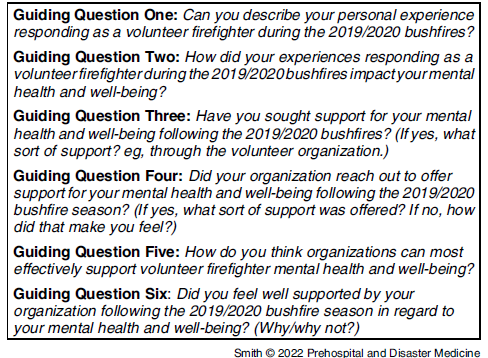
Interviews were conducted by telephone or via electronic video conference. A semi-structured script was utilized during the interviews to prompt discussion while still allowing for flexibility in probing and phrasing of questions (Table 1). The questions were developed following discussion by three members of the research group and were designed to elicit responses around the participant’s experience of the Black Summer bushfires, impact to volunteer well-being, and perceptions of the well-being support provided. Each interview was between 45-60 minutes in duration. With the permission of participants, all interviews were audio recorded.
Guiding Questions Utilized in Participant Interviews.

Data Analysis
Interviews were conducted independently by two members of the research team and were transcribed verbatim. This research utilized phenomenology to give meaning to participant experiences. Reference Byrne4 Due to the exploratory nature of the interviews, a coding protocol was developed for data analysis using a combination of several qualitative analytic approaches. Reference Patton5 Two independent members of the research team coded 25% of the data. Inter-coder agreement was assessed using the kappa coefficient and agreement was high (0.90) for all coding. Ethical approval was granted by the Edith Cowan University Human Research Ethics Committee (Joondalup, Perth, Western Australia; Project # 2021-02526-SMITH).
Results
Qualitative data were collected from 58 participants aged from 23 to 61-years-of-age (average age of 46 years) who self-reported as volunteer firefighters who had responded to the 2019-2020 Black Summer bushfires in Australia. Just over 80% of participants were male and the majority lived in the Australian states of New South Wales (65%) and Victoria (32%). This is reflective of the distribution of Australia’s 195,000 firefighter volunteers: the most populous state of New South Wales has the largest number (71,234), followed by Victoria (52,992). 6 This breakdown of male and female participants is also representative of Australian fire services, where women constitute between 12% and 24% of volunteers. Reference Beatson and Mclennan7
Impact on Well-Being
All 58 participants described an impact on their well-being following the Black Summer bushfires. Participants who experienced more than one traumatic event during the bushfires were more likely to report that their well-being had been seriously impacted:
“It was a prolonged period of nothing but fire activity, nothing but focusing on that next deployment, that next fire, with very little time to rest and recover. And with each new fire, I noticed that my mental state was taking a bigger hit.” [Interviewer response: “Do you think it’s a cumulative effect?”] “Oh, 100%.” – Male volunteer firefighter.
Almost one-half (n = 28) of all participants reported experiencing posttraumatic stress symptoms during the twelve months following the fires, while eight reported that they had been diagnosed with posttraumatic stress disorder (PTSD). A further three participants disclosed having made suicide plans following their experiences responding to the bushfires. One participant reflected on the mental health impact of volunteering during Black Summer by saying:
“I haven’t thought about suicide. But I also don’t really care if I live.” [Interviewer response: “Have you spoken to anyone about how you are feeling?”] “My family know, but if they [the organization] don’t care enough to ask, why am I going to tell them?”– Female volunteer firefighter.
Supporting Well-Being
Despite the clear impact on well-being among participants, over one-half (n = 32) reported that they had not sought mental health support in the twelve months following the fires. Of the 26 participants who had sought help, only four (15%) reported that they had asked for assistance through their fire service; the remainder had sought well-being support from a range of alternative sources including face-to-face and online peer support, online chat forums, general practitioners (GPs), and mental health professionals, as well as faith-based and spiritual leaders:
“I knew I was struggling. I was having nightmares and flashbacks and I was just angry all the time. But there was no way I was going let [the organization] know. Why would I? So they could tell me that if I couldn’t hack it, I shouldn’t be a firefighter? I ended up just speaking to some of my mates who had also been there. That helped.” – Male volunteer firefighter.
When asked if they felt that their organization had provided enough well-being support following the fires, the overwhelming response was an emphatic “no.” Further, most participants believed that the type of well-being support provided was not appropriate to meet their needs:
“I only ever received a bulk email from [the organization] that said, ‘Here’s the number for the EAP [Employee Assistance Program], call them if you need to.’ I mean, that’s it? That’s all they can do? Just shows you how little they actually care.” – Male volunteer firefighter.
Intense work demands, minimal intervals between deployments, the impact of cumulative exposure to trauma, and responding to fires in local communities all impacted well-being. Most participants reported multiple trauma exposures over a long period of time, with very little downtime for rest and recuperation. Fire-induced fatigue also resulted in subsequent impact on primary employment. Participants reflected on how their volunteer roles significantly affected their ability to perform in their primary employment. One participant summarized this impact:
“It’s not like we had a chance to rest, we had to go back to our jobs. Bills still needed to be paid. But I wasn’t feeling the best, I had a cough that took weeks to [go away], and I was just tired. Like, not normal tired, but ‘aching in my bones’ kind of tired. But whenever I tried to sleep, I just kept seeing all those dead animals, and I heard the screams of people we couldn’t help. That was weird because I didn’t hear people scream during the fires. But I kept hearing them in my dreams. I still do. We had been sent to an address where there were people trapped, surrounded by fire. But we were diverted to another job. We can’t second-guess, we can only go on the information that we are given. But that second job was a false alarm [Participant becomes quiet, then starts to cry. Interviewer response: “Do you need to take a break?”] No, it’s just that, sometimes I think it’s a sort of guilt. That’s why I hear those screams. I went back later, you know, to check on that house we couldn’t get to. There was nothing left. I had to take time off work, and I didn’t have any sick leave left.” – Male volunteer firefighter.
Lessons for Volunteer Emergency Service Organizations
Four clear lessons for volunteer service organization emerged from the experiences of the participants in this research.
(1) Well-being support needs to be both proactive and reactive and empower local and organizational leaders to “reach in” while encouraging responders to “reach out:”
“It feels like the [organization] just sends out an email after the fact as part of a tick-box approach to well-being support, but it’s disingenuous and we see through it. No one cares how we are any other time. So yeah, to really feel supported, I think they need to check in on us regularly, before and after fires.” – Male volunteer firefighter.
Participants also identified that well-being programs need to empower local leaders to reach in and provide peer support, as well as encouraging volunteers to reach out when they need help. Further, organizational leaders need to be provided with opportunities to build mental health literacy and develop skills in having conversations around mental health:
“Why would I go and talk to my team leader about my mental health, when it’s clear they don’t want to talk about it. One time, when I was really struggling, I approached [team leader], and you could just see this look on his face, he absolutely didn’t want to engage in this conversation with me. I think he thought I was going to fall apart, but all I really needed was for him to say, ‘you know what, I’ve been there, and this is how I got through it.’” – Female volunteer firefighter.
(2) The use of EAPs was identified as a largely ineffective method of supporting volunteer firefighter mental health:
“During training, we were told about the EAP, kind of a tick-box requirement for them to say, yep, we have told them how to look after their mental health. I tried calling them once. What a joke. These people answering the calls have no idea what it’s like to see what we have seen. In the end, I felt like I had traumatized the person who was meant to be helping me!” – Male volunteer firefighter.
While EAPs have a role in supporting well-being, participants overwhelmingly reported that they should not be the only option made available to volunteers.
(3) Participants frequently highlighted that the most effective method for supporting well-being was sharing what they had gone through with someone who “got it.” The sharing of lived experience Reference Mapp8 through both formal and informal peer support was a favored approach when it came to talking about mental health among participants:
“I spoke to both my GP and my [psychologist] and neither of them could really understand, because they hadn’t been there. They hadn’t seen what these fires could do, how much they could destroy. They hadn’t been scared for their lives as that relentless heat hit and the sky turned black. They hadn’t seen the death and destruction. And I couldn’t even talk to my family about it, they didn’t need to hear about what I had seen, I didn’t want to burden them. In the end, the only thing that has really helped has been joining an online support group. I can talk openly about what I saw, and what I am feeling. And they understand. They get it.” – Male volunteer firefighter.
(4) Participants also clearly highlighted that volunteer organization support programs need to address self-stigmatization. In line with results from the 2018 Australian national survey of emergency service personnel mental health “Answering the Call,” 9 self-stigmatization was a recurring theme among research participants. When asked why they hadn’t sought support, responses largely related to the traditionally masculine culture of most emergency service organizations. Participants expressed concern about how colleagues and their organization would view them if they openly admitted they were struggling:
“What are they going to think if I say I’m not coping? They are just going to say man up. If you can’t hack it, you have no business being a firefighter.” – Male volunteer firefighter.
Seeking support was seen by some participants as being career-limiting, or even career-ending. Both male and female participants expressed this concern. One female volunteer firefighter summed up her thoughts on this issue by saying:
“No one asks for help.” [Interviewer response: “Why do you think that is?”] “Because if you ask for help, you probably won’t get activated again. And for many of us, being a volunteer is in our blood. It’s a big part of who we are, and to have that taken away, well, we just don’t want to risk it. So, we stay quiet, and suck it up.” – Female volunteer firefighter.
Discussion
Given the integral role that volunteer firefighters play in Australia’s emergency management system, it is likely they will continue to play a significant role in responding to major bushfires in the foreseeable future. Finding a way to sustain a volunteer firefighter workforce of sufficient size and capacity to respond effectively to major bushfire events without placing them at risk of burnout or poor mental health is a priority for Australian fire services.
While most Australian emergency service organizations have existing well-being support strategies in place, an important issue to consider is whether these current supports are effective. Previous research suggests they may not be; a national survey of some 21,000 Australian emergency services personnel conducted in 2018 identified that 33% of Australian emergency service volunteers had been diagnosed with a mental health condition in their life compared to 20% of the general Australian population, 9–11 and recent research following the Black Summer bushfires identified that 4.5% of volunteers who responded to the fires had probable PTSD and 4.6% had very high psychological distress indicative of serious mental illness compared with 4.0% of the Australian population. Additionally, 4.6% of volunteers had seriously considered ending their own life in the year following the fires, 1.6% had a suicide plan, and 0.2% had attempted suicide. Rates of suicidal ideation and suicide plans were approximately twice as high as in the general population. 3
These findings are concerning, and the results reported in this study echo many of these problems. What is more concerning is that these findings are not new. Experience from the 2009 Black Saturday bushfires in Victoria, Australia showed that the mental health impact on those who respond to major bushfire events will likely be complex and protracted. Firefighters and other support personnel were at increased risk of developing PTSD, depression, anxiety, and complicated grief compared to the general public, and when these issues were inadequately treated, they carried an increased risk of suicide. 12
So why, some ten years later during yet another major bushfire event, are they dealing with the same problems? There are likely several contributing factors, but a major challenge to overcoming these persistent problems is inadequate support for mental health and well-being. Excessively long shifts and prolonged periods of emergency response volunteering should be minimized to the extent possible in the often-extreme realities of bushfires. Best-practice well-being support should be made available to support the volunteer firefighter workforce and consideration should be given to appropriately supporting both volunteers and their families with the heavy toll on well-being that volunteer firefighting can have. 13
Another factor that needs to be considered in future disaster planning is how the changing nature of bushfires in Australia could contribute to cumulative trauma exposure among volunteer firefighters. Previous research has identified that repeated exposure to trauma is a major risk factor for poor well-being and mental health. 9,Reference Jahnke, Poston, Haddock and Murphy14–16 With the frequency and intensity of bushfires increasing, 17 it is likely that many of the volunteer firefighters who responded to the Black Summer fires will be involved in subsequent major fire event response in the future, potentially increasing their risk of experiencing mental health impacts.
The evolving nature of volunteer firefighting should also be considered, recognizing that the time commitment and role expectations for volunteers are evolving, making it important to ensure that volunteers are comprehensively vetted and given access to appropriate infrastructure and suitable training and professional development opportunities. It is also important to ensure that organizational capability to support well-being is increased proportionately and provided in a way that is effective and acceptable to the volunteers.
Like both Answering the Call 9 and After the Fires, 3 this study has found that many volunteer firefighters are concerned about the potential adverse career impacts associated with speaking openly about their mental health. Participants reported that seeking help for their mental health could be either career-limiting or career-ending. Contributing to this is the on-going, toxic masculine culture associated with emergency service organizations. This culture continues to promote the belief that speaking out about mental health is weak and that there is a need for firefighters to be impervious to the impact of trauma exposure. The overwhelming majority of participants in this study and Answering the Call self-stigmatized. No participant in this research reported being stigmatized by a colleague about their mental health. Continuing efforts to break down stigma and normalizing conversations about mental health will go a long way toward changing this longstanding culture, an important step for effectively supporting the well-being of volunteer firefighters.
Limitations
The findings reported in this publication are subject to several limitations. From a methodological perspective, the sampling methods utilized are an example of non-probability sampling. However, researchers often use non-probability samples for projects that are qualitative in nature where the researcher’s goal is in-depth, contextual understanding rather than more general, nominal understanding. The results are based on the responses of a small number of participants, predominantly from two Australian states. Future research should repeat this methodology with a broader range of volunteer firefighters and with volunteers from other emergency services.
Conclusion
This research has identified how the Black Summer bushfires impacted the well-being of responding volunteer firefighters. Participants in this research identified that effective well-being support needs to be both proactive and reactive and holistic in approach.
Conflicts of interest
None declared.