Introduction
Huntington's disease (HD) is a hereditary neurodegenerative disorder, presenting with a wide range of motor, cognitive and psychiatric disturbances (Reference Rosenblatt and Leroi1). A majority of HD gene carriers display a lot of subtle abnormalities, even up to two decades before the onset of chorea (Reference Paulsen, Langbehn and Stout2). Despite the fact that psychiatric symptoms may precede motor abnormalities in HD, there is no difference in the lifetime frequency of clinical psychiatric disorders between gene carriers and non-carriers. The former reported only more depressive symptoms (Reference Julien, Thompson and Wild3). Conversion disorder as a psychiatric manifestation of HD is a very rare phenomenon. Arrojo-Romero et al (Reference Arrojo-Romero, Silva and Palha4) presented the case in whom hypochondriasis (e.g. unspecified somatic complaints, weakness) preceded by 14 years the onset of gait dysfunction (wide-based gait with small steps) and choreic movements.
We present a case of abnormal gait with severe general motor slowing (slowness or bradykinesia) in a presymptomatic gene carrier unaware of her own and her mother's genetic status.
Case presentation
A 33-year-old Caucasian female, with 11 years of education, reported gait impairment of sudden onset, chronic fatigue and apathy. Medical history revealed that 6 months earlier, she recovered from tuberculosis with drug-induced liver lesion. Her family situation was difficult due to the death of her child a couple of years earlier and marriage problems related to alcoholism in her husband. Subsequently, as the walking problems were not a prominent complaint, first she was referred to a psychiatrist and to a psychological examination. Minnesota Multiphasic Personality Inventory confirmed severe adjustment disorder with depressed mood and anxiety and withdrawal as a predominant coping mechanism.
She was admitted to Psychiatry Department, diagnosed with dissociative disorder and discharged after 1 week at own request. Paroxetine therapy was introduced. One month later, as the walking problems and general slowness became severe, she was admitted to Neurology Department. Examination revealed atypical gait with small steps and stiffening knee joints while walking (but with preserved arms balance), impaired initiation of movement, bradykinesia, rather increased but fluctuating muscle tone in lower limbs (withdrawing following distraction, feigned rigidity) and hypomimia. Magnetic resonance imaging and somatosensory evoked potentials failed to identify any abnormalities.
Psychological examination revealed denial as a main defence mechanism, low insight and susceptibility to conversion reactions as well as intelligence below average (Wechsler Adult Intelligence Scale-Revised; IQ = 77). Treatment with paroxetine was maintained (20 mg/day) and buspirone (15 mg/day) was added. Following several days of treatment at the Neurology Department and explanation of non-organic aetiology of symptoms, marked improvement of gait during 2-week hospitalisation was observed, and she recovered completely within the next month.
At the time of the onset of symptoms, hospitalisation and recovery, the patient was blind to her mother's HD diagnosis and her own genetic status. Choreic movements in her mother had been already present for 3 years, without family history of chorea. Both of them were hospitalised at the Neurology Department at the same time and consented to genetic testing, which confirmed mutation in both the proband (12/42 CAG repeats) and her mother (16/41 CAG repeats).
Despite informing the patient about her own and her mother's genetic testing results, during the 2-year follow-up, no depressive symptoms were observed. She continued treatment with paroxetine (20 mg/day) and buspirone (15 mg/day), and nitrazepam was added (5 mg/day), for the next 8 months.
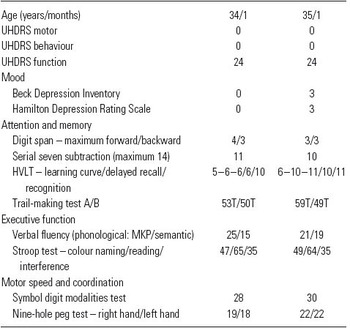
As evidenced by two follow-up examinations, according to the REGISTRY protocol, by European Huntington's Disease Network, no specific for HD (oculo)motor or psychiatric symptoms developed. In terms of cognitive function, which was at baseline below average but with no dementia (Mini-Mental State Examination 27; Mattis Dementia Rating Scale 128), no deterioration was noted during the observation period (Table 1). Slowed information processing was evidenced by symbol digit modalities test and Stroop test.
Neurological, neuropsychiatric and neuropsychological follow-up examinations results

HVLT, Hopkins verbal learning test; UHDRS, Unified Huntington's Disease Rating Scale.
Discussion
The clinical presentation of parkinsonism with predominant gait disturbance in the reported case is atypical for HD in the adults. In accordance with the criteria of Williams et al (Reference Williams, Ford and Fahn5), medical history, neurological examination, psychiatric records and remission following treatment seemed to confirm psychogenic origin of symptoms. It can be questioned whether psychogenic movement disorder can be diagnosed in an asymptomatic gene carrier. However, it seems possible as she was not aware of the genetic disorder of her mother.
Psychiatric disturbances in HD gene carriers may be caused by both genetic and environmental (e.g. disturbed upbringing) factors (Reference Berrios, Wagle, Markova, Wagle, Rosser and Hodges6). Depression in HD gene carriers may both precede motor symptoms, constituting the first manifestation of the disease, and appear while considering predictive testing or after obtaining positive genetic testing result (Reference Julien, Thompson and Wild3,Reference Berrios, Wagle, Markova, Wagle, Rosser and Hodges6). In our patient, only the first explanation may be valid. She developed abnormal gait with predominant slowing after being diagnosed with severe adjustment disorder. It is open to debate whether conversion disorder (psychogenic movement disorder) in the presented case is the psychiatric manifestation of HD, heralding the clinical onset (Reference Paulsen, Langbehn and Stout2,Reference Julien, Thompson and Wild3), or is HD unrelated and can be attributable to other factors, e.g. environmental (Reference Berrios, Wagle, Markova, Wagle, Rosser and Hodges6). In the patient, several environmental stressors may have triggered conversion: (a) undiagnosed motor symptoms in her mother, (b) returning to the role of mother, wife and housewife after a long hospitalisation due to tuberculosis, (c) alcoholism in her husband, (d) the death of her child a few years before without mourning period.
Recent data suggest the usefulness of functional imaging in the differential diagnosis of psychogenic movement disorders, factitious disorders and malingering (Reference Nowak and Fink7). However, these methods are not routinely used in the clinical practice, and their applicability in the asymptomatic HD gene carrier seems questionable because of no standards for preclinical HD population. In our patient, none of these techniques were used. In our case, according to the criteria of Williams et al (Reference Williams, Ford and Fahn5), the recovery without specific treatment confirmed the psychogenic origin of symptoms. However, if the recovery is not observed, functional neuroimaging may be helpful to establish the diagnosis (Reference Ginovart, Lundin and Farde8,Reference Kägi, Bhatia and Tolosa9).
Parkinsonian symptoms are typical for juvenile HD, but in our case, the age was beyond the range typical for Westphal form of HD, and the symptoms disappeared without any specific treatment.
To our knowledge, this is the first presented adult case who presented with Parkinsonian features in the preclinical phase of HD, albeit the second case in whom psychogenic symptoms have preceded HD onset (Reference Arrojo-Romero, Silva and Palha4). It remains a matter of debate if motor symptoms observed in our patient are related to HD and can be regarded as a psychogenic movement disorder or if those motor symptoms of psychogenic origin are rather environmentally related. However, this case report adds dissociative disorder to the spectrum of psychiatric diagnoses in preclinical HD, as the causal relationship cannot be excluded. Nevertheless, it seems important in the clinical practice to be aware of possible psychogenic origin of symptoms in gene carriers as those symptoms, unless recognised and treated, may persist.
Acknowledgements
During the preparation of the manuscript EJS was supported by START Scholarship from the Foundation for Polish Science.