1 Introduction
Defining and describing the nature of lexical meaning is a matter of great concern to linguists of many persuasions and the endeavour lies at the very heart of the study of lexical semantics. The way lexical meaning is characterized greatly influences, if not determines, the potential treatment of sense relations, meaning change, the particular role of context in the construction of meaning, among many other things. Over the past decade or two, much effort has been expended within cognitive research on facilitating a perspective shift in lexical semantics (e.g. Allwood Reference Allwood, Allwood and Gärdenfors1999, Reference Allwood, Cuyckens, Dirven and Taylor2003; Paradis Reference Paradis, Faccinetti, Krug and Palmer2003, Reference Paradis2005; Croft & Cruse Reference Croft and Cruse2004; Fauconnier Reference Fauconnier, Horn and Ward2004; Linell Reference Linell2009). This perspective shift, inherent to a meaning potential approach to lexical meaning, involves a rejection of a view of lexical items as essentially ‘having’ meanings, in favour of a view of lexical items as providing access to or promoting certain modes of reasoning and conceptualization. This shift is broadly in line with a basic assumption made in Cognitive Linguistics:
A lexical item is not thought of as incorporating a fixed, limited, and uniquely linguistic semantic representation, but rather as providing access to indefinitely many conceptions and conceptual systems, which it evokes in a flexible, open-ended, context-dependent manner. (Langacker Reference Langacker2000: 4)
This article offers an exploration of a particular lexical item, the English word bit. The investigation of bit’s semantics serves as an illustration of the potential for semantic description and explanation inherent to a meaning potential perspective. After introducing the lexical item bit, the article offers a brief overview of the meaning potential approach as it has been presented in the literature, followed by a description of a particular model for the explanation and description of lexical meaning: lexical meaning as ontologies and construals (LOC, Paradis Reference Paradis2005). As is generally true of a meaning potential approach to lexical meaning, this model views lexical items as cues for activation of conceptual structures by means of construal operations rather than as repositories of ready-to-use meanings. The article presents a case study of bit in terms of the LOC model and then, in light of this description and explanation, discusses some advantages and potential shortcomings of the model in terms of future directions for elaboration and refinement.
1.1 Introducing bit
A cursory examination of the results of a corpus query for bit reveals that this lexical item evokes a range of situated meanings, meanings that vary substantially along with their communicative contexts. As a way of introducing bit we can look at the following examples from the British National Corpus (BNC) (Davies Reference Davies2004–) and the Corpus of Contemporary American English (COCA) (Davies Reference Davies2008–):
-
(1) I'm gonna eat a bit of your brain. Just a bit. (COCA FICTION 2010)
-
(2) And now for the exciting bit: . . . (COCA MAGAZINE 2005)
-
(3) “I'm going to stay up and read a bit,” she says when Ben turns in early. (COCA FICTION 2010)
-
(4) If your pockets feel a bit full, well, you might need to make room . . . (COCA SPOKEN 2005)
-
(5) Well it is to a certain extent it's a bit of a typing pool as well as a sales office . . . (BNC SPOKEN 1994)
-
(6) There's not a single bit of proof. (COCA SPOKEN 1993)
Naturally, these examples do not come close to capturing bit’s range, but they can give us an idea of its use potential. At a glance, bit seems to evoke something small or insignificant, as in (1). At the same time, instances like (2), while potentially involving smallness, seem to conjure up the opposite of insignificance – the exciting bit is potentially the bit we have been waiting for. In addition, bit can evoke a brief space of time, as in (3), and can also cue meanings involving slight excess, as in (4). In some instances, insignificance gives way to classificational doubt; in (5), we are invited to question whether it is a typing pool or indeed a sales office, or perhaps both. Bit also thrives in the context of negation, as in (6), where it cues emphatic negation.
Based on this cursory glance, a provisional meaning for bit could be suggested in terms of ‘a small portion, amount, degree or extent’. As can perhaps be surmised from the description of examples (1)−(6), this provisional meaning is not quite sufficient and later sections provide a different kind of description of bit’s meaning, one that places its diverse uses within a semantic framework that can explain its synchrony.
Bit has been described in the literature from different vantage points. It has been discussed in the context of degree modification (e.g. Bolinger Reference Bolinger1972; Paradis Reference Paradis1997, Reference Paradis and Kirk2000, Reference Paradis2001; Traugott e.g. Reference Traugott2007, Reference Traugott, Bergs and Diewald2008a, Reference Traugott, Eckhart, Jäger and Veenstra2008b) and in connection with partitive expressions (e.g. Koptjevskaja-Tamm Reference Koptjevskaja-Tamm, Dahl and Koptjevskaja-Tamm2001, Reference Koptjevskaja-Tamm, Helmbrecht, Nishina, Shin, Skopeteas and Verhoeven2009; Brems Reference Brems2003, Reference Brems2007, Reference Brems2011; Traugott e.g. Reference Traugott2007, Reference Traugott, Bergs and Diewald2008a, Reference Traugott, Eckhart, Jäger and Veenstra2008b). Bit has also been treated in connection with adjectives (Tribushinina Reference Tribushinina2008, Reference Tribushinina2009, Reference Tribushinina2011) and it has been a more central focus of additional studies (Goddard Reference Goddard and Goddard2006; Hartman Reference Hartman2013; Claridge & Kytö Reference Claridge, Kytö, Taavitsainen, Jucker and Tuominen2014). Some of these take a diachronic perspective and others are more synchronically oriented. The primary aim of this article is not to offer a new and competing description of bit’s uses, but to present a systematic description and explanation of the semantic basis for its uses within a cognitive framework, an explanation of its semantics that could potentially be compatible with some earlier treatments of bit. As it turns out, bit’s semantics can advantageously be described and explained from a meaning potential perspective in that LOC offers the necessary tools and provides a cohesive explanatory framework.
2 Lexical meaning as potential
A lexical item's potential for meaning should not be regarded in terms of a ‘container of meanings’, or in terms of an abstract representation of situated meanings. Paradis writes that ‘lexical items evoke meanings rather than have meanings’ (Reference Paradis2008: 320). No situated meaning fully realizes or exhausts a lexical item's potential for meaning; instead each meaning in use constitutes a partial activation of this potential and results from ‘an active construal or shaping of the activated information’ and not from ‘passive selection of already available meanings’ (Allwood Reference Allwood, Cuyckens, Dirven and Taylor2003: 47). Meaning potential is sometimes described in terms of a ‘union of individually or collectively remembered uses’ (Allwood Reference Allwood, Cuyckens, Dirven and Taylor2003: 43) and this illustrates the usage-oriented nature of this approach. A lexical item's potential for meaning is continuously in flux and shaped through use and may be structured in various ways due to conventionalization (Linell Reference Linell2009).
The rejection of lexical meaning as static and determinate is central to a meaning potential perspective. Fauconnier writes that ‘the assumption of invariant meaning [is] simplistic. Context matters’ (Reference Fauconnier, Horn and Ward2004: 657). Similarly, Allwood writes that
the activation of a meaning potential always takes place in a context which creates certain conditions for the activation. These conditions determine the way in which the potential is activated. The result of an activation is normally a structured partial activation of the potential. (2003: 43)
Context is not limited to the linguistic context. The cognitive operations that prompt the activation of meaning potential can be ‘triggered through language use’ or ‘independently of language’ (Allwood Reference Allwood, Cuyckens, Dirven and Taylor2003: 43). Linell notes that context includes ‘linguistic resources that are locally present (such as grammatical constructions and other words)’ but also ‘global topics, relevant communicative projects, communicative activity types (and text genres)’ (Reference Linell2009: 338). Semantic description and explanation should ideally involve a characterization of the nature of contextual resources and requirements.
Not only words carry meaning potentials; ‘all linguistic expressions (morphemes, words, idioms, phrases, etc.) are associated with meaning potentials’ (Allwood Reference Allwood, Cuyckens, Dirven and Taylor2003: 52). In that all activation of meaning potentials requires negotiation to achieve consonance between the situated meanings of the elements involved and their use contexts, a meaning potential perspective is potentially compatible with construction-based descriptions of meaning (in the vein of e.g. Goldberg Reference Goldberg1995). The type of lexical description and explanation presented in this article can provide a cognitive-semantic foundation for descriptions that aim to capture features of and restrictions on constructional meaning. Constructions also stand as important ‘linguistic requirements’ (Allwood Reference Allwood, Cuyckens, Dirven and Taylor2003) and ‘resources’ (Linell Reference Linell2009) for the activation of meaning potentials. The meaning potentials of lexical items are potentially closely tied to the potentials of their instantiating schematic constructions.
While ambiguity and vagueness are traditionally usage notions (i.e. a given meaning can be ambiguous or vague only in use), homonymy and polysemy tend to be described in terms of mental representations. In this article, polysemy is considered a usage notion in that sense boundaries are regarded as established in use. Homonymy, on the other hand, can be considered a feature of conceptual structure when posited (in terms of two or more distinct potentials). Polysemy can be described in terms of ‘conventionalizations of semantic operations meeting contextual requirements’ (Allwood Reference Allwood, Cuyckens, Dirven and Taylor2003: 50). However, polysemy does not have to be conventionalized; it can take the form of ‘ad hoc uses’ (Paradis Reference Paradis, Benczes, Barcelona and de Mendoza Ibáñez2011: 63). Cruse suggests that sense boundaries are ‘located not in the lexical entry, but arise as part of the process of meaning construal’ (Reference Cruse2002: 51); sense boundaries are realized in use and there is a continuum between lexical items that conventionally display ‘ease of boundary construal’ (Cruse Reference Cruse2002: 44) and those that do not. Cruse (Reference Cruse2002) uses the examples of bank (potential readings include ‘financial institution’ and ‘margin of river’) and teacher (potential readings include ‘male teacher’ and ‘female teacher’) to illustrate that bank shows great ease of boundary construal whereas this is less so for teacher.
Vagueness is often defined in opposition to (or at least in relation to) ambiguity and both notions rely on an assumption of sense boundaries as rather stable and fixed (i.e. as properties of lexical items). Tuggy writes that, under a traditional definition of these terms, ‘ambiguity corresponds to separation, and vagueness to unity, of different meanings’ (Reference Tuggy1993: 274) so that ambiguity concerns separate meanings that cannot easily be unified whereas vagueness concerns related meanings that can easily be unified. Because sense boundaries are regarded, from a meaning potential perspective, as realized in use, vagueness and ambiguity are considered the realization of non-specificity with regard to meaning determination within contextually established sense boundaries (vagueness) or between contextually established sense boundaries (ambiguity). In other words, if it is important in a given contextual setting to differentiate (establish a sense boundary) between a bit of bread ‘an individual piece of bread’ and a bit of bread ‘a small amount of bread’, ambiguity could arise. Imagine a person asking for a bit of bread and being offered a pile of crumbs. The comment I asked for a BIT of bread could be answered with Oh, I thought you just wanted a bit of BREAD. This would be an example of contextually realized ambiguity (without posited homonymy) with regard to bit’s use. In many cases, however, a bit of bread would more likely be realized as vague between these two readings.
A meaning potential perspective further holds that lexical items provide means of portraying and organizing conceptual content in a manner that is fundamentally communicative. Linell suggests that ‘[l]inguistic items and processes are methods to accomplish actions, communicative projects, and to provide structure and meaning to utterances’ (Reference Linell2009: 282). This perspective demands a usage-based approach to the study of lexical meaning and requires attention to both subjective and intersubjective features of lexical meaning (e.g. Verhagen Reference Verhagen2005, Reference Verhagen, Geeraerts and Cuyckens2007; Linell Reference Linell2009). Verhagen argues that ‘an important part of the semantics of basic linguistic units should specifically involve the cognitive handling of people's understanding of their own and other “selves”’ (Verhagen Reference Verhagen2005: 4).
The precise manner in which meaning potential is described and explained will vary depending on the model and most likely depending on the lexical item associated with the potential. The explanatory model utilized in this article (LOC) proposes that lexical items cue conceptual structures, ranging from contentful to schematic, through various cognitive processes (i.e. construals) that provide Gestalt, salience, comparison and perspectivization to these structures in accordance with context.
2.1 Lexical meaning as ontologies and construals
Paradis (Reference Paradis2005) proposes a model of lexical meaning as ontologies and construals (LOC). This model is in line with the larger framework of cognitive semantics (e.g. Talmy Reference Talmy2000; Croft & Cruse Reference Croft and Cruse2004; Geeraerts & Cuyckens Reference Geeraerts and Cuyckens2007; Langacker Reference Langacker2008; Gärdenfors Reference Gärdenfors2014) and is reconcilable with various uses of the notion of meaning potential (e.g. Allwood Reference Allwood, Cuyckens, Dirven and Taylor2003; Fauconnier Reference Fauconnier, Horn and Ward2004; Linell Reference Linell2009). The LOC model presents a distinction between conceptual structures and cognitive processes. Paralleling this distinction, Langacker notes that ‘a meaning consists of both conceptual content and a particular way of construing that content’ (Reference Langacker2008: 43) and notes that ‘every element evokes some content (however schematic it might be), and conversely, any content evoked is construed in some fashion’ (Reference Langacker2008: 43). The varying schematicity of conceptual structures is reflected in LOC by a continuum between contentful and configurational structures. Ontologies are not schematic versions of situated meanings, but ‘pre-meanings’ that stem from ‘lower levels of conceptual organization’ (Jones et al. Reference Jones, Murphy, Paradis and Willners2012: 130). Conceptual content can be described with varying degrees of specificity depending on the aim and purpose of the description.
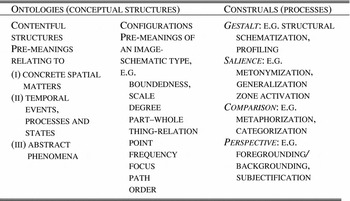
The content structures in figure 1 represent ‘the three most general contentful pre-meaning structures’ (Jones et al. Reference Jones, Murphy, Paradis and Willners2012: 131). These can be made more specific since they ‘in turn comprise more fine-grained Ontologies’ (Jones et al. Reference Jones, Murphy, Paradis and Willners2012: 131). For instance, abstract phenomena is relied on for the conceptualization of such abstract domains as infatuation, knowledge or business. In turn, business is relied on, among other domains, for the interpretation of retail or, very specifically, walmart.
The LOC model (ontologies and cognitive processes in meaning construction) as presented in Jones et al. (Reference Jones, Murphy, Paradis and Willners2012: 130), based on Paradis (Reference Paradis2005) (reproduced by the author’s permission)

Configurations are schematic templates relative to and expressive of our perception of the world. They include such basic modes of structuring perception as boundary and scale. LOC's configurations are applied to conceptual content in a free manner. The distinction between content and configurations allows for a rich description of the dynamic, highly flexible and context-dependent ways in which ontological structures are realized in language use and captures the independent nature of schematic structures relative to contentful ones.
Construal operations provide means for, for instance, perspectivizing or affording selective salience to conceptual structures on specific occasions of use and operate on the conceptual structures:
The ontological constitution provides the possibilities on which construals can act. The inferences that can be made grow out of the potential of the ontological system in combination with the potential of the construal operations. (Paradis Reference Paradis2005: 565)
Two schematic ontologies are of particular importance to the discussion of bit’s semantic potential: boundary and scale.
2.1.1 BOUNDARY
Boundedness has been discussed a great deal in the literature (e.g. Langacker Reference Langacker2008; Frawley Reference Frawley1992; Talmy Reference Talmy2000; Croft & Cruse Reference Croft and Cruse2004). It represents one of the most basic ways of structuring the conceptualization of entities. Langacker treats ‘boundary’ as one of his ‘highly schematic configurational concepts’ (Reference Langacker2008: 33) and in figure 1, boundedness exemplifies a fundamental configuration. Boundedness is a constitutive configuration the use of which has its origin in Gestalt psychology. It concerns whether an entity is conceptualized as delimited according to boundaries that make it distinctive from other entities. For nouns boundedness is discussed in terms of countability and individuation or incrementation (e.g. Frawley Reference Frawley1992; Talmy Reference Talmy2000; Croft & Cruse Reference Croft and Cruse2004). For verbs discussion of boundedness has primarily concerned aspectuality (e.g. Dahl Reference Dahl, Tedeschi and Zaenen1981; Depraetere Reference Depraetere1995); processes can be viewed as bounded or unbounded aspectually and/or temporally (cf. Langacker's perfective/imperfective processes, e.g. Reference Langacker2000). Boundedness has also been discussed relative to adjectival structures (e.g. Paradis Reference Paradis and Kirk2000, Reference Paradis2001, Reference Paradis2005; Paradis & Willners Reference Paradis, Willners, Paradis, Hudson and Magnusson2013; Tribushinina Reference Tribushinina2008, Reference Tribushinina2009, Reference Tribushinina2011). I refer to boundary rather than boundedness to indicate the profiling of boundaries for an entity because boundedness can be applied more broadly to indicate varying degrees of delimitation for entities.
2.1.2 SCALE
Scale represents another fundamental schematic template for the conceptualization of an entity (see configurations in figure 1), one that ‘provides a gradable dimension to a domain, which may or may not be measurable’ (Croft & Cruse Reference Croft and Cruse2004: 65). Scales have been discussed extensively in the literature not least in connection to adjectives (e.g. Cruse & Togia Reference Cruse and Togia1995; Croft & Cruse Reference Croft and Cruse2004). This article makes a division between three particular modes of scalar construal, amount, extent and degree, and these differ somewhat in their of realization of a scalar configuration. amount is scalar construal along an inherent scale of magnitude for an entity construed as thing. So, in example (7) an instance of snow is construed as scalar along an inherent scale of magnitude (amount):
-
(7) There was a bit of snow blown in, toward the entrance. (COCA FICTION 2010)
Extent and degree are scalar construals pertaining to temporal and atemporal relations. For temporal relations the gradable dimensions are frequency and duration, whereas for atemporal relations various dimensions may apply. Example (8) expresses scalar extent in the form of duration and (9) expresses degree (of corniness).
-
(8) . . . when he saw a brother dozing off, he let him sleep a bit resting on his lap (COCA MAGAZINE 1995)
-
(9) For me, it was, I know it sounds a bit corny, but love at first sight. (COCA SPOKEN 2006)
Lexical items are not predetermined for particular types of scales, although their application may be quite conventionalized.
3 A study in meaning potential: bit
3.1 The corpus study
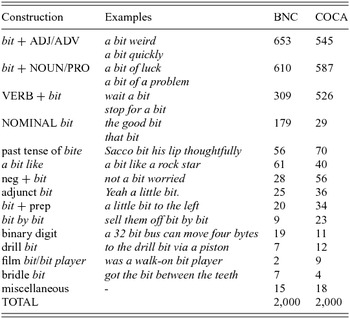
The corpus component of this study of bit makes use of the British National Corpus and the Corpus of Contemporary American English, both accessed through the Mark Davies interfaces (2004– and 2008–). The BNC and COCA are large balanced language corpora available online. The BNC is made up of 10 per cent spoken and 90 per cent written language whereas COCA includes about 20 per cent spoken and 80 per cent written language. For samples of bit from the corpora, however, the distribution between spoken and written language is quite different. In the BNC the instances of bit from spoken language make up close to 50 per cent of the total instances and in COCA spoken instances of bit make up about 42 per cent.Footnote 2 The corpus study involved close scrutiny of 2,000 instances of bit from the BNC and 2,000 instances from COCA.Footnote 3 Data from searches on Google are also presented at times in this article (as indicated). Table 1 gives an idea of the distribution of the different uses of bit in the samples from BNC and COCA.
Use of bit in two random 2,000-instance samples from BNC and COCA

As can be gleaned from table 1, in the samples from BNC and COCA bit is used primarily in conjunction with nouns, adjectives, adverbs, and verbs and in these contexts it mostly cues meanings pertaining to scalar degree, extent or amount. At times, bit is used as a nominal (nominal bit in table 1) in expressions like that bit or the steep bit. These boundary profiling uses are more common in the BNC sample. When bit is used in conjunction with nouns (bit + NOUN/PRO in table 1), it is mainly used in the constructions a bit of NOUN (BNC: 275, COCA: 300) and a bit of a NOUN (BNC: 194, COCA: 136). In a bit of NOUN, bit profiles boundary and/or scalar amount, whereas in a bit of a NOUN, bit predominantly profiles scalar degree and generally against intersubjectively construed dimensions (e.g. he is a bit of an idiot). When bit is used as a modifier of adjectives and adverbs (bit + ADJ/ADV in table 1), it is primarily used in the constructions a bit ADJ (BNC: 558, COCA: 433) and a bit ADV (BNC: 68, COCA: 82). In these constructions, bit invariably cues a scalar construal. When bit is used with verbs, it is mainly used in the constructions VERB a bit (BNC: 157, COCA: 261) and VERB NP a bit (BNC: 91, COCA: 186). In these constructions, bit profiles scalar extent (frequency or duration) and may itself elaborate a landmark for a process (i.e. as a direct object) while attending to scalar amount (e.g. she contributed quite a bit). In other words, bit stands (schematically) as the thing she contributed while also elaborating the amount of this schematic thing. In many instances, bit evokes meanings that concern ‘smallness’, but the evoked meanings are quite varied in construal.
3.2 An LOC perspective on bit
Bit’s semantics can be explained in terms of a dual potential for two configurations: boundary and scale (see figure 1). These configurations are realized through construal so that either the boundaries of an entity are profiled (boundary) or the extension of an entity is profiled (scale), as in (10) and (11) respectively:
-
(10) I enjoyed that bit of his speech best of all. . . (BNC WRITTEN 1991–2)
-
(11) Fill the vessel with a bit of water and a single flower . . . (COCA MAGAZINE 2010)
Profiling does not rule out joint attention to other aspects of meaning; profiling of boundary allows for attention to scalar extension and vice versa. In (10) the boundaries of a particular segment of the speech are profiled and bit is construed as thing. In (11), the extension (amount) of the water is profiled resulting in a construal of bit as relation (between water and an inherent scalar dimension). The activation of these for bit fundamental configurations is contextually enabled; some communicative contexts push for profiling of boundary or scale, whereas other contexts easily allow for either, or both. In this manner, various facets of bit’s potential, e.g. for construed negation, comparison, or partitioning, are invited, so to speak, by its core configurations in response to contextual demands.
Bit’s semantic structures provide the raw material for all its situated meanings. An explanation according to LOC involves no separate accounts of its semantics and its pragmatics. As an example, bit’s potential for scale enables evaluation. Evaluation is always subjective in nature and is often intersubjectively directed, as in (12):
-
(12) S1: Yeah? Well I'm, as a matter of fact before that I actually said that er this, all this that I'm doing on your behalf is completely free of charge
S2: You did.
S1: I did, didn't I?
S2: Yes
S1: Well, it's a bit of a lie actually (pause) er there's a fee involved in all the preparation and all the work I've done er and what do you think the fee's worth? How much do you think it's worth? (BNC SPOKEN 1994)
Bit’s potential for evoking scale enables its application relative to intersubjectively established dimensions (e.g. epistemic ones), as in (12). A central feature of bit’s semantics–pragmatics is its potential to serve as a hedge in communicative contexts that provide resources for such uses. Some schematic constructions, such as the predicative nominative construction (X is a Y), are frequent in bit’s use as a hedge due to their utility in expressing classification and evaluation.
3.2.1 From contentful to schematic
Bit’s potential to profile either the boundaries of an entity or its extension can be accounted for by reference to bit’s diachronic development from a partitive to a quantifier (e.g. Traugott Reference Traugott2007, Reference Traugott, Bergs and Diewald2008a, Reference Traugott, Eckhart, Jäger and Veenstra2008b, Reference Traugott, Davidse, Vandelanotte and Cuyckens2010; Brems Reference Brems2003, Reference Brems2007, Reference Brems2011; Claridge & Kytö Reference Claridge, Kytö, Taavitsainen, Jucker and Tuominen2014). Early on, bit was used for ‘a biting action’ and it was later used for ‘a piece bitten off’ (i.e. ‘a bite’). Traugott describes this initial partitive use as having come about ‘by metonymy from action of biting to result’ (Reference Traugott, Bergs and Diewald2008a: 29; Reference Traugott, Davidse, Vandelanotte and Cuyckens2010: 46) and gives the sixteenth century as the time of occurrence. Bit’s use was later broadened to also include pieces removed from a larger whole by other processes (e.g. cutting or breaking). Traugott writes that ‘[t]his is still partitive, but importantly for later reinterpretation as a Quantifier, the unit [bit or NP1] has been bleached of the literal meaning ‘mouthful’, and the NP2 (the complement) can be abstract’ (Reference Traugott, Davidse, Vandelanotte and Cuyckens2010: 46). Traugott mentions that by the earlier part of the seventeenth century bit was used to describe ‘a small, insufficient, or inadequate part of the pragmatic Focus’ (Reference Traugott, Davidse, Vandelanotte and Cuyckens2010: 46) and by the eighteenth century bit is used as a quantifier.
According to Paradis, ‘[c]ontemporary degree modifiers [such as a bit] have undergone change from foregrounding of content structures to foregrounding of configuration (degree) through a process of metonymization’ (Reference Paradis2008: 334; see also Paradis Reference Paradis, Benczes, Barcelona and de Mendoza Ibáñez2011; Traugott & Trousdale Reference Traugott and Trousdale2013). In other words, bit’s potential for meaning has seen a development from more objectively construed meanings that foreground content structures (‘a bite of something’) to (inter)subjectively construed meanings that foreground schematic structures (primarily scale). The stages in bit’s development (diachronically) and the facets of synchronic potential are connected through inference. Historically, bit’s modification according to scales of magnitude inherent to entities as in a bit of apple (boundary or scalar volume) enabled modification according to scalar dimensions less inherent to the modified entities as in run around a bit (spatial distance/temporal duration) and a bit of an idiot (epistemic dimension).
3.2.2 BOUNDARY profiling bit
As noted, situated meanings are always constructed through interplay between semantic structures and the linguistic and extralinguistic contexts through which they are put to use; bit cues boundary relative to its situating context:
-
(13) . . . been trying to look for a bit of paper and I opened a book today and found it! (BNC SPOKEN 1991)
The inclusion of it enables bit’s profiling of the boundaries of a particular piece of paper rather than a loosely specified amount of paper. Example (13), including the use of trying to look for, also suggests a purposeful endeavor directed at a particular piece of paper rather than a more random amount of paper. Croft & Cruse note that boundedness is established not just by individual lexical items but by the overall linguistic context, referring to this as ‘unity of selection’ so that ‘[t]he referents of a clause must conform to a single instantiation of the event plus participants’ (Reference Croft and Cruse2004: 71). ‘Unity of selection’ accounts for the boundedness of wine in Sally spilled wine on the carpet; the event is construed as temporally bounded and so the wine must be construed as ‘referring to a specific bounded amount of the liquid’ (Reference Croft and Cruse2004: 71). In Sally likes wine, however, the event is construed as unbounded and so is wine.
Bit’s situating constructions also serve as contextual resources that may direct meaning determination. Complex constructions like a bit of NOUN can develop meaning potentials in their own right (for a discussion of various constructions including bit, see Brems Reference Brems2011), potentials that may be closely tied to those of their constitutive lexical elements. When realized in some schematic constructions, bit almost exclusively profiles either boundaries or extension. However, as we saw for example (13), in a bit of paper (an instantiation of a bit of NOUN), bit can profile either boundaries or extension and meaning determination relies on a range of contextual resources, such as the overall activity type (look for/found) and co-reference between a bit of paper and it. A bit of NOUN is an example of a construction through which bit can profile either boundary or scale. This construction often cues scale rather than boundary, especially when it incorporates nouns for entities that are not easily construed as discrete (i.e. divisible into units). Since a bit of NOUN allows for either boundary profiling or extension profiling, context reinforces the construal of boundaries when a boundary construal is effected:
-
(14) Sports Illustrated prides itself on its swimsuit issues, which have “become pan and parcel of our culture” and “a bit of Americana.” (COCA ACADEMIC 1994)
-
(15) But the flurry of renovations has provided a rare bit of hope for Liberty Heights, the first subdivision ever built in Gwinnett. (COCA NEWS 2004)
One way in which boundary profiling is contextually realized is through the expression of two or more alternative conceptualizations of an entity. If two situated construals are applicable to the same entity and one is clearly bounded, bit will also be construed as such. In (14) the inclusion of its swimsuit issues is crucial for the construal of boundaries for a bit of Americana. Example (15) illustrates the fact that premodifying adjectives can serve as contextual resources for a boundary construal and bit’s construal as thing. Not all premodifying adjectives support a bounded construal in this manner. Adjectives like nice and good tend not to (Hartman Reference Hartman2013) due to their potential for adjusting scale (e.g. a healthy bit of motor oil). Whereas some constructions can cue either scale or boundary, other constructions show more preference for one of these. Constructions that show preferenceFootnote 4 for boundary are, among others: the NOUN bit, the ADJ bit, DEM PRO bit, DEM PRO bit of NOUN, the bit of NOUN, and various negated constructions involving bit.
Early on in its development bit was, as noted, used for a bite of something. Its use later expanded to include results of other forms of partitioning. In other words, over time the expression of part–whole relations has been an important feature of bit’s use. Studies on partitives generally distinguish partitive expressions from, so called, pseudo-partitive expressions. Whereas true partitives of the kind in that bit of my book express a part of a whole, pseudo-partitives, exemplified by a bit of water, express an amount of something (e.g. Ekberg Reference Ekberg1994; Koptjevskaja-Tamm Reference Koptjevskaja-Tamm, Dahl and Koptjevskaja-Tamm2001, Reference Koptjevskaja-Tamm, Helmbrecht, Nishina, Shin, Skopeteas and Verhoeven2009). Bit is used in both kinds of constructions; which type of asymmetrical relation is realized (part–whole or instance-type) depends on whether or not there is a construed whole.
Today, bit is sometimes, but less commonly, used to express actual partitioning where a part of something is broken off from a larger whole as in (16):
-
(16) He tore off a bit of the cupcake and put it in his mouth. (COCA FICTION 2006)
In various settings bit’s use still involves the expression of partitioning, albeit in ways different from concrete partitioning. In such expressions bit does not exclusively profile boundary but may also profile scalar extension:
-
(17) So couldn't you tone down a bit of your violence and be more of a sweet girl? (COCA FICTION 1997)
In the exchange between Billy and Helen in (17), Billy asks Helen to tone down some of her violence rather than a particular part of her violence. In this context, the whole is not easily divided into units and therefore extension profiling of bit is more likely than boundary profiling. This can be compared to (16) where bit cues boundary profiling. The construction a bit of NP in many ways presents the most straightforward instances of partitioning for bit; the construction includes an explicit whole in the form of an NP, an explicit part (bit), and of, which prototypically profiles ‘an inherent-and-restricted-subpart relationship’ (Langacker Reference Langacker2000: 76).
There are other constructions that less explicitly realize partitioning:
-
(18) They had long brown coats and brown bowler hats and boots. The only fancy bit was the buttons. (BNC WRITTEN 1991)
Contrast, as in (18), is inherently partitive in that a particular entity is made salient relative to a whole or relative to other entities (e.g. other parts). This boundary profiling use of bit is emphatic in nature (similar to its negated uses; see section 3.2.2.1) and can be contrasted with its many attenuating scalar uses.
3.2.2.1 Negation
In negated contexts bit invariably profiles boundary, resulting in emphatic negation. Hoeksema & Rullmann (Reference Hoeksema, Rullmann, Hoeksema, Rullmann, Sánchez-Valencia and van der Wouden2001) and Traugott (Reference Traugott, Davidse, Vandelanotte and Cuyckens2010) note that degree adverbs denoting a small degree such as a bit tend to develop diachronically into negative polarity items. Traugott notes that ‘meanings that would normally be understating in positive contexts (a bit (of), a shred of) are reversed and in this context are emphatic’ so that ‘[w]hile a bit means “to some extent”, not a bit means “to no extent, not at all”’ (Reference Traugott, Davidse, Vandelanotte and Cuyckens2010: 51).
Bit is different from some other diminishers/minimizers in its response to negation. As noted, when a bit is used in negated contexts it takes on an emphatic negated meaning as in he was not a bit defensive = ‘he was not at all defensive’. This is different from, for instance, the response to negation of a little, as in he was not a little defensive = ‘he was very defensive’. Bit’s response to negation as an emphatic negative, as opposed to little’s emphatic affirmative, can be accounted for in conceptual terms. Unlike little, bit has potential for boundary profiling and is not limited to extension profiling. Negated bit operates on boundaries rather than extension so that the boundaries are negated rather than the specific extension. Boundary profiling is not a possibility for little, which only operates within boundaries to modify extension, but is a possibility for, for instance, shred, scrap and flicker and these respond to negation in the same way as bit, as emphatic negatives:
-
(19) There is not a shred of physical evidence tying him to the crime . . . (COCA NEWS 2010)
-
(20) There's not a scrap of physical evidence, fingerprints, blood, oil on his hands or anything that would link him to that. (COCA SPOKEN 2002)
-
(21) There was not a flicker of sympathy in the granite expressions before her. (COCA FICTION 2006)
Just like bit these lexical items (shred, scrap and flicker) respond to negation by emphasizing the negation, as in (19)–(21). They respond in this manner to negation because they all have potential for boundary profiling.
3.2.3 Scalar bit
Contextual resources play a key role in establishing the particular contentful dimension of evaluation for bit’s schematic scale. Consider examples (22)−(24):
-
(22) There's two ways of doing this, you can either put some local anaesthetic in and actually burn them off, but that often leaves a bit of a scar. (BNC SPOKEN 1985–94)
-
(23) Quite frankly after 10 years of shift work I'm looking forward to a bit of a break. (BNC WRITTEN 1992)
-
(24) I had a bit of a headache on Wednesday, but I did some running yesterday and training today and I'm in great shape again. (BNC WRITTEN 1985–94)
In (22) the conceptual base cued by scar offers various potential dimensions for evaluation. It could be the size of the scar or perhaps more likely its visibility that is evaluated; these dimensions are connected from the perspective of the perceiving individual in that a big scar is more visible. In (23) a break is most easily evaluated for duration, and a headache, in (24), can be evaluated for severity or potentially for duration. In addition, for (22)–(24), there is potential for evaluation according to intersubjective dimensions that may concern, for instance, the particular significance of the scar, the break, and the headache to the communicative contexts at hand.
In combination with adjectives in a bit ADJ, bit modifies degree along a contentful dimension cued by the adjective. Depending on the adjective and additional contextual resources, this may result in a situated reading of ‘a small degree’ or with adequate contextual support ‘an understated great degree’. In combination with some adjectives a reading can cue ‘failure to meet a contextually set norm for the dimension’. The latter is exemplified by (25):
-
(25) The amount you come up with may seem a bit low or a bit high depending on where you live. (COCA ACADEMIC 2007)
Adjectives that support ‘normative’ readings in this construction are generally either adjectives that rely on an open scale for which no boundaries are relevant (e.g. tall, short, narrow, wide) or adjectives that rely on a boundary of some kind (an upper or lower scalar boundary, e.g. full, empty, open, closed). Open-scale adjectives rely on a contextually set norm for their interpretation. The sense of excess inherent to, for instance, a bit tall results from the correlation of two contextually set values, a reference value (for preferred/expected tallness) and a focus value (actual tallness) along an open scale (Hartman Reference Hartman2013).
Scalar bit combines with nouns as in (22)−(24) and adjectives as in (25), but it also combines with verbs to modify a process for extent according to either duration or frequency, as in (26) and (27):
-
(26) “You need to sleep a bit,” Vivian said, from the back of the van. (COCA FICTION 1998)
-
(27) I watch that show a bit, even though I think its pretty bad . . .Footnote 5
Langacker notes that a lot is ‘a generalized unit of quantity, independent of any particular dimension of assessment’ (Reference Langacker, Rice and Newman2010: 51) and he notes that a lot can attend to a range of different ‘parameters’ for various physical substances as well as abstract entities and processes (Reference Langacker, Rice and Newman2010: 51). Much like a lot, a bit can be ‘a generalized unit of quantity’ and its schematic scale applies quite freely to a range of dimensions of evaluation, more or less inherent to the entity modified. It is in the interaction with bit’s situating context that the ‘particular dimension of assessment’ is determined.
In combination with some verbs, bit can also elaborate the landmark of a process (for landmark, see e.g. Langacker Reference Langacker1991: 547). If the process relies on a schema involving a nominal entity as an elaboration of its primary landmark (i.e. a direct object) bit can profile its boundaries while also potentially modifying its extension. In other words, bit can be used with transitive verbs for which a landmark is an inherent part of the configurational schema as in (28):
-
(28) As a matter of fact, several women owe a bit to bras.Footnote 6
In (28) bit stands as ‘what women owe to bras’, even if very schematically, and it also qualifies how much is owed, either a small amount or an understated great amount.
3.3 Hedging: potential for intersubjectively directed meaning
A fundamental feature of bit’s use is its varied potential for what we might call communicative grounding as illustrated by examples (29) and (30):
-
(29) In fact we turned up some gas shares on the way, but er and a bit of cash, but that wasn't enough to pay the funeral accounts and she made no provision for paying any of the bills so I sold the shares . . . (BNC SPOKEN 1993)
-
(30) . . . a couple of pots in the kitchen window-sill, a window-box or two, tubs grouped on the terrace, a bit of a bed by the back door or a formal arrangement of beds.Footnote 7
The uses of bit in (29) and (30) are similar to ones like she drank a bit of milk in that they also cue scalar evaluation. They differ, however, in the nature of their applicable dimensions of evaluation. For she drank a bit of milk the applicable scale is inherent to milk (‘amount of milk’), whereas in (29) and (30) the applicable scales are not (primarily) inherent to cash and bed, but are established through the communicative situation, roughly sufficiency for (29) and certainty for (30). Although ‘small’ in terms of scalar extension is arguably central to many of bit’s uses, the ‘smallness’ is discursively and communicatively established and is often realized in terms of scalar dimensions that are negotiated intersubjectively.
Bit’s use as a hedge is enabled by its semantic structures (primarily scale) and is realized in and through communicative settings that demand the coordination of different perspectives or viewpoints. Traugott notes that historically bit has undergone first subjectification ‘in the sense of being recruited to speakers’ beliefs and attitudes’ (Reference Traugott2007: 543) and later on also intersubjectification. She notes that in negatively evaluated contexts ‘a bit (of) is used intersubjectively as a hedge’ (Traugott Reference Traugott, Davidse, Vandelanotte and Cuyckens2010: 49). In Present-day English, bit has varied potential for intersubjectively directed meaning.
As noted by Paradis, ‘[t]he expression of scalar meanings is always subjective’ (Reference Paradis, Faccinetti, Krug and Palmer2003: 216). Scalar meaning involves evaluation and therefore requires a conceptualizer's perspective. Intersubjectivity is founded in the ability of a conceptualizer to take account of not only his/her own perspective, but also of another's potential perspective. Various communicative situations establish contextual resources for bit’s use as a hedge. Through conventionalization and due to their utility in meeting particular communicative needs, some constructions involving bit are often used for hedging. One of these constructions is a bit ADJ and another is a bit of a NOUN, as in (31) and (32) respectively:
-
(31) I thought it was horrible because there was no aggression. It was very lightweight . . . it looked a bit stupid. (COCA NEWS 2009)
-
(32) I'll be perfectly honest with you here. When it comes to music Ingrid is a bit of a snob. I've come to accept this minor flaw in her personality as I'm sure we all have things in our backgrounds that we're not proud of. (COCA FICTION 2001)
Example (31) is taken from the TV show American Idol where one of the judges offers his opinion of a performance of Michael Jackson's song Beat It. The subjective nature of (31) is clear and is established non-linguistically (the non-linguistic context is set up to offer opinions) and linguistically (the linguistic context includes expressions like I thought). Hedging is realized through interplay between the communicative setting, I thought, and a bit to save face for the contestant. In (32) Ingrid is classified as a snob and through the use of a bit of the classification is unbounded (to a degree). In (32) hedging is established not just through bit, but through reliance on various contextual resources; the classification is prefaced by I'll be perfectly honest with you here and is also limited through the use of When it comes to music, so as to avoid making the classification sweeping and general. Various mitigating circumstances are also introduced after the classification.
Reluctant or careful classification deployed for the coordination of different perspectives sometimes results in classificatory doubt, as in (33):
-
(33) They've got a bit of a sex thing over at Fiat. You could say they're exploring the parameters of gendered experience if you were that type.Footnote 8
The vagueness of (33) is partly due to the unbounded classification and partly to the use of thing; (33) negotiates the applicability of the classification to this context of use. In some communicative settings, the use of bit for unbounded classification results in an understatement, as in (34):
-
(34) S1: Erm I would like to apologize on behalf of myself and my (unclear) proof reading team for the fact that two calls for nominations that erm that are in this newsletter don't actually have closing dates on them.
S2: Oh God.
S1: Which is a bit of a stupendous cock-up from us (BNC SPOKEN 1994)
The use of intensifying stupendous in combination with a bit of a results in an understatement; leaving out the closing dates was a bad mistake.
This description of bit reveals the crucial role of bit’s semantic structures in the realization of all its situated meanings, including those that are primarily intersubjective in nature, such as its uses for hedging.
4 Bit’s meaning as potential
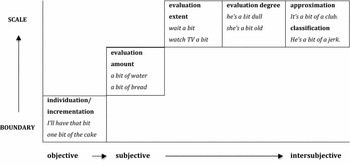
An explanation and description of bit according to LOC achieves a conceptually based, unified description and systematic explanation of its situated meanings that accounts for both its semantic potential – in terms of cueing of conceptual structures through construal operations – and its communicative potential, understood as an interplay between its semantic structures and their situating communicative contexts. From this perspective, bit’s semantic potential relative to its communicative potential can be illustrated as in figure 2. The figure outlines the relation between bit’s schematic templates boundary and scale and their construal as broadly objective, subjective and intersubjective (see e.g. Verhagen Reference Verhagen2005 for a discussion of objective, subjective and intersubjective construal). No use of language is truly objective, of course. There is always an element of (inter)subjectivity in language use because a conceptualizer is invariably involved and language is always directed at one or more co-conceptualizers. However, uses of bit through which boundaries are profiled in order to delimit an entity tend to pertain most essentially to structural schematization (see construals in figure 1). As such, these uses do not typically involve evaluation or hedging. Uses of bit for the construal of amount are more subjective in nature. Because amount attends to the inherent scales/magnitudes of modified entities there is great interplay between scale and boundary for expressions like a bit of bread. The potential for vagueness/ambiguity inherent to expressions like a bit of bread (‘an amount of bread’ vs ‘a piece of bread’) is a meaning reflex of the fact that entities (in this case bread) can be profiled according to their boundaries or their inherent scalar extension.
Bit’s semantic potential

The evaluation of extent and degree is always scalar and always subjective in nature. Extent evaluation is less often deployed for intersubjective purposes than that of degree because evaluation of extent is limited to time (duration/frequency) whereas degree evaluation can pertain to a range of dimensions. Finally, when bit is used for approximation or classification, as in the examples to the right in figure 2, the scalar dimensions are epistemic in nature and these uses are always scalar and primarily intersubjective.
This explanation of bit’s use reveals that seemingly disparate elements of bit’s potential are connected conceptually. Despite their apparent differences in meaning, the following two examples of bit’s use are both activations of parts of a common semantic potential.
-
(35) He tore off a bit of the cupcake and put it in his mouth. (COCA FICTION 2006)
-
(36) Well, I think it, he had a bit of a stroke and he sort of looked, you know (BNC SPOKEN 1992)
Whereas bit in (35) is more objectively construed and evokes boundary (lower left-hand corner of figure 2), bit in example (36) is intersubjectively construed and evokes scale (upper right-hand corner of figure 2). Figure 2 illustrates bit’s synchronic potential and the conceptual ties between its uses.Footnote 9 LOC enables a systematic description of the conceptual structures that constitute bit’s semantics. The more objectively construed and contentful uses of bit to the left are connected conceptually to the more subjective and intersubjective uses of bit on the right-hand side of the figure. LOC also provides a conceptual foundation for an explanation of ties between bit’s various scalar uses, which vary not in their configuration of conceptual content (according to scale), but in their applicable dimensions of evaluation. These dimensions range from instantiating dimensions, both basic dimensions (e.g. space and time) and abstract ones, to grounding dimensions (e.g. probability or evidentiality).
5 Conclusion
Bit’s semantic potential has been described and explained in terms of the cueing of two fundamental schematic templates for structuring conceptual content: boundary and scale. This dual configurational potential stems from a metonymical shift in bit’s past use, a shift through which bit’s semantic potential expanded from the expression of partitioning to also including modulation of quantity and later degree. Bit’s profiling of boundary, resulting in individuation, comes closest to its earlier potential for expressing ‘a bite of something’, but this potential is significantly broader in present-day use. Bit’s potential for scale, the realization of which is inherently subjective and evaluative, invites various construals that pertain most essentially to the regulation of communication and the coordination of perspectives, resulting in approximation and hedging. Additional features of bit’s potential can be described as modes of realizing the core configurations resulting in, for instance, partitive, comparative and negated meanings. The description of bit according to LOC reveals conceptual ties between its diverse uses and offers a cohesive and systematic account of its semantic potential in terms of contextually enabled cueing of conceptual structures through construal operations.
The LOC description provides a cognitive semantic basis for an explanation that highlights the inferentially connected nature of bit’s potential. It allows description of uses that flexibly draw on more than one facet of this potential, something that would clearly be more difficult to achieve through a model of lexical meaning relying on reified meanings along with processes of meaning selection. The description of bit presented here, while cohesive and systematic, allows for a multitude of situated meanings that draw upon the semantic structures cued by bit in response to diverse communicative demands.
The meaning potential approach is still undergoing significant development and refinement. There is need for further elaboration and empirical application of available models to find avenues for fine-tuning and adjustment. Since this perspective places great weight on contextual factors, there is need for further explication and modelling of features of contextual resources and their interplay with conceptual structures and construal. This pertains to the role of the linguistic context, but also to the role of various grounding contexts (see e.g. Allwood Reference Allwood, Cuyckens, Dirven and Taylor2003 for discussion of linguistic and extralinguistic requirements; Linell Reference Linell2009 for various thoughts on contextualism; Verhagen Reference Verhagen2005 for exploration of objective and (inter)subjective construals). There is great potential for merging LOC with models proposing discourse-oriented approaches to meaning making from a cognitive perspective (e.g. Hart Reference Hart and Hart2011). This would allow more precise and explicit treatments of connections between construal and various features of discourse. Each application of the theoretical frameworks and the available explanatory models for the description of actual language use potentially constitutes further development and adjustment of these models. The description and explanation of bit’s potential offered here can take us a bit along the way towards achieving this goal.