“Anti-Catholicism has always been the pornography of the Puritan,” noticed Richard Hofstadter in his famous essay “The Paranoid Style in American Politics” (21).Footnote 1 This observation, made in the 1960s, draws upon centuries-old tradition of casting Catholics in the role of sexual perverts, not only in American politics but also in British politics and culture. Through the study of anti-Catholic Victorian writing we can analyse the particular crux embodied in Hofstadter's pithy remark: a mixture of moral superiority combined with prurient enjoyment of the described practices it purports to condemn. This part of my study is dedicated to the Victorian novel and its depictions of Catholic sexuality, which, as the novelists often suggested, was either stifled and warped or rampant, but either way it transgressed the boundaries delineated by the Protestant family ideal. It also discusses Victorian gender roles and the ways in which Catholicism was allegedly undermining them.
Ironically, the subject which inspired Protestant novel writers with such disgust, was also the subject which seemed to exercise a particular fascination over them. The depictions of the iniquities of Catholicism seem to lend themselves to a psychoanalytical reading, in particular the one employing the idea of abjection as defined by Julia Kristeva in her Powers of Horror. Abjection, according to Kristeva, is the feeling of repulsion mingled with contradictory attraction to the Other, the rejected, the-Thing-which-is-not-me. Catholicism, the old religion of England rejected by the Reformation as the Other, loomed large in English collective imagination and it could as well be interpreted as the abject, the Other inspiring disgust which is at the same time strangely appealing. Following Robert Miles, who in his “Abjection, Nationalism and the Gothic” proposed the use of the category in the study of the Gothic fiction, I am going to argue that the category of abjection can be used with equally interesting results in the study of Victorian popular religious fiction or fiction which touched on religious themes.
The factor to which I would like to pay a special attention is the frequent reappearance of the connection between Roman Catholicism and femininity. In Kristeva's theory of abjection, the original abject is mother's body, from which an infant in the process of individuation has to differentiate itself. The Roman Catholic Church, “the old religion,” played in the national subconscious of the English the role of the abject mother, who had to be rejected in the process of the Reformation. Consequently, Protestantism was set in the role of the masculine subject, under the constant threat of being defiled by the rejected maternal body and yet deeply attracted to it. The Roman Catholic Church, “the Mother Church,” in turn, became the feminine element, menacing and appealing at the same time.
Sexuality in Roman Catholic culture, as portrayed in Protestant texts, was represented as the abject, the repellent other. Protestant culture celebrated sexuality within society- and church-accepted bounds of marriage; both sexuality outside wedlock and the conscious rejection of sexuality seemed equally abhorrent. Catholicism, with its sanctioned structures for celibate religious life, was presented as a religion which condemned physical love wholesale. On the other hand, it was a widely accepted axiom that the confessionals, monasteries and convents were the places where the most unspeakable acts of debauchery were practised. The Catholic approach to sexuality, the argument went, was a profane parody of the Protestant one, scorning the holy sexuality of marriage while tacitly accepting or even encouraging sinful fornication. Much of the moral panic inspired by Catholicism was centred around women, who were perceived as especially vulnerable to the temptations of priests, being weaker and more emotional. And indeed, Catholicism itself was portrayed as a feminine religion, relying on the appeal to senses and emotions, in contrast to the rational, masculine Protestantism. In keeping with that, men falling under the influence of Catholicism were often described as effeminate. Priests officially celibate and secretly licentious; young women led astray from their natural roles of wives and mothers to the barren life behind the convent bars; young men emasculated by their creed; families no longer ruled by the father: all these aspects of Catholicism created an image of the culture where God-given gender roles were perverted in the way described by Kristeva: “The abject is perverse because it neither gives up nor assumes a prohibition, a rule, or a law; but turns them aside, misleads, corrupts; uses them, takes advantage of them, the better to deny them” (15).
My research is based on the work of other literary critics and historians who, from the 1990s on, have been paying a growing attention to the previously underappreciated and understudied aspect of the religious experience in culture and literature.Footnote 2 In particular, my work is indebted to Susan M. Griffin and her important study Anti-Catholicism and Nineteenth-Century Fiction (2004). Although my book lacks her breadth of vision (Griffin discusses both American and British texts, while I limit myself to British ones), her psychoanalytical readings of many of the texts I am also discussing proved invaluable to me. However, in one more important respect my work diverges from Griffin's. The central premise of her book is that in Protestant fiction of the nineteenth century Catholicism is the ancient religion of primitive holy fathers which had to be left behind while more modern Protestantism is associated with the image of the mother “reading the Bible with the child” (Griffin 5). This may be more true for American than British literature, but in my readings I hope to show that a reverse thesis can be advanced: it was Roman Catholicism which was associated with primal, perverse, abject femininity while Protestantism stood for modern and rational masculinity.
Victorian fiction provides intriguing material for study because it was written in the era when for the first time since the Reformation English Catholics were no longer a small and relatively insignificant minority, but a quickly growing group (with the growth fuelled mostly by Irish immigration), enfranchised by the Catholic Emancipation Act of 1829, attracting new converts and increasingly more and more vocal in its demands. This in turn led to a growth of anti-Catholic feeling, periodically stirred by such events as the reestablishment of the Catholic diocesan organization in England in 1850, dubbed by the press “the Papal Aggression.” Walter Arnstein compared this situation to the growth of racial militancy resulting from the achievements of the civil rights movement in the United States in the 1960s (3). In both cases, the minority which could be accepted as long as it submitted to its inferior status, became perceived as threatening or dangerous when it started to receive equal rights with the majority – and demanded more.
The Secrets of the Convent: The Celibate as the Abject
In view of that, it comes as no surprise that Victorian fiction began to rediscover and re-employ the polemic arguments against Catholicism dating back to the days of the Reformation, including the charges of the “unnaturalness” of Catholic attitude to sex. Paradoxically, what made Catholics particularly open to the charges of lechery was the voluntary renunciation of sexual lives and, consequently, family lives on the part of some Catholics, namely nuns and priests. This, from the Protestant point of view, had a deleterious effect on the whole society, because it removed individuals (especially women) from the normative family structure and put them in the alternative fake family of a religious order, with Fathers and Mothers (Superior) usurping the titles that belonged only to the biological parents. The natural affections were replaced with artificial ones, resulting not from the ties of blood and the God-ordained family hierarchy, but from the human construct built by a false, heathenish cult in order – as it was often suggested – to enrich itself. Thus, the monastery and the convent became the figures of the abject in the Protestant imagination: they embodied everything that was repellent about Catholicism: the disintegration of family, the unnatural thwarting of sexual desires, the disgusting penitential practices through which deluded Catholics, believing more in works than grace, sought to win salvation. But its very otherness and isolation had also a power of attraction, to which numerous English novels, not only the Gothic ones, bear witness.
The criticism of celibate life is, of course, a topic which appeared in the Protestant polemic long before the nineteenth century. Among numerous writers who criticized it we could quote, for instance, Robert Burton, who claimed that celibacy inevitably led to all sorts of perversities (although Burton himself was the first to point to the irony of the fact that this critique came from an unmarried man who “[led] a monastic life in a college”) (252).
How odious and abominable are those superstitious and rash vows of Popish monasteries, so to bind and enforce men and women to vow virginity, to lead a single life, against the laws of nature, opposite to religion, policy, and humanity, so to starve, to offer violence, to suppress the vigour of youth . . . .For let them but consider what fearful maladies, feral diseases, gross inconveniences, come to both sexes by this enforced temperance, it troubles me to think of, much more to relate those frequent abortions and murdering of infants in their nunneries. . .and notorious fornications, those Spintrias, Tribadas, Ambubeias, &c., those rapes, incests, adulteries, mastuprations, sodomies, buggeries of monks and friars. (Burton 253; Part. I. Sect. III. Memb. II. Subsect IV)
Consequently, priests and nuns were labelled as unnatural, if their vows of celibacy were believed, or perverted, if they were not (Wolffe 247). But the institution of celibacy itself was a perversion of the natural order of things, as indicated by the confrontation between a young reformer Raphael Roodspere and his natural father, Cardinal Wolsey, in Emma Robinson's Westminster Abbey (1854). While the licentious Cardinal insinuates that he would condone a relationship between Raphael and his beloved novitiate nun Lily-Virgin (who was saved by Roodspere himself from Cardinal's advances), making them “a happier Abelard and Helowis” (2: 249; ch. 21), he angrily refuses his permission for them to marry. Thus the Church creates the inverted system of values, in which the illicit and carnal relationships between priests and nuns are overlooked, if not tacitly approved, while the lawful and holy marital love is a sin.
The alleged sexual misdemeanours of nuns excited much prurient interest, increased by the isolation and mystery of convent life. The Victorian Protestant novel drew on the tradition of both the Gothic novel and the eighteenth-century libertine novel (in the vein of Diderot's La Religieuse), providing its readers with lurid descriptions of the sexual perversities behind the convent bars, veiled with the note of the righteous indignation.Footnote 3 A particularly important role in this discourse was played by the “escaped nun narratives,” stories which occupy the blurry border zone between fact and fiction. The ones which attract today most critical attention are American ones, although they were also known and widely read in Great Britain: Rebecca Reed's Six Months in a Convent (1835) and Maria Monk's Awful Disclosures of the Hotel Dieu Nunnery (1836). Reed's book is usually singled out for critical attention because her story, circulated in a manuscript form, notoriously inspired the burning of the Ursuline convent in Charleston, Massachusetts in 1834. Monk's revelations became famous because of their extremely lurid (even for an anti-convent text) and graphic descriptions of priestly depravities behind the convent bars. Maria Monk, who claimed to be a runaway from Hotel Dieu in Montreal, won fame with her book containing blood-curdling descriptions, for a moment becoming a minor celebrity in New York before she sank into oblivion and early death. In her story she describes the convent as essentially a brothel for the exclusive use of the priests who can access it without being seen through subterranean corridors. The nuns who do not conform are punished by being put under mattresses and trampled to death. Children born out of these illicit relationships are baptized and only then strangled, with their bodies being disposed of by being thrown into a lime pit. (The lime pit became a recurring trope – in a later English pamphlet by a Reverend Dr Coleridge, Awful Disclosures of Miss Julia Gordon, the lime pit is located, conveniently enough, near St. Peter's in Rome and is used to house bodies of murdered infants from convents all over Europe [Berman 4–5]).
Probably the most blatant example of the intersection between anti-Catholicism and pornography was the court case Regina vs. Hicklin (1868). The Protestant Electoral Union published in 1867 a pamphlet against the practise of confession titled The Confessional Unmasked. The copies of the pamphlet were seized and destroyed on the ground of disseminating pornography; the publisher appealed against the ruling, arguing that the purpose of the publication was “exposing. . .the errors of the church of Rome, and particularly the immorality of the confessional” (Regina). The case of The Confessional Unmasked is particularly illustrative, partly because it seems to fit Hofstadter's aphorism almost to a letter: an anti-Catholic publication was officially deemed obscene despite the protestations of its publishers about their honest intentions.Footnote 4 “There can be no doubt that some male anti-Catholics found in this a godly, uplifiting and acceptable form of consuming pornography” (Paz 276). In his opinion (still referred to in the legal discussions around obscenity and pornography trials as “Hicklin test”) Chief Justice Cockburn stated: “I think the test of obscenity is this, whether the tendency of the matter charged as obscenity is to deprave and corrupt those whose minds are open to such immoral influences, and into whose hands a publication of this sort may fall.” The Confessional failed the Hicklin test, because in Cockburn's opinion, it was bound to suggest to its readers, young or old, “thoughts of a most impure and libidinous character” (Regina).
The text which caused such moral panic was a compilation of quotations from confessors' handbooks, including such authorities as Peter Dens and Alphonsus Liguori, in the original Latin, accompanied by English translations and indignant commentaries of the editors. The shocking questions supposedly posed by confessors mostly concerned the technical details of sexual lives of married couples. The Protestant Electoral Union through publishing it wanted to reveal the dangers to which confessing women were exposed, not only because their modesty was endangered by such indelicate questioning, but also because through discussing the details of their marital lives they were being disloyal to their husbands. While the stated reason of the publishers was to protect Englishwomen against the lascivious priests, the reason of the verdict was to protect the English reading public at large, especially since the fact that the Latin text was accompanied by an English translation meant that its audience could be potentially much larger than the relatively small elite of educated men.
The Confessional Unmasked appeared in Henry Spencer Ashbee's second volume of Bibliography of Prohibited Books (Centuria Librorum Absconditorum [1879]) (88–111), where Ashbee gives the detailed description of the whole trial, quoting extensively from the book's most racy sections, for instance those dealing with sanctioned and prohibited sex positions. This is not the only book of this kind in Ashbee's eclectic collection, as his bibliography contains a significant amount of entries on anti-clerical and anti-Catholic texts. As Steven Marcus comments, “Ashbee's obsession with Rome is the counterpart and analogue of his interest in pornography. What he experiences with direct sexual pleasure in pornography he experiences with the added pleasure of moral indignation in relation to Rome” (62). In other words, his motivation is quite similar to the motivation of the editors of The Confessional Unmasked: the ethical duty of exposing the corrupt practices of Rome becomes mixed with a little pleasure in describing precisely the extent of their corruption.
The demarcation lines between religion and pornography became blurry more often than might be expected; in the 1870s the English public was shocked by the revelation that there was in existence a manual for Anglican confessors, titled The Priest in Absolution, so secret that it was only distributed to subscribing Ritualist priests recommended by their fellows (Hanson 282), a model of distribution strangely reminiscent in its exclusiveness of that of Victorian pornography, prohibitively priced and sent by mail order to wealthy clients, who were picked by the publishers from the social register and the society pages (Sigel 114). This is the way in which The Pearl, a short-lived monthly journal (1879–1880) was distributed; one of its issues contained a novella “Lady Pokingham, or They All Do It.” In one of its subplots it uses the tropes of anti-Catholic fiction similar to those used by the publishers of The Confessional Unmasked and other texts discussed here, with the exception that while the latter satisfied the prurience of their readers under the guise of self-righteous anger against the outrages of Catholicism, “Lady Pokingham” is plainly and cheerfully pornographic. The “Catholic” chapters utilize, or perhaps one should rather say cannibalize, Disraeli's Lothair (1870), deploying the characters from the novel, but where Disraeli only suggests that the Catholic Clare Arundel is used as a sexual bait for Lothair, a young heir of immense fortune, who would convert in order to marry her, the author of “Lady Pokingham” does not need this sort of pretence. In “Lady Pokingham” Clare Arundel and her aunt Lady St. Jerome are members of the secret sisterhood of St. Bridget, whose purpose is to seduce or even marry powerful men if it “tends to further the interests of the Church” (49; part 3); the confessor commands Clare to make Lothair fall for her and absolves her in advance from all the sins she may commit to accomplish this purpose, which is a recurring trope in anti-Catholic narratives, and could be traced back all the way to Foxe's Actes and Monuments (1563–1583), where the monk who is about to poison King John is absolved in advance. During the initiation ceremony in the chapel Clare is first scourged and then deflowered by the confessor. The young female narrator, who surreptitiously watches the ceremony, warns Lothair about their schemes; the forewarned Lothair invites both ladies to dinner and when Lady St Jerome whispers “Join our Church, and there is nothing we will deny you,” (72; part 4) he can take advantage of the offer, having sex with both ladies. “Lady Pokingham” uses old pornographic conventions (the officially celibate and virtuous are secret lechers) in a rather similar way the “escaped nun” and “confessional unmasked” narratives used them, just with more colourful detail; in both cases the purpose is the titillation of the readers.
A similarly blurred line between titillation and condemnation can be observed in the descriptions of beatings, administered either to nuns themselves as a penance, or to children who were in their charge as a punishment (Peschier 211). “She tied this little child, only about six years old, across a broken chair; stripped off her clothes, and in a merciless manner applied the lash on the tender flesh, which rose in purple stripes at every stroke” (46; ch.7). “The victim writhed in agony and rage, but her blows only increased in force, beginning to raise great fiery-looking weals all over his buttocks” (38; part 2). “I noticed that the ugly ones made their strokes twice as hard as the pretty ones. It seemed to me as though they were settling an account with nature for their own ugliness, when they let their rods fall on that white skin, from which red weals sprang with every blow” (42; letter 3). The first quotation is from Trials and Persecutions, an account of her convent life by Edith O'Gorman, an Irish-American former nun; the second one from “Lady Pokingham,” where the birch is an almost indispensable part of foreplay; the third one from The Merry Order of St Bridget (1868Footnote 5 ), a novel by “Margaret Anson” about the underground flagellating society of Parisian ladies; in contrast to the one described in “Lady Pokingham,” the ladies have no secret agenda and the only purpose of their meetings are ritual whippings. This text clearly catered to a more specialized readership than “Lady Pokingham.”Footnote 6 The more openly pornographic the text is, the more sexualized the victim of beating is: graduating from vague “tender flesh” through more specific and bearing erotic connotations “white skin” to the openly sexual reference to “buttocks.” What these texts have in common is the gaze of the first-person narrator, who is at the same time an observer and often a participant in the whippings, the gaze which focuses on the lacerated flesh; the declared intention of the narrator and the intended effect on the reader may be to convey the feeling of horror or sexual excitement, but the images which inspire these feelings and the language used to describe them remain strikingly alike. The first-person narrator also serves to create an illusion of reality: pornography, as Steven Marcus observed, “typically undertakes to represent itself not as a story or fantasy but something that ‘really’ happened,” (46) which is also precisely the aim of the “escaped nun” or “convent mysteries” narratives. In passages like this we can see the dual mechanism of attraction and repulsion, so characteristic of abjection; even when the ostensible purpose of the text is to condemn the inhumane practices of convents, it also provided its audience with potentially fascinating and arousing material.
Incidentally, the same Justice Alexander Cockburn who ruled in Regina vs. Hicklin, was seventeen years earlier Newman's advocate in the criminal libel case made against him by Giacinto Achilli, a former Dominican monk who worked the anti-Catholic lecture circuit. Achilli professed to be defrocked and persecuted by the Inquisition for his conversion to Protestantism; Newman in his Lectures on the Present Position of Catholics in England (1851) claimed that Achilli was expelled from his order for seducing a number of girls, which on some occasions resulted in pregnancies; moreover, as Cardinal Wiseman wrote in his article in Dublin Review, which was Newman's main source, Achilli continued his scandalous career after his defrocking, having affairs with married women. In a paradoxical turn of events, Newman and his legal team were put in the position in which they had to prove that Achilli was indeed a friar like the one described in the anti-Catholic tracts, “a profligate under a cowl” (qtd. in Mirow 407). Cockburn himself used the anti-Catholic stereotyping pointing out that Achilli, as “an Italian, a priest, a monk” was well-versed in all casuistic tricks and his testimony was therefore not to be trusted (Mirow 442). This defence was used on behalf of Newman, a Protestant convert to Catholicism, against Achilli, a Catholic convert to Protestantism. Thus, the text which gave rise to the whole libel case, and whose purpose was to explain the causes of the anti-Catholic phobia and the unjust stereotyping, was defended by using the very stereotypes which Newman sought to dispel.
The images of the sexual and physical abuse, perpetrated behind the convent bars, whether cloaked in virtuous indignation or openly pornographic, have one thing in common, which is the attraction they exert on their readers. Their titles, promising “disclosures,” “unmasking” and “exposing” indicate the potentially unsavoury content of these revelations, which is precisely the source of this attraction. Their actual purpose was not converting or convincing anybody about the corrupt state of the Catholic Church; they were very much preaching to the choir, or to the audience whose views on the Roman Catholic Church had been established long ago.Footnote 7 (Catholics, if they read them at all, did so only for the purpose of writing equally numerous “answers,” “vindications” and “refutations.”) Instead, they provide their readers with the graphic descriptions of illicit sex and violence, both disgusting and appealing. The Catholic abject, existing outside the norms of British Protestant culture, served as the useful Other, cheerfully indulging in all its desires behind the pretence of respectability. In its quasi-parental role, it denied the satisfaction of one's impulses to its children while secretly satisfying them behind the convent bars (Marcus 63), becoming the Holy Mother and the Whore of Babylon in one.
The Romanist Threat to the Protestant Family
The official renunciation of sexuality by clergymen and nuns led to the mounting suspicions that the façade of celibacy was hiding a multitude of sins. However, the reasons why celibacy proved such a divisive issue are manifold and have to be seen in the context of the whole Protestant family ideology. Family life was perceived as the natural condition of men and women, while celibacy was the root of all evil. The renunciation of celibacy was, of course, among the first acts of Luther after leaving the Catholic Church. In Protestant culture family took over many of the religious tasks of the church; instead of delegating the religious matters into the hands of the professional caste, as it were, each family was to be its own small-scale church, with father standing in the stead of the priest. Even the interior furnishings of English churches reflected that in the shape of traditional family box pews, which replicated family hearth to such an extent that they often contained home furniture, pillows and small stoves, and in which each family was cooped under the watchful eye of pater familias. In the nineteenth century some members of the Cambridge Camden Society, whose aim was the restoration of the churches in the “authentic” medieval style and which was sometimes perceived as an architectural branch of the Tractarians, fought to replace box pews with democratic wooden benches (Paz 278); a Tractarian clergyman Francis E. Paget wrote a whole novel titled Milford Malvoisin: or, Pews and Pewholders (1842) devoted to the injustice that the rented pews system caused. The controversy about pews versus benches persisted into the nineteenth century, with Ritualist priests continuing to remove pews, sometimes going even as far as hacking them publicly (Chadwick 1: 521). We can learn what the Low-Church faction thought about it, for instance, from a rhyme “Parish Clerk's Lament” that appeared in various versions in a few Protestant religious magazines in the late 1860s. In this ditty the title character bemoans his parson who “took up wi’ they Ritchelist views. . .an’ the old village church ‘er-ev-done-it up new/And there is plenty of benches but never a pew” (l.1, 17–18). From the point of view of Evangelical Protestants, such an act indicated “the disappearance of the rules and ‘differences’ that define cultural divisions,” (Girard 12) which René Girard identified as the characteristic feature of all the descriptions of these moments when societies descend into chaos due to wars, plagues or natural disasters. No such disaster struck Victorian England, but for Low Church adherents the activities of Catholics and Tractarians or Ritualists were symptomatic of such times in which laws of love and nature were suspended.
The controversy about the benches, which, breaking up the accustomed seating arrangement, broke up symbolically also the family, illustrates the bigger cultural fear about the detrimental influence of Catholicism on natural and God-ordained family structure. In Catherine Sinclair's Beatrice (1852) the local parson and his wife, described as his ideal helpmeet, discuss the unnaturalness of celibacy; his wife expresses her surprise that any religion claiming to be a Christian one can forbid priests to marry while the Bible says that “‘it is not good for man to be alone. How on earth could you get on without me, Edward?’ ‘Not very well!’ replied Mr. Clinton,” chiming in that the Catholic Church, while enforcing celibacy, at the same time propagated “the blasphemous legend of the marriage of St. Catherine” (Sinclair 47; ch. 2). The scene encapsulates the view that the Catholic Church tries to replace the natural marital vows with the perverse clerical or monastic vows, tying its victims to the institution instead of the family.
Much of the panic about the disintegration of the families was inspired by the feeling that priests, winning hearts and minds of women, removed them from the “natural” rule of their fathers and husbands, thus creating an alternative family and alternative power structure. An eighteenth-century anti-Popish pamphlet stated: “[n]o Man ought to confess a Wife but her Husband, and. . .a Daughter ought to be confess'd by none but her Father,” (qtd. in Peakman 135) which sums up equally well the position of many Protestants Britons in the nineteenth century. In Michelet's Priests, Women and Families, published in English almost immediately after its publication in France in 1843, the author deplores the rift in the family caused by the fact that “mothers, wives and daughters” contradict the master of the household in matters of religion, having been “brought up and governed by our enemies!. . .venture even there, in your own house, at your own fire-side, to say one word about these things; your mother sadly shakes her head, your wife contradicts you, your daughter, by her very silence, shows her disapprobation. They are on one side of the table, and you on the other – and alone” (Michelet xxix; “Preface to the First Edition”).
The horror of the scene described above depends solely on the fact that the women have a different point of view on the religious matters and band together against the man, for the dramatic purposes presented as the only man in the household. The argument was sure to strike a chord with Michelet's English readers, even though the vast majority of their wives and daughters were not, in fact, brought up by the Roman Catholic Church. However, the terror caused by the potential invasion of the English hearth by priests, acting as the third person in the marriage, was used repeatedly as an argument, not only when it came to discussing the Roman Catholic Church in England and its encroachment on the English turf, but also when Tractarians and later on Ritualists tried to revive certain devotional practices, including confession, which in view of Protestants smacked dangerously of Popery.
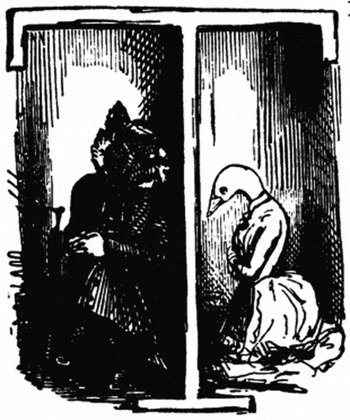
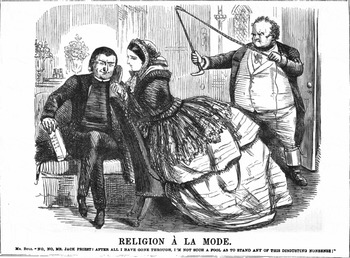
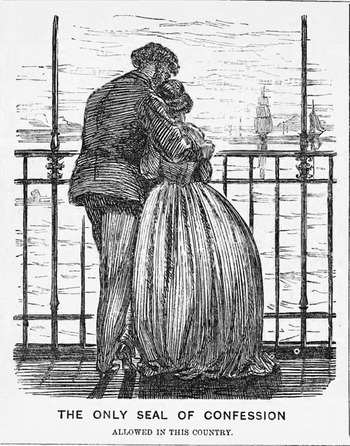
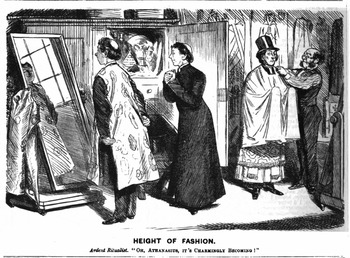
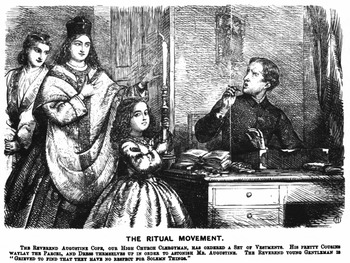
The auricular confession was believed to be one of the most harmful channels through which priests sought to destroy family and undermine paternal authority. The disgust inspired by it was derived not so much from the theological argument about the legitimacy of absolution given by the priest, but from the fear about the possibly deleterious effect it could have on the minds of women, taught to trust priests more than their fathers and husbands. Thus, the seduction was not limited to the physical unfaithfulness but also included the moral one. The cartoons from Punch provide ample visual material about the feelings of a large part of society on that topic. In one of them, printed in 1850, at the height of the “Papal Aggression” scare, the confessor and the female penitent are portrayed as respectively the fox and the goose (“Expectations from Rome”) (Figure 26). In another cartoon from 1858, this time directed against the practice of confession in the Tractarian circles and titled “Religion À La Mode,” John Bull bursts in with a whip in his hand into a drawing-room where a fashionably-dressed lady, presumably a member of his family, confesses to a foppish priest (Figure 27). The confession cartoons reappeared whenever an event attracting public notice to the practise of confession, be it by Anglo-Catholics or Roman Catholics, took place. In a cartoon “The Only Seal of Confession Allowed in this Country” from 1865 a young couple is standing on a bridge in a close embrace, with man's arm wrapped protectively around woman's shoulders (Figure 28). The title of the cartoon alludes to the cause célèbre of Constance Kent, who at that time admitted to the murder of her young half-brother committed a few years earlier. Constance's owning up was apparently inspired by the atmosphere of the Anglo-Catholic convent in which she had spent several years; for the Victorian public opinion, her admission of guilt was perhaps not much more shocking than the fact that the Reverend Arthur Wagner, the founder of the community where Constance lived and the key witness during her trial, used the argument about “the seal of confession” to justify his silence about some part of the communication he had had with Constance (Summerscale 239). While the Punch image itself bears little relevance to the actual circumstances of Constance Kent's case, it illustrates the attitude of its readers, who assumed that any confessions women might make were reserved for male family members, their natural guardians, while priests, be it Anglican or Catholic, who listen to them were usurpers and interlopers.
“Expectations from Rome.” Engraving, from Punch 19 (1850): 193.

“Religion À La Mode.” Engraving, from Punch 26 June 1858: 257.

“The Only Seal of Confession Allowed in this Country.” Engraving, from Punch 8 July 1865: 10.

Much of the controversy provoked by The Priest in Absolution, the manual for Anglican confessors mentioned earlier, was caused not only by its secret distribution, but also by the fact that it apparently encouraged the indiscreet and prying questioning of wives and daughters by priests. The book, published by the Society of the Holy Cross, which was a small association of Ritualist priests, came out in two parts, published respectively in 1866 and 1872. The first part was mentioned during the debate in the House of Lords in an 1873 anti-Ritualist debate as a “filthy production”(UK HL Parliament 14 July 1873). However, it was the second volume which caused the public uproar in 1877 after Lord Redesdale read out some of more objectionable passages in the House of Lords, and which was condemned by all the bishops present, including the Archbishop of Canterbury, and later on by the Convocation; it also had the dubious honour of making its way into Ashbee's Centuria Librorum Absconditorum (292–300). The arguments used against the book, and by extension the practice of confession, indicate that what troubled its opponents so much was not only the perceived indelicacy of the questions and the fear that they planted indecent ideas in the hitherto innocent minds (Shuttleworth 634–35). During the debate in the House of Lords Archbishop Tait used the word “family” three times within one sentence, saying that he could not imagine “that any right-minded man could wish to have such questions addressed to any member of his family; and if he had any reason to suppose that any member of his family had been exposed to such an examination, I am sure it would be the duty of any father of a family to remonstrate with the clergyman who had put the questions, and warn him never to approach his house again” (UK Parliament HL 14 June 1877). During the 1873 debate the Marquess of Salisbury expressed the view, quoted again in 1877 by the Earl of Harrowby that the confession is “injurious to the moral independence and virility of the nation” and that “an Englishman. . .looks with abhorrence upon any system that introduces another power into that family life, that introduces a third person between father and daughter, and husband and wife” (UK Parliament HL 14 June 1877). As can be seen, the idea about the authority of father and husband being undermined by the sneaky confessor, even to the point of emasculating the whole nation, reverberated throughout the discussion.
The majority of anti-Catholic authors described priests as intruders in the lives of married couples, even if no actual seduction took place, and the unease surrounding their role was clearly a gendered one, focusing on their harmful influence on women. In Disraeli's Lothair, Lord Culloden warns the eponymous hero, on the verge of attaining legal maturity and already dangerously attracted to the Catholic Clare Arundel:
A man should be master in his own house. You will be taking a wife, some day; at least it is to be hoped so; and how will you like one of these monsignores to be walking into her bedroom, eh; and talking to her alone when he pleases, and where he pleases; and when you want to consult your wife, which a wise man should often do, to find there is another mind between hers and yours? (246-47; ch. 46)
The condemnation of Roman Catholic confessional practices extended, as indicated before, also to the confession practised in the Anglican church. The title of Eliza Lynn Linton's anti-Ritualist novel Under Which Lord? (1879) sums up the key argument against confession which is elaborated in the book. The Ritualist priest Honorable and Reverend Lancelot Lascelles effectively steals Hermione Fullerton from her husband; even though no actual act of physical unfaithfulness is committed, Hermione is guilty of “giving to another man than her husband the same unquestioning obedience, the same womanly submission that had marked her life with him” (1: 90; ch. 4). Linton's position is, however, different from the previously discussed authors because she attacks the confession not as a Protestant but as an atheist and rationalist, combining these views nevertheless with conservative social attitudes. A young male neighbour, who is clearly her mouthpiece, says, echoing the eighteenth-century argument quoted above, “The best confessor for a girl is her mother – for a woman, her husband . . . .Any one else is worse than a mistake” (1: 310; ch. 13). “[T]he dishonouring, shameful, destructive habit of confession” (2: 147; ch. 6) which Hermione and her daughter Virginia are taught to go to every week, is instrumental in seducing them away from their husband and father; the novel ends with Virginia converting to Roman Catholicism and eloping to the Continent to become a nun, while Hermione, forced to choose between her spiritual director and her atheistic husband, chooses man-made religion over natural affections, eventually becoming estranged from her noble husband and wrecking her life.
There were, admittedly, other, more nuanced views on the confession, as evinced in for example Elizabeth Harris's From Oxford to Rome (1847), a strange text, half-novel, half-cautionary tale, in which a rather feeble plot is interspersed with long religious diatribes of the narrator. Harris's position is a curious one: she was a convert to Roman Catholicism, disenchanted with her decision, who nevertheless decided to remain a member of the Roman Catholic Church, while warning all prospective Anglican converts away. Having the first-hand experience of the Catholic confession, she is rather dismissive of all the more sensational anti-confession material published by Evangelicals; as she writes: “[w]ith regard to the Moral Influence of the Roman Confessional, we have only to say that we simply discredit the mass of the charges of impiety and impurity lavished on it by the impure and the impious. Michelet has been too much read, and S. John too little studied” (229; ch. 6). She herself supports the auricular confession as practised by then in some High Church circles: voluntary and treated as “one of. . .secret privileges” (227; ch. 6) in keeping with the Tractarian doctrine of the reserve. But, as she argues, the very frequency and obligatory character of the confession in the Catholic church make it mechanical, and the penance is just “a certain amount of affliction for a certain amount of sin, arranged as immutably as the value of exchange in the currencies,” while the Anglican confession, conducted in the pastor's study, as spontaneous is “more aiding to the penitent” (229; ch. 6).
While most authors focused on the dangers the confessional posed for women, there are some texts which touch upon the Catholic tradition of the examination of conscience as generally degrading for both sexes. In Mrs Humphry Ward's Helbeck of Bannisdale (1896) (the “one real novel” that Mrs. Ward “managed to write,” in Q. D. Leavis's acerbic view [116]) the title Catholic hero is tormented about the behaviour of his young ward, whom he secretly loves and who seems to be flirting with her cousin. As Ward points out, the discipline of the confession makes it impossible for a Catholic to conceive of a relationship between man and woman as an innocent one: “There is something in the Catholic discipline on points of sex-relation that perhaps weakens a man's instinctive confidence in women . . . .It is the confessional that works. The devout Catholic sees all the world sub specie peccati. The flesh seems to him always ready to fall – the Devil always at hand” (294-95; book III, ch. 3).
Mrs Ward, who was far from being sympathetic towards Evangelicals and their abhorrence for everything smacking of Popery (the two Evangelical characters in the novel are described in a satirical manner), still perceived confession as an intrusive procedure, which inevitably corrupts the soul while it attempts to heal it. In a way, her observations foreshadow in a striking manner Foucault's thought that “under the authority of a language that had been carefully expurgated so that it no longer directly named, sex was taken charge of. . .by a discourse that aimed to allow it no obscurity, no respite” (20). Similarly, Mrs. Ward shows that the confessional discourse, geared towards recognizing and naming sin, in Catholic culture moves outside the boundaries of the confessional and infiltrates all relationships between men and women.
The confession is the tool of seduction in Emma Robinson's Westminster Abbey, which uses the story of Richard Hunne, a real-life sixteenth-century London merchant tailor who became embroiled in a long-running trial over a dispute about the fee for his child's funeral, was accused of heresy and found hanging in his prison cell in 1514 as a result of suicide, as his accusers claimed, or murder, as the coroner's inquest stated. Robinson adds to the historical record, known from Foxe and other sources, Hunne's wife Maudelyn, seduced in equal measure by the monk Sancgraal as well as “the gaudiest shows. . .and the most luscious sweet music. . .in the world, trilled from the lips of young choir-boys and novices” (1: 214; ch. 8). When her husband forbids her to frequent the Abbey, she steals away there in secret and after the birth of her child visits Sancgraal in his hermitage in the loft of the Westminster Abbey, ostensibly for the private ceremony of churching. Richard Hunne follows her there, accuses her of adultery, snatches the infant away from her and leaves, expecting her to follow, which however the depraved woman does not do, preferring instead to seek refuge in the Abbey and finally getting rid of her husband by being the key witness at his trial for heresy. The whole story of what happened between Maudelyn and Sancgraal, however, is revealed to the readers and the protagonist Raphael Roodspere gradually; the first time Roodspere hears about Hunne's case is when he witnesses burning his body and charges against him are read out. Even without knowing yet Hunne's back story, he is deeply shocked by the fact that “Hunne's own wife, the partner of his bosom, should have been the main agent in his own immolation . . . .[This] seemed to add an unknown species of sacrilege to all the other horrors of his deed” (1: 121; ch. 6).
The story of Hunne in Robinson's retelling illustrates the danger which theoretically celibate communities pose to Protestant society. Richard Hunne and Maudelyn are a mismatched couple, she young and flighty, he many years her senior and according to Cromwell's flippant description, “one of the new kind of Lollards. . .taught by one Calvinus, who do believe no man shall be saved unless his visage vinegar milk, and his garb out-glooms the gallows’ raven's!” (1: 213; ch. 8). However, unsatisfying as Maudelyn's home life may be, it is no justification for her and Sancgraal. The legally and religiously sanctioned community of unmarried men proves dangerous to the stability of family, this key building block of Protestant society, providing disappointed wives with a refuge under the disguise of religious ceremonies. This point is emphasized by the parallel plot taking place in the Sanctuary of Westminster, which offers “refuge for the crimes and misery of the age . . . .The victory of the church over the laity in the middle ages could scarcely have been more emphatically asserted than by this close neighbourhood of the supreme executive power of the laws with a fortress of her raising which secured impunity to their most flagrant violators!” (1: 288; ch. 11). Robinson's message here is decidedly mixed, since on the other hand she admits the sometimes beneficial role of the Sanctuary, protecting people from “the draconic fury of [medieval] laws” (1: 288; ch. 11) and whose gates even Richard III did not dare to force. The author here plays with the conventions of “the Reformation tale.” the popular sub-genre of the historical novel describing the early stages of the Reformation in a strongly anti-Catholic vein (Burstein 74–75): while ostensibly siding with the Reformers and praising their achievements, she also gives in to the nostalgia about some elements of life in pre-Reformation England. On the whole, however, Westminster Abbey in its pre-Reformation shape is a breeding place for all sorts of dissent, undermining both the family and the state and thus has to be suppressed.
Still, Robinson's depiction of the Hunne marriage could be read as an attempt to create a more multifaceted image of the family than the one presented by many Protestant writers in which the family is invariably happy until it falls under the baneful influence of meddlesome priests. Even stronger doubts about the myth of family happiness are voiced by Thackeray in Henry Esmond (1852). His comments about the role of husband, inspired by the unhappy marriage of Lady Esmond, bear quoting at some length:
. . .in our society there's no law to control the King of the Fireside. He is master of property, happiness – life almost. He is free to punish, to make happy or unhappy – to ruin or to torture. He may kill a wife gradually, and be no more questioned than the Grand seignior who drowns a slave at midnight. He may make slaves and hypocrites of his children; or friends and freemen; or drive them into revolt and enmity against the natural law of love. I have heard politicians and coffee-house wiseacres talking over the newspaper, and railing at the tyranny of the French King, and the Emperor, and wondered how these (who are monarchs, too, in their way) govern their own dominions at home, where each man rules absolute. When the annals of each little reign are shown to the Supreme Master, under whom we hold sovereignty, histories will be laid bare of household tyrants as cruel as Amurath, and as savage as Nero, and as reckless and dissolute as Charles. (113; book I, ch. 13)
While the list of the tyrants used by Thackeray in this passage does not include the Pope or Inquisitors, the language he uses is strongly reminiscent of the rhetoric used in Protestant polemic writings, which often used the pope as an example of temporal tyranny combined with spiritual slavery. Using the name of the pope in the same breath as the sultan's became almost a cliché, as in this example from William Sewell's Christian Morals (1841): “No man ever lived – emperor, tyrant, pope, sultan, absolute as he may seem, with the whole world under his feet. . .” (230; ch. 17). By putting English husbands on the tyrant list, Thackeray questions in a subtle way the whole opposition between the benevolent rule of the English father and the oppressive regime of Popery.
As the above examples show, the ideal of Protestant domestic felicity was by no means adopted uncritically by all writers; however, the predominant tone was set by more populist anti-convent novels, which liked to compare the imprisonment of women for life in nunneries with the visions of the family hearth they were deprived of, as is the case with Catherine Sinclair's Beatrice. Luring innocent and gullible girls into convents was a popular trope of anti-Catholic fiction, illustrating the larger theme of Catholicism as a threat to the family. In Beatrice there are as many as three such potential victims. “Miss Farinelli, every hour of your life thank God that you are a Protestant, that you belong to a faith which does not abhor every human affection and annihilate every relative duty” (Sinclair 270; ch. 23), says the broken-hearted mother of Lady Anna, who is about to become a nun, having been led astray by cunning priests. Another would-be nun is an affected spinster governess for whom, as the novel strongly implies, the main attraction of convent life is the vow-taking ceremony, which would be her only chance to wear a bridal dress, complete with the orange-flower wreath. The third one is a naïve Highlander girl, torn away by the lying priest from her broken-hearted fiancé. Fortunately all three are rescued: the two younger ones see the error of their ways and get married in the last chapter; even the governess receives a proposal from a nice elderly doctor but she feels obliged to refuse him because she has already taken upon her “very solemn vows, and our Protestant consciences cannot break an oath, even with heretics. I do not deny that it is with great regret I take upon myself the penalty of my mistake, as the worthy Doctor and I might have grown old very comfortably over our tea and backgammon together” (Sinclair 491; ch. 44).
Sinclair, who herself never married, emphasizes the pro-family message of her novel by dedicating the book to her brother, “whose inestimable friendship makes my home what it is” (v). Such an epigraph to the book which relentlessly preached the message about the destructive role of Catholicism on the family life, provided an interesting way out for the author whose own life fell short of the ideal the book promulgated, with almost all the characters paired off in the finale. The Protestant gender norms relegated women to the role of wives and mothers; their best summary was provided by Michael Hobart Seymour, the secretary to the Reformation Society, who in his anti-convent lecture said about the nuns: “they live without the interest of mothers, for they have no daughters; without the interest of daughters. for they have no mothers; without the interest of wives, for they have no husbands. They are without any one object that nature designed to interest or to occupy the female heart” (qtd. in Ceraldi 95). Such a viewpoint precluded women having any other interests or occupations than their family; for those who did not marry, a tentative comfort was offered in the role of a spinster daughter caring for her parents, a helpful aunt or engaging in parish charity. Resigning from marriage was perceived as somehow shirking one's duty to society; Sinclair scoffed “[t]hose people who are least fit for domestic and Christian duties at home. . .are those who become canonized at Rome” (254; ch. 23).
If young women could not be lured into the convent by the hypnotic influence of priests and the promise of orange-flower wreaths, a well-tried solution was the traditional disappointment in love. On such assumption Frances Trollope based her Father Eustace (1847). The title protagonist is a Jesuit who arrives in an English county disguised as a layman Edward Stormont, and immediately wins everyone's hearts, becoming a particular favourite of the ladies because of his good looks, musical talents, and conversational skills. However, the secret purpose of Eustace's mission is to convert Juliana de Morley, the Protestant heiress of a Catholic father; in the course of his mission they fall in love with each other, as Eustace's ecclesiastical superiors secretly hoped they would. However, the Jesuit plot is thwarted because Eustace, after revealing his true identity, does not convince Juliana to become a nun and relinquish all her possessions to the Catholic Church. What Trollope offers to her broken-hearted heroine could be perceived in a way as a sound Protestant equivalent to the traditional Catholic plot of burying the frustrated love behind the convent bars, since in this highly romantic narrative with Gothic elements the prosaic solution of presenting Juliana as happily married to somebody else is not an option. Juliana, after the obligatory long illness brought about by the shock caused by reading Eustace's revelatory letter, recuperates. She never marries, nor becomes a Catholic, let alone a nun; instead she becomes a substitute mother to a whole adoptive family of half-siblings, born from her mother's second marriage to the local Anglican rector. Her half-brother Julian calls Juliana “Mamma” and his biological mother “Granny”; he becomes her heir, adopting her surname, and marries her best friend's daughter, whose name is also Juliana; finally Juliana the elder lives to see the birth of their son and heir, whose name is, predictably enough, Julian. Thus the danger of seeing a Protestant castle and all its lands falling into the hands of the sterile, rapacious regime of celibates is deflected (Wilt 9): it is still owned by the happy Protestant family, whose idyllic image (the joyful Rector, his wife and their cherub-like children celebrating the birthday of their son at an outdoor feast) is presented to the weary Edward Stormont when he returns from his imprisonment in Italy to die at Juliana's feet. It is significant that Lady Sarah after her unhappy marriage to Juliana's Catholic father, remarries an Anglican clergyman; normative marital sexuality, while denied to Juliana (whose only romantic prospect is to be buried together with Stormont), withstands the attacks of Rome and finds its refuge in the Anglican church, epitomized by the union of Mr Wardour and Lady Sarah.
The destruction of the family is also one of the themes in the already mentioned cautionary tale by Elizabeth Harris, From Oxford to Rome. One of the characters, an Anglican clergyman disenchanted with his church decides to convert to Roman Catholicism and become a priest, which involves parting from his family. His wife, crushed by this, is temporarily beguiled by her sister, also a convert and a nun, to enter novitiate for a time, but soon the scales fall from her eyes and she dies a good Anglican. Also her young son, who accompanied his father to Italy, dies before her. Their sweet home is permanently destroyed and their family life shattered because of her deluded husband who can only quote the words of the Psalm “By the rivers of Babylon we sat down, and we wept when we remembered Zion,” realizing that there is no return for him to the idyll of his home and to the church he forsook.
The descriptions of Catholicism acting as a dissolving agent to the Protestant patriarchal family demonstrate its power as the abject. In the Protestant novels the normative family, with father acting as its head priest, was threatened by the influence of the false “Fathers,” who tried to remove his wife and female relatives from the established, God- and nature-ordained structure and subjugate them to another, false and man-made hierarchy. Both through unsexing its nuns and priests, as well as through its deconstruction of family life, and replacing the authority of the real father with that of the usurping priest, Catholicism twisted and perverted gender norms, replacing the ideal Protestant family with its blasphemous parody. Paraphrasing Kristeva's words about the abject, Catholicism depicted in the Protestant novels took advantage of the family and gender norms the better to deny them (Kristeva 15). While dangerous, Catholicism was also represented as irresistible: Sinclair and other authors warned that the most innocent interest in it, like going to a Catholic mass only to listen to the music, visiting a Catholic family and conversing there with a priest, not to mention sending one's daughters to a school in the Continent could be the first stop on the slippery slope at the end of which the convent or the monastery was looming, according to the logic of abjection both menacing and attractive. Both the Protestant authors and their characters could not take their eyes off this fascinating object of their disgust.
Roman Catholicism and Women
Much of the anti-Catholic discourse is constructed around the apparent special danger that Catholicism posed for women. The perfect embodiment of the theme “women persecuted by priests” (although not distinguished by any literary quality) was the “escaped nun narrative,” of which the already mentioned Maria Monk's story was the most successful and most sensational example, but far from being the only one. In fact, a whole branch of polemic industry, with other escaped nun narratives, the rebuttals to these narratives published by Catholics, the answers to the rebuttals etc. thrived for many decades of the nineteenth century on both sides of the Atlantic. Some authors, such as the previously mentioned Irish American Edith O'Gorman, for many years managed to make a career out of travelling on the lecture circuit, which included Great Britain, United States, and Australia (Kollar, “An American ‘Escaped Nun’”). Many such narratives, while they did not reach Maria Monk's level of explicitness, were written by authentic “escaped nuns”; while today it is impossible to assess the veracity of their claims, at least they knew the convents they wrote about from the inside, as opposed to Maria Monk, whose plan of Hotel-Dieu included in her book turned out to be an utter fabrication. The real stories of convent abuse, both domestic and foreign were also fodder for the press; in 1869 the case of Mary Saurin, a former nun suing her mother superior for conspiring with her assistant to drive her away from her convent, received such a publicity that it was dubbed by the Times “the Great Convent Case,” (Arnstein 108–22) and in the same year the story of Barbara Ubryk, a Carmelite nun imprisoned in a Cracow convent, received extensive newspaper coverage in Britain (Kollar, “The Myth and Reality of Sr Barbara Ubryk”). Whatever the factual merits of these stories were, their popularity proves that they answered to an apparent demand on the market and they gained an eager audience.
The expectations of this audience were to a large degree formed by the tropes of the Gothic novel; we can see these expectations reflected in Catherine Morland's immediate reaction to being invited to Northanger Abbey, which is “hope of some traditional legends, some awful memorials of an injured and ill-fated nun” (Austen 144; vol. 2: ch.2). The grown men were as susceptible to these emotions as impressionable teenage girls: Thackeray describing his visit to an Ursuline convent near Cork admits that although the nun receiving them is young, smiling, and pretty, he cannot help being scared a little bit of nuns “in their black mysterious robes and awful veils . . . .Here I was, in a room with a real live nun, pretty and pale – I wonder has she any of her sisterhood immured in oubliettes down below; is her poor little, weak, delicate body scarred all over with scourgings, iron-collars, hair-shirts?” (The Irish Sketch-Book 124; ch. 6).
The nuns who were imprisoned or immured for life abounded in the Gothic fiction (e.g., Lewis's The Monk) and their transgressions were usually implied to be of sexual nature. Most of the authors portrayed themselves as bravely resisting the advances of the priests, and Maria Monk is somewhat exceptional in admitting to her having a child fathered by a priest (Griffin 48). However, the celebrity they gained was of a mixed sort. Through their books, public appearances, etc. they entered the public stage, a realm reserved in the nineteenth century only for men. A remark made by the Bulwark, a magazine published by the Protestant Association, in connection with Edith O'Gorman's lectures in Britain is illustrative here. While praising her lectures and her message, the magazine did not approve of her speaking in public. “We have an insuperable objection to female lecturers and preachers,” it pointed out, since in “every instance of their lecturing or preaching, they contravene a commandment of God.” Moreover, “it is contrary to our idea of that womanly modesty which is the very beauty of the female character” (qtd. in Kollar, “An American ‘Escaped Nun’” 211). The prefaces to other “escaped nun narratives” seem to anticipate this charge as well, repeatedly emphasizing that these stories were written not because of any “pecuniary inducements” or fame-seeking, but published by reluctant authors who yielded to “the dictates of duty,” feeling that the responsibility to reveal the truth and warn any other prospective victims outweighed the requirements of feminine modesty and self-effacing (Griffin 45).
The Bulwark's comments throw an interesting light on the position of women in the nineteenth century, regardless of their religion. The ideals of Victorian woman and Catholic nun in many respects could be seen as overlapping. As Casteras observes, “[t]he nun might qualify as a perfect embodiment of the Victorian idealization of womanhood, particularly with her qualities of virginity, docility, dedication, spirituality, and modesty” (157). This is borne out by some depictions of nuns in Protestant novels, including the above-mentioned Westminster Abbey by Emma Robinson. The young novice loved by Raphael Roodspere, called (presumably in order to drive the point home) Lily-Virgin, a “timid and sensitive orphan” (2: 76; ch. 16) is pure, shy, and completely innocent. This exemplary nun is contrasted with other, sinful ones. The women who possess carnal knowledge, such as Dame Juliana, the prioress of Lily-Virgin's convent, who is rumoured to be of rather amorous disposition, is distinguished by a “bold and unfeminine stare” (3: 375; ch. 36). Maudelyn Hunne, the former mistress of the Prior Sancgraal, who lives in Westminster Abbey disguised as a male chorister, after her declaration of love had been rebuffed by Raphael, “appeared to cower and shrink into the very dust at his feet, in an agony of shame and fear that perhaps attested she had still some remains of her sex's natural sentiments” (3: 28; ch. 26), the unspoken assumption being that forwardness in love is unnatural for women. In comparison with them, Lily-Virgin is the exemplary nun and thus, paradoxically, the one chosen by Roodspere as worthy of his love.
In the self-contradictory conflation of the ideal nun with the ideal wife we can observe the mechanism of abjection at work, where the outcast is at the same time strongly attractive. Women who chose celibate life were condemned as deluded, or pitied as victims. The figure of the nun was the Other of the Protestant culture, as the woman who chose or was made to choose the unnatural life, outside the normative world of the Protestant family. But the ideal nun, demure, innocent, and otherworldly was at the same time strongly reminiscent of the Victorian feminine ideal, all the more desirable because not ostensibly in the marriage market. “The angel in the house” was just transferred from the family house to a religious house; the ideal daughter, sister, or bride, a part of the body of the Protestant family became, if we dare to pursue this logic, a piece of waste matter, wasted in her life behind the convent bars, spent on useless acts of gruesome penance. The dynamic of the abjection, in which Victorian Protestant culture recognizes in the Other, the Catholic nun a distorted version of its own feminine ideal, could account at least partly for the fascination with which Protestant novelists returned to the convent.
Thackeray's comments after his visit to the Cork convent are illustrative here, as he confronts his Gothic fantasies with rather mundane reality: the smell of cooking vegetables from the kitchen, the cheap mass-produced pictures of saints on the walls, the pupils banging their scales on the pianos. The nuns are free to go out, the gates are open and yet they choose to stay; but their declarations of happiness sound hollow to Thackeray. “These nuns affect extreme happiness. and content with their condition; a smiling beatitude which they insist belongs peculiarly to them, and about which the only doubtful point is the manner in which it is produced before strangers” (TISB 124–25; ch. 6).
Even though the convent does not look or feel like anything Thackeray read in The Monk, it still has the power to give him a Gothic shudder. The spot which sends exactly such a shudder down his spine is the ledge where the future nun kneels when she is taking her vows.
There rest the girl's knees as she offers herself up, and forswears the sacred affections which God gave her; there she kneels and denies for ever the beautiful duties of her being – no tender maternal yearnings – no gentle attachments are to be had for her or from her, – there she kneels, and commits suicide upon her heart . . . .Look at yonder nun, – pretty, smiling, graceful, and young, – what has God's world done to her, that she should run from it, or she done to the world, that she should avoid it? What call has she to give up all her duties and affections; and would she not be best serving God with a husband at her side, and a child on her knee? (TISB 130–31; ch. 6)
For a Protestant observer the nondescript setting of the nineteenth-century Irish convent becomes infused with meaning as the place where what he considers to be the normal destiny of women – marriage and children – becomes subverted, when young women choose the celibate death-in-life over the normative family life. Thackeray makes much of the fact that the graveyard where the sisters are buried is near the convent, their lives being thus one long death, where the funeral is only a change of place “from the grave up-stairs in the house to the one scarcely narrower in the churchyard here” (TISB 132; ch. 6). What the young novitiates imagine to be religious vocation is a perverse death-wish, as Thackeray's final comments confirm:
we have as much right to permit Sutteeism in India, as to allow women in the United Kingdom to take these wicked vows, or Catholic Bishops to receive them; and that Government has as good a right to interpose in such cases, as the police has to prevent a man from hanging himself, or the doctor to refuse a glass of prussic acid to any one who may have a wish to go out of the world. (TISB 132–33; ch. 6)
It is worth remembering that in Victorian Britain the police not only had a right to prevent suicides but also prosecute the unsuccessful ones, as attempted suicide was an indictable offence. Connecting in one sentence monastic vows, religiously-motivated suicide and plain suicide, Thackeray sets up an opposition between the world of Protestant reason, supported by the state and the world of pagan (i.e., non-Protestant) madness, which is the state's duty to curb and control. His Protestant “I” is confronted during this meeting with the Catholic “Other” and he does feel the attraction of self-abasement: when on entering the chapel the Catholic ladies who took him to the convent kneel down to pray, he is tempted to do so as well, but feels ashamed: “our northern usages not encouraging – among men at least – that sort of abandonment of dignity” (TISB 129; ch. 6). Nevertheless, on emerging from the convent he breathes a sigh of relief, being back in what he defines as the “natural” world. John McAuliffe convincingly argues that Thackeray's narrative persona, Michelangelo Titmarsh, “a Cockney in Ireland,” should not be conflated with Thackeray himself, and there is a hint of ironic self-awareness in Titmarsh's fear of nuns inspired by his readings of Gothic novels. Still, his closing remarks reveal a persona of the Protestant middle-class Englishman addressing a similar reader, sharing the same set of values and cultural expectations, which were to a large degree Thackeray's own (McAuliffe 32).
Thackeray uses in his travel narrative Gothic tropes in order to deflate them comically but also in a way confirm them: even though there are no immured nuns in the convent he visits, it is still a sepulchral place, where young women are buried alive by the pagan cult they perversely choose to follow. Also some of nineteenth-century anti-convent novels, such as Mary Martha Sherwood's The Nun (1833) or Eliza Smith Richardson's The Veil Lifted (1865), when describing the nuns’ life, steer away from Gothic tropes and depict it instead as “domesticity gone wrong” (LaMonaca 98). The nuns spend their days in enforced idleness, producing various useless knick-knacks or sweetmeats for charity sales, infantilized by the limited scope of their daily life and by being taught to rely for their opinions completely on their superiors. Similar observations are made by Thackeray – the convent parlour is decorated with “a series of small fineries, such only as women very idle know how to make” (TISB 127; ch. 6). When their guide leads them to the grandly-named “museum,” which is in fact a “little collection of gimcracks” (TISB 128; ch. 6), he responds with a “mixture of pity and pleasure. . .which comes over you sometimes, when a child takes you by the hand, and leads you up solemnly to some little treasure of its own – a feather, or a string of glass beads? I declare I have often looked at such with more delight than at diamonds; and felt the same sort of soft wonder examining the nuns’ little treasure-chamber” (TISB 128; ch. 6). The nuns are like children in their circumscribed little world – a Chinese shoe and some medals of Popes have to stand for them in the stead of the whole world of experience they are cut off from.
Dinah Mulock Craik sounds similar notes when writing in Olive (1850) about the lives of nuns at St Margaret's convent in Edinburgh as seen through the eyes of the title heroine. Olive, who at the time of the visit is suffering from heartbreak and has no hopes of ever marrying because of her physical deformity, feels the attraction of convent life with its silence and serenity; however, she also feels “that good St. Margaret, the mother of her people, the softener of her half-savage lord, the teacher and guide of her children, was more near the ideal of womanhood than the simple, kind-hearted, but childish worshippers, who spent their lives in the harmless baby-play of decking her shrine with flowers” (3: 121; ch. 38). If this ideal of being a wife and mother cannot be achieved, then the ideal maiden life is that of Olive's Aunt Flora, “who goes about the world. . .not shrinking from her appointed work but doing it meekly and diligently” (3: 122; ch. 38). Craik's attitude is far from the animus expressed by some of more ardent anti-convent writers: she repeatedly refers to the inhabitants of St Margaret's as “the good nuns” and admits the usefulness of the convent as a refuge. Still, as she implies, those women who choose it are deserters, in a manner of speaking, from their womanly duties, bearing the penalty of growing old but never growing up, in a kind of cultural neoteny, being forever occupied with trifles.
These images are not that remote from the lives of many Victorian women from wealthier families, who were expected to spend their lives in their drawing rooms, occupied with useless “work,” as their handiwork was commonly termed. Another recurring motif in the anti-convent novel was that by entering a convent, women relinquished their whole property to the Church, which, as it was implied, was only after their dowries. Yet, in Victorian England before the Married Women's Property Act (1882) women who married were exactly in the same predicament, losing their whole property to their husbands. Such analogies were not lost on many contemporaries, both Protestant and Catholic. Florence Nightingale observed in a private note: “I have known a good deal of convents. And of course everyone has talked of the petty, grinding tyrannies supposed to be exercised there. But I know nothing like the petty, grinding tyranny of a good English family” (qtd. in Woodham-Smith 62). William Ullathorne, the Catholic Bishop of Birmingham, contrasted unfavourably the long process a novice nun has to undergo before taking her perpetual vows with the preparations for the equally binding marriage vows, asking quite reasonably: “[I]s. . .not [marriage] accompanied with a far less degree of probation, if previous acquaintance can be called such, and with infinitely smaller checks and reserves against the despotism of authority?” (qtd. in LaMonaca 104).
The futility of women's lives was recognized as a motivation for conversion also by some male contemporaries of Nightingale. During a parliamentary debate in 1870 on one more unsuccessful attempt to establish the select committee for convent inspection, a Liberal MP Henry Winterbotham said: “How many doctors, lawyers, merchants, mechanics, or artizans were ever heard of as becoming Roman Catholics? The converts were women, parsons, and peers”Footnote 8 and appealed to the House for “a more manly education” for women. “Till this was done, the House would have no right to be surprised that some women – and those not the least noble of their sex – preferred the devotions and even the austerities of a convent to the frivolities of outdoor daily life” (UK Parliament HC Debate 2 May 1870).
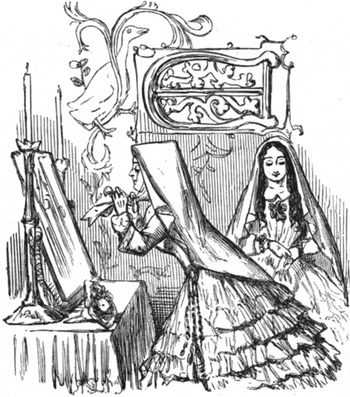
The dispute around the alleged attraction of women to Catholicism was not limited only to hand-wringing. While the family and motherhood was the ideal role for Victorian women, for many of them this goal simply would not have been attainable, even if all of them had actually desired it. The census of 1851, which revealed the existence of a large surplus of unmarried women, made the existence of religious organizations for them seem like a viable solution. In William Sewell's Hawkstone (1845), the exemplary High Anglican landlord Ernest Villiers founds exactly such an organization, modelled on the Beguines. It gives spinsters and widows a sense of usefulness, engages them in social work and saves the well-meaning but misguided Miss Mabel Brooke from engaging in such enormities as running charity schemes in collaboration with Dissenters. The real-life Anglican sisterhoods, inspired by the Tractarian movement, started to spring up all over England: the first woman took her vows in front of Edward Pusey in 1841, the first sisterhood was founded in London in 1845. They had to fight a powerful social and cultural opposition from many sources. They were mocked by Punch as associations of affected upper-class ladies, as evinced by the article “Convent of the Belgravians” (1850). illustrated by a drawing of two ladies in full evening dress, adjusting their nuns’ veils in front of the mirror (Figure 29). (The text was followed by “The Monastery of Pimlico,” describing in the same vein a similar men's institution, where monks would be wearing theatrical fake tonsures and flesh tights instead of bare feet.) More serious opponents included F. D. Maurice, who in his text “On Sisterhoods” (1863) expressed his scepticism, believing that women were far more useful when left in their natural place in society, exerting their leavening influence, as it were, instead of separating them from men. This elevated ideal, when translated into the reality of the Victorian family, meant often the expectation that the unmarried daughter should act as an unpaid lady-companion, nurse and baby-sitter for all other family members, and families deprived of such help by the woman's decision to join the sisterhood often took it exceedingly ill, trying to stop her by using all physical and psychological means at their disposal (Mumm 166–90).
“Convent of the Belgravians.” Engraving, from Punch 19 (1850): 163.

The arguments used against Anglican sisterhoods or “Puseyite nunneries” are essentially similar to the arguments used against Roman Catholic convents (to which they were often unfavourably compared [Mumm 190–95]): they disintegrate the family, the natural place of women, luring them by the romantic aura connected with convent life, taking the veil and hiding behind the bars. For the Belgravian ladies satirised by Punch the religious life offers them a new set of playthings when they become too jaded with the ones offered by the worldly life. For weak-minded women, such attractions were irresistible.
The anxiety around new conversions seemed to be triggered for the most part by women converts, who in this way slipped away from the network of their real families and their obligations. But some authors looked past the alleged causes of women's attraction to Catholicism, perceiving that it did not always have to rely solely on the emotional allure and dramatic thrill of the convent, as many Protestant authors suggested. As Florence Nightingale wrote in an angry outburst:
I would have given [the Church of England] my head, my heart, my hand. She would not have them. She did not know what to do with them. She told me to go back and do crochet in my mother's sewing-room; or, if I were tired of that, to marry and look well at the head of my husband's table. You may go to the Sunday School, if you like it, she said. But she gave me no training even for that. She gave me neither work to do for her, nor education for it. (qtd. in Showalter 405)
Nightingale for some time had entertained the idea of converting to Catholicism precisely for the reasons listed above, that is the fact that a personality like hers could not be accommodated by the ideology of the traditional Protestant domesticity, supported both by society and the Church. Her strictures against the cult of the family are even more striking because she calls it essentially pagan, thus using the same language that was employed by Protestant writers against the Roman Catholic Church: “the degree to which [the Evangelicals] have raised the claims upon women of ‘Family’ – the idol they have made of it . . . .They acknowledge no God, for all they have said to the contrary, but this Fetich” (qtd. in LaMonaca 12). But her problem was shared by many women who could not or would not fit in the socially prescribed roles of dutiful daughters and wives. Catholicism provided such outlets, and the introduction of High Church sisterhoods in the 1840s, followed by Low Church deaconesses in the 1860s, could be interpreted as an attempt of the Anglican Church to provide their counterparts.Footnote 9 The claims that Victorian society pushed women into the arms of the Roman Catholic Church were made repeatedly throughout the nineteenth century, even as more and more outlets for women's energies were becoming available.
When we look at all the disparate strands of the Victorian Protestant discourse on the women who chose the life of celibacy for religious reasons, we see one common theme, implicit or explicit, uniting various voices: the nun, the polar opposite of the Victorian female ideal of mother and wife, became at the same time the embodiment of its various features, both good and bad ones. The women who by renouncing marriage and motherhood essentially renounced their sex, paradoxically became the embodiment of the Victorian womanhood. Putting aside for a moment the Gothic fantasies about immured nuns, the life of enforced perpetual infancy in the convents, as described by such authors as Thackeray, was not dissimilar to the life of married women, whose legal status was the same as minors. Even Punch's jabs at Belgravian ladies playing at being nuns are based on the stereotypical interest of women in new clothes and frippery. But the image of the nun included not only what was considered typical feminine foibles, but their characteristic virtues, emphasized by the vows they took. Chastity, obedience, self-abnegation, desire to serve others – all of these were a part of the Victorian ideal recognized by the culture, with the only difference that it was removed from the family home to the convent. Essentially, the nun was the ideal Victorian mother and wife, which perhaps might account partly for the popularity of the “escaped nun” plot: the deceived young woman, looking for a possibility to sacrifice herself, was brought back into the fold of the Protestant family, the proper sphere for all her renunciation urges. What was in danger of becoming a dangerous free radical outside the patriarchal family structures, becomes domesticated and in the process which could be described as a reversal of abjection: the Other becomes the part of Us again.
Gender Confusion
Roman Catholicism was perceived as attractive to weak-minded women – and also to some men. Punch regularly published cartoons poking fun at the unmanly preoccupation of Ritualist priests with clothes: one of them depicts a priest mincing in his new vestments in front of a mirror while another exclaims “Oh, Athanasius, it's charmingly becoming!” (“Height of Fashion”); in another, the young female cousins of the Reverend Augustus Cope intercept the package with the vestments he ordered and “dress themselves up” while the Reverend looks on with horror (“The Ritual Movement”) (Figures 30 and 31). One did not even need to be a Catholic or Ritualist priest; the mere association with this movement could often imply a deviation from Victorian gender norms. In Kate and Rosalind (1853) (probably by Elizabeth J. Whately, a daughter of Richard Whately, the Archbishop of Dublin) the local rector, who has already made himself known as a Puseyite, is visited by his brother, a student from Oxford bringing a friend with him; both men claim to belong to “Young England.”Footnote 10 “Young Englanders” were popularly linked in the public mind with the Oxford Movement as a sort of its political arm: both of these movements, facing the unstable contemporary situation, sought refuge in the idealized vision of pre-industrial, pre-Reformation Merry England. The young men behave in a peculiar way, ignoring the visiting ladies (both young and old) to the point of rudeness and they seem a little too preoccupied with each other: “Mr. Augustus Sackville. . .was leaning against the mantel-piece, the other had his arm round his friend's neck. As the ladies entered, the host and his sister came forward very cordially to meet them, but the others did not appear aware of the arrival of visitors, and retained their affectionate position” (56). Later on, when Rosalind is invited to play the piano, neither of the men moves to open the piano for her and shockingly enough, she has to open it herself. But Edwin, Augustus's friend, finally agrees to sing the following song, certainly not addressing any of the ladies present:
“Height of Fashion.” Engraving, from Punch 22 Dec 1866: 258.

“The Ritual Movement.” Engraving, from Punch 15 Sep 1866: 109.

This satirical scene shows how Tractarians and their allies were perceived by their Evangelical opponents: the dangerous Catholic tendencies of the priest go hand in hand with the dangerously intimate friendships of his brother. In a way that is not clearly explained in the novel, but somehow taken for granted by the author and her intended reader the religion that is showy and ostentatious in its forms of worship leads to this kind of showy and ostentatious behaviour.
The fervent male friendships in the Tractarian circle, the preoccupation with vestments and other ornate parts of liturgy, the voluntary celibacy – all of this raised more than a few eyebrows in the Victorian times and may trigger associations with gay culture in our times. However, one has to be wary when making such judgements. For one thing, it would be anachronistic to apply contemporary psychosexual categories to the period when the emotional professions of same-sex friendship with the frequent use of the word “love” did not automatically connote homosexuality, latent or not. Tennyson and Hallam, Newman and Richard Hurrell Froude, and later Ambrose St. John, or even Charles Kingsley and Charles Mansfield – these romantic friendships between men were acceptable in Victorian times when, it should be remembered, young middle- and upper-class men spent much of their life in the homosocial environment of boarding schools and universities (Buckton 368). Moreover, as John Shelton Reed points out, “those who assailed Anglo-Catholicism as effeminate did not even usually mean to imply that the movement nurtured homoeroticism. If they had meant that, they would not have stopped at verbal abuse” (223). And the very idea of the effeminate gay man did not exist in the collective imagination then; until late in the nineteenth century, man could commit homosexual acts (and be punished for them, if caught), but the idea of homosexuality as a condition, or going even further, homosexual sensibility, “had currency only in some very rarified circles” (Reed 222).Footnote 11
Incidentally, the conversions to Rome were in the nineteenth century were commonly referred to as “perversions,” and those who underwent them as “perverts”; the sexual implications of the word (even though they can be traced back to ShakespeareFootnote 12 ) seemed to be of secondary importance until late in the century, but it is interesting to observe how both meanings seeped into each other. The usage of the word “pervert” in the sense of “convert to Catholicism” seemed to peak in the 1840s but continued until late nineteenth century (O'Malley 91); it was also used by Catholic writers with reference to conversions to Protestantism (for instance in an article in the Rambler, its author denies “the perversion to Protestantism of our settlers” [“Emigration Considered” 465]). At the same time, already in 1850 Bishop Wilberforce fulminated against the too papist wording of the vows taken by the sisters in the then new Anglican sisterhoods, considering them to be “savouring of one of the most carnal perversions of the Church of Rome” because they included references to Christ as the “heavenly Spouse” (qtd. in O'Malley 91). But even “carnal perversion” could be used in the sense “physical, non-spiritual distortion of a religious truth”, and it was used in this way, for instance, by Anglican polemicists arguing over the doctrine of the Real Presence.Footnote 13 Thus, William J. Conybeare could title his novel published in 1856 Perversion, or the Causes and Consequences of Infidelity in the safe assumption that the reading public would recognize his “perversion” and “infidelity” as being of the religious kind. The perversion that Conybeare and his pre-Freudian contemporaries had in mind was, as Jonathan Dollimore points out, rather the intellectual and moral form of subversion than the sexual one (240-41), even though Conybeare includes a satirical portrait of a Tractarian Oxford don, who forms “singularly sentimental and schoolgirlish attachments” to undergraduates:
It would not be enough to say that he swore an eternal friendship with his favourite pupils; eternal love would be almost too tame an expression for the endearments which he lavished upon them in succession, while the caprice lasted. He celebrated the praises of their beauty in English sonnets and Latin lyrics; he forced upon them the most intimate confidences, and revealed to them the hidden secrets of his heart; he addressed them by their Christian names, joined with the most caressing epithets; and he signed his notes to them; “Yours. with fond affection,” “Yours till death,” or “Your own Henry.” (179; ch. 10)
The accusations of effeminacy did not include only Tractarians; Catholic priests themselves, when they were not portrayed as sexually insatiable lechers, were portrayed as somewhat feminized, The allusions to Catholicism as an emasculated religion abound in Victorian literature: George Borrow in The Romany Rye (1857) on numerous occasions compares the Catholic priest who tries to convert him to the fox from Aesop's fable who lost its tail, thus equating the animal's symbolic castration with the conversion to Catholicism. Even Ruskin's strictures against Renaissance architecture carry the echoes of this attitude; Renaissance lintels are “effeminate” (2: 252; ch. 6, §89) because they are a product of the Counter-Reformation Catholicism, drifting further and further away from its true Christian roots, which produced in the past the vigorous Gothic. The one notable example to the contrary, that of Carlyle's Abbot Samson is an exception that proves the rule: Samson, through the force of his personality elevates his monastic community from its default state of idle, feminized men occupied by listless gossip to the utopian all-male society whose celibacy means not the deprivation of male energy but rather full control over it. Moreover, by removing his ideal into the safe historical distance of the twelfth century Carlyle emphasized the difference between the monks of St Edmunds and the disdained Puseyites or contemporary Catholics (Sussman 16–74).
One of the possible reasons why the allegations of emasculation returned in the discussions of Roman Catholic or Anglo-Catholic priests was the issue of celibacy, obligatory for the former, but in case of the latter often chosen voluntarily. The echoes of this discussion can be heard in the conversation in Oscar Wilde's The Importance of Being Earnest (1895) between Miss Prism and Dr. Chasuble (who is clearly meant to be a Ritualist, since his name is a joke on the attachment of these priests to their liturgical vestments). When Miss Prism advises Dr Chasuble to get married, he answers “The precept as well as the practice of the Primitive Church was distinctly against matrimony.” This allusion to the attachment of Ritualists to the tradition of the early fathers as an important authority for the contemporary Church meets with the following retort from Miss Prism: “That is obviously the reason why the Primitive Church has not lasted up to the present day. And you do not seem to realise, dear Doctor, that by persistently remaining single, a man converts himself into a permanent public temptation. Men should be more careful; this very celibacy leads weaker vessels astray” (Wilde 371; Act II). Celibacy, whether obligatory as in the Roman Catholic Church, or voluntary, as among many Anglo-Catholic priests, was by default a suspicious state; and while the nineteenth-century newspaper report about High Church vicars “practising celibacy in the open streets” is probably apocryphal,Footnote 14 the sentiment may have been shared by many Englishmen.
The issue of masculinity and effeminacy lay at the roots of the lifelong conflict between John Henry Newman and Charles Kingsley. Even before the well-known polemic which led Newman to writing Apologia Pro Vita Sua (1864-65), Kingsley seemed to have set himself up as Newman's polar opposite, primarily when it came to masculinity. As a leading exponent of Christian Socialism, which was dubbed, at least initially with a derisive intention, “muscular Christianity,” he, together with his many fellows, was afraid that religion would become the sole province of women. In their works, Christian Socialists tried to redeem the situation, by presenting the characters who were ultra-manly and at the same time pious and chaste Christians. When Thomas Hughes, the author of Tom Brown's Schooldays (1857) and Kingsley's friend, wrote his popular book on the life of Jesus, he titled it The Manliness of Christ (1879) with chapters bearing headings such as, for instance, “The Holy Land A.D. 10 – The Battlefield of the Great Captain.” Similarly, Kingsley from the beginning of his career as a writer repeatedly expressed his disgust and distrust of effeminate clergymen. In The Saint's Tragedy, Walter, a knight at the Thuringian court, is suspicious of Conrad of Marburg – as the text later shows, justifiably so, since it is Conrad who drives Elizabeth, the saint of the title, to the extremities of asceticism and early death. Walter senses it right after the first meeting with Conrad: “I have seen such an eye in men possessed – with devils, or with self: sleek passionless men, who are too refined to be manly, and measure their grace by their effeminacy . . . .I always mistrust those wall-eyed saints” (82; Act II, Scene 2).
The same argument continues in Westward Ho! (1855), Kingsley's swashbuckling story about the adventures of Elizabethan sailors, where the fear of the encroaching Popery and the fear of effeminacy gnawing at the roots of Victorian society merged together. Amyas Leigh, Kingsley's protagonist, is a brave soldier and sailor, endowed more with brawn than brains, but equipped with natural virtue and simple Protestant piety inculcated by his mother. In contrast, his Catholic cousin Eustace is a malicious, effeminate, and weak man, protected by Amyas out of family loyalty and ultimately a traitor. Eustace also prays to the “Blessed Virgin” similarly to the Spaniards he plots with; as one sailor says, “I tell you, these Spaniards are rank cowards, as all bullies are. They pray to a woman, the idolatrous rascals! And no wonder they fight like women” (4; ch. 1). This repudiation of the cult of Mary was one of the characteristic features of Kingsley's writing and perhaps could be explained as the vociferous rejection of the most feminine part of the allegedly irrational, emotional, and highly decorative religion, appealing in particular to women and unmanly men. (Engelhardt 47).
In Amyas Kingsley tries to build a new Protestant hero, both masculine and religious at the same time; attempting to replace the worldly notions of manhood with his ideal of Christian chaste manliness, since Amyas remained, despite his adventurous lifestyle, “as pure as the day he was born, having been trained as many a brave young man was then, to look upon profligacy not as a proof of manhood, but as. . .a cowardly and effeminate sin” (42; ch. 2). The effeminacy of the Church is seen as the reason why it loses so many male worshippers. John Brimblecombe, an Anglican parson accompanying Amyas and his brother Frank on their journey, shows himself to be a coward, which earns him this rebuke by Amyas: “No wonder that young men, as the parsons complain so loudly, will not listen to the Gospel, while it is preached to them by men on whom they cannot but look down; a set of softhanded fellows who cannot dig, and are ashamed to beg; and, as my brother has it, must needs be parsons before they are men” (287; ch. 18). In these lines, as in many others in Westward Ho! Kingsley clearly addresses his contemporaries through the mouth of his sixteenth-century protagonist, trying to find the explanation for the lack of attractiveness of the Church to young men in the effeminacy of its priests, especially those who, under the influence of the Oxford Movement chose voluntary celibacy, or in the words of Frank Leigh “vowed not to be men” (287; ch. 18). Amyas Leigh was going to be Kingsley's alternative model of manhood: strong, courageous, pious and pure at the same time.
The personal motivations behind Kingsley's animus are well-known and often recalled: Kingsley himself, as a student at Oxford, felt attracted to the Tractarian ideals and even was tempted to convert to Roman Catholicism. We know also that his future wife, Frances, was under the influence of Tractarians and dreamt about joining a sisterhood, while her sister Charlotte seriously considered entering a Roman Catholic convent before she met her future husband, James Anthony Froude, the historian whose writings inspired Westward Ho! (Engelhardt 48). Kingsley, who was a man of strong sexual appetites and equally strong religious convictions, reconciled the two passions through evolving his own theology of hallowed marital lovemaking or pro-sexual Christianity, bringing the spouses closer to God and giving them a foretaste of the joys of Heaven (Maynard 94–95). From his point of view, voluntary celibacy advocated by many Tractarians and later Ritualists (not to mention the compulsory celibacy of Roman Catholic clergy and religious orders) implied a denigration of marital love (Barker 468–70), which, as the extensive collection of his love letters to Fanny proves, was the central passion of his life.
The idea that all Catholic priests are in a sense feminine appeared in Kingsley's writings long before the public conflict with Newman. In Yeast (1851) the protagonist's cousin Luke, who is on the verge of converting, writes to Lancelot in a letter peppered with elision marks, as if Luke were not a man enough to end a sentence with the period mark.
Would you have me try to be a Prometheus, while I am longing to be once more an infant on a mother's breast? Let me alone. . .I am a weary child, who knows nothing, can do nothing, except lose its way in arguings and reasonings, and “find no end, in wandering mazes lost.” Will you reproach me, because when I see a soft cradle lying open for me. . .with a Virgin Mother's face smiling down all woman's love about it. . .I long to crawl into it, and sleep awhile? I want loving, indulgent sympathy. . .(86; ch. 5)
The effeminacy of Popish priests is also emphasized by Kingsley in an article he published anonymously in Fraser's Magazine in 1848 titled “Why Should We Fear the Romish Priests.” The title is a ploy, since the main brunt of Kingsley's argument seems to run along the lines of “the only thing we have to fear is fear itself”; he claims that the Romish Priests cannot “cope with the English freeman – the English husband and father” (468). The word “husband” recurs in the article once again, when Kingsley exhorts his readers about “the rights of the citizen, the husband, the individual conscience” (469) defended by the English constitution. The emphasis on English husbands, which word in Kingsley's texts implies not only male heads of households, but also men enjoying healthy marital life, pitted against the Romish priests, shows that it was priests' celibacy which made them incapable of facing the opposition of John Bull.
Yet many of Kingsley's contemporaries noticed a strong feminine element about him; Justin McCarthy, Kingsley's student at Cambridge called him “as feminine in his likes and dislikes, his impulses and prejudices, as Harriet Martineau was masculine in her intellect and George Sand in her emotions” (qtd. in Schiefelbein 154). Kingsley's strident criticism of everything he perceived as unmanly strongly smacks of overcompensation, as many commentators have noticed (Adams 132–33). Roman Catholicism, as the embodiment of effeminacy, became Kingsley's bête noire because he perceived it primarily as the accumulation of transgressions of Victorian gender roles: celibate, effeminate, and weak men, such as Eustace Leigh, women deprived of their natural roles of wives and mothers, such as St. Elizabeth – all that added up in Kingsley's eyes to the image of the perverse world, where all God-given instincts are thwarted and corrupted by misguided asceticism. Yet the same asceticism had a strong appeal for Kingsley, as can be seen both in his public and private work. In his letters to his future wife Fanny the fantasies, sometimes put into life, of hair-shirts, scourging and rolling in thorn bushes accompanied by explicit drawings, recur regularly (Maynard 98–100). Also in his published texts the theme of female martyrdom, of the female body being stripped and tortured in various ways returns under various guises, sometimes those of Christian martyrs (“Saint Maura. A.D. 304,” a dramatic monologue delivered by a crucified pregnant woman; the already mentioned Saint Elizabeth), mythological figures (the poem “Andromeda”) or even pagan martyrs, such as Hypatia in the novel of that name (Munich 54–55). Mortifying sinful flesh, which became for Kingsley associated with Roman Catholicism had an irresistible subconscious appeal for him, even as he was consciously rejecting it. For Kingsley Roman Catholicism became his abject, both attractive and repellent at the same time.
Kingsley is by no means the only Victorian writer who connected Catholicism with effeminate men. In Disraeli's Lothair, which was inspired by the conversion of the young Marquess of Bute, Lady Corisande says: “When I hear of young nobles, the natural leaders of the land, going over to the Roman Catholic Church, I confess I lose heart and patience. It seems so unpatriotic, so effeminate” (51). Charlotte Brontë in a letter to her father compared Cardinal Wiseman to an old lady (640). And William Thackeray in Henry Esmond writes about the Pretender: “and the Prince's affairs, being in the hands of priests and women, were conducted as priests and women will conduct them, artfully, cruelly, feebly, and to a certain bad issue” (180; book II ch. 4). Later on, when Frank Esmond converts to Catholicism in order to marry a German Catholic countess, his sister Beatrice comments:
Frank is as vain as a girl, cousin. Talk of us girls being vain, what are WE to you? It was easy to see that the first woman who chose would make a fool of him, or the first robe – I count a priest and a woman all the same. We are always caballing; we are not answerable for the fibs we tell; we are always cajoling and coaxing, or threatening; and we are always making mischief, Colonel Esmond – mark my word. (288–89; book III ch. 2)
Thackeray's approach is different from other writers writing at that period (Henry Esmond was written at the height of anxiety provoked by the Papal Aggression of 1850) since in his descriptions he emphasizes above all one feature connected with their effeminacy, and that is their ineffectualness. The quotes above show that Thackeray tries to put the Catholic intrigues of the eighteenth century on a par with female intrigues, presumably in order to put his readers at ease. While Jesuits in the anti-Catholic fiction of the 1840s and 1850s are portrayed as figures of demonic power (e.g., Father Eustace in Catherine Sinclair's Beatrice), masters of disguise (Pearce in Sewell's Hawkstone) and overall criminal masterminds, Father Holt, for all his posturing, turns out to be comically powerless; he likes to pose as omniscient, but his information always turns out not to be quite correct, as opposed to the all-knowing and all-powerful Jesuits in the popular novels of that period.
The links made by Protestant writers between Catholic priests and effeminacy, Catholicism and the particular influence it was supposed to have on women, or finally between Catholicism and femininity bring to mind Kristeva's discussion of the link between the defilement taboo and the feminine. The stronger the defilement taboos are in a given culture, the stronger distrust of women, perceived as wily and scheming. “That other sex, the feminine, becomes synonymous with a radical evil that is to be suppressed” (70). Thackeray's Beatrice Esmond describes women and priests in similar terms, as “caballing” and “cajoling,” conveying the impression of a subversive but weak force, constrained to use underhanded means. In the texts which described women not as schemers but as angelic creatures, such as Elizabeth of Hungary in Kingsley's Saint's Tragedy (1848), the burden of the blame was shifted from women to priests, the creatures even more odious because their effeminacy was not a “natural” but an acquired one. Women, on the other hand, because of their sensitive and impressionable nature were a particularly easy prey for these predators.
In view of the above described and widely shared attitude towards Catholicism as the religion appealing mostly to women, it is interesting to read one of the few novels in which the main hero, a Catholic, is not effeminate. Mrs. Humphry Ward's Helbeck of Bannisdale is an example of a novel featuring such a character. Alan Helbeck is the last heir of a formerly powerful Catholic family, living a celibate life of prayer and privation as a Tertiary Franciscan in a remote manor in Westmoreland, spending the remnants of his wealth on supporting various Catholic charities. He falls in love with Laura, his sister's stepdaughter, an independent and strong-minded agnostic. They become engaged and for some time they entertain the fantasy of living as a happy married couple, mutually respecting each other's religious views. However, Laura soon realizes the impossibility of such a plan, taking into account the central role religion plays in Helbeck's life. After much anguish, realizing they cannot be happy either together or apart, she drowns herself.
Obviously, Helbeck and Laura are not the only fictional mixed-denomination couple in which it is the man who is Catholic; a bigger novelty is that Helbeck is described sympathetically. The family influence may have played a role here; it was Ward's father, Thomas Arnold, a son of Dr Thomas Arnold and brother of Matthew, who converted to Catholicism not once but twice, while his wife remained Protestant. (He reverted to Anglicanism after the publication of Syllabus Errorum and re-converted to Catholicism once again in 1877, causing much anguish to his family, not only on emotional level, but also, more prosaically, in terms of economic status, since his Catholicism barred him from having a job at any other British university but the Catholic oneFootnote 15 ). But apart from the family factors, Ward set herself the purpose, openly stated in the Introduction to Helbeck when it was reissued in the collected edition of her novels, to reverse the traditional dichotomy between Catholicism and obedience on one hand and “Protestantism and the free mind” on the other hand. Making the woman “the priestess of the past” (Ward xiii) and the man the representative of modernity would be in Ward's opinion too obvious, showing that the connection between Catholicism, irrationality and femininity on one hand, and Protestantism, modernity and masculinity on the other hand was deep-rooted. Even though the trope of the brave Protestant heroine was undoubtedly present in the British fiction, especially in the novels written by women (e.g., the title heroine of Sinclair's Beatrice or the historical novels for young readers by Emily Sarah Holt), the assumption about women being by their very nature attracted to Catholicism must have been much stronger if Mrs. Ward chose consciously to revert it.
Alan Helbeck is described against the stereotype of an effeminate Catholic as a very manly man, physically imposing (his size is repeatedly contrasted with that of the diminutive Laura), gruff and awkward in society. Laura's attraction to him has masochistic undertones; though an independent, New-Woman kind of girl, she longs for having her will curbed by her significantly older lover and to be mastered by him. Her rationalism is actually quite irrational: it was inherited from her atheist scientist father, who, however, did not pay much attention to her education. Ward's first inspiration for the novel was the story of an Old Catholic family from Westmoreland, clinging stubbornly to their faith through centuries of persecution and gradual impoverishment, and Laura's fidelity to her father's worldview is as blind as their adherence to the Mass. When observing Catholic practices in Bannisdale, she experiences the same mixture of attraction and disgust that is characteristic of abjection; what keeps her from converting is ultimately the instinctive repulsion born out of love for her father, and, as Ward suggests obliquely, some kind of collective Protestant unconscious: “Through the shiver of an invincible repulsion that held her spoke a hundred things: things inherited, things died for, things wrought out by the moral experience of generations. But she could not analyse them. All she knew were the two words ‘I can't’” (395; book IV ch. 4).
Helbeck with its reversal of stereotypical gender roles provides an appropriate ending for this study. Mrs. Ward, writing at the end of the Victorian era, faced a different situation than writers of the 1840s and 1850s – the mass conversion of England that Catholics hoped for and Protestants feared did not take place; the individual famous converts did not make up for the high numbers of working-class Catholics falling away from the faith of their forefathers (Arnstein 216). In this social climate, Mrs. Ward could depict her Catholic hero, without identifying with his religious views, as a masculine, tragic and sympathetic figure, very different from Kingsley's sneaking Eustace Leigh.
As I attempted to show here, throughout the nineteenth century anti-Catholic novel was the provider of pious thrills to the Protestant reading public – pious because it purported to denounce the abominations caused by the Popery with its transgressions of gender roles, while providing exciting reading matter based to a significant degree on the depictions of victimized females, in need of protection by Protestant men. While the historical and social roots of anti-Catholicism have been studied and expertly explained by many historians, the study of the Victorian novel reveals its psychological foundations. The theory of the Catholicism as the abject in the Protestant popular imagination helps to explain the trope associating Catholicism with femininity (female converts, effeminate men) and with depraved sexuality at the same time – depraved because removed outside the normative boundaries of Protestant family. The metaphorical feminine body of the Roman Catholic Church, the abject Mother, threatening and endlessly fascinating at the same time, provided material for the Protestant novel for several decades of the nineteenth century.