INTRODUCTION
The deep sea, in general and within European waters in particular, represents an ecosystem that occupies an extensive area but is still scarcely known. Deep sea, fascinating habitats, such as cold seeps, cold-water coral mounds and reefs, canyons and anoxic environments, represent biodiversity hotspots (Weaver et al., Reference Weaver, Billett, Boetius, Danovaro, Freiwald and Sibuet2004) or may harbour endemic or rare species (Sibuet & Olu, Reference Sibuet and Olu1998). Recent projects, supported by the European Union, are trying to fill this gap; such as HERMES, an integrated research project designed to gain new insights into the biodiversity, structure, function and dynamics of ecosystems along Europe's deep-sea margin (http://www.eu-hermes.net/). In addition, the LIFE + INDEMARES project is studying 10 Spanish offshore areas in the Atlantic, Mediterranean and Macaronesian regions, all away from the coastline, with the aim of contributing to the protection and sustainable use of the biodiversity, through the identification of valuable areas for the Natura 2000 Network. One of these areas is the Spanish waters of the Gulf of Cádiz (subproject ‘Chimeneas de Cádiz’), where cold seeps and mud volcanoes are found between 300 and 1200 m. These areas with fluid emissions form a special habitat, supporting unique ecosystems based on methane oxidation as a primary source of energy (Milkov, Reference Milkov2000; Van Dover et al., Reference Van Dover, German, Speer, Parson and Vrijenhoek2002; Vanreusel et al., Reference Vanreusel, Andersen, Boetius, Connelly, Cunha, Decker, Heeschen, Hilario, Kormas, Maigniem, Olu, Pachiadaki, Ritt, Rodrigues, Sarrazin, Tyler, Van Gaever and Vanneste2009), with biological communities supported by chemosynthetic processes and with respiratory adaptations to their hypoxic environment (Hourdez & Lallier, Reference Hourdez and Lallier2007).
In the Gulf of Cádiz, more than 60 mud volcanoes have been found (in Spanish, Portuguese and Moroccan waters) between 200 and 4000 m (Medialdea et al., Reference Medialdea, Somoza, Pinheiro, Fernández-Puga, Vázquez, León, Ivanov, Magalhaes, Díaz del Río and Vegas2009; León et al., Reference León, Somoza, Medialdea, Vázquez, González, López-González, Casas, Mata, Fernández-Puga, Jiménez-Moreno and Díaz-del-Río2012), and some faunistic studies have recently been carried out (Dworschak & Cunha, Reference Dworschak and Cunha2007; Génio et al., Reference Génio, Johnson, Vrijenhoek, Cunha, Tyler, Kiel and Little2008; Hilário & Cunha, Reference Hilário and Cunha2008; Rodrigues et al., Reference Rodrigues, Oliver and Cunha2008; Vanreusel et al., Reference Vanreusel, Andersen, Boetius, Connelly, Cunha, Decker, Heeschen, Hilario, Kormas, Maigniem, Olu, Pachiadaki, Ritt, Rodrigues, Sarrazin, Tyler, Van Gaever and Vanneste2009; Oliver et al., Reference Oliver, Rodrigues and Cunha2011) and INDEMARES (Rueda et al., Reference Rueda, González-García, Urra, Oporto, Gofas, García-Raso, López-González, Fernández-Salas, Díaz del Río and Borja2012a, Reference Rueda, Urra, Gofas, Lopez-Gonzalez, Fernandez-Salas and Diaz-Del-Ríob). Data on decapods living in these special and restricted habitats are very scarce for the Gulf of Cádiz and the Mediterranean Sea (Olu-Le Roy et al., Reference Olu-Le Roy, Sibuet, Fiala-Médioni, Gofas, Salas, Mariotti, Foucher and Woodside2004; Dworschak & Cunha, Reference Dworschak and Cunha2007; Taviani et al., Reference Taviani, Angeletti, Ceregato, Foglini, Froglia and Trincardi2013). A general review of the decapod crustaceans from hydrothermal vents and cold seeps was provided by Martin & Haney (Reference Martin and Haney2005). Therefore, information on decapods inhabiting cold seeps within European waters, and the Gulf of Cádiz in particular, is needed in order to improve the knowledge on these ecosystems and on rare invertebrate species within European waters.
MATERIALS AND METHODS
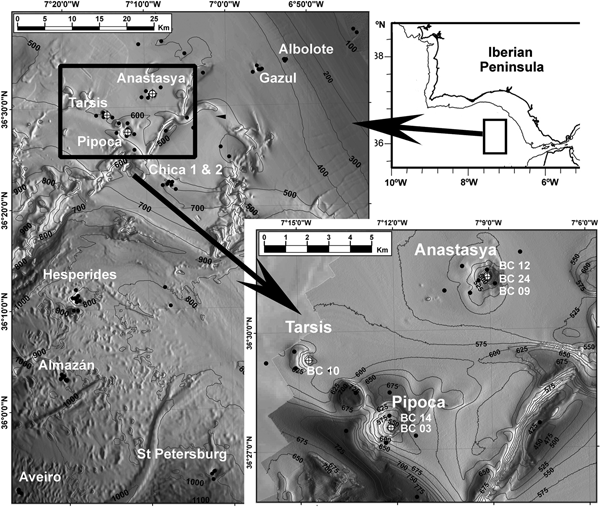
During the INDEMARES/CHICA 0610, 0211 and 0412 expeditions, samples were collected in different areas (in summits of seamounts, flanks, depressions, adjacent bottoms) of 11 mud volcanoes (MV) located within the Spanish sector of the Gulf of Cádiz (Albolote, Gazul, Anastasya, Tarsis, Pipoca, Chica1, Chica2, Hespérides, Almazán, Aveiro, St Petersburg) at depths from 300 to 1100 m (Figure 1). This mud volcano field is exposed to the highly saline (36.1–36.9) and warm (~12–14°C) Mediterranean Outflow Water (MOW), that forms a strong bottom current flowing towards the W and NW (into two main cores – at depths from 500 to 800 m and 800 to 1200 m respectively), below the less saline (35.6–36.8, 12–18°C) North Atlantic Central Water (NACW, formed in the western Atlantic basin) which flows from west to east in the Gulf of Cádiz at 100–600 m depth (Dubois-Dauphin et al., Reference Dubois-Dauphin, Colin, Bonneau, Montero-Serrano, Blamart, Van Rooij and Franck2014). Different sampling methods were used in each expedition: box-corer (BC: sampling area of ~0.09 m2, N = 82), benthic dredge (DA: ~300 m2 of sampling area, N = 56) and beam-trawl (BT: ~2000 m2 of sampling area, N = 40) on board the RV ‘Emma Bardán’, ‘Cornide de Saavedra’ and ‘Ramon Margalef’. Fauna collected in those samples was identified to the lowest taxonomic level and quantified. Individuals of eucalliacid decapods were identified, counted and sexed in each sample.
Area of study and sampling points. Box-corer samples (black circles) obtained in the mud volcano field within Spanish waters of the Gulf of Cádiz, highlighting those that contained individuals of Calliax lobata (white circles) in mud volcanoes of El Laberinto fishing grounds.

The sediments collected with the box-corer (generally down to 0.15–0.20 m below sea floor ‘mbsf’) were sectioned at 5 cm intervals and sieved (0.5 mm) in order to study the vertical distribution of fauna and of eualliacid decapods in particular. Values of pH and Eh were obtained along the sediment column on board by means of pHenomenal portable pH- and Eh-meter before sub-sampling. Grain size analysis was also done along the vertical column by dry sieving (from >2 to 0.063 mm) and Sedigraph III 5120 (<0.063 mm) in the laboratory. The organic matter and carbonate content of the sediments was obtained by Loss of Ignition (LOI) method.
The specimens were preserved in 70% ethanol, and deposited in the reference collection of Centro Oceanográfico de Málaga (Instituto Español de Oceanografía), in the collection of Departamento Biología Animal of University of Málaga and one specimen was donated to the Naturhistorisches Museum Wien (MHNW).
The carapace length (CL), dorsally from the rostrum to the end of the carapace, has been measured as a reference of the size.
RESULTS
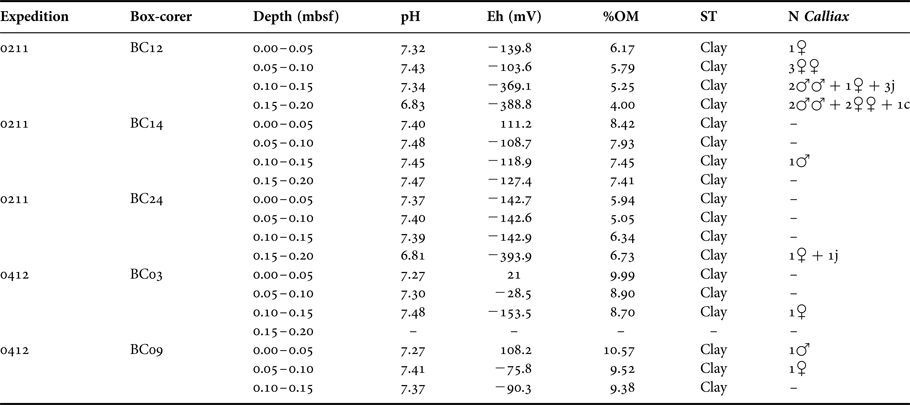
Chemoautotrophic communities were found in 9 out of 11 mud volcanoes, including the decapod Calliax lobata that was detected in two mud volcanoes (MV): Anastasya and Pipoca. In addition, remains of one specimen of Calliax were found in Tarsis MV (BC10, 548 m). All Calliax individuals were collected in box-corer samples and no individuals were found in samples collected with other sampling techniques (e.g. benthic dredge, beam trawl). Both the chemoautotrophic communities and this eucalliacid decapod were always found at the summit of mud volcanoes, however remains of this typical cold seep fauna (mainly of lucinids and solemyids bivalve shells) were also present in sediment close to the MV (e.g. bottom depression) and were found in the box-corer, the beam-trawl and the benthic dredge samples. Sediment characteristics (grain-size, % organic material, % carbonate, pH and Eh between 0 to 0.20 mbsf (intervals of 0.05 m)) where populations of C. lobata occur were obtained (Table 1).
Characteristics and physico-chemical conditions of sediments within burrows of the ghost shrimp Calliax lobata, at different depth intervals.

ST, sediment texture; %OM, percentage of organic matter; pH and Eh (redox potential); mbsf, metres below sea floor; N Calliax, abundance of Calliax in each sample and sediment depth interval (♂ – male, ♀ – female, j – juvenile, c – carapace).
The capture of the Calliax lobata in bathyal bottoms of the Gulf of Cádiz represents the first record of the genus in the western European margin.
Order: Decapoda Latreille, Reference Latreille1802 Infraorder: Axiidea de Saint Laurent, Reference de Saint Laurent1979 Family: Eucalliacidae Manning & Felder, Reference Manning and Felder1991 Genus: Calliax de Saint Laurent, Reference de Saint Laurent1973 Calliax lobata (de Gaillande & Lagardère, Reference de Gaillande and Lagardère1966) (Figures 2–5)
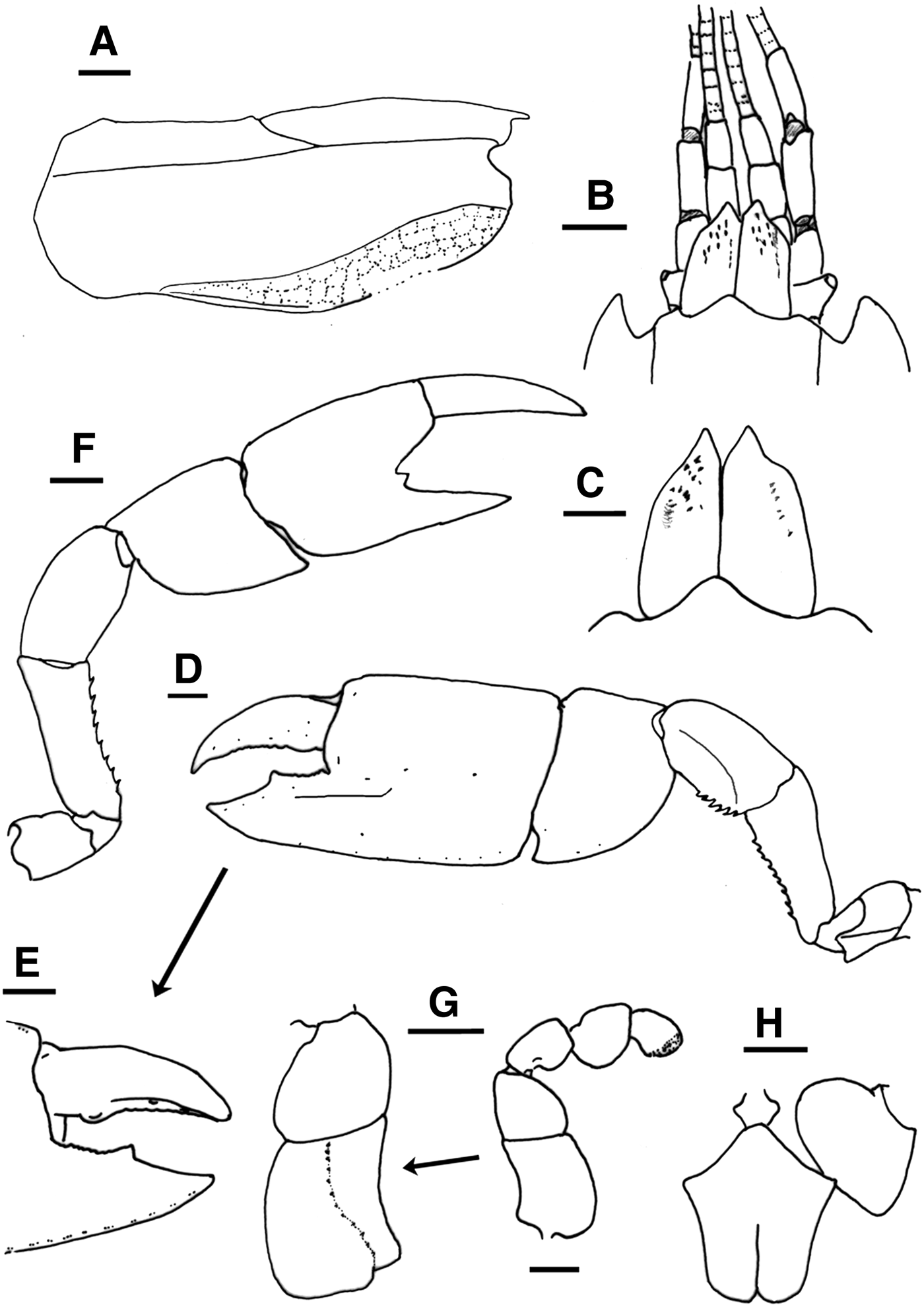
Calliax lobata. (A) carapace, lateral view; (B) carapace, anterior-dorsal view; (C) eyestalk; (D, E) first left pereopod and detail of fingers, inner and outer views respectively; (F) first right pereopod, outer view; (G) third maxilliped, outer and inner views; (H) mid-sternal plate. Female specimen 12.25 mm carapace length (sample BC12. Scale bars: 1 mm, except C: 0.5 mm.

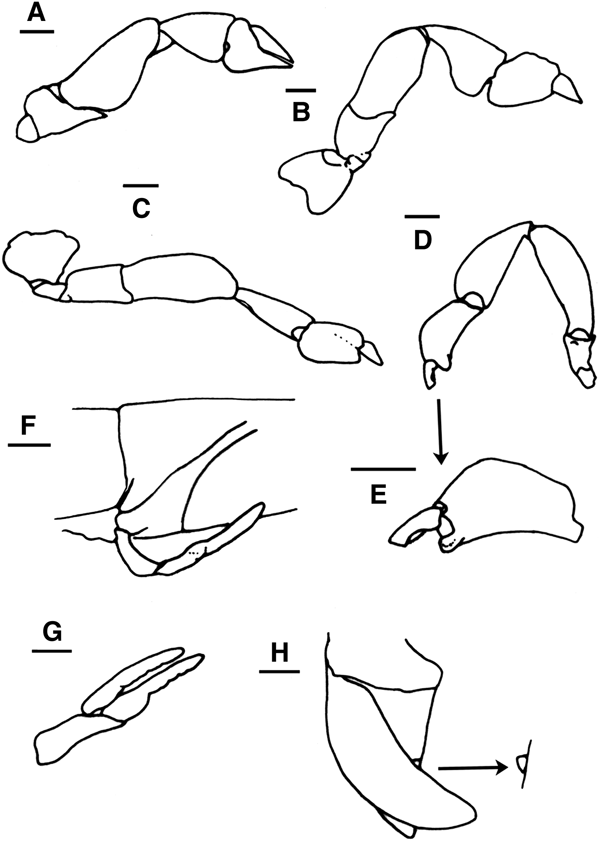
Calliax lobata. (A) second right pereopod, outer view; (B) third right pereopod, outer view; (C) fourth right pereopod, outer view; (D, E) fifth right pereopod and detail, inner views; (F) first right female pleopod; (G) second left female pleopod; (H) third right pleopod, outer view, and detail of appendix interna. A to G female specimen 12.25 mm carapace length (sample BC12); H male specimen 6.1 mm carapace length (sample BC12). Scale bars: 1 mm.

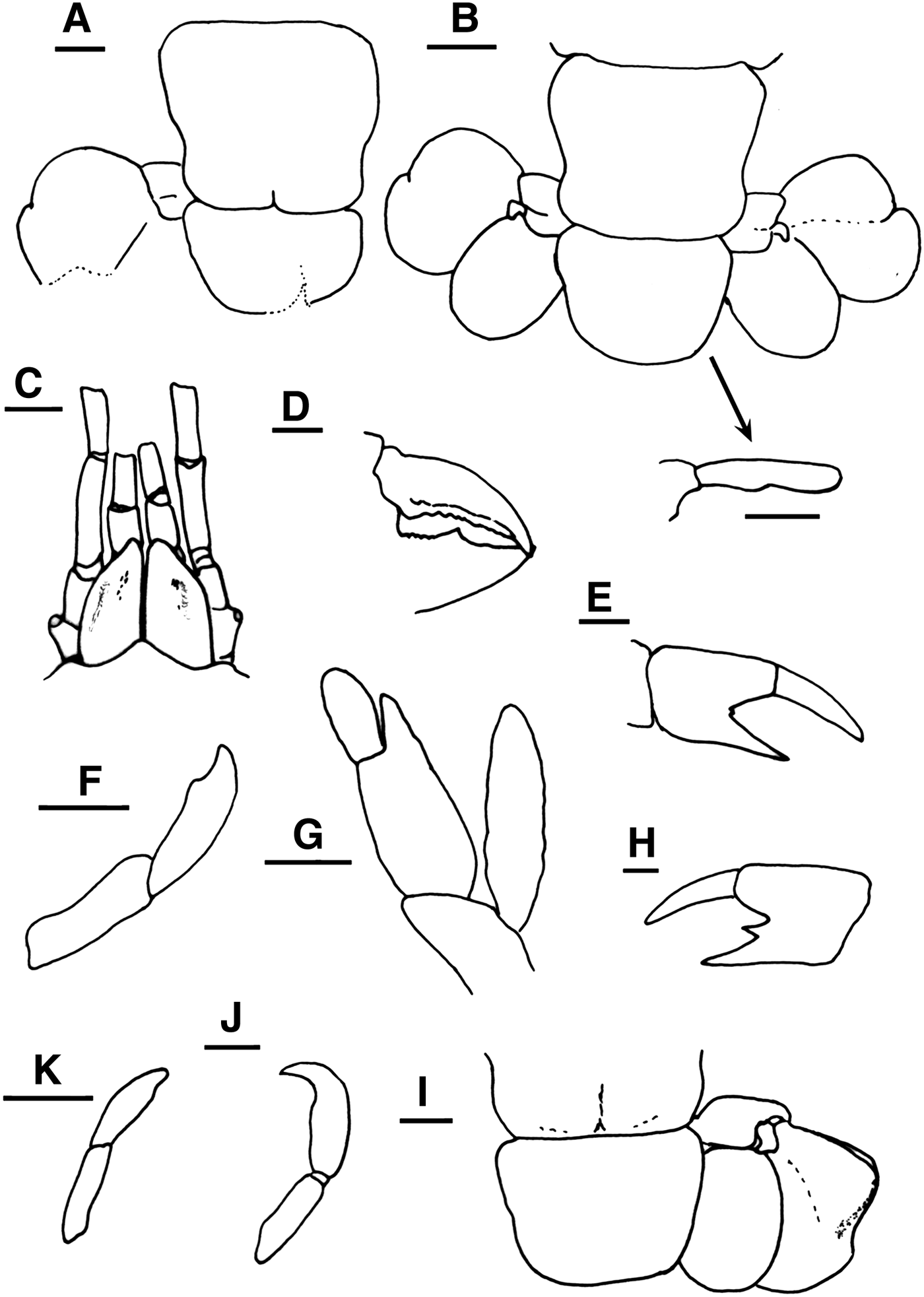
Calliax lobata. (A, B) posterior part of pleon, telson and uropods, and lateral view of telson; (C) eyestalks, antennular and antennal peduncles; (D) finger of first large pereopd, (E) finger of first small pereopod; (F) first male pleopod; (G) second male pleopod; (H) propodus and dactylus of small first pereopod (large specimen); (I) telson and uropods; (J, K) first male pleopods, from adult and juvenile respectively. A female specimen 12.25 mm carapace length (sample BC12); B to G male specimen 6.1 mm carapace length (sample BC12); H to J male adult specimen 8.0 mm carapace length (sample BC14); K male juvenile specimen 4.5 mm carapace length (sample BC12). Scale bars: 1 mm; except F, G, J and K: 0.5 mm.

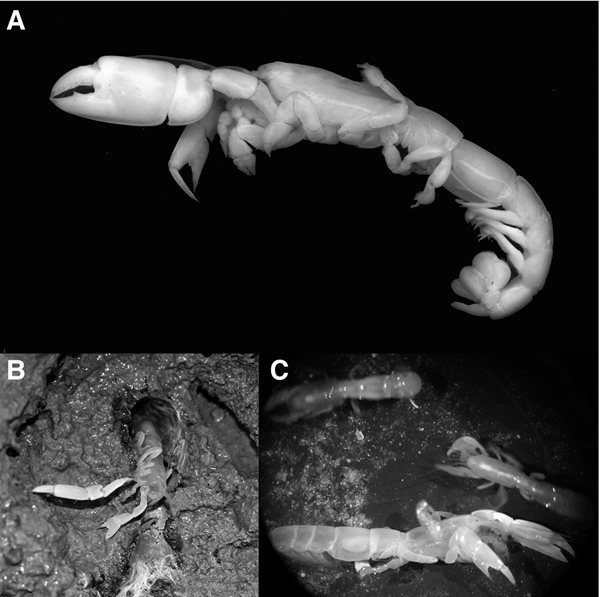
Calliax lobata. (A) general view, (B) specimen leaving its burrow, (C) group of three recently caught specimens under the microscope.

MATERIAL CAPTURED AND EXAMINED
Indemares-Chica 0211: Anastasya mud volcano (MV) – CH0211-BC12, 36°31′21.144″N 07°09′04.369″W, 22 Feb 2011, 457 m, 7♀♀ (1 female is deposited in NHMW 25511), 4♂♂, 3 juveniles and 1 carapace; CH0211-BC24, 36°31′20.884″N 07°09′04.335″W, 28 Feb 2011, 458 m, 1♀, 1 juvenile. Pipoca MV – CH0211-BC14, 36°27′33.646″N 07°12′09.624″W, 23 Feb 2011, 501 m, 1♂. Indemares-Chica 0412: Pipoca MV, CH0412-BC03, 36°27′33.804″N 07°12′09.360″W, 12 Apr 2012, 500 m, 1 ♀. Anastasya MV, CH0412-BC09, 36°31′19.056″N 07°09′ 03.888″W, 17 Apr 2012, 455 m, 1 ♂, 1 ♀. Remains of one specimen, Tarsis MV, CH0412-BC10, 36°29′17.268″N 07°14′40.992″W, 17 Apr 2012, 548 m.
COMPARATIVE MATERIAL EXAMINED
Callianassa (Callichirus) lobata de Gaillande & Lagardère, Reference de Gaillande and Lagardère1966: 4 specimens Port Miou, près de Toulon, de Galliande coll. 1972, MNHN-IU-2009-2297 (ex MNHN-Th674).
The morphological features of our 21 specimens (Figures 2–4) allow us to assign them to the genus Calliax: carapace without dorsal oval and with linea thalassinica lateral to antennae, straight antero-posteriorly on carapace; rostrum obsolete; eyestalk usually dorsoventrally flattened and contiguous; pleurobranch absent on pereopods 2 to 4 (P2–P4); dactylus of third maxilliped (Mxp3) ovate, and without exopod; and uropodal exopod without yellow-transparent circular structure (Sakai, Reference Sakai1999, Reference Sakai2005, Reference Sakai2011; Ngoc-Ho, Reference Ngoc-Ho2003).
Characters of the material also fit those described for the infalittoral Mediterranean species Calliax lobata by de Gaillande & Lagardère (Reference de Gaillande and Lagardère1966), de Saint Laurent & Božić (Reference de Saint Laurent and Božić1976), Sakai (Reference Sakai1999) and Ngoc-Ho (Reference Ngoc-Ho2003) and also the features observed in loaned specimens from MNHN Paris. Therefore, a complete morphological description is not given, but Figures 2A–H, 3A–H and 4A–K are shown for comparative purposes.
However, some morphological differences among specimens of small and large size were observed. The triangular proximal tooth on the dactylus of minor cheliped (P1) (palm with w-shaped distal margin) is minuscule in small specimens and large in large ones (Figures 2F & 4E, H); the number of spines on the lower margin of merus of major cheliped is smaller in small specimens (Hyžný & Gašparič, Reference Hyžný and Gašparič2014: Figure 3) than in large ones (Figure 2D); and the distal part of the first male pleopod is more curved in large specimens (Figures 4J, F, K). Also, this first pleopod is not developed in specimens CL <2.8 mm.
Colour: whitish.
Size range: Males, CL 4.7–8.0 mm; females CL 3.1–12.3 mm.
Sex ratio (females/males): 2.75/1.
Distribution
Calliax lobata was described from the Mediterranean Sea, in Port Miou, Toulon, France, at a depth of 2–8 m (de Gaillande & Lagardère, Reference de Gaillande and Lagardère1966), and later reported from Patras (=Patraikos) Gulf, Greece, at 15 m in sandy mud (Thessalou-Legaki & Zenetos, Reference Thessalou-Legakis and Zenetos1985; Thessalou-Legaki, Reference Thessalou-Legakis1986) and near Rovinj, Croatia, in silty sand at 21 m (Števčić, Reference Števčić1985, Reference Števčić1990). Recently, in Italy, Taviani et al. (Reference Taviani, Angeletti, Ceregato, Foglini, Froglia and Trincardi2013) found specimens of Calliax sp. in the Strait of Sicily at ~800 m, and Sakai (Reference Sakai2017) in Palinuro Seamount, southern Tyrrhenian Sea, at 622 m. Our captures represent a new record for the North-east Atlantic Ocean: Gulf of Cádiz (Spain), in clay bottoms at summits of MV, 455–501 m.
Habitat
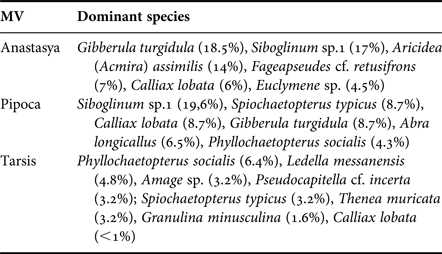
The chemoautotrophic community of these cold seeps occurring at summits of MV, in which C. lobata has been found, includes frenulate polychaetes (Siboglinum sp.) (densities up to 100 ind. m−2) and bivalves (Lucinoma asapheus Oliver, Rodrigues & Cunha, Reference Oliver, Rodrigues and Cunha2011 and Solemya elarraichensis Oliver, Rodrigues & Cunha, Reference Oliver, Rodrigues and Cunha2011) (densities up to ~70 ind. m−2). Other dominant living species in the different mud volcanoes are listed in Table 2. In Anastasya MV, C. lobata shows a patchy distribution at the summit with densities between 22.2 and ~150.0 ind. m−2 in anoxic muddy sediments (redox potential Eh between −90.3 and −393.9 mV, pH between 7.4 and 6.8), with strong sulphide smell. This eucalliacid inhabits burrows (Figure 5b), in which the sediment surface between burrow openings seems covered by bacterial mats, and displays the highest densities at 0.1–0.2 mbsf, being the dominant species at this level. Some of the burrows were also occupied by the bivalve S. elarraichensis (at densities of 66.7 ind. m−2); other chemosymbiotic species occurring at the summit were L. asapheus and Siboglinum sp.1. In Pipoca MV, this eucalliacid also occurs at the summit but was less abundant than in Anastasya MV, occurring at densities of 22.2 ind. m−2 in anoxic clay sediments (Eh −127.4 mV, pH 7.47) at the 0.1–0.15 mbsf level. In spite of this the species shows a higher dominance due to a low abundance of other components of the community. Another chemoautotrophic species from this community is Siboglinum sp.1 (densities up to 80 ind. m−2), which represents the top dominant species. Remains of L. asapheus were found in the sediment samples of this mud volcano, but no living individuals. In Tarsis MV, remains of C. lobata were only found at the summit (with lowest densities 11.1 ind. m−2), being only present at the 0.1–0.15 mbsf level with anoxic muddy sediments (Eh −125.8 mV, pH 7.35). Siboglinum sp.1 is also present (densities up to 30 indiv. m−2) and no remains of chemoautotrophic bivalves were found in this sample.
Top dominant species at the summits of the mud volcanoes (MV) that displayed populations of Calliax lobata.

Relative abundance values in parentheses.
In all mud volcanoes C. lobata is practically one of the few macrofaunal species (except the chemoautotrophic bivalves S. elarraichensis and L. asapheus) inhabiting sediment below 0.1 mbsf. The highest relative abundances, in relation to the total number of Calliax individuals collected along the sediment column, were found between 0.10–0.15 and 0.15–0.20 mbsf intervals (40 and 33% respectively) (Table 1).
In general, C. lobata populations display a low frequency of occurrence within the mud volcano field of the Spanish margin (3 MV of El Laberinto fishing grounds out of 11 MV within Spanish waters), considering that there was similar sampling effort in all mud volcanoes. Moreover, these populations are always restricted to summits of these submarine structures and they were never found in the flanks or adjacent seafloor depression of each MV.
DISCUSSION
During the three INDEMARES/CHICA expeditions the presence of populations of a rare deep eucalliacid species was detected, in anoxic bottoms of mud volcanoes of the Gulf of Cádiz, whose morphology is similar to the Mediterranean species Calliax lobata, originally captured and described from shallow waters (2–8 to 21 m, de Gaillande & Lagardère, Reference de Gaillande and Lagardère1966; Števčić, Reference Števčić1985; Thessalou-Legaki, Reference Thessalou-Legakis1986) and subsequently found in deep bottoms (622 to 840.9 m, Taviani et al., Reference Taviani, Angeletti, Ceregato, Foglini, Froglia and Trincardi2013; Sakai, Reference Sakai2017). Also, the abundance of C. lobata in the mud volcanoes of the Gulf of Cádiz contrast with the scarcity of records and individuals found in the shallow Mediterranean species C. lobata (previous references).
In this study it was the only axiidean species caught. Nevertheless, in deep waters of the Southern Iberian Peninsula (Gulf of Cádiz and Alborán Sea, García Raso, Reference García Raso1996) other species were found: Calocaris macandreae Bell 1846, and Calocarides coronatus (Trybom, 1904). Probably, the most common and abundant axiidean in Mediterranean deep waters is Calocaris macandreae (Axiidae) (Cartes & Sarda, Reference Cartes and Sarda1992; Cartes et al., Reference Cartes, Maynou, Moranta, Massutí, Lloris and Morales-Nin2004; Follesa et al., Reference Follesa, Porcu, Gastoni, Mulas, Sabatini and Cau2009), a species relatively abundant down to about 1000 m, with isolated individuals appearing down to 1300–1500 m, and dominant at 600 m (Catalan Sea, Cartes & Sarda, Reference Cartes and Sarda1992). Axiideans can also represent an important resource in the diet of other deep-water decapods (e.g. Calocaris macandreae for Plesionika heterocarpus (A. Costa, 1871), Plesionika ensis (A. Milne-Edwards, 1881) and Polycheles typhlops Heller, 1862 (Labropoulou & Kostikas, Reference Labropoulou and Kostikas1999)).
Only a few species of axiideans in chemosynthesis-based communities inhabiting hydrothermal vents, cold seeps and mud volcanoes have been found in the last years (Martin & Haney, Reference Martin and Haney2005) and studies have shown that the physiology of the axiideans is generally well adapted to hypoxic and sulphidic conditions (Atkinson & Taylor, Reference Atkinson and Taylor2005; Wardiatno, Reference Wardiatno2009). Only six species have been mentioned to occur in reducing environments: Bathycalliax geomar Sakai & Türkay, Reference Sakai and Türkay1999, off Oregon, at 627 m (Sakai & Türkay, Reference Sakai and Türkay1999); Callianassa truncata Giard & Bonnier, 1890, around the islands of Milos and Santorini, Aegean Sea, at ~12 m (Dando et al., Reference Dando, Huges, Thiermann, Parson, Walker and Dixon1995); Nihonotrypaea thermophila Lin, Komai & Chan, Reference Lin, Komai and Chan2007, off north-eastern Taiwan and Kagosima Bay, Japan, at 105–310 m (Lin et al., Reference Lin, Komai and Chan2007; Komai & Fujiwara, Reference Komai and Fujiwara2012); Paraglypturus calderus Türkay & Sakai, Reference Türkay and Sakai1995, submarine volcano Esmeralda Bank, in the Mariana Arc (63–114 m) (Türkay & Sakai, Reference Türkay and Sakai1995); Vulcanocalliax arutyunovi Dworschak & Cunha, Reference Dworschak and Cunha2007, from MV of the Gulf of Cádiz, Atlantic Ocean (Captain Arutyunov MV) at 1327–1339 m (Dworschak & Cunha, Reference Dworschak and Cunha2007) and Cheramus cavifrons Komai & Fujiwara, Reference Komai and Fujiwara2012 off Cape Nomamisaki, Kyushu, Japan, at 226 m (Komai & Fujiwara, Reference Komai and Fujiwara2012). Recently, in a pockmark field in the Strait of Sicily and at 820–840 m depth, specimens of Calliax sp. have also been found by Taviani et al. (Reference Taviani, Angeletti, Ceregato, Foglini, Froglia and Trincardi2013).
The shallow Mediterranean Calliax lobata inhabits muddy and silty bottoms at 2–21 m depth (de Graillande & Lagardère, Reference de Gaillande and Lagardère1966; Števčić, Reference Števčić1990). The deep-water specimens of Calliax cited by Taviani et al. (Reference Taviani, Angeletti, Ceregato, Foglini, Froglia and Trincardi2013) (which also share characters with C. lobata) were captured in a pockmark field in the Strait of Sicily at 811–840.9 m depth, and our specimens collected in the Gulf of Cádiz inhabit clay and silty bottoms of MV located at ~500 m depth. In all these cases the specimens are living in a reducing sedimentary environment. On the other hand, although it is not common that a same axiidean species occurs over such a wide bathymetric range, in all cases mentioned above the specimens are living in a reducing sedimentary environment, and there are some examples of callianassid that occur over a wide bathymetric range. In the Mediterranean and Atlantic waters, Callianassa subterranea (Montagu, 1808) has been found from 10 to 270 m depth (Sakai, Reference Sakai2005) and C. marginata Rathbun, 1901, from 55 to 640 m depth in the Western Atlantic Ocean (Sakai, Reference Sakai2005).
So, the Mediterranean Outflow Water current that runs through the mud volcano field of the Gulf of Cádiz, together with the special anoxic environmental conditions of sediments occurring at the summits of mud volcanoes, could justify the presence of a Mediterranean species in the studied Atlantic area (close to the Mediterranean Sea). For the same reason it is very probable that this rare species can be found and captured in other Mediterranean areas, with reducing environments, although for this (it is a burrowing species) an appropriate sampling method should be used.
The presence and maximal abundance of C. lobata in Anastasya and Pipoca MV could be related to a higher or moderate seepage activity when compared with other MV from the Spanish field. Moreover, species such as Siboglinum sp., Solemya elarraichensis and Lucinoma asapheus, typical of anoxic muddy substrates with low potential redox and living in symbiosis with chemotrophic bacteria (using methane and sulphide as energy sources) are more abundant in these two mud volcanoes (specially Anastasya) when compared with others located in the area, such as Tarsis or Gazul (Oporto et al., Reference Oporto, Marina, López, Fernández-Zambrano, Bruque, González-García, Sánchez, López, Moreira, Gofas, García Raso, Fernández-Salas, López-González, Rueda, Díaz del Río, Freitas, Cascalho, Taborda, Ribeiro, Drago, Andrade, Fatela and Cruces2012; Rueda et al., Reference Rueda, González-García, Urra, Oporto, Gofas, García-Raso, López-González, Fernández-Salas, Díaz del Río and Borja2012a, Reference Rueda, Urra, Gofas, Lopez-Gonzalez, Fernandez-Salas and Diaz-Del-Ríob). This differential distribution of typical cold seep fauna in mud volcanoes of the Gulf of Cádiz seems to be very common and has been related to the heterogeneity of nutrient sources (nitrogen and sulphur) and the ability for exploiting different resources by the different species (Rodrigues et al., Reference Rodrigues, Hilário and Cunha2013). In addition, the tanatocoenosis from MV of the Spanish margin displays a high abundance of remains of this callianassid in Anastasya and Pipoca as well as of putative gastropods associated with cold seeps (e.g. Taranis moerchii (Malm, 1861)), as was observed by Taviani et al. (Reference Taviani, Angeletti, Ceregato, Foglini, Froglia and Trincardi2013) in sediments collected in the Gela Basin pockmark field in the strait of Sicily. The infaunal life habit of this species that burrows deeply in the sediment may have also influenced the scarcity of previous records in shallow or deep sea bottoms.
ACKNOWLEDGEMENTS
We appreciate the assistance provided by the members of INDEMARES/CHICA 0610, 0211 and 0412 expeditions, by the crews and captains of the RV ‘Emma Bardan’, ‘Cornide de Saavedra’ and ‘Ramón Margalef’. We are grateful to Victor Díaz del Río, Francisco J. López, Tatiana Oporto and Gerardo Bruque (Instituto Español de Oceanografía) for their contribution to the sediment characterization and elaboration of maps, Miguel García for the photo of Calliax Figure 5B, and Juan Moreira and Eduardo López (Universidad Autónoma de Madrid) for identification of polychaete species. Also, our thanks to reviewers whose comments have been very helpful in improving this article.
FINANCIAL SUPPORT
This study was supported by the INDEMARES/CHICA Project, EC contract INDEMARES-LIFE+ (07/NAT/E/000732) as well as to the follow-up project LIFE IP INTEMARES. FEDER funding assigned to equipment of RV ‘Cornide de Saavedra’ (FICTS-2010-01) and to construction of RV ‘Ramón Margalef’ (FICTS-2011-03-01).