


Introduction
The Brazil nut tree Bertholletia excelsa (Bonp. Lecythidaceae), a hyperdominant species (Fauset et al. Reference Fauset, Johnson, Gloor, Baker, Monteagudo and Brienen2015) and a symbol of Amazonian conservation (Guariguata et al. Reference Guariguata, Cronkleton, Duchelle and Zuidema2017), plays a fundamental role in Amazonian forests and human ecology. It contributes to nutrient cycling, carbon storage (Zeidemann et al. Reference Zeidemann, Kainer and Staudhammer2014, Thomas et al. Reference Thomas, Atkinson and Kettle2018, Guedes et al. Reference Guedes, da Costa, de Castilho, Frazão, Milheiras, de Sousa, Wadt, Maroccolo, Guedes and Katia2023) and other ecosystem services (Tourne et al. Reference Tourne, Ballester, James, Martorano, Guedes and Thomas2019, Guedes et al. Reference Guedes, da Costa, de Castilho, Frazão, Milheiras, de Sousa, Wadt, Maroccolo, Guedes and Katia2023). That the seeds (or nuts) of the monotypic Bertholletia have long been a subsistence source (Shepard & Ramirez Reference Shepard and Ramirez2011) was confirmed when fossilized nuts over 10 000 years old were found in Amazonian caves (Roosevelt et al. Reference Roosevelt, Lima da Costa, Lopes Machado, Michab, Mercier and Valladas1996). These globally known ‘Brazil nuts’ – or, as they have been more recently coined, ‘Amazon nuts’ – are harvested almost exclusively from native forests (Wadt et al. Reference Kainer, Staudhammer and Serrano2008, Ribeiro et al. Reference Ribeiro, Jerozolimski, De Robert, Salles, Kayapó and Pimentel2014).
Bertholletia populations are often aggregated in ‘Brazil nut groves’ (Mori & Prance Reference Mori and Prance1990, Thomas et al. Reference Thomas, Caicedo, Loo and Kindt2014), which are associated with anthropogenic processes (Scoles & Gribel Reference Scoles and Gribel2015, Thomas et al. Reference Thomas, Alcázar Caicedo, Mcmichael, Corvera and Loo2015). Human presence influences the demographic structure of Bertholletia and is important for large-scale species dispersal (Scoles & Gribel Reference Scoles and Gribel2011), whereas rodents execute short-distance dispersal (Haugaasen et al. Reference Haugaasen, Haugaasen, Peres, Gribel and Wegge2010).
Central to the Amazonian extractive economy, the extent to which intensive nut collection for markets undermines natural regeneration and population dynamics is controversial. Based on the interpretation that intensive harvesting over long periods significantly compromises recruitment and the long-term sustainability of this extractive activity, Peres et al. (Reference Peres, Baider, Zuidema, Wadt, Kainer and Gomes-Silva2003) recommended harvest restrictions. However, other research has proved that nut harvests in natural Amazonian stands do not affect the establishment of Bertholletia seedlings (Zuidema & Boot Reference Zuidema and Boot2002, Wadt et al. Reference Kainer, Staudhammer and Serrano2008, Paiva et al. Reference Paiva, Guedes and Funi2011, Scoles & Gribel Reference Scoles and Gribel2012, Ribeiro et al. Reference Ribeiro, Jerozolimski, De Robert, Salles, Kayapó and Pimentel2014, Bertwell et al. Reference Bertwell, Kainer, Cropper, Staudhammer and de Oliveira Wadt2018). Ribeiro et al. (Reference Ribeiro, Jerozolimski, De Robert, Salles, Kayapó and Pimentel2014) went further and reported positive correlations between Bertholletia regeneration and the direct use of Bertholletia-rich forests for ‘agroextractive activities’, including nut harvesting. Agroextractivism is a joint and complementary practice of nut collection and agricultural activities throughout the year. Most families in the Cajari River Extractive Reserve are agroextractivists, cultivating mainly cassava outside the nut harvest (De Jesus & Guedes Reference De Jesus, Guedes, Dias, Eidt and Udry2017).
Agroextractivism favours the regeneration and establishment of Amazon nut trees in areas of swidden agriculture. A central tenet of Bertholletia population dynamics, often ignored or overlooked, is the need for light to penetrate the forest floor and promote seedling establishment and growth (Scoles & Gribel Reference Scoles and Gribel2012). Bertholletia is a heliophilic species (Mori & Prance Reference Mori and Prance1990) with reduced recruitment in dense, heavily shaded forests (Myers et al. Reference Myers, Newton and Melgarejo2000). Secondary forests, low-impact logging gaps, agricultural fallows and slash-and-burn agriculture are ideal sites for the natural regeneration of Bertholletia (Cotta et al. Reference Cotta, Kainer, Wadt and Staudhammer2008, Paiva et al. Reference Paiva, Guedes and Funi2011).
The fact that slash-and-burn agriculture may be beneficial to Bertholletia and Amazonian forests deserves critical consideration, given that burning vegetation to prepare planting sites emits greenhouse gases. However, the traditional use of fire on subsistence agricultural plots has been, and continues to be, small-scale and family-based, providing local food security. In these cases, slash-and-burn agricultural systems, where forest plots are converted to subsistence agriculture, abandoned and then forest regrowth follows, are a form of temporary forest loss, unlike commodity-driven deforestation (Curtis et al. Reference Curtis, Slay, Harris, Tyukavina and Hansen2018). In addition, fallow forest regrowth and associated carbon sequestration offset the carbon emitted by fires during site preparation (Szott et al. Reference Szott, Palm and Buresh1999). However, even in these small-scale systems, it is critical to maintain adequate fallow periods for biomass recovery and to manage burning and fuel loads to prevent fires from escaping, especially given the increasing vulnerability of the Amazon to drought-related fires and their associated emissions (Aragão et al. Reference Aragão, Anderson, Fonseca, Rosan, Vedovato and Wagner2018).
The centuries-old practice of slash-and-burn agriculture has historically benefitted and continues to support the demographics of B. excelsa within contemporary conservation efforts aimed at sustainable use and the historical ecology of the Amazon. Using the life history of Bertholletia, we sought to demonstrate that the best strategy to protect the Amazon and its most iconic species is through forest conservation via sustainable management practices. We build on Ribeiro et al. (Reference Ribeiro, Jerozolimski, De Robert, Salles, Kayapó and Pimentel2014), who highlighted unintentional practices such as inadvertently dropping seeds along harvest trails by Indigenous Kayapó, to discuss the contemporary anthropogenic impacts of nut harvesting and dispersal by analyzing the age, density and historical legacy of Bertholletia groves. We also draw on insights from Maezumi et al. (Reference Maezumi, Robinson, de Souza, Urrego, Schaan and Alves2018b) on pre-Columbian Amazonian land use and fire management to analyse differences in Bertholletia dynamics between mature and early successional forests derived from slash-and-burn agricultural systems.
Bertholletia and humans have a symbiotic relationship. Low-intensity and infrequent forest disturbances caused by early human activities shaped the geographical distribution and stand formation of Bertholletia, suggesting the existence of ‘cultural forests’ (Posey Reference Posey1985, Balée Reference Balée and Balée1998, Clement et al. Reference Clement, Denevan, Heckenberger, Junqueira, Neves and Teixeira2015) or, in contemporary parlance, ‘biocultural’ forests (Gavin et al. Reference Gavin, McCarter, Mead, Berkes, Stepp and Peterson2015). The notion of the Amazon as a biocultural forest posits that its current species composition and structure are related to interactions between historical human activities and natural processes. This theory derives from the positive relationship between species richness and the agroextractive and traditional forest management activities of Indigenous Amazonian peoples, with the age and age structure of Bertholletia coinciding with periods and locations of human occupation (Caetano Andrade et al. Reference Caetano Andrade, Flores, Levis, Clement, Roberts and Schöngart2019). Fire was a commonly used tool in these processes, including the formation of anthropogenic soils. This suggests that policies and regulations that prohibit burning and promote mechanized permanent agriculture dependent on external inputs are detrimental to the conservation of Bertholletia and Amazonian forests.
Nuts are collected annually by over 6000 families in Brazil alone, prompting various public policies. Most critically, the National Agroecological and Organic Production Policy (Decree 7.794/2012) recognized that Brazil nut agroextractivism – a combination of extractive activities with cultivation techniques – is a product of sociobiodiversity and plays a key role in the development and appreciation of contemporary Indigenous Peoples and traditional communities (Maroccolo et al. Reference Maroccolo, Wadt, de Abreu Sá Diniz, Wadt, Maroccolo, Guedes and Katia2023). In fact, the single species B. excelsa has been credited with protecting millions of hectares of intact forest in Brazil, Bolivia and Peru (Ortiz Reference Ortiz, Shanley, Pierce, Laird and Guillén2002). Bertholletia provides one of the few successful non-timber forest products associated with both economic development and forest conservation (Rosenfeld et al. Reference Rosenfeld, Pokorny, Marcovitch and Poschen2024a, Reference Rosenfeld, Pokorny, Marcovitch and Poschen2024b).
We conducted a systematic literature review of Bertholletia studies and historical records to answer the following questions: (1) does slash-and-burn agriculture increase Bertholletia density and growth? (2) What do historical records reveal about the links between Bertholletia life history and human occupation? And (3) what policies and regulations shape the current context for harnessing this synergistic potential for sustainable use?
Methods
We conducted a systematic literature review to identify studies on B. excelsa related to interactions with human occupation, species demography and ecological dynamics in mature and secondary forests. We used the Web of Science, Scopus and Google Scholar search engines and searched the Coordenação de Aperfeiçoamento de Pessoal de Nível Superior (CAPES) database, a Brazilian federal government archive of theses and dissertations from Brazilian higher education institutions. The keywords used in the search were ‘Bertholletia excelsa’ together with ‘dynamics’, ‘demography’, ‘growth’, ‘population structure’, ‘survival’, ‘tropical forest’, ‘swidden-fallow systems’ and ‘agroextractivis’ in both English and Portuguese. More general terms (e.g. ‘Amazonian biocultural forest’) that were important in the context of this article were also searched.
We reviewed articles for relevance based on the titles, abstracts and full documents, sorting studies into those directly or indirectly related to each Bertholletia-centred topic. After selecting the relevant articles, we organized the information into an Excel spreadsheet to support the writing of each section and subsection of this manuscript. Finally, we identified Brazilian public policies that shape the current context and potential future synergies between the sustainable use and conservation of Bertholletia and Amazonian forests.
The combined search yielded a total of 240 publications. After selecting relevant articles, 80 publications, the majority of which were in English (n = 58), were used to formulate the text. Two of these were Brazilian dissertations, which are rarely included in English-language reviews.
Bertholletia density and growth in areas of swidden agriculture and forests
Most Bertholletia populations are dominated by centenarians in mature Amazonian forests, where regeneration rates and juvenile densities are lower than those in managed or secondary forests (Cotta et al. Reference Cotta, Kainer, Wadt and Staudhammer2008, Paiva et al. Reference Paiva, Guedes and Funi2011, Guedes et al. Reference Guedes, Neves, Rodrigues, Paiva, Costa and Freitas2014). These comparative differences are attributed to superior seed dispersal and light availability, and thus better establishment conditions in managed/secondary forests.
The cutia (Dasyprocta spp.) are among the few animals that can open this hard fruit, typically consuming a portion of the released seeds and burying the rest for periods of food shortage. In the event that burial sites are forgotten, Dasyprocta spp. facilitate Brazil nut plantations. These rodents are frequently found in the closed vegetation of slash-and-burn agricultural fallows that provide shelter (Silvius & Fragoso Reference Silvius and Fragoso2003) and agricultural plots where they encounter food.
Paiva et al. (Reference Paiva, Guedes and Funi2011) documented a positive linear relationship between Bertholletia regeneration and the number of slash-and-burn agricultural cycles; the effect was cumulative. Existing individuals that were slashed and burned during the cultivation phase resprouted, while new fruit and seeds were deposited and buried by Dasyprocta spp. during each cultivation–fallow sequence.
The establishment of Brazil nut trees in dense forests under a closed canopy is limited, with growth occurring only when light conditions become more favourable (Scoles & Gribel Reference Scoles and Gribel2012), such as after the creation of forest gaps (Myers et al. Reference Myers, Newton and Melgarejo2000, Moll-Rocek et al. Reference Moll-Rocek, Gilbert and Broadbent2014) and swidden and fallows plots. In the latter, seedlings and saplings also benefit from greater nutrient availability, either because agricultural plots are often intentionally established on anthropic soils (terras marrons and terras pretas de índio) or because of the residual fertility effects of recent slash-and-burn agriculture. The diameter growth rates of Bertholletia in managed environments with high light incidence can be up to three times higher than those in closed forests (Schöngart et al. Reference Schöngart, Gribel, Ferreira da Fonseca-Junior and Haugaasen2015). In summary, the contemporary establishment of small agricultural plots and other moderate forest disturbance activities carried out by agroextractivists promote an ideal forest matrix for the establishment and growth of Bertholletia (Scoles & Gribel Reference Scoles and Gribel2011, Thomas et al. Reference Thomas, Caicedo, Loo and Kindt2014).
These positive interactions between Bertholletia demographic dynamics and abandoned fallow suggest synergistic opportunities between Brazil nut extractivism and slash-and-burn farming systems, as practiced by agroextractivists. In sustainable use reserves, such as in southern Amapá, agroextractivists commonly and intentionally abandon their traditional agricultural fallows when they observe at least five Bertholletia individuals ha–1 with productive potential, removing them from the shifting cultivation cycle and allowing them to develop into Brazil nut stands (Guedes et al. Reference Guedes, Neves, Rodrigues, Paiva, Costa and Freitas2014).
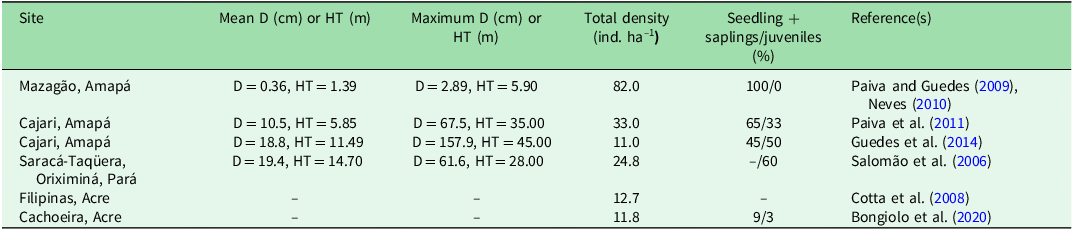
When Bertholletia seed trees are nearby, secondary fallows resulting from slash-and-burn management systems consistently have higher numbers of recruits, even when compared to Amazonian nut-rich stands in mature forest (Wadt et al. Reference Kainer and Silva2005, Cotta et al. Reference Kainer, Staudhammer and Serrano2008, Paiva et al. Reference Paiva, Guedes and Funi2011). This comparative advantage holds throughout the Brazilian Amazon, with fallow densities ranging from 11 to 82 individuals ha–1 and a mean of 29.2 individuals ha–1 (Table 1).
Demographic and growth data on Brazil nut trees (Bertholletia excelsa) in young fallows in six locations in the Brazilian Amazon, with mean and maximum height (HT) or diameter at ground level (D), total population density and percentage of seedlings (HT < 1.5 m) plus saplings (HT ≥ 1.5 m and D < 10 cm) and juveniles (10 ≤ DBH < 50 cm) observed in slash-and-burn farming system fallows throughout the Brazilian Amazon.

For Cotta et al. (Reference Cotta, Kainer, Wadt and Staudhammer2008), total density is for diameter at breast height >10 cm.
Guedes et al. (Reference Guedes, Neves, Rodrigues, Paiva, Costa and Freitas2014) documented 636 Bertholletia individuals in 58.5 ha of secondary fallow in the Alto Cajari Extractive Reserve, 95% of which were <50 cm diameter at breast height (DBH). The mean DBH was 18.8 cm, confirming the increased regeneration and early growth potential produced by the slash-and-burn farming systems, especially when compared to the Amazonian nut-rich mature forest (Table 2). There is a higher growth rate of seedlings (Kainer et al. Reference Kainer, Duryea, Macedo and Williams1998, Scoles et al. Reference Scoles, Gribel and Klein2011) and young nut trees in areas of swidden agriculture than in mature forest gaps (Kainer et al. Reference Kainer, Duryea, Macedo and Williams1998, Scoles et al. Reference Scoles, Gribel and Klein2011, Batista et al. Reference Batista, Scolforo, de Mello, Guedes, Terra and Scalon2019).
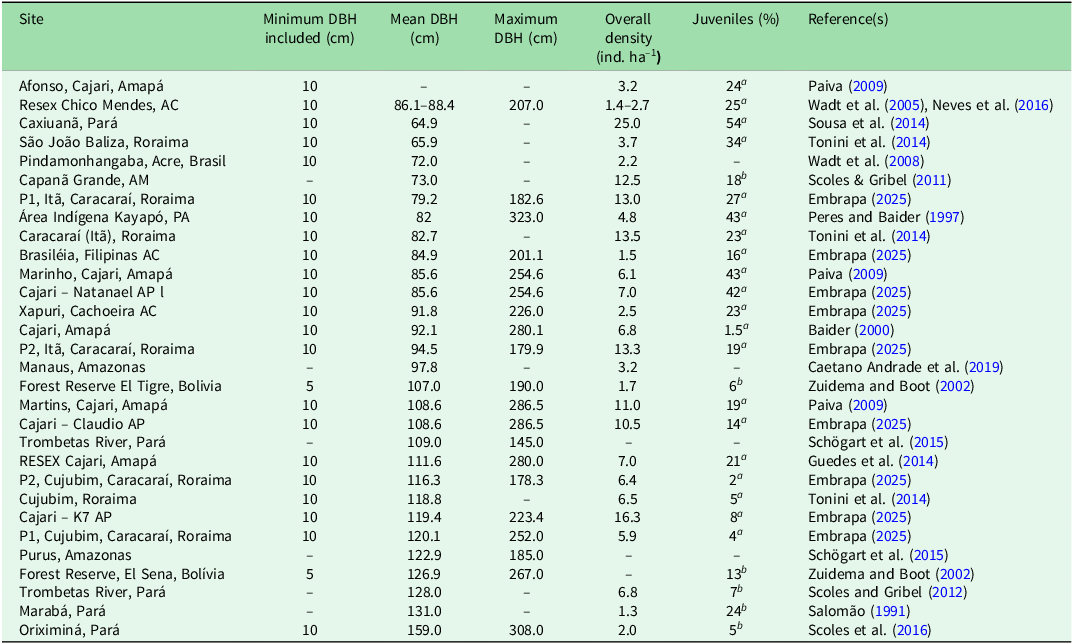
Minimum, mean and maximum diameter at breast height (DBH) of Bertholletia individuals, total density and proportion of individuals <50 cm DBH observed in Brazil nut-rich mature forests throughout the Brazilian Amazon.

a 10 cm ≤ DBH < 50 cm.
b DBH < 40 cm.
Bertholletia is commonly found in stands with documented total densities ranging from 1.5 individuals ha–1 (Wadt et al. Reference Kainer and Silva2005) to 25 individuals ha–1 (Sousa et al. Reference Sousa, Almeida and Amaral2014), with the proportion of juveniles varying from 2% to 54% (Table 2), with a mean of 20%. Low juvenile densities indicate an ageing population, suggesting difficulties in maintaining recruitment and regeneration throughout the long life cycle of Bertholletia in dense forests.
However, at some sites (2, 10, 13, 16 and 27; Table 2), more than 30% of the individuals in a given stand showed smaller diameters. At Site 10 (43% juveniles), the current extractivist confirmed that the Bertholletia stand measured was his grandfather’s slash-and-burn farming plot (Paiva Reference Paiva2009). These data suggest that young stands may have originated from more recent agroextractive practices, creating a matrix conducive to Bertholletia recruitment and establishment (Cotta et al. Reference Cotta, Kainer, Wadt and Staudhammer2008, Paiva et al. Reference Paiva, Guedes and Funi2011). In both younger and older Brazil nut groves, throughout the succession and replacement of trees, several species of the Amazon rainforest that live more than a century and the Brazil nut trees may coexist at different stages of forest formation. As the lifespan of most Amazonian tree species exceeds 200 years, forests that have been modified over the past centuries to millennia are probably still in a mid-successional state (MacMichael et al. Reference McMichael, Bush, Jiménez and Gosling2023).
During site preparation to initiate a slash-and-burn farming systems cycle, most agroextractivists are not particularly vigilant about the presence of young Bertholletia recruits; they slash them along with other vegetation before burning (Guedes et al. Reference Guedes, Neves, Rodrigues, Paiva, Costa and Freitas2014). Nonetheless, young individuals have high resprouting potential, rarely experiencing mortality even after burning (Paiva et al. Reference Paiva, Guedes and Funi2011). The Brazil nut tree grows best in conditions of full light, such as cleared areas or large forest clearings (Scoles et al. Reference Scoles, Gribel and Klein2011).
The capacity of Bertholletia to resprout and grow is a key factor in the demographic dynamics of the species, resulting in a pattern of forked individuals with multiple stems. This can create a demographic legacy of up to five times more forked Bertholletia trees in forested areas historically used for small-scale subsistence agriculture than in mature forest (Paiva et al. Reference Paiva, Guedes and Funi2011). In some sites, individuals with more than 10 stems have been documented, although competition naturally eliminates branching to only two to three stems (Fig. 1).
(a) Forked Bertholletia in a secondary forest from an abandoned slash-and-burn farming system and (b) a trifurcated tree in the process of trunk fusion in a mature forest stand rich in Brazil nut trees.

Evidence of fused trunks from multiple Bertholletia stems can also be seen in secondary and mature forests (Fig. 1). These observations, which at first glance appear to be from a single stem, support the anthropogenic origin hypothesis of Brazil nut forests. Bertholletia adults usually have single, undivided stems (Salomão Reference Salomão1991), but most stems are forked in Bertholletia-dense agricultural fallows that have been deliberately removed from the cycle of slash-and-burn agriculture.
Maintaining a certain degree of forest disturbance through slash-and-burn farming systems is essential for the establishment of Bertholletia, renewing Brazil nut groves and maintaining their productive capacity (Cotta et al. Reference Cotta, Kainer, Wadt and Staudhammer2008, Paiva et al. Reference Paiva, Guedes and Funi2011, Guedes et al. Reference Guedes, Neves, Rodrigues, Paiva, Costa and Freitas2014, Bongiolo et al. Reference Bongiolo, Kainer, Cropper and Staudhammer2020). Furthermore, in more open fallows with high solar incidence, established individuals reach reproductive maturity at an earlier age than in mature forests. Fruit production began 7 years after the implementation of additional cultural practices, such as thinning, cutting and tending, in the management of Bertholletia fallow recruits, in contrast to a period of 16 years without such interventions (Guedes et al. Reference Guedes, Neves, Rodrigues, Paiva, Costa and Freitas2014).
Simulation models generated from data collected from agricultural fallows indicate that 22% of Bertholletia recruits would initiate fruit production within 10 years, and by 40 years virtually all individuals within 18 fallows studied were reproductive, producing an estimate of 1475 fruits ha–1 (Bongiolo et al. Reference Bongiolo, Kainer, Cropper and Staudhammer2020). Additional cultural practices are likely to reduce the time required to achieve high productivity.
The renewal of Bertholletia stands and the attainment of reproductive maturity in mature forests are much slower processes. Using matrix population models, Bertwell et al. (Reference Bertwell, Kainer, Cropper, Staudhammer and de Oliveira Wadt2018) estimated that individuals in one mature forest population reached reproductive size in 83 years, whereas individuals in a second population took 167 years. Using the same methodology in neighbouring Bolivia, Zuidema and Boot (Reference Zuidema and Boot2002) estimated that it took nearly 300 years for stems to reach DBH values >160 cm.
Low-impact logging in mature forests may also cause intermediate disturbances that contribute to the renewal and regeneration of Bertholletia. In Bolivia, increased Bertholletia densities in log landings corroborated an explanatory canopy openness model, suggesting compatibility between careful smallholder logging and sustainable Brazil nut extraction (Soriano et al. Reference Soriano, Kainer, Staudhammer and Soriano2012).
Links between Bertholletia life history and human occupation
Bertholletia individuals can live for up to 1000 years (Vieira et al. Reference Vieira, Trumbore, Camargo, Selhorst, Chambers and Higuchi2005), making them important elements of the Amazon’s historical ecology. These centuries-old trees serve as witnesses to the human occupation of the Amazon, marking events before, during and after the arrival of the Europeans.
Analysis of Bertholletia ages and age structures in relation to historical human occupation reinforces the notion that this species has been managed for centuries. Dendrochronological samples from the Amazonian states of Pará and Amazonas identified adults up to 401 (Schöngart et al. Reference Schöngart, Gribel, Ferreira da Fonseca-Junior and Haugaasen2015) and 412 years old, respectively (Caetano Andrade et al. Reference Caetano Andrade, Flores, Levis, Clement, Roberts and Schöngart2019). The latter study also identified two distinct age groups: (1) older adults between 198 and 412 years old and (2) a younger group between 27 and 176 years, suggesting that Bertholletia recruitment was associated with pre- and post-colonial human activities. The timeframe of the younger population coincides with the period of occupation by traditional people who had adopted and now maintain Indigenous agricultural slash-and-burn practices after the collapse of Indigenous societies throughout Central Amazonia. This second, more recent recruitment period has been attributed to past and present Brazil nut collection and small-scale logging (Caetano Andrade et al. Reference Caetano Andrade, Flores, Levis, Clement, Roberts and Schöngart2019), providing evidence of a positive association between Bertholletia abundance and human presence.
In eastern Amazonia, the documented collapse of a distinct holdout Indigenous population in Amapá at the end of the eighteenth century makes it possible to associate the presence of Indigenous people and their subsequent displacement with older and more recent Bertholletia stands (da Silva Reference da Silva2018). As related by Chmyz and Sganzerla (Reference Chmyz and Sganzerla2006), before their social destruction, a distinct ethnic group lived in southern Amapá between Macapá Fort and the Jari River valley (Nimuendajú Reference Nimuendajú2017). Portuguese persecution forced this ethnic clan to retreat further south to the lower Oiapoque River, where they were ultimately expelled from Amapá, along with all Indigenous groups, c. 1790. Evidence of this this Indigenous presence in the region, however, remains through archaeological sites and various records of Amazon Dark Earth (ADE) – soils characterized by exceptionally high fertility, high concentrations of charcoal particles and distinct colouration (Schmidt et al. Reference Schmidt, Arroyo-Kalin, Lima, Neves and Texeira2022). This region also overlaps with the robust populations of Bertholletia, where da Silva (Reference da Silva2018) evaluated 72 samples of anthropogenic terra marrom soils.
Unlike ADE soils, terra marrom soils are associated with Indigenous agriculture. They are less fertile than ADE soils, have lower phosphorus levels and may or may not contain artefacts/ceramics in their composition; however, they contain higher nutrient levels than most low-fertility Amazonian soils (Sombroek Reference Sombroek1966). The formation and expansion of terra marrom soils occur with the addition of dung and/or animal, mollusc or root remains, creating areas that are more favourable for agricultural production (Kern et al. Reference Kern, D’Aquino, Rodrigues, Frazao, Sombroek and Myers2003).
da Silva (Reference da Silva2018) reported that the colouration and texture of soils observed during field expeditions in the southern region of Amapá confirmed that these were not areas typical of ADE but rather terra marrom soils. Available phosphorus was high (177 mg dm–3) and well distributed within the soil profiles, being well above that of adjacent, non-ADE soils (4 mg dm–3) and below the 500 mg dm–3 typical of ADEs (Falcão & Borges Reference Borges2006).
Pre-Columbian societies are also known to have actively managed the Amazonian forests. At archaeological sites, the distribution and disproportionate abundance of useful species such as the Brazil nut are attributed to Indigenous interventions (Pärssinen et al. Reference Pärssinen, Ferreira, Virtanen and Ranzi2020b). Well-documented archaeological (Roosevelt et al. Reference Roosevelt, Lima da Costa, Lopes Machado, Michab, Mercier and Valladas1996) and historical ecology studies (Balée Reference Balée1989, Maezumi et al. Reference Maezumi, Robinson, de Souza, Urrego, Schaan and Alves2018b) reinforce the notion of ‘cultural forests’ resulting from slash-and-burn agricultural systems and forest management activities practiced by Indigenous peoples living in the region.
Historical ecology provides several methods for understanding human–environment interactions across time and space (Balée, Reference Balée and Balée1998). Historical ecology in the Amazon has shown that past connections with Indigenous peoples (Ribeiro et al. Reference Ribeiro, Jerozolimski, De Robert, Salles, Kayapó and Pimentel2014) and traditional communities (Milheiras et al. Reference Milheiras, Guedes, Silva, Aparício and Mace2020) can benefit ecosystem function and may have helped shape the Amazon forest and its associated diversity observed today (Palace et al. Reference Palace, McMichael, Braswell, Hagen, Bush and Neves2017). Forests exposed to historical Brazil nut collection and those with archaeological remains maintain levels of biotic diversity (beetles, butterflies and trees) similar to those of mature forests without recent anthropic intervention (Milheiras et al. Reference Milheiras, Guedes, Silva, Aparício and Mace2020).
The occurrence of ADE, recognized as anthropogenic in origin (Lombardo et al. Reference Lombardo, Arroyo-Kalin, Schmidt, Huisman, Lima and de Paula Moraes2022), and the enrichment of Brazil nut trees in historically occupied areas are evidence that part of the Amazon is a biocultural forest. Furthermore, Thomas et al. (Reference Thomas, Alcázar Caicedo, Mcmichael, Corvera and Loo2015) modelled the association between Bertholletia and anthropogenic soils and found a greater association in eastern and central Amazonia, suggesting that the south-eastern region may be the centre of this species’ origin. Bertholletia has been found at higher densities in ADE areas surrounding archaeological sites (Levis et al. Reference Levis, Costa, Bongers, Peña-Claros, Clement and Junqueira2017, Pärssinen et al. Reference Pärssinen, Balée, Ranzi and Barbosa2020a).
Analyses of the extent to which pre-Columbian populations shaped patterns of Bertholletia presence and distribution are part of larger more fundamental questions of species domestication and landscape change in the Amazon. This species has been used for human subsistence since its arrival. Given the long-term human interest in Amazon nut, the Bertholletia population and distribution patterns probably reflect a complex web of ecological processes and human impacts (Shepard & Ramirez Reference Shepard and Ramirez2011, Thomas et al. Reference Thomas, Alcázar Caicedo, Mcmichael, Corvera and Loo2015, Pärssinen et al. Reference Pärssinen, Balée, Ranzi and Barbosa2020a).
Bertholletia stands have been described as ancestral islands for agroecological management by the original Amazonian inhabitants (Shepard & Ramirez Reference Shepard and Ramirez2011, Robinson et al. Reference Robinson, De Souza, Maezumi, Cárdenas, Pessenda and Prufer2018). Similar to Posey (Reference Posey1985), these studies suggest that Bertholletia stands were intentionally created through Indigenous seed planting and distribution.
Nonetheless, Bertholletia also benefits from moderate levels of disturbance, whether natural or anthropic, that may occur or may have occurred without a specific intention to increase species abundance. This is the case for small, often familial anthropic areas opened by slash-and-burn agricultural systems (Cotta et al. Reference Cotta, Kainer, Wadt and Staudhammer2008). These disturbances facilitate species regeneration and are considered crucial for the establishment of new Bertholletia stands (Shepard & Ramirez Reference Shepard and Ramirez2011). Furthermore, the exceptional number of extant stands near or within archaeological sites and on anthropic soils suggests that Indigenous peoples have influenced the current patterns of Bertholletia distribution and abundance (Shepard & Ramirez Reference Shepard and Ramirez2011).
Bertholletia trees established in agricultural plots, prepared using the same centuries-old swidden techniques used by Indigenous populations, are typically forked and readily resprout after the use of slash-and-burn practices. While individuals emerging from seeds present a single stem, forked trees in mature forests indicate that extant stands may have originated under involuntary anthropic conditions, theoretically within agricultural plots cultivated by Indigenous people and traditional communities. In addition, Bertholletia is often associated with archaeological sites and anthropogenic soils, providing further evidence that human activities favour the establishment and maintenance of Bertholletia stands (Scoles & Gribel Reference Scoles and Gribel2011, Shepard & Ramirez Reference Shepard and Ramirez2011, Levis et al. Reference Levis, Costa, Bongers, Peña-Claros, Clement and Junqueira2017). Since some 4500 years ago (Maezumi et al. Reference Maezumi, Robinson, de Souza, Urrego, Schaan and Alves2018b), slashing and burning of vegetation in preparation for slash-and-burn agricultural systems has been the norm throughout the Brazilian Amazon (Levis et al. Reference Levis, Costa, Bongers, Peña-Claros, Clement and Junqueira2017). Currently, people who live in the forest and practise slash-and-burn farming systems and Brazil nut extraction are responsible for the renewal and expansion of Brazil nut stands (Paiva et al. Reference Paiva, Guedes and Funi2011, Guedes et al. Reference Guedes, Neves, Rodrigues, Paiva, Costa and Freitas2014, Pärssinen et al. Reference Pärssinen, Ferreira, Virtanen and Ranzi2020b). These relationships and practices are similar to those that occurred centuries ago, allowing for the historical reconstruction of the past based on current patterns. The main crops cultivated today (cassava, maize, sweet potato and pumpkin) are the same as those that have been cultivated for thousands of years (Maezumi et al. Reference Maezumi, Alves, Robinson, de Souza, Levis and Barnett2018a) by pre-Columbian populations for food production in village gardens, cultivated fields, orchards and domesticated forests, and on associated anthropogenic soils and earthworks (Clement et al. Reference Clement, Denevan, Heckenberger, Junqueira, Neves and Teixeira2015).
Disturbances of moderate size, intensity and frequency in dense forests create a mosaic of small patches in different successional stages that maximize biodiversity (Connell Reference Connell1978, Sheil & Burslem Reference Sheil and Burslem2003), leaving ecological legacies that influence current forest systems in the Amazon (McMichael et al. Reference McMichael, Bush, Jiménez and Gosling2023) and favour heliophytes such as Bertholletia. This ecological principle again suggests the importance of conservation through rational and moderate use to protect and maintain Amazonian diversity through interactions with people who have lived and continue to live in the forest.
Bertholletia, ranked 279th in abundance out of 15 000 hyperdominant tree species in Amazonia (ter Steege et al. 2020), is indicative of ‘biocultural forests’. This hyperdominance is reinforced by its wide geographical distribution across the Pan-Amazonian region, which cannot be explained by natural dispersal processes as Dasyprocta spp. are inefficient long-distance dispersers (Zuidema Reference Zuidema2003, Paiva et al. Reference Paiva, Guedes and Funi2011). Several studies have suggested that the long-distance dispersal of Bertholletia trees across the basin is dependent on Amerindian peoples and their associated activities (Shepard & Ramirez Reference Shepard and Ramirez2011, Guedes et al. Reference Guedes, Neves, Rodrigues, Paiva, Costa and Freitas2014, Clement et al. Reference Clement, Denevan, Heckenberger, Junqueira, Neves and Teixeira2015).
Policies and regulations for the sustainable use of Amazon and Brazil nut
We highlight two features of public policies that have shaped the current context and potential future synergies between the sustainable use and conservation of Bertholletia and Amazonian forests: the National System of Conservation Units (SNUCs) and the regulations for the bioeconomy and family agricultural production. First, the complementary relationship between the distribution of Bertholletia and the creation of Brazilian SNUCs is undeniable, as are the synergies between Bertholletia in the forested landscape and large-scale Amazonian conservation. An examination of the life history of Bertholletia and the historical ecology of the Amazon provides evidence that sustainable use, as codified in sustainable use protected areas, is effective for conservation, perhaps even more so than strictly protected areas in the case of Indigenous Territories (Nepstad et al. Reference Nepstad, Schwartzman, Bamberger, Santilli, Ray and Schlesinger2006). Traditional populations living in remote and large protected areas can be critical allies in effectively securing territories and preventing deforestation (Pacheco & Meyer Reference Pacheco and Meyer2022, Guedes et al. Reference Guedes, da Costa, de Castilho, Frazão, Milheiras, de Sousa, Wadt, Maroccolo, Guedes and Katia2023).
In Brazil, the environmental policy defined in Law 6938/81 considers traditional lifestyles and livelihoods when creating conservation units that focus on sustainable use. The result in Amazonia is millions of hectares of Brazil nut-rich protected forest in 74 conservation units and 50 Indigenous Territories (Guedes et al. Reference Guedes, da Costa, de Castilho, Frazão, Milheiras, de Sousa, Wadt, Maroccolo, Guedes and Katia2023).
The demarcation of protected areas for sustainable use and the concomitant territorial security for local populations have been critical in preventing Amazonian forest conversion, in contrast to other poorly defined land tenure regimes that have exacerbated deforestation (Pacheco & Meyer Reference Pacheco and Meyer2022). In the state of Amapá alone, 2 million ha of Amazonian forest rich in Bertholletia were demarcated, benefiting more than 4000 agroextractive families (De Jesus & Guedes Reference De Jesus, Guedes, Dias, Eidt and Udry2017).
The SNUC guidelines state that agriculture within conservation units should focus on family food security and the reproduction of traditional agroextractive livelihoods in a sustainable manner. The sustainability of food systems should be constantly discussed with the government and society, with an emphasis on joint decision-making, appreciation of agrobiodiversity and products of sociobiodiversity (Trovatto et al. Reference Trovatto, Bianchini, de Souza, Medaets, Ruano, Sambuichi, de Moura, de Mattos, de Ávila, Spínola and da Silva2017). Agriculture plays a much larger role than food production. Food systems are increasingly being linked to human and environmental health (Shomaker et al. Reference Shomaker, Green and Yandow2013, Garcia et al. Reference Garcia, Osburn and Jay-Russell2020). From this perspective, it is necessary to distinguish between the various family and traditional agricultural systems in the Amazon from monocultures of highly mechanized agriculture and livestock production that contribute to large-scale deforestation.
The main driver of deforestation in the Amazon is extensive commodity agriculture, including cattle ranching (Yanai et al. Reference Yanai, de Alencastro Graça, Ziccardi, Escada and Fearnside2022, Levy et al. Reference Levy, Cammelli, Munger, Gibbs and Garrett2023). However, agriculture does not need to be the enemy of forests, as is the case in many traditional agroecological systems and much swidden agriculture in tropical regions (Schuck et al. Reference Schuck, Nganje and Yantio2002, Peng et al. Reference Peng, Zhiming, Luguang, Chenhua and Jinghua2014). Extractivist livelihoods in sustainable use conservation units that take advantage of Bertholletia ecology, such as castanha na roça (Guedes et al. Reference Guedes, Neves, Rodrigues, Paiva, Costa and Freitas2014), exemplify agricultural practices that balance forest restoration and conservation with family food production. These traditional swidden systems produce organic products without the risk of chemical contamination of food or the surrounding environment, suggesting that they may be more appropriate than agriculture based on modern practices promoted within conservation units, including intensive mechanization, synthetic inputs and improved seeds from outside the region.
Recently, the Brazilian government has been developing policies to promote sustainable production and the bioeconomy – the economy based on the biotic resources of nature – in the protected areas of the Amazon, from which extractivists and family farmers working with Brazil nuts can benefit. The National Bioeconomy Strategy (Brasil 2024) has as its first objective to promote national, regional and local development through the environmentally, socially and economically sustainable use of biological resources in order to contribute to the water, food and energy security of the population (Brasil 2024).
However, ‘bioeconomy’ is a broad term with various meanings (Bugge et al. Reference Bugge, Hansen and Klitkou2016), and for it to become an efficient local development strategy, it needs to be made more inclusive through social justice, a guarantee of food security for these families and a greater role for agroextractivists in the Amazon who practice itinerant agriculture. Slash-and-burn farming systems, which include the strategic use of fire, have been practiced for centuries by agroextractivists in the Amazon and play a relevant role in global food security (Eloy et al. Reference Eloy, Bilbao, Mistry and Schmidt2019, Carmenta et al. 2021). In Amazonia, crop cultivation typically occurs for 2–3 consecutive years, followed by a fallow period (Guedes et al. Reference Guedes, Neves, Rodrigues, Paiva, Costa and Freitas2014). This system favours Bertholletia to such an extent that traditional peoples consistently report higher densities of Brazil nut recruits in agricultural fallows than in nearby mature forests.
Fire is an important element of the material and spiritual existence of traditional peoples, whether it is for blazing trails, clearing fields, cooking food, facilitating communication or performing rituals. Fire is an integral part of daily life in many such communities (Mistry & Bizerril Reference Mistry and Bizerril2011, Trauernicht et al. Reference Trauernicht, Brook, Murphy, Williamson and Bowman2015). However, smallholder farmers are often blamed for forest fires, and their fire-based agricultural practices are considered outdated (Carmenta et al. 2021).
Most tropical countries have adopted zero-fire policies that aim to prevent and control virtually all fires. These prioritize firefighting strategies with fire brigades, the use of predictive fire-risk models and environmental education to eliminate the use of fire (Mistry et al. Reference Mistry, Schmidt, Eloy and Bilbao2019). Nevertheless, fire prevention guidelines have fallen short of the needs of true slash-and-burn farming systems, penalizing those whose longstanding agricultural practices include fire use without providing viable alternatives (Carmenta et al. Reference Carmenta, Coudel and Steward2018).
The frequency of forest fires underscores the mismatch between anti-fire guidelines and local fire practices that are adapted to specific environmental contexts (Eloy et al. Reference Eloy, Bilbao, Mistry and Schmidt2019). In addition, growing evidence suggests that traditional communities play a critical role in fire management (Trauernicht et al. Reference Trauernicht, Brook, Murphy, Williamson and Bowman2015). Learning together and adapting well-designed local fire management strategies could reduce the risk of megafires in the face of an increasingly arid Amazon with increasing fuel loads (Maezumi et al. Reference Maezumi, Robinson, de Souza, Urrego, Schaan and Alves2018b). Burn bans can also undermine local food security and place the responsibility and injustice of fire bans and the inevitable firefighting that ensues on smallholder farmers (Carmenta et al. Reference Carmenta, Coudel and Steward2018).
Although strict fire ban policies can have negative impacts in various settings (Daeli et al. Reference Daeli, Carmenta, Monroe and Adams2021), alternative approaches are being tested. Brazil approved Decree 10424 on 15 July 2020, which banned the use of fire in Amazonia and the Pantanal for 120 days of the year but allowed the use of fire by traditional and Indigenous populations for subsistence agricultural production. In addition, recognition of the use of fire management by traditional groups is on the rise, and a search for appropriate policies and techniques, such as community-based fire brigades, commenced in the mid-2000s (Eloy et al. Reference Eloy, Bilbao, Mistry and Schmidt2019).
Conclusion
Moderate disturbance by forest dwellers favours the regeneration, growth and establishment of Brazil nut trees, contributing to the renewal of Bertholletia stands and helping to conserve the Amazon forest. Slash-and-burn agricultural systems continue to be fundamental to tree recruitment. In contrast, absolute forest preservation hinders species establishment through excessive shading, resulting in declining Bertholletia populations and stand ageing.
The documented interactions between the current lifestyles of agroextractivists and Brazil nut harvesters, Bertholletia autecology and the historical ecology of the Amazon help define a synergistic conservation strategy that integrates the demographic expansion of Brazil nut stands, supports agroextractivist and Indigenous land uses and increases the likelihood that Bertholletia stands and forest patches of different successional stages will persist into the future. Protecting young individuals in agricultural slash-and-burn fallows and maintaining reproductive adults in mature forests support healthy populations, with seed trees providing recruits to populate newly cleared areas.
Slash-and-burn agriculture and manual collection of Brazil nuts using the same centuries-old Indigenous tools are sometimes seen as symbols of regression or stagnation. However, we argue that these activities represent a measured and sophisticated manipulation of natural processes that provoke intermediate disturbance and promote Amazonian megadiversity; they provide evidence of the involuntary anthropic origin of Bertholletia stands.
We recommend that those formulating public policies and regulations in the Amazon consider and prioritize actions that encourage the management, sustainable use and conservation of sociobiodiversity. The intensification of ‘modern’ agriculture in conservation units should be avoided, as should regulations that completely prohibit the use of fire in the preparation of traditional agricultural areas. Similarly, we call for careful fire management policies developed in consultation with traditional fire users and fire scientists. In Bertholletia-rich protected areas that are used for nut extraction, conservation policies that promote sustainable use, including market incentives, should be developed to go beyond compensation for the environmental services provided by agroextractivists, whose way of life sustains standing forests and their ecosystem services.
Acknowledgements
We thank our agroextractivist partners who allowed us to work on their properties and shared their many ecological and cultural insights.
Financial support
The Coordination for the Improvement of Higher Education Personnel (CAPES) provided a graduate scholarship, and the National Council for Research and Development (CNPq) provided a fellowship. The CNPq funded the project Dendrocronologia e dendroclimatologia aplicadas ao estudo da ecologia histórica da Amazônia (CNPq/MCTI/FNDCT 18/2021, processo 422905/2021-6).
Competing interests
There authors declare none.
Ethical standards
Not applicable.
Human and animal rights and informed consent
This article does not contain any studies with human or animal subjects conducted by any of the authors.