Introduction
Transcatheter technique has become the standard for closure of ostium secundum atrial septal defects.Reference Everett, Jennings and Sibinga 1 A major disadvantage of transcatheter technique compared with surgical closure is the exposure to radiation. There is increasing literature demonstrating the deleterious effects of radiation.Reference Vijayalakshmi, Kelly and Chapple 2 , Reference Harbron, Chapple, O’Sullivan, Best, Berrington de González and Pearce 3 This awareness has pushed many interventionalists to find ways to reduce X-ray exposure in standardised procedures such as atrial septal defects closure.Reference Hendee and Edwards 4 Besides unmodifiable intrinsic anatomical factors, we recently showed that multiple factors can influence the total radiation dose received by a patient. The technique used to close the defect and machine parameters are some of the major contributors to radiation exposure. In an effort to lower radiation exposure, we recommended (1) to reduce frame rate to 7.5 frames per second, (2) to avoid the use of lateral view and cine acquisition, (3) to limit the fluoroscopic time by avoiding unnecessary manoeuvres such as systematic balloon calibration and systematic calculation of Qp/Qs, and (4) to use echocardiographic guidance as much as possible. Using these recommendations, we reported very low radiation exposure.Reference Sitefane, Malekzadeh-Milani, Villemain, Ladouceur and Boudjemline 5
The use of 4 frames per second has been reported.Reference Hiremath, Meadows and Moore 6 The authors found a trend towards decreased radiation exposure. Despite disappointing results on radiation exposure, they were able to show that there was no increase in procedural, fluoroscopic, and cine times, or complication rate, at 4 frames per second compared with 7.5 frames per second. Because our aim is to continuously reduce the exposure and because we showed that frame rate was one of the main contributors to radiation exposure, we decided to further reduce our default fluoroscopic frame rate to 4 frames per second and to evaluate the effects on radiation exposure, and clinical results compared with 7.5 frames per second.
Methods
Study
All consecutive children referred to our catheterisation laboratory for atrial septal defects closure between January, 2015 and June, 2017 were included in this study. All procedures were performed by the same operator (Y.B.). Patients having additional interventional procedures were excluded from this analysis. Informed consent was obtained for all patients.
Catheterisation laboratory
All closures were performed in the same catheterisation laboratory (biplane C-arm Artis Zee system installed in March 2013; Siemens Medical Solution, Erlangen, Germany). From January, 2015 to January, 2016, frame rate was set at 7.5 frames per second. After January 2016, frame rate was reduced to 4 frames per second. Only front plane was used for atrial septal defects closure. Fluoroscopic images were stored and cineangiography was avoided in all patients. Machine setting, with the exception of frame rate, did not change throughout the survey. Children were divided into two groups according to frame rate used to close the atrial septal defects.
Closure technique
The same technique was used to close all atrial septal defects during the study. Briefly, atrial septal defects were assessed using transthoracic echocardiography before admission in the catheterisation laboratory. Position, number, borders, and size of the atrial septal defect were carefully evaluated. Qp/Qs and pulmonary artery pressures were estimated using echocardiography. Procedures were performed under general anaesthesia with orotracheal intubation or deep sedation if transoesophageal echocardiography was deemed not needed. Access (i.e. femoral vein) was granted blindly using conventional technique. Invasive haemodynamic assessment was performed only if non-invasive data showed pulmonary hypertension either directly, by assessment of tricuspid and/or pulmonary regurgitation, or indirectly, by septum curvature. Balloon sizing of the atrial septal defect using the “stop-flow technique” was performed exclusively in patients with very floppy rims, discrepancy in measurements between transthoracic and transoesophageal echocardiographies, and unusual anatomy. Stop-flow atrial septal defect diameter was measured both by echo and cine. Elsewhere, balloon calibration was not performed. As a rule of thumb, 3–4 mm was added to the largest echocardiographic diameter in case of normal rims, and 4–5 mm in cases of deficient aortic rim. This policy was consistent throughout the survey.
Collected data
Because no matching was performed and to avoid any bias while comparing exposure data, all parameters known to be responsible of possible increased use of radiation were collected and analysed. Demographic, echocardiographic, and procedural data, including the need for balloon calibration, were collected and compared. Atrial septal defects were characterised and classified as simple or complex according to size, number, aspect, and presence of rims. Atrial septal defects with the following features were considered complex: size >25 mm or >15 mm/m2; multiple defects; and/or deficient or floppy rim. Complications and outcome were recorded to see whether the reduction of frame rate had any impact on clinical outcome. Radiation measures recorded were fluoroscopy time (in minutes); total air kerma (in mGy); dose area product (in μGy.m2); and dose area product normalised to body weight (in μGy.m2/kg). The measures were extracted directly from the equipment without calculation or conversion.
Statistical analysis
Sample characteristics were expressed as counts and percentage for categorical variables, and as median and interquartile range (25–75) for non-parametric data. We used statistical analyses to evaluate all data.
SPSS statistical software package 24.0 (SPSS Inc., Chicago, Illinois, United States of America) was used to perform statistical analysis. Descriptive statistics for categorical variables were reported as frequency and percentage, and continuous variables were expressed as means and standard deviations or as a median and interquartile range (25–75). Differences in median of two populations (7.5 and 4 frames per second) were compared by Mann–Whitney U test. For all analyses, a two-tailed p value <0.05 was used as the criterion for statistical significance. We have performed univariant and bivariant analysis. Bonferroni test was performed. We calculate that our sample would allow us to detect, with a 5% significance level and 80% statistical power, through a bilateral Student’s t-test, effect sizes (Cohen’s d) of 0.5 or greater.
Results
Between January, 2015 and June, 2017, 144 atrial septal defects closures were attempted. A total of 10 children who had atrial septal defect closure and additional procedure were excluded. Data from 134 children were ultimately analysed. Atrial septal defects were closed using 7.5 and 4 frames per second in 49 and 85 children, respectively.
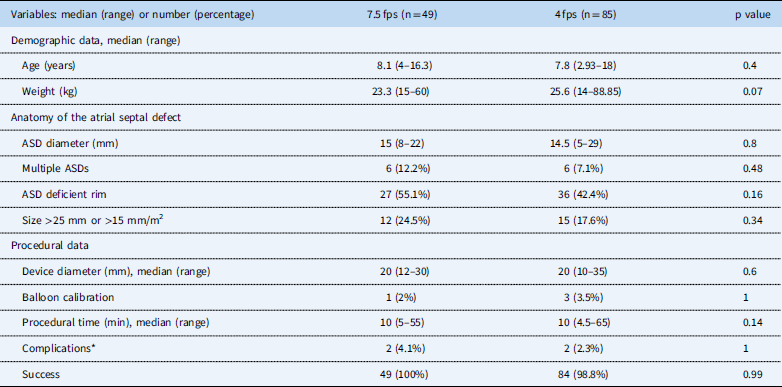
Baseline characteristics and anatomical features of the atrial septal defects were similar in both groups (see Table 1 for details). Both populations – 7.5 and 4 frames per second – were similar in terms of age, weight, atrial septal defect size, device size, and complexity of the atrial septal defects.
Demographic features.

ASD=atrial septal defect; fps=frame per second
* Please refer to the “Results” section for details
Median procedural and fluoroscopic times were identical in the two groups (10 and 1.1 min, p>0.05, respectively). Device closure was successful using 7.5 and 4 frames per second, respectively, in 100 and 98.8% (p>0.05, NS). The unsuccessful patient had a large atrial septal defect with deficient inferior caval vein rim. A 28-mm device was successfully positioned but embolised around 1 hour after placement. The device was snared and retrieved. Because we considered that the proper device was used, the patient had no further attempt. He was discharged without sequelae next day and underwent uneventful surgical closure 2 months later.
The need for balloon calibration was slightly higher in the 4 frames per second group, but this was not statistically significant (2 versus 3.5%, p>0.05). Rate of complications was also similar in both groups (4.1% [7.5-frames per second] versus 2.3% [4 frames per second], p>0.05). Three patients had transient atrio-ventricular block (two in group 7.5-frames per second) and one had device embolisation (see description above).
Both populations (7.5 and 4 frames per second) were similar in terms procedural data and rate of success and complications.
Radiation data
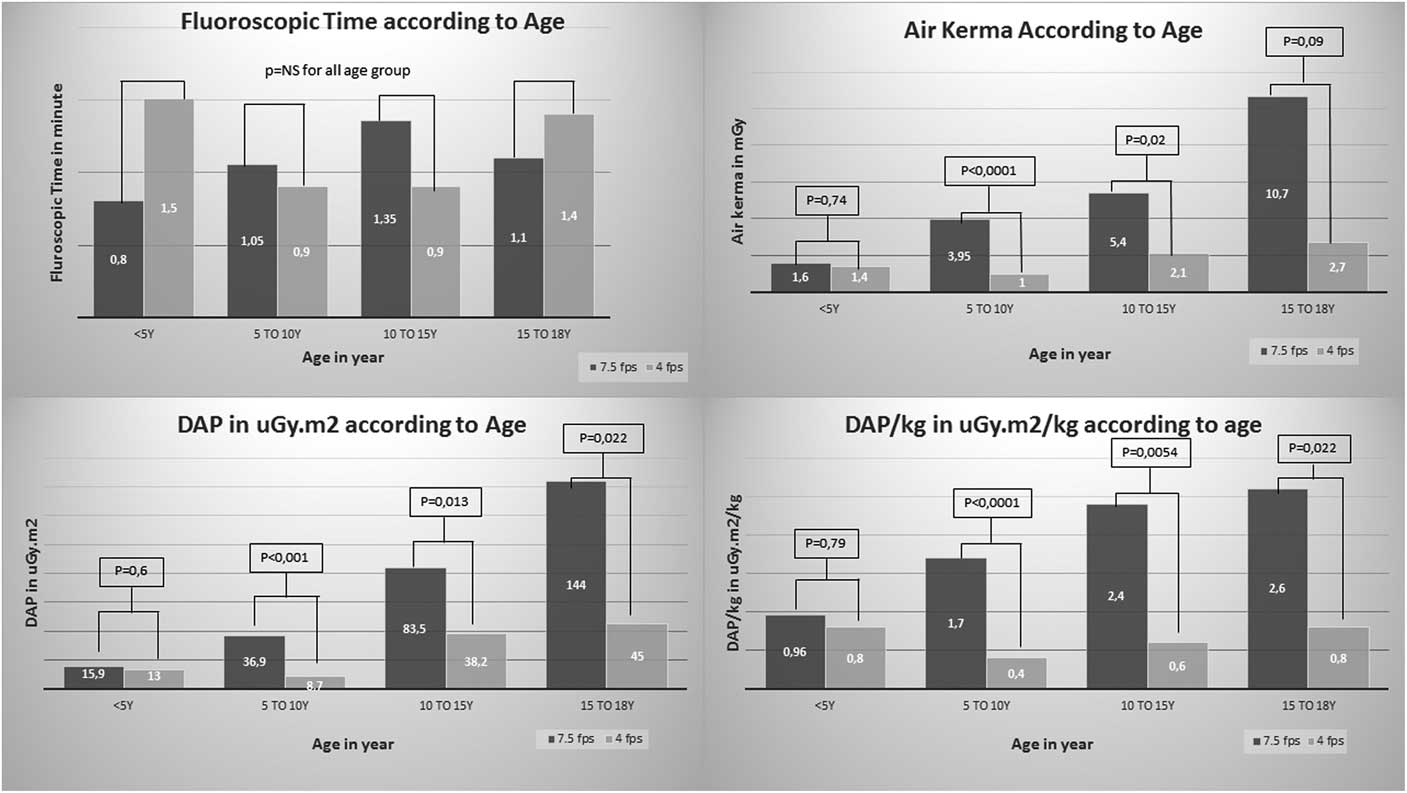
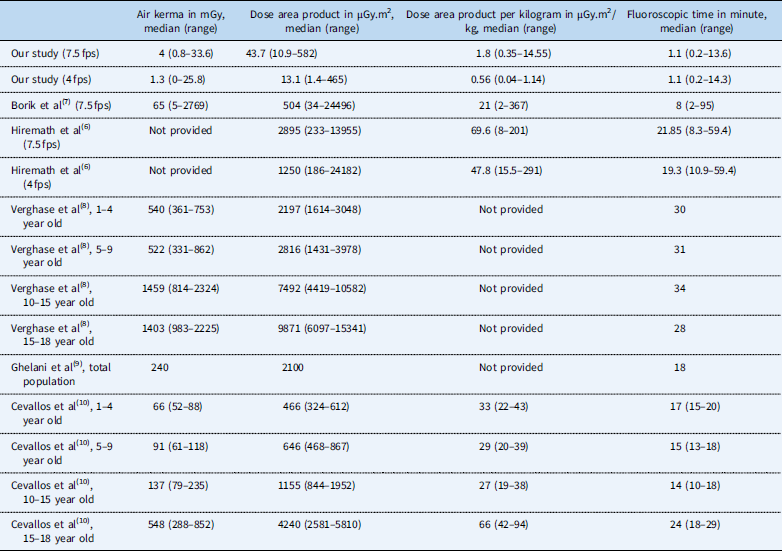
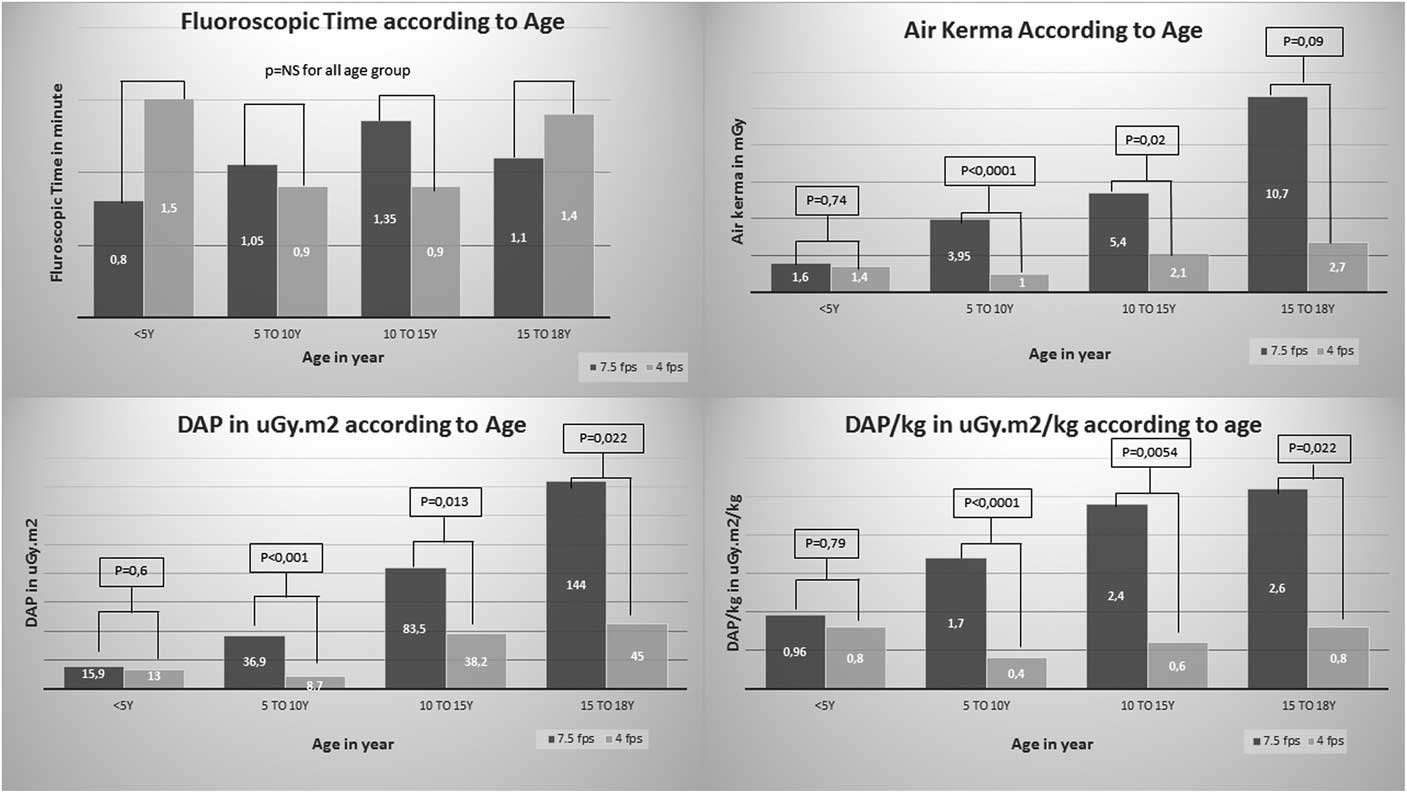
Setting of fluoroscopic frame rate to 4 frames per second significantly reduced all radiation parameters. Median air kerma dropped from 4 to 1.3 mGy (p<0.001), whereas median dose area product and dose area product normalised to weight decreased from 43.7 to 13.1 μGy.m2 (p<0.001) and 1.8 to 0.6 μGy.m2/kg (p<0.001), respectively (Table 2). Results according to age groups are provided in detail in Figure 1.
Radiation parameters according to age groups and frame rates. DAP=dose area product; fps=frame per second.
Radiation exposure according to frame rate.

* Mann–Whitney U test
Discussion
Transcatheter atrial septal defect closure is well standardised and performed worldwide. Because the mid- and long-term results of this procedure are excellent, interventionists should focus not only on clinical success but also on possible deleterious effects linked to radiation exposure. Radiation-induced cancer can occur even if radiation dose does not exceed 2000 mGy.Reference Vijayalakshmi, Kelly and Chapple 2 , Reference Harbron, Chapple, O’Sullivan, Best, Berrington de González and Pearce 3 Moreover, recent data demonstrated DNA damages on experienced operators during interventional procedures.Reference El-Sayed, Patel and Cho 11 , Reference Borghini, Vecoli and Mercuri 12 It is thus recommended to keep radiation exposure as low as possible following the as low as reasonably achievable (ALARA) concept during any cardiac catheterisation.Reference Hendee and Edwards 4 Most studies focus on clinical success, and limited data exist on radiation exposure in the paediatric population.Reference Hiremath, Meadows and Moore 6 – Reference Cevallos, Armstrong and Glatz 10 We recently showed that a very low radiation exposure can be achieved and reported levels at least 10 times lower than data reported in the same period of time (Table 3).Reference Sitefane, Malekzadeh-Milani, Villemain, Ladouceur and Boudjemline 5 These levels can be achieved by applying technical measures, as well as modifications of machine settings. Technically, we reviewed all steps of the standardised technique and discussed the usefulness of each step. Because information like Qp/Qs and pulmonary artery pressures were available most of the time using radiation-free imaging (echocardiography), we stopped using X-ray to measure these parameters. In addition, we noticed that balloon calibration was a large contributor to X-ray exposure. In most patients, we were able to predict the size of the device to be used by analysing size of the defect and aspects of the rims by echo. Therefore, we decided to limit the use of balloon calibration in patients with very floppy rims or multiple atrial septal defects. Another major contributor to the total radiation exposure is cine acquisition. In the setting of atrial septal defect, this modality is unnecessary. New catheterisation laboratories can store fluoroscopy if any acquisition is needed during the procedure. We avoided the use of lateral view that has also been showed to increase radiation exposure. Atrial septal defects were closed using front and left anterior oblique projections only. Finally, similar to other studies, we showed that reduction of frame rate to 7.5 frames per second significantly reduced the radiation without affecting the clinical results of atrial septal defects closure.
Comparison of radiation exposure in our series and in the literature.

fps=frame per second
Recently, Hiremath et alReference Hiremath, Meadows and Moore 6 showed that further reduction of frame rate to 4 frames per second had no impact in procedure, fluoroscopic and cine times, or in success and complication rates. They, however, failed to show significant reduction of radiation exposure. In a continuous effort to reduce radiation exposure, we decided to reduce furthermore the frame rate to 4 frames per second to assess the impact of such reduction on clinical results and radiation exposure.
To give the full picture of our experience without selecting the cases, we decided to include all atrial septal defects closures during a period of time. Because, as a result, the study was unmatched, we verified – by analysing all features and demographic parameters known to affect radiation exposure – that our two groups (i.e. 7.5 and 4 frames per second) were comparable. Parameters such as age, weight, atrial septal defects complexity, or use of balloon calibration were statistically not different in the two groups. The technique used for atrial septal defect closure did not change during the survey, and machine settings were similar with the exception of frame rates. As in the study by Hiremath et alReference Hiremath, Meadows and Moore 6 , we showed that the use of 4 frames per second had no impact in terms of procedural and fluoroscopic times, as well as procedural success and complication rate. Thus, this reduction of frame rate offered a minimal radiation dose keeping image quality enough for effective patient care. We had to increase the frame rate to 7.5 frames per second only in the patient in whom the device embolised. Elsewhere, we never had to change it because of inadequate imaging to complete the task. Of course, the use of low frame rate has an impact on image quality. Low frame rate can, in our opinion, be offered safely only in the subset of procedures where imaging is only required for the positioning of catheters, wires, and/or devices typically as in atrial septal defect closure. Using this low frame rate, one should remember to slowly advance the catheter as the visualisation of its movement is delayed.
Interestingly, despite extremely low fluoroscopic time and dose area product in 7.5 frames per second group, we were able to demonstrate further statistically significant reduction of radiation exposure in the total population and in each age group with the exception of patients younger than 5 years. This was possible only because all procedures were performed by a single and very experienced operator. In our study, we were unable to measure the effect of education on radiation exposure for this specific procedure. Of course, in centres with education programme (like in ours), the radiation exposure might be higher but, in our opinion, patients should pay only a limited price for training. To apply the ALARA concept and the educational role of public hospitals, the training should be progressive. Many procedures including atrial septal defect closure are step-wise procedures. Trainees should, in our opinion, go from one step to the next when the previous one has been performed appropriately – i.e. successfully and timely – starting with non-complex cases. If one step is not performed after a certain duration, which should be defined for each procedure, then the senior interventionist should take the lead of the procedure and the trainee will have to redo the same step over and over again until its full acquisition and before going to the next stages. However, we, senior interventionists, still focus on clinical results without looking at the effect of radiation on patients. Many senior interventionists are, for example, still performing systemic haemodynamic assessment, using high frame rate, cine acquisition, lateral projection, and systematic balloon calibration to close atrial septal defect despite clear demonstration that these were increasing radiation exposure without improving clinical outcome. Reduction of radiation is a culture that should be trained to all of us, not only junior but also senior interventionists. We should, finally, interact more closely with radiophysicians who have a better understanding of radiation exposure. They can help us improve our practice and ultimately reduce radiation exposure. Close interaction with manufacturers is also mandatory to achieve the same goals.
Limitations to the study
We are aware that our study has a small number of patients, but we consider that this is a very homogeneous population, with no differences between both groups, with all the procedures being performed by a single operator in a single centre. Even though the ideal scenario would be to perform a randomised study, such a study would be very difficult to power as the groups would need to be adjusted on all parameters showed to increase radiation exposure. Pooling data from different centres with multiple operators, operating systems, and multiple techniques would make such a study so heterogeneous that conclusions regarding the effect of reducing frame rate might be difficult to obtain. We conducted a single-centre/single-operator study modifying only and solely a single parameter: the frame rate. We were able to prove that there was a significant reduction of radiation exposure by reducing the frame rate to 4 frames per second. We cannot exclude that the population treated during the two periods were different despite showing no statistical difference using univariate and multivariate analyses with or without Bonferroni correction. Nevertheless, our dose area product is up to 40 to 700 times less than dose area product reported elsewhere.
Conclusions
Transcatheter atrial septal defects closure using fluoroscopy only at a frame rate of 4 frames per second is safe and effective in children. Compared with a frame rate of 7.5 frames per second, there was no statistically measurable difference in procedural and fluoroscopic times, and in success and complication rates. Using 4 frames per second, we showed substantial reduction of radiation exposure. Decrease of frame rate is easy to implement in all centres and should be recommended to lower radiation exposure.
Acknowledgements
The author thanks Dr Georgia Sarquella-Brugada and Iolanda Jordan for their tremendous help in analysing the data.
Financial Support
This research received no specific grant from any funding agency or from commercial or not-for-profit sectors.
Conflicts of Interest
None.
Ethical Standards
The author asserts that all procedures contributing to this work comply with the ethical standards of the relevant national guidelines on human experimentation in France and with Helsinki Declaration of 1975, as revised in 2008.