

2. Pain: definitions, concepts and mechanisms in humans and farm animals
Although human pain involves unique features when compared with animal pain, as assessed by humans, it is obvious that the underlying neurobiological mechanisms fall along the lines of an evolutionary continuity. This article reviews the generic knowledge on pain that has been established by work done in humans and laboratory species. The degree to which this knowledge on pain can be transposed from man to farm animals (including mammals, gallinaceous and waterfowl (duck and geese species), fish and cephalopods) is examined based on arguments ranging from phylogenetic analysis to the work on emotion in animals and to current debates on the concept of conscience in relation to pain perception. The precautions that need to be taken and the questions raised by such transpositions are discussed.
2.1. A growing scientific interest
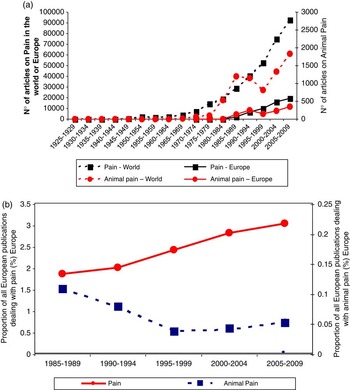
Over the last 30 years there has been a constant growth in the total number of scientific publications on pain. Although this output has concerned animal species as well as humans, it was only at the end of the 1970s on a global plan and at the end of the 1990s on the European level that research on pain in animals increased in earnest (Figure 1a).
Bibliographic analysis of publications on the topic of pain. (a) Number of publications on pain per 5-year period in all species including man or specifically in non-human animals without distinction of species, worldwide and at the European level: A Medline search of articles published between 1950 and 2009 was conducted. The terms covered by the search were: pain, nociception or nociceptors, pain, alertness or awareness. The specific search on ‘animals’ included the following English words: animals, domestic or animals, laboratory or animals, newborn or animals, poisonous or animals, suckling or animals, wild or animals, zoo or cattle or swine or fishes or sheep or ruminants or birds or poultry or swine The main disciplines included in the studies on pain are the same in France, Europe and worldwide: Neurosciences & Neurology, Biochemistry & Molecular Biology, Pharmacology & Pharmacy, Behavioural Sciences, Psychology. (b) Percentage of all European biomedical publications dealing with pain in general or specifically animal pain over the period 1985 to 2009. Red circles: % of publications in the biomedical field on pain. Blue squares: % of publications specific to animal pain. *Defined by OST (Observatoire des Sciences et Techniques: www.obs-ost.fr), the percentage is the ratio between the number of publications from a specific actor (research institute, country, field of research) and the number of publications in a specific database (e.g. country of the research institute, the world, or the biomedical field), multiplied by 100. Source: MEDLINE database in the biomedical field.

There has been a steady ratio of 50 : 1 in the number of publications on pain reporting studies in human clinical medicine or on generic knowledge of the mechanisms of pain, especially the study of chronic pain, as opposed to pain in animals. The proportion is basically the same for Europe as worldwide (Figure 1a). This data supports the hypothesis of a fundamental and increasing interest in human suffering and a collective will to gain control over pain. Following the ‘publication share’ index (Figure 1b) for publications specialised on pain as a percentage of all publications in the biomedical domain confirms the increase in the production of data on human pain. This interest may have played a driving role in studies on animal pain but this is not evidenced by the ‘publication share’ for the field of animal pain which has shown a slight decrease rather than sustained growth.
The work reported in the literature is thus generally carried out with a view to relieving human suffering. In practice the studies are often conducted on animal models, mostly rodents or more rarely on primates. They are also conducted according to specifically controlled protocols arising directly from human clinical medicine.
Improved knowledge of the mechanisms and the control of pain is derived from various disciplines. The general approach is to combine the use of new investigative tools (brain imaging and genomics) with studies in the areas of behaviour, cognitive neuroscience, neurophysiology, neurobiochemistry and neuropharmacology. Currently new specialities are appearing and proliferating in the field of research on pain, particularly in human clinical medicine. Over the last 10 years research aimed at elucidating the mechanisms of pain has been centred round either the elementary genetic characteristics of noxious stimuli receptors (nociceptors) or the assessment of perceptive capacities and the associated levels of consciousness.
2.2. Gradual widening of the scope of studies on pain in humans
Pain is an aversive experience that comprises sensory, cognitive and emotional components. It serves as an alert warning of the presence of a threat to the physical integrity of the subject and triggers biological or behavioural mechanisms for defence or adaptation/coping (avoidance, escape). It should be noted that the lack of an ability to feel pain, a rather rare human clinical condition, is accompanied by serious pathologies. Increasing knowledge has led to a gradual widening of the whole concept of pain, both in its definition and in the range of human beings considered likely to feel it.
2.2.1. Broadening the concept of pain
For years, clinicians and researchers considered pain as a sensation that either indicates trauma or tissue injury, or appears during the development of a pathological condition. This rough definition did not take into account the succession of emotions inherent in any long-lasting pain. Nor did it cover the chronic situations where, despite the absence of an obvious biological cause, the resulting pain can be just as debilitating as pain for which the bodily origin has been identified. Additionally, there is a great variability from one individual to another in the perception of pain.
A first distinction was made between acute and chronic pain. Acute pain is transitory and results from the activation of the system transmitting the noxious message. This acute feeling is an alarm signal that allows a wound or injury to be diagnosed. When this pain is prolonged and not treated quickly, it loses its biological function as a warning and becomes detrimental, giving rise to chronic pain. It affects the personal life and relationships of the individual, causing disturbances in appetite and loss of sleep. It invades the emotional world to become the dominant concern, interfering with daily life and leading to social, professional and family repercussions.
Furthermore, there are pains that cannot be readily associated with trauma or obvious injuries (projected pain that in humans is felt not at its source but in a cutaneous area, phantom pains that occur after amputations). In human clinical medicine, a nomenclature has been defined to describe the different types of pain that are not related to trauma or injuries, but to dysfunction of the nervous system.
It has been established that a person's environment is a crucial factor in determining the person's perception of pain. The social and cultural context modulates the way pain is felt. Thus, some ethnic and religious rituals (mutilations, for example) do not seem to have painful connotations and seldom lead to the externalisation of pain. The threshold of pain itself is modulated by cultural factors. It has been shown that the perception of pain by an individual varies according to the level of attention to or distraction from the pain, whether or not the pain is curable, whether it is acute or chronic, reference to a similar prior experience, to the impact of the pain on lifestyle, and to the medical or the emotional environment.
All pain has an impact on affectivity. It has more or less effect according to the previous state of the individual, the intensity and duration of the pain, and can vary from transient anxiety to depression. Thus, pain can not just be taken as a simple, unequivocal reaction since its purpose is to allow the various facets of physical integrity to be maintained. Pain occupies a special place in the diversity of sensations experienced by living beings and must be understood as a feeling associated with an emotional dimension for mobilising attention.
The consideration of these facts, added to the demand from society for better pain management for patients, has resulted in the adoption of three successive pain management plans in France. This initiative, launched in 1998, will be completed in 2010 with a series of measures aimed at better pain management for hospitalised populations and among the most vulnerable patients, including children and adolescents, persons with multiple disabilities, the elderly and terminally ill. At the completion of this initiative, the medical treatment of pain, particularly chronic pain management, will have been restructured to improve the effectiveness of the whole system of patient care.
2.2.2. A recent extension to all human beings
Consideration of pain in the newborn child and disabled people who are unable to express themselves verbally and, even more recently, the interest shown in pain in the foetus reflect a broadening of the range of humans recognised as being able to feel pain. The first articles published on pain in the newborn or foetus date from 1987, and those for disabled children in 1996 and 2002. It should be borne in mind that the International Association for the Study of Pain (IASP) has pointed out that an inability to communicate verbally does not mean that a person does not feel pain and does not need treatment for pain relief.
The disabled
A number of recent studies using validated measurements, show that people with intellectual disabilities exhibit specific reactions in response to pain arising from their condition, even if they have more difficulty locating it or if they respond to it more slowly due to modified sensory perceptions, impaired language or communicative expressions, or variability in basal levels. These specificities explain the difficulties of using conventional clinical examination. Interpretation is hampered by problems with verbal communication and pre-existing neurological disorders. It has been shown that cross evaluations by those close to the patient and unfamiliar observers provide a good indication of the patient's state of pain and discomfort provided a validated tool is used.
Pain in children
For children aged 0 to 5 years, the presence of pain that can be presumed to be enduring should be sought based on the differentiation between the various manners in which the child beckons. The diagnosis can only be made by gathering the accounts given by all those involved with the child (nurse, paediatric nurse, physiotherapist, psychologist, occupational therapist, nursing auxiliary, doctor) and trying to identify patterns that express discontent, desire for affection, ‘physical pain’ and psychological distress. The child should then be examined using identified means of communication, in peaceful and caring surroundings and in a serious, rigorous, calm and progressive manner.
Pain in the human foetus
The case of foetal animals, mammalian foetuses in particular, does not fall specifically within the framework of the present study. However, the use of certain foetal tissues from animals prompted the examination of the sampling procedures used and the potential negative effects they could give rise to. In line with the approach adopted where data on human pain are presented so as to clarify the understanding of the mechanisms at work in animal species, here reference is only made to cases involving human foetuses where the question of pain was examined.
Available data have shown that in the human foetus, pain pathways as well as cortical and sub-cortical centres involved in the perception of pain are fully developed in the last third of pregnancy. The neurochemical systems currently known to be associated with the transmission and modulation of pain are functional. However there is no data to determine whether activating these structures involved in pain actually results in a newborn infant feeling pain in a similar manner to a child or an adult. While it has been demonstrated that the foetus develops a hormonal stress response to invasive procedures (an increase in stress hormones circulating in the bloodstream), it is not possible to conclude that the foetus feels pain.
2.2.3. The current definition of pain for humans
The definition of pain has evolved over the last 3 decades. Pain experienced and described by patients despite the absence of an identifiable pathophysiological cause is now also listed in the classifications. The normalised protocols for the treatment of pain have been expanded in parallel, accompanied by the appearance of patient charters and awareness slogans (stopping the pain is a patient's right). Instead of just trying to sedate pain the concern now is to anticipate the likely experience of pain in conjunction with therapeutic interventions
The definition used here is the one which has been adopted worldwide by the IASP: ‘pain is an unpleasant sensory and emotional experience associated with actual or potential tissue damage, or described in terms of such damage’.
This definition refers to pain without stimulus of external origin, which shows the existence of pain of central origin, in other words being literally fabricated by the brain.
2.3. Pain: mechanisms and structures involved
2.3.1. The elements of pain
Nociception
The term nociception (from the Latin nocere, to harm) was introduced in the early 20th century to characterise the ability to specifically detect nociceptive stimuli which have in common the ability to threaten the integrity of tissues or of the body and to activate a set of sensory organs, the nociceptors. Nociception is considered as an alarm system that protects the body by triggering behavioural and reflex responses (somatic and vegetative responses) whose purpose is to suppress the cause and to limit the negative consequences. It contributes to the dynamic maintenance of general physiological equilibrium (homeostasis).
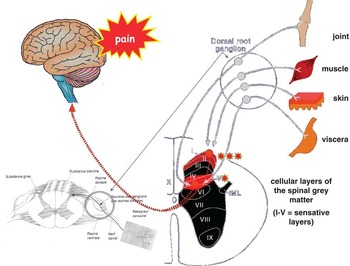
Nociceptors are made of thin unmyelinated nerve fibres which are undifferentiated at their end. They are found in varying densities depending on the innervated tissues. Some tissues, which are part of solid organs such as the brain or the liver, lack nociceptors. Nociceptors are preferentially sensitive to noxious stimuli and many of them, named polymodal nociceptors, respond indiscriminately to several types of stimuli whether they are mechanical, thermal or chemical (Figure 2). Nociceptors send information directly to the spinal cord (for the body) or to cranial nerve nuclei (for the head) via bundles of sensory nerves. At the level of the medulla network, the organisation of the afferents makes it possible to localise the source of information on the basis of a spatially ordered neural architecture. This organisation constitutes the basis of body representation and the substrate for spatial location of noxious stimuli borne by the body or coming from the viscera (analytical component of sensation).
The peripheral sensitive afferents of nociception in humans (J. Servière, personal communication). Nociceptors are located in peripheral tissues (joint, muscle, skin, viscera) and their nerve fibres conduct the information to the spinal cord via sensory nerves (through the dorsal horn of the grey matter). The cell bodies of the sensory neurons are located on both sides of the spinal cord in the dorsal root ganglia. The synaptic junction is anatomically located in different cell layers of the dorsal horns depending on the tissue of origin. Superficial layers (I & II) receive signals from the skin whereas signals from visceral organs reach a deeper layer of cells (V).

From peripheral mechanisms to brain integration
Pain is more than just a discriminative sensory experience enabling the determination of the characteristics (intensity, duration and location on the body) of a noxious stimulus. It is associated with an emotion that is caused by the confrontation with a situation involving the interpretation of reality. The aversive emotional state associated with the sensation of pain is a powerful motivation to perform an act of protection. This emotion whether ‘unpleasant’ (illustrating the sensory component) or ‘aversive’ (illustrating the behavioural component) is an intrinsic part of painful experience. Emotion is indissociable from pain experience which makes pain a more complex sensation than touch, vision, or hearing. Because of its profound aversive nature, pain has strong abilities to capture the subject's attention, to interfere with any other activities and to mobilise resources and defence strategies.
Pain can be classed in three categories according to pathophysiological mechanisms: acute or physiological pain, inflammatory pain and neuropathic pain. Various function modes of the somatosensory system (the sensitivity of the body) are at the origin of these three categories. Pain of different kinds may co-exist, leading to ‘mixed’ pain that is often difficult to diagnose and treat. Acute pain is often associated with inflammatory pain as, for example, after tissue damage or after surgery. This is called ‘pain due to excessive nociception’.
During an inflammatory episode, nociceptor responses are modified leading to increased sensitivity, or even to the involvement of receptors that were initially ‘silent’ when the tissue was intact. The pain threshold is consequently lowered so that even a gentle touch can become painful (allodynia) while a noxious stimulus is perceived more intensely (hyperalgesia). Hyperalgesia may result from a disturbance in receptor peripheral sensitivity as well as from a modification in pain thresholds of central origin due to the control of descending pathways from the brainstem and spinal cord interactions. In this case, pain may extend beyond the duration of stimulation or may even occur spontaneously, after a reorganisation of the neural networks involved. Such changes promote healing by adjusting reactions and behaviours such as resting the injured area and protecting it through an analgesic posture.
Neuropathic pain may result from long-term consequences of an injury (e.g. due to amputation) or from a functional change of the somatosensory system which then evolve in an abnormal and inappropriate way. Persistent pain with no biological purpose has a pathological nature. It develops independently of whether the initial injury is maintained or not, and relies on mechanisms of neural plasticity. In the case of neuropathic pain, the physiological system that is normally involved in nociception generates the sensation of pain itself.
It is possible to follow the progression of events occurring in the nervous system from the peripheral activation of nociceptive responses to the integrative responses in the brain structures responsible for the onset of the painful sensation. Cortical and diencephalic nuclei which are responsible for processing emotions, memory, basic consciousness (awareness, alertness) are activated in parallel with motor pathways which organise movements and protective behaviours.
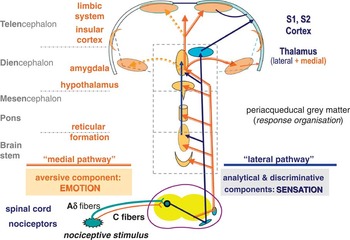
Once in the spinal cord, nociceptive signals are simultaneously directed towards both spinal motor neurons responsible for reflex activities, and to higher brain centres. Nociceptive and thermal sensory information follow a specific ascending pathway in the spinal cord (bundles of nerve fibres assembled into distinct anatomical pathways or ventro-lateral tract). Functional brain-imaging techniques (functional magnetic resonance imaging and positron emission tomography) have shown in humans that the cingulate and insular cortices are particularly activated. These structures, belonging to the limbic system, are crucial in generating emotions. To a lesser extent, the somatosensory, primary and secondary cortices are also activated by noxious stimuli. It appears that it is a whole network of brain areas that is responsible for the perception of pain and not just a unique structure (Figure 3).
The spinothalamic tract. This is the main pathway for transmission of signals from nociceptors and thermoceptors (in primates) (J. Servière. personal communication). After the initial relay in the spinal cord, nerve signals are conveyed in parallel to higher centres via two types of pathways that transmit different components of pain. The signal is relayed differentially according to two major functional characteristics. The alarm and discriminative sensory components of the stimulation (location in the body, intensity, duration, repetition) are conducted through the spinal cord by nerve fibers of the ‘lateral pathway’ which project into the ventral posterior lateral nucleus of the thalamus and then reach the SI & II somatosensory cortex. The ‘unpleasant’ component of the sensation is transmitted via the slow ‘medial pathway’ from which the fibres are distributed to a set of nerve centres located along the antero-posterior axis of the brain.

The pain response system allows the analysis of nociceptive information and triggers protective reactions. It differs from other sensory systems (vision, hearing) in that it necessarily activates structures involved in processing events that are beyond the mere sensory analysis. Pain networks are at the junction of the domains of physiology and psychology because they can trigger simple vegetative responses (heart rate, levels of adrenaline), protective motor responses (flight reflexes), or more complex behavioural strategies (specific postures, withdrawal strategies, social isolation) that may be associated with complex emotional experiences.
Emotions
From the cognitivist viewpoint, emotions are defined as complex affective reactions combining body and brain functions. These reactions include a subjective mental state (anger, fear, anxiety, depression, compassion, love), a drive to flee or attack which may or may not be expressed behaviourally, and physiological changes (increased heart rate, blood pressure, altered muscle tone). Some of these changes prepare the individual for actions of sustainable duration. Additional observable responses (posture, gestures, facial expressions) may serve as signals to communicate what it is experiencing, or manipulate, to the signaller's benefit, how others interpret its motivational/emotional state.
Negative human emotions are the consequences of dramatic events in a person's life, associated with their lot, the values and ideas they hold close to their heart as well as their beliefs about themselves and the world they live in. The emotion is triggered by a personal assessment of the meaning of what is happening. The dramatic episode varies from one emotion to another, each emotion having its own history. The onset of emotions involves complex processes to assess the current situations. These processes are correlated with the activation of brain structures that are relatively recent on a phylogenetic scale.
The functional interactions between phylogenetically recent structures (like the cerebral cortex which is particularly developed in non-human primates and in humans) and phylogenetically older structures which are also found in non-mammalian species (limbic system, hypothalamus, brainstem nuclei such as the periaqueductal grey), show how different anatomical levels of the nervous system interact. These complex interactions modulate the autonomic responses associated with pain, or may modulate the experience of pain itself (cf. response thresholds of the receptor). Thus, in some rodents, the response thresholds to noxious thermal stimuli are modulated by social emotional components (presence of a conspecific, hierarchical position).
Emotions result from cognitive processes that lead to the assessment of the characteristics of the stimulus encountered in the context of its occurrence. It appears that what is called ‘somatic markers of emotion’ reflects in fact a sensory and cognitive analysis, usually performed automatically first, and then involving different levels of the central nervous system that are activated in parallel.
Sensory awareness
Consciousness as a psychological phenomenon has rarely been addressed in studies on the neural mechanisms of pain. Research is focused on aspects of emotional experience and the concept of consciousness is very rarely developed. In the present report, we restricted the definition of consciousness to the level of vigilance which corresponds to awareness from a neurophysiological point of view, and combines the perception of information from the environment and sensations from the body. In the neurological form of arousal, stimuli are transformed into sensory information and noxious stimuli can be perceived as painful. This form of consciousness is always associated with, or triggered by, sensory information and corresponds with what is qualified as primary consciousness. Reflexive consciousness or self-consciousness does not lie within the scope of this assessment.
The functional dimension of consciousness (alertness and vigilance) has important practical implications, especially when animals are slaughtered for human consumption. It is the level of vigilance that allows or suppresses the emergence of a conscious sensation of pain resulting from the application of a noxious stimulus, such as bleeding at slaughter. Conversely, the lack of consciousness prevents higher structures of the nervous system (mainly the neocortex and the thalamus) to transform sensory stimuli into a sensation. The animal is in a state of partial unresponsiveness characterised by specific patterns of electrophysiological brain activity which can be observed during sleeping, some types of unprovoked seizures (epilepsy) or deep coma.
Experimental data collected by neuroscientists come mainly from work on humans and some primate species. Based on their work it can be proposed that emotions of sensory origin (primary emotion) involve the existence of a basic form of consciousness called phenomenal consciousness which is simply experience. In this view, emotions arise because of primary consciousness (this does not require self awareness) and an individual's drive to react would rely on this type of consciousness. In the case of pain, the first response is to rapidly move away from the noxious stimulus, and then to develop behavioural and postural strategies that make healing possible.
The world-wide accepted definition of pain was initially designed for humans. The relevance of this definition was to state that pain necessarily implies an emotion, in the sense of a primary emotion for protection and survival, which according to some authors falls into the category of ‘basic’ or homeostatic emotions. However, it is noteworthy that even if it was formulated for humans, this definition does not mention phenomenal consciousness and its related forms, such as an increased level of vigilance, which corresponds with being on the alert. Questions on phenomenal consciousness have only emerged in recent years.
2.3.2. Related notions
Suffering
The word ‘suffering’ is frequently used as a synonym for pain which includes sorrow, grief, disorientation, fear, anxiety, distress and depression. The official definition of the IASP, essentially formulated for medical studies, states that suffering is an ‘emotional distress associated with events that threaten the biological or psychological integrity of the individual’.
Irrespective of this definition, formulated for humans by physicians and neurologists, some philosophers have tried to distinguish between pain and suffering. Their argument is based on two facts. The first is that suffering is often associated with severe and long-lasting pain which affect body image and mental integrity. The second fact is that suffering occurs commonly in the absence of pain of physical origin.
Stress
Pain is very often associated with stress because of its aversive dimension. Stress is defined as a reaction to a situation threatening the adaptability of the subject and which results in the activation of two systems: (1) the hypothalamic–pituitary–adrenal (HPA) axis which releases glucocorticoid hormones (cortisol and corticosterone) and (2) the sympathetic nervous system with the adrenal medulla which releases adrenaline and noradrenaline. Stress refers to a standard physiological response that is not specific to the stimulus provoking it. It covers a wide range of phenomena of physical (abrupt changes in the environment), immunological (pathogens) or psychological (threat) origin. The concept of stress refers to the uniqueness of the physiological response towards extremely diverse stressors. Whereas common usage of the term stress may confound the aggressing agents and the organism's response to them, here stress is defined as the overall, non-specific responses of an organism to stressors. The brain structures involved in stress responses are localised in the brainstem and the hypothalamus. Activation of these structures leads to a series of neural responses directed to the spine and the endocrine glands, the so-called stress response. Functional interrelations between the pain neural network and the autonomic nervous system are found at peripheral and central levels. The most obvious sign is the relationship between acute pain and increased heart rate, blood pressure and peripheral vasoconstriction (paleness). The biological function of these responses is to enable the body to adapt to the threatening situation with a complex set of reactions such as energy mobilisation, cardiovascular regulation by the autonomic nervous system, anti-inflammatory properties of glucocorticoids and their effects on the central nervous system. It must be borne in mind however that, although pain causes stress, a stress response is not necessarily painful. Stress responses may therefore help to detect the nature of noxious stimuli, but are in no way characteristic of pain.
Health
Health is defined by the World Health Organisation (WHO) as ‘a state of complete physical, mental and social well-being, and not just the absence of disease or infirmity’.
In the past, health was seen as the opposite state of disease. Addressing health issues meant fighting against diseases. With the WHO definition, prevention and care are no longer the only means for safeguarding health. Laws, regulations and political guidelines on environmental issues and land management are now included. The health of the population has become a political responsibility (Ottawa Charter, 1986).
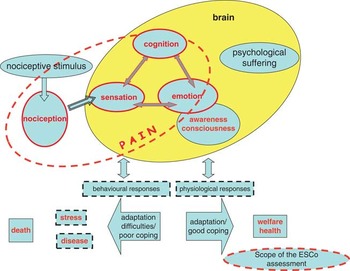
The various elements defining pain that are exposed in this assessment are described in Figure 4 along with related concepts that are not directly taken into account. The scope of the ESCo assessment is represented by the red dotted line.
Representation of the main concepts used in the ESCo assessment on animal pain.

2.4. Transposing the concept of pain from humans to animals
Nociception and pain in animals (if characterised as such) is likely to have the same biological functions as in humans: protection of the individual. Nociception and pain are just as vital to animals as they are essential to humans. However, it may be that the mechanisms involved in animal species (including non-human primates) are not strictly identical to those found in humans. This raises the following question: are the characteristics of noxious sensory-emotional experience in animals similar to those in humans, partly identical or fundamentally different? This question is frequently posed by ethologists who study cognitive and emotional states in animal species.
2.4.1. Pain in animals
Definition of pain in animals
The definition of pain given by the IASP was formulated for humans and is not applicable to animals. Since animals are unable to communicate verbally, they cannot reveal the characteristics of their sensory experience to humans. The original definition of pain was therefore modified in order to provide one that was more suited to animal abilities. Hence pain is defined as the awareness that an animal has of an aversive sensory and emotional experience associated with actual or potential tissue damage.
The definition applies to vertebrates only and specifies that a painful sensory experience must trigger:
• protective motor responses (withdrawal of a limb),
• neurovegetative responses (increased heart rate, higher blood pressure, peripheral vasoconstriction, transitional change in breathing),
• learnt avoidance responses (long-lasting avoidance of a conspecific, avoidance of a predator or a place associated with an aversive experience, behavioural changes: animal becoming fearful, decreased exploration of a novel place).
This definition, which is widely accepted by the scientific community, includes the concepts of emotion and saliency. The inclusion of emotion emphasises the fact that pain is an aversive and unpleasant sensation, which is considered as a primary emotion. Referring to saliency draws attention to the fact that the existence of a form of consciousness has become, under the influence of cognitive sciences, a key element in recognising mental states in animals. It refers to the functional dimension of consciousness as defined in Section 2.3.1, also called phenomenal consciousness.
Many animal species have emotions
Only behavioural and physiological responses can characterise emotions in animals. This approach is based on work from cognitive psychologists who state that emotions result from an assessment of the situation experienced. The level of assessment varies according to the cognitive abilities of a species. The assessment process relies on: (i) the characteristics of the triggering stimulus (suddenness, novelty, pleasantness), (ii) the corresponding inconsistency between the triggering stimulus and the individual's needs or expectations; (iii) the possibilities for adaptation proffered by the environment. The overall assessment leads either to a positive or a negative emotion. From this perspective, the study of the emotional repertoire of farmed species is aimed at linking the neurobiological process involved in evaluating a particular event with the behavioural and physiological responses.
A series of studies undertaken on mammals, mostly rodents, indicates that the anatomical and functional substrates involved in the emotional state triggered by physical pain and those involved in the distress responses displayed after disruption of strong social bonds (separation of mother and young, e.g.) are similar. The fact that a small dose of morphine reduces significantly the vocal activity of rat pups separated from their dams suggests that such distress response relies on neurochemical mechanisms and brain structures that are also involved in physical pain. It can be assumed that there is neural network regulating the expression of emotions and that it may be activated by physical as well as by psychological threats.
Identification of neural structures activated by noxious stimuli in humans has shown that the negative affective state associated with it involves several brain areas of the cortex that are phylogenetically old, as well as the cortical somatosensory area SII. In contrast, non noxious somatosensory stimuli activate preferentially the cortical somatosensory area SI which is considered phylogenetically more recent; this cortical area is found in all primates. The distinction between these two kinds of stimuli (noxious v. non-noxious) shows that there are two functional somatosensory components and that they are controlled by distinct neural pathways. It has not been established yet if this distinction is found at different levels of the animal phylogeny with the same characteristics. This raises many questions about the nature of the sensations experienced by species that differ as widely as vertebrates and invertebrates.
The characteristics of pain are modulated by the social environment
Modulation of nociceptive thresholds
The study of emotions and cognitive abilities opens up new perspectives for a better understanding of the emotional state of animals when they face noxious events, especially in livestock farming. Because of its affective component, animal pain might be modulated by emotions like it is in humans. The influence of emotions on pain has been investigated in animals by taking into account the context in which noxious events take place. Inducing positive emotions on farms may help improve the quality of animal life, in particular by reducing the perception of pain as has been shown for humans. Beyond the emotions themselves, which are by definition short-lasting, it is also important to take into account the consequences of a persistent emotional state, commonly called mood or basal affective state, which results from the accumulation of emotional experiences on the perception of pain.
One question posed to breeders is whether reared species have the ability to ‘perceive’ the emotional states of other animals reared with them. In the specific case of negative emotions triggered by noxious stimuli, the question is whether or not the perception and interpretation of distress signals (postural visual cues, olfactory cues, vocalisations) can alter the behaviour of the animals receiving the signals. Experimental data in mice show that the response to pain may vary with the status of the individuals present (familiar, unfamiliar, dominance relationship) and is modulated by a genetic component. It is the same for the existence of specific reactions to distress calls by the offspring of the species. This has probably led some authors to prematurely adopt the idea that there is a form of empathy in some species. In this interpretation, the emphasis is placed on the role of emotional reactivity among conspecifics. It should be remembered that the concept of empathy comes from observations initially made with primates. If we want to extend this capability to all animals, especially to farm livestock, this will require confirmation based on experiments with each species. Extending the proposition that empathy exists in all animals (especially in farm livestock) requires confirmation based on experiments with each species.
Modulation by inter-species relationships: the incidence of the human–animal relationship on the expression of pain in animals
Several review articles show how animals and humans develop inter-individual relationships, especially in the case of experimental animals and farm species. Recently, the cognitive abilities involved in communication between humans and animals (dogs, horses) have received particular interest, for example the existence of reciprocal attention between humans and animals. The subjective interpretation of the situation determines the animal's reaction. This is particularly true for their emotional perception of humans. Animal fear of humans has been studied in particular because of its effects on animal behaviour, physiology and production capacity. Pain, as a perception of a physical threat, may be influenced by the human–animal relationship, especially if animals are afraid of humans. This fear is genetically inheritable but it is also influenced by the individual's previous experience. Thus, the animal can easily associate the pain due to a specific veterinary or farm procedure with the presence of a specific person and remember it.
Fear is an emotion that is defined as the perception of a real or potential danger and which prepares the animal to face it. However, fear is not the only emotional state that can be investigated and which may affect the responses of animals to humans and to painful procedures. Animals can indeed perceive certain situations positively and have positive emotions in the presence of humans. These situations may improve the human–animal relationship and enhance approach responses towards humans. Some types of human contact may generate positive emotions in animals. For instance, studies have shown that tactile interactions, mimicking positive allogrooming between animals, diminish heart rate and induce relaxation postures and facilitate contact with the animals. The presence of humans in such conditions can reduce pain perception by animals. Studies on this topic, however, are still scarce.
Pain in the mammalian foetus
In order to feel pain, all animals must: (i) have fully functional neural structures allowing the detection of noxious stimuli from the environment or from within the body, their transmission to brain structures and their expression as sensations (ii) be able to reach a state of awareness (iii) be able to identify the characteristics, the intensity and the duration of noxious or stressful stimuli in order to perceive them at the cognitive and emotional levels as an aversive experience. While for mammals, adults and their fully grown young are generally considered as sentient beings, the question remains for young that are still neurologically immature and foetuses.
In a review on the physiological characteristics of foetal sheep, New Zealand scientists put forward the theory that the sensory environment in utero maintains the foetus in a state close to permanent sleep, in other words, the individual would be unconscious. They concluded that states of awareness and alertness are not reached until shortly after birth. During the birth process, profound changes in auditory, visual, tactile and thermal sensory inputs trigger the process of awareness and the onset of consciousness, making the young a sentient being.
2.4.2. Concepts associated with pain in animals
Definition of suffering in animals
Some researchers suggest that suffering may be experienced when the conditions imposed on the animals prevent them from ‘fulfilling their life project’ or in other words performing the natural behavioural pattern of their species. The needs of a species are considered as covered when their behavioural repertoire can be expressed entirely. Experimental data indicate that when animals are prevented from displaying some behaviours, their natural drive for action evolves into tension that pushes them to react in an unsuitable manner, that may cause frustration and discomfort. This is the case for animals reared in restricted and impoverished environments in which they cannot display all the behaviours that are typical of their species. Such a state of psychological distress, which is not associated with tissue damage, may result in the animal developing stereotypies, which are repetitive acts expressed without apparent objectives. In other cases, apathy or resignation dominate in an attitude reflecting the individual's lack of interest in or concern about the surrounding events, illustrated by the absence of a reaction. This type of psychological suffering is beyond the scope of the present assessment.
Definitions of animal welfare
The European Community has been emphasising the ethical importance of animal welfare over the last 20 years by presenting it as a political concern and a collective cultural preoccupation. This impetus has been paralleled by a steady increase in research on welfare, both at national and European levels.
There have been many attempts to provide a definition of animal welfare. One of the first refers to a state of harmony between the animal and its environment. This equilibrium should lead to full mental and physical health, but the definition does not specify exactly what harmony is.
A second definition, widely adopted by scientists working on animal welfare, focuses on the adaptability of a species. It specifies that a high level of welfare is reached when adaptation to the environment can be achieved at low cost to the animal, for example without significant energy expenditure. On the other hand, if the adaptation processes require the animal to rely heavily on its reserves (e.g. extremely low temperatures, allocated space limiting the expression of some behaviours or generating social aggression) then the level of welfare is considered to be low.
Another definition, formulated for practical on-farm usage, assembles the criteria characterising farm animal welfare into major components. This approach puts emphasis on the environmental conditions and the level of care that all farmers should comply with. Thus animal welfare depends on the respect of five basic rules (Five Freedoms):
• Freedom from thirst and hunger – by covering basic needs to maintain full health and vigour,
• Freedom from discomfort – by providing an appropriate environment,
• Freedom from pain, injury, and disease – by prevention or rapid diagnosis and treatment,
• Freedom to express normal behaviour – by providing sufficient space, proper facilities and a satisfactory social environment,
• Freedom from fear and distress – by ensuring conditions and treatment which avoid mental suffering.
More recently, the World Organisation for Animal Health (l'Office international de la santé animale: OIE) stated that ‘animal welfare is the result of a complex public organization with multiple components comprising scientific, ethical, economical and political dimensions’. This definition, less focused on the animal than the previous ones, emphasises the complexity of the human factors which determine the living conditions of the animals, including during transport.
2.4.3. Examples of transposition to non-mammalian species
Factors in a phylogenetic approach to pain
Humans have always been taken as a reference to understand what pain could be in a given animal species. This approach necessitates the combined use of criteria concerning the neural structures involved and the behavioural and cognitive abilities.
As a matter of fact, the criteria found in the literature depend on the authors’ scientific discipline. Thus, neurobiologists focus on behavioural, cognitive and neuro-anatomical features, while many ethologists and specialists in animal welfare favour the behavioural and emotional aspects, using only occasionally information on neural cues, or cognitive, sensory and motor performances.
Comparative anatomy of the brain (homology between species e.g., presence or absence of frontal, telencephalic, limbic, cingulate cortices) and the comparisons of behavioural abilities between species suggest that non-human mammals feel pain. In contrast, the issue about the existence of pain is still debated in birds, fish and marine molluscs like cephalopods.
We will limit this section to key data that support the hypothesis for the existence of well-characterised pain, in contrast to nociception which is defined as a more restricted sensation lacking the emotional dimension and consciousness. The methodological difficulties that helped the experimental validation of a given position on nociception, emotion and awareness of sensation will be reported as will the scientific controversies.
Whether there may be forms of mental representation of the body's state other than those described for mammals remains to be tested (Table 1).
Summary of the existence of perceptual phenomena associated with the concept of pain in the six categories of animals presented in this assessment, based on current state of knowledge

+ = presence of a positive response; − = absence; ? = uncertain; ?/+ = debated.
Existence of pain in birds
Comparative Anatomy
Structures homologous to those involved in nociception in mammals are found in birds. In particular, electrophysiological studies conducted in chickens and pigeons have shown that their nociceptors have similar properties to those found in mammals. The neural mechanisms described at the level the spinal cord do not differ significantly from what is known in mammals, however, our current state of knowledge of birds is not as extensive as for mammals.
Birds display strong behavioural and physiological responses (activation of the HPA axis and sympathetic system) when submitted to frightening situations, conditions of food frustration or social separation. Fear responses have been particularly well described. They are associated with an activation of brain structures quite similar to those described in mammals, and include the posterior pallial amygdala and the archipallium, which could be homologous to the mammalian amygdala, the nucleus of the stria terminal and the paraventricular nucleus of the hypothalamus. These activation processes do not rely on the type of stimulus but on the way the situation is assessed. In particular they are modulated by previous experience. The mechanisms involved in memory have also been studied, especially in the case of conditioned fear. Conditioned fear is an emotion provoked when an animal is put in an environment that has been previously associated with an aversive experience (e.g. electrical shock). As in mammals, conditioned fear activates the hippocampus in birds.
Neurobiological studies performed on pigeons have shown that situations generating nociception also trigger significant emotional responses, and the brain structures involved in these responses are similar to those reported in mammals. Chickens and pigeons that have been are trained with a classical aversive conditioning protocol using tone-shock associations, later display exacerbated fear behaviour and an increased heart rate when they hear the sound alone. This response is blocked by lesions of the archipallium which, like the amygdala in mammals, is involved in the onset and the control of emotions. It appears that in birds the nociception system and the associated memory processes activate upper brain structures involved in the expression of emotions.
Nonetheless, it has been shown that cortical decerebration of chickens does not inhibit the protective postural behaviour of leg bending to avoid standing on a foot when it is made sore by intra-plantar injection of urate crystals. This suggests that some of the protective behaviour is controlled at the level of the brainstem, thus, in the absence of any conscious emotional component.
Behaviours
Very soon after hatching, birds display escape responses when confronted by a noxious stimulation. In response to a nociceptive stimulation, birds exhibit defensive behaviours and attempts to escape. If they cannot put an end to their aversive experience, they are overcome with exhaustion and apathy. Changes in posture are often observed in birds, with the appearance of limping and, as the severity of the lameness increases, a total reluctance to move or inability to stand. Phasic changes in behaviour are observed in animals subjected to feather plucking: initially, the animals are reactive, try to escape (jump up, flap their wings), or vocalise, while later on, they crouch down and remain motionless suggesting a state of resignation.
Several experiments in chickens, pigeons and quail have shown that the behavioural responses triggered by nociceptive stimuli are reduced or disappear after an injection of morphine. The impairment of these responses due to morphine treatment shows that the abnormal stance observed in the animals studied is not due to a functional handicap but to a nociceptive phenomenon or even pain. The injection of non-steroidal anti-inflammatory drugs can also improve the stance of chickens which were previously limping. These data demonstrate the existence of receptors for substances like morphine, which is consistent with data from phylogenetic studies showing the presence of opioid-like receptor families in almost the entire vertebrate phylum and even sometimes in very primitive marine invertebrates.
These behavioural responses are not just reflexes because they can also be modulated by endogenous analgesia provoked by other motivated behaviours. Thus, a hen that is about to lay will crouch down on both legs even though she previously avoided standing on a leg in which arthritis had been induced experimentally. Similarly, a strong motivation to feed can diminish or eliminate the expression of joint pain in the chicken.
Cognition
Even though birds are quite capable of expressing protective and escape behaviours of nociceptive origin in combination with emotional responses, the level of consciousness, and therefore the characteristics of the sensory and emotional experience of pain, may vary according to the species. It must be borne in mind that the avian class includes animals with a wide range of cognitive abilities. Gallinaceous and web-footed poultry, and quail, which constitute the majority of farmed birds, have very reduced cognitive capacities in comparison to other birds, especially the corvids and the parrots. Work performed on jays has shown that these birds are capable of forming episodic memories very similar to some of the most complex memory processes in humans. Some parrots seem able to count, to combine shapes and colours from oral instructions, to indicate the location of an object that has been hidden, to such a point that some authors believe they have a high form of consciousness. It is quite possible that the diversities in cognitive abilities and in levels of consciousness (in the sense of alertness and perception of the environment) evolved in parallel.
In conclusion, the neurobiological data confirm the behavioural and physiological results. They suggest that noxious stimuli trigger emotional responses, and in that regard we can suspect the existence of pain in birds, not just nociception, although this is still being debated in the scientific community, especially for farm species.
Existence of pain in reptiles and amphibians
There is still very little data in the literature on these two phyla.
Reptiles
Phylogenetic review articles on brain functions reveal that the first events associated with a form of consciousness (sleep/wake cycles, primary emotions, positive reinforcement) are seen in the reptiles. Elements concerning the expression of pain (nociception, emotion, phenomenal consciousness) are still too fragmentary to make clear conclusions.
Amphibians
In the frog the existence of somatosensory and chemical nociceptors can be demonstrated by the swift and vigorous extension of the hind limbs in response to stinging or to the application of an acidic solution to the skin. Work on amphibians is mainly focused on the identification of peripheral nociceptors or at the level of the spinal cord. Recently, a chemo-nociceptor that is sensitive to a neuropeptide known for its analgesic effect in the spinal cord in other vertebrates has been characterised in the frog. This receptor is specific to nociceptin and differs in its structure and properties to opioid receptors (μ, δ and κ) which are found in many animal species. It can be concluded through phylogeny that the analgesic properties of nociceptin found in the frog indicate the presence of elementary nociceptors.
However, the huge differences in the anatomical organisation of the nervous system between amphibians and mammals make it very difficult or even impossible, in the current state of our knowledge, to speak about pain in the former. Thus the predominant involvement of the forebrain in the identification of chemical stimuli (smell), in addition to the lack of cortex, makes it difficult to conclude to the existence of elementary sensory emotions associated with a primary form of consciousness.
In conclusion, the escape responses described in amphibians are controlled by brainstem centres which receive information from peripheral nociceptors. These are reflex responses which, if they appear rather elaborate, do not include the participation of emotional awareness in the way it is applicable to mammals. The organisation of such protective behavioural responses does not exclude the existence of elementary forms of sensory awareness, often described by the concept of sentiency.
Existence of pain in fish
Fish form a very vast and heterogeneous phylogenetic group. Current knowledge on this class is limited to a small number of species and cannot be generalised to all fish.
Anatomy
Anatomical and electrophysiological work has recently demonstrated the existence of nociceptors in trout. These nociceptors are located on labial areas of the head and respond to mechanical, thermal and chemical stimuli. They send information to the brain via small trigeminal Aδ and C fibres (a cranial nerve), the number of which is much smaller than in mammals and birds. It should be noted that neither nociceptors nor a system of nociception have yet been found among cartilaginous fish (elasmobranchs) even though such features are essential for the survival of individuals.
Trout present five different types of nociceptive responses and its nociceptors have similar characteristics to mammals. The receptors do not show, however, the sensitisation phenomenon widely described in mammals after invasive chemical or thermal stimulation known to induce inflammatory responses and hyperalgesia. Instead, after such stimulation these receptors display either the same response as that initially observed, or become irreversibly insensitive. Trout and goldfish have opioid receptors which respond to Met-enkephalin and leu-enkephalin, two substances found in the nociceptive system of rodents. A stressful event induces the secretion of met-enkephalin in goldfish.
Behaviour
Fear-like behaviour is observed in the trout after introduction of an unfamiliar object into its environment. The same type of behaviour is displayed after a subcutaneous injection of an acidic solution into its mouth; the effect is neutralised by an analgesic treatment of morphine. Other studies in goldfish show the existence of long-term memory, resulting in the avoidance of situations previously associated with a noxious stimulation.
In conclusion, experimental results in teleost fish confirm the existence of nociceptors and avoidance behaviours which can help memorising the context where a noxious stimulation was experienced. However, proof for the existence of an emotional component is still lacking, therefore there is no solid evidence to prove that these elementary reactions reflect pain. This issue is still being debated within the scientific community but experimental data is still patchy and limited to a few species.
Existence of pain in cephalopods
Very few species of invertebrates are raised for human consumption. Revision of the EU Directive on the use of animals in experiments (EEC 86/609) has extended the scope of application to some invertebrates, including cephalopods. Data on nociception and pain in marine cephalopods should therefore be examined.
The diversity of adaptive niches and species does not exclude the existence of differences in conscious sensory activity (primary consciousness) like alarm, awareness and alertness according to the type of cephalopod.
Neuroanatomy
Cognitive and behavioural performances of cephalopods are linked to their considerable brain size (520 million neurons in the octopus). Removal of the cephalic lobes (superior vertical optic lobes), has been performed but only to gain understanding of the neurobiological bases to visual recognition. These lobectomy experiments do not solve issues on homology of brain structures between cephalopods and vertebrates in regards to the processing of nociceptive information.
Behaviour and cognition
The behavioural performances of cephalopods are strongly linked to predation. They reveal important cognitive and adaptive abilities (discrimination between shapes, colour or, intensity of stimulations; special memory; learning by visual observation; categorisation of shapes) that are very similar to those found of vertebrates.
Data on aversive learning could be relevant for assessing the potential existence of pain in these species, in the sense that any aversive stimulus, whether of nociceptive origin or not, can trigger a minimal withdrawal response or avoidance. Threatening stimuli trigger immediate flight responses in cephalopods, followed by hiding or protective behaviours. This can be caused by a particular element of the environment or the situation, or by the context itself (contextual learning).
Aversive situations are memorised for several days after a single experience. This is typical of the consequences of being exposed to a noxious or potentially dangerous stimulus, such as the reaction to bitterness (quinine) which in many species is associated with the risk of being poisoned.
In conclusion, cephalopods are clearly sensitive animals, with highly developed memory and cognitive abilities. While some behavioural expressions described in the literature are characteristic of nociception, the emotional components, associated with pain in higher vertebrates, remain largely unexplored. The level of consciousness so far determined for cephalopods still corresponds to elementary forms of sensory awareness. The debate within the scientific community on emotion and consciousness in cephalopods shows that there is a need to develop further work on this matter.
Conclusion
This brief review on the phylogenetic aspect of nociception and pain seems to indicate that elementary solutions have been conserved down through evolution. This is the case for peripheral nociceptors, all of which have free nerve endings that do not have peripheral structures or some spinal neuronal receptors responding to analgesic substances (opioids analgesic neuropeptides) that are found in animal categories as diverse as cephalopods, amphibians, fish, birds or mammals. Protective reflexes are present at all evolutionary levels and are often associated with the ability to memorise aversive sensory experience. However, the organisational diversity of the nervous systems is such that protective behaviours cannot be assimilated to more complex forms of responses to pain and to mental representations of pain as seen in primates (emotions, forms of sensory awareness). The emergence of these components may be dated phylogenetically to the time of transition from the aquatic to the terrestrial environment, including in the embryonic forms (amniotic egg). We still have very little knowledge of this phenomenon and there is a need for an interdisciplinary approach. Thus asserting that basic emotions (primary emotions) exist in lower vertebrates and some aquatic invertebrates is premature.
2.5. Summary
Reviewing our current knowledge on the neurological mechanisms of nociception and pain reveals the following key points:
The definitions of words and concepts relating to pain, which are accepted worldwide, were originally chosen to characterise pain in humans. Pain and its emotional and cognitive components are well-defined in humans. It is not the case for non-human animals.
Pain is indissociable from an emotional component that is linked to primary emotions. This type of emotion is related to the concept of homeostasis.
Pain is not a single, unequivocal entity. There are different kinds of pain, depending on where it is located in the body tissues (with a special distinction between somatic and visceral tissues), the duration of trauma and the associated neural mechanisms. Different types of pain can be distinguished by their acute or chronic nature or whether or not they are associated with an inflammatory process.
Lack of acute pain management can induce neurobiological changes leading to neural plasticity that may result in changes in sensitivity and for which the interpretation in terms of chronic pain in animals is the subject of scientific debates.
It may be that the various forms of pain described in mammals are not the only ones that exist in the animal kingdom. In this respect, research needs to be undertaken to test the hypothesis of the existence of other forms of pain in infra-mammalian species. That such a hypothesis has never been examined very seriously is probably because the extensive knowledge gained from work on primates, including man, has influenced our concept of pain.
Sensitivity to noxious stimuli, characterised by response thresholds, is modulated by socio-emotional factors such as relationships between conspecifics or the mother–young bond.
Transposing data from one animal species to any other is only relevant from a phylogenetic perspective. There is no consensus in the scientific community (neuroscientists, cognitive philosophers and ethologists) on the abilities of all vertebrates and some invertebrates to feel emotions associated with avoidance of noxious stimuli, to reach consciousness and experience pain as higher mammals do. A similar question can be posed for nociception: some researchers believe that it participates in the emergence of the most basic forms of consciousness.
Based on the current state of knowledge, we can suppose that pain, with its sensory, cognitive and emotional components is present in mammals and birds, however it must be borne in mind that there is no consensus for birds.
In contrast, there is a more clear-cut position on other species such as fish. In general, fish appear to be more similar to amphibians, reptiles and cephalopods, which indeed have a neural network enabling efficient detection of noxious stimuli, the expression of protective responses, and the ability to remember stimuli which threatened their physical integrity. However, the characterisation of emotional components of pain still remains to be established for these species.